Tips on using my ppt.
1. You can freely download, edit, modify and put your
name etc.
2. Don’t be concerned about number of slides. Half the
slides are blanks except for the title.
3. First show the blank slides (eg. Aetiology ) > Ask
students what they already know about ethology of
today's topic. > Then show next slide which enumerates
aetiologies.
4. At the end rerun the show – show blank> ask questions >
show next slide.
5. This will be an ACTIVE LEARNING SESSION x
three revisions.
6. Good for self study also.
7. See notes for bibliography.
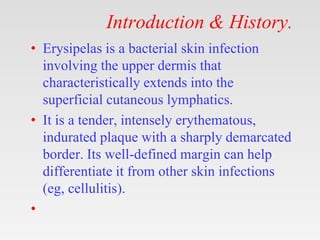
Introduction & History.
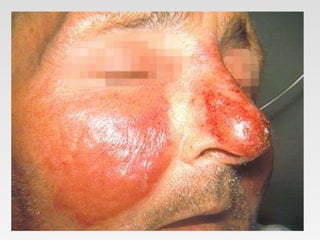
• Erysipelas is a bacterial skin infection
involving the upper dermis that
characteristically extends into the
superficial cutaneous lymphatics.
• It is a tender, intensely erythematous,
indurated plaque with a sharply demarcated
border. Its well-defined margin can help
differentiate it from other skin infections
(eg, cellulitis).
•
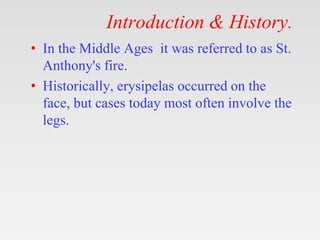
Introduction & History.
• In the Middle Ages it was referred to as St.
Anthony's fire.
• Historically, erysipelas occurred on the
face, but cases today most often involve the
legs.
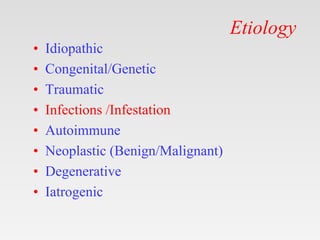
Etiology
Etiology
• Idiopathic
• Congenital/Genetic
• Traumatic
• Infections /Infestation
• Autoimmune
• Neoplastic (Benign/Malignant)
• Degenerative
• Iatrogenic
Etiology
• The group A streptococcal
bacterium Streptococcus pyogenes causes most of
the facial infections;
• lower extremity infections are now being caused
by non–group A streptococci.
• The role of Staphylococcus aureus, and
specifically methicillin-resistant S
aureus (MRSA), remains controversial.
• Erysipelas in newborns , perineal and lower-trunk
erysipelas occurring in postpartum women.is often
caused by group B streptococci.
Pathophysiology
Pathophysiology
• Bacterial inoculation into an area of skin trauma is
the initial event in developing erysipelas
• Thus, local factors, such as venous insufficiency,
stasis ulcerations, inflammatory dermatoses,
dermatophyte infections, insect bites, and surgical
incisions, have been implicated as portals of
entry.
• The source of the bacteria in facial erysipelas is
often the host's nasopharynx, and a history of
recent streptococcal pharyngitis has been reported
in up to one third of cases..
Pathophysiology
• The infection rapidly invades and spreads through
the lymphatic vessels.
• This can produce overlying skin "streaking" and
regional lymph node swelling and tenderness.
• Immunity does not develop to the inciting
organism.
• Streptococcal toxins are thought to contribute to
the brisk inflammation that is typical of this
infection
Predisposing factors
• Lymphatic obstruction
or edema
• Saphenous vein
grafting in lower
extremities
• Status postradical
mastectomy
• Immunocompromise:
Including patients who
are diabetic or
alcoholic HIV.
•
• Arteriovenous
insufficiency
• Paretic limbs
• Nephrotic syndrome
• Vagrant lifestyle
Clinical Features
Clinical Features
• Demography
• Symptoms
• Signs
• Prognosis
• Complications
Demography
Demography
• Isolated cases are although epidemics have
been reported.
• The incidence declined throughout the mid-
20th century, possibly due to antibiotic
development, improved sanitation, and
decreased virulence.
• The change in distribution from the face to
the lower extremities is most likely related
to an aging population with risk factors such
as lymphedema.
Demography
• Erysipelas is somewhat more common in
European countries.
• all age groups, but infants, young children,
and elderly patients are most commonly
affected.
• Slightly more common in females.
• Occur at an earlier age in males
Symptoms
Symptoms
• Prodromal symptoms, such as malaise, chills, and
high fever.
• Pruritus, burning, tenderness, and swelling are
typical complaints.
• Muscle and joint pain
• Nausea
• Headache and other systemic manifestations of an
infectious process
• Associated comorbidities in erysipelas include
diabetes mellitus, as well as hypertension, chronic
venous insufficiency, and other cardiovascular
diseases.
Signs
Signs
• lower extremities in 80% of patients;
• face
• The patient may appear healthy or toxic
depending on the extent of infection.
• begins as a small erythematous patch that
progresses to a fiery-red, indurated, tense,
and shiny plaque.
• Step sign- classically a sharply raised
border with abrupt demarcation from
healthy skin .
Signs
• warmth, edema, and tenderness,
• overlying skin streaking and regional
lymphadenopathy
• vesicles and bullae, along with petechiae
and even frank necrosis
Differential Diagnosis
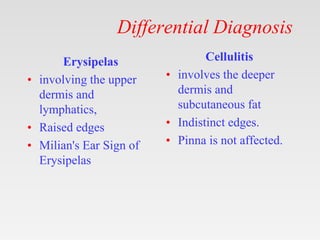
Erysipelas
• involving the upper
dermis and
lymphatics,
• Raised edges
• Milian's Ear Sign of
Erysipelas
Cellulitis
• involves the deeper
dermis and
subcutaneous fat
• Indistinct edges.
• Pinna is not affected.
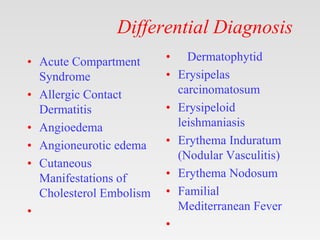
Differential Diagnosis
• Acute Compartment
Syndrome
• Allergic Contact
Dermatitis
• Angioedema
• Angioneurotic edema
• Cutaneous
Manifestations of
Cholesterol Embolism
•
• Dermatophytid
• Erysipelas
carcinomatosum
• Erysipeloid
leishmaniasis
• Erythema Induratum
(Nodular Vasculitis)
• Erythema Nodosum
• Familial
Mediterranean Fever
•
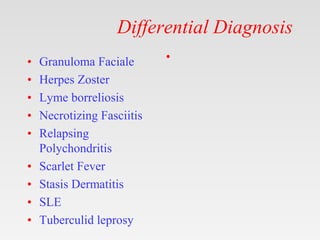
Differential Diagnosis
• Granuloma Faciale
• Herpes Zoster
• Lyme borreliosis
• Necrotizing Fasciitis
• Relapsing
Polychondritis
• Scarlet Fever
• Stasis Dermatitis
• SLE
• Tuberculid leprosy
•
Prognosis
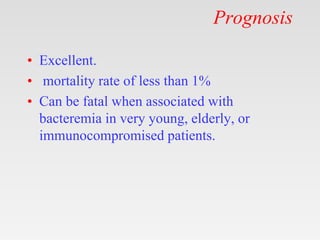
Prognosis
• Excellent.
• mortality rate of less than 1%
• Can be fatal when associated with
bacteremia in very young, elderly, or
immunocompromised patients.
Complications
Complications
• Uncommon
• Gangrene/amputation
• Chronic edema
• Scarring
• Bacteremia sepsis
• Scarlet fever
• Pneumonia
• Abscess
• Embolism
• Meningitis
• Death
• bursitis, osteitis,
arthritis, and
tendinitis.
• acute
glomerulonephritis,
endocarditis,
septicemia, and
streptococcal toxic
shock syndrome.
• elephantiasis nostras
verrucosa.
Investigations
Investigations
• Laboratory Studies
– Routine
– Special
• Imaging Studies
• Tissue diagnosis
– Cytology
• FNAC
– Histlogy
Diagnostic Studies
Diagnostic Studies
Imaging Studies
• X-Ray
• USG
• CT
• Angiography
• MRI
• Endoscopy
• Nuclear scan
Management
Management
• Penicillin
• A first-generation cephalosporin
• Clindamycin
• roxithromycin and pristinamycin
• The FDA approved 3 antibiotics,
– oritavancin(Orbactiv),
– dalbavancin(Dalvance),
– tedizolid(Sivextro),
for the treatment of acute bacterial skin and
skin structure infections.
Management
• Symptomatic treatment of aches and fever
• Hydration (oral intake if possible)
• Cold compresses
• Elevation and rest of the affected limb:
Recommended to reduce local swelling,
inflammation, and pain
• Saline wet dressings: Should be applied to
ulcerated and necrotic lesions and changed
every 2-12 hours, depending on the severity
of the infection
Operative Therapy
Operative Therapy
• Debridement is necessary only in severe
infections with necrosis or gangrene.
Get this ppt in mobile
1. Download Microsoft
PowerPoint from play
store.
2. Open Google assistant
3. Open Google lens.
4. Scan qr code from
next slide.
Get this ppt in mobile
Get my ppt collection
• https://www.slideshare.net/drpradeeppande/
edit_my_uploads
• https://www.dropbox.com/sh/x600md3cvj8
5woy/AACVMHuQtvHvl_K8ehc3ltkEa?dl
=0
• https://www.facebook.com/doctorpradeeppa
nde/?ref=pages_you_manage

Erysipelas.pptx

  • 1.
    Tips on usingmy ppt. 1. You can freely download, edit, modify and put your name etc. 2. Don’t be concerned about number of slides. Half the slides are blanks except for the title. 3. First show the blank slides (eg. Aetiology ) > Ask students what they already know about ethology of today's topic. > Then show next slide which enumerates aetiologies. 4. At the end rerun the show – show blank> ask questions > show next slide. 5. This will be an ACTIVE LEARNING SESSION x three revisions. 6. Good for self study also. 7. See notes for bibliography.
  • 2.
  • 3.
    Introduction & History. •Erysipelas is a bacterial skin infection involving the upper dermis that characteristically extends into the superficial cutaneous lymphatics. • It is a tender, intensely erythematous, indurated plaque with a sharply demarcated border. Its well-defined margin can help differentiate it from other skin infections (eg, cellulitis). •
  • 4.
    Introduction & History. •In the Middle Ages it was referred to as St. Anthony's fire. • Historically, erysipelas occurred on the face, but cases today most often involve the legs.
  • 6.
  • 7.
    Etiology • Idiopathic • Congenital/Genetic •Traumatic • Infections /Infestation • Autoimmune • Neoplastic (Benign/Malignant) • Degenerative • Iatrogenic
  • 8.
    Etiology • The groupA streptococcal bacterium Streptococcus pyogenes causes most of the facial infections; • lower extremity infections are now being caused by non–group A streptococci. • The role of Staphylococcus aureus, and specifically methicillin-resistant S aureus (MRSA), remains controversial. • Erysipelas in newborns , perineal and lower-trunk erysipelas occurring in postpartum women.is often caused by group B streptococci.
  • 9.
  • 10.
    Pathophysiology • Bacterial inoculationinto an area of skin trauma is the initial event in developing erysipelas • Thus, local factors, such as venous insufficiency, stasis ulcerations, inflammatory dermatoses, dermatophyte infections, insect bites, and surgical incisions, have been implicated as portals of entry. • The source of the bacteria in facial erysipelas is often the host's nasopharynx, and a history of recent streptococcal pharyngitis has been reported in up to one third of cases..
  • 11.
    Pathophysiology • The infectionrapidly invades and spreads through the lymphatic vessels. • This can produce overlying skin "streaking" and regional lymph node swelling and tenderness. • Immunity does not develop to the inciting organism. • Streptococcal toxins are thought to contribute to the brisk inflammation that is typical of this infection
  • 12.
  • 13.
    Predisposing factors • Lymphaticobstruction or edema • Saphenous vein grafting in lower extremities • Status postradical mastectomy • Immunocompromise: Including patients who are diabetic or alcoholic HIV. • • Arteriovenous insufficiency • Paretic limbs • Nephrotic syndrome • Vagrant lifestyle
  • 14.
  • 15.
    Clinical Features • Demography •Symptoms • Signs • Prognosis • Complications
  • 16.
  • 17.
    Demography • Isolated casesare although epidemics have been reported. • The incidence declined throughout the mid- 20th century, possibly due to antibiotic development, improved sanitation, and decreased virulence. • The change in distribution from the face to the lower extremities is most likely related to an aging population with risk factors such as lymphedema.
  • 18.
    Demography • Erysipelas issomewhat more common in European countries. • all age groups, but infants, young children, and elderly patients are most commonly affected. • Slightly more common in females. • Occur at an earlier age in males
  • 19.
  • 20.
    Symptoms • Prodromal symptoms,such as malaise, chills, and high fever. • Pruritus, burning, tenderness, and swelling are typical complaints. • Muscle and joint pain • Nausea • Headache and other systemic manifestations of an infectious process • Associated comorbidities in erysipelas include diabetes mellitus, as well as hypertension, chronic venous insufficiency, and other cardiovascular diseases.
  • 21.
  • 22.
    Signs • lower extremitiesin 80% of patients; • face • The patient may appear healthy or toxic depending on the extent of infection. • begins as a small erythematous patch that progresses to a fiery-red, indurated, tense, and shiny plaque. • Step sign- classically a sharply raised border with abrupt demarcation from healthy skin .
  • 23.
    Signs • warmth, edema,and tenderness, • overlying skin streaking and regional lymphadenopathy • vesicles and bullae, along with petechiae and even frank necrosis
  • 24.
  • 25.
    Differential Diagnosis Erysipelas • involvingthe upper dermis and lymphatics, • Raised edges • Milian's Ear Sign of Erysipelas Cellulitis • involves the deeper dermis and subcutaneous fat • Indistinct edges. • Pinna is not affected.
  • 26.
    Differential Diagnosis • AcuteCompartment Syndrome • Allergic Contact Dermatitis • Angioedema • Angioneurotic edema • Cutaneous Manifestations of Cholesterol Embolism • • Dermatophytid • Erysipelas carcinomatosum • Erysipeloid leishmaniasis • Erythema Induratum (Nodular Vasculitis) • Erythema Nodosum • Familial Mediterranean Fever •
  • 27.
    Differential Diagnosis • GranulomaFaciale • Herpes Zoster • Lyme borreliosis • Necrotizing Fasciitis • Relapsing Polychondritis • Scarlet Fever • Stasis Dermatitis • SLE • Tuberculid leprosy •
  • 28.
  • 29.
    Prognosis • Excellent. • mortalityrate of less than 1% • Can be fatal when associated with bacteremia in very young, elderly, or immunocompromised patients.
  • 30.
  • 31.
    Complications • Uncommon • Gangrene/amputation •Chronic edema • Scarring • Bacteremia sepsis • Scarlet fever • Pneumonia • Abscess • Embolism • Meningitis • Death • bursitis, osteitis, arthritis, and tendinitis. • acute glomerulonephritis, endocarditis, septicemia, and streptococcal toxic shock syndrome. • elephantiasis nostras verrucosa.
  • 32.
  • 33.
    Investigations • Laboratory Studies –Routine – Special • Imaging Studies • Tissue diagnosis – Cytology • FNAC – Histlogy

  • 34.
  • 35.
    Diagnostic Studies Imaging Studies •X-Ray • USG • CT • Angiography • MRI • Endoscopy • Nuclear scan
  • 36.
  • 37.
    Management • Penicillin • Afirst-generation cephalosporin • Clindamycin • roxithromycin and pristinamycin • The FDA approved 3 antibiotics, – oritavancin(Orbactiv), – dalbavancin(Dalvance), – tedizolid(Sivextro), for the treatment of acute bacterial skin and skin structure infections.
  • 38.
    Management • Symptomatic treatmentof aches and fever • Hydration (oral intake if possible) • Cold compresses • Elevation and rest of the affected limb: Recommended to reduce local swelling, inflammation, and pain • Saline wet dressings: Should be applied to ulcerated and necrotic lesions and changed every 2-12 hours, depending on the severity of the infection
  • 39.
  • 40.
    Operative Therapy • Debridementis necessary only in severe infections with necrosis or gangrene.
  • 41.
    Get this pptin mobile 1. Download Microsoft PowerPoint from play store. 2. Open Google assistant 3. Open Google lens. 4. Scan qr code from next slide.
  • 42.
    Get this pptin mobile
  • 43.
    Get my pptcollection • https://www.slideshare.net/drpradeeppande/ edit_my_uploads • https://www.dropbox.com/sh/x600md3cvj8 5woy/AACVMHuQtvHvl_K8ehc3ltkEa?dl =0 • https://www.facebook.com/doctorpradeeppa nde/?ref=pages_you_manage

Editor's Notes

  • #2 drpradeeppande@gmail.com 7697305442