

URINARY TRACT INFECTIONS
Presented by
Bibek Bhandari
IInd
batch
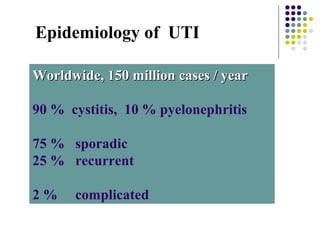
Epidemiology of UTI
Worldwide, 150 million cases / yearWorldwide, 150 million cases / year
90 % cystitis, 10 % pyelonephritis
75 % sporadic
25 % recurrent
2 % complicated
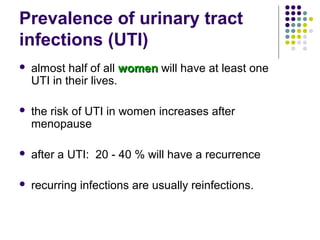
Prevalence of urinary tract
infections (UTI)
 almost half of all womenwomen will have at least one
UTI in their lives.
 the risk of UTI in women increases after
menopause
 after a UTI: 20 - 40 % will have a recurrence
 recurring infections are usually reinfections.
 UTI is rare in young and middle-aged menmen & often
with catheterisation or urological procedures.
 Urinary catheter increases the risk almost ten-fold in
hospitalised patients and those in other care homes.
 Pyelonephritis is common in patients who have
been catheterised for over a month.
Gender and sexual contact
Infant and children : Male >> femaleInfant and children : Male >> female
Adolescent-menopause : Female >> maleAdolescent-menopause : Female >> male
Older age : Female = = maleOlder age : Female = = male
Women: Short ureterWomen: Short ureter
Sexual contact : colonization of pathogensSexual contact : colonization of pathogens
in bladderin bladder
Spermicidal : Change of normal floraSpermicidal : Change of normal flora
Men (<50)Men (<50) : Prostate infection, anatomical defects ,: Prostate infection, anatomical defects ,
Lack of circumcision, homosexualsLack of circumcision, homosexuals
Classification by
Type of UTI
Upper / Lower UTI Pyelonephritis
Asymptomatic bacteriuria
Cystitis
Symptoms Symptomatic
Asymptomatic
Recurrence Sporadic < 1 UTI / 6 m
Recurrent ≥ 1 UTI / 6m
Complicating factors Uncomplicated
Complicated
Classification of UTIs
Urinary Tract Infection- Types
Urethritis
Cystitis Lower
Prostatitis
Pyelonephritis
Intrarenal & Upper
Perinephric abscess
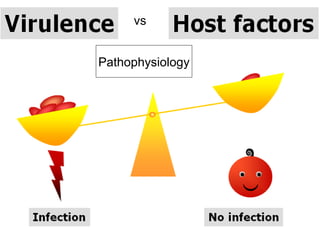
vs
Pathophysiology
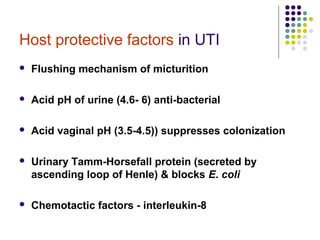
Host protective factors in UTI
 Flushing mechanism of micturition
 Acid pH of urine (4.6- 6) anti-bacterial
 Acid vaginal pH (3.5-4.5)) suppresses colonization
 Urinary Tamm-Horsefall protein (secreted by
ascending loop of Henle) & blocks E. coli
 Chemotactic factors - interleukin-8
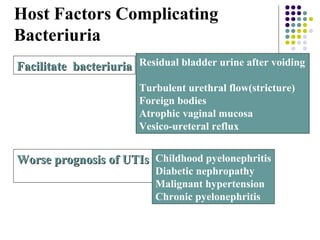
Facilitate bacteriuriaFacilitate bacteriuria Residual bladder urine after voiding
Turbulent urethral flow(stricture)
Foreign bodies
Atrophic vaginal mucosa
Vesico-ureteral reflux
Worse prognosis of UTIsWorse prognosis of UTIs Childhood pyelonephritis
Diabetic nephropathy
Malignant hypertension
Chronic pyelonephritis
Host Factors Complicating
Bacteriuria
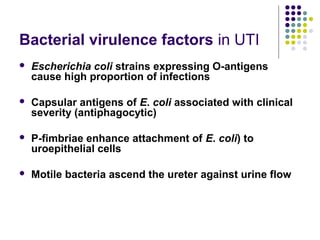
Bacterial virulence factors in UTI
 Escherichia coli strains expressing O-antigens
cause high proportion of infections
 Capsular antigens of E. coli associated with clinical
severity (antiphagocytic)
 P-fimbriae enhance attachment of E. coli) to
uroepithelial cells
 Motile bacteria ascend the ureter against urine flow
Bacterial virulence factors in UTI
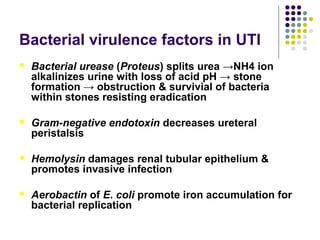
 Bacterial urease (Proteus) splits urea →NH4 ion
alkalinizes urine with loss of acid pH → stone
formation → obstruction & survivial of bacteria
within stones resisting eradication
 Gram-negative endotoxin decreases ureteral
peristalsis
 Hemolysin damages renal tubular epithelium &
promotes invasive infection
 Aerobactin of E. coli promote iron accumulation for
bacterial replication
Pathogenesis of UTI
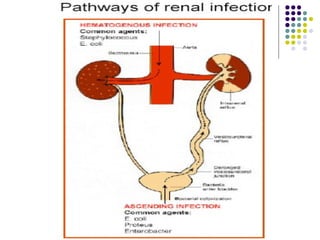
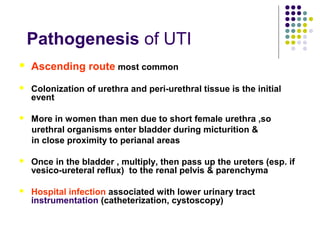
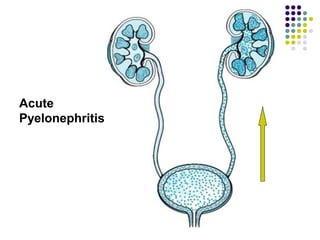
 Ascending route most common
 Colonization of urethra and peri-urethral tissue is the initial
event
 More in women than men due to short female urethra ,so
urethral organisms enter bladder during micturition &
in close proximity to perianal areas
 Once in the bladder , multiply, then pass up the ureters (esp. if
vesico-ureteral reflux) to the renal pelvis & parenchyma
 Hospital infection associated with lower urinary tract
instrumentation (catheterization, cystoscopy)
Pathogenesis of UTI- blood borne
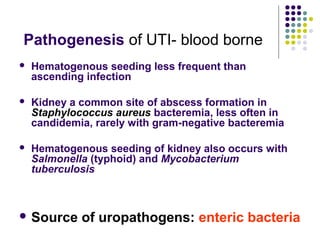
 Hematogenous seeding less frequent than
ascending infection
 Kidney a common site of abscess formation in
Staphylococcus aureus bacteremia, less often in
candidemia, rarely with gram-negative bacteremia
 Hematogenous seeding of kidney also occurs with
Salmonella (typhoid) and Mycobacterium
tuberculosis
 Source of uropathogens: enteric bacteria
Pathogenesis of UTI: Risk Factors
 ↓ resistance of mucous membranes (e.g. in
menopause)
 sexual intercourse
 disturbances in ureteral functioning
 in children the re-entering of urine back into the ureters
(vesicoureteral reflux),
 Uterine prolapse
 Diabetes
Pathogenesis of UTIs
Predisposing Conditions- contdPredisposing Conditions- contd
 Benign prostatic hypertrophy
 Any illness, eg diabetes, affecting the
emptying -Neurogenic Bladder
 Spinal injury →disturbances in bladder
emptying or urinary catheter)
 Stones
 Catheterisation & other urological
procedures
 Renal Transplantation
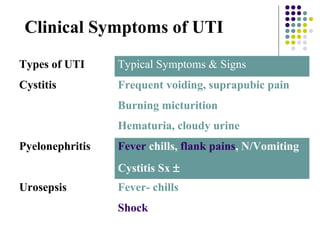
Types of UTI Typical Symptoms & Signs
Cystitis Frequent voiding, suprapubic pain
Burning micturition
Hematuria, cloudy urine
Pyelonephritis Fever chills, flank pains, N/Vomiting
Cystitis Sx ±
Urosepsis Fever- chills
Shock
Clinical Symptoms of UTI
Urethritis
 Acute dysuria, frequency
 Suspect sexually transmitted pathogens,
no hematuria, no suprapubic pain,
new sexual partner, cervicitis
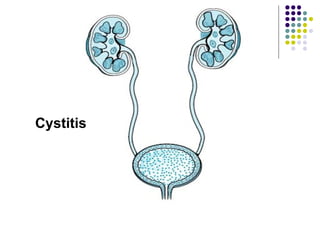
Cystitis
 Symptoms: frequency, dysuria, urgency,
suprapubic pain
 Cloudy, mal-odorous urine (nonspecific)
 Pyuria
 WBC (2-5 with symptoms) and bacteria on
urine microscopy
Cystitis
Acute
Pyelonephritis
Pyelonephritis
 Fever, chills
 Nausea/Vomiting, diarrhea, tachycardia,
 Costo-vertebral angleTenderness or
deep abdominal tenderness
 Leukocytosis
 Urine microscopy: Pyuria + WBC casts,
bacteria & hematuria
 Possibly signs of Gram negative sepsis
Pyelonephritis
 Complications:
Sepsis
Papillary necrosis
Abscess,
Ureteral obstruction
↓ renal function if scarring,
In pregnancy – ↑incidence of preterm labor
Diagnosis of UTI
 History
 Physical exam
 Lab parameters:
 Urinalysis with microscopy for WBC, bacteria
 Urine culture with sensitivities
 Diagnose acute uncomplicated cystitis in women based on
Hx, PE, and UA alone, no need for culture to treat
Diagnosis
 Urinalysis
 Leukocyte-esterase positive. = pyuria
 Nitrite positive from urease producing bacteria
eg proteus (but not always)
 Microscopy – WBC ( > 5 in pt with symptoms)
-- Bacteria
Collecting a sample
 in adults, mid stream urine (MSU)(MSU) sample usually
reliably represents the urine in the bladder.
 samples from urinary bags or bedpans should not
be used as they invariably will be contaminated
 the most reliable sample is obtained via a
suprapubic puncture
 urine in bladder >4 hoursurine in bladder >4 hours (any shorter time
will increase the risk of false negative findings)
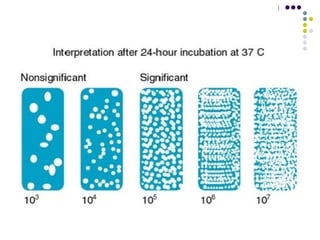
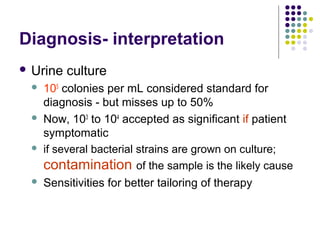
Diagnosis- interpretation
 Urine culture
 105
colonies per mL considered standard for
diagnosis - but misses up to 50%
 Now, 103
to 104
accepted as significant if patient
symptomatic
 if several bacterial strains are grown on culture;
contamination of the sample is the likely cause
 Sensitivities for better tailoring of therapy
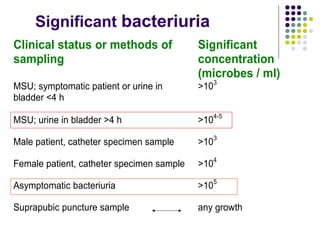
Significant bacteriuria
Clinical status or methods of
sampling
Significant
concentration
(microbes / ml)
MSU; symptomatic patient or urine in
bladder <4 h
>103
MSU; urine in bladder >4 h >104-5
Male patient, catheter specimen sample >103
Female patient, catheter specimen sample >104
Asymptomatic bacteriuria >105
Suprapubic puncture sample any growth
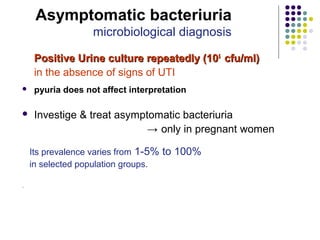
Positive Urine culture repeatedly (10Positive Urine culture repeatedly (1055
cfu/ml)cfu/ml)
in the absence of signs of UTI
 pyuria does not affect interpretation
 Investige & treat asymptomatic bacteriuria
→ only in pregnant women
Its prevalence varies from 1-5% to 100%
in selected population groups.
.
Asymptomatic bacteriuria
microbiological diagnosis
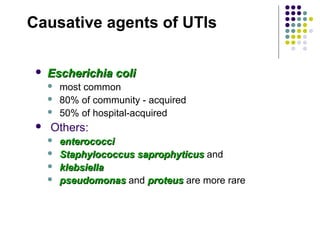
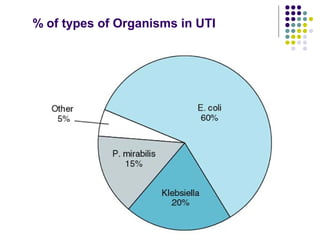
 Escherichia coliEscherichia coli
 most common
 80% of community - acquired
 50% of hospital-acquired
 Others:
 enterococcienterococci
 Staphylococcus saprophyticusStaphylococcus saprophyticus and
 klebsiellaklebsiella
 pseudomonaspseudomonas and proteusproteus are more rare
Causative agents of UTIs
% of types of Organisms in UTI
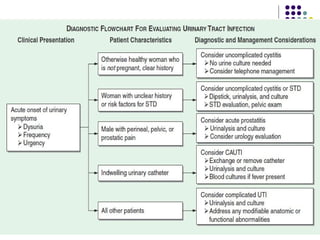
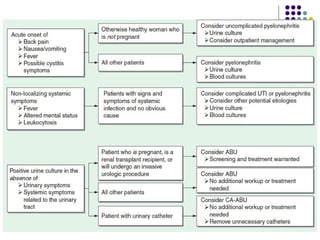
Diagnostic Flowchart for evaluatingDiagnostic Flowchart for evaluating
Patients with UTIPatients with UTI
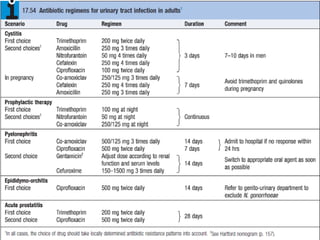
Antibiotic Regimen for UTI
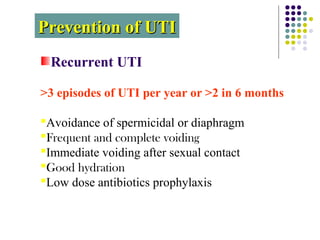
Prevention of UTIPrevention of UTI
Recurrent UTI
>3 episodes of UTI per year or >2 in 6 months
Avoidance of spermicidal or diaphragm
Frequent and complete voiding
Immediate voiding after sexual contact
Good hydration
Low dose antibiotics prophylaxis
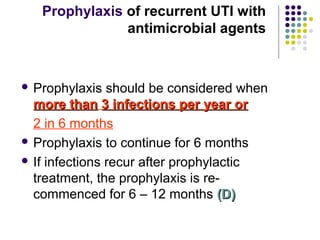
 Prophylaxis should be considered when
more thanmore than 3 infections per year or3 infections per year or
2 in 6 months
 Prophylaxis to continue for 6 months
 If infections recur after prophylactic
treatment, the prophylaxis is re-
commenced for 6 – 12 months (D)(D)
Prophylaxis of recurrent UTI with
antimicrobial agents
THANKYOU

Urinary Tract Infection (UTI)

  • 1.
    URINARY TRACT INFECTIONS Presentedby Bibek Bhandari IInd batch
  • 2.
    Epidemiology of UTI Worldwide,150 million cases / yearWorldwide, 150 million cases / year 90 % cystitis, 10 % pyelonephritis 75 % sporadic 25 % recurrent 2 % complicated
  • 3.
    Prevalence of urinarytract infections (UTI)  almost half of all womenwomen will have at least one UTI in their lives.  the risk of UTI in women increases after menopause  after a UTI: 20 - 40 % will have a recurrence  recurring infections are usually reinfections.
  • 4.
     UTI israre in young and middle-aged menmen & often with catheterisation or urological procedures.  Urinary catheter increases the risk almost ten-fold in hospitalised patients and those in other care homes.  Pyelonephritis is common in patients who have been catheterised for over a month.
  • 5.
    Gender and sexualcontact Infant and children : Male >> femaleInfant and children : Male >> female Adolescent-menopause : Female >> maleAdolescent-menopause : Female >> male Older age : Female = = maleOlder age : Female = = male Women: Short ureterWomen: Short ureter Sexual contact : colonization of pathogensSexual contact : colonization of pathogens in bladderin bladder Spermicidal : Change of normal floraSpermicidal : Change of normal flora Men (<50)Men (<50) : Prostate infection, anatomical defects ,: Prostate infection, anatomical defects , Lack of circumcision, homosexualsLack of circumcision, homosexuals
  • 6.
    Classification by Type ofUTI Upper / Lower UTI Pyelonephritis Asymptomatic bacteriuria Cystitis Symptoms Symptomatic Asymptomatic Recurrence Sporadic < 1 UTI / 6 m Recurrent ≥ 1 UTI / 6m Complicating factors Uncomplicated Complicated Classification of UTIs
  • 7.
    Urinary Tract Infection-Types Urethritis Cystitis Lower Prostatitis Pyelonephritis Intrarenal & Upper Perinephric abscess
  • 8.
  • 9.
    Host protective factorsin UTI  Flushing mechanism of micturition  Acid pH of urine (4.6- 6) anti-bacterial  Acid vaginal pH (3.5-4.5)) suppresses colonization  Urinary Tamm-Horsefall protein (secreted by ascending loop of Henle) & blocks E. coli  Chemotactic factors - interleukin-8
  • 10.
    Facilitate bacteriuriaFacilitate bacteriuriaResidual bladder urine after voiding Turbulent urethral flow(stricture) Foreign bodies Atrophic vaginal mucosa Vesico-ureteral reflux Worse prognosis of UTIsWorse prognosis of UTIs Childhood pyelonephritis Diabetic nephropathy Malignant hypertension Chronic pyelonephritis Host Factors Complicating Bacteriuria
  • 11.
    Bacterial virulence factorsin UTI  Escherichia coli strains expressing O-antigens cause high proportion of infections  Capsular antigens of E. coli associated with clinical severity (antiphagocytic)  P-fimbriae enhance attachment of E. coli) to uroepithelial cells  Motile bacteria ascend the ureter against urine flow
  • 12.
    Bacterial virulence factorsin UTI  Bacterial urease (Proteus) splits urea →NH4 ion alkalinizes urine with loss of acid pH → stone formation → obstruction & survivial of bacteria within stones resisting eradication  Gram-negative endotoxin decreases ureteral peristalsis  Hemolysin damages renal tubular epithelium & promotes invasive infection  Aerobactin of E. coli promote iron accumulation for bacterial replication
  • 14.
    Pathogenesis of UTI Ascending route most common  Colonization of urethra and peri-urethral tissue is the initial event  More in women than men due to short female urethra ,so urethral organisms enter bladder during micturition & in close proximity to perianal areas  Once in the bladder , multiply, then pass up the ureters (esp. if vesico-ureteral reflux) to the renal pelvis & parenchyma  Hospital infection associated with lower urinary tract instrumentation (catheterization, cystoscopy)
  • 15.
    Pathogenesis of UTI-blood borne  Hematogenous seeding less frequent than ascending infection  Kidney a common site of abscess formation in Staphylococcus aureus bacteremia, less often in candidemia, rarely with gram-negative bacteremia  Hematogenous seeding of kidney also occurs with Salmonella (typhoid) and Mycobacterium tuberculosis  Source of uropathogens: enteric bacteria
  • 16.
    Pathogenesis of UTI:Risk Factors  ↓ resistance of mucous membranes (e.g. in menopause)  sexual intercourse  disturbances in ureteral functioning  in children the re-entering of urine back into the ureters (vesicoureteral reflux),  Uterine prolapse  Diabetes
  • 17.
    Pathogenesis of UTIs PredisposingConditions- contdPredisposing Conditions- contd  Benign prostatic hypertrophy  Any illness, eg diabetes, affecting the emptying -Neurogenic Bladder  Spinal injury →disturbances in bladder emptying or urinary catheter)  Stones  Catheterisation & other urological procedures  Renal Transplantation
  • 18.
    Types of UTITypical Symptoms & Signs Cystitis Frequent voiding, suprapubic pain Burning micturition Hematuria, cloudy urine Pyelonephritis Fever chills, flank pains, N/Vomiting Cystitis Sx ± Urosepsis Fever- chills Shock Clinical Symptoms of UTI
  • 19.
    Urethritis  Acute dysuria,frequency  Suspect sexually transmitted pathogens, no hematuria, no suprapubic pain, new sexual partner, cervicitis
  • 20.
    Cystitis  Symptoms: frequency,dysuria, urgency, suprapubic pain  Cloudy, mal-odorous urine (nonspecific)  Pyuria  WBC (2-5 with symptoms) and bacteria on urine microscopy
  • 21.
  • 22.
  • 23.
    Pyelonephritis  Fever, chills Nausea/Vomiting, diarrhea, tachycardia,  Costo-vertebral angleTenderness or deep abdominal tenderness  Leukocytosis  Urine microscopy: Pyuria + WBC casts, bacteria & hematuria  Possibly signs of Gram negative sepsis
  • 24.
    Pyelonephritis  Complications: Sepsis Papillary necrosis Abscess, Ureteralobstruction ↓ renal function if scarring, In pregnancy – ↑incidence of preterm labor
  • 25.
    Diagnosis of UTI History  Physical exam  Lab parameters:  Urinalysis with microscopy for WBC, bacteria  Urine culture with sensitivities  Diagnose acute uncomplicated cystitis in women based on Hx, PE, and UA alone, no need for culture to treat
  • 26.
    Diagnosis  Urinalysis  Leukocyte-esterasepositive. = pyuria  Nitrite positive from urease producing bacteria eg proteus (but not always)  Microscopy – WBC ( > 5 in pt with symptoms) -- Bacteria
  • 27.
    Collecting a sample in adults, mid stream urine (MSU)(MSU) sample usually reliably represents the urine in the bladder.  samples from urinary bags or bedpans should not be used as they invariably will be contaminated  the most reliable sample is obtained via a suprapubic puncture  urine in bladder >4 hoursurine in bladder >4 hours (any shorter time will increase the risk of false negative findings)
  • 29.
    Diagnosis- interpretation  Urineculture  105 colonies per mL considered standard for diagnosis - but misses up to 50%  Now, 103 to 104 accepted as significant if patient symptomatic  if several bacterial strains are grown on culture; contamination of the sample is the likely cause  Sensitivities for better tailoring of therapy
  • 30.
    Significant bacteriuria Clinical statusor methods of sampling Significant concentration (microbes / ml) MSU; symptomatic patient or urine in bladder <4 h >103 MSU; urine in bladder >4 h >104-5 Male patient, catheter specimen sample >103 Female patient, catheter specimen sample >104 Asymptomatic bacteriuria >105 Suprapubic puncture sample any growth
  • 31.
    Positive Urine culturerepeatedly (10Positive Urine culture repeatedly (1055 cfu/ml)cfu/ml) in the absence of signs of UTI  pyuria does not affect interpretation  Investige & treat asymptomatic bacteriuria → only in pregnant women Its prevalence varies from 1-5% to 100% in selected population groups. . Asymptomatic bacteriuria microbiological diagnosis
  • 32.
     Escherichia coliEscherichiacoli  most common  80% of community - acquired  50% of hospital-acquired  Others:  enterococcienterococci  Staphylococcus saprophyticusStaphylococcus saprophyticus and  klebsiellaklebsiella  pseudomonaspseudomonas and proteusproteus are more rare Causative agents of UTIs
  • 33.
    % of typesof Organisms in UTI
  • 34.
    Diagnostic Flowchart forevaluatingDiagnostic Flowchart for evaluating Patients with UTIPatients with UTI
  • 37.
  • 38.
    Prevention of UTIPreventionof UTI Recurrent UTI >3 episodes of UTI per year or >2 in 6 months Avoidance of spermicidal or diaphragm Frequent and complete voiding Immediate voiding after sexual contact Good hydration Low dose antibiotics prophylaxis
  • 39.
     Prophylaxis shouldbe considered when more thanmore than 3 infections per year or3 infections per year or 2 in 6 months  Prophylaxis to continue for 6 months  If infections recur after prophylactic treatment, the prophylaxis is re- commenced for 6 – 12 months (D)(D) Prophylaxis of recurrent UTI with antimicrobial agents
  • 41.

Editor's Notes

  • #37 ABU- Asymptomatic bacteruria