“ Add your company slogan ”

Using Data Mining
Techniques to Analyze Crime
Pattern
Presented by:
Dr.Zakaria Suliman Zubi
Associate Professor
Computer Science Department
Faculty of Science
Sirte University
Sirte, Libya

LOGO
Contents
 Abstract.








Introduction.
Data Mining Models.
Why Analyze Crime?
Data Mining Task.
Data Set.
The MLCR Proposed Model.
Conclusion.

www.themegallery.com
Abstract
 Law enforcement agencies represented in the police today faced a
large volume of data every day. These data can be processed and
transformed into useful information. In this since, Data mining can
be applied to greatly improve crime analysis. Which can help to
reduce and preventing crime as much as possible.
 Crime reports and data are used as an input for the formulation of
the crime prevention policies and strategic plans.
 This work will apply some data mining methods to analyses Libyan
national criminal record data to help the Libyan government to make
a strategically decision regarding prevention the increasing of the
high crime rate these days.
 The data was collected manually from Benghazi, Tripoli, and AlJafara Supremes Security Committee (SSC).
 Our proposed model will be able to extract crime patterns by using
association rule mining and clustering to classify crime records on
the basis of the values of crime attributes.

www.themegallery.com
Contents
 Abstract.
 Introduction.







Data Mining Models.
Why Analyze Crime?
Data Mining Task.
Data Set.
The MLCR Proposed Model.
Conclusion.
www.themegallery.com
Introduction
 Data Mining or Knowledge Discovery in Databases (KDD) in simple
words is nontrivial extraction of implicit, previously unknown, and
potentially useful information from data.


KDD is the process of identifying a valid, potentially, useful and
ultimately understandable structure in data..

 Crime analyzes is an emerging field in law enforcement without
standard definitions. This makes it difficult to determine the crime
analyzes focus for agencies that are new to the field.
 Crime analysis is act of analyzing crime. More specifically, crime
analysis is the breaking up of acts committed in violation of laws into
their parts to find out their nature and reporting, some analysis.
 The role of the crime analysts varies from agency to agency.
Statement of these findings, The objective of most crime analysis is
to find meaningful information in vast amounts of data and
disseminate this information to officers and investigators in the field
to assist in their efforts to apprehend criminals and suppress
criminal activity.
www.themegallery.com
Contents




Abstract.
Introduction.
Data Mining Models.







Why Analyze Crime?
Data Mining Task.
Data Set.
The MLCR Proposed Model.
Conclusion.

www.themegallery.com
Data Mining Models
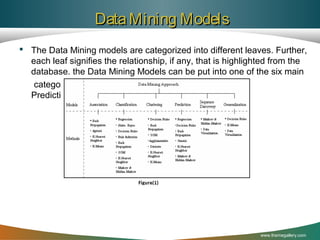
 The Data Mining models are categorized into different leaves. Further,
each leaf signifies the relationship, if any, that is highlighted from the
database. the Data Mining Models can be put into one of the six main
categories: 1) Association, 2) Classification, 3) Clustering, 4)
Prediction, 5) Sequence Discovery, and 6) Generalization

www.themegallery.com
data Mining Models Cont…
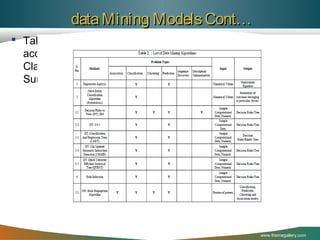
 Table 2 classifies the various Data Mining algorithms
according to problem type, namely, Association,
Classification, Clustering, Prediction, Discovery, and
Summarization.

www.themegallery.com
Data Mining models Cont…


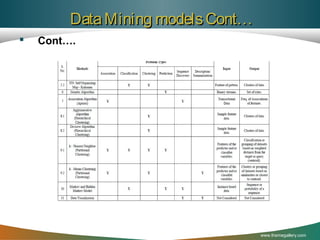
Cont….

www.themegallery.com
Contents





Abstract.
Introduction.
Data Mining Models.
Why Analyze Crime?






Data Mining Task.
Data Set.
The MLCR Proposed Model.
Conclusion.

www.themegallery.com
Why Analyze Crime?
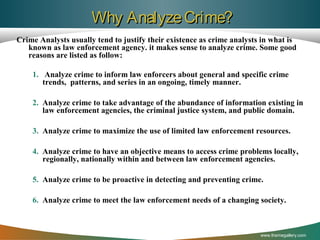
Crime Analysts usually tend to justify their existence as crime analysts in what is
known as law enforcement agency. it makes sense to analyze crime. Some good
reasons are listed as follow:
1. Analyze crime to inform law enforcers about general and specific crime
trends, patterns, and series in an ongoing, timely manner.
2. Analyze crime to take advantage of the abundance of information existing in
law enforcement agencies, the criminal justice system, and public domain.
3. Analyze crime to maximize the use of limited law enforcement resources.
4. Analyze crime to have an objective means to access crime problems locally,
regionally, nationally within and between law enforcement agencies.
5. Analyze crime to be proactive in detecting and preventing crime.
6. Analyze crime to meet the law enforcement needs of a changing society.

www.themegallery.com
Why Analyze Crime? Cont…
 In general there are four different techniques for
analyzing crimes, as follow:
1.
2.
3.
4.

Linkage Analysis
Statistical Analysis
Profiling
Spatial Analysis

 Each of the above techniques has its own advantages
and drawbacks and can be used in specific cases.

www.themegallery.com
Contents






Abstract.
Introduction.
Data Mining Models.
Why Analyze Crime?
Data Mining Task.





Data Set.
The MLCR Proposed Model.
Conclusion.
www.themegallery.com
Data Mining Task
A. Data collection.
The dataset that was used as training and testing data
set were extracted from the Supreme Security
Committee in Tripoli, Benghazi and Al-Jafara.
These data contain data about both Crimes and
Criminals with the following main attributes:
1. Crime ID: Individual crimes are designated by unique crime id.
2. Crime type: indicates crime type.
3. Date: Indicate when a crime happened.
4. Gender: Male or Female.
5. Age: age of individual Criminal.
6. Crime Address: location of the crime.
7. Marital status: status of the Criminal.
www.themegallery.com
Data Mining Task Cont…
B. Data Preprocessing .
 Real world usually have the following drawbacks:
Incompleteness, Noisy, and Inconsistence. So these data need to
be preprocessed to get the data suitable for analysis purpose. The
preprocessing includes the following tasks as it shown in
1.
2.
3.
4.
5.

Data cleaning.
Data integration
Data transformation.
Data reduction.
Data discretization

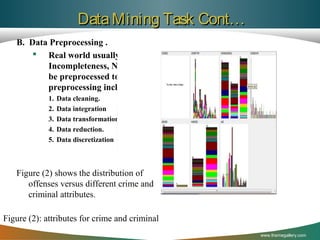
Figure (2) shows the distribution of
offenses versus different crime and
criminal attributes.
Figure (2): attributes for crime and criminal
www.themegallery.com
Contents







Abstract.
Introduction.
Data Mining Models.
Why Analyze Crime?
Data Mining Task.
Data Set.

 The MLCR Proposed Model.
 Conclusion.
www.themegallery.com
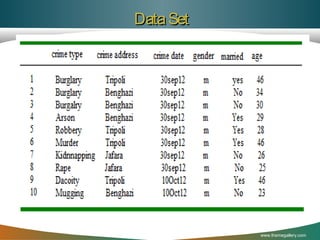
Data Set
We will consider crime database as a training dataset used in
our model. The mentioned database contains a real data values
from crime and criminal attributes. We will also consider 70
percent as training value of the proposed model and 30 percent
for testing. The following table shows the data we used in our
model.

www.themegallery.com








Contents

Abstract.
Introduction.
Data Mining Models.
Why Analyze Crime?
Data Mining Task.
Data Set.
The MLCR Proposed Model.

 Conclusion.
www.themegallery.com
The MLCR proposed model
The Mining Libyan Criminal Record (MLCR) proposed
model will be implemented to conduct and interact with two
types of mining algorithms to overcome with two different
types of results effectively. Those two approaches are
considered as a sub-prototypes of the proposed MLCR
model. Those prototypes will be illustrated as follows:
A.Mining Libyan Criminal Record-using Association rules
(MLCR-AR).

B.Mining Libyan Criminal Record-using Clustering (MLCR-C).

www.themegallery.com
The MLCR proposed model Cont…
A. Mining Libyan Criminal Record-using
Association rules (MLCR-AR).


Association rule mining is a method used to generate rules from crime
dataset based on frequents occurrence of patterns to help the decision
makers of our security society to make a prevention action.

 One of the most popular algorithm are called Apriori and FP-growth
Association rule mining classically intends at discovering association
between items in a transactional database.
 The Apriori algorithm called also as “Sequential Algorithm” developed
by [Agrawal1994]. Is a great accomplishment in the history of mining
association rules[Cheung1996c]. It is also the most well known
association rules algorithm. This technique uses to perform association
analyze on the attributes of crimes.

www.themegallery.com
The MLCR proposed model Cont…
B. Mining Libyan Criminal Record-using Clustering (MLCR-C).


This prototype will use the same dataset indicated in MLCR_AR prototype. But
with Clustering Analysis.



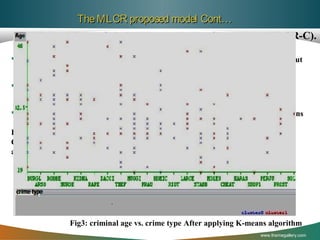
Clustering is the technique that is used to group objects (crime and criminals)
without having predefined specification for their attributes.



Clustering is unsupervised classification: no predefined classes. Simple K-means
clustering algorithm is used in this work.
K-mean algorithm clusters the data members groups were m is predefined. InputCrime type. Number of clusters, Number of Iteration Initial seeds might produce
an important role in the final results.
Step1: Randomly choose cluster centers.
Step2: Assign instance to cluster based on their Distance to the cluster centers.
Step3: Centers of clusters are adjusted.
Step4: go to Step1 until convergence.
Step5: output X0 ,X1,X2 ,X3.
Fig3: criminal age vs. crime type After applying K-means algorithm
www.themegallery.com









Contents

Abstract.
Introduction.
Data Mining Models.
Why Analyze Crime?
Data Mining Task.
Data Set.
The MLCR Proposed Model.
Conclusion.

www.themegallery.com
Conclusion



Clustering and association rules were defined as a data mining techniques to
automatically retrieve, extract and evaluate information for knowledge
discovery from crime data.




This information was collected from many police departments in Libya.

Association rules Mining is one of the data mining techniques for data to be
used to identify the relationship and to generate rules from crime dataset based
on frequents occurrence of patterns to help the decision makers of our security
society to make a prevention action.




Clustering is one of the data mining techniques also used to group objects
(crime and criminals) without having predefined specification for their
attributes.
The algorithms such as K-means algorithm and Aproir algorithm are used in
this paper.



Those algorithms were expressed in details and a comparative study were
denoted in this paper.


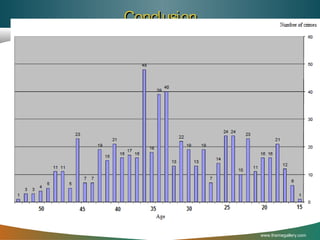
A promising results were shown in the following figure.
www.themegallery.com
Thank you !!!
Using Data Mining Techniques to Analyze Crime Pattern

Using Data Mining Techniques to Analyze Crime Pattern

  • 1.
    “ Add yourcompany slogan ” Using Data Mining Techniques to Analyze Crime Pattern Presented by: Dr.Zakaria Suliman Zubi Associate Professor Computer Science Department Faculty of Science Sirte University Sirte, Libya LOGO
  • 2.
    Contents  Abstract.        Introduction. Data MiningModels. Why Analyze Crime? Data Mining Task. Data Set. The MLCR Proposed Model. Conclusion. www.themegallery.com
  • 3.
    Abstract  Law enforcementagencies represented in the police today faced a large volume of data every day. These data can be processed and transformed into useful information. In this since, Data mining can be applied to greatly improve crime analysis. Which can help to reduce and preventing crime as much as possible.  Crime reports and data are used as an input for the formulation of the crime prevention policies and strategic plans.  This work will apply some data mining methods to analyses Libyan national criminal record data to help the Libyan government to make a strategically decision regarding prevention the increasing of the high crime rate these days.  The data was collected manually from Benghazi, Tripoli, and AlJafara Supremes Security Committee (SSC).  Our proposed model will be able to extract crime patterns by using association rule mining and clustering to classify crime records on the basis of the values of crime attributes. www.themegallery.com
  • 4.
    Contents  Abstract.  Introduction.       DataMining Models. Why Analyze Crime? Data Mining Task. Data Set. The MLCR Proposed Model. Conclusion. www.themegallery.com
  • 5.
    Introduction  Data Miningor Knowledge Discovery in Databases (KDD) in simple words is nontrivial extraction of implicit, previously unknown, and potentially useful information from data.  KDD is the process of identifying a valid, potentially, useful and ultimately understandable structure in data..  Crime analyzes is an emerging field in law enforcement without standard definitions. This makes it difficult to determine the crime analyzes focus for agencies that are new to the field.  Crime analysis is act of analyzing crime. More specifically, crime analysis is the breaking up of acts committed in violation of laws into their parts to find out their nature and reporting, some analysis.  The role of the crime analysts varies from agency to agency. Statement of these findings, The objective of most crime analysis is to find meaningful information in vast amounts of data and disseminate this information to officers and investigators in the field to assist in their efforts to apprehend criminals and suppress criminal activity. www.themegallery.com
  • 6.
    Contents    Abstract. Introduction. Data Mining Models.      WhyAnalyze Crime? Data Mining Task. Data Set. The MLCR Proposed Model. Conclusion. www.themegallery.com
  • 7.
    Data Mining Models The Data Mining models are categorized into different leaves. Further, each leaf signifies the relationship, if any, that is highlighted from the database. the Data Mining Models can be put into one of the six main categories: 1) Association, 2) Classification, 3) Clustering, 4) Prediction, 5) Sequence Discovery, and 6) Generalization www.themegallery.com
  • 8.
    data Mining ModelsCont…  Table 2 classifies the various Data Mining algorithms according to problem type, namely, Association, Classification, Clustering, Prediction, Discovery, and Summarization. www.themegallery.com
  • 9.
    Data Mining modelsCont…  Cont…. www.themegallery.com
  • 10.
    Contents     Abstract. Introduction. Data Mining Models. WhyAnalyze Crime?     Data Mining Task. Data Set. The MLCR Proposed Model. Conclusion. www.themegallery.com
  • 11.
    Why Analyze Crime? CrimeAnalysts usually tend to justify their existence as crime analysts in what is known as law enforcement agency. it makes sense to analyze crime. Some good reasons are listed as follow: 1. Analyze crime to inform law enforcers about general and specific crime trends, patterns, and series in an ongoing, timely manner. 2. Analyze crime to take advantage of the abundance of information existing in law enforcement agencies, the criminal justice system, and public domain. 3. Analyze crime to maximize the use of limited law enforcement resources. 4. Analyze crime to have an objective means to access crime problems locally, regionally, nationally within and between law enforcement agencies. 5. Analyze crime to be proactive in detecting and preventing crime. 6. Analyze crime to meet the law enforcement needs of a changing society. www.themegallery.com
  • 12.
    Why Analyze Crime?Cont…  In general there are four different techniques for analyzing crimes, as follow: 1. 2. 3. 4. Linkage Analysis Statistical Analysis Profiling Spatial Analysis  Each of the above techniques has its own advantages and drawbacks and can be used in specific cases. www.themegallery.com
  • 13.
    Contents      Abstract. Introduction. Data Mining Models. WhyAnalyze Crime? Data Mining Task.    Data Set. The MLCR Proposed Model. Conclusion. www.themegallery.com
  • 14.
    Data Mining Task A.Data collection. The dataset that was used as training and testing data set were extracted from the Supreme Security Committee in Tripoli, Benghazi and Al-Jafara. These data contain data about both Crimes and Criminals with the following main attributes: 1. Crime ID: Individual crimes are designated by unique crime id. 2. Crime type: indicates crime type. 3. Date: Indicate when a crime happened. 4. Gender: Male or Female. 5. Age: age of individual Criminal. 6. Crime Address: location of the crime. 7. Marital status: status of the Criminal. www.themegallery.com
  • 15.
    Data Mining TaskCont… B. Data Preprocessing .  Real world usually have the following drawbacks: Incompleteness, Noisy, and Inconsistence. So these data need to be preprocessed to get the data suitable for analysis purpose. The preprocessing includes the following tasks as it shown in 1. 2. 3. 4. 5. Data cleaning. Data integration Data transformation. Data reduction. Data discretization Figure (2) shows the distribution of offenses versus different crime and criminal attributes. Figure (2): attributes for crime and criminal www.themegallery.com
  • 16.
    Contents       Abstract. Introduction. Data Mining Models. WhyAnalyze Crime? Data Mining Task. Data Set.  The MLCR Proposed Model.  Conclusion. www.themegallery.com
  • 17.
    Data Set We willconsider crime database as a training dataset used in our model. The mentioned database contains a real data values from crime and criminal attributes. We will also consider 70 percent as training value of the proposed model and 30 percent for testing. The following table shows the data we used in our model. www.themegallery.com
  • 18.
           Contents Abstract. Introduction. Data Mining Models. WhyAnalyze Crime? Data Mining Task. Data Set. The MLCR Proposed Model.  Conclusion. www.themegallery.com
  • 19.
    The MLCR proposedmodel The Mining Libyan Criminal Record (MLCR) proposed model will be implemented to conduct and interact with two types of mining algorithms to overcome with two different types of results effectively. Those two approaches are considered as a sub-prototypes of the proposed MLCR model. Those prototypes will be illustrated as follows: A.Mining Libyan Criminal Record-using Association rules (MLCR-AR). B.Mining Libyan Criminal Record-using Clustering (MLCR-C). www.themegallery.com
  • 20.
    The MLCR proposedmodel Cont… A. Mining Libyan Criminal Record-using Association rules (MLCR-AR).  Association rule mining is a method used to generate rules from crime dataset based on frequents occurrence of patterns to help the decision makers of our security society to make a prevention action.  One of the most popular algorithm are called Apriori and FP-growth Association rule mining classically intends at discovering association between items in a transactional database.  The Apriori algorithm called also as “Sequential Algorithm” developed by [Agrawal1994]. Is a great accomplishment in the history of mining association rules[Cheung1996c]. It is also the most well known association rules algorithm. This technique uses to perform association analyze on the attributes of crimes. www.themegallery.com
  • 21.
    The MLCR proposedmodel Cont… B. Mining Libyan Criminal Record-using Clustering (MLCR-C).  This prototype will use the same dataset indicated in MLCR_AR prototype. But with Clustering Analysis.  Clustering is the technique that is used to group objects (crime and criminals) without having predefined specification for their attributes.  Clustering is unsupervised classification: no predefined classes. Simple K-means clustering algorithm is used in this work. K-mean algorithm clusters the data members groups were m is predefined. InputCrime type. Number of clusters, Number of Iteration Initial seeds might produce an important role in the final results. Step1: Randomly choose cluster centers. Step2: Assign instance to cluster based on their Distance to the cluster centers. Step3: Centers of clusters are adjusted. Step4: go to Step1 until convergence. Step5: output X0 ,X1,X2 ,X3. Fig3: criminal age vs. crime type After applying K-means algorithm www.themegallery.com
  • 22.
            Contents Abstract. Introduction. Data Mining Models. WhyAnalyze Crime? Data Mining Task. Data Set. The MLCR Proposed Model. Conclusion. www.themegallery.com
  • 23.
    Conclusion  Clustering and associationrules were defined as a data mining techniques to automatically retrieve, extract and evaluate information for knowledge discovery from crime data.   This information was collected from many police departments in Libya. Association rules Mining is one of the data mining techniques for data to be used to identify the relationship and to generate rules from crime dataset based on frequents occurrence of patterns to help the decision makers of our security society to make a prevention action.   Clustering is one of the data mining techniques also used to group objects (crime and criminals) without having predefined specification for their attributes. The algorithms such as K-means algorithm and Aproir algorithm are used in this paper.  Those algorithms were expressed in details and a comparative study were denoted in this paper.  A promising results were shown in the following figure. www.themegallery.com
  • 24.