Abstract
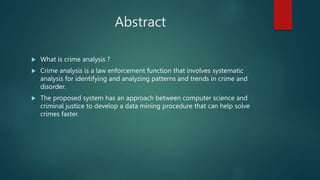
 What is crime analysis ?
 Crime analysis is a law enforcement function that involves systematic
analysis for identifying and analyzing patterns and trends in crime and
disorder.
 The proposed system has an approach between computer science and
criminal justice to develop a data mining procedure that can help solve
crimes faster.
Introduction
 It is only within the last few decades that the technology made spatial data
mining a practical solution for wide audiences of law enforcement officials
which is affordable and available.
 Huge chunks of data to be collected-web sites, news sites, blogs, social
media, RSS feeds etc.
 So the main challenge in front of us is developing a better , efficient crime
pattern detection tool to identify crime patterns effectively.
Doing analysis is a hard job !
 The reason for the choosing this (clustering)
 Only known data present with us
 Classification technique will not predict well
 Also nature of crimes change over time
 So in order to be able to detect newer and unknown patterns
in future , clustering techniques work better.
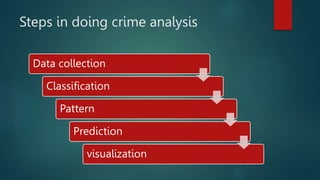
Steps in doing crime analysis
Data collection
Classification
Pattern
Prediction
visualization
Related work
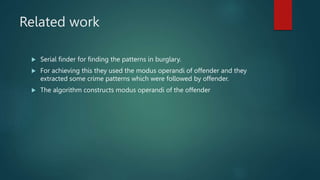
 Serial finder for finding the patterns in burglary.
 For achieving this they used the modus operandi of offender and they
extracted some crime patterns which were followed by offender.
 The algorithm constructs modus operandi of the offender
Methodology
 Collection data from various sources like news sites , blogs , social media
RSS feeds etc.
 But the data we got is “very unstructured ” !, and how do we store it ?
 The advantage of NO SQL database is that it allows insertion of data
without a predefined schema
 Object – oriented programming – hence is easy to use and flexible.
 Unlike sql database it not need to know what we are storing in advance
specify its size etc.
Methodology
 Classification
 Naïve baye – a supervised learning method as well as a
statistical method
 The algorithm classifies a news article into a crime type to
which it fits the
 Best eg.”what is the probability that a crime document d
belongs to a given class c ?”
Future work
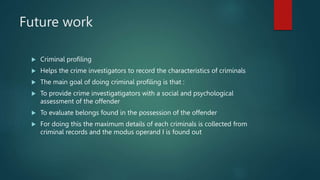
 Criminal profiling
 Helps the crime investigators to record the characteristics of criminals
 The main goal of doing criminal profiling is that :
 To provide crime investigatigators with a social and psychological
assessment of the offender
 To evaluate belongs found in the possession of the offender
 For doing this the maximum details of each criminals is collected from
criminal records and the modus operand I is found out
Criminal profiling
Root
bbb@exp.com
Bob
bsmith@acme.com
alice@yahoo.net
Alice
person
Email
Email Email
Email
Email
Email
person
Advantages
 Helps to prevent crime in society
 System will keep historical record of crime
 System is user friendly
 Saves the time
Disadvantages
 Users who don’t have internet connection can not access the system
 Admin must enter correct records otherwise system will provide wrong
information
Thank you

Case.pptx

  • 1.
    Abstract  What iscrime analysis ?  Crime analysis is a law enforcement function that involves systematic analysis for identifying and analyzing patterns and trends in crime and disorder.  The proposed system has an approach between computer science and criminal justice to develop a data mining procedure that can help solve crimes faster.
  • 2.
    Introduction  It isonly within the last few decades that the technology made spatial data mining a practical solution for wide audiences of law enforcement officials which is affordable and available.  Huge chunks of data to be collected-web sites, news sites, blogs, social media, RSS feeds etc.  So the main challenge in front of us is developing a better , efficient crime pattern detection tool to identify crime patterns effectively.
  • 3.
    Doing analysis isa hard job !  The reason for the choosing this (clustering)  Only known data present with us  Classification technique will not predict well  Also nature of crimes change over time  So in order to be able to detect newer and unknown patterns in future , clustering techniques work better.
  • 4.
    Steps in doingcrime analysis Data collection Classification Pattern Prediction visualization
  • 5.
    Related work  Serialfinder for finding the patterns in burglary.  For achieving this they used the modus operandi of offender and they extracted some crime patterns which were followed by offender.  The algorithm constructs modus operandi of the offender
  • 6.
    Methodology  Collection datafrom various sources like news sites , blogs , social media RSS feeds etc.  But the data we got is “very unstructured ” !, and how do we store it ?  The advantage of NO SQL database is that it allows insertion of data without a predefined schema  Object – oriented programming – hence is easy to use and flexible.  Unlike sql database it not need to know what we are storing in advance specify its size etc.
  • 7.
    Methodology  Classification  Naïvebaye – a supervised learning method as well as a statistical method  The algorithm classifies a news article into a crime type to which it fits the  Best eg.”what is the probability that a crime document d belongs to a given class c ?”
  • 8.
    Future work  Criminalprofiling  Helps the crime investigators to record the characteristics of criminals  The main goal of doing criminal profiling is that :  To provide crime investigatigators with a social and psychological assessment of the offender  To evaluate belongs found in the possession of the offender  For doing this the maximum details of each criminals is collected from criminal records and the modus operand I is found out
  • 9.
  • 10.
    Advantages  Helps toprevent crime in society  System will keep historical record of crime  System is user friendly  Saves the time
  • 11.
    Disadvantages  Users whodon’t have internet connection can not access the system  Admin must enter correct records otherwise system will provide wrong information
  • 12.