Crime
Detection
Prepared By:
-Krupali Dobariya(18DIT014)
-Kevin Khunt(18DIT028)
-Yash Mistry(D19DIT081)
Contents
 Introduction
 Current System and its Limitations
 Scope
 Tools and Technology
 Hardware and Software Requirement
 Project Definition
 Snapshots
 Learning Outcome
 References
Introduction
• As we know crime prevention plays an vital role in
quality life of all citizen and using core methods of
Machine learning its possible to make a
program/application to help make it maintain.
• Our project focuses on analysing crime rate with an
process of Data gathering, Classification and
Prediction.
• With help of entities like location, number of crimes,
and time from the dataset, we anticipate crimes.
Current System and its limitations
• Less Accurate.
• Limited Feature.
• Time consuming.
• No future prediction.
Scope
• Efficient prediction.
• Reduced time consumption.
• Accurate result
• Various ways to predict.
Tools and Technology
• Python.
• Jupyter notebook.
Hardware and Software Requirement
Minimum Hardware Requirement:
• Intel(R)core(TM) i3-3200.
• 2GB of RAM memory.
• 1GB of Secondary storage.
• Intel UHD Graphics 620.
Minimum Software Requirement:
• Operating System: Windows 7 or higher, Linux.
• Development language: Python
• Interpreter: Python IDLE(3.7), Jupyter Notebook.
Project Definition
• Give accurate dataset.
• Pandas –
Pre-processing: Format data for pre-processing.
: Removal of null values , Filling
of incomplete data.
• Matplotlib –
Data visualisation: Meaningful visualisation using
graph like bar , chart ,scatter.
Project Definition
• Numpy -
Data manipulation : Easy and efficient data
calculation within dataset.
• Sklearn –
Data analysis and prediction : model trained
using KNN classifier and predict based on
that.
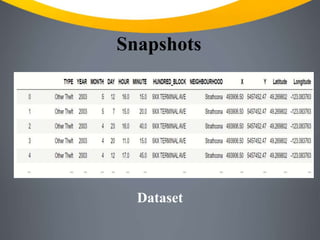
Snapshots
Dataset
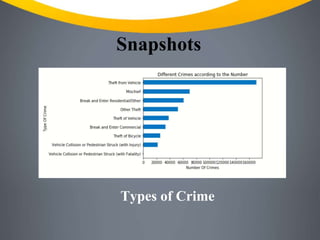
Snapshots
Types of Crime
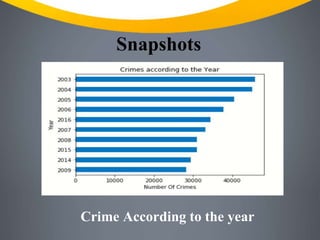
Snapshots
Crime According to the year
Learning Outcome
• Selection of suitable dataset.
• Techniques of data pre-processing.
• Various methods of data visualisation.
• selection of appropriate model.
• Various libraries of python.
References
• https://www.geeksforgeeks.org/python-introduction-
matplotlib/
• https://www.udemy.com/course/machinelearning/
• https://towardsdatascience.com/machine-learning-basics-
with-the-k-nearest-neighbors-algorithm-6a6e71d01761
• https://towardsdatascience.com/data-preprocessing-
concepts-fa946d11c825
• https://www.learndatasci.com/tutorials/python-pandas-
tutorial-complete-introduction-for-beginners/
Crime Detection

Crime Detection

  • 1.
  • 2.
    Contents  Introduction  CurrentSystem and its Limitations  Scope  Tools and Technology  Hardware and Software Requirement  Project Definition  Snapshots  Learning Outcome  References
  • 3.
    Introduction • As weknow crime prevention plays an vital role in quality life of all citizen and using core methods of Machine learning its possible to make a program/application to help make it maintain. • Our project focuses on analysing crime rate with an process of Data gathering, Classification and Prediction. • With help of entities like location, number of crimes, and time from the dataset, we anticipate crimes.
  • 4.
    Current System andits limitations • Less Accurate. • Limited Feature. • Time consuming. • No future prediction.
  • 5.
    Scope • Efficient prediction. •Reduced time consumption. • Accurate result • Various ways to predict.
  • 6.
    Tools and Technology •Python. • Jupyter notebook.
  • 7.
    Hardware and SoftwareRequirement Minimum Hardware Requirement: • Intel(R)core(TM) i3-3200. • 2GB of RAM memory. • 1GB of Secondary storage. • Intel UHD Graphics 620. Minimum Software Requirement: • Operating System: Windows 7 or higher, Linux. • Development language: Python • Interpreter: Python IDLE(3.7), Jupyter Notebook.
  • 8.
    Project Definition • Giveaccurate dataset. • Pandas – Pre-processing: Format data for pre-processing. : Removal of null values , Filling of incomplete data. • Matplotlib – Data visualisation: Meaningful visualisation using graph like bar , chart ,scatter.
  • 9.
    Project Definition • Numpy- Data manipulation : Easy and efficient data calculation within dataset. • Sklearn – Data analysis and prediction : model trained using KNN classifier and predict based on that.
  • 10.
  • 11.
  • 12.
  • 13.
    Learning Outcome • Selectionof suitable dataset. • Techniques of data pre-processing. • Various methods of data visualisation. • selection of appropriate model. • Various libraries of python.
  • 14.
    References • https://www.geeksforgeeks.org/python-introduction- matplotlib/ • https://www.udemy.com/course/machinelearning/ •https://towardsdatascience.com/machine-learning-basics- with-the-k-nearest-neighbors-algorithm-6a6e71d01761 • https://towardsdatascience.com/data-preprocessing- concepts-fa946d11c825 • https://www.learndatasci.com/tutorials/python-pandas- tutorial-complete-introduction-for-beginners/