CRIME PATTERN DETECTION
CONTENTSWhat is crime?Types of crimeWhat makes one commit crime?StatisticsEffects of crime Steps of  Crime Pattern  Detection Clustering
 Pattern Analysis
 Pattern Results
 Advantages of CPD
 Limitations of CPD
 Conclusions
 Future DirectionCRIMEDEFINITION“an action which constitutes a serious offence against an individual or the state and is punishable by law.” - Concise Oxford Dictionary“an act or the commission of an act that is forbidden or the omission of a duty that is commanded by a public law and that makes the offender liable to punishment by that law”	   - Merriam Webster Dictionary
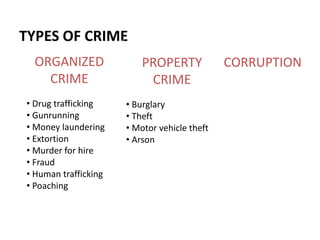
Types of crimePROPERTY CRIME Burglary
 Theft
 Motor vehicle theft
 ArsonCORRUPTIONORGANIZED CRIME Drug trafficking
 Gunrunning
 Money laundering
 Extortion
 Murder for hire
 Fraud
 Human trafficking
 PoachingWHAT MAKES ONE COMMIT CRIME?
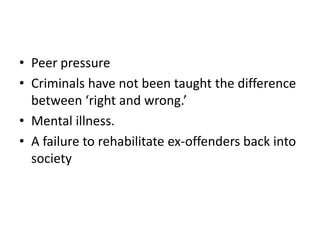
Peer pressureCriminals have not been taught the difference between ‘right and wrong.’ Mental illness. A failure to rehabilitate ex-offenders back into society
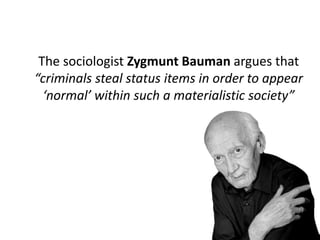
	The sociologist Zygmunt Bauman argues that “criminals steal status items in order to appear ‘normal’ within such a materialistic society”
The peak age of criminal activity is during the years 16-25. WHAT MAKES THEM COMMIT THEM?
Boys often have to ‘prove’ their masculinity which can, at times, result in criminal activityThe likelihood of a young person belonging to a subculture is high, and some subcultures engage in criminal behaviorYoung people may have few legitimate means available of acquiring material goodsLess responsibilitiesTeenage rebellion can lead to people breaking the law
negative impacts of crime upon an area
Depopulation, particularly in urban areasHigh levels of crime may damage community spirit and result in less neighborliness. High crime levels can contribute to environmental povertyOnce a region with a high level of crime is labeling as a bad area, it might become a ghetto
Several causes of deviant behavior that you also need to be aware of
People may feel alienated from society. Deviant behavior may simply be the product of teenage rebellionIn order to conform to the subculture of that group, people adopt the ways of the subculture.
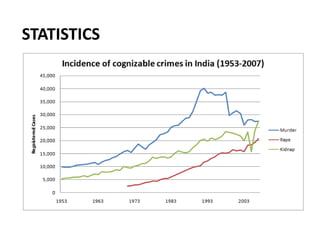
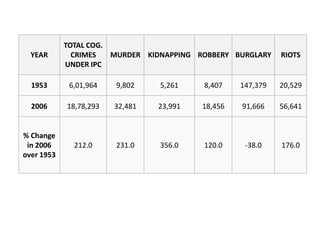
STATISTICS
CRIME Pattern DETECTION
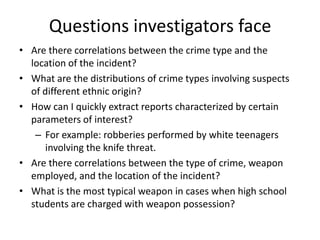
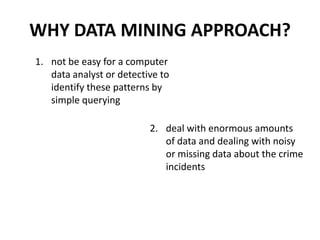
Questions investigators faceAre there correlations between the crime type and the location of the incident? What are the distributions of crime types involving suspects of different ethnic origin? How can I quickly extract reports characterized by certain parameters of interest? For example: robberies performed by white teenagers involving the knife threat.Are there correlations between the type of crime, weapon employed, and the location of the incident?What is the most typical weapon in cases when high school students are charged with weapon possession?
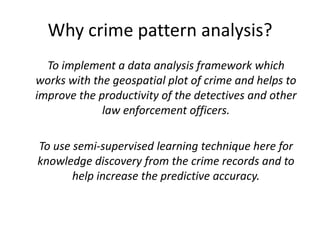
Why crime pattern analysis?	To implement a data analysis framework which works with the geospatial plot of crime and helps to improve the productivity of the detectives and other law enforcement officers.	To use semi-supervised learning technique here for knowledge discovery from the crime records and to help increase the predictive accuracy.
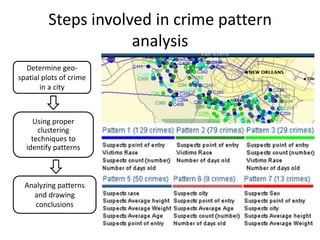
Steps involved in crime pattern analysisDetermine geo-spatial plots of crime in a cityUsing proper clustering techniques to identify patternsAnalyzing patterns and drawing conclusions
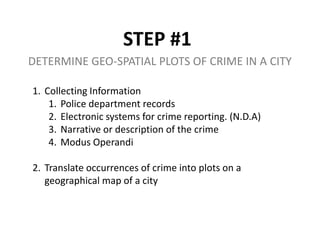
Step #1DETERMINE GEO-SPATIAL PLOTS OF CRIME IN A CITYCollecting Information Police department recordsElectronic systems for crime reporting. (N.D.A)Narrative or description of the crimeModus OperandiTranslate occurrences of crime into plots on a geographical map of a city
STEP #2USING PROPER CLUSTERING TECHNIQUES TO IDENTIFY PATTERNS
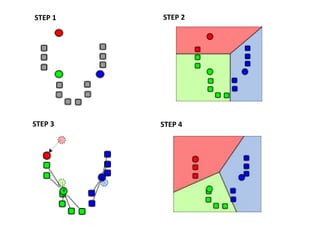
CLUSTERINGCrime terminology a cluster is a group of crimes in a geographical region or a hot spot of crime. Data mining terminology a cluster is group of similar data points (a possible crime pattern)
	Cluster analysis or clustering is the assignment of a set of observations into subsets (called clusters) so that observations in the same cluster are similar in some sense.
	Clustering is a method of unsupervised learning, and a common technique for statistical data analysis used in many fields, including machine learning, data mining, pattern recognition, image analysis, information retrieval, and bioinformatics.
Clustering Technique	Task of identifying groups of records that are similar between themselves but different from the rest of the data and of finding the variables providing the best clustering	Clusters will useful for identifying a crime spree committed by one or same group of suspects.
	These clusters will then be presented to the detectives to drill down using their domain expertise.	Automated detection of crime patterns, allows the detectives to focus oncrime sprees first and solving one of these crimes results in solving the whole spree” groups of incidents suspected to be one spree, the complete evidence can be built from the different bits of information from each of the crime incidents.
Why Clustering?Crimes vary in nature widely Nature of crimes change over timeCrime database often contains several unsolved crimes.Less predictive quality for solving future crimes

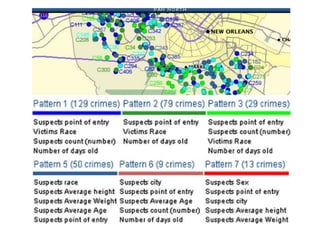
Why Clustering?	In order to be able to detect newer and unknown patterns in future, clustering techniques work better.K-Means Clustering was used here.
K-Means Clustering	The k-means algorithm assigns each point to the cluster whose centroid is nearest. The center is the average of all the points in the cluster	Example: The data set has three dimensions and the cluster has two points: X = (x1,x2,x3) and Y = (y1,y2,y3). Then the centroid Z becomes Z = (z1,z2,z3) , where              ,              and 

Crime Pattern Detection using K-Means Clustering

  • 1.
  • 2.
    CONTENTSWhat is crime?Typesof crimeWhat makes one commit crime?StatisticsEffects of crime Steps of Crime Pattern Detection Clustering
  • 3.
  • 4.
  • 5.
  • 6.
  • 7.
  • 8.
    Future DirectionCRIMEDEFINITION“anaction which constitutes a serious offence against an individual or the state and is punishable by law.” - Concise Oxford Dictionary“an act or the commission of an act that is forbidden or the omission of a duty that is commanded by a public law and that makes the offender liable to punishment by that law” - Merriam Webster Dictionary
  • 9.
  • 10.
  • 11.
  • 12.
  • 13.
  • 14.
  • 15.
  • 16.
  • 17.
  • 18.
  • 19.
    PoachingWHAT MAKESONE COMMIT CRIME?
  • 20.
    Peer pressureCriminals havenot been taught the difference between ‘right and wrong.’ Mental illness. A failure to rehabilitate ex-offenders back into society
  • 21.
    The sociologist ZygmuntBauman argues that “criminals steal status items in order to appear ‘normal’ within such a materialistic society”
  • 22.
    The peak ageof criminal activity is during the years 16-25. WHAT MAKES THEM COMMIT THEM?
  • 23.
    Boys often haveto ‘prove’ their masculinity which can, at times, result in criminal activityThe likelihood of a young person belonging to a subculture is high, and some subcultures engage in criminal behaviorYoung people may have few legitimate means available of acquiring material goodsLess responsibilitiesTeenage rebellion can lead to people breaking the law
  • 24.
    negative impacts ofcrime upon an area
  • 25.
    Depopulation, particularly inurban areasHigh levels of crime may damage community spirit and result in less neighborliness. High crime levels can contribute to environmental povertyOnce a region with a high level of crime is labeling as a bad area, it might become a ghetto
  • 26.
    Several causes ofdeviant behavior that you also need to be aware of
  • 27.
    People may feelalienated from society. Deviant behavior may simply be the product of teenage rebellionIn order to conform to the subculture of that group, people adopt the ways of the subculture.
  • 28.
  • 30.
  • 31.
    Questions investigators faceArethere correlations between the crime type and the location of the incident? What are the distributions of crime types involving suspects of different ethnic origin? How can I quickly extract reports characterized by certain parameters of interest? For example: robberies performed by white teenagers involving the knife threat.Are there correlations between the type of crime, weapon employed, and the location of the incident?What is the most typical weapon in cases when high school students are charged with weapon possession?
  • 32.
    Why crime patternanalysis? To implement a data analysis framework which works with the geospatial plot of crime and helps to improve the productivity of the detectives and other law enforcement officers. To use semi-supervised learning technique here for knowledge discovery from the crime records and to help increase the predictive accuracy.
  • 33.
    Steps involved incrime pattern analysisDetermine geo-spatial plots of crime in a cityUsing proper clustering techniques to identify patternsAnalyzing patterns and drawing conclusions
  • 34.
    Step #1DETERMINE GEO-SPATIALPLOTS OF CRIME IN A CITYCollecting Information Police department recordsElectronic systems for crime reporting. (N.D.A)Narrative or description of the crimeModus OperandiTranslate occurrences of crime into plots on a geographical map of a city
  • 35.
    STEP #2USING PROPERCLUSTERING TECHNIQUES TO IDENTIFY PATTERNS
  • 36.
    CLUSTERINGCrime terminology acluster is a group of crimes in a geographical region or a hot spot of crime. Data mining terminology a cluster is group of similar data points (a possible crime pattern)
  • 37.
    Cluster analysis or clustering is theassignment of a set of observations into subsets (called clusters) so that observations in the same cluster are similar in some sense.
  • 38.
    Clustering is amethod of unsupervised learning, and a common technique for statistical data analysis used in many fields, including machine learning, data mining, pattern recognition, image analysis, information retrieval, and bioinformatics.
  • 39.
    Clustering Technique Task ofidentifying groups of records that are similar between themselves but different from the rest of the data and of finding the variables providing the best clustering Clusters will useful for identifying a crime spree committed by one or same group of suspects.
  • 40.
    These clusters willthen be presented to the detectives to drill down using their domain expertise. Automated detection of crime patterns, allows the detectives to focus oncrime sprees first and solving one of these crimes results in solving the whole spree” groups of incidents suspected to be one spree, the complete evidence can be built from the different bits of information from each of the crime incidents.
  • 41.
    Why Clustering?Crimes varyin nature widely Nature of crimes change over timeCrime database often contains several unsolved crimes.Less predictive quality for solving future crimes
  • 42.
    Why Clustering? In orderto be able to detect newer and unknown patterns in future, clustering techniques work better.K-Means Clustering was used here.
  • 43.
    K-Means Clustering The k-means algorithmassigns each point to the cluster whose centroid is nearest. The center is the average of all the points in the cluster Example: The data set has three dimensions and the cluster has two points: X = (x1,x2,x3) and Y = (y1,y2,y3). Then the centroid Z becomes Z = (z1,z2,z3) , where   ,  and 

Editor's Notes

  • #12 People may simply want to ‘keep themselves to themselves’ for fear of harassmentGhetto - (a neighborhood populated by minorities)
  • #14 3rd point -Some people seek acceptance from a particular group, and therefore act in a deviant manner
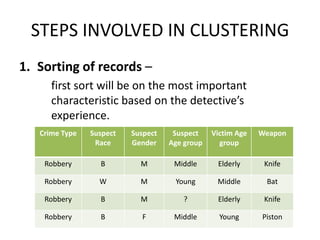
  • #34 The type of crime is robbery and it will be the most important attribute. The rows 1 and 3 show a simple crime pattern where the suspect description matches and victim profile is also similar.
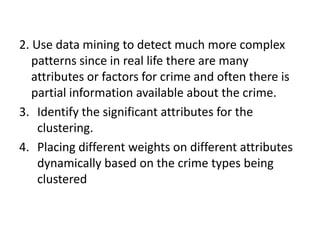
  • #35 4.for same word such as blank, unknown, or junk all meant the same for missing age of the person.5. This process involved talking to domain experts such as the crime detectives, the crime data analysts and iteratively running the attribute importancealgorithm to arrive at the set of attributes for the clustering the given crime types. We refer to this as the semi-supervised or expert-based paradigm of problem solving. Based on the nature of crime the different attributes become important such as the age group of victim is important for homicide, for burglary the same may not be as important since the burglar may not care about the age of the owner of the house.