Using blurred images to assess 
damage in bridge structures? 
Dr Alessandro Palmeri 
The School of Civil and Building Engineering 
Loughborough University, UK 
Email: A.Palmeri@LBORO.ac.uk 
1
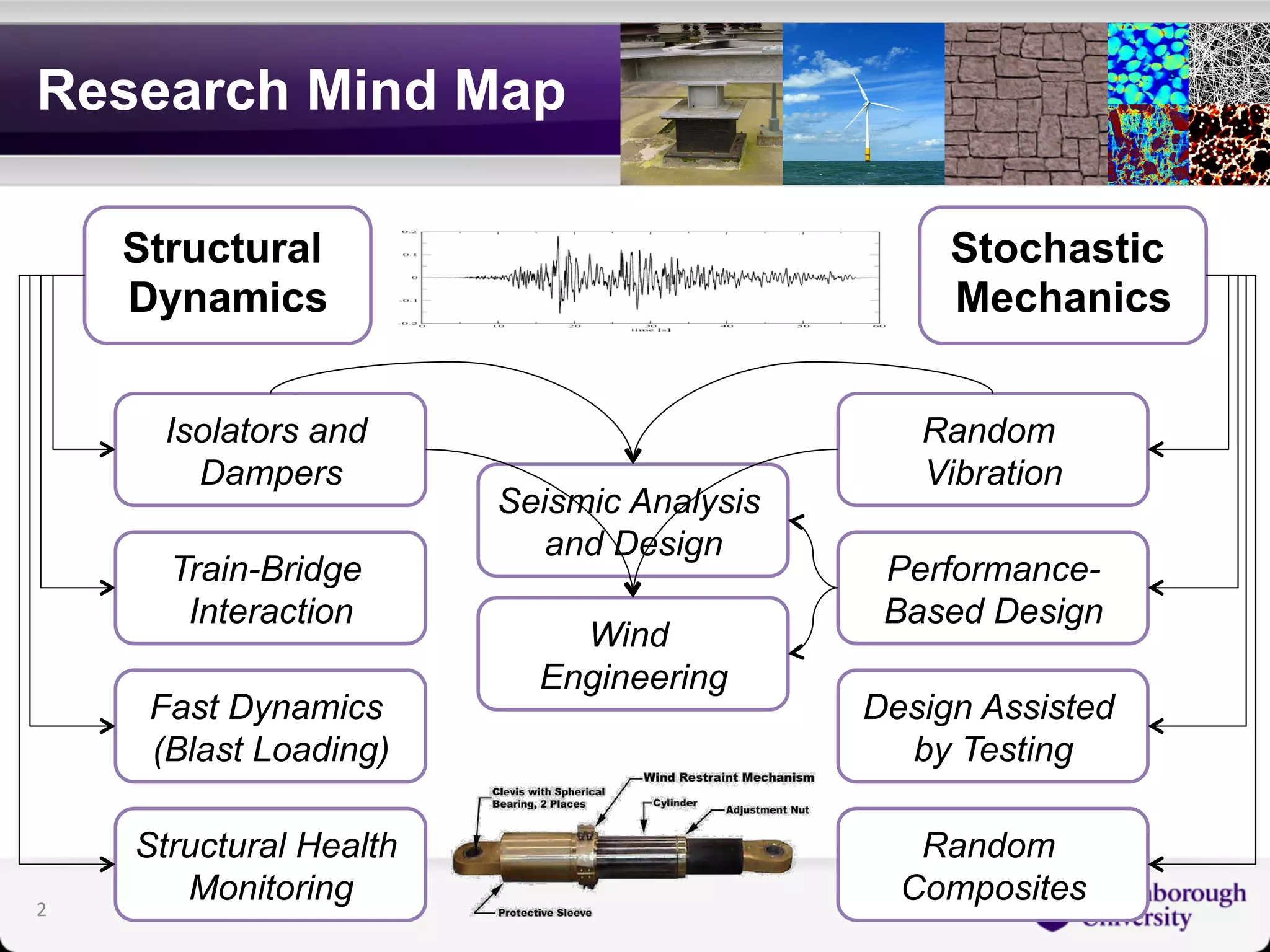
Research Mind Map 
Structural 
Dynamics 
Stochastic 
Mechanics 
Seismic Analysis 
and Design 
Wind 
Engineering 
Isolators and 
Dampers 
Train-Bridge 
Interaction 
Random 
Vibration 
Performance- 
Based Design 
Design Assisted 
by Testing 
Random 
Composites 
Fast Dynamics 
(Blast Loading) 
Structural Health 
Monitoring 
2
Research Word Cloud (2000-date) 
3 
University of 
Messina 
2000-07 
University of 
Naples 
Federico II 
2001 
University of 
California at 
Berkeley 
2002 
University of 
Patras 
2004 
University of 
Bradford 
2008-09 
Loughborough 
University 
2010-date
Outline 
• Introduction 
• 1. Coupled dynamics of composite bridges 
(Analytical formulation, 2009-10) 
• 2. How sensitive is the envelope to damage? 
(Numerical study, 2012-13) 
• 3. How can we measure the envelope? 
(Experimental investigations, 2011-14) 
• Conclusions 
4
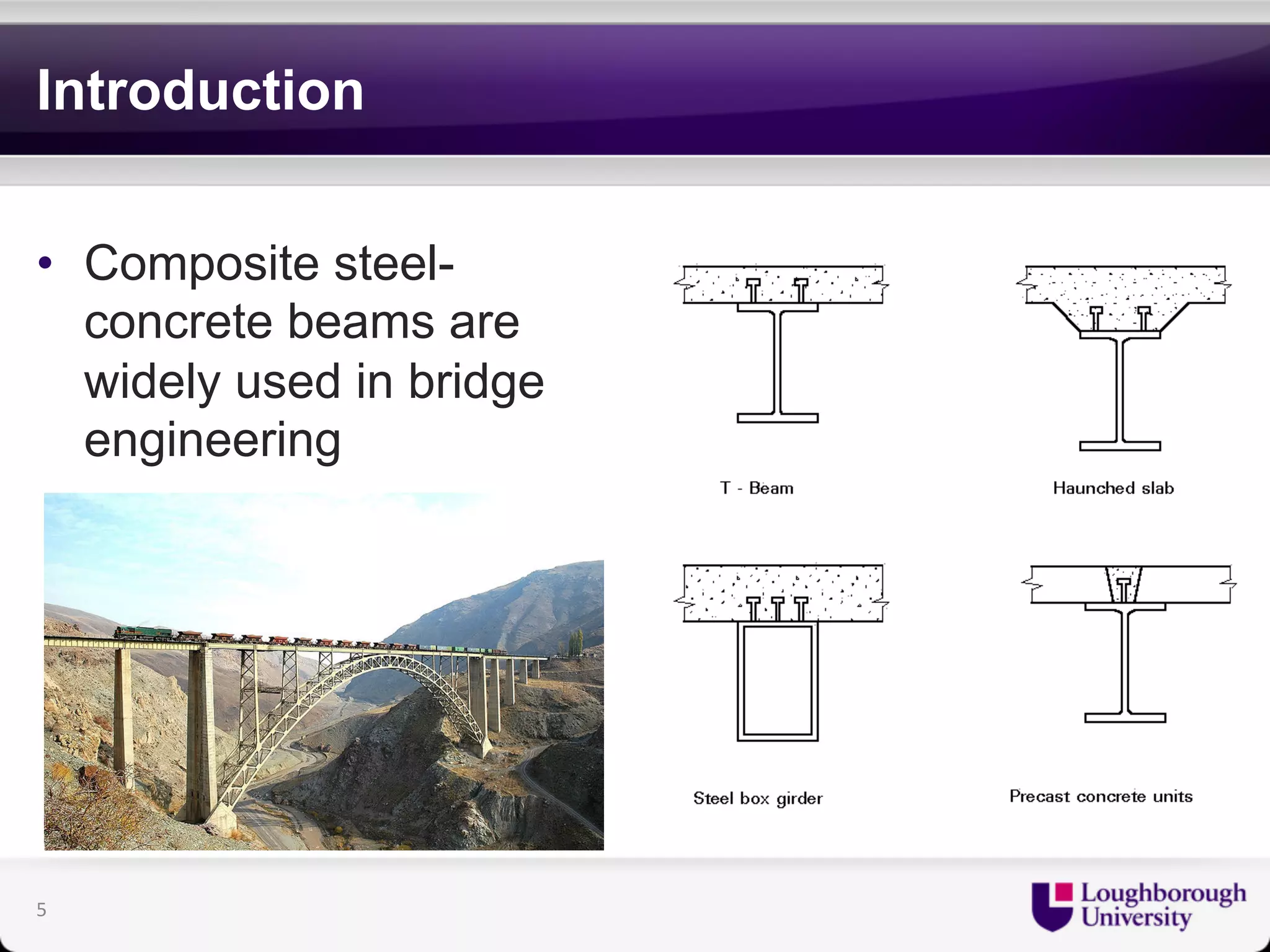
Introduction 
• Composite steel-concrete 
beams are 
widely used in bridge 
engineering 
5
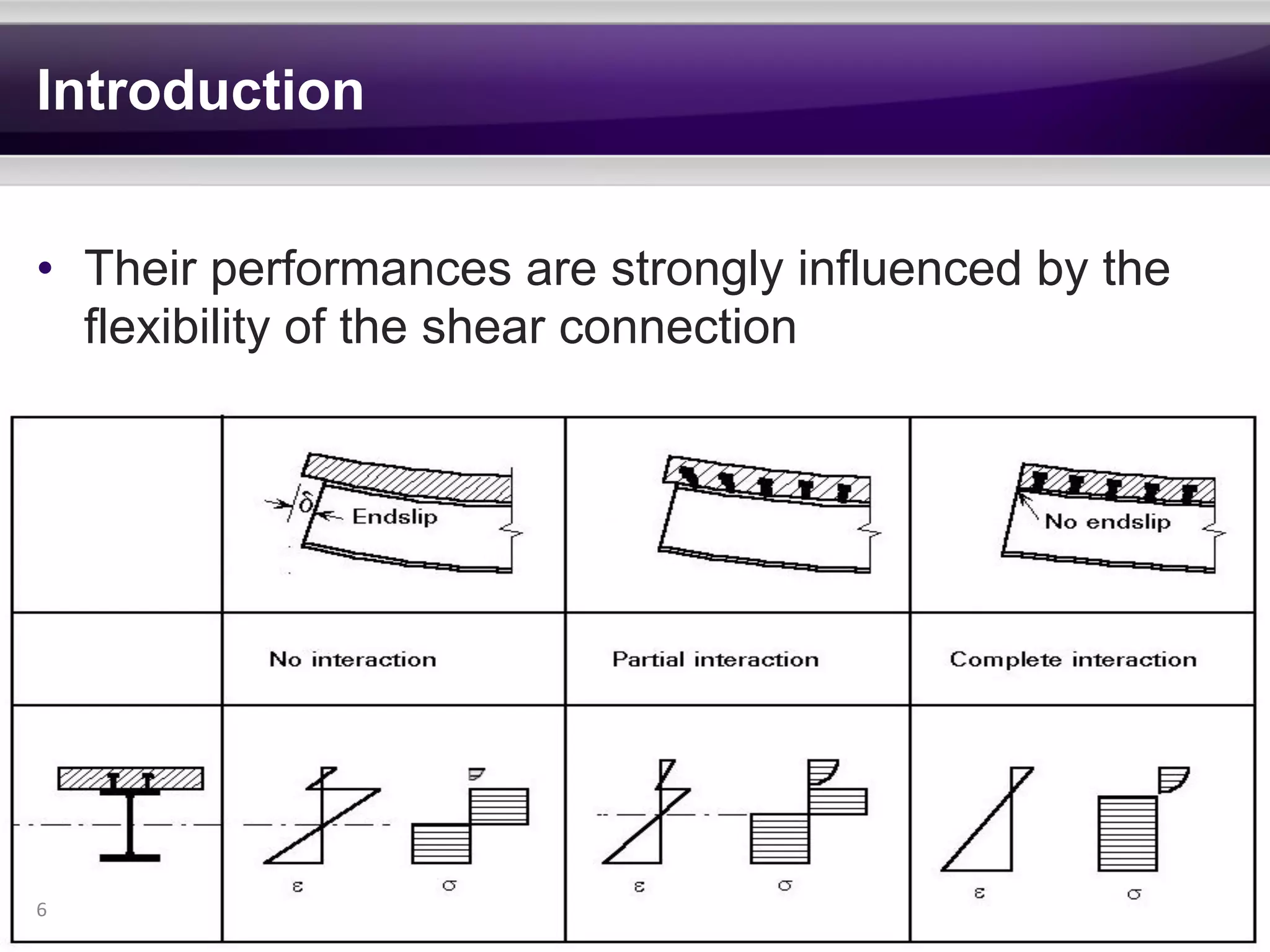
Introduction 
• Their performances are strongly influenced by the 
flexibility of the shear connection 
6
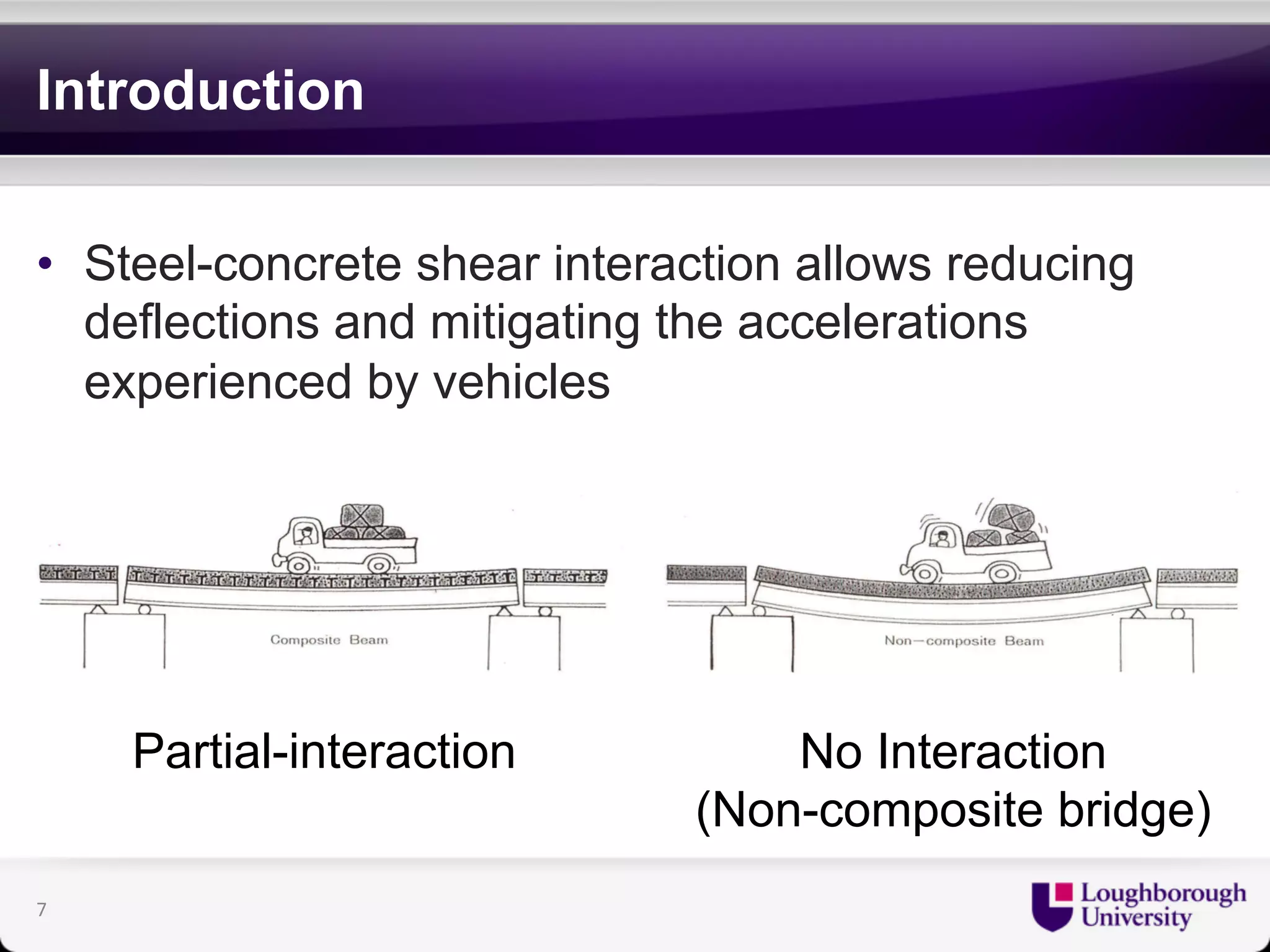
Introduction 
• Steel-concrete shear interaction allows reducing 
deflections and mitigating the accelerations 
experienced by vehicles 
Partial-interaction No Interaction 
(Non-composite bridge) 
7
Analytical formulation, 
2009-10 
Coupled Dynamics of 
Composite Bridges 
8
Coupled Dynamics of Composite Bridges 
• Literature Review 
• The most popular approach for the mechanics of 
composite steel-concrete beam is due to Newmark et al. 
(1951), in which top slab and bottom girder are two beams 
continuously connected by a linear-elastic interface 
However… 
• Non-rigid steel-concrete connection is ignored in the 
technical literature devoted to the coupled vibrations of 
bridges and vehicles 
9
Coupled Dynamics of Composite Bridges 
10 
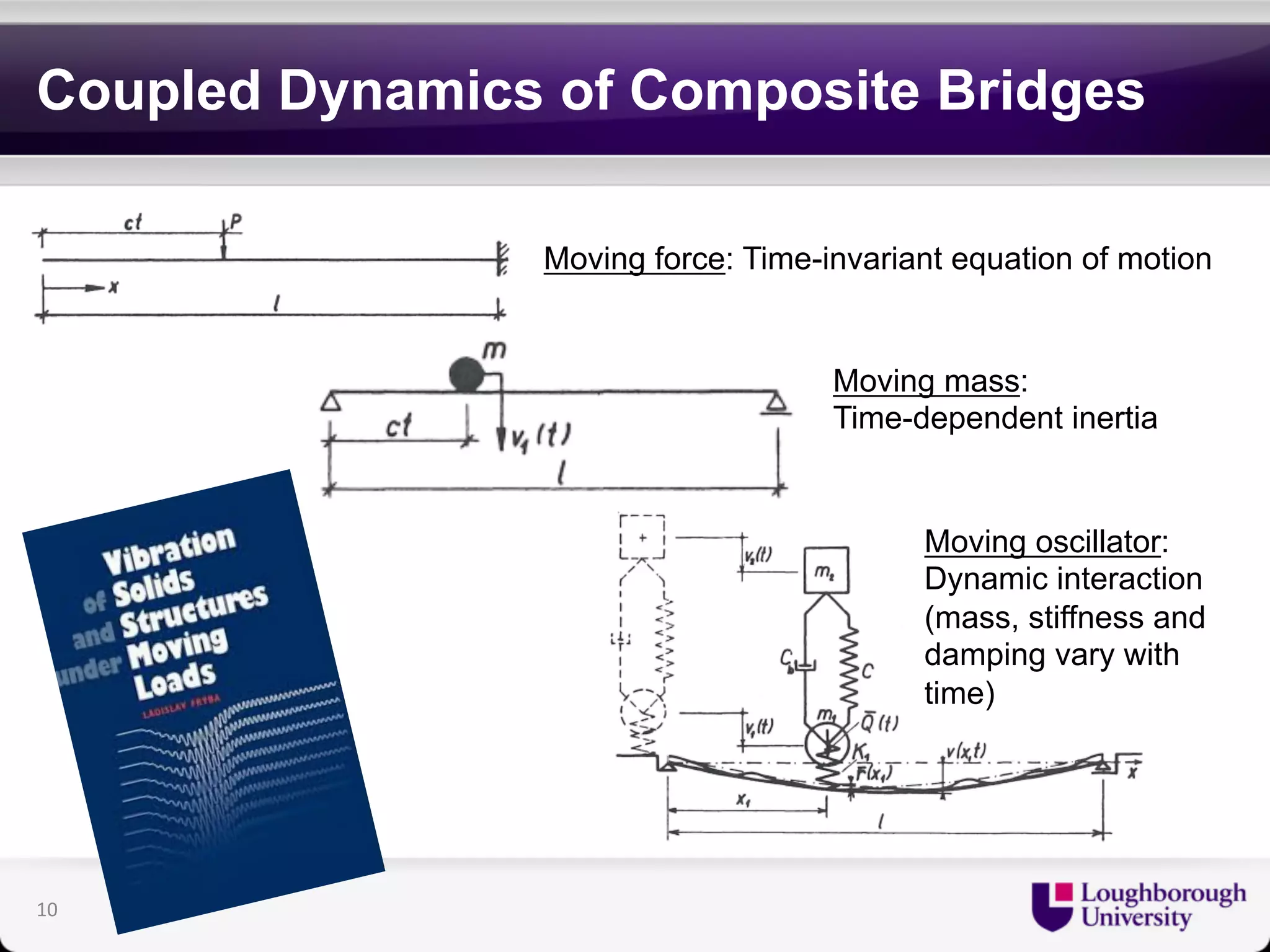
Moving force: Time-invariant equation of motion 
Moving mass: 
Time-dependent inertia 
Moving oscillator: 
Dynamic interaction 
(mass, stiffness and 
damping vary with 
time)
Coupled Dynamics of Composite Bridges 
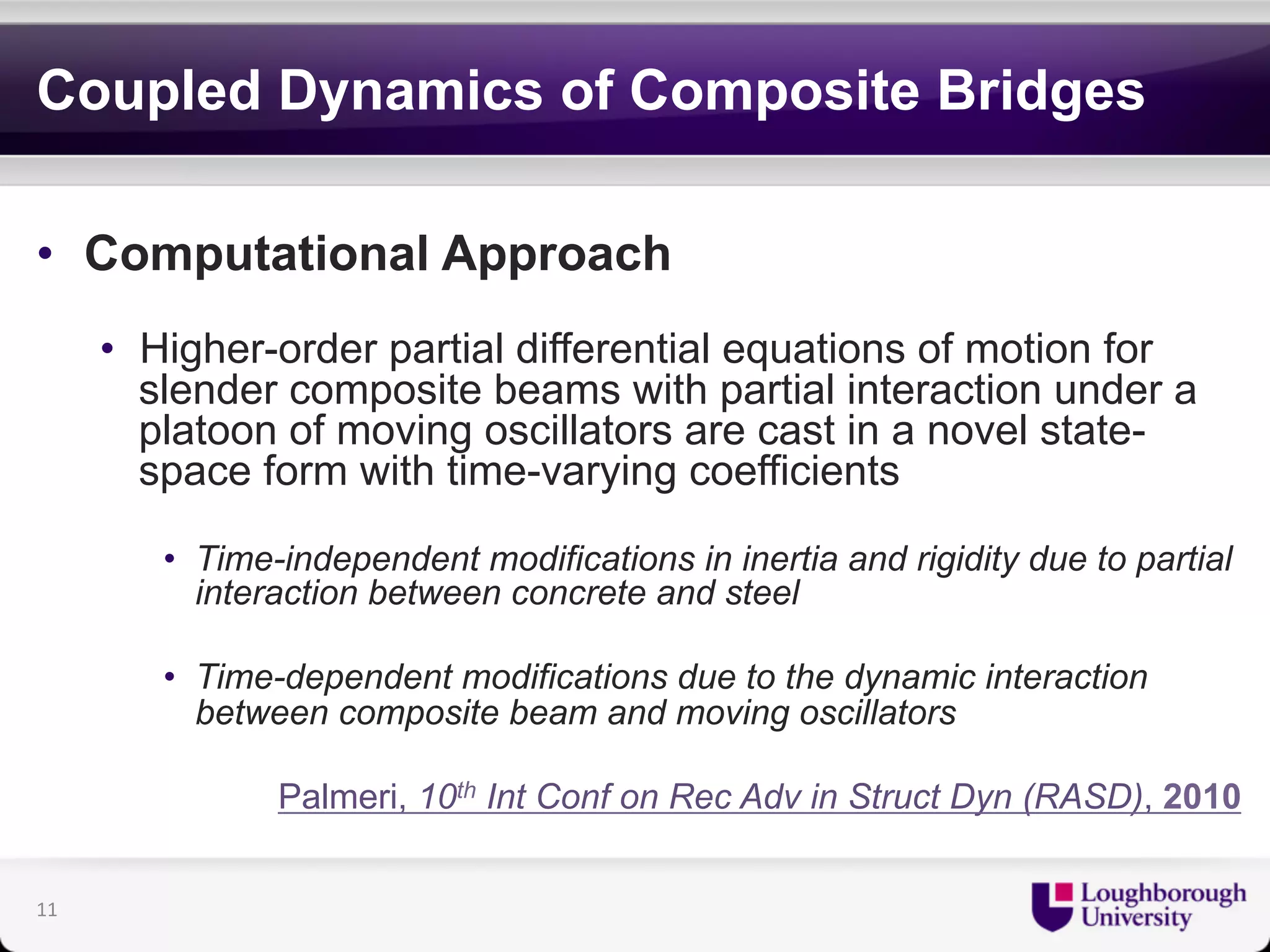
• Computational Approach 
• Higher-order partial differential equations of motion for 
slender composite beams with partial interaction under a 
platoon of moving oscillators are cast in a novel state-space 
form with time-varying coefficients 
• Time-independent modifications in inertia and rigidity due to partial 
interaction between concrete and steel 
• Time-dependent modifications due to the dynamic interaction 
between composite beam and moving oscillators 
Palmeri, 10th Int Conf on Rec Adv in Struct Dyn (RASD), 2010 
11
Coupled Dynamics of Composite Bridges 
v(1) v(nv ) mv(2) m m L 
k 
c 
k c 
v(nv ) v(nv ) v(2) v(2) k c v(1) v(1) (s) 
b f 
b L 
E 
A I 
E 
A I 
, 
, 
ρ ⎧⎨⎩ 
, 
, 
s s 
s s 
ρ ⎧⎨⎩ 
c c 
c c 
} i b K ,d 
z 
w z t 
z t 
, 
( , ), 
c 
( ) 
v 
y 
v z t 
v t 
, 
( , ), 
( ) 
b 
v 
Figure 
1. 
Simply-­‐supported 
steel-­‐concrete 
composite 
beam 
crossed 
by 
a 
platoon 
of 
moving 
oscillators. 
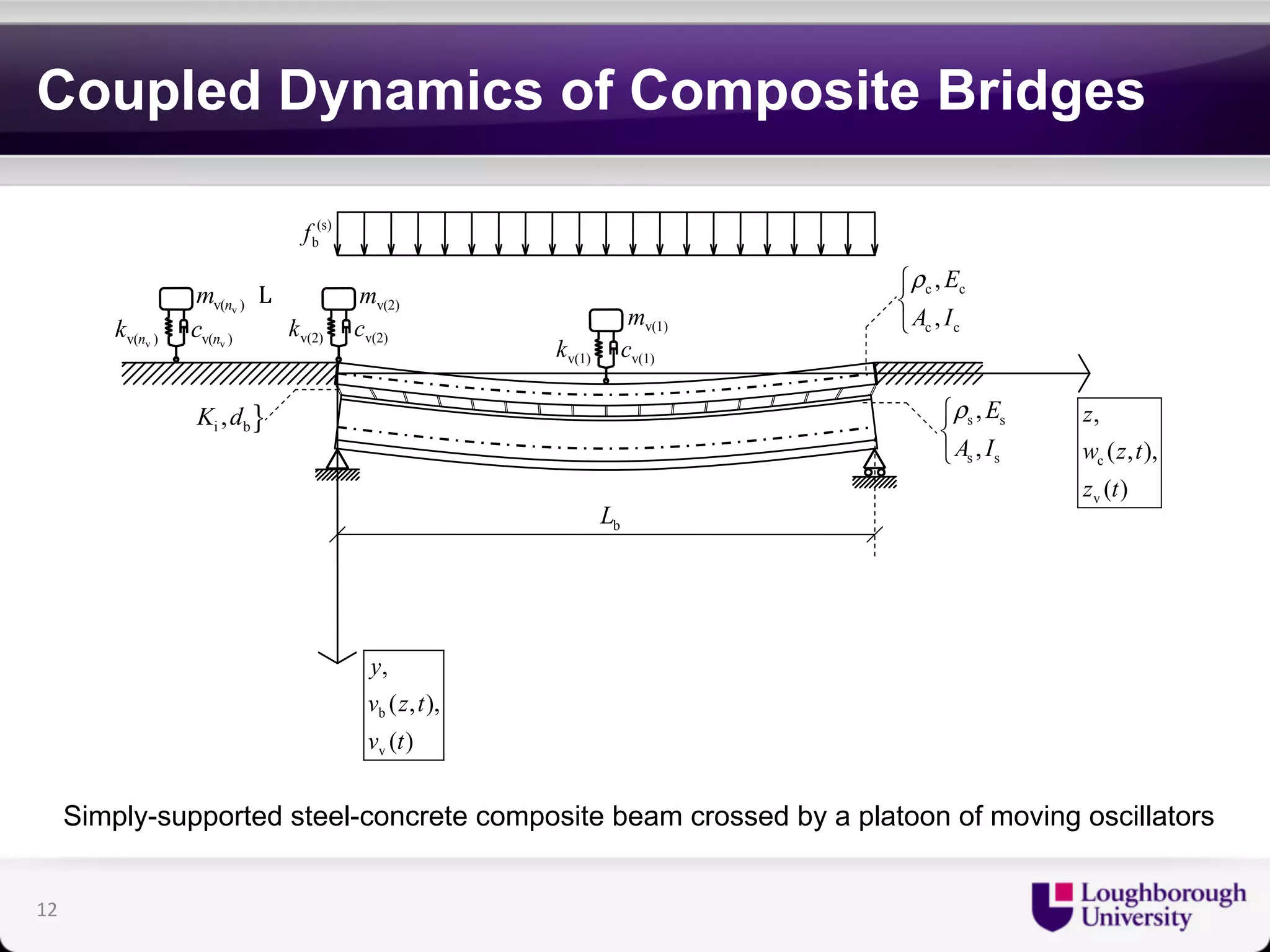
Simply-supported steel-concrete composite beam crossed by a platoon of moving oscillators 
12
Coupled Dynamics of Composite Bridges 
! Cascade'equations'of'motion:' 
⎪⎪⎨⎪ 
⎧ ⎧ ∂ 2 ⎫ ∂ 2 ⎧ ∂ 2 ⎫ ∂ 4 ⎧ ∂ 2 
⎫ ⎪ ⎨ − + ∂ ⎬ ∂ ⎨ − ⎬ + = ∂ ∂ ⎨ − ∂ ⎬ ⎩ ⎭ ⎩ ⎭ ⎩ ⎭ ⎪∂ ⎛ ∂ ∂ ∂ ⎞ = ⎜ + − − ⎩⎪ ∂ ⎝ ∂ ∂ ∂ ⎟ ⎠ 
A v z t EI v z t R z t f z t 
1 1 ( , ) 1 1 ( , ) ( , ) 1 1 ( , ) , 
b 2 2 2 b( ) 2 2 4 b 2 2 b 
z t z z z 
b b b 
w z t f z t K d v z t A v z t EI v z t 
z rEA z t z 
( , ) 1 ( , ) ( , ) ( , ) ( , ) ; 
! where:' 
b b 
f A A Agρ = ρ +ρ + 
[ ] 
[ ] [ ] 
[ ] 
(s) 
b 
b c c s s 
EI E I E I 
b(0) c c s s 
EI EI E E A A d 
c s c s 2 
b( ) b(0) b 
∞ E A E A 
c c s s 
= + 
= + 
+ 
Composite$beam$transverse$deflections$ 
2 2 4 
[ ] [ ] 
[ ] 
[ ] 
[ ] 
[ ] [ ] 
[ ] 
2 
2 i b 
b 
b(0) 
b(0) 
b( ) 
2 
2 2 b(0) i b 
b b 
b( ) b(0) 
b( ) 
b( ) 
1 
; 
1 
K d 
EI 
EI 
EI 
EI K d 
EI EI 
EI 
EI 
α 
β α 
∞ 
∞ 
∞ 
∞ 
= 
⎛ ⎞ 
⎜ − ⎟ 
⎜⎝ ⎟⎠ 
= = 
⎛ ⎞ 
⎜ − ⎟ 
⎜⎝ ⎟⎠ 
Non$Composite$ 
Fully$Composite$ 
Concrete$slab$axial$displacements$ 
[ ] [ ] 
[ ] [ ] 
c 2 
2 b i b 2 b b 2 b b(0) 4 b 
b b c c 
ρ 
β α β 
ρ 
β 
∞ 
13 
Vibration of the beam: Governing equation
Coupled Dynamics of Composite Bridges 
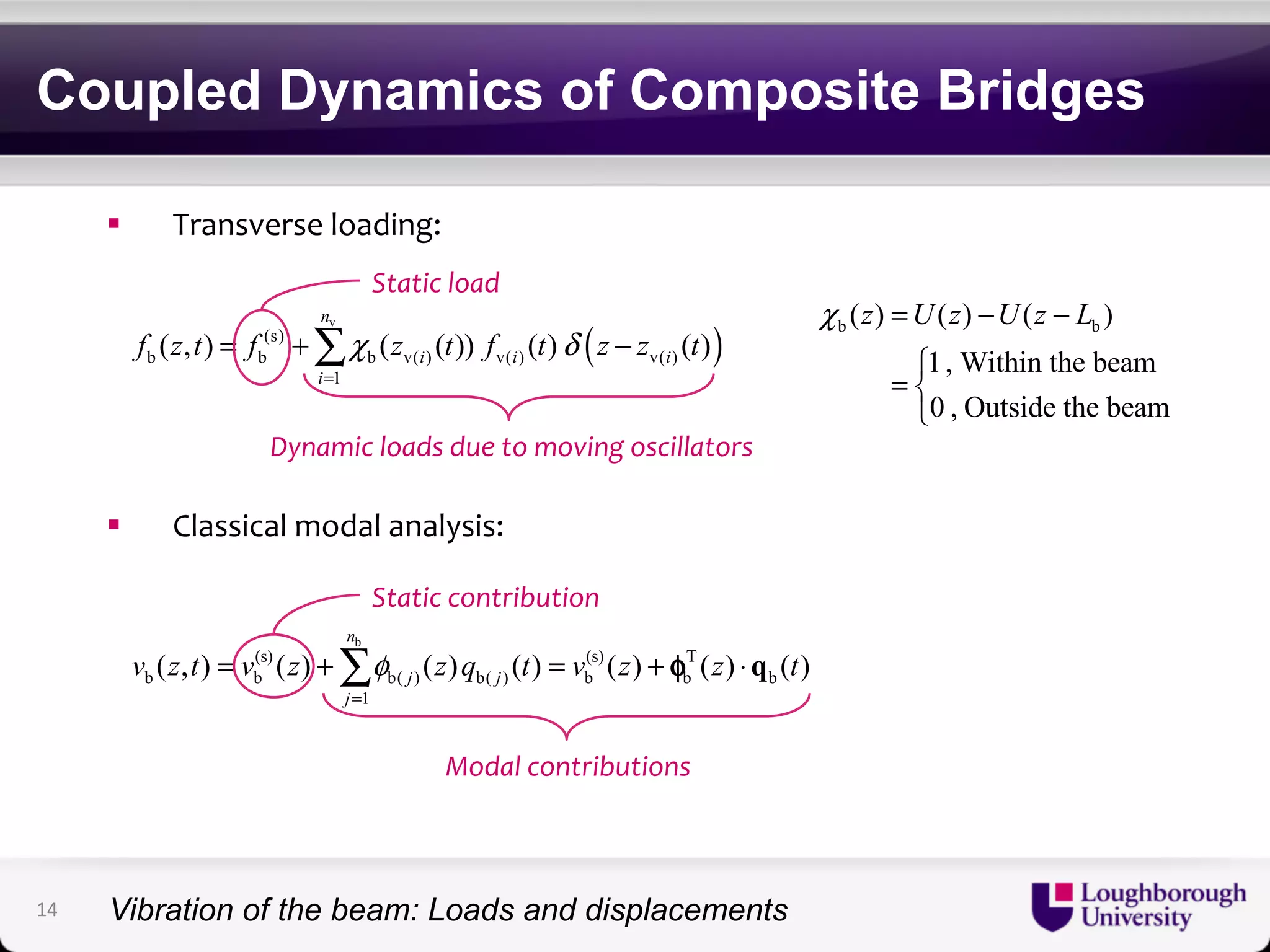
! Transverse(loading:( 
n 
Static(load( 
( ) v 
= (s) 
+Σ − 
f ( z , t ) f χ ( z ( t )) f ( t ) δ z z ( t 
) 
i i i 
b b b v( ) v( ) v( ) 
= 
1 
i 
Dynamic(loads(due(to(moving(oscillators( 
! Classical(modal(analysis:( 
χ z =U z −U z − L 
b b ( ) ( ) ( ) 
1, Within the beam 
0 , Outside the beam 
⎧ 
=⎨⎩ 
b 
= (s) +Σ = (s) + φ T 
⋅q 
v z t v z φ z q t v z z t 
( , ) ( ) ( ) ( ) ( ) ( ) ( ) 
b b b( ) b( ) b b b 
1 
n 
j j 
j 
= 
Static(contribution( 
Modal(contributions( 
14 
Vibration of the beam: Loads and displacements
Coupled Dynamics of Composite Bridges 
! Modal&equations&of&motion:& 
2 ⋅qb (t) = Jb ⋅Qb (t) 
qb (t) + Ξb ⋅ qb (t) +Ωb 
⎧ ⎫ 
( ) ( ( )) ( ) ( ( )) 1 ( ( )) 
Q Σ φ φ 
= ⎨ − ′′ ⎬ 
t χ z t f t z t z t 
2 1 2 
J = ⎡⎣I + Δm ⎤⎦ − b 
1 
b n bi 
Ω J Ω k 
b b b() bi 
Ξ Ω 
b b b 2ζ 
− 
∞ = ⎡⎣ ⋅ ⎡⎣ + Δ ⎤⎦⎤⎦ 
= 
b( ) b( ,1) b( ,2) b( , b ) Diag n ω ω ω ∞ ∞ ∞ ∞ Ω = ⎡⎣ L ⎤⎦ 
[ ] 
[ ] 
2 
⎛ ⎞ ∞ 
=⎜ ⎟ 
⎝ ⎠ 
b( ) 
b( ) 
b b 
j 
j EI 
L A 
ω π 
ρ 
1 
⎡ ⎤ 
π 
m N 
Δ = bi 2 ⎢ b 
⎥ 
[EI] 
L 
β 
⎣ ⎦ 
b b 
∞ ⎡ ⎤ 
k N 
Δ = ⎢ ⎥ 
[ ] 
2 
6 
b( ) 
π 
bi 2 b 
A L 
α ρ 
⎣ ⎦ 
b b b 
[ ] b b N = Diag 1 2 L n 
v 
b b v( ) v( ) b v( ) 2 b v( ) 
1 b 
n 
i i i i 
i 
= β 
⎩ ⎭ 
15 
Vibration of the beam: Modal analysis
Coupled Dynamics of Composite Bridges 
! Absolute)displacements)are)used:) 
!Impulsive!terms!in!the!equations!of!motion!can!be!avoided! 
)(Muscolino,)Palmeri)&)Sofi,)2009)) 
mv(i) vv(i) (t) = −cv(i)  vv(i) (t) −  vw(i) ( (t))− kv(i) vv(i) (t) − vw(i) ( (t)), 
Static!contributions! Dynamic!contributions! 
T (t) ⋅qb (t) 
vw(i) (t) = rv(i) (t) + χ b (zv(i) (t))abv(i) 
( T (t) ⋅ q(t) + bT (t) ⋅q(t)) 
b bv(i) 
b  vw(i) (t) = sv(i) (t) + χ b (zv(i) (t)) abv(i) 
16 
Vibration of the oscillator: Governing equation
Coupled Dynamics of Composite Bridges 
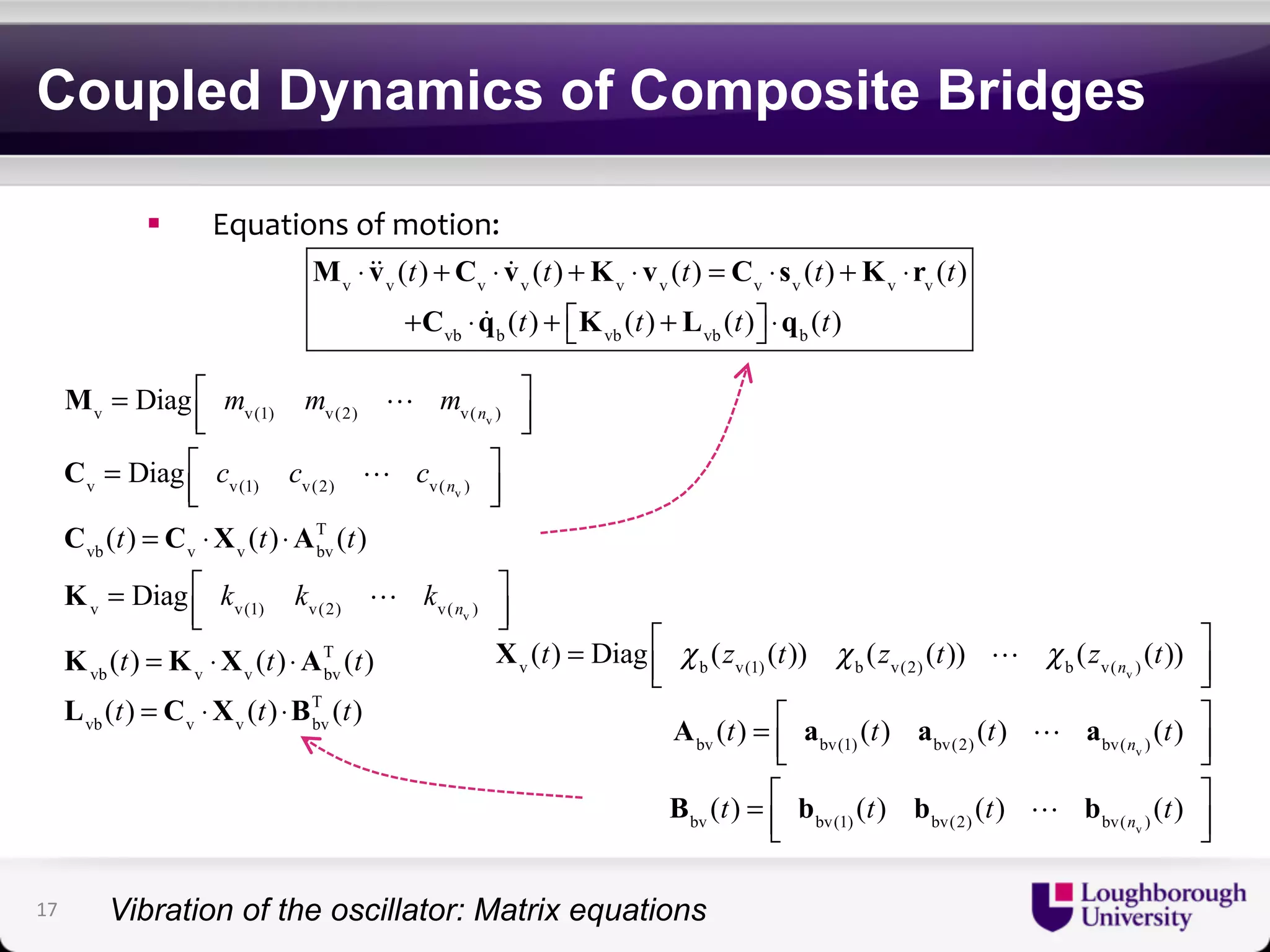
! Equations*of*motion:* 
Mv ⋅ vv (t) +Cv ⋅ vv (t) +Kv ⋅ vv (t) = Cv ⋅sv (t) +Kv ⋅rv (t) 
+Cvb ⋅ qb (t) + Kvb (t) + Lvb (t) ⎡⎣ 
⎤⎦ 
⋅qb (t) 
⎡⎣⎢ 
Mv = Diag mv(1) mv(2)  mv(nv ) 
⎤⎦⎥ 
⎡⎣⎢ 
Cv = Diag cv(1) cv(2)  cv(nv ) 
⎤⎦⎥ 
T (t) 
Cvb (t) = Cv ⋅Xv (t) ⋅Abv 
⎡⎣⎢ 
Kv = Diag kv(1) kv(2)  kv(nv ) 
⎤⎦⎥ 
T (t) 
Kvb (t) = Kv ⋅Xv (t) ⋅Abv 
T (t) 
Lvb (t) = Cv ⋅Xv (t) ⋅Bbv 
Xv (t) = Diag χ b (zv(1) (t)) χ b (zv(2) (t))  χ b (zv(nv ) (t)) ⎡⎣⎢ 
⎤⎦⎥ 
Abv (t) = abv(1) (t) abv(2) (t)  abv(nv ) (t) ⎡⎣⎢ 
⎤⎦⎥ 
Bbv (t) = bbv(1) (t) bbv(2) (t)  bbv(nv ) (t) ⎡⎣⎢ 
⎤⎦⎥ 
17 
Vibration of the oscillator: Matrix equations
Coupled Dynamics of Composite Bridges 
! The$generic$oscillator/beam$interaction$force$is$given$by:$ 
fv(i) (t) = mv(i) g 
( T ⋅qb (t)) 
+cv(i)  vv(i) (t) − sv(i) (t) − χ b (zv(i) (t))abv(i) 
T ⋅qb ( (t)) 
$Leading$to:$ 
T ⋅ qb (t) − χ b (zv(i) (t))bbv(i) 
+kv(i) vv(i) (t) − rv(i) (t) − χ b (zv(i) (t))abv(i) 
qb (t) + Ξb + ΔCb (t) ⎡⎣ 
⎤⎦ 
2 + ΔKb (t) ⎡⎣ 
⋅ qb (t) + Ωb 
⎤⎦ 
⋅qb (t) 
= Cbv (t) ⋅ vv (t) +Kbv (t) ⋅ vv (t) +Q b (t) 
ΔCb (t) = Tbv (t) ⋅Cvb (t) 
ΔKb (t) = Tbv (t) ⋅ Kvb (t) + Lvb (t) ⎡⎣ 
⎤⎦ 
Cbv (t) = Tbv (t) ⋅C 
Kbv (t) = Tbv (t) ⋅Kv 
Q b (t) = Tbv (t) ⋅ gMv ⋅τ v −Cv ⋅sv (t) −Kv ⋅rv { (t)} 
τ v = { 1 1  1 }T 
Tbv (t) = Jb ⋅ Abv (t) + ΔAbv (t) ⎡⎣ 
⎤⎦ 
⋅Xv (t) 
ΔAbv (t) = − 1 
2 φ ′′ b (zv(1) (t)) φ ′′ b (zv(2) (t))  φ ′′ b (zv(nv ) (t)) ⎡⎣⎢ 
βb 
⎤⎦⎥ 
18 
Vibration of the oscillator: Matrix equations
Coupled Dynamics of Composite Bridges 
! Matrix'equations'of'motion'can'be'obtained'for'the'platoon'of' 
moving'oscillators:' 
2 ⋅qv (t) = Q v + μv ⋅Cvb ⋅ qb (t) + μv ⋅ Kvb (t) + Lvb (t) ⎡⎣ 
qv (t) + Ξv ⋅ qv (t) +Ωv 
⎤⎦ 
⋅qb (t) 
{ } μ = M− b 
v v(1) v(2) v( ) ( ) ( ) ( ) ( ) n q t = q t q t L q t Dimensional* 
⎡⎣⎢ 
Ξv = 2Diag ζ v(1) ζ v(2)  ζ v(nv ) 
⎤⎦⎥ 
⋅Ωv 
⎡⎣⎢ 
Ωv = Diag ωv(1) ωv(2)  ωv(nv ) 
⎤⎦⎥ 
Q v (t) = μv ⋅ Cv ⋅sv (t) +Kv ⋅rv { (t)} 
i 
v( ) 
v( ) 
v( ) 
v( ) 
v( ) 
v( ) v( ) 2 
i 
i 
i 
i 
i i 
k 
m 
c 
m 
ω 
ζ 
ω 
= 
= 
1 2 
v v 
T 
consistency* 
19 
Coupled vibration
Coupled Dynamics of Composite Bridges 
! Finally'the'two'matrix'equations'are'rewritten'in'an'enlarged' 
modal'space:' 
q(t) + c0 + Δc(t) ⎡⎣ 
⎤⎦ 
⋅ q(t) + k0 + Δk(t) ⎡⎣ 
⎤⎦ 
⋅q(t) = Q(t) 
O 
⎡ = ⎢ n v × 
n 
⎤ 
b 
⎥ 
⎢⎣ b v 
⎥⎦ 
O C 
⎡ − ⋅ ⎤ 
v v 
v 
c 0 
O 
b 
v vb 
bv v b 
( ) 
( ) 
( ) ( ) 
n n 
n n t 
t 
t t 
× 
× 
c 
Δ = ⎢⎣− ⎢ C ⋅ Δ C 
⎥ ⎥⎦ 
Ξ 
Ξ 
μ 
μ 
T (t) Q b 
{ T (t) }T 
v b 
b v 
O 
O 
[ ] 
O K L 
v v 
2 
v 
0 2 
b 
( ) ( ) 
v vb vb 
k 
μ 
bv v b 
( ) 
( ) ( ) 
n n 
n n 
n n t t 
t 
t t 
× 
× 
× 
⎡ Ω ⎤ 
= ⎢ ⎥ 
⎢ Ω ⎥ ⎣ ⎦ 
⎡ − ⋅ + ⎤ 
Δ =⎢ ⎥ 
⎢⎣− ⋅ Δ ⎥⎦ 
k 
K μ 
K 
{ T T }T 
v b q(t) = q (t) q (t) Q(t) = Q v 
“Small”'modifications' 
20 
Coupled vibration: Proposed model
Coupled Dynamics of Composite Bridges 
! Single'step+(unconditionally+stable)+numerical+integration:+ 
{[ ] [ ] [ ] } 0 01 01 02 x(t + Δt) = E(t) ⋅ Θ + Γ ⋅ΔD(t) ⋅ x(t) + Γ ⋅V ⋅Q(t) + Γ ⋅V ⋅Q(t + Δt) 
! Reference+transition+matrix+without+dynamic+interaction:+ 
L I D 
Γ Θ 
! Dynamic+modification+matrix:+ 
= ⎡⎣ Θ 
− n + 
n 
⎤⎦ ⋅ 
− 
= ⎡ − ⎤ ⎢⎣ Δ ⎥⎦ 
⋅ = ⎡ ⎤ ⎢⎣− Δ ⎥⎦ 
⋅ 0 0 2( ) 0 
v b 
1 
− 
L D 
01 0 0 0 
1 
L I D 
n n 
t 
− 
+ 
02 0 2( ) 0 
v b 
1 
1 
1 
t 
2( ) 02 ( ) ( ) n n t t t − 
v b 
1 
+ E = ⎡⎣Ι − Γ ⋅ΔD + Δ ⎤⎦ 
Γ 
[ ] 0 0 Θ = exp D Δt 
21 
Coupled vibration: Proposed numerical scheme
Coupled Dynamics of Composite Bridges 
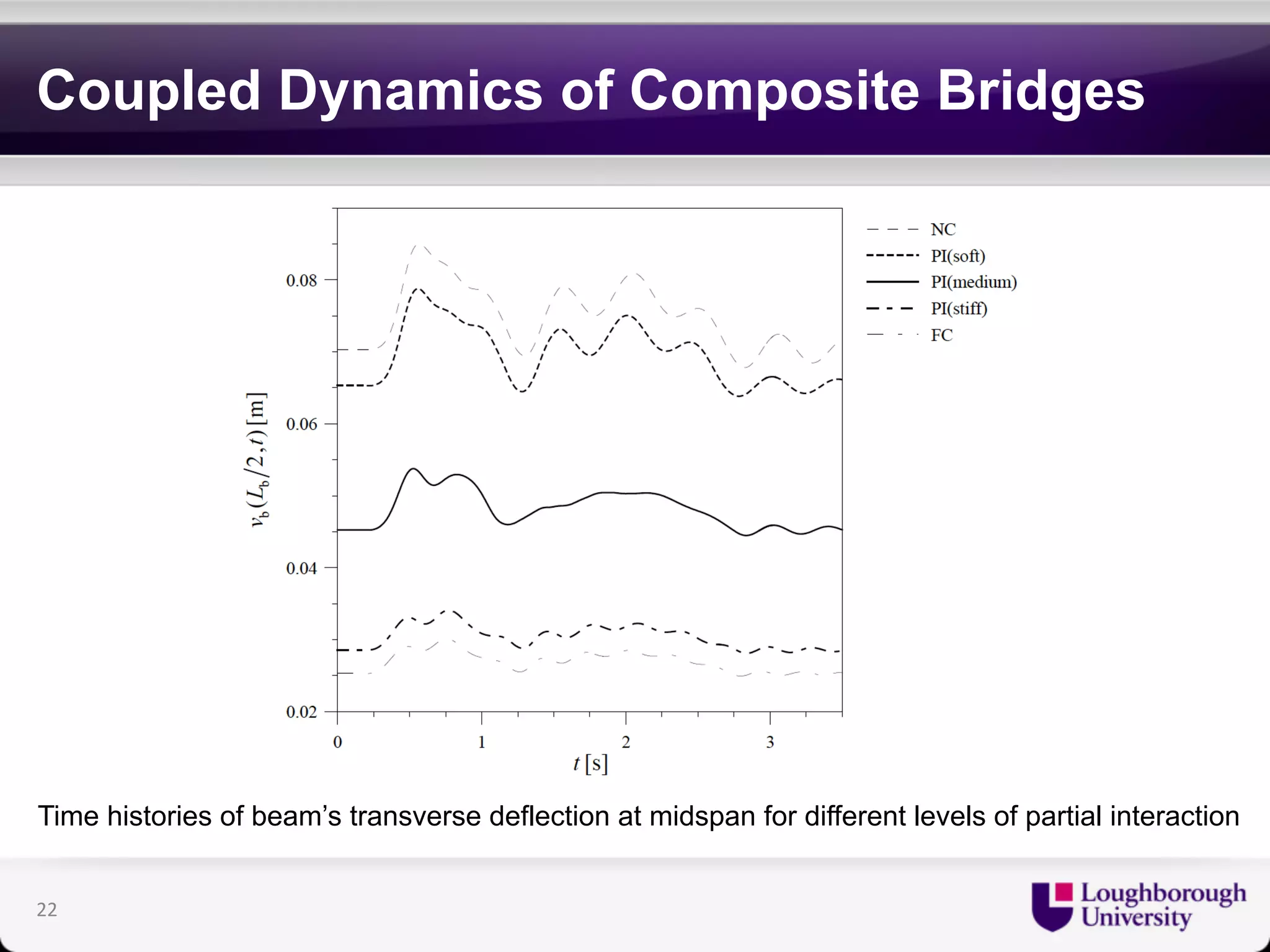
Time histories of beam’s transverse deflection at midspan for different levels of partial interaction 
22
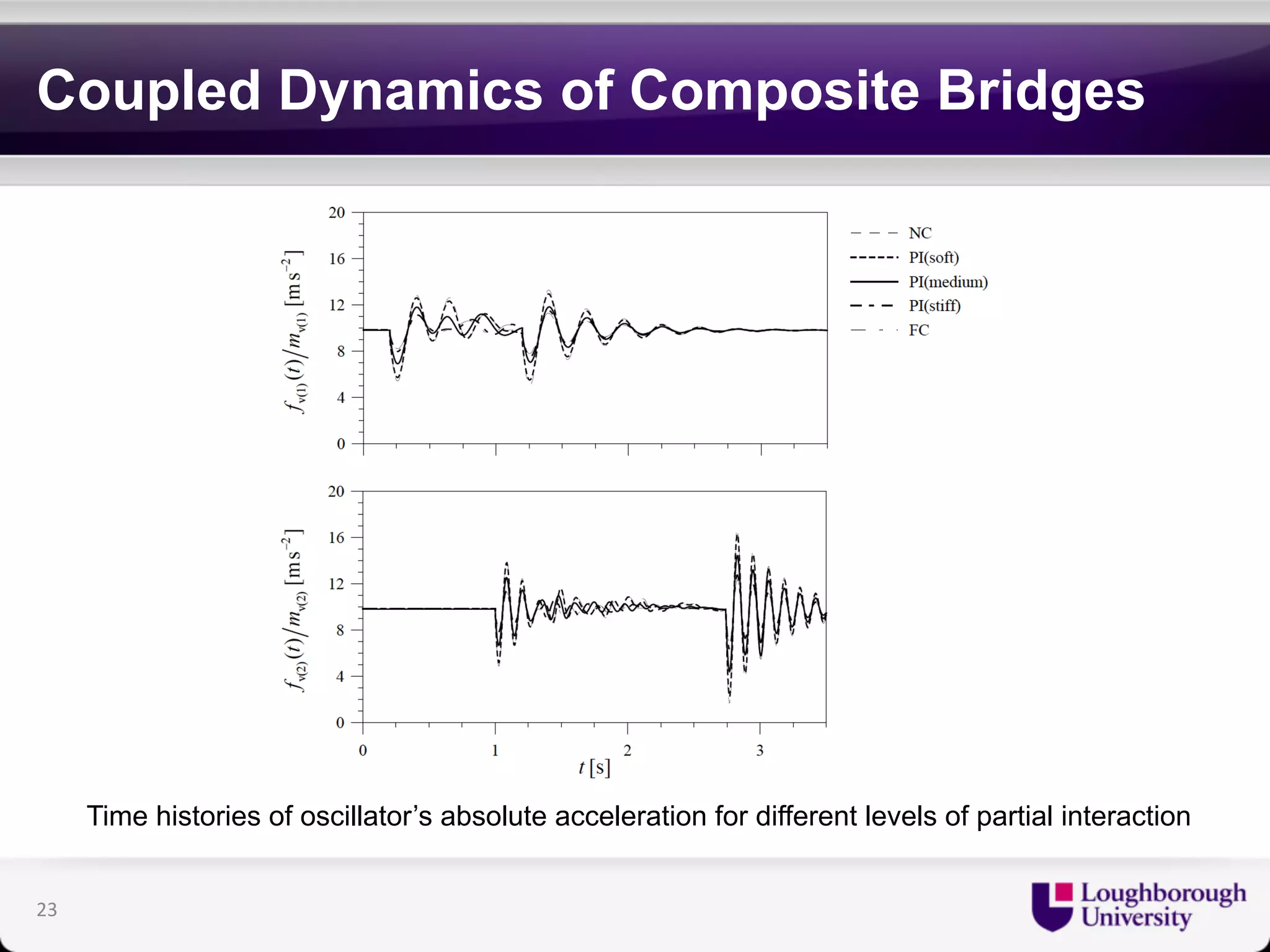
Coupled Dynamics of Composite Bridges 
Time histories of oscillator’s absolute acceleration for different levels of partial interaction 
23
Part-1 Conclusions (from 2010) 
• A novel method of dynamic analysis has been proposed and 
numerically validated for studying the dynamic interaction 
phenomenon in composite steel-concrete beams subjected to a 
platoon of single-DoF moving oscillators 
• Time-independent modifications arise in the composite beam because of the 
partial interaction between concrete slab and steel girder 
• Beam-oscillators dynamic interaction is represented by a set of time-dependent 
functions, playing the role of time-varying stiffness and damping 
coefficients 
• A single-step numerical scheme of solution has been formulated, 
based on the observation that the dynamic modifications are small 
• Further studies: 
• Effect of roughness in the beam-oscillators’ contact 
• Sensitivity of the dynamic response of the subsystems to the degree of PI in 
the supporting beam 
24
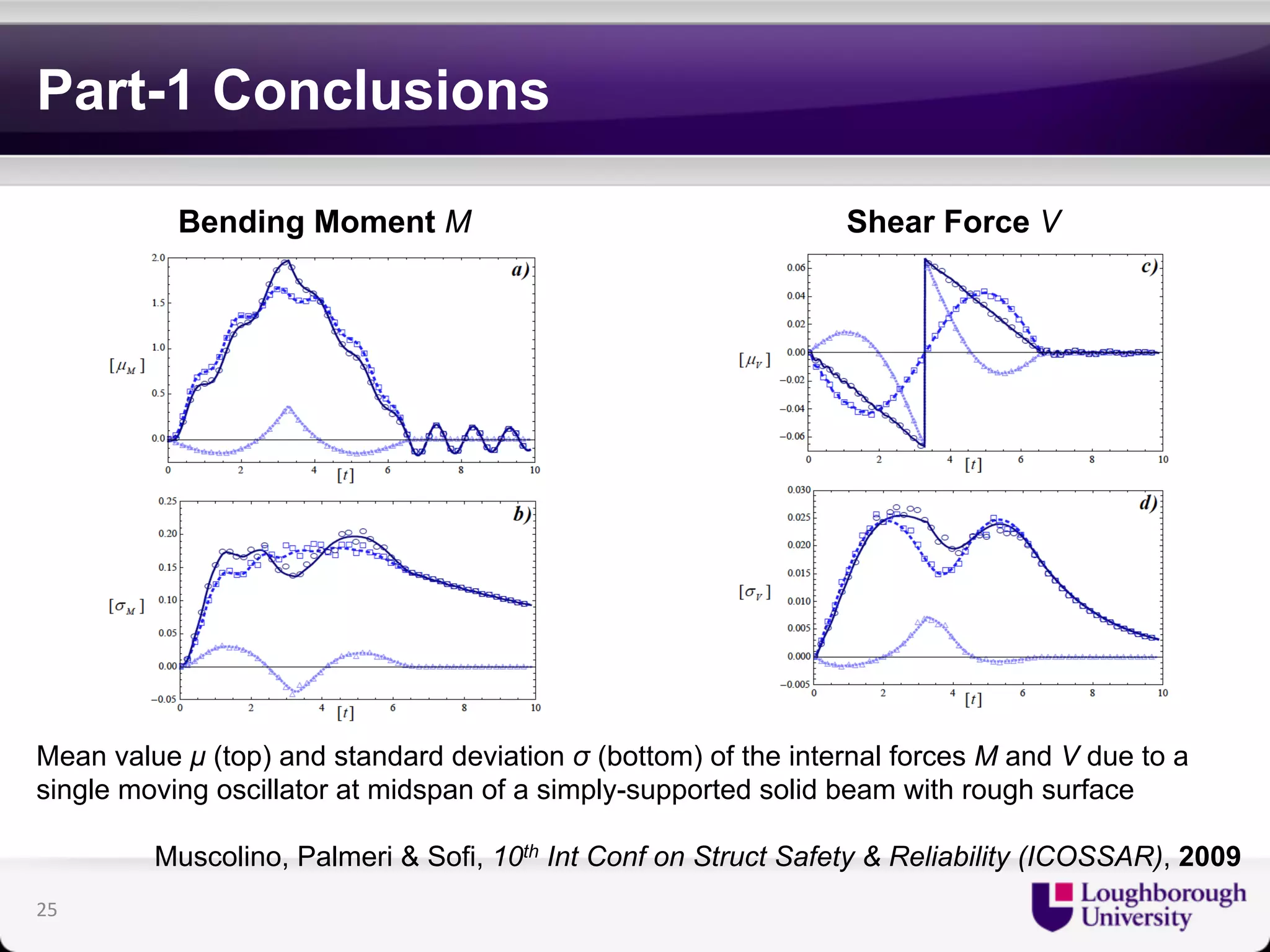
Part-1 Conclusions 
Bending Moment M Shear Force V 
Mean value μ (top) and standard deviation σ (bottom) of the internal forces M and V due to a 
single moving oscillator at midspan of a simply-supported solid beam with rough surface 
Muscolino, Palmeri & Sofi, 10th Int Conf on Struct Safety & Reliability (ICOSSAR), 2009 
25
Numerical study, 
2012-13 
How sensitive is the 
envelope to damage? 
26
How sensitive is the envelope to damage? 
• Literature Review 
• Conventional approaches of damage detection (including ultrasonic, thermal, eddy 
current and X-ray testing) were termed as cumbersome and expensive 
• Vibration-based damage methods have emerged, as they allow identifying meaningful 
changes in the dynamic characteristics of the composite beam 
• Accelerometers have been extensively employed, BUT their application to large structural 
systems may be difficult because of long cabling, number of sensors and installation time 
• Laser doppler vibrometers can be used as a viable non-contact alternative, especially when 
targets are difficult to access, BUT the simultaneous acquisition of vibration at multiple points 
would make very expensive the dynamic testing 
Therefore… 
• The idea of using the envelopes profile of deflections and rotations induced by a moving 
load has been investigated 
• That’s radically different than recording and analysing multiple time histories 
Kasinos, Palmeri & Lombardo, Structures, In press 
27
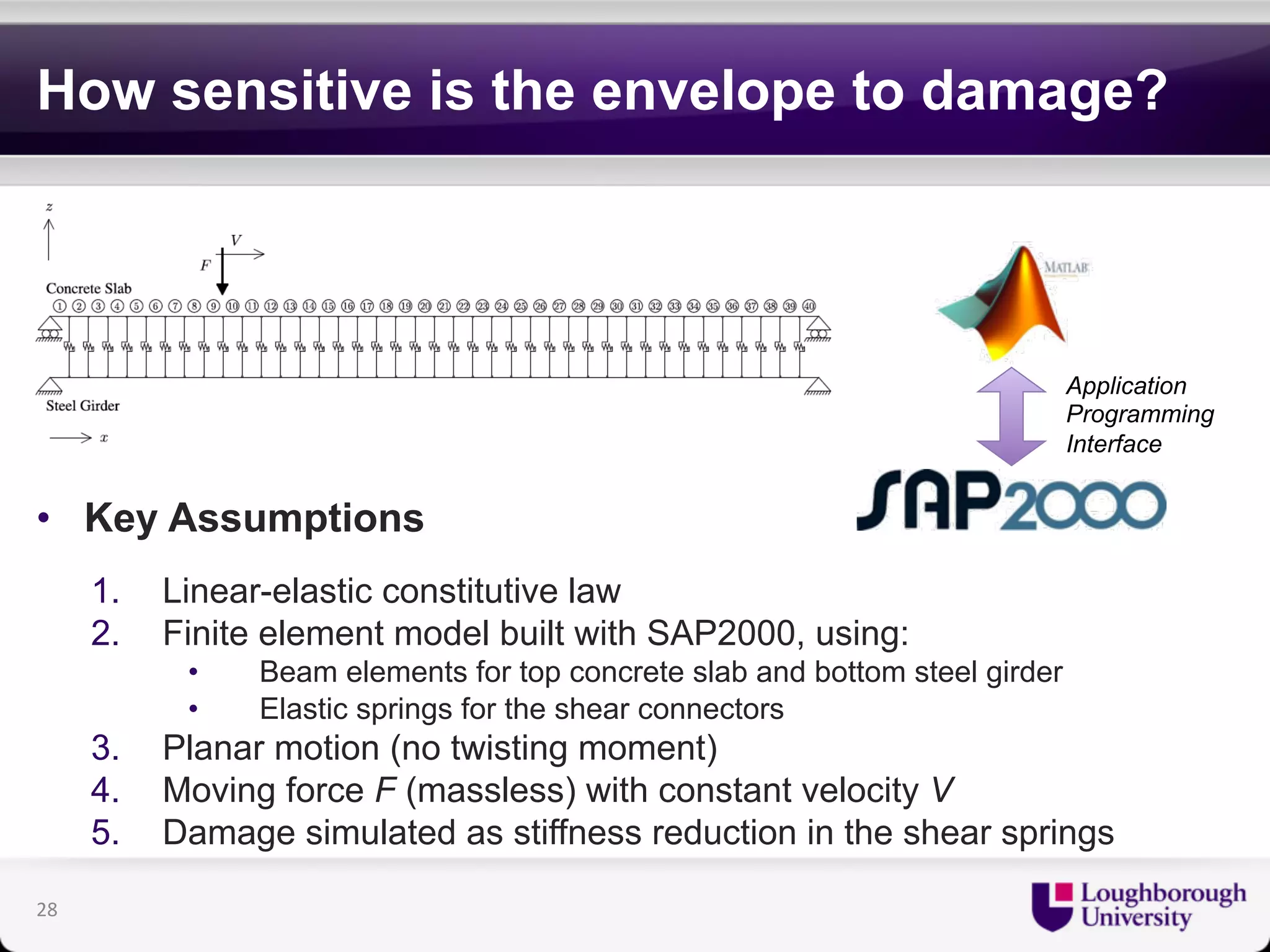
How sensitive is the envelope to damage? 
• Key Assumptions 
1. Linear-elastic constitutive law 
2. Finite element model built with SAP2000, using: 
• Beam elements for top concrete slab and bottom steel girder 
• Elastic springs for the shear connectors 
3. Planar motion (no twisting moment) 
4. Moving force F (massless) with constant velocity V 
5. Damage simulated as stiffness reduction in the shear springs 
28 
Application 
Programming 
Interface
How sensitive is the envelope to damage? 
• Governing equations 
• Dynamic response of interest (displacement 
or rotation) 
• Envelope of the dynamic response 
• Damage measure (DM) 
29
How sensitive is the envelope to damage? 
Dynamic amplification factors of midspan deflection δM and right support rotation φR 
for different levels of concrete-steel partial interaction 
= θ due to gravitational loads 
= θ when the 
moving force is 
applied statically 
Amplification factors: 
30
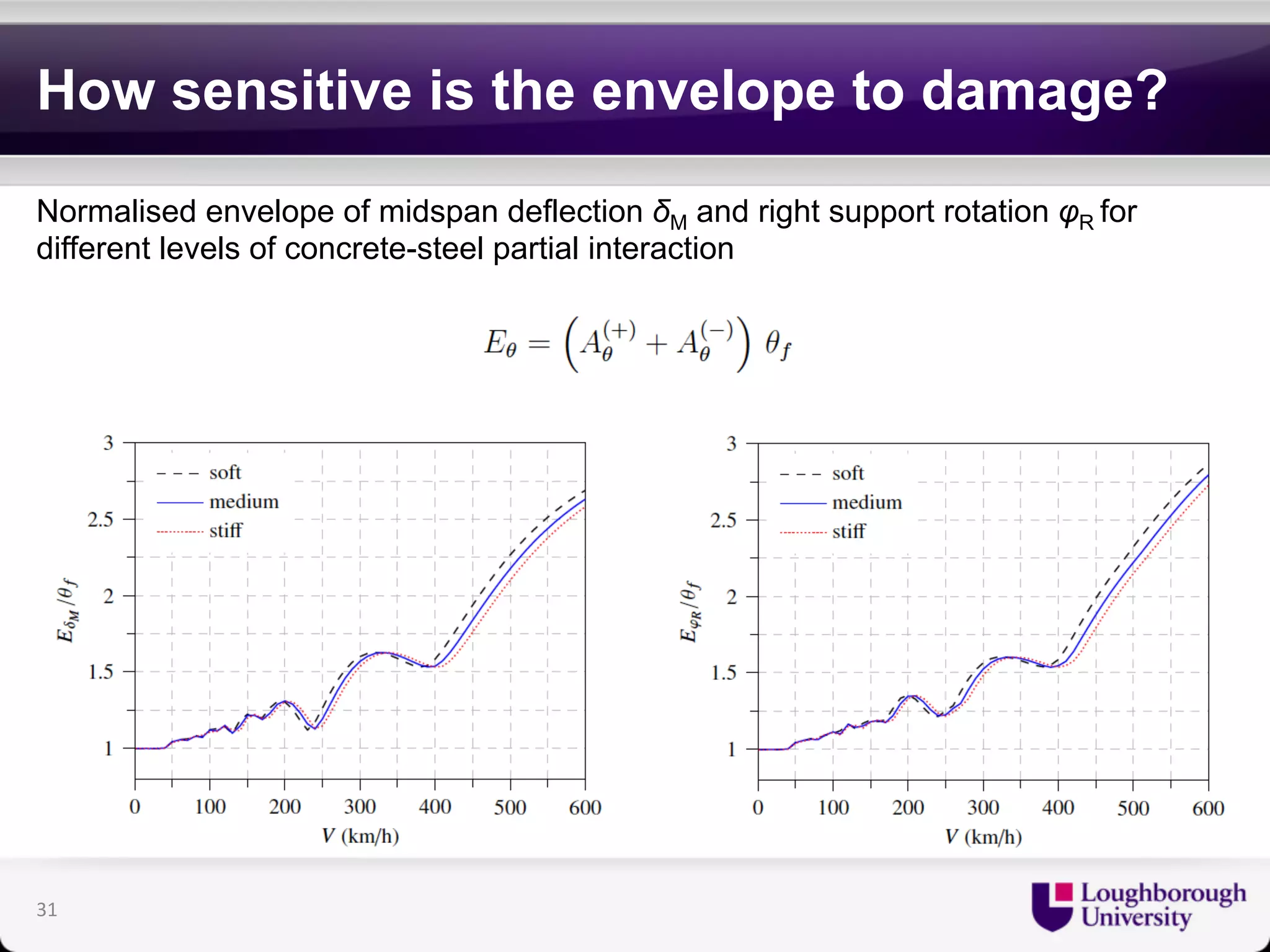
How sensitive is the envelope to damage? 
Normalised envelope of midspan deflection δM and right support rotation φR for 
different levels of concrete-steel partial interaction 
31
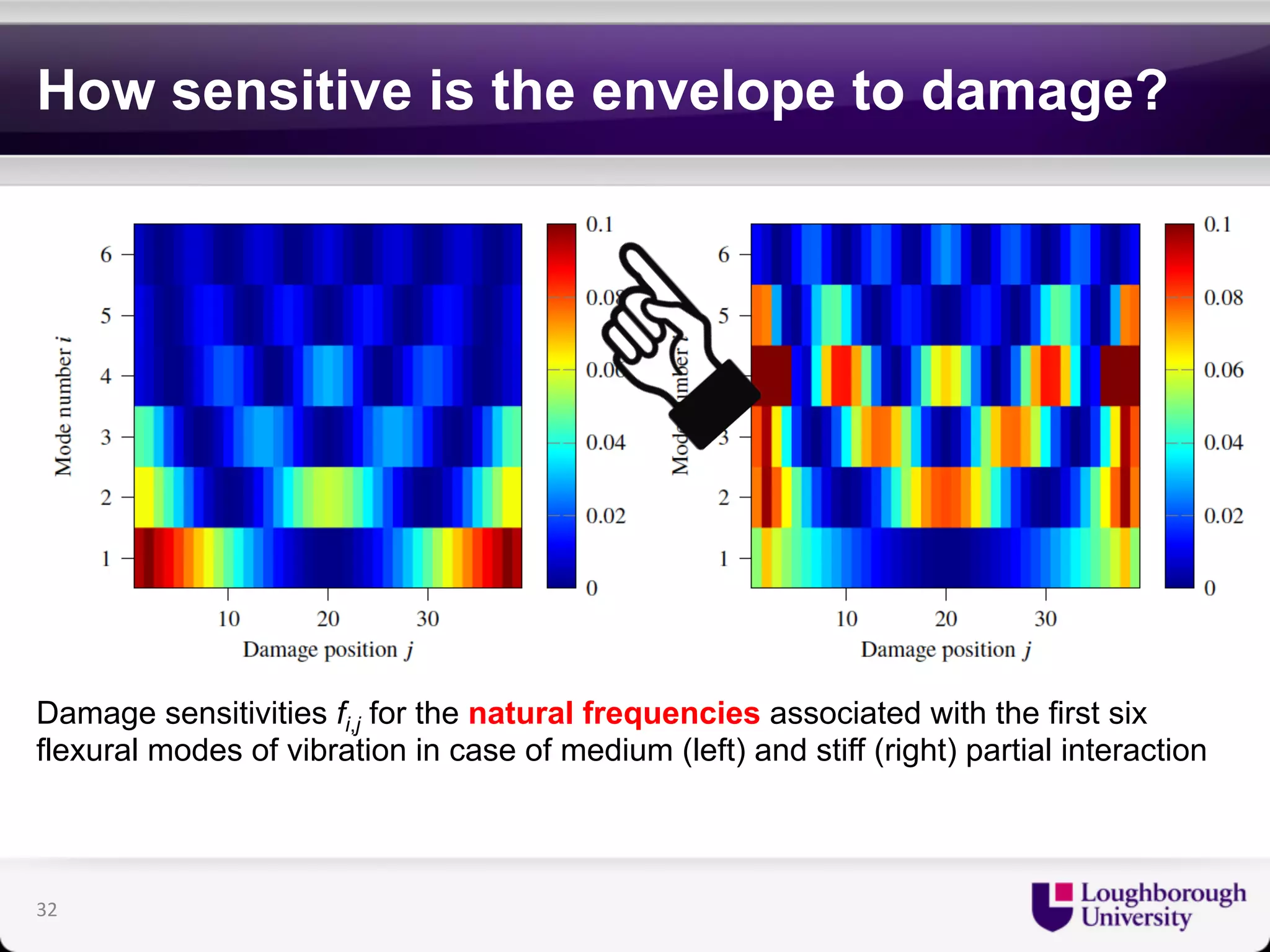
How sensitive is the envelope to damage? 
Damage sensitivities fi,j for the natural frequencies associated with the first six 
flexural modes of vibration in case of medium (left) and stiff (right) partial interaction 
32
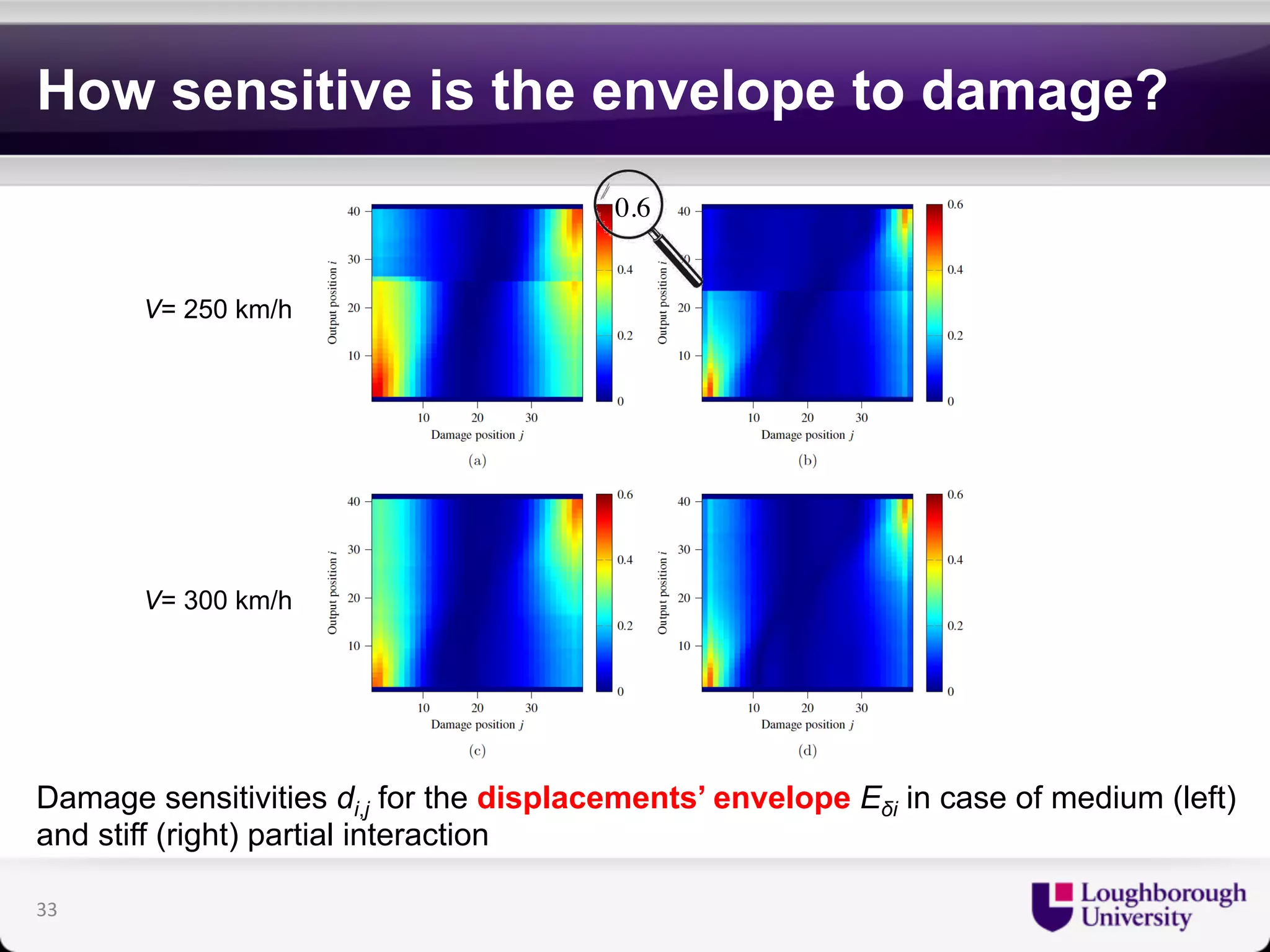
How sensitive is the envelope to damage? 
V= 250 km/h 
V= 300 km/h 
Damage sensitivities di,j for the displacements’ envelope Eδi in case of medium (left) 
and stiff (right) partial interaction 
33 
0.6
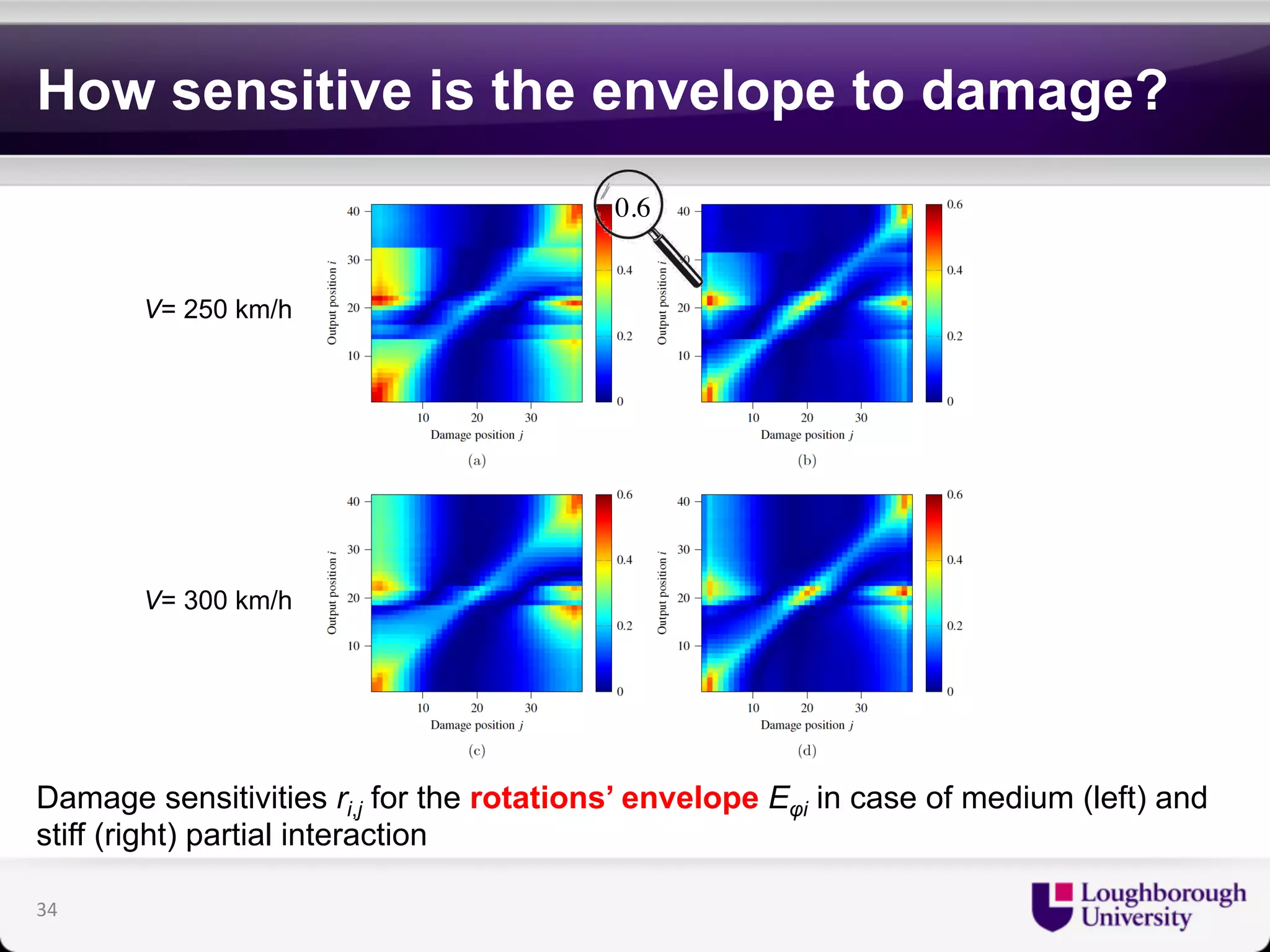
How sensitive is the envelope to damage? 
V= 250 km/h 
V= 300 km/h 
Damage sensitivities ri,j for the rotations’ envelope Eφi in case of medium (left) and 
stiff (right) partial interaction 
34 
0.6
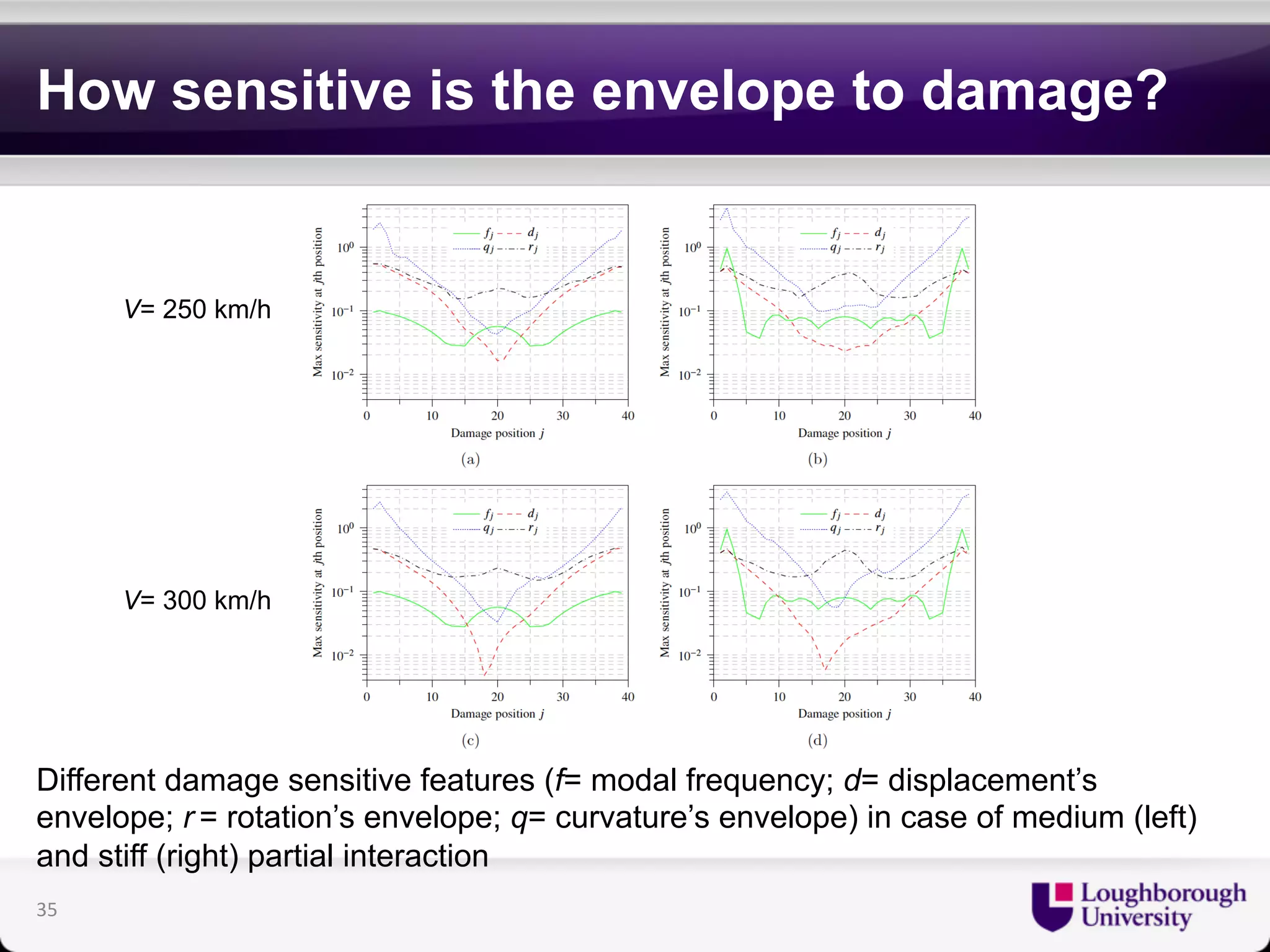
How sensitive is the envelope to damage? 
V= 250 km/h 
V= 300 km/h 
Different damage sensitive features (f= modal frequency; d= displacement’s 
envelope; r = rotation’s envelope; q= curvature’s envelope) in case of medium (left) 
and stiff (right) partial interaction 
35
Part-2 Conclusions 
• The envelope of deflections and rotations induced by moving 
loads has been suggested as damage sensitive feature for 
composite steel-concrete bridges 
• The envelope of the dynamic response tends to increase when 
damage occurs in the shear connectors 
• The envelope enjoys: 
• High sensitivity to the damage (higher than frequency shifts, at least 
for the first few modes of vibration) 
• The sensitivity tends to increase closer to the ends of the bridge, where 
damage in the shear connectors is more likely to happen 
• Ordered sets of results, that can potentially enhance the 
predictiveness of damage-detection algorithms 
36
Experimental investigations, 
2011-14 
How can we measure 
the envelope? 
37
How can we measure the envelope? 
• Literature Review 
• Advantages of 
photogrammetric 
monitoring techniques 
includes: 
• Simultaneous measurement 
of many points 
• Non-contact 
• Small and inexpensive 
targets 
• Relatively less expensive 
• Scalable 
Ronnholm et al., The Photogrammetric 
Record, 2009 
Albert et al., 2nd Symposium on Geodesy for 
Geotechnical and Structural Engineering, 
2002 38
How can we measure the envelope? 
Control 
points 
Monitoring 
points 
39 
Displacement 
Image 
number
How can we measure the envelope? 
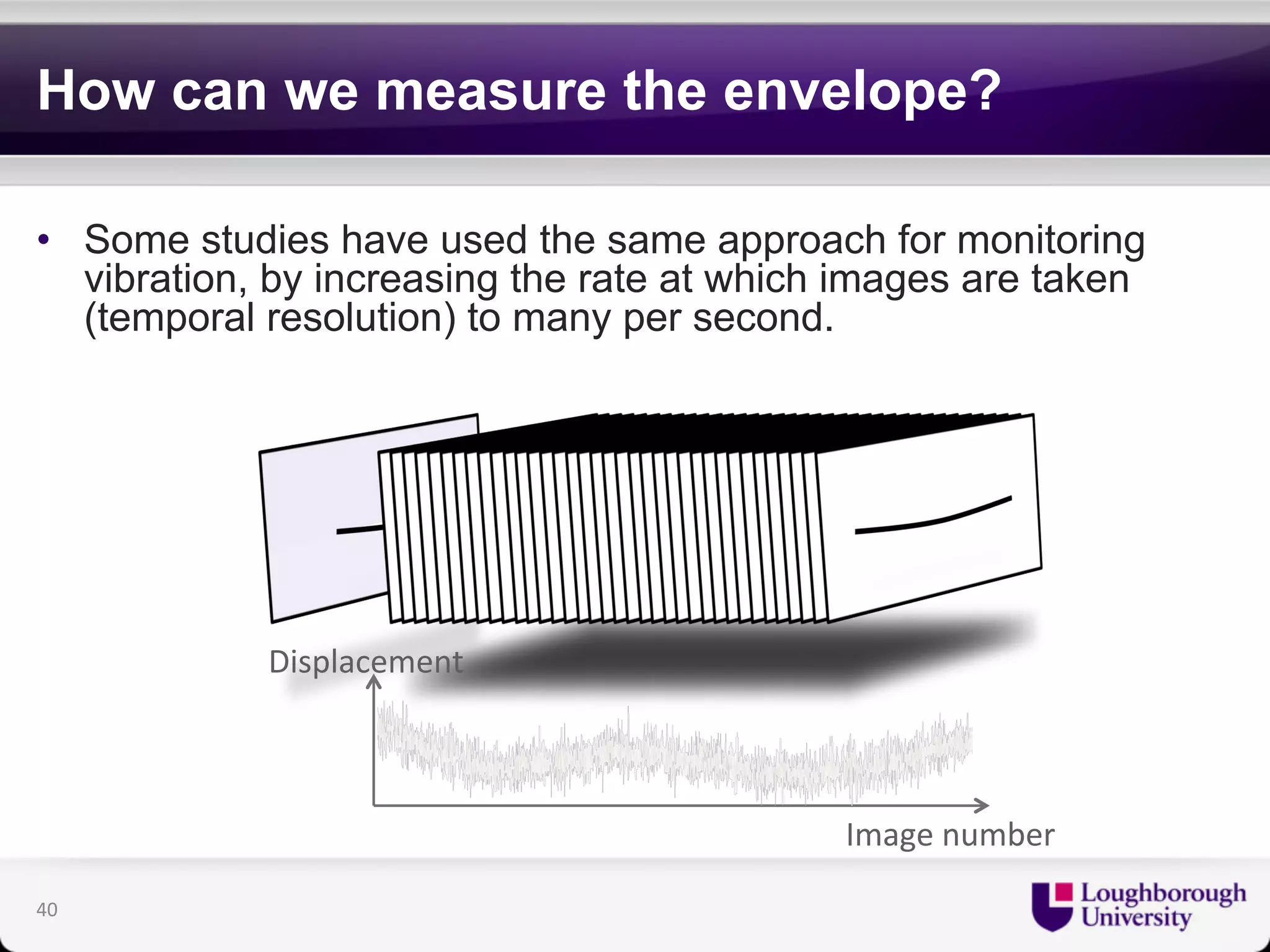
• Some studies have used the same approach for monitoring 
vibration, by increasing the rate at which images are taken 
(temporal resolution) to many per second. 
Displacement 
Image 
number 
40
How can we measure the envelope? 
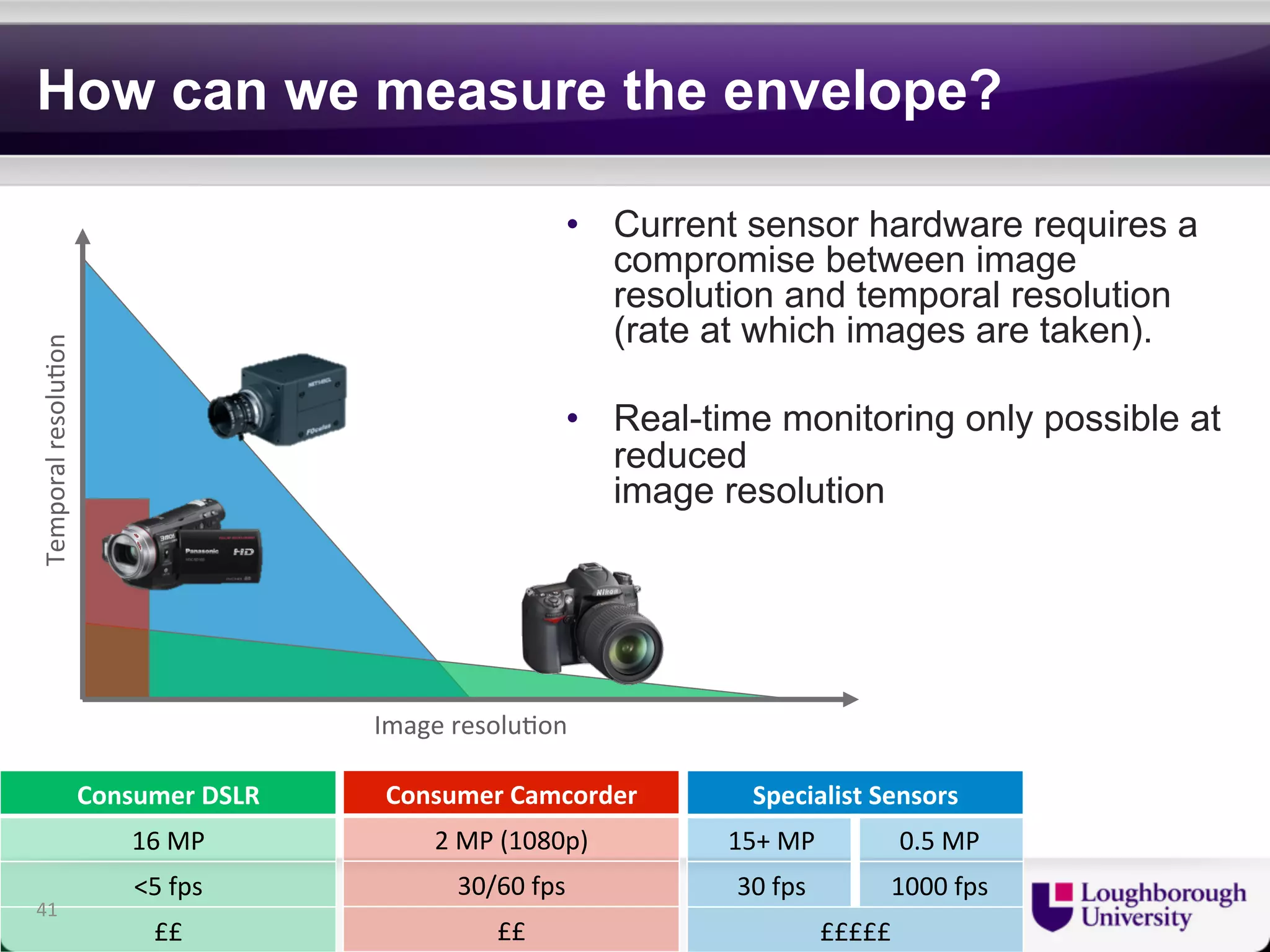
• Current sensor hardware requires a 
compromise between image 
resolution and temporal resolution 
(rate at which images are taken). 
• Real-time monitoring only possible at 
reduced 
image resolution 
Image 
resolu?on 
Temporal 
resolu?on 
Consumer)DSLR) 
16#MP# 
<5#fps# 
££# 
Consumer)Camcorder) 
2"MP"(1080p)" 
30/60"fps" 
££" 
Specialist*Sensors* 
15+$MP$ 0.5$MP$ 
30$fps$ 1000$fps$ 
£££££$ 
41
How can we measure the envelope? 
• Literature Review 
Vehicle speed 
Measuring motion 
of sports balls 
Caglioti & Giusti, 
Computer Vision and 
Image Understanding, 
2009 
Blurred images for… 
detection 
Lin, Li, & Chang, Image and 
Vision Computing, 2008 
Measuring vibration 
of computer circuits 
Wang et al., Pattern 
Recognition Letters, 2007 
42 
Spacecraft 
guidance systems 
Xiaojuan & Xinlong, Acta 
Astronautica, 2011
How can we measure the envelope? 
High speed imaging 
Proposed: Long-exposure image, 
deliberately blurred 
• Advantages 
• Allows measuring the 
envelope of the dynamic 
response 
• Higher image resolutions 
• No temporal resolution 
limitation 
• Less image data 
• Frequency independent 43
How can we measure the envelope? 
diameter 
= 
d 
vibra?on 
< 
d 
vibra?on 
> 
d 
255 
80 
80 
250 
75 
70 
200 
65 
60 
150 
55 
50 
100 
45 
50 
40 
35 
0 
0 
35 
30 
255 
250 
200 
150 
100 
50 
0 
0 
How does a 
blurred target 
look like? 
44
How can we measure the envelope? 
Accuracy ≅ 1 pixel Sub-pixel accuracy 
45
How can we measure the envelope? 
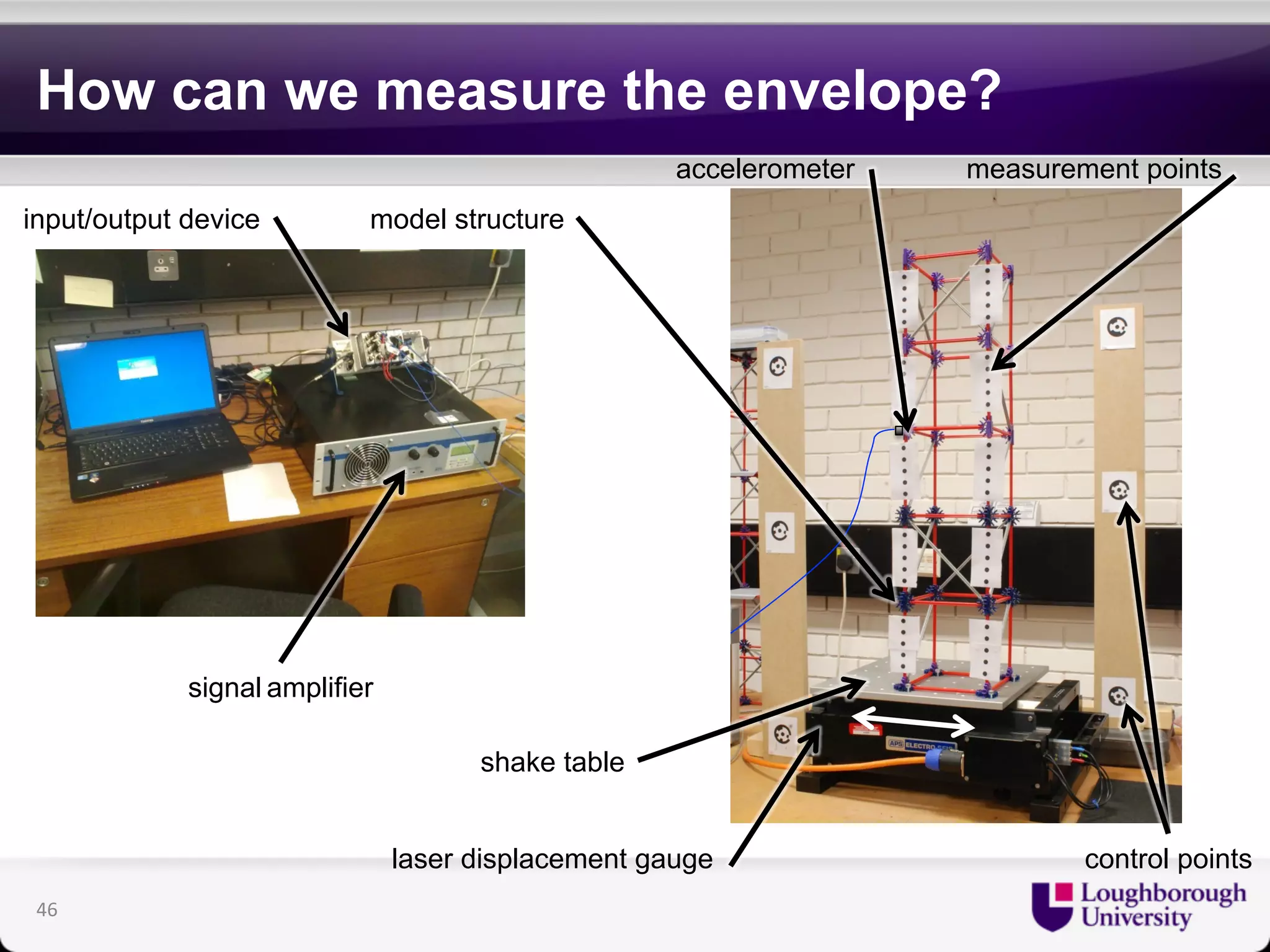
model structure 
shake table 
accelerometer measurement points 
control points 
input/output device 
signal amplifier 
laser displacement gauge 
46
How can we measure the envelope? 
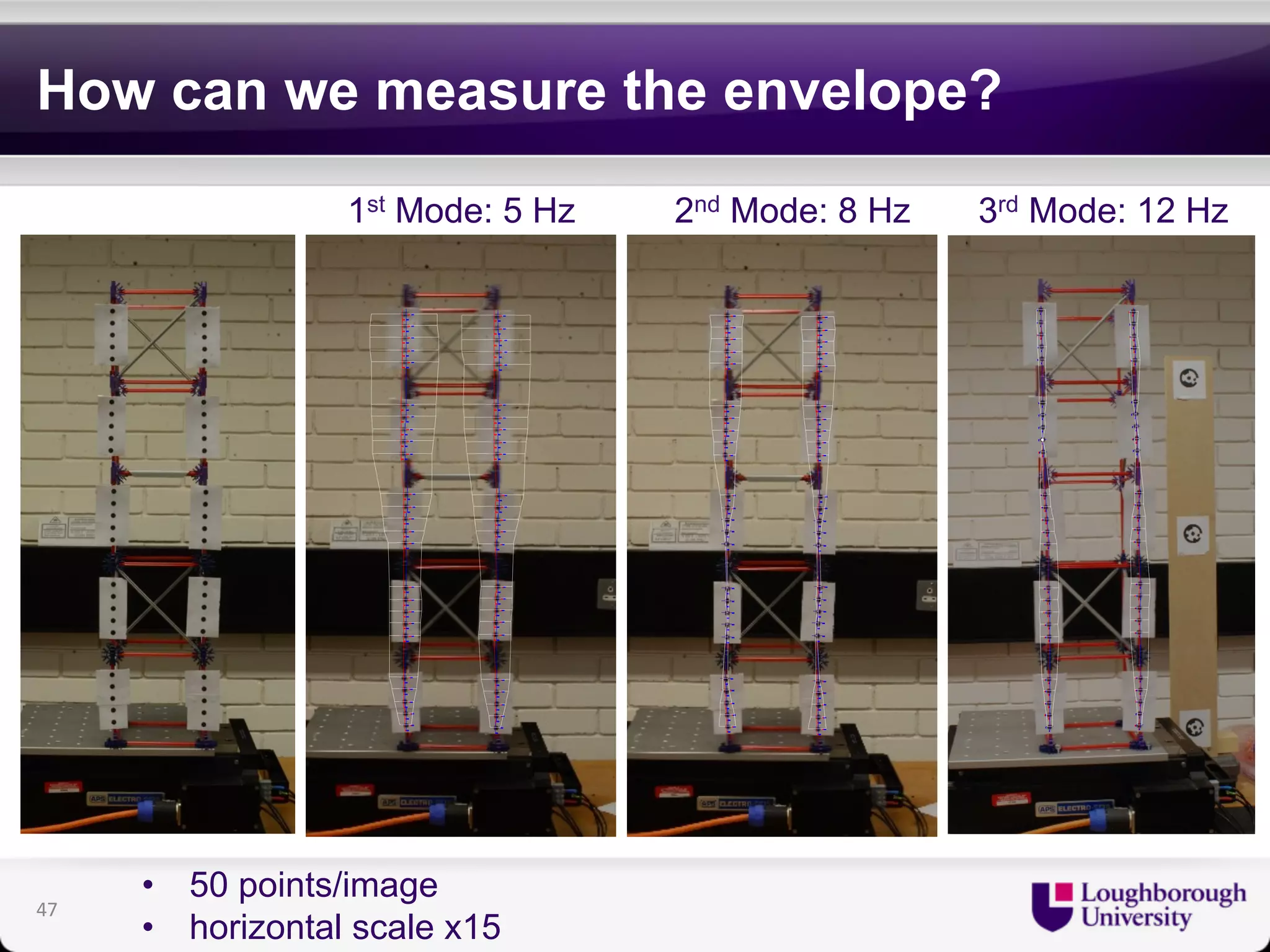
1st Mode: 5 Hz 2nd Mode: 8 Hz 3rd Mode: 12 Hz 
5 Hz 
• 50 points/image 
• horizontal scale x15 
47
How can we measure the envelope? 
110 120 130 140 150 160 170 
25 
20 
15 
10 
5 
0 
-5 
-10 
-15 
-20 
Displacement (mm) 
Time (s) 
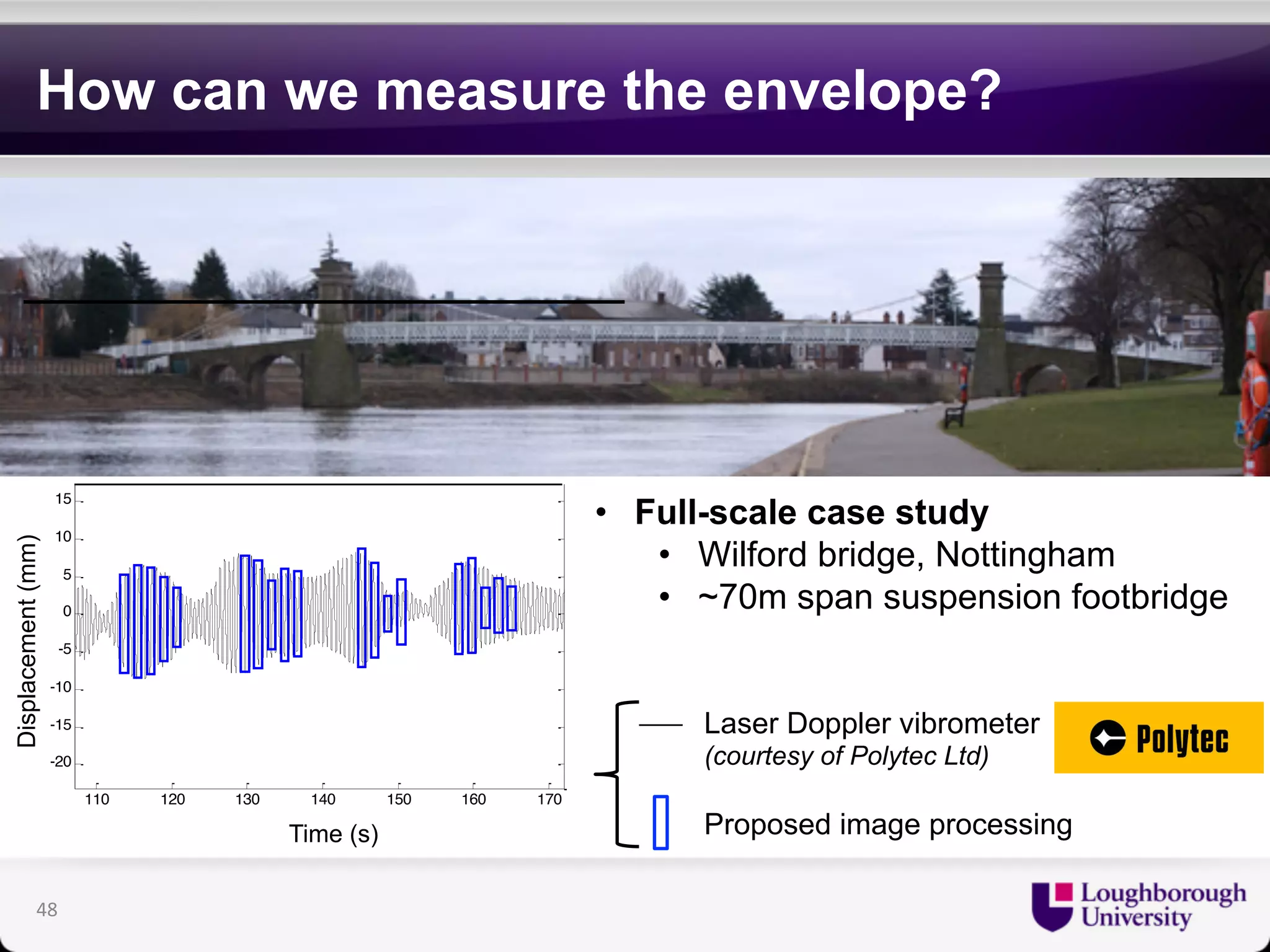
• Full-scale case study 
• Wilford bridge, Nottingham 
• ~70m span suspension footbridge 
Laser Doppler vibrometer 
(courtesy of Polytec Ltd) 
Proposed image processing 
48
How can we measure the envelope? 
1st mode (5 Hz) 2nd mode (8 Hz) 3rd mode (12 Hz) 
0.2 
0.4 
0.6 
0.2 
0.4 
0.9 
0.8 
0.7 
0.6 
0.5 
0.4 
0.3 
0.2 
0.1 
y x 
z 
0.2 
0.4 
0.6 
0.2 
0.4 
0.9 
0.8 
0.7 
0.6 
0.5 
0.4 
0.3 
0.2 
0.1 
y x 
z 
0.2 
0.4 
0.6 
0.2 
0.4 
0.9 
0.8 
0.7 
0.6 
0.5 
0.4 
0.3 
0.2 
0.1 
y x 
z 
Modification 2 (c) Modification 1 (b) Unmodified structure (a) 
0.5 
0.6 0.7 0.8 
0 
0.9 
0.8 
0.7 
0.6 
0.5 
0.4 
0.3 
0.2 
0.1 
0.2 
y x 
z 
0.5 
0.6 
0.7 
0.8 
0 
0.9 
0.8 
0.7 
0.6 
0.5 
0.4 
0.3 
0.2 
0.1 
0.2 
y x 
z 
0.5 
0.6 
0.7 
0.8 
0 
0.9 
0.8 
0.7 
0.6 
0.5 
0.4 
0.3 
0.2 
0.2 
0.1 
y x 
z 
0.5 0.6 0.7 0.8 
0 
0.9 
0.8 
0.7 
0.6 
0.5 
0.4 
0.3 
0.2 
0.2 
0.9 
0.8 
0.7 
0.6 
0.5 
0.4 
0.3 
0.2 
0.2 
0.1 
x 
z 
y 
0.5 0.6 0.7 0.8 
0 
0.9 
0.8 
0.7 
0.6 
0.5 
0.4 
0.3 
0.2 
0.2 
0.1 
y x 
z 
0.5 0.6 0.7 0.8 
0 
0.1 
y x 
z 
Unmodified Modification 1 Modification 2 
• 3D effects of structural 
modifications 
Added mass 
Standard member 
Reduced stiffness member 
(back of model) 
49
Part-3 Conclusions 
• Novel approach to identifying vibration patterns in civil engineering 
structures using long-exposure images 
• Targets appear blurred because of the motion of the structure 
• The vibration envelope is recorded, not the instantaneous deformed shapes 
• Sensors with higher image resolutions can be used 
• High-quantity measurements achieved in both laboratory and field tests 
• The approach can also be used to detect structural changes 
• The proposed frequency-independent approach expands the capabilities of 
existing sensors 
• Otherwise restricted by their imaging frequency 
McCarthy, Chandler & Palmeri, Photogrammetric Record, Under review 
50
Final Remarks 
• Part-1: Concrete-steel partial interaction and vehicle-bridge 
dynamic interaction can be represented 
efficiently with the proposed analytical formulation for 
the dynamics of composite bridges 
• Part-2: A numerical study has shown a promising 
level of sensitivity to damage for the envelope of the 
dynamic response of composite bridges subjected to 
moving loads 
• Part 3: Experimental investigations have confirmed 
that long-exposure digital images can be used to 
measure the envelope of 2D and 3D structural 
vibrations with good accuracy (sub-pixel) 
51
Acknowledgments 
52 
Stavros Kasinos 
Loughborough University 
Dr Mariateresa Lombardo 
Loughborough University 
David McCarthy 
Loughborough University 
Prof Jim Chandler 
Loughborough University
References 
• J Albert, HG. Maas, A Schade & W Schwarz, Pilot studies on photogrammetric bridge deformation 
measurement, 2nd Symp on Geodesy for Geotechnical and Structural Engineering, Berlin, May 2002 
• L Frýba, Vibration of Solids and Structures Under Moving Loads, 3rd Ed., Thomas Telford,1999 
• S Kasinos, A Palmeri & M Lombardo, Using the vibration envelope as damage-sensitive feature in 
composite beam structures, Structures, In press 
• DMJ McCarthy, JH Chandler & A Palmeri, Monitoring dynamic structural tests using image deblurring 
techniques, 10th Int Conf on Damage Assessment of Structures, Dublin, July 2013 
• DMJ McCarthy, JH Chandler & A Palmeri, Monitoring 3D vibrations in structures using high resolution 
blurred imagery, The Photogrammetric Record, Under review 
• G Muscolino, A Palmeri & A Sofi, Absolute versus relative formulations of the moving oscillator problem, 
Int Journal of Solids and Structures 46: 1085-1094, 2009 
• G Muscolino, A Palmeri & A Sofi, Random fluctuation of internal forces in rough beams under moving 
oscillators, 10th Int Conf on Structural Safety and Reliability, Osaka, September 2009 
• NM Newmark, CP Siess & IM Viest, Test and analysis of composite beams with incomplete interaction. 
Proc of the Society of Experimental Stress Analysis 9: 75-92, 1951 
• A Palmeri, Vibration of slender composite beams with flexible shear connection under moving oscillators, 
10th Int Conf on Recent Advances in Structural Dynamics, Southampton, July 2010 
• P Rönnholm, Comparison of measurement techniques and static theory applied to concrete beam 
deformation, The Photogrammetric Record, 24: 351-371 
53

Using blurred images to assess damage in bridge structures?

  • 1.
    Using blurred imagesto assess damage in bridge structures? Dr Alessandro Palmeri The School of Civil and Building Engineering Loughborough University, UK Email: A.Palmeri@LBORO.ac.uk 1
  • 2.
    Research Mind Map Structural Dynamics Stochastic Mechanics Seismic Analysis and Design Wind Engineering Isolators and Dampers Train-Bridge Interaction Random Vibration Performance- Based Design Design Assisted by Testing Random Composites Fast Dynamics (Blast Loading) Structural Health Monitoring 2
  • 3.
    Research Word Cloud(2000-date) 3 University of Messina 2000-07 University of Naples Federico II 2001 University of California at Berkeley 2002 University of Patras 2004 University of Bradford 2008-09 Loughborough University 2010-date
  • 4.
    Outline • Introduction • 1. Coupled dynamics of composite bridges (Analytical formulation, 2009-10) • 2. How sensitive is the envelope to damage? (Numerical study, 2012-13) • 3. How can we measure the envelope? (Experimental investigations, 2011-14) • Conclusions 4
  • 5.
    Introduction • Compositesteel-concrete beams are widely used in bridge engineering 5
  • 6.
    Introduction • Theirperformances are strongly influenced by the flexibility of the shear connection 6
  • 7.
    Introduction • Steel-concreteshear interaction allows reducing deflections and mitigating the accelerations experienced by vehicles Partial-interaction No Interaction (Non-composite bridge) 7
  • 8.
    Analytical formulation, 2009-10 Coupled Dynamics of Composite Bridges 8
  • 9.
    Coupled Dynamics ofComposite Bridges • Literature Review • The most popular approach for the mechanics of composite steel-concrete beam is due to Newmark et al. (1951), in which top slab and bottom girder are two beams continuously connected by a linear-elastic interface However… • Non-rigid steel-concrete connection is ignored in the technical literature devoted to the coupled vibrations of bridges and vehicles 9
  • 10.
    Coupled Dynamics ofComposite Bridges 10 Moving force: Time-invariant equation of motion Moving mass: Time-dependent inertia Moving oscillator: Dynamic interaction (mass, stiffness and damping vary with time)
  • 11.
    Coupled Dynamics ofComposite Bridges • Computational Approach • Higher-order partial differential equations of motion for slender composite beams with partial interaction under a platoon of moving oscillators are cast in a novel state-space form with time-varying coefficients • Time-independent modifications in inertia and rigidity due to partial interaction between concrete and steel • Time-dependent modifications due to the dynamic interaction between composite beam and moving oscillators Palmeri, 10th Int Conf on Rec Adv in Struct Dyn (RASD), 2010 11
  • 12.
    Coupled Dynamics ofComposite Bridges v(1) v(nv ) mv(2) m m L k c k c v(nv ) v(nv ) v(2) v(2) k c v(1) v(1) (s) b f b L E A I E A I , , ρ ⎧⎨⎩ , , s s s s ρ ⎧⎨⎩ c c c c } i b K ,d z w z t z t , ( , ), c ( ) v y v z t v t , ( , ), ( ) b v Figure 1. Simply-­‐supported steel-­‐concrete composite beam crossed by a platoon of moving oscillators. Simply-supported steel-concrete composite beam crossed by a platoon of moving oscillators 12
  • 13.
    Coupled Dynamics ofComposite Bridges ! Cascade'equations'of'motion:' ⎪⎪⎨⎪ ⎧ ⎧ ∂ 2 ⎫ ∂ 2 ⎧ ∂ 2 ⎫ ∂ 4 ⎧ ∂ 2 ⎫ ⎪ ⎨ − + ∂ ⎬ ∂ ⎨ − ⎬ + = ∂ ∂ ⎨ − ∂ ⎬ ⎩ ⎭ ⎩ ⎭ ⎩ ⎭ ⎪∂ ⎛ ∂ ∂ ∂ ⎞ = ⎜ + − − ⎩⎪ ∂ ⎝ ∂ ∂ ∂ ⎟ ⎠ A v z t EI v z t R z t f z t 1 1 ( , ) 1 1 ( , ) ( , ) 1 1 ( , ) , b 2 2 2 b( ) 2 2 4 b 2 2 b z t z z z b b b w z t f z t K d v z t A v z t EI v z t z rEA z t z ( , ) 1 ( , ) ( , ) ( , ) ( , ) ; ! where:' b b f A A Agρ = ρ +ρ + [ ] [ ] [ ] [ ] (s) b b c c s s EI E I E I b(0) c c s s EI EI E E A A d c s c s 2 b( ) b(0) b ∞ E A E A c c s s = + = + + Composite$beam$transverse$deflections$ 2 2 4 [ ] [ ] [ ] [ ] [ ] [ ] [ ] [ ] 2 2 i b b b(0) b(0) b( ) 2 2 2 b(0) i b b b b( ) b(0) b( ) b( ) 1 ; 1 K d EI EI EI EI K d EI EI EI EI α β α ∞ ∞ ∞ ∞ = ⎛ ⎞ ⎜ − ⎟ ⎜⎝ ⎟⎠ = = ⎛ ⎞ ⎜ − ⎟ ⎜⎝ ⎟⎠ Non$Composite$ Fully$Composite$ Concrete$slab$axial$displacements$ [ ] [ ] [ ] [ ] c 2 2 b i b 2 b b 2 b b(0) 4 b b b c c ρ β α β ρ β ∞ 13 Vibration of the beam: Governing equation
  • 14.
    Coupled Dynamics ofComposite Bridges ! Transverse(loading:( n Static(load( ( ) v = (s) +Σ − f ( z , t ) f χ ( z ( t )) f ( t ) δ z z ( t ) i i i b b b v( ) v( ) v( ) = 1 i Dynamic(loads(due(to(moving(oscillators( ! Classical(modal(analysis:( χ z =U z −U z − L b b ( ) ( ) ( ) 1, Within the beam 0 , Outside the beam ⎧ =⎨⎩ b = (s) +Σ = (s) + φ T ⋅q v z t v z φ z q t v z z t ( , ) ( ) ( ) ( ) ( ) ( ) ( ) b b b( ) b( ) b b b 1 n j j j = Static(contribution( Modal(contributions( 14 Vibration of the beam: Loads and displacements
  • 15.
    Coupled Dynamics ofComposite Bridges ! Modal&equations&of&motion:& 2 ⋅qb (t) = Jb ⋅Qb (t) qb (t) + Ξb ⋅ qb (t) +Ωb ⎧ ⎫ ( ) ( ( )) ( ) ( ( )) 1 ( ( )) Q Σ φ φ = ⎨ − ′′ ⎬ t χ z t f t z t z t 2 1 2 J = ⎡⎣I + Δm ⎤⎦ − b 1 b n bi Ω J Ω k b b b() bi Ξ Ω b b b 2ζ − ∞ = ⎡⎣ ⋅ ⎡⎣ + Δ ⎤⎦⎤⎦ = b( ) b( ,1) b( ,2) b( , b ) Diag n ω ω ω ∞ ∞ ∞ ∞ Ω = ⎡⎣ L ⎤⎦ [ ] [ ] 2 ⎛ ⎞ ∞ =⎜ ⎟ ⎝ ⎠ b( ) b( ) b b j j EI L A ω π ρ 1 ⎡ ⎤ π m N Δ = bi 2 ⎢ b ⎥ [EI] L β ⎣ ⎦ b b ∞ ⎡ ⎤ k N Δ = ⎢ ⎥ [ ] 2 6 b( ) π bi 2 b A L α ρ ⎣ ⎦ b b b [ ] b b N = Diag 1 2 L n v b b v( ) v( ) b v( ) 2 b v( ) 1 b n i i i i i = β ⎩ ⎭ 15 Vibration of the beam: Modal analysis
  • 16.
    Coupled Dynamics ofComposite Bridges ! Absolute)displacements)are)used:) !Impulsive!terms!in!the!equations!of!motion!can!be!avoided! )(Muscolino,)Palmeri)&)Sofi,)2009)) mv(i) vv(i) (t) = −cv(i)  vv(i) (t) −  vw(i) ( (t))− kv(i) vv(i) (t) − vw(i) ( (t)), Static!contributions! Dynamic!contributions! T (t) ⋅qb (t) vw(i) (t) = rv(i) (t) + χ b (zv(i) (t))abv(i) ( T (t) ⋅ q(t) + bT (t) ⋅q(t)) b bv(i) b  vw(i) (t) = sv(i) (t) + χ b (zv(i) (t)) abv(i) 16 Vibration of the oscillator: Governing equation
  • 17.
    Coupled Dynamics ofComposite Bridges ! Equations*of*motion:* Mv ⋅ vv (t) +Cv ⋅ vv (t) +Kv ⋅ vv (t) = Cv ⋅sv (t) +Kv ⋅rv (t) +Cvb ⋅ qb (t) + Kvb (t) + Lvb (t) ⎡⎣ ⎤⎦ ⋅qb (t) ⎡⎣⎢ Mv = Diag mv(1) mv(2)  mv(nv ) ⎤⎦⎥ ⎡⎣⎢ Cv = Diag cv(1) cv(2)  cv(nv ) ⎤⎦⎥ T (t) Cvb (t) = Cv ⋅Xv (t) ⋅Abv ⎡⎣⎢ Kv = Diag kv(1) kv(2)  kv(nv ) ⎤⎦⎥ T (t) Kvb (t) = Kv ⋅Xv (t) ⋅Abv T (t) Lvb (t) = Cv ⋅Xv (t) ⋅Bbv Xv (t) = Diag χ b (zv(1) (t)) χ b (zv(2) (t))  χ b (zv(nv ) (t)) ⎡⎣⎢ ⎤⎦⎥ Abv (t) = abv(1) (t) abv(2) (t)  abv(nv ) (t) ⎡⎣⎢ ⎤⎦⎥ Bbv (t) = bbv(1) (t) bbv(2) (t)  bbv(nv ) (t) ⎡⎣⎢ ⎤⎦⎥ 17 Vibration of the oscillator: Matrix equations
  • 18.
    Coupled Dynamics ofComposite Bridges ! The$generic$oscillator/beam$interaction$force$is$given$by:$ fv(i) (t) = mv(i) g ( T ⋅qb (t)) +cv(i)  vv(i) (t) − sv(i) (t) − χ b (zv(i) (t))abv(i) T ⋅qb ( (t)) $Leading$to:$ T ⋅ qb (t) − χ b (zv(i) (t))bbv(i) +kv(i) vv(i) (t) − rv(i) (t) − χ b (zv(i) (t))abv(i) qb (t) + Ξb + ΔCb (t) ⎡⎣ ⎤⎦ 2 + ΔKb (t) ⎡⎣ ⋅ qb (t) + Ωb ⎤⎦ ⋅qb (t) = Cbv (t) ⋅ vv (t) +Kbv (t) ⋅ vv (t) +Q b (t) ΔCb (t) = Tbv (t) ⋅Cvb (t) ΔKb (t) = Tbv (t) ⋅ Kvb (t) + Lvb (t) ⎡⎣ ⎤⎦ Cbv (t) = Tbv (t) ⋅C Kbv (t) = Tbv (t) ⋅Kv Q b (t) = Tbv (t) ⋅ gMv ⋅τ v −Cv ⋅sv (t) −Kv ⋅rv { (t)} τ v = { 1 1  1 }T Tbv (t) = Jb ⋅ Abv (t) + ΔAbv (t) ⎡⎣ ⎤⎦ ⋅Xv (t) ΔAbv (t) = − 1 2 φ ′′ b (zv(1) (t)) φ ′′ b (zv(2) (t))  φ ′′ b (zv(nv ) (t)) ⎡⎣⎢ βb ⎤⎦⎥ 18 Vibration of the oscillator: Matrix equations
  • 19.
    Coupled Dynamics ofComposite Bridges ! Matrix'equations'of'motion'can'be'obtained'for'the'platoon'of' moving'oscillators:' 2 ⋅qv (t) = Q v + μv ⋅Cvb ⋅ qb (t) + μv ⋅ Kvb (t) + Lvb (t) ⎡⎣ qv (t) + Ξv ⋅ qv (t) +Ωv ⎤⎦ ⋅qb (t) { } μ = M− b v v(1) v(2) v( ) ( ) ( ) ( ) ( ) n q t = q t q t L q t Dimensional* ⎡⎣⎢ Ξv = 2Diag ζ v(1) ζ v(2)  ζ v(nv ) ⎤⎦⎥ ⋅Ωv ⎡⎣⎢ Ωv = Diag ωv(1) ωv(2)  ωv(nv ) ⎤⎦⎥ Q v (t) = μv ⋅ Cv ⋅sv (t) +Kv ⋅rv { (t)} i v( ) v( ) v( ) v( ) v( ) v( ) v( ) 2 i i i i i i k m c m ω ζ ω = = 1 2 v v T consistency* 19 Coupled vibration
  • 20.
    Coupled Dynamics ofComposite Bridges ! Finally'the'two'matrix'equations'are'rewritten'in'an'enlarged' modal'space:' q(t) + c0 + Δc(t) ⎡⎣ ⎤⎦ ⋅ q(t) + k0 + Δk(t) ⎡⎣ ⎤⎦ ⋅q(t) = Q(t) O ⎡ = ⎢ n v × n ⎤ b ⎥ ⎢⎣ b v ⎥⎦ O C ⎡ − ⋅ ⎤ v v v c 0 O b v vb bv v b ( ) ( ) ( ) ( ) n n n n t t t t × × c Δ = ⎢⎣− ⎢ C ⋅ Δ C ⎥ ⎥⎦ Ξ Ξ μ μ T (t) Q b { T (t) }T v b b v O O [ ] O K L v v 2 v 0 2 b ( ) ( ) v vb vb k μ bv v b ( ) ( ) ( ) n n n n n n t t t t t × × × ⎡ Ω ⎤ = ⎢ ⎥ ⎢ Ω ⎥ ⎣ ⎦ ⎡ − ⋅ + ⎤ Δ =⎢ ⎥ ⎢⎣− ⋅ Δ ⎥⎦ k K μ K { T T }T v b q(t) = q (t) q (t) Q(t) = Q v “Small”'modifications' 20 Coupled vibration: Proposed model
  • 21.
    Coupled Dynamics ofComposite Bridges ! Single'step+(unconditionally+stable)+numerical+integration:+ {[ ] [ ] [ ] } 0 01 01 02 x(t + Δt) = E(t) ⋅ Θ + Γ ⋅ΔD(t) ⋅ x(t) + Γ ⋅V ⋅Q(t) + Γ ⋅V ⋅Q(t + Δt) ! Reference+transition+matrix+without+dynamic+interaction:+ L I D Γ Θ ! Dynamic+modification+matrix:+ = ⎡⎣ Θ − n + n ⎤⎦ ⋅ − = ⎡ − ⎤ ⎢⎣ Δ ⎥⎦ ⋅ = ⎡ ⎤ ⎢⎣− Δ ⎥⎦ ⋅ 0 0 2( ) 0 v b 1 − L D 01 0 0 0 1 L I D n n t − + 02 0 2( ) 0 v b 1 1 1 t 2( ) 02 ( ) ( ) n n t t t − v b 1 + E = ⎡⎣Ι − Γ ⋅ΔD + Δ ⎤⎦ Γ [ ] 0 0 Θ = exp D Δt 21 Coupled vibration: Proposed numerical scheme
  • 22.
    Coupled Dynamics ofComposite Bridges Time histories of beam’s transverse deflection at midspan for different levels of partial interaction 22
  • 23.
    Coupled Dynamics ofComposite Bridges Time histories of oscillator’s absolute acceleration for different levels of partial interaction 23
  • 24.
    Part-1 Conclusions (from2010) • A novel method of dynamic analysis has been proposed and numerically validated for studying the dynamic interaction phenomenon in composite steel-concrete beams subjected to a platoon of single-DoF moving oscillators • Time-independent modifications arise in the composite beam because of the partial interaction between concrete slab and steel girder • Beam-oscillators dynamic interaction is represented by a set of time-dependent functions, playing the role of time-varying stiffness and damping coefficients • A single-step numerical scheme of solution has been formulated, based on the observation that the dynamic modifications are small • Further studies: • Effect of roughness in the beam-oscillators’ contact • Sensitivity of the dynamic response of the subsystems to the degree of PI in the supporting beam 24
  • 25.
    Part-1 Conclusions BendingMoment M Shear Force V Mean value μ (top) and standard deviation σ (bottom) of the internal forces M and V due to a single moving oscillator at midspan of a simply-supported solid beam with rough surface Muscolino, Palmeri & Sofi, 10th Int Conf on Struct Safety & Reliability (ICOSSAR), 2009 25
  • 26.
    Numerical study, 2012-13 How sensitive is the envelope to damage? 26
  • 27.
    How sensitive isthe envelope to damage? • Literature Review • Conventional approaches of damage detection (including ultrasonic, thermal, eddy current and X-ray testing) were termed as cumbersome and expensive • Vibration-based damage methods have emerged, as they allow identifying meaningful changes in the dynamic characteristics of the composite beam • Accelerometers have been extensively employed, BUT their application to large structural systems may be difficult because of long cabling, number of sensors and installation time • Laser doppler vibrometers can be used as a viable non-contact alternative, especially when targets are difficult to access, BUT the simultaneous acquisition of vibration at multiple points would make very expensive the dynamic testing Therefore… • The idea of using the envelopes profile of deflections and rotations induced by a moving load has been investigated • That’s radically different than recording and analysing multiple time histories Kasinos, Palmeri & Lombardo, Structures, In press 27
  • 28.
    How sensitive isthe envelope to damage? • Key Assumptions 1. Linear-elastic constitutive law 2. Finite element model built with SAP2000, using: • Beam elements for top concrete slab and bottom steel girder • Elastic springs for the shear connectors 3. Planar motion (no twisting moment) 4. Moving force F (massless) with constant velocity V 5. Damage simulated as stiffness reduction in the shear springs 28 Application Programming Interface
  • 29.
    How sensitive isthe envelope to damage? • Governing equations • Dynamic response of interest (displacement or rotation) • Envelope of the dynamic response • Damage measure (DM) 29
  • 30.
    How sensitive isthe envelope to damage? Dynamic amplification factors of midspan deflection δM and right support rotation φR for different levels of concrete-steel partial interaction = θ due to gravitational loads = θ when the moving force is applied statically Amplification factors: 30
  • 31.
    How sensitive isthe envelope to damage? Normalised envelope of midspan deflection δM and right support rotation φR for different levels of concrete-steel partial interaction 31
  • 32.
    How sensitive isthe envelope to damage? Damage sensitivities fi,j for the natural frequencies associated with the first six flexural modes of vibration in case of medium (left) and stiff (right) partial interaction 32
  • 33.
    How sensitive isthe envelope to damage? V= 250 km/h V= 300 km/h Damage sensitivities di,j for the displacements’ envelope Eδi in case of medium (left) and stiff (right) partial interaction 33 0.6
  • 34.
    How sensitive isthe envelope to damage? V= 250 km/h V= 300 km/h Damage sensitivities ri,j for the rotations’ envelope Eφi in case of medium (left) and stiff (right) partial interaction 34 0.6
  • 35.
    How sensitive isthe envelope to damage? V= 250 km/h V= 300 km/h Different damage sensitive features (f= modal frequency; d= displacement’s envelope; r = rotation’s envelope; q= curvature’s envelope) in case of medium (left) and stiff (right) partial interaction 35
  • 36.
    Part-2 Conclusions •The envelope of deflections and rotations induced by moving loads has been suggested as damage sensitive feature for composite steel-concrete bridges • The envelope of the dynamic response tends to increase when damage occurs in the shear connectors • The envelope enjoys: • High sensitivity to the damage (higher than frequency shifts, at least for the first few modes of vibration) • The sensitivity tends to increase closer to the ends of the bridge, where damage in the shear connectors is more likely to happen • Ordered sets of results, that can potentially enhance the predictiveness of damage-detection algorithms 36
  • 37.
    Experimental investigations, 2011-14 How can we measure the envelope? 37
  • 38.
    How can wemeasure the envelope? • Literature Review • Advantages of photogrammetric monitoring techniques includes: • Simultaneous measurement of many points • Non-contact • Small and inexpensive targets • Relatively less expensive • Scalable Ronnholm et al., The Photogrammetric Record, 2009 Albert et al., 2nd Symposium on Geodesy for Geotechnical and Structural Engineering, 2002 38
  • 39.
    How can wemeasure the envelope? Control points Monitoring points 39 Displacement Image number
  • 40.
    How can wemeasure the envelope? • Some studies have used the same approach for monitoring vibration, by increasing the rate at which images are taken (temporal resolution) to many per second. Displacement Image number 40
  • 41.
    How can wemeasure the envelope? • Current sensor hardware requires a compromise between image resolution and temporal resolution (rate at which images are taken). • Real-time monitoring only possible at reduced image resolution Image resolu?on Temporal resolu?on Consumer)DSLR) 16#MP# <5#fps# ££# Consumer)Camcorder) 2"MP"(1080p)" 30/60"fps" ££" Specialist*Sensors* 15+$MP$ 0.5$MP$ 30$fps$ 1000$fps$ £££££$ 41
  • 42.
    How can wemeasure the envelope? • Literature Review Vehicle speed Measuring motion of sports balls Caglioti & Giusti, Computer Vision and Image Understanding, 2009 Blurred images for… detection Lin, Li, & Chang, Image and Vision Computing, 2008 Measuring vibration of computer circuits Wang et al., Pattern Recognition Letters, 2007 42 Spacecraft guidance systems Xiaojuan & Xinlong, Acta Astronautica, 2011
  • 43.
    How can wemeasure the envelope? High speed imaging Proposed: Long-exposure image, deliberately blurred • Advantages • Allows measuring the envelope of the dynamic response • Higher image resolutions • No temporal resolution limitation • Less image data • Frequency independent 43
  • 44.
    How can wemeasure the envelope? diameter = d vibra?on < d vibra?on > d 255 80 80 250 75 70 200 65 60 150 55 50 100 45 50 40 35 0 0 35 30 255 250 200 150 100 50 0 0 How does a blurred target look like? 44
  • 45.
    How can wemeasure the envelope? Accuracy ≅ 1 pixel Sub-pixel accuracy 45
  • 46.
    How can wemeasure the envelope? model structure shake table accelerometer measurement points control points input/output device signal amplifier laser displacement gauge 46
  • 47.
    How can wemeasure the envelope? 1st Mode: 5 Hz 2nd Mode: 8 Hz 3rd Mode: 12 Hz 5 Hz • 50 points/image • horizontal scale x15 47
  • 48.
    How can wemeasure the envelope? 110 120 130 140 150 160 170 25 20 15 10 5 0 -5 -10 -15 -20 Displacement (mm) Time (s) • Full-scale case study • Wilford bridge, Nottingham • ~70m span suspension footbridge Laser Doppler vibrometer (courtesy of Polytec Ltd) Proposed image processing 48
  • 49.
    How can wemeasure the envelope? 1st mode (5 Hz) 2nd mode (8 Hz) 3rd mode (12 Hz) 0.2 0.4 0.6 0.2 0.4 0.9 0.8 0.7 0.6 0.5 0.4 0.3 0.2 0.1 y x z 0.2 0.4 0.6 0.2 0.4 0.9 0.8 0.7 0.6 0.5 0.4 0.3 0.2 0.1 y x z 0.2 0.4 0.6 0.2 0.4 0.9 0.8 0.7 0.6 0.5 0.4 0.3 0.2 0.1 y x z Modification 2 (c) Modification 1 (b) Unmodified structure (a) 0.5 0.6 0.7 0.8 0 0.9 0.8 0.7 0.6 0.5 0.4 0.3 0.2 0.1 0.2 y x z 0.5 0.6 0.7 0.8 0 0.9 0.8 0.7 0.6 0.5 0.4 0.3 0.2 0.1 0.2 y x z 0.5 0.6 0.7 0.8 0 0.9 0.8 0.7 0.6 0.5 0.4 0.3 0.2 0.2 0.1 y x z 0.5 0.6 0.7 0.8 0 0.9 0.8 0.7 0.6 0.5 0.4 0.3 0.2 0.2 0.9 0.8 0.7 0.6 0.5 0.4 0.3 0.2 0.2 0.1 x z y 0.5 0.6 0.7 0.8 0 0.9 0.8 0.7 0.6 0.5 0.4 0.3 0.2 0.2 0.1 y x z 0.5 0.6 0.7 0.8 0 0.1 y x z Unmodified Modification 1 Modification 2 • 3D effects of structural modifications Added mass Standard member Reduced stiffness member (back of model) 49
  • 50.
    Part-3 Conclusions •Novel approach to identifying vibration patterns in civil engineering structures using long-exposure images • Targets appear blurred because of the motion of the structure • The vibration envelope is recorded, not the instantaneous deformed shapes • Sensors with higher image resolutions can be used • High-quantity measurements achieved in both laboratory and field tests • The approach can also be used to detect structural changes • The proposed frequency-independent approach expands the capabilities of existing sensors • Otherwise restricted by their imaging frequency McCarthy, Chandler & Palmeri, Photogrammetric Record, Under review 50
  • 51.
    Final Remarks •Part-1: Concrete-steel partial interaction and vehicle-bridge dynamic interaction can be represented efficiently with the proposed analytical formulation for the dynamics of composite bridges • Part-2: A numerical study has shown a promising level of sensitivity to damage for the envelope of the dynamic response of composite bridges subjected to moving loads • Part 3: Experimental investigations have confirmed that long-exposure digital images can be used to measure the envelope of 2D and 3D structural vibrations with good accuracy (sub-pixel) 51
  • 52.
    Acknowledgments 52 StavrosKasinos Loughborough University Dr Mariateresa Lombardo Loughborough University David McCarthy Loughborough University Prof Jim Chandler Loughborough University
  • 53.
    References • JAlbert, HG. Maas, A Schade & W Schwarz, Pilot studies on photogrammetric bridge deformation measurement, 2nd Symp on Geodesy for Geotechnical and Structural Engineering, Berlin, May 2002 • L Frýba, Vibration of Solids and Structures Under Moving Loads, 3rd Ed., Thomas Telford,1999 • S Kasinos, A Palmeri & M Lombardo, Using the vibration envelope as damage-sensitive feature in composite beam structures, Structures, In press • DMJ McCarthy, JH Chandler & A Palmeri, Monitoring dynamic structural tests using image deblurring techniques, 10th Int Conf on Damage Assessment of Structures, Dublin, July 2013 • DMJ McCarthy, JH Chandler & A Palmeri, Monitoring 3D vibrations in structures using high resolution blurred imagery, The Photogrammetric Record, Under review • G Muscolino, A Palmeri & A Sofi, Absolute versus relative formulations of the moving oscillator problem, Int Journal of Solids and Structures 46: 1085-1094, 2009 • G Muscolino, A Palmeri & A Sofi, Random fluctuation of internal forces in rough beams under moving oscillators, 10th Int Conf on Structural Safety and Reliability, Osaka, September 2009 • NM Newmark, CP Siess & IM Viest, Test and analysis of composite beams with incomplete interaction. Proc of the Society of Experimental Stress Analysis 9: 75-92, 1951 • A Palmeri, Vibration of slender composite beams with flexible shear connection under moving oscillators, 10th Int Conf on Recent Advances in Structural Dynamics, Southampton, July 2010 • P Rönnholm, Comparison of measurement techniques and static theory applied to concrete beam deformation, The Photogrammetric Record, 24: 351-371 53