Structural
Dynamics
& Earthquake
Engineering
Dr Alessandro
Palmeri

Structural Dynamics
& Earthquake Engineering
Lectures #6 and 7: State-space equation of motion
and Transition matrix for SDoF oscillators
Dr Alessandro Palmeri
Civil and Building Engineering @ Loughborough University

Tuesday, 25th February 2014
State-Space Formulation
Structural
Dynamics
& Earthquake
Engineering

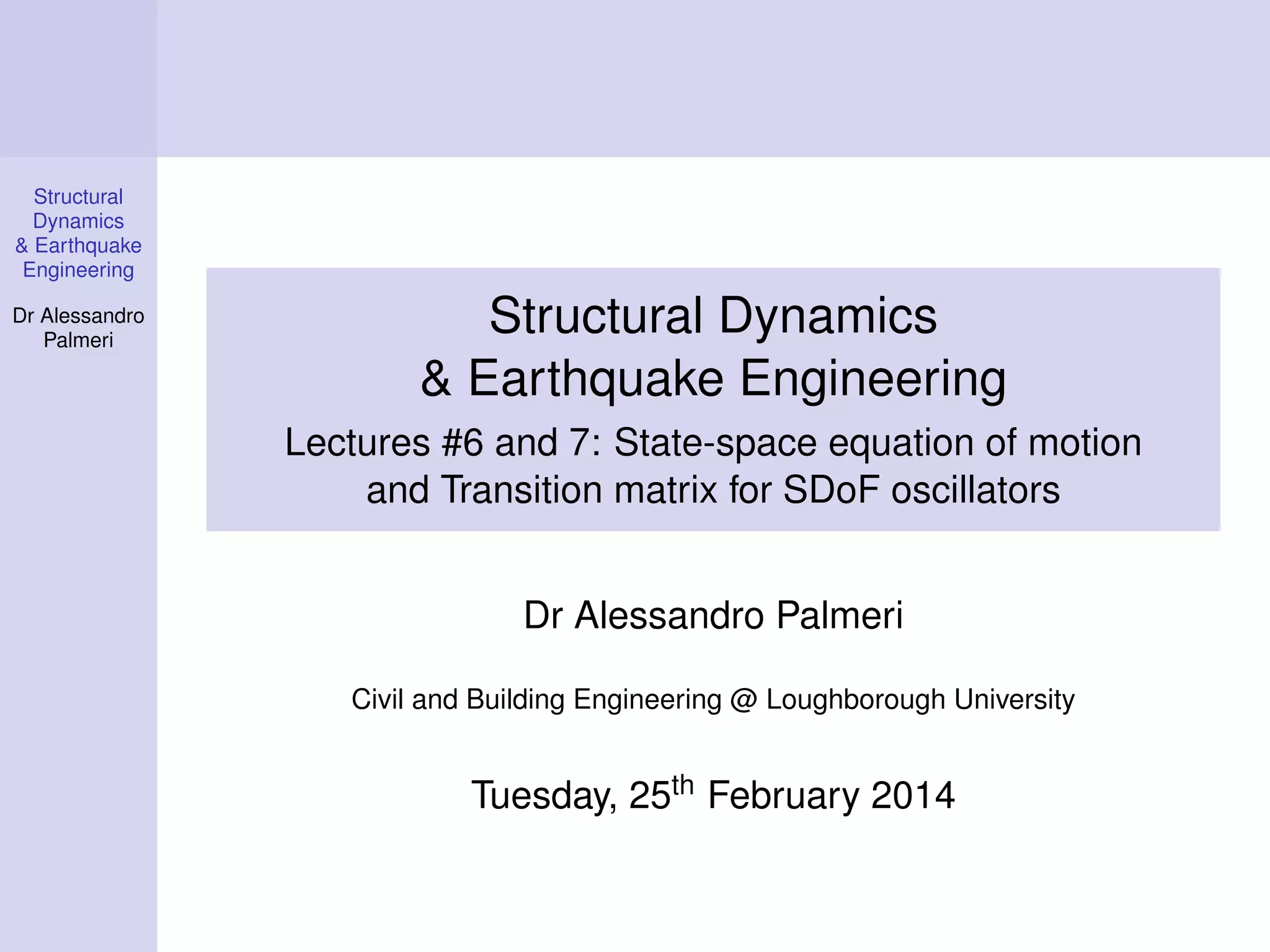
The equation of motion for a SDoF oscillator reads:
2
¨
˙
u (t) + 2 ζ0 ω0 u(t) + ω0 u(t) =

Dr Alessandro
Palmeri

1
f (t)
m

(1)

and can be posed in the alternative matrix form:
˙
y(t) = A · y(t) + b f (t)

(2)

where y(t) is the array of the state variables (displacement
and velocity) for the oscillator:
y(t) =

u(t)
˙
u(t)

(3)

while:
A=

0
1
2 −2 ζ ω
−ω0
0 0

, b=

0
1/m

(4)
Duhamel’s Solution
Structural
Dynamics
& Earthquake
Engineering
Dr Alessandro
Palmeri

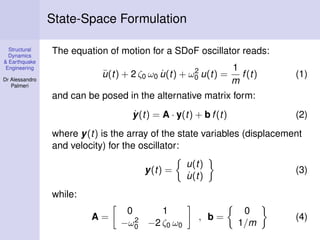
Let us consider a scalar first-order inhomogeneous ODE:
˙
y (t) = A y(t) + b f (t)

(5)

The integral solution of Eq. (5) can be formally written as:
t

Θ(t − τ ) b f (τ ) dτ

y(t) = Θ(t) y(0) +

(6)

0

where y(0) is the initial condition at time t = 0, while the
transition function Θ(t) is so defined:
Θ(t) = eA t

(7)
Duhamel’s Solution
Structural
Dynamics
& Earthquake
Engineering
Dr Alessandro
Palmeri

This integral solution can be extended to systems with many
state variables as:
t

y(t) = Θ(t) · y(0) +

Θ(t − τ ) · b f (τ ) dτ

(8)

0

where the array y0 = y(0) collects the initial conditions at
time t = 0, and the transition matrix Θ(t) is evaluated as the
exponential matrix of [A t]:
Θ(t) = eA t

(9)
Step-by-Step Numerical Solution
Structural
Dynamics
& Earthquake
Engineering
Dr Alessandro
Palmeri

For t = ∆t, and assuming a linear variation of the forcing
term f (t) in the time interval [0, ∆t]:
f (t) = f0 +

f1 − f0
t
∆t

(10)

one can mathematically prove that the Duhamel’s integral
gives:
y1 = Θ(∆t) · y0 + Γ0 (∆t) · {b f0 } + Γ1 (∆t) · {b f1 }

(11)

where y1 = y(∆t) collects the state variables at t = ∆t,
while the integration matrices Γ0 (∆t) and Γ1 (∆t) can be
computed from the transition matrix Θ(∆t) and the matrix of
coefficients A.
Step-by-Step Numerical Solution
Structural
Dynamics
& Earthquake
Engineering
Dr Alessandro
Palmeri

That is:
Γ0 (∆t) = [Θ(∆t) − L(∆t)] · A−1

(12)

Γ1 (∆t) = [L(∆t) − I2 ] · A−1

(13)

in which I2 is the 2-dimensional identity matrix, while the
loading matrix L(∆t) is given by:
L(∆t) =

1
[Θ(∆t) − I2 ] · A−1
∆t

(14)
Step-by-Step Numerical Solution
Structural
Dynamics
& Earthquake
Engineering

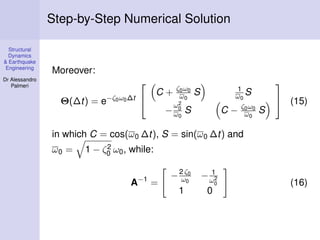
Moreover:

Dr Alessandro
Palmeri


Θ(∆t) = e−ζ0 ω0 ∆t 

ζ0 ω0
ω0
2
ω0
− ω0 S

C+

S
C

1
ω0 S
0
− ζωω0
0


S

 (15)

in which C = cos(ω 0 ∆t), S = sin(ω 0 ∆t) and
ω0 =

2
1 − ζ0 ω0 , while:

A−1 =

− 2 ζ00
ω

1
− ω2

1

0

0

(16)
Step-by-Step Numerical Solution
Structural
Dynamics
& Earthquake
Engineering
Dr Alessandro
Palmeri

The incremental solution offered by Eq. (11) for the time
interval [0, ∆t] can be extended to a generic time instant
tn = n ∆t as:
yn+1 = y(tn+1 ) =Θ(∆t) · yn
+ Γ0 (∆t) · {b f (tn )}
+ Γ1 (∆t) · {b f (tn+1) }
for n = 1, 2, 3, · · ·

(17)

SDEE: Lecture 6

  • 1.
    Structural Dynamics & Earthquake Engineering Dr Alessandro Palmeri StructuralDynamics & Earthquake Engineering Lectures #6 and 7: State-space equation of motion and Transition matrix for SDoF oscillators Dr Alessandro Palmeri Civil and Building Engineering @ Loughborough University Tuesday, 25th February 2014
  • 2.
    State-Space Formulation Structural Dynamics & Earthquake Engineering Theequation of motion for a SDoF oscillator reads: 2 ¨ ˙ u (t) + 2 ζ0 ω0 u(t) + ω0 u(t) = Dr Alessandro Palmeri 1 f (t) m (1) and can be posed in the alternative matrix form: ˙ y(t) = A · y(t) + b f (t) (2) where y(t) is the array of the state variables (displacement and velocity) for the oscillator: y(t) = u(t) ˙ u(t) (3) while: A= 0 1 2 −2 ζ ω −ω0 0 0 , b= 0 1/m (4)
  • 3.
    Duhamel’s Solution Structural Dynamics & Earthquake Engineering DrAlessandro Palmeri Let us consider a scalar first-order inhomogeneous ODE: ˙ y (t) = A y(t) + b f (t) (5) The integral solution of Eq. (5) can be formally written as: t Θ(t − τ ) b f (τ ) dτ y(t) = Θ(t) y(0) + (6) 0 where y(0) is the initial condition at time t = 0, while the transition function Θ(t) is so defined: Θ(t) = eA t (7)
  • 4.
    Duhamel’s Solution Structural Dynamics & Earthquake Engineering DrAlessandro Palmeri This integral solution can be extended to systems with many state variables as: t y(t) = Θ(t) · y(0) + Θ(t − τ ) · b f (τ ) dτ (8) 0 where the array y0 = y(0) collects the initial conditions at time t = 0, and the transition matrix Θ(t) is evaluated as the exponential matrix of [A t]: Θ(t) = eA t (9)
  • 5.
    Step-by-Step Numerical Solution Structural Dynamics &Earthquake Engineering Dr Alessandro Palmeri For t = ∆t, and assuming a linear variation of the forcing term f (t) in the time interval [0, ∆t]: f (t) = f0 + f1 − f0 t ∆t (10) one can mathematically prove that the Duhamel’s integral gives: y1 = Θ(∆t) · y0 + Γ0 (∆t) · {b f0 } + Γ1 (∆t) · {b f1 } (11) where y1 = y(∆t) collects the state variables at t = ∆t, while the integration matrices Γ0 (∆t) and Γ1 (∆t) can be computed from the transition matrix Θ(∆t) and the matrix of coefficients A.
  • 6.
    Step-by-Step Numerical Solution Structural Dynamics &Earthquake Engineering Dr Alessandro Palmeri That is: Γ0 (∆t) = [Θ(∆t) − L(∆t)] · A−1 (12) Γ1 (∆t) = [L(∆t) − I2 ] · A−1 (13) in which I2 is the 2-dimensional identity matrix, while the loading matrix L(∆t) is given by: L(∆t) = 1 [Θ(∆t) − I2 ] · A−1 ∆t (14)
  • 7.
    Step-by-Step Numerical Solution Structural Dynamics &Earthquake Engineering Moreover: Dr Alessandro Palmeri  Θ(∆t) = e−ζ0 ω0 ∆t  ζ0 ω0 ω0 2 ω0 − ω0 S C+ S C 1 ω0 S 0 − ζωω0 0  S  (15) in which C = cos(ω 0 ∆t), S = sin(ω 0 ∆t) and ω0 = 2 1 − ζ0 ω0 , while: A−1 = − 2 ζ00 ω 1 − ω2 1 0 0 (16)
  • 8.
    Step-by-Step Numerical Solution Structural Dynamics &Earthquake Engineering Dr Alessandro Palmeri The incremental solution offered by Eq. (11) for the time interval [0, ∆t] can be extended to a generic time instant tn = n ∆t as: yn+1 = y(tn+1 ) =Θ(∆t) · yn + Γ0 (∆t) · {b f (tn )} + Γ1 (∆t) · {b f (tn+1) } for n = 1, 2, 3, · · · (17)