ECE4510/5510: Feedback Control Systems. 3–1
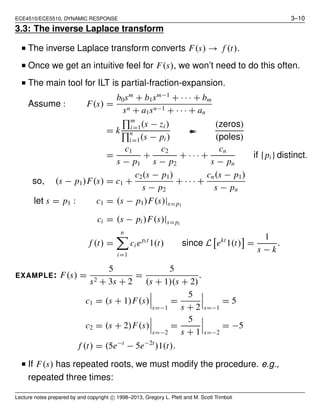
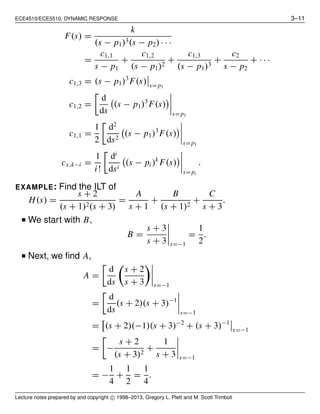
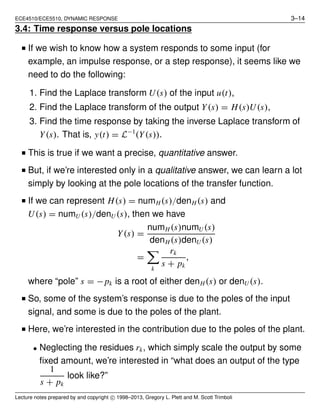
DYNAMIC RESPONSE
3.1: System response in the time domain
■ We can now model dynamic systems with differential equations.
What do these equations mean?
■ We’ll proceed by looking at a system’s response to certain inputs in
the time domain.
■ Then, we’ll see how the Laplace transform can make our lives a lot
easier by simplifying the math.
■ This will give insights into how we might specify the way the system
should respond.
■ Finally, we’ll preview how adding dynamics (e.g., a controller) can
change how the system responds.
Some important input signals
■ Several signals recur throughout this course.
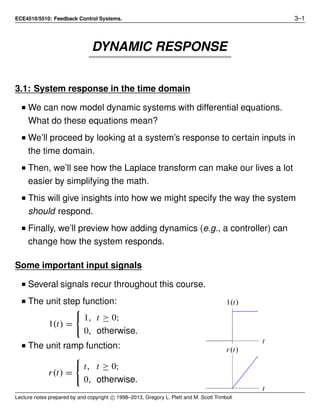
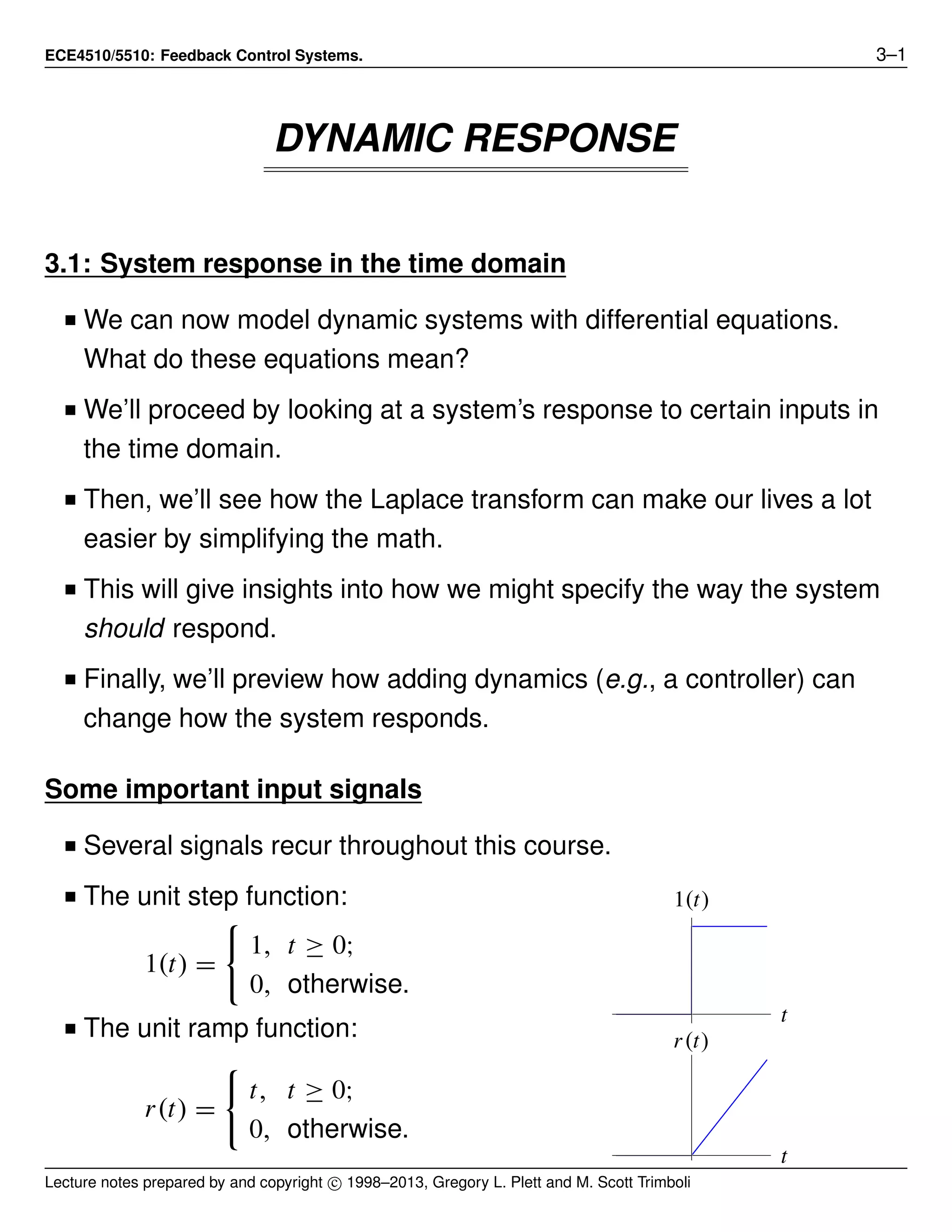
■ The unit step function:
1(t) =
1, t ≥ 0;
0, otherwise.
t
1(t)
■ The unit ramp function:
r(t) =
t, t ≥ 0;
0, otherwise.
t
r(t)
Lecture notes prepared by and copyright c⃝ 1998–2013, Gregory L. Plett and M. Scott Trimboli
ECE4510/ECE5510, DYNAMIC RESPONSE 3–2
■ The unit parabola function:
p(t) =
⎧
⎨
⎩
t2
2
, t ≥ 0;
0, otherwise.
t
p(t)
■ The cosine/sine functions:
t
cos(t)
t
sin(t)
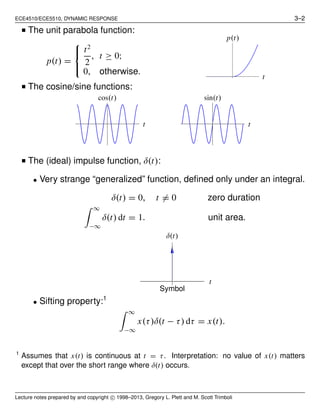
■ The (ideal) impulse function, δ(t):
• Very strange “generalized” function, defined only under an integral.
δ(t) = 0, t ̸= 0 zero duration
∞
−∞
δ(t) dt = 1. unit area.
Symbol
t
δ(t)
• Sifting property:1
∞
−∞
x(τ)δ(t − τ) dτ = x(t).
1
Assumes that x(t) is continuous at t = τ. Interpretation: no value of x(t) matters
except that over the short range where δ(t) occurs.
Lecture notes prepared by and copyright c⃝ 1998–2013, Gregory L. Plett and M. Scott Trimboli
ECE4510/ECE5510, DYNAMIC RESPONSE 3–3
Time response of a linear time invariant system
■ Let y(t) be the output of an LTI system with input x(t).
y(t) = T[x(t)]
= T
∞
−∞
x(τ)δ(t − τ) dτ (sifting)
=
∞
−∞
x(τ)T[δ(t − τ)] dτ. (linear)
Let h(t, τ) = T[δ(t − τ)]
=
∞
−∞
x(τ)h(t, τ) dτ
If the system is time invariant, h(t, τ) = h(t − τ)
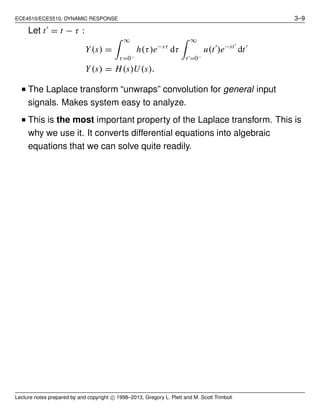
=
∞
−∞
x(τ)h(t − τ) dτ (time invariant)
△
= x(t) ∗ h(t).
■ The output of an LTI system is equal to the convolution of its impulse
response with the input.
■ This makes life EASY (TRUST me!)
EXAMPLE: Finding an impulse response:
■ Consider a first-order system, ˙y(t) + ky(t) = u(t).
■ Let y(0−
) = 0, u(t) = δ(t).
■ For positive time we have ˙y(t) + ky(t) = 0. Recall from your
differential-equation math course: y(t) = Aest
, solve for A, s.
˙y(t) = Asest
Lecture notes prepared by and copyright c⃝ 1998–2013, Gregory L. Plett and M. Scott Trimboli
ECE4510/ECE5510, DYNAMIC RESPONSE 3–4
Asest
+ k Aest
= 0
s + k = 0
s = −k.
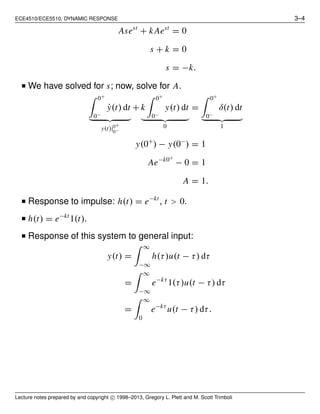
■ We have solved for s; now, solve for A.
0+
0−
˙y(t) dt
y(t)|0+
0−
+ k
0+
0−
y(t) dt
0
=
0+
0−
δ(t) dt
1
y(0+
) − y(0−
) = 1
Ae−k0+
− 0 = 1
A = 1.
■ Response to impulse: h(t) = e−kt
, t > 0.
■ h(t) = e−kt
1(t).
■ Response of this system to general input:
y(t) =
∞
−∞
h(τ)u(t − τ) dτ
=
∞
−∞
e−kτ
1(τ)u(t − τ) dτ
=
∞
0
e−kτ
u(t − τ) dτ.
Lecture notes prepared by and copyright c⃝ 1998–2013, Gregory L. Plett and M. Scott Trimboli
ECE4510/ECE5510, DYNAMIC RESPONSE 3–5
3.2: Transfer functions
■ Response to impulse = “impulse response”: h(t).
■ Response to general input = messy convolution: h(t) ∗ u(t).
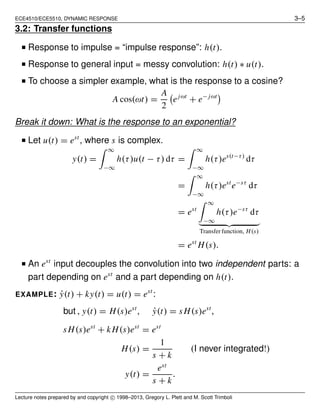
■ To choose a simpler example, what is the response to a cosine?
A cos(ωt) =
A
2
ejωt
+ e− jωt
Break it down: What is the response to an exponential?
■ Let u(t) = est
, where s is complex.
y(t) =
∞
−∞
h(τ)u(t − τ) dτ =
∞
−∞
h(τ)es(t−τ)
dτ
=
∞
−∞
h(τ)est
e−sτ
dτ
= est
∞
−∞
h(τ)e−sτ
dτ
Transfer function, H(s)
= est
H(s).
■ An est
input decouples the convolution into two independent parts: a
part depending on est
and a part depending on h(t).
EXAMPLE: ˙y(t) + ky(t) = u(t) = est
:
but , y(t) = H(s)est
, ˙y(t) = sH(s)est
,
sH(s)est
+ kH(s)est
= est
H(s) =
1
s + k
(I never integrated!)
y(t) =
est
s + k
.
Lecture notes prepared by and copyright c⃝ 1998–2013, Gregory L. Plett and M. Scott Trimboli
ECE4510/ECE5510, DYNAMIC RESPONSE 3–6
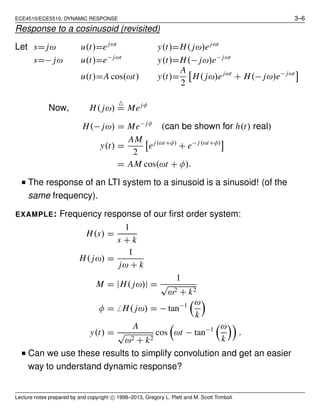
Response to a cosinusoid (revisited)
Let s= jω u(t)=ejωt
y(t)=H( jω)ejωt
s=− jω u(t)=e− jωt
y(t)=H(− jω)e− jωt
u(t)=A cos(ωt) y(t)=
A
2
H( jω)ejωt
+ H(− jω)e− jωt
Now, H( jω)
△
= Mejφ
H(− jω) = Me− jφ
(can be shown for h(t) real)
y(t) =
AM
2
ej(ωt+φ)
+ e− j(ωt+φ)
= AM cos(ωt + φ).
■ The response of an LTI system to a sinusoid is a sinusoid! (of the
same frequency).
EXAMPLE: Frequency response of our first order system:
H(s) =
1
s + k
H( jω) =
1
jω + k
M = |H( jω)| =
1
√
ω2 + k2
φ = ̸ H( jω) = − tan−1 ω
k
y(t) =
A
√
ω2 + k2
cos ωt − tan−1 ω
k
.
■ Can we use these results to simplify convolution and get an easier
way to understand dynamic response?
Lecture notes prepared by and copyright c⃝ 1998–2013, Gregory L. Plett and M. Scott Trimboli
ECE4510/ECE5510, DYNAMIC RESPONSE 3–7
Defining the Laplace L− transform
■ We have seen that if a system has an impulse response h(t), we can
compute a transfer function H(s),
H(s) =
∞
−∞
h(t)e−st
dt.
■ Since we deal with causal systems (possibly with an impulse at
t = 0), we can integrate from 0−
instead of negative infinity.
H(s) =
∞
0−
h(t)e−st
dt.
■ This is called the one-sided (uni-lateral) Laplace transform of h(t).
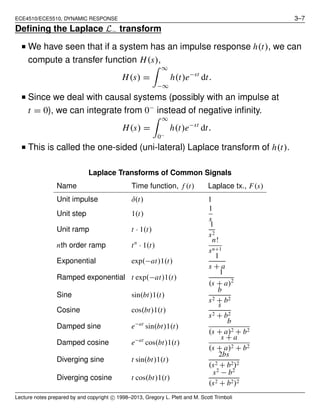
Laplace Transforms of Common Signals
Name Time function, f (t) Laplace tx., F(s)
Unit impulse δ(t) 1
Unit step 1(t)
1
s
Unit ramp t · 1(t)
1
s2
nth order ramp tn
· 1(t)
n!
sn+1
Exponential exp(−at)1(t)
1
s + a
Ramped exponential t exp(−at)1(t)
1
(s + a)2
Sine sin(bt)1(t)
b
s2 + b2
Cosine cos(bt)1(t)
s
s2 + b2
Damped sine e−at
sin(bt)1(t)
b
(s + a)2 + b2
Damped cosine e−at
cos(bt)1(t)
s + a
(s + a)2 + b2
Diverging sine t sin(bt)1(t)
2bs
(s2 + b2)2
Diverging cosine t cos(bt)1(t)
s2
− b2
(s2 + b2)2
Lecture notes prepared by and copyright c⃝ 1998–2013, Gregory L. Plett and M. Scott Trimboli
ECE4510/ECE5510, DYNAMIC RESPONSE 3–8
Properties of the Laplace transform
■ Superposition: L {af1(t) + bf2(t)} = aF1(s) + bF2(s).
■ Time delay: L { f (t − τ)} = e−sτ
F(s).
■ Time scaling: L { f (at)} =
1
|a|
F
s
a
.
(useful if original equations are expressed poorly in time scale. e.g.,
measuring disk-drive seek speed in hours).
■ Differentiation:
L ˙f (t) = sF(s) − f (0−
)
L ¨f (t) = s2
F(s) − s f (0−
) − ˙f (0−
)
L f (m)
(t) = sm
F(s) − sm−1
f (0−
) − . . . − f (m−1)
(0−
).
■ Integration: L
t
0−
f (τ) dτ =
1
s
F(s).
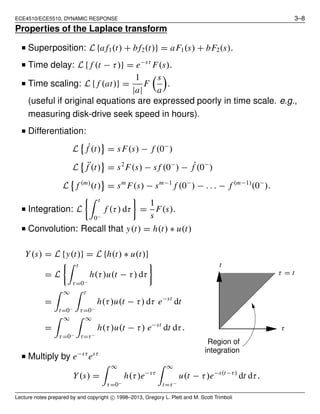
■ Convolution: Recall that y(t) = h(t) ∗ u(t)
Y(s) = L {y(t)} = L {h(t) ∗ u(t)}
= L
t
τ=0−
h(τ)u(t − τ) dτ
=
∞
t=0−
t
τ=0−
h(τ)u(t − τ) dτ e−st
dt
=
∞
τ=0−
∞
t=τ−
h(τ)u(t − τ) e−st
dt dτ.
t
τ
τ = t
Region of
integration
■ Multiply by e−sτ
esτ
Y(s) =
∞
τ=0−
h(τ)e−sτ
∞
t=τ−
u(t − τ)e−s(t−τ)
dt dτ.
Lecture notes prepared by and copyright c⃝ 1998–2013, Gregory L. Plett and M. Scott Trimboli
ECE4510/ECE5510, DYNAMIC RESPONSE 3–9
Let t′
= t − τ :
Y(s) =
∞
τ=0−
h(τ)e−sτ
dτ
∞
t′=0−
u(t′
)e−st′
dt′
Y(s) = H(s)U(s).
■ The Laplace transform “unwraps” convolution for general input
signals. Makes system easy to analyze.
■ This is the most important property of the Laplace transform. This is
why we use it. It converts differential equations into algebraic
equations that we can solve quite readily.
Lecture notes prepared by and copyright c⃝ 1998–2013, Gregory L. Plett and M. Scott Trimboli
ECE4510/ECE5510, DYNAMIC RESPONSE 3–10
3.3: The inverse Laplace transform
■ The inverse Laplace transform converts F(s) → f (t).
■ Once we get an intuitive feel for F(s), we won’t need to do this often.
■ The main tool for ILT is partial-fraction-expansion.
Assume : F(s) =
b0sm
+ b1sm−1
+ · · · + bm
sn + a1sn−1 + · · · + an
= k
m
i=1(s − zi)
n
i=1(s − pi )
➠ (zeros)
(poles)
=
c1
s − p1
+
c2
s − p2
+ · · · +
cn
s − pn
if {pi} distinct.
so, (s − p1)F(s) = c1 +
c2(s − p1)
s − p2
+ · · · +
cn(s − p1)
s − pn
let s = p1 : c1 = (s − p1)F(s)|s=p1
ci = (s − pi)F(s)|s=pi
f (t) =
n
i=1
ciepi t
1(t) since L ekt
1(t) =
1
s − k
.
EXAMPLE: F(s) =
5
s2 + 3s + 2
=
5
(s + 1)(s + 2)
.
c1 = (s + 1)F(s)
s=−1
=
5
s + 2 s=−1
= 5
c2 = (s + 2)F(s)
s=−2
=
5
s + 1 s=−2
= −5
f (t) = (5e−t
− 5e−2t
)1(t).
■ If F(s) has repeated roots, we must modify the procedure. e.g.,
repeated three times:
Lecture notes prepared by and copyright c⃝ 1998–2013, Gregory L. Plett and M. Scott Trimboli
ECE4510/ECE5510, DYNAMIC RESPONSE 3–11
F(s) =
k
(s − p1)3(s − p2) · · ·
=
c1,1
s − p1
+
c1,2
(s − p1)2
+
c1,3
(s − p1)3
+
c2
s − p2
+ · · ·
c1,3 = (s − p1)3
F(s) s=p1
c1,2 =
d
ds
(s − p1)3
F(s)
s=p1
c1,1 =
1
2
d2
ds2
(s − p1)3
F(s)
s=p1
cx,k−i =
1
i!
di
dsi
(s − pi)k
F(s)
s=pi
.
EXAMPLE: Find the ILT of
H(s) =
s + 2
(s + 1)2(s + 3)
=
A
s + 1
+
B
(s + 1)2
+
C
s + 3
.
■ We start with B,
B =
s + 3
s + 3 s=−1
=
1
2
.
■ Next, we find A,
A =
d
ds
s + 2
s + 3 s=−1
=
d
ds
(s + 2)(s + 3)−1
s=−1
= (s + 2)(−1)(s + 3)−2
+ (s + 3)−1
s=−1
= −
s + 2
(s + 3)2
+
1
s + 3 s=−1
= −
1
4
+
1
2
=
1
4
.
Lecture notes prepared by and copyright c⃝ 1998–2013, Gregory L. Plett and M. Scott Trimboli
ECE4510/ECE5510, DYNAMIC RESPONSE 3–12
■ Lastly, we find C,
C =
s + 2
(s + 1)2
s=−3
= −
1
4
.
■ Therefore, the inverse Laplace transform we are looking for is
h(t) =
1
2
te−t
+
1
4
e−t
−
1
4
e−3t
1(t).
EXAMPLE: Find ILT of
s + 3
(s + 1)(s + 2)2
.
■ ans: f (t) = (2e−t
− 2e−2t
− te−2t
from repeated root.
)1(t).
■ Note that this is quite tedious, but MATLAB can help.
■ Try MATLAB with two examples; first, F(s) =
5
s2 + 3s + 2
.
Example 1. Example 2.
>> Fnum = [0 0 5]; >> Fnum = [0 0 1 3];
>> Fden = [1 3 2]; >> Fden = conv([1 1],conv([1 2],[1 2]));
[r,p,k] = residue(Fnum,Fden); [r,p,k] = residue(Fnum,Fden);
r = -5 r = -2
5 -1
p = -2 2
-1 p = -2
k = [] -2
-1
k = []
■ When you use “residue” and get repeated roots, BE SURE to type
“help residue” to correctly interpret the result.
Lecture notes prepared by and copyright c⃝ 1998–2013, Gregory L. Plett and M. Scott Trimboli
ECE4510/ECE5510, DYNAMIC RESPONSE 3–13
Using the Laplace transform to solve problems
■ We can use the Laplace transform to solve both homogeneous and
forced differential equations.
EXAMPLE: ¨y(t) + y(t) = 0, y(0−
) = α, ˙y(0−
) = β.
s2
Y(s) − αs − β + Y(s) = 0
Y(s)(s2
+ 1) = αs + β
Y(s) =
αs + β
s2 + 1
=
αs
s2 + 1
+
β
s2 + 1
.
From tables, y(t) = [α cos(t) + β sin(t)]1(t).
■ If initial conditions are zero, things are very simple.
EXAMPLE:
¨y(t)+5 ˙y(t)+4y(t) = u(t), y(0−
) = 0, ˙y(0−
) = 0, u(t) = 2e−2t
1(t).
s2
Y(s) + 5sY(s) + 4Y(s) =
2
s + 2
Y(s) =
2
(s + 2)(s + 1)(s + 4)
=
−1
s + 2
+
2/3
s + 1
+
1/3
s + 4
.
From tables, y(t) = −e−2t
+
2
3
e−t
+
1
3
e−4t
1(t).
Lecture notes prepared by and copyright c⃝ 1998–2013, Gregory L. Plett and M. Scott Trimboli
ECE4510/ECE5510, DYNAMIC RESPONSE 3–14
3.4: Time response versus pole locations
■ If we wish to know how a system responds to some input (for
example, an impulse response, or a step response), it seems like we
need to do the following:
1. Find the Laplace transform U(s) of the input u(t),
2. Find the Laplace transform of the output Y(s) = H(s)U(s),
3. Find the time response by taking the inverse Laplace transform of
Y(s). That is, y(t) = L−1
(Y(s)).
■ This is true if we want a precise, quantitative answer.
■ But, if we’re interested only in a qualitative answer, we can learn a lot
simply by looking at the pole locations of the transfer function.
■ If we can represent H(s) = numH(s)/denH (s) and
U(s) = numU (s)/denU (s), then we have
Y(s) =
numH (s)numU (s)
denH (s)denU (s)
=
k
rk
s + pk
,
where “pole” s = −pk is a root of either denH(s) or denU (s).
■ So, some of the system’s response is due to the poles of the input
signal, and some is due to the poles of the plant.
■ Here, we’re interested in the contribution due to the poles of the plant.
• Neglecting the residues rk, which simply scale the output by some
fixed amount, we’re interested in “what does an output of the type
1
s + pk
look like?”
Lecture notes prepared by and copyright c⃝ 1998–2013, Gregory L. Plett and M. Scott Trimboli
ECE4510/ECE5510, DYNAMIC RESPONSE 3–15
• That is, the poles qualitatively determine the behavior of the
system; zeros (equivalently, residues) quantify this relationship.
■ Note that the poles pk may be real, or they may occur in
complex-conjugate pairs.
■ So, in the next sections, we look at the time responses of real poles
and of complex-conjugate poles.
Time response due to a real pole
■ Consider a transfer function having a single real pole:
H(s) =
1
s + σ
➠ h(t) = e−σt
1(t).
■ If σ > 0, pole is at s < 0, STABLE i.e., impulse response decays, and
any bounded input produces bounded output.
■ If σ < 0, pole is at s > 0, UNSTABLE.
■ σ is “time constant” factor: τ = 1/σ.
0 1 2 3 4 5
0
0.2
0.4
0.6
0.8
1
impulse([0 1],[1 1]);
Time (sec × τ)
t = τ
←−
1
e
e−σt
h(t)
0 1 2 3 4 5
0
0.2
0.4
0.6
0.8
1
step([0 1],[1 1]);
Time (sec × τ)
t = τ
y(t)×K
K(1 − e−t/τ
)
System response. K = dc gain
Response to initial condition
−→ 0.
Time response due to complex-conjugate poles
■ Now, consider a second-order transfer function having
complex-conjugate poles
Lecture notes prepared by and copyright c⃝ 1998–2013, Gregory L. Plett and M. Scott Trimboli
ECE4510/ECE5510, DYNAMIC RESPONSE 3–16
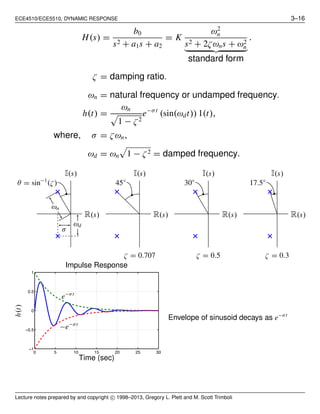
H(s) =
b0
s2 + a1s + a2
= K
ω2
n
s2 + 2ζωns + ω2
n
standard form
.
ζ = damping ratio.
ωn = natural frequency or undamped frequency.
h(t) =
ωn
1 − ζ2
e−σt
(sin(ωdt)) 1(t),
where, σ = ζωn,
ωd = ωn 1 − ζ2 = damped frequency.
θ = sin−1
(ζ)
I(s)
R(s)
ωd
σ
ωn
ζ = 0.707
I(s)
R(s)
45◦
ζ = 0.5
I(s)
R(s)
30◦
ζ = 0.3
I(s)
R(s)
17.5◦
0 5 10 15 20 25 30
−1
−0.5
0
0.5
1
e−σt
−e−σt
Time (sec)
h(t)
Impulse Response
Envelope of sinusoid decays as e−σt
Lecture notes prepared by and copyright c⃝ 1998–2013, Gregory L. Plett and M. Scott Trimboli
ECE4510/ECE5510, DYNAMIC RESPONSE 3–17
0 2 4 6 8 10 12
−1
−0.5
0
0.5
1
ζ = 0
0.2
0.4
0.6
0.8ζ = 1
ωnt
y(t)
Impulse Responses of 2nd-Order Systems
0 2 4 6 8 10 12
0
0.5
1
1.5
2
ζ = 0
0.2
0.4
0.6
0.8
1.0
ωnt
y(t)
Step Responses of 2nd-Order Systems
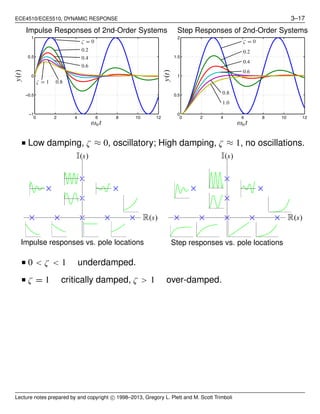
■ Low damping, ζ ≈ 0, oscillatory; High damping, ζ ≈ 1, no oscillations.
I(s)
R(s)
Impulse responses vs. pole locations
I(s)
R(s)
Step responses vs. pole locations
■ 0 < ζ < 1 underdamped.
■ ζ = 1 critically damped, ζ > 1 over-damped.
Lecture notes prepared by and copyright c⃝ 1998–2013, Gregory L. Plett and M. Scott Trimboli
ECE4510/ECE5510, DYNAMIC RESPONSE 3–18
3.5: Time-domain specifications
■ We have seen impulse and step responses for first- and second-order
systems.
■ Our control problem may be to specify exactly what the response
SHOULD be.
■ Usually expressed in terms of the step response.
0.1
0.9
1
ttr
Mptp
ts
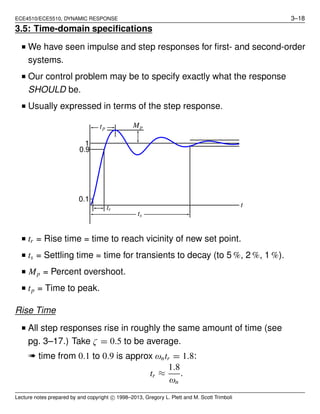
■ tr = Rise time = time to reach vicinity of new set point.
■ ts = Settling time = time for transients to decay (to 5 %, 2 %, 1 %).
■ Mp = Percent overshoot.
■ tp = Time to peak.
Rise Time
■ All step responses rise in roughly the same amount of time (see
pg. 3–17.) Take ζ = 0.5 to be average.
➠ time from 0.1 to 0.9 is approx ωntr = 1.8:
tr ≈
1.8
ωn
.
Lecture notes prepared by and copyright c⃝ 1998–2013, Gregory L. Plett and M. Scott Trimboli
ECE4510/ECE5510, DYNAMIC RESPONSE 3–19
■ We could make this more accurate, but note:
• Only valid for 2nd-order systems with no zeros.
• Use this as approximate design “rule of thumb” and iterate design
until spec. is met.
Peak Time and Overshoot
■ Step response can be found from ILT of H(s)/s.
y(t) = 1 − e−σt
cos(ωdt) +
σ
ωd
sin(ωdt) ,
ωd = ωn 1 − ζ2, σ = ζωn.
■ Peak occurs when ˙y(t) = 0
˙y(t) = σe−σt
cos(ωdt) +
σ
ωd
sin(ωdt) − e−σt
(−ωd sin(ωdt) + σ cos(ωdt))
= e−σt σ2
ωd
sin(ωdt) + ωd sin(ωdt) = 0.
■ So,
ωdtp = π,
tp =
π
ωd
=
π
ωn 1 − ζ2
.
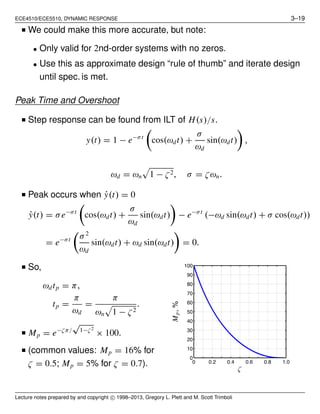
■ Mp = e−ζπ/
√
1−ζ2
× 100.
■ (common values: Mp = 16% for
ζ = 0.5; Mp = 5% for ζ = 0.7). 0 0.2 0.4 0.6 0.8 1.0
0
10
20
30
40
50
60
70
80
90
100
ζ
Mp,%
Lecture notes prepared by and copyright c⃝ 1998–2013, Gregory L. Plett and M. Scott Trimboli
Text
ECE4510/ECE5510, DYNAMIC RESPONSE 3–20
Settling Time
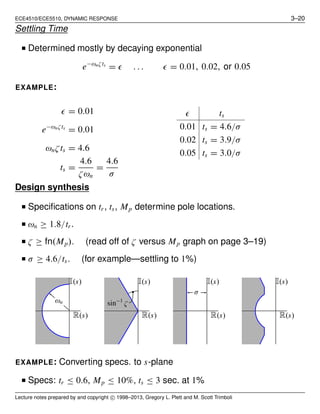
■ Determined mostly by decaying exponential
e−ωnζts
= ϵ . . . ϵ = 0.01, 0.02, or 0.05
EXAMPLE:
ϵ = 0.01
e−ωnζts
= 0.01
ωnζts = 4.6
ts =
4.6
ζωn
=
4.6
σ
ϵ ts
0.01 ts = 4.6/σ
0.02 ts = 3.9/σ
0.05 ts = 3.0/σ
Design synthesis
■ Specifications on tr, ts, Mp determine pole locations.
■ ωn ≥ 1.8/tr.
■ ζ ≥ fn(Mp). (read off of ζ versus Mp graph on page 3–19)
■ σ ≥ 4.6/ts. (for example—settling to 1%)
I(s)
R(s)
ωn
I(s)
R(s)
sin−1
ζ
I(s)
R(s)
σ
I(s)
R(s)
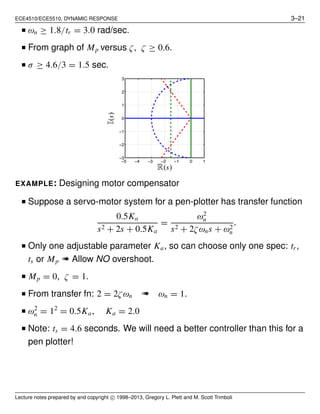
EXAMPLE: Converting specs. to s-plane
■ Specs: tr ≤ 0.6, Mp ≤ 10%, ts ≤ 3 sec. at 1%
Lecture notes prepared by and copyright c⃝ 1998–2013, Gregory L. Plett and M. Scott Trimboli
ECE4510/ECE5510, DYNAMIC RESPONSE 3–21
■ ωn ≥ 1.8/tr = 3.0 rad/sec.
■ From graph of Mp versus ζ, ζ ≥ 0.6.
■ σ ≥ 4.6/3 = 1.5 sec.
−5 −4 −3 −2 −1 0 1
−3
−2
−1
0
1
2
3
R(s)
I(s)
EXAMPLE: Designing motor compensator
■ Suppose a servo-motor system for a pen-plotter has transfer function
0.5Ka
s2 + 2s + 0.5Ka
=
ω2
n
s2 + 2ζωns + ω2
n
.
■ Only one adjustable parameter Ka, so can choose only one spec: tr,
ts or Mp ➠ Allow NO overshoot.
■ Mp = 0, ζ = 1.
■ From transfer fn: 2 = 2ζωn ➠ ωn = 1.
■ ω2
n = 12
= 0.5Ka, Ka = 2.0
■ Note: ts = 4.6 seconds. We will need a better controller than this for a
pen plotter!
Lecture notes prepared by and copyright c⃝ 1998–2013, Gregory L. Plett and M. Scott Trimboli
ECE4510/ECE5510, DYNAMIC RESPONSE 3–22
3.6: Time response vs. pole locations: Higher order systems
■ We have looked at first-order and second-order systems without
zeros, and with unity gain.
Non-unity gain
■ If we multiply by K, the dc gain is K. tr, ts, Mp, tp are not affected.
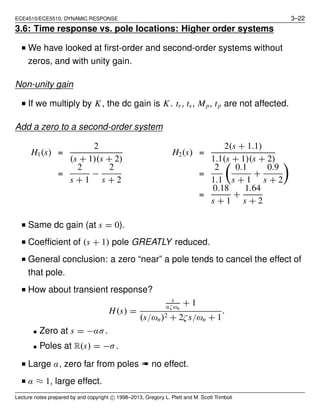
Add a zero to a second-order system
H1(s) =
2
(s + 1)(s + 2)
H2(s) =
2(s + 1.1)
1.1(s + 1)(s + 2)
=
2
s + 1
−
2
s + 2
=
2
1.1
0.1
s + 1
+
0.9
s + 2
=
0.18
s + 1
+
1.64
s + 2
■ Same dc gain (at s = 0).
■ Coefficient of (s + 1) pole GREATLY reduced.
■ General conclusion: a zero “near” a pole tends to cancel the effect of
that pole.
■ How about transient response?
H(s) =
s
αζωn
+ 1
(s/ωn)2 + 2ζs/ωn + 1
.
• Zero at s = −ασ.
• Poles at R(s) = −σ.
■ Large α, zero far from poles ➠ no effect.
■ α ≈ 1, large effect.
Lecture notes prepared by and copyright c⃝ 1998–2013, Gregory L. Plett and M. Scott Trimboli
ECE4510/ECE5510, DYNAMIC RESPONSE 3–23
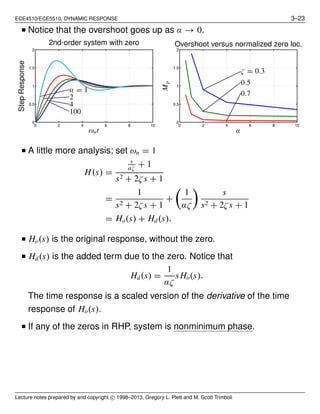
■ Notice that the overshoot goes up as α → 0.
0 2 4 6 8 10
0
0.5
1
1.5
2
α = 1
2
4
100
ωnt
StepResponse
2nd-order system with zero
0 2 4 6 8 10
0
0.5
1
1.5
2
ζ = 0.3
0.5
0.7
α
Mp
Overshoot versus normalized zero loc.
■ A little more analysis; set ωn = 1
H(s) =
s
αζ
+ 1
s2 + 2ζs + 1
=
1
s2 + 2ζs + 1
+
1
αζ
s
s2 + 2ζs + 1
= Ho(s) + Hd(s).
■ Ho(s) is the original response, without the zero.
■ Hd(s) is the added term due to the zero. Notice that
Hd(s) =
1
αζ
sHo(s).
The time response is a scaled version of the derivative of the time
response of Ho(s).
■ If any of the zeros in RHP, system is nonminimum phase.
Lecture notes prepared by and copyright c⃝ 1998–2013, Gregory L. Plett and M. Scott Trimboli
ECE4510/ECE5510, DYNAMIC RESPONSE 3–24
0 2 4 6 8 10
−0.5
0
0.5
1
1.5
2
H(s)
Ho(s)
Hd(s)
Time (sec)
y(t)
2nd-order min-phase step resp.
0 2 4 6 8 10
−1.5
−1
−0.5
0
0.5
1
1.5
Ho(s)
H(s)
Hd(s)
Time (sec)
y(t)
2nd-order nonmin-phase step resp.
Add a pole to a second order system
H(s) =
1
s
αζωn
+ 1 [(s/ωn)2 + 2ζs/ωn + 1]
.
■ Original poles at R(s) = −σ = −ζωn.
■ New pole at s = −αζωn.
■ Major effect is an increase in rise time.
0 1 2 3 4 5 6 7 8
0
0.2
0.4
0.6
0.8
1
1.2
1.4
α = 1
2
5
100
ωnt
StepResponse
2nd-order system with pole
0 2 4 6 8 10
1
2
3
4
5
6
7
8
9
ζ = 1.0
0.7
0.5
α
ωntr
Norm. rise time vs. norm. pole loc.
Summary of higher-order approximations
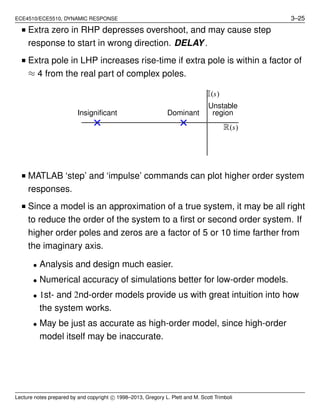
■ Extra zero in LHP will increase overshoot if the zero is within a factor
of ≈ 4 from the real part of complex poles.
Lecture notes prepared by and copyright c⃝ 1998–2013, Gregory L. Plett and M. Scott Trimboli
ECE4510/ECE5510, DYNAMIC RESPONSE 3–25
■ Extra zero in RHP depresses overshoot, and may cause step
response to start in wrong direction. DELAY.
■ Extra pole in LHP increases rise-time if extra pole is within a factor of
≈ 4 from the real part of complex poles.
Unstable
regionDominantInsignificant
I(s)
R(s)
■ MATLAB ‘step’ and ‘impulse’ commands can plot higher order system
responses.
■ Since a model is an approximation of a true system, it may be all right
to reduce the order of the system to a first or second order system. If
higher order poles and zeros are a factor of 5 or 10 time farther from
the imaginary axis.
• Analysis and design much easier.
• Numerical accuracy of simulations better for low-order models.
• 1st- and 2nd-order models provide us with great intuition into how
the system works.
• May be just as accurate as high-order model, since high-order
model itself may be inaccurate.
Lecture notes prepared by and copyright c⃝ 1998–2013, Gregory L. Plett and M. Scott Trimboli
ECE4510/ECE5510, DYNAMIC RESPONSE 3–26
3.7: Changing dynamic response
■ Topic of the rest of the course.
■ Important tool: block diagram manipulation.
Block-diagram manipulation
■ We have already seen block diagrams (see pg. 1–4).
■ Shows information/energy flow in a system, and when used with
Laplace transforms, can simplify complex system dynamics.
■ Four BASIC configurations:
H(s) Y(s)U(s) Y(s) = H(s)U(s)
H1(s) H2(s) Y(s)U(s) Y(s) = [H2(s)H1(s)]U(s)
H1(s)
H2(s)
Y(s)U(s) Y(s) = [H1(s) + H2(s)]U(s)
H1(s)
H2(s)
Y(s)R(s)
U1(s)
Y2(s) U2(s)
U1(s) = R(s) − Y2(s)
Y2(s) = H2(s)H1(s)U1(s)
so, U1(s) = R(s) − H2(s)H1(s)U1(s)
=
R(s)
1 + H2(s)H1(s)
Y(s) = H1(s)U1(s)
=
H1(s)
1 + H2(s)H1(s)
R(s)
Lecture notes prepared by and copyright c⃝ 1998–2013, Gregory L. Plett and M. Scott Trimboli
ECE4510/ECE5510, DYNAMIC RESPONSE 3–27
■ Alternate representation
H(s)
H1(s)
H1(s)
H1(s) H2(s)
H2(s)
−H2(s)
Y(s)
Y(s)
Y(s)
Y(s)
U(s)
U(s)
U(s)
R(s)
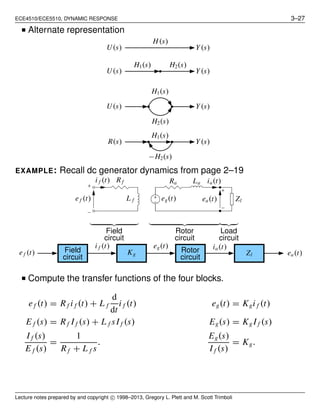
EXAMPLE: Recall dc generator dynamics from page 2–19
R f Ra Lai f (t) ia(t)
e f (t) L f eg(t) Zlea(t)
Field
circuit
Rotor
circuit
Load
circuit
ef (t) ea(t)
i f (t) eg(t) ia(t)Field
circuit
Kg
Rotor
circuit
Zl
■ Compute the transfer functions of the four blocks.
ef (t) = R f i f (t) + L f
d
dt
i f (t)
E f (s) = R f I f (s) + L f sI f (s)
I f (s)
E f (s)
=
1
R f + L f s
.
eg(t) = Kgi f (t)
Eg(s) = Kg I f (s)
Eg(s)
I f (s)
= Kg.
Lecture notes prepared by and copyright c⃝ 1998–2013, Gregory L. Plett and M. Scott Trimboli
ECE4510/ECE5510, DYNAMIC RESPONSE 3–28
ea(t) = ia(t)Zl
Ea(s) = Zl Ia(s)
Ea(s)
Ia(s)
= Zl.
eg(t) = Raia(t) + La
d
dt
ia(t) + ea(t)
Eg(s) = Ra Ia(s) + LasIa(s) + Ea(s)
= (Ra + Las + Zl) Ia(s)
Ia(s)
Eg(s)
=
1
Las + Ra + Zl
.
■ Put everything together.
Ea(s)
E f (s)
=
Ea(s)
Ia(s)
Ia(s)
Eg(s)
Eg(s)
I f (s)
I f (s)
E f (s)
=
Kg Zl
L f s + R f (Las + Ra + Zl)
.
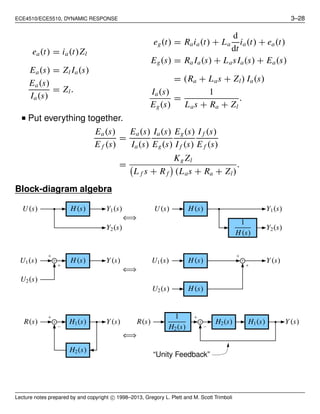
Block-diagram algebra
⇐⇒
⇐⇒
⇐⇒
H(s)
H(s)
H(s)H(s)
H(s)
1
H(s)
H1(s)H1(s) H2(s)
H2(s)
1
H2(s)
Y(s)Y(s)
Y(s)Y(s)
Y1(s)Y1(s)
Y2(s)Y2(s)
U(s)U(s)
U1(s)U1(s)
U2(s)
U2(s)
R(s)R(s)
“Unity Feedback”
Lecture notes prepared by and copyright c⃝ 1998–2013, Gregory L. Plett and M. Scott Trimboli
ECE4510/ECE5510, DYNAMIC RESPONSE 3–29
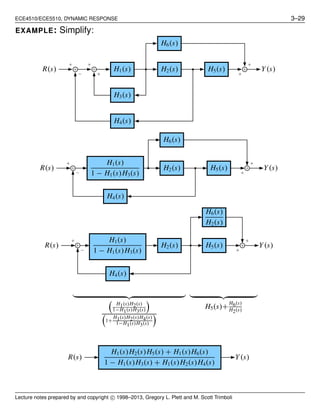
EXAMPLE: Simplify:
H1(s) H2(s)
H3(s)
H4(s)
H5(s)
H6(s)
Y(s)R(s)
H1(s)
1 − H1(s)H3(s)
H2(s)
H4(s)
H5(s)
H6(s)
Y(s)R(s)
H1(s)
1 − H1(s)H3(s)
H2(s)
H4(s)
H5(s)
H6(s)
H2(s)
Y(s)R(s)
H1(s)H2(s)
1−H1(s)H3(s)
1+
H1(s)H2(s)H4(s)
1−H1(s)H3(s)
H5(s)+
H6(s)
H2(s)
H1(s)H2(s)H5(s) + H1(s)H6(s)
1 − H1(s)H3(s) + H1(s)H2(s)H4(s)
R(s) Y(s)
Lecture notes prepared by and copyright c⃝ 1998–2013, Gregory L. Plett and M. Scott Trimboli

Ece4510 notes03

  • 1.
    ECE4510/5510: Feedback ControlSystems. 3–1 DYNAMIC RESPONSE 3.1: System response in the time domain ■ We can now model dynamic systems with differential equations. What do these equations mean? ■ We’ll proceed by looking at a system’s response to certain inputs in the time domain. ■ Then, we’ll see how the Laplace transform can make our lives a lot easier by simplifying the math. ■ This will give insights into how we might specify the way the system should respond. ■ Finally, we’ll preview how adding dynamics (e.g., a controller) can change how the system responds. Some important input signals ■ Several signals recur throughout this course. ■ The unit step function: 1(t) = 1, t ≥ 0; 0, otherwise. t 1(t) ■ The unit ramp function: r(t) = t, t ≥ 0; 0, otherwise. t r(t) Lecture notes prepared by and copyright c⃝ 1998–2013, Gregory L. Plett and M. Scott Trimboli
  • 2.
    ECE4510/ECE5510, DYNAMIC RESPONSE3–2 ■ The unit parabola function: p(t) = ⎧ ⎨ ⎩ t2 2 , t ≥ 0; 0, otherwise. t p(t) ■ The cosine/sine functions: t cos(t) t sin(t) ■ The (ideal) impulse function, δ(t): • Very strange “generalized” function, defined only under an integral. δ(t) = 0, t ̸= 0 zero duration ∞ −∞ δ(t) dt = 1. unit area. Symbol t δ(t) • Sifting property:1 ∞ −∞ x(τ)δ(t − τ) dτ = x(t). 1 Assumes that x(t) is continuous at t = τ. Interpretation: no value of x(t) matters except that over the short range where δ(t) occurs. Lecture notes prepared by and copyright c⃝ 1998–2013, Gregory L. Plett and M. Scott Trimboli
  • 3.
    ECE4510/ECE5510, DYNAMIC RESPONSE3–3 Time response of a linear time invariant system ■ Let y(t) be the output of an LTI system with input x(t). y(t) = T[x(t)] = T ∞ −∞ x(τ)δ(t − τ) dτ (sifting) = ∞ −∞ x(τ)T[δ(t − τ)] dτ. (linear) Let h(t, τ) = T[δ(t − τ)] = ∞ −∞ x(τ)h(t, τ) dτ If the system is time invariant, h(t, τ) = h(t − τ) = ∞ −∞ x(τ)h(t − τ) dτ (time invariant) △ = x(t) ∗ h(t). ■ The output of an LTI system is equal to the convolution of its impulse response with the input. ■ This makes life EASY (TRUST me!) EXAMPLE: Finding an impulse response: ■ Consider a first-order system, ˙y(t) + ky(t) = u(t). ■ Let y(0− ) = 0, u(t) = δ(t). ■ For positive time we have ˙y(t) + ky(t) = 0. Recall from your differential-equation math course: y(t) = Aest , solve for A, s. ˙y(t) = Asest Lecture notes prepared by and copyright c⃝ 1998–2013, Gregory L. Plett and M. Scott Trimboli
  • 4.
    ECE4510/ECE5510, DYNAMIC RESPONSE3–4 Asest + k Aest = 0 s + k = 0 s = −k. ■ We have solved for s; now, solve for A. 0+ 0− ˙y(t) dt y(t)|0+ 0− + k 0+ 0− y(t) dt 0 = 0+ 0− δ(t) dt 1 y(0+ ) − y(0− ) = 1 Ae−k0+ − 0 = 1 A = 1. ■ Response to impulse: h(t) = e−kt , t > 0. ■ h(t) = e−kt 1(t). ■ Response of this system to general input: y(t) = ∞ −∞ h(τ)u(t − τ) dτ = ∞ −∞ e−kτ 1(τ)u(t − τ) dτ = ∞ 0 e−kτ u(t − τ) dτ. Lecture notes prepared by and copyright c⃝ 1998–2013, Gregory L. Plett and M. Scott Trimboli
  • 5.
    ECE4510/ECE5510, DYNAMIC RESPONSE3–5 3.2: Transfer functions ■ Response to impulse = “impulse response”: h(t). ■ Response to general input = messy convolution: h(t) ∗ u(t). ■ To choose a simpler example, what is the response to a cosine? A cos(ωt) = A 2 ejωt + e− jωt Break it down: What is the response to an exponential? ■ Let u(t) = est , where s is complex. y(t) = ∞ −∞ h(τ)u(t − τ) dτ = ∞ −∞ h(τ)es(t−τ) dτ = ∞ −∞ h(τ)est e−sτ dτ = est ∞ −∞ h(τ)e−sτ dτ Transfer function, H(s) = est H(s). ■ An est input decouples the convolution into two independent parts: a part depending on est and a part depending on h(t). EXAMPLE: ˙y(t) + ky(t) = u(t) = est : but , y(t) = H(s)est , ˙y(t) = sH(s)est , sH(s)est + kH(s)est = est H(s) = 1 s + k (I never integrated!) y(t) = est s + k . Lecture notes prepared by and copyright c⃝ 1998–2013, Gregory L. Plett and M. Scott Trimboli
  • 6.
    ECE4510/ECE5510, DYNAMIC RESPONSE3–6 Response to a cosinusoid (revisited) Let s= jω u(t)=ejωt y(t)=H( jω)ejωt s=− jω u(t)=e− jωt y(t)=H(− jω)e− jωt u(t)=A cos(ωt) y(t)= A 2 H( jω)ejωt + H(− jω)e− jωt Now, H( jω) △ = Mejφ H(− jω) = Me− jφ (can be shown for h(t) real) y(t) = AM 2 ej(ωt+φ) + e− j(ωt+φ) = AM cos(ωt + φ). ■ The response of an LTI system to a sinusoid is a sinusoid! (of the same frequency). EXAMPLE: Frequency response of our first order system: H(s) = 1 s + k H( jω) = 1 jω + k M = |H( jω)| = 1 √ ω2 + k2 φ = ̸ H( jω) = − tan−1 ω k y(t) = A √ ω2 + k2 cos ωt − tan−1 ω k . ■ Can we use these results to simplify convolution and get an easier way to understand dynamic response? Lecture notes prepared by and copyright c⃝ 1998–2013, Gregory L. Plett and M. Scott Trimboli
  • 7.
    ECE4510/ECE5510, DYNAMIC RESPONSE3–7 Defining the Laplace L− transform ■ We have seen that if a system has an impulse response h(t), we can compute a transfer function H(s), H(s) = ∞ −∞ h(t)e−st dt. ■ Since we deal with causal systems (possibly with an impulse at t = 0), we can integrate from 0− instead of negative infinity. H(s) = ∞ 0− h(t)e−st dt. ■ This is called the one-sided (uni-lateral) Laplace transform of h(t). Laplace Transforms of Common Signals Name Time function, f (t) Laplace tx., F(s) Unit impulse δ(t) 1 Unit step 1(t) 1 s Unit ramp t · 1(t) 1 s2 nth order ramp tn · 1(t) n! sn+1 Exponential exp(−at)1(t) 1 s + a Ramped exponential t exp(−at)1(t) 1 (s + a)2 Sine sin(bt)1(t) b s2 + b2 Cosine cos(bt)1(t) s s2 + b2 Damped sine e−at sin(bt)1(t) b (s + a)2 + b2 Damped cosine e−at cos(bt)1(t) s + a (s + a)2 + b2 Diverging sine t sin(bt)1(t) 2bs (s2 + b2)2 Diverging cosine t cos(bt)1(t) s2 − b2 (s2 + b2)2 Lecture notes prepared by and copyright c⃝ 1998–2013, Gregory L. Plett and M. Scott Trimboli
  • 8.
    ECE4510/ECE5510, DYNAMIC RESPONSE3–8 Properties of the Laplace transform ■ Superposition: L {af1(t) + bf2(t)} = aF1(s) + bF2(s). ■ Time delay: L { f (t − τ)} = e−sτ F(s). ■ Time scaling: L { f (at)} = 1 |a| F s a . (useful if original equations are expressed poorly in time scale. e.g., measuring disk-drive seek speed in hours). ■ Differentiation: L ˙f (t) = sF(s) − f (0− ) L ¨f (t) = s2 F(s) − s f (0− ) − ˙f (0− ) L f (m) (t) = sm F(s) − sm−1 f (0− ) − . . . − f (m−1) (0− ). ■ Integration: L t 0− f (τ) dτ = 1 s F(s). ■ Convolution: Recall that y(t) = h(t) ∗ u(t) Y(s) = L {y(t)} = L {h(t) ∗ u(t)} = L t τ=0− h(τ)u(t − τ) dτ = ∞ t=0− t τ=0− h(τ)u(t − τ) dτ e−st dt = ∞ τ=0− ∞ t=τ− h(τ)u(t − τ) e−st dt dτ. t τ τ = t Region of integration ■ Multiply by e−sτ esτ Y(s) = ∞ τ=0− h(τ)e−sτ ∞ t=τ− u(t − τ)e−s(t−τ) dt dτ. Lecture notes prepared by and copyright c⃝ 1998–2013, Gregory L. Plett and M. Scott Trimboli
  • 9.
    ECE4510/ECE5510, DYNAMIC RESPONSE3–9 Let t′ = t − τ : Y(s) = ∞ τ=0− h(τ)e−sτ dτ ∞ t′=0− u(t′ )e−st′ dt′ Y(s) = H(s)U(s). ■ The Laplace transform “unwraps” convolution for general input signals. Makes system easy to analyze. ■ This is the most important property of the Laplace transform. This is why we use it. It converts differential equations into algebraic equations that we can solve quite readily. Lecture notes prepared by and copyright c⃝ 1998–2013, Gregory L. Plett and M. Scott Trimboli
  • 10.
    ECE4510/ECE5510, DYNAMIC RESPONSE3–10 3.3: The inverse Laplace transform ■ The inverse Laplace transform converts F(s) → f (t). ■ Once we get an intuitive feel for F(s), we won’t need to do this often. ■ The main tool for ILT is partial-fraction-expansion. Assume : F(s) = b0sm + b1sm−1 + · · · + bm sn + a1sn−1 + · · · + an = k m i=1(s − zi) n i=1(s − pi ) ➠ (zeros) (poles) = c1 s − p1 + c2 s − p2 + · · · + cn s − pn if {pi} distinct. so, (s − p1)F(s) = c1 + c2(s − p1) s − p2 + · · · + cn(s − p1) s − pn let s = p1 : c1 = (s − p1)F(s)|s=p1 ci = (s − pi)F(s)|s=pi f (t) = n i=1 ciepi t 1(t) since L ekt 1(t) = 1 s − k . EXAMPLE: F(s) = 5 s2 + 3s + 2 = 5 (s + 1)(s + 2) . c1 = (s + 1)F(s) s=−1 = 5 s + 2 s=−1 = 5 c2 = (s + 2)F(s) s=−2 = 5 s + 1 s=−2 = −5 f (t) = (5e−t − 5e−2t )1(t). ■ If F(s) has repeated roots, we must modify the procedure. e.g., repeated three times: Lecture notes prepared by and copyright c⃝ 1998–2013, Gregory L. Plett and M. Scott Trimboli
  • 11.
    ECE4510/ECE5510, DYNAMIC RESPONSE3–11 F(s) = k (s − p1)3(s − p2) · · · = c1,1 s − p1 + c1,2 (s − p1)2 + c1,3 (s − p1)3 + c2 s − p2 + · · · c1,3 = (s − p1)3 F(s) s=p1 c1,2 = d ds (s − p1)3 F(s) s=p1 c1,1 = 1 2 d2 ds2 (s − p1)3 F(s) s=p1 cx,k−i = 1 i! di dsi (s − pi)k F(s) s=pi . EXAMPLE: Find the ILT of H(s) = s + 2 (s + 1)2(s + 3) = A s + 1 + B (s + 1)2 + C s + 3 . ■ We start with B, B = s + 3 s + 3 s=−1 = 1 2 . ■ Next, we find A, A = d ds s + 2 s + 3 s=−1 = d ds (s + 2)(s + 3)−1 s=−1 = (s + 2)(−1)(s + 3)−2 + (s + 3)−1 s=−1 = − s + 2 (s + 3)2 + 1 s + 3 s=−1 = − 1 4 + 1 2 = 1 4 . Lecture notes prepared by and copyright c⃝ 1998–2013, Gregory L. Plett and M. Scott Trimboli
  • 12.
    ECE4510/ECE5510, DYNAMIC RESPONSE3–12 ■ Lastly, we find C, C = s + 2 (s + 1)2 s=−3 = − 1 4 . ■ Therefore, the inverse Laplace transform we are looking for is h(t) = 1 2 te−t + 1 4 e−t − 1 4 e−3t 1(t). EXAMPLE: Find ILT of s + 3 (s + 1)(s + 2)2 . ■ ans: f (t) = (2e−t − 2e−2t − te−2t from repeated root. )1(t). ■ Note that this is quite tedious, but MATLAB can help. ■ Try MATLAB with two examples; first, F(s) = 5 s2 + 3s + 2 . Example 1. Example 2. >> Fnum = [0 0 5]; >> Fnum = [0 0 1 3]; >> Fden = [1 3 2]; >> Fden = conv([1 1],conv([1 2],[1 2])); [r,p,k] = residue(Fnum,Fden); [r,p,k] = residue(Fnum,Fden); r = -5 r = -2 5 -1 p = -2 2 -1 p = -2 k = [] -2 -1 k = [] ■ When you use “residue” and get repeated roots, BE SURE to type “help residue” to correctly interpret the result. Lecture notes prepared by and copyright c⃝ 1998–2013, Gregory L. Plett and M. Scott Trimboli
  • 13.
    ECE4510/ECE5510, DYNAMIC RESPONSE3–13 Using the Laplace transform to solve problems ■ We can use the Laplace transform to solve both homogeneous and forced differential equations. EXAMPLE: ¨y(t) + y(t) = 0, y(0− ) = α, ˙y(0− ) = β. s2 Y(s) − αs − β + Y(s) = 0 Y(s)(s2 + 1) = αs + β Y(s) = αs + β s2 + 1 = αs s2 + 1 + β s2 + 1 . From tables, y(t) = [α cos(t) + β sin(t)]1(t). ■ If initial conditions are zero, things are very simple. EXAMPLE: ¨y(t)+5 ˙y(t)+4y(t) = u(t), y(0− ) = 0, ˙y(0− ) = 0, u(t) = 2e−2t 1(t). s2 Y(s) + 5sY(s) + 4Y(s) = 2 s + 2 Y(s) = 2 (s + 2)(s + 1)(s + 4) = −1 s + 2 + 2/3 s + 1 + 1/3 s + 4 . From tables, y(t) = −e−2t + 2 3 e−t + 1 3 e−4t 1(t). Lecture notes prepared by and copyright c⃝ 1998–2013, Gregory L. Plett and M. Scott Trimboli
  • 14.
    ECE4510/ECE5510, DYNAMIC RESPONSE3–14 3.4: Time response versus pole locations ■ If we wish to know how a system responds to some input (for example, an impulse response, or a step response), it seems like we need to do the following: 1. Find the Laplace transform U(s) of the input u(t), 2. Find the Laplace transform of the output Y(s) = H(s)U(s), 3. Find the time response by taking the inverse Laplace transform of Y(s). That is, y(t) = L−1 (Y(s)). ■ This is true if we want a precise, quantitative answer. ■ But, if we’re interested only in a qualitative answer, we can learn a lot simply by looking at the pole locations of the transfer function. ■ If we can represent H(s) = numH(s)/denH (s) and U(s) = numU (s)/denU (s), then we have Y(s) = numH (s)numU (s) denH (s)denU (s) = k rk s + pk , where “pole” s = −pk is a root of either denH(s) or denU (s). ■ So, some of the system’s response is due to the poles of the input signal, and some is due to the poles of the plant. ■ Here, we’re interested in the contribution due to the poles of the plant. • Neglecting the residues rk, which simply scale the output by some fixed amount, we’re interested in “what does an output of the type 1 s + pk look like?” Lecture notes prepared by and copyright c⃝ 1998–2013, Gregory L. Plett and M. Scott Trimboli
  • 15.
    ECE4510/ECE5510, DYNAMIC RESPONSE3–15 • That is, the poles qualitatively determine the behavior of the system; zeros (equivalently, residues) quantify this relationship. ■ Note that the poles pk may be real, or they may occur in complex-conjugate pairs. ■ So, in the next sections, we look at the time responses of real poles and of complex-conjugate poles. Time response due to a real pole ■ Consider a transfer function having a single real pole: H(s) = 1 s + σ ➠ h(t) = e−σt 1(t). ■ If σ > 0, pole is at s < 0, STABLE i.e., impulse response decays, and any bounded input produces bounded output. ■ If σ < 0, pole is at s > 0, UNSTABLE. ■ σ is “time constant” factor: τ = 1/σ. 0 1 2 3 4 5 0 0.2 0.4 0.6 0.8 1 impulse([0 1],[1 1]); Time (sec × τ) t = τ ←− 1 e e−σt h(t) 0 1 2 3 4 5 0 0.2 0.4 0.6 0.8 1 step([0 1],[1 1]); Time (sec × τ) t = τ y(t)×K K(1 − e−t/τ ) System response. K = dc gain Response to initial condition −→ 0. Time response due to complex-conjugate poles ■ Now, consider a second-order transfer function having complex-conjugate poles Lecture notes prepared by and copyright c⃝ 1998–2013, Gregory L. Plett and M. Scott Trimboli
  • 16.
    ECE4510/ECE5510, DYNAMIC RESPONSE3–16 H(s) = b0 s2 + a1s + a2 = K ω2 n s2 + 2ζωns + ω2 n standard form . ζ = damping ratio. ωn = natural frequency or undamped frequency. h(t) = ωn 1 − ζ2 e−σt (sin(ωdt)) 1(t), where, σ = ζωn, ωd = ωn 1 − ζ2 = damped frequency. θ = sin−1 (ζ) I(s) R(s) ωd σ ωn ζ = 0.707 I(s) R(s) 45◦ ζ = 0.5 I(s) R(s) 30◦ ζ = 0.3 I(s) R(s) 17.5◦ 0 5 10 15 20 25 30 −1 −0.5 0 0.5 1 e−σt −e−σt Time (sec) h(t) Impulse Response Envelope of sinusoid decays as e−σt Lecture notes prepared by and copyright c⃝ 1998–2013, Gregory L. Plett and M. Scott Trimboli
  • 17.
    ECE4510/ECE5510, DYNAMIC RESPONSE3–17 0 2 4 6 8 10 12 −1 −0.5 0 0.5 1 ζ = 0 0.2 0.4 0.6 0.8ζ = 1 ωnt y(t) Impulse Responses of 2nd-Order Systems 0 2 4 6 8 10 12 0 0.5 1 1.5 2 ζ = 0 0.2 0.4 0.6 0.8 1.0 ωnt y(t) Step Responses of 2nd-Order Systems ■ Low damping, ζ ≈ 0, oscillatory; High damping, ζ ≈ 1, no oscillations. I(s) R(s) Impulse responses vs. pole locations I(s) R(s) Step responses vs. pole locations ■ 0 < ζ < 1 underdamped. ■ ζ = 1 critically damped, ζ > 1 over-damped. Lecture notes prepared by and copyright c⃝ 1998–2013, Gregory L. Plett and M. Scott Trimboli
  • 18.
    ECE4510/ECE5510, DYNAMIC RESPONSE3–18 3.5: Time-domain specifications ■ We have seen impulse and step responses for first- and second-order systems. ■ Our control problem may be to specify exactly what the response SHOULD be. ■ Usually expressed in terms of the step response. 0.1 0.9 1 ttr Mptp ts ■ tr = Rise time = time to reach vicinity of new set point. ■ ts = Settling time = time for transients to decay (to 5 %, 2 %, 1 %). ■ Mp = Percent overshoot. ■ tp = Time to peak. Rise Time ■ All step responses rise in roughly the same amount of time (see pg. 3–17.) Take ζ = 0.5 to be average. ➠ time from 0.1 to 0.9 is approx ωntr = 1.8: tr ≈ 1.8 ωn . Lecture notes prepared by and copyright c⃝ 1998–2013, Gregory L. Plett and M. Scott Trimboli
  • 19.
    ECE4510/ECE5510, DYNAMIC RESPONSE3–19 ■ We could make this more accurate, but note: • Only valid for 2nd-order systems with no zeros. • Use this as approximate design “rule of thumb” and iterate design until spec. is met. Peak Time and Overshoot ■ Step response can be found from ILT of H(s)/s. y(t) = 1 − e−σt cos(ωdt) + σ ωd sin(ωdt) , ωd = ωn 1 − ζ2, σ = ζωn. ■ Peak occurs when ˙y(t) = 0 ˙y(t) = σe−σt cos(ωdt) + σ ωd sin(ωdt) − e−σt (−ωd sin(ωdt) + σ cos(ωdt)) = e−σt σ2 ωd sin(ωdt) + ωd sin(ωdt) = 0. ■ So, ωdtp = π, tp = π ωd = π ωn 1 − ζ2 . ■ Mp = e−ζπ/ √ 1−ζ2 × 100. ■ (common values: Mp = 16% for ζ = 0.5; Mp = 5% for ζ = 0.7). 0 0.2 0.4 0.6 0.8 1.0 0 10 20 30 40 50 60 70 80 90 100 ζ Mp,% Lecture notes prepared by and copyright c⃝ 1998–2013, Gregory L. Plett and M. Scott Trimboli Text
  • 20.
    ECE4510/ECE5510, DYNAMIC RESPONSE3–20 Settling Time ■ Determined mostly by decaying exponential e−ωnζts = ϵ . . . ϵ = 0.01, 0.02, or 0.05 EXAMPLE: ϵ = 0.01 e−ωnζts = 0.01 ωnζts = 4.6 ts = 4.6 ζωn = 4.6 σ ϵ ts 0.01 ts = 4.6/σ 0.02 ts = 3.9/σ 0.05 ts = 3.0/σ Design synthesis ■ Specifications on tr, ts, Mp determine pole locations. ■ ωn ≥ 1.8/tr. ■ ζ ≥ fn(Mp). (read off of ζ versus Mp graph on page 3–19) ■ σ ≥ 4.6/ts. (for example—settling to 1%) I(s) R(s) ωn I(s) R(s) sin−1 ζ I(s) R(s) σ I(s) R(s) EXAMPLE: Converting specs. to s-plane ■ Specs: tr ≤ 0.6, Mp ≤ 10%, ts ≤ 3 sec. at 1% Lecture notes prepared by and copyright c⃝ 1998–2013, Gregory L. Plett and M. Scott Trimboli
  • 21.
    ECE4510/ECE5510, DYNAMIC RESPONSE3–21 ■ ωn ≥ 1.8/tr = 3.0 rad/sec. ■ From graph of Mp versus ζ, ζ ≥ 0.6. ■ σ ≥ 4.6/3 = 1.5 sec. −5 −4 −3 −2 −1 0 1 −3 −2 −1 0 1 2 3 R(s) I(s) EXAMPLE: Designing motor compensator ■ Suppose a servo-motor system for a pen-plotter has transfer function 0.5Ka s2 + 2s + 0.5Ka = ω2 n s2 + 2ζωns + ω2 n . ■ Only one adjustable parameter Ka, so can choose only one spec: tr, ts or Mp ➠ Allow NO overshoot. ■ Mp = 0, ζ = 1. ■ From transfer fn: 2 = 2ζωn ➠ ωn = 1. ■ ω2 n = 12 = 0.5Ka, Ka = 2.0 ■ Note: ts = 4.6 seconds. We will need a better controller than this for a pen plotter! Lecture notes prepared by and copyright c⃝ 1998–2013, Gregory L. Plett and M. Scott Trimboli
  • 22.
    ECE4510/ECE5510, DYNAMIC RESPONSE3–22 3.6: Time response vs. pole locations: Higher order systems ■ We have looked at first-order and second-order systems without zeros, and with unity gain. Non-unity gain ■ If we multiply by K, the dc gain is K. tr, ts, Mp, tp are not affected. Add a zero to a second-order system H1(s) = 2 (s + 1)(s + 2) H2(s) = 2(s + 1.1) 1.1(s + 1)(s + 2) = 2 s + 1 − 2 s + 2 = 2 1.1 0.1 s + 1 + 0.9 s + 2 = 0.18 s + 1 + 1.64 s + 2 ■ Same dc gain (at s = 0). ■ Coefficient of (s + 1) pole GREATLY reduced. ■ General conclusion: a zero “near” a pole tends to cancel the effect of that pole. ■ How about transient response? H(s) = s αζωn + 1 (s/ωn)2 + 2ζs/ωn + 1 . • Zero at s = −ασ. • Poles at R(s) = −σ. ■ Large α, zero far from poles ➠ no effect. ■ α ≈ 1, large effect. Lecture notes prepared by and copyright c⃝ 1998–2013, Gregory L. Plett and M. Scott Trimboli
  • 23.
    ECE4510/ECE5510, DYNAMIC RESPONSE3–23 ■ Notice that the overshoot goes up as α → 0. 0 2 4 6 8 10 0 0.5 1 1.5 2 α = 1 2 4 100 ωnt StepResponse 2nd-order system with zero 0 2 4 6 8 10 0 0.5 1 1.5 2 ζ = 0.3 0.5 0.7 α Mp Overshoot versus normalized zero loc. ■ A little more analysis; set ωn = 1 H(s) = s αζ + 1 s2 + 2ζs + 1 = 1 s2 + 2ζs + 1 + 1 αζ s s2 + 2ζs + 1 = Ho(s) + Hd(s). ■ Ho(s) is the original response, without the zero. ■ Hd(s) is the added term due to the zero. Notice that Hd(s) = 1 αζ sHo(s). The time response is a scaled version of the derivative of the time response of Ho(s). ■ If any of the zeros in RHP, system is nonminimum phase. Lecture notes prepared by and copyright c⃝ 1998–2013, Gregory L. Plett and M. Scott Trimboli
  • 24.
    ECE4510/ECE5510, DYNAMIC RESPONSE3–24 0 2 4 6 8 10 −0.5 0 0.5 1 1.5 2 H(s) Ho(s) Hd(s) Time (sec) y(t) 2nd-order min-phase step resp. 0 2 4 6 8 10 −1.5 −1 −0.5 0 0.5 1 1.5 Ho(s) H(s) Hd(s) Time (sec) y(t) 2nd-order nonmin-phase step resp. Add a pole to a second order system H(s) = 1 s αζωn + 1 [(s/ωn)2 + 2ζs/ωn + 1] . ■ Original poles at R(s) = −σ = −ζωn. ■ New pole at s = −αζωn. ■ Major effect is an increase in rise time. 0 1 2 3 4 5 6 7 8 0 0.2 0.4 0.6 0.8 1 1.2 1.4 α = 1 2 5 100 ωnt StepResponse 2nd-order system with pole 0 2 4 6 8 10 1 2 3 4 5 6 7 8 9 ζ = 1.0 0.7 0.5 α ωntr Norm. rise time vs. norm. pole loc. Summary of higher-order approximations ■ Extra zero in LHP will increase overshoot if the zero is within a factor of ≈ 4 from the real part of complex poles. Lecture notes prepared by and copyright c⃝ 1998–2013, Gregory L. Plett and M. Scott Trimboli
  • 25.
    ECE4510/ECE5510, DYNAMIC RESPONSE3–25 ■ Extra zero in RHP depresses overshoot, and may cause step response to start in wrong direction. DELAY. ■ Extra pole in LHP increases rise-time if extra pole is within a factor of ≈ 4 from the real part of complex poles. Unstable regionDominantInsignificant I(s) R(s) ■ MATLAB ‘step’ and ‘impulse’ commands can plot higher order system responses. ■ Since a model is an approximation of a true system, it may be all right to reduce the order of the system to a first or second order system. If higher order poles and zeros are a factor of 5 or 10 time farther from the imaginary axis. • Analysis and design much easier. • Numerical accuracy of simulations better for low-order models. • 1st- and 2nd-order models provide us with great intuition into how the system works. • May be just as accurate as high-order model, since high-order model itself may be inaccurate. Lecture notes prepared by and copyright c⃝ 1998–2013, Gregory L. Plett and M. Scott Trimboli
  • 26.
    ECE4510/ECE5510, DYNAMIC RESPONSE3–26 3.7: Changing dynamic response ■ Topic of the rest of the course. ■ Important tool: block diagram manipulation. Block-diagram manipulation ■ We have already seen block diagrams (see pg. 1–4). ■ Shows information/energy flow in a system, and when used with Laplace transforms, can simplify complex system dynamics. ■ Four BASIC configurations: H(s) Y(s)U(s) Y(s) = H(s)U(s) H1(s) H2(s) Y(s)U(s) Y(s) = [H2(s)H1(s)]U(s) H1(s) H2(s) Y(s)U(s) Y(s) = [H1(s) + H2(s)]U(s) H1(s) H2(s) Y(s)R(s) U1(s) Y2(s) U2(s) U1(s) = R(s) − Y2(s) Y2(s) = H2(s)H1(s)U1(s) so, U1(s) = R(s) − H2(s)H1(s)U1(s) = R(s) 1 + H2(s)H1(s) Y(s) = H1(s)U1(s) = H1(s) 1 + H2(s)H1(s) R(s) Lecture notes prepared by and copyright c⃝ 1998–2013, Gregory L. Plett and M. Scott Trimboli
  • 27.
    ECE4510/ECE5510, DYNAMIC RESPONSE3–27 ■ Alternate representation H(s) H1(s) H1(s) H1(s) H2(s) H2(s) −H2(s) Y(s) Y(s) Y(s) Y(s) U(s) U(s) U(s) R(s) EXAMPLE: Recall dc generator dynamics from page 2–19 R f Ra Lai f (t) ia(t) e f (t) L f eg(t) Zlea(t) Field circuit Rotor circuit Load circuit ef (t) ea(t) i f (t) eg(t) ia(t)Field circuit Kg Rotor circuit Zl ■ Compute the transfer functions of the four blocks. ef (t) = R f i f (t) + L f d dt i f (t) E f (s) = R f I f (s) + L f sI f (s) I f (s) E f (s) = 1 R f + L f s . eg(t) = Kgi f (t) Eg(s) = Kg I f (s) Eg(s) I f (s) = Kg. Lecture notes prepared by and copyright c⃝ 1998–2013, Gregory L. Plett and M. Scott Trimboli
  • 28.
    ECE4510/ECE5510, DYNAMIC RESPONSE3–28 ea(t) = ia(t)Zl Ea(s) = Zl Ia(s) Ea(s) Ia(s) = Zl. eg(t) = Raia(t) + La d dt ia(t) + ea(t) Eg(s) = Ra Ia(s) + LasIa(s) + Ea(s) = (Ra + Las + Zl) Ia(s) Ia(s) Eg(s) = 1 Las + Ra + Zl . ■ Put everything together. Ea(s) E f (s) = Ea(s) Ia(s) Ia(s) Eg(s) Eg(s) I f (s) I f (s) E f (s) = Kg Zl L f s + R f (Las + Ra + Zl) . Block-diagram algebra ⇐⇒ ⇐⇒ ⇐⇒ H(s) H(s) H(s)H(s) H(s) 1 H(s) H1(s)H1(s) H2(s) H2(s) 1 H2(s) Y(s)Y(s) Y(s)Y(s) Y1(s)Y1(s) Y2(s)Y2(s) U(s)U(s) U1(s)U1(s) U2(s) U2(s) R(s)R(s) “Unity Feedback” Lecture notes prepared by and copyright c⃝ 1998–2013, Gregory L. Plett and M. Scott Trimboli
  • 29.
    ECE4510/ECE5510, DYNAMIC RESPONSE3–29 EXAMPLE: Simplify: H1(s) H2(s) H3(s) H4(s) H5(s) H6(s) Y(s)R(s) H1(s) 1 − H1(s)H3(s) H2(s) H4(s) H5(s) H6(s) Y(s)R(s) H1(s) 1 − H1(s)H3(s) H2(s) H4(s) H5(s) H6(s) H2(s) Y(s)R(s) H1(s)H2(s) 1−H1(s)H3(s) 1+ H1(s)H2(s)H4(s) 1−H1(s)H3(s) H5(s)+ H6(s) H2(s) H1(s)H2(s)H5(s) + H1(s)H6(s) 1 − H1(s)H3(s) + H1(s)H2(s)H4(s) R(s) Y(s) Lecture notes prepared by and copyright c⃝ 1998–2013, Gregory L. Plett and M. Scott Trimboli