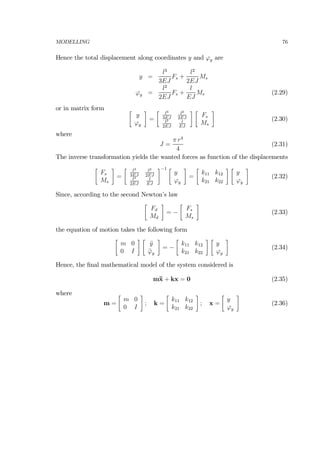
436-431 MECHANICS 4
UNIT 2
MECHANICAL VIBRATION
J.M. KRODKIEWSKI
2008
THE UNIVERSITY OF MELBOURNE
Department of Mechanical and Manufacturing Engineering
.
1
2
MECHANICAL VIBRATIONS
Copyright C 2008 by J.M. Krodkiewski
The University of Melbourne
Department of Mechanical and Manufacturing Engineering
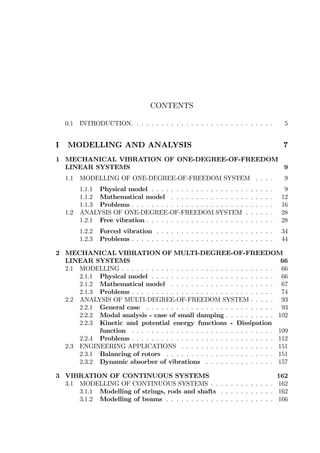
CONTENTS
0.1 INTRODUCTION. . . . . . . . . . . . . . . . . . . . . . . . . . . . . 5
I MODELLING AND ANALYSIS 7
1 MECHANICAL VIBRATION OF ONE-DEGREE-OF-FREEDOM
LINEAR SYSTEMS 9
1.1 MODELLING OF ONE-DEGREE-OF-FREEDOM SYSTEM . . . . 9
1.1.1 Physical model . . . . . . . . . . . . . . . . . . . . . . . . . 9
1.1.2 Mathematical model . . . . . . . . . . . . . . . . . . . . . 12
1.1.3 Problems . . . . . . . . . . . . . . . . . . . . . . . . . . . . . 16
1.2 ANALYSIS OF ONE-DEGREE-OF-FREEDOM SYSTEM . . . . . . 28
1.2.1 Free vibration . . . . . . . . . . . . . . . . . . . . . . . . . . 28
1.2.2 Forced vibration . . . . . . . . . . . . . . . . . . . . . . . . 34
1.2.3 Problems . . . . . . . . . . . . . . . . . . . . . . . . . . . . . 44
2 MECHANICAL VIBRATION OF MULTI-DEGREE-OF-FREEDOM
LINEAR SYSTEMS 66
2.1 MODELLING . . . . . . . . . . . . . . . . . . . . . . . . . . . . . . . 66
2.1.1 Physical model . . . . . . . . . . . . . . . . . . . . . . . . . 66
2.1.2 Mathematical model . . . . . . . . . . . . . . . . . . . . . 67
2.1.3 Problems . . . . . . . . . . . . . . . . . . . . . . . . . . . . . 74
2.2 ANALYSIS OF MULTI-DEGREE-OF-FREEDOM SYSTEM . . . . . 93
2.2.1 General case . . . . . . . . . . . . . . . . . . . . . . . . . . 93
2.2.2 Modal analysis - case of small damping . . . . . . . . . . 102
2.2.3 Kinetic and potential energy functions - Dissipation
function . . . . . . . . . . . . . . . . . . . . . . . . . . . . . 109
2.2.4 Problems . . . . . . . . . . . . . . . . . . . . . . . . . . . . . 112
2.3 ENGINEERING APPLICATIONS . . . . . . . . . . . . . . . . . . . 151
2.3.1 Balancing of rotors . . . . . . . . . . . . . . . . . . . . . . 151
2.3.2 Dynamic absorber of vibrations . . . . . . . . . . . . . . 157
3 VIBRATION OF CONTINUOUS SYSTEMS 162
3.1 MODELLING OF CONTINUOUS SYSTEMS . . . . . . . . . . . . . 162
3.1.1 Modelling of strings, rods and shafts . . . . . . . . . . . 162
3.1.2 Modelling of beams . . . . . . . . . . . . . . . . . . . . . . 166
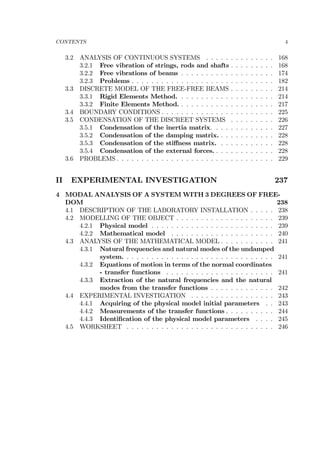
CONTENTS 4
3.2 ANALYSIS OF CONTINUOUS SYSTEMS . . . . . . . . . . . . . . 168
3.2.1 Free vibration of strings, rods and shafts . . . . . . . . . 168
3.2.2 Free vibrations of beams . . . . . . . . . . . . . . . . . . . 174
3.2.3 Problems . . . . . . . . . . . . . . . . . . . . . . . . . . . . . 182
3.3 DISCRETE MODEL OF THE FREE-FREE BEAMS . . . . . . . . . 214
3.3.1 Rigid Elements Method. . . . . . . . . . . . . . . . . . . . 214
3.3.2 Finite Elements Method. . . . . . . . . . . . . . . . . . . . 217
3.4 BOUNDARY CONDITIONS . . . . . . . . . . . . . . . . . . . . . . . 225
3.5 CONDENSATION OF THE DISCREET SYSTEMS . . . . . . . . . 226
3.5.1 Condensation of the inertia matrix. . . . . . . . . . . . . 227
3.5.2 Condensation of the damping matrix. . . . . . . . . . . . 228
3.5.3 Condensation of the stiffness matrix. . . . . . . . . . . . 228
3.5.4 Condensation of the external forces. . . . . . . . . . . . . 228
3.6 PROBLEMS . . . . . . . . . . . . . . . . . . . . . . . . . . . . . . . . 229
II EXPERIMENTAL INVESTIGATION 237
4 MODAL ANALYSIS OF A SYSTEM WITH 3 DEGREES OF FREE-
DOM 238
4.1 DESCRIPTION OF THE LABORATORY INSTALLATION . . . . . 238
4.2 MODELLING OF THE OBJECT . . . . . . . . . . . . . . . . . . . . 239
4.2.1 Physical model . . . . . . . . . . . . . . . . . . . . . . . . . 239
4.2.2 Mathematical model . . . . . . . . . . . . . . . . . . . . . 240
4.3 ANALYSIS OF THE MATHEMATICAL MODEL . . . . . . . . . . . 241
4.3.1 Natural frequencies and natural modes of the undamped
system. . . . . . . . . . . . . . . . . . . . . . . . . . . . . . . 241
4.3.2 Equations of motion in terms of the normal coordinates
- transfer functions . . . . . . . . . . . . . . . . . . . . . . 241
4.3.3 Extraction of the natural frequencies and the natural
modes from the transfer functions . . . . . . . . . . . . . 242
4.4 EXPERIMENTAL INVESTIGATION . . . . . . . . . . . . . . . . . 243
4.4.1 Acquiring of the physical model initial parameters . . 243
4.4.2 Measurements of the transfer functions . . . . . . . . . . 244
4.4.3 Identification of the physical model parameters . . . . 245
4.5 WORKSHEET . . . . . . . . . . . . . . . . . . . . . . . . . . . . . . 246
INTRODUCTION. 5
0.1 INTRODUCTION.
The purpose of this text is to provide the students with the theoretical background
and engineering applications of the theory of vibrations of mechanical systems. It is
divided into two parts. Part one, Modelling and Analysis, is devoted to this solu-
tion of these engineering problems that can be approximated by means of the linear
models. The second part, Experimental Investigation, describes the laboratory
work recommended for this course.
Part one consists of four chapters.
The first chapter, Mechanical Vibration of One-Degree-Of-Freedom
Linear System, illustrates modelling and analysis of these engineering problems
that can be approximated by means of the one degree of freedom system. Infor-
mation included in this chapter, as a part of the second year subject Mechanics 1,
where already conveyed to the students and are not to be lectured during this course.
However, since this knowledge is essential for a proper understanding of the following
material, students should study it in their own time.
Chapter two is devoted to modeling and analysis of these mechanical systems
that can be approximated by means of the Multi-Degree-Of-Freedom models.
The Newton’s-Euler’s approach, Lagrange’s equations and the influence coefficients
method are utilized for the purpose of creation of the mathematical model. The
considerations are limited to the linear system only. In the general case of damping
the process of looking for the natural frequencies and the system forced response
is provided. Application of the modal analysis to the case of the small structural
damping results in solution of the initial problem and the forced response. Dynamic
balancing of the rotating elements and the passive control of vibrations by means of
the dynamic absorber of vibrations illustrate application of the theory presented to
the engineering problems.
Chapter three, Vibration of Continuous Systems, is concerned with the
problems of vibration associated with one-dimensional continuous systems such as
string, rods, shafts, and beams. The natural frequencies and the natural modes are
used for the exact solutions of the free and forced vibrations. This chapter forms a
base for development of discretization methods presented in the next chapter
In chapter four, Approximation of the Continuous Systems by Dis-
crete Models, two the most important, for engineering applications, methods of
approximation of the continuous systems by the discrete models are presented. The
Rigid Element Method and the Final Element Method are explained and utilized to
produce the inertia and stiffness matrices of the free-free beam. Employment of these
matrices to the solution of the engineering problems is demonstrated on a number of
examples. The presented condensation techniques allow to keep size of the discrete
mathematical model on a reasonably low level.
Each chapter is supplied with several engineering problems. Solution to some
of them are provided. Solution to the other problems should be produced by students
during tutorials and in their own time.
Part two gives the theoretical background and description of the laboratory
experiments. One of them is devoted to the experimental determination of the nat-
ural modes and the corresponding natural frequencies of a Multi-Degree-Of-Freedom-
INTRODUCTION. 6
System. The other demonstrates the balancing techniques.
Part I
MODELLING AND ANALYSIS
7
8
Modelling is the part of solution of an engineering problems that aims to-
wards producing its mathematical description. This mathematical description can
be obtained by taking advantage of the known laws of physics. These laws can not
be directly applied to the real system. Therefore it is necessary to introduce many
assumptions that simplify the engineering problems to such extend that the physic
laws may be applied. This part of modelling is called creation of the physical model.
Application of the physics law to the physical model yields the wanted mathematical
description that is called mathematical model. Process of solving of the mathematical
model is called analysis and yields solution to the problem considered. One of the
most frequently encounter in engineering type of motion is the oscillatory motion of
a mechanical system about its equilibrium position. Such a type of motion is called
vibration. This part deals with study of linear vibrations of mechanical system.
Chapter 1
MECHANICAL VIBRATION OF ONE-DEGREE-OF-FREEDOM
LINEAR SYSTEMS
DEFINITION: Any oscillatory motion of a mechanical system about its
equilibrium position is called vibration.
1.1 MODELLING OF ONE-DEGREE-OF-FREEDOM SYSTEM
DEFINITION: Modelling is the part of solution of an engineering problem
that aims for producing its mathematical description.
The mathematical description of the engineering problem one can obtain by
taking advantage of the known lows of physics. These lows can not be directly
applied to the real system. Therefore it is necessary to introduce many assumptions
that simplify the problem to such an extend that the physic laws may by apply. This
part of modelling is called creation of the physical model. Application of the physics
law to the physical model yields the wanted mathematical description which is called
mathematical model.
1.1.1 Physical model
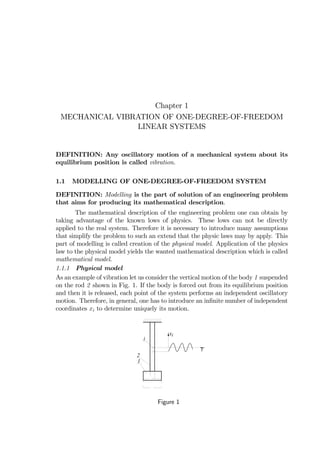
As an example of vibration let us consider the vertical motion of the body 1 suspended
on the rod 2 shown in Fig. 1. If the body is forced out from its equilibrium position
and then it is released, each point of the system performs an independent oscillatory
motion. Therefore, in general, one has to introduce an infinite number of independent
coordinates xi to determine uniquely its motion.
t
xi
i
1
2
Figure 1
MODELLING OF ONE-DEGREE-OF-FREEDOM SYSTEM 10
DEFINITION: The number of independent coordinates one has to use to
determine the position of a mechanical system is called number of degrees of
freedom
According to this definition each real system has an infinite number of degrees
of freedom. Adaptation of certain assumptions, in many cases, may results in reduc-
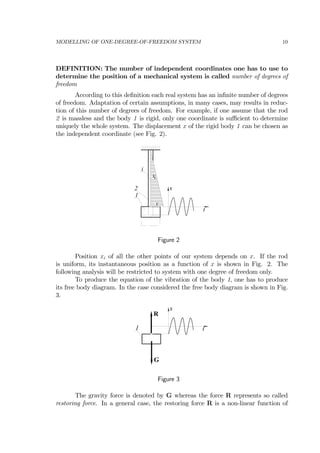
tion of this number of degrees of freedom. For example, if one assume that the rod
2 is massless and the body 1 is rigid, only one coordinate is sufficient to determine
uniquely the whole system. The displacement x of the rigid body 1 can be chosen as
the independent coordinate (see Fig. 2).
t
x
i
x
ix
1
2
Figure 2
Position xi of all the other points of our system depends on x. If the rod
is uniform, its instantaneous position as a function of x is shown in Fig. 2. The
following analysis will be restricted to system with one degree of freedom only.
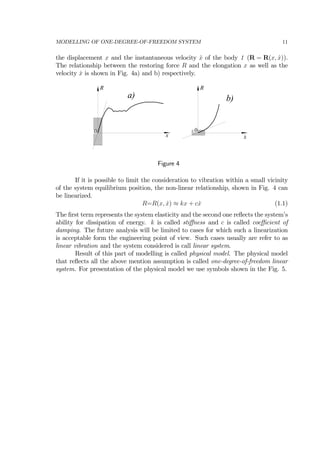
To produce the equation of the vibration of the body 1, one has to produce
its free body diagram. In the case considered the free body diagram is shown in Fig.
3.
t
x
1
R
G
Figure 3
The gravity force is denoted by G whereas the force R represents so called
restoring force. In a general case, the restoring force R is a non-linear function of
MODELLING OF ONE-DEGREE-OF-FREEDOM SYSTEM 11
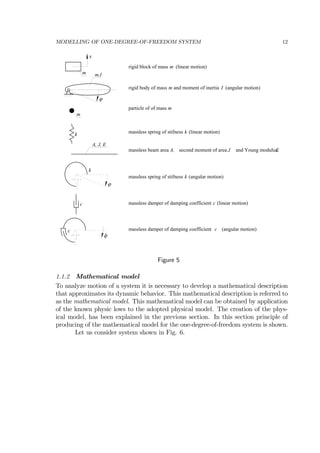
the displacement x and the instantaneous velocity ˙x of the body 1 (R = R(x, ˙x)).
The relationship between the restoring force R and the elongation x as well as the
velocity ˙x is shown in Fig. 4a) and b) respectively.
x x
.
R R
0 0
a) b)
Figure 4
If it is possible to limit the consideration to vibration within a small vicinity
of the system equilibrium position, the non-linear relationship, shown in Fig. 4 can
be linearized.
R=R(x, ˙x) ≈ kx + c ˙x (1.1)
The first term represents the system elasticity and the second one reflects the system’s
ability for dissipation of energy. k is called stiffness and c is called coefficient of
damping. The future analysis will be limited to cases for which such a linearization
is acceptable form the engineering point of view. Such cases usually are refer to as
linear vibration and the system considered is call linear system.
Result of this part of modelling is called physical model. The physical model
that reflects all the above mention assumption is called one-degree-of-freedom linear
system. For presentation of the physical model we use symbols shown in the Fig. 5.
MODELLING OF ONE-DEGREE-OF-FREEDOM SYSTEM 12
m
ϕ
x
m,I
m
k
A, J, E
ϕ
k
c
ϕ
.c
rigid block of mass
rigid body of mass
m
m and moment of inertia I
particle of of mass m
massless spring of stifness k
massless beam area second moment of area and Young modulusA, J E
(linear motion)
(angular motion)
(linear motion)
massless spring of stifness k (angular motion)
massless damper of damping coefficient c (linear motion)
massless damper of damping coefficient c (angular motion)
Figure 5
1.1.2 Mathematical model
To analyze motion of a system it is necessary to develop a mathematical description
that approximates its dynamic behavior. This mathematical description is referred to
as the mathematical model. This mathematical model can be obtained by application
of the known physic lows to the adopted physical model. The creation of the phys-
ical model, has been explained in the previous section. In this section principle of
producing of the mathematical model for the one-degree-of-freedom system is shown.
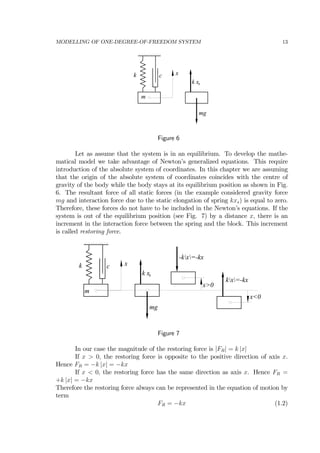
Let us consider system shown in Fig. 6.
MODELLING OF ONE-DEGREE-OF-FREEDOM SYSTEM 13
k
m
c x
mg
sk x
Figure 6
Let as assume that the system is in an equilibrium. To develop the mathe-
matical model we take advantage of Newton’s generalized equations. This require
introduction of the absolute system of coordinates. In this chapter we are assuming
that the origin of the absolute system of coordinates coincides with the centre of
gravity of the body while the body stays at its equilibrium position as shown in Fig.
6. The resultant force of all static forces (in the example considered gravity force
mg and interaction force due to the static elongation of spring kxs) is equal to zero.
Therefore, these forces do not have to be included in the Newton’s equations. If the
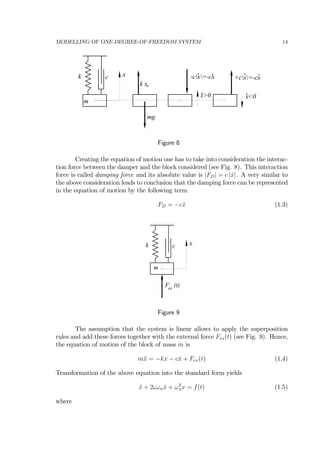
system is out of the equilibrium position (see Fig. 7) by a distance x, there is an
increment in the interaction force between the spring and the block. This increment
is called restoring force.
k
m
c x
mg
sk x
-kx=-kx
x>0
x<0
kx=-kx
Figure 7
In our case the magnitude of the restoring force is |FR| = k |x|
If x > 0, the restoring force is opposite to the positive direction of axis x.
Hence FR = −k |x| = −kx
If x < 0, the restoring force has the same direction as axis x. Hence FR =
+k |x| = −kx
Therefore the restoring force always can be represented in the equation of motion by
term
FR = −kx (1.2)
MODELLING OF ONE-DEGREE-OF-FREEDOM SYSTEM 14
k
m
c x
mg
sk x
-cx=-cx
x>0 x<0
. .
.
+cx=-cx
. .
.
Figure 8
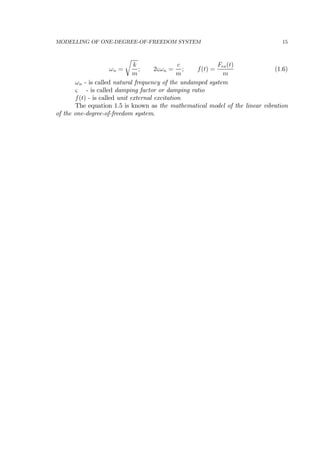
Creating the equation of motion one has to take into consideration the interac-
tion force between the damper and the block considered (see Fig. 8). This interaction
force is called damping force and its absolute value is |FD| = c | ˙x| . A very similar to
the above consideration leads to conclusion that the damping force can be represented
in the equation of motion by the following term
FD = −c ˙x (1.3)
k
m
c x
F (t)ex
Figure 9
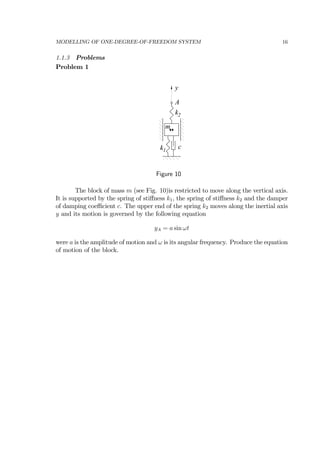
The assumption that the system is linear allows to apply the superposition
rules and add these forces together with the external force Fex(t) (see Fig. 9). Hence,
the equation of motion of the block of mass m is
m¨x = −kx − c ˙x + Fex(t) (1.4)
Transformation of the above equation into the standard form yields
¨x + 2ςωn ˙x + ω2
nx = f(t) (1.5)
where
MODELLING OF ONE-DEGREE-OF-FREEDOM SYSTEM 15
ωn =
r
k
m
; 2ςωn =
c
m
; f(t) =
Fex(t)
m
(1.6)
ωn - is called natural frequency of the undamped system
ς - is called damping factor or damping ratio
f(t) - is called unit external excitation
The equation 1.5 is known as the mathematical model of the linear vibration
of the one-degree-of-freedom system.
MODELLING OF ONE-DEGREE-OF-FREEDOM SYSTEM 16
1.1.3 Problems
Problem 1
A
c
y
k1
k2
m
Figure 10
The block of mass m (see Fig. 10)is restricted to move along the vertical axis.
It is supported by the spring of stiffness k1, the spring of stiffness k2 and the damper
of damping coefficient c. The upper end of the spring k2 moves along the inertial axis
y and its motion is governed by the following equation
yA = a sin ωt
were a is the amplitude of motion and ω is its angular frequency. Produce the equation
of motion of the block.
MODELLING OF ONE-DEGREE-OF-FREEDOM SYSTEM 17
Solution
A
c
y
k1
k2
m
x
Figure 11
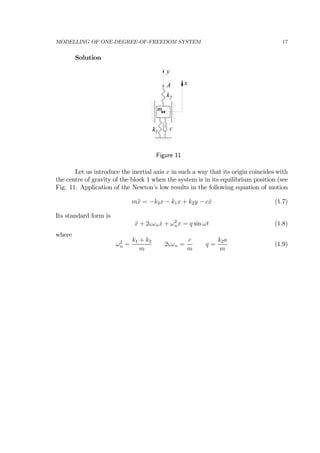
Let us introduce the inertial axis x in such a way that its origin coincides with
the centre of gravity of the block 1 when the system is in its equilibrium position (see
Fig. 11. Application of the Newton’s low results in the following equation of motion
m¨x = −k2x − k1x + k2y − c ˙x (1.7)
Its standard form is
¨x + 2ςωn ˙x + ω2
nx = q sin ωt (1.8)
where
ω2
n =
k1 + k2
m
2ςωn =
c
m
q =
k2a
m
(1.9)
MODELLING OF ONE-DEGREE-OF-FREEDOM SYSTEM 18
Problem 2
r
R
1
2
Figure 12
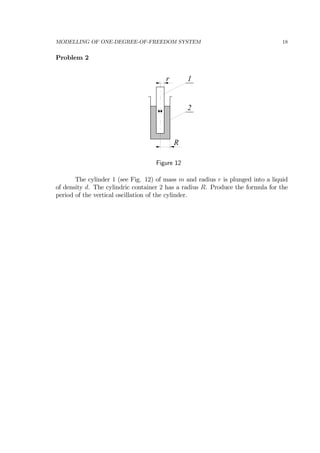
The cylinder 1 (see Fig. 12) of mass m and radius r is plunged into a liquid
of density d. The cylindric container 2 has a radius R. Produce the formula for the
period of the vertical oscillation of the cylinder.
MODELLING OF ONE-DEGREE-OF-FREEDOM SYSTEM 19
Solution
r
R
x
x
G
z
V
V
1
2
Figure 13
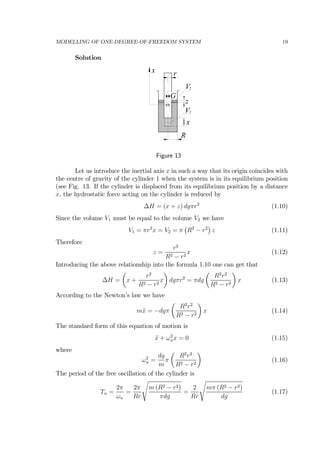
Let us introduce the inertial axis x in such a way that its origin coincides with
the centre of gravity of the cylinder 1 when the system is in its equilibrium position
(see Fig. 13. If the cylinder is displaced from its equilibrium position by a distance
x, the hydrostatic force acting on the cylinder is reduced by
∆H = (x + z) dgπr2
(1.10)
Since the volume V1 must be equal to the volume V2 we have
V1 = πr2
x = V2 = π
¡
R2
− r2
¢
z (1.11)
Therefore
z =
r2
R2 − r2
x (1.12)
Introducing the above relationship into the formula 1.10 one can get that
∆H =
µ
x +
r2
R2 − r2
x

dgπr2
= πdg
µ
R2
r2
R2 − r2

x (1.13)
According to the Newton’s law we have
m¨x = −dgπ
µ
R2
r2
R2 − r2

x (1.14)
The standard form of this equation of motion is
¨x + ω2
nx = 0 (1.15)
where
ω2
n =
dg
m
π
µ
R2
r2
R2 − r2

(1.16)
The period of the free oscillation of the cylinder is
Tn =
2π
ωn
=
2π
Rr
s
m (R2 − r2)
πdg
=
2
Rr
s
mπ (R2 − r2)
dg
(1.17)
MODELLING OF ONE-DEGREE-OF-FREEDOM SYSTEM 20
Problem 3
c
R
G
D
L
m 1
Figure 14
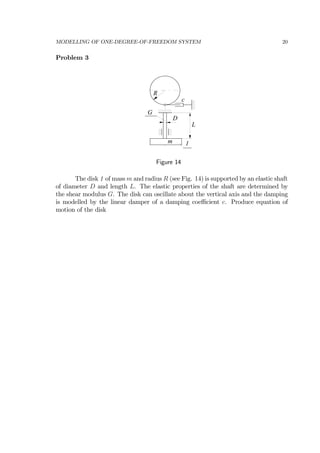
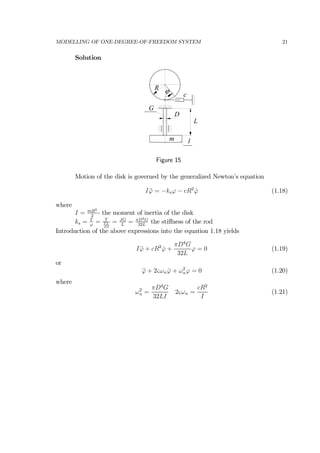
The disk 1 of mass m and radius R (see Fig. 14) is supported by an elastic shaft
of diameter D and length L. The elastic properties of the shaft are determined by
the shear modulus G. The disk can oscillate about the vertical axis and the damping
is modelled by the linear damper of a damping coefficient c. Produce equation of
motion of the disk
MODELLING OF ONE-DEGREE-OF-FREEDOM SYSTEM 21
Solution
c
R
G
D
L
m 1
ϕ
Figure 15
Motion of the disk is governed by the generalized Newton’s equation
I ¨ϕ = −ksϕ − cR2
˙ϕ (1.18)
where
I = mR2
2
- the moment of inertia of the disk
ks = T
ϕ
= T
T L
JG
= JG
L
= πD4G
32L
the stiffness of the rod
Introduction of the above expressions into the equation 1.18 yields
I ¨ϕ + cR2
˙ϕ +
πD4
G
32L
ϕ = 0 (1.19)
or
¨ϕ + 2ςωn ˙ϕ + ω2
nϕ = 0 (1.20)
where
ω2
n =
πD4
G
32LI
2ςωn =
cR2
I
(1.21)
MODELLING OF ONE-DEGREE-OF-FREEDOM SYSTEM 22
Problem 4
O
k c
l
b
a
1
m
Figure 16
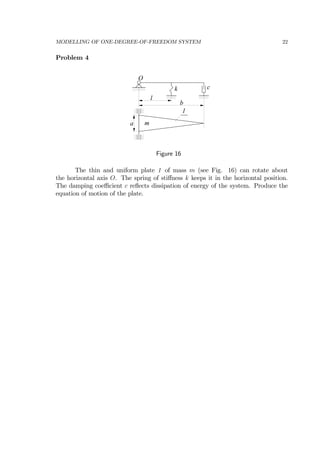
The thin and uniform plate 1 of mass m (see Fig. 16) can rotate about
the horizontal axis O. The spring of stiffness k keeps it in the horizontal position.
The damping coefficient c reflects dissipation of energy of the system. Produce the
equation of motion of the plate.
MODELLING OF ONE-DEGREE-OF-FREEDOM SYSTEM 23
Solution
O
k c
l
b
a
1
m
ϕ
Figure 17
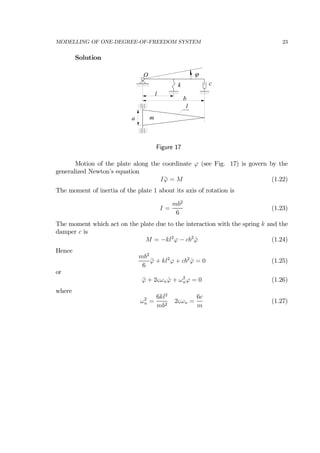
Motion of the plate along the coordinate ϕ (see Fig. 17) is govern by the
generalized Newton’s equation
I ¨ϕ = M (1.22)
The moment of inertia of the plate 1 about its axis of rotation is
I =
mb2
6
(1.23)
The moment which act on the plate due to the interaction with the spring k and the
damper c is
M = −kl2
ϕ − cb2
˙ϕ (1.24)
Hence
mb2
6
¨ϕ + kl2
ϕ + cb2
˙ϕ = 0 (1.25)
or
¨ϕ + 2ςωn ˙ϕ + ω2
nϕ = 0 (1.26)
where
ω2
n =
6kl2
mb2
2ςωn =
6c
m
(1.27)
MODELLING OF ONE-DEGREE-OF-FREEDOM SYSTEM 24
Problem 5
E,I
M
m
ω t
l
c
µ
Figure 18
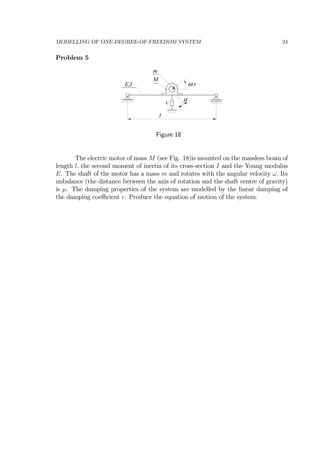
The electric motor of mass M (see Fig. 18)is mounted on the massless beam of
length l, the second moment of inertia of its cross-section I and the Young modulus
E. The shaft of the motor has a mass m and rotates with the angular velocity ω. Its
unbalance (the distance between the axis of rotation and the shaft centre of gravity)
is µ. The damping properties of the system are modelled by the linear damping of
the damping coefficient c. Produce the equation of motion of the system.
MODELLING OF ONE-DEGREE-OF-FREEDOM SYSTEM 25
Problem 6
yA
0
c
k
d D
l
L
Figure 19
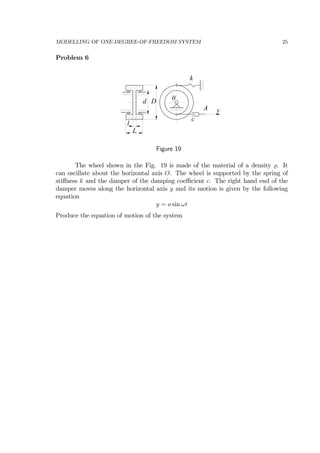
The wheel shown in the Fig. 19 is made of the material of a density . It
can oscillate about the horizontal axis O. The wheel is supported by the spring of
stiffness k and the damper of the damping coefficient c. The right hand end of the
damper moves along the horizontal axis y and its motion is given by the following
equation
y = a sin ωt
Produce the equation of motion of the system
MODELLING OF ONE-DEGREE-OF-FREEDOM SYSTEM 26
Problem 7
L
r
1
2
Figure 20
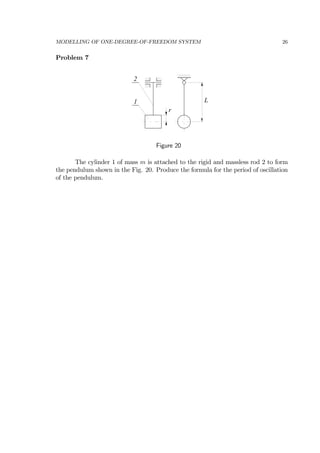
The cylinder 1 of mass m is attached to the rigid and massless rod 2 to form
the pendulum shown in the Fig. 20. Produce the formula for the period of oscillation
of the pendulum.
MODELLING OF ONE-DEGREE-OF-FREEDOM SYSTEM 27
Problem 8
O
k c
l
b
a
1
m
Figure 21
The thin and uniform plate 1 (see Fig. 21) of mass m can rotate about the
horizontal axis O. The spring of stiffness k keeps it in the horizontal position. The
damping coefficient c reflects dissipation of energy of the system. Produce the formula
for the natural frequency of the system.
ANALYSIS OF ONE-DEGREE-OF-FREEDOM SYSTEM 28
1.2 ANALYSIS OF ONE-DEGREE-OF-FREEDOM SYSTEM
1.2.1 Free vibration
DEFINITION: It is said that a system performs free vibration if there are
no external forces (forces that are explicitly dependent on time) acting on this
system.
In this section, according to the above definition, it is assumed that the resul-
tant of all external forces f(t) is equal to zero. Hence, the mathematical model that
is analyzed in this section takes form
¨x + 2ςωn ˙x + ω2
nx = 0 (1.28)
The equation 1.28 is classified as linear homogeneous ordinary differential equation of
second order. If one assume that the damping ratio ς is equal to zero, the equation
1.28 governs the free motion of the undamped system.
¨x + ω2
nx = 0 (1.29)
Free vibration of an undamped system
The general solution of the homogeneous equation 1.29 is a linear combination of its
two particular linearly independent solutions. These solutions can be obtained by
means of the following procedure. The particular solution can be predicted in the
form 1.30.
x = eλt
(1.30)
Introduction of the solution 1.30 into the equation 1.29 yields the characteristic equa-
tion
λ2
+ ω2
n = 0 (1.31)
This characteristic equation has two roots
λ1 = +iωn and λ2 = −iωn (1.32)
Hence, in this case, the independent particular solution are
x1 = sin ωnt and x2 = cos ωnt (1.33)
Their linear combination is the wanted general solution and approximates the free
vibration of the undamped system.
x = Cs sin ωnt + Cc cos ωnt (1.34)
The two constants Cs and Cc should be chosen to fulfill the initial conditions which
reflect the way the free vibrations were initiated. To get an unique solution it is nec-
essary to specify the initial position and the initial velocity of the system considered.
Hence, let us assume that at the instant t = 0 the system was at the position x0 and
was forced to move with the initial velocity v0. Introduction of these initial conditions
ANALYSIS OF ONE-DEGREE-OF-FREEDOM SYSTEM 29
into the equation 1.34 results in two algebraic equation that are linear with respect
to the unknown constants Cs and Cc.
Cc = x0
Csωn = v0 (1.35)
According to 1.34, the particular solution that represents the free vibration of the
system is
x =
v0
ωn
sin ωnt + x0 cos ωnt =
= C sin(ωnt + α) (1.36)
where
C =
s
(x0)2 +
µ
v0
ωn
¶2
; α = arctan
Ã
x0
v0
ωn
!
(1.37)
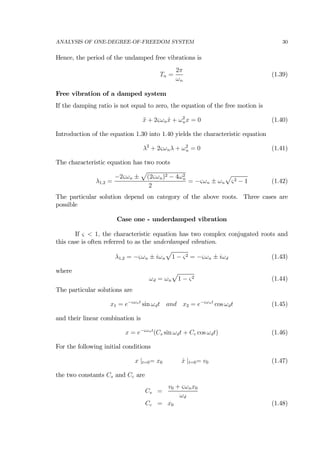
For ωn = 1[1/s], x0 = 1[m] v0 = 1[m/s] and ς = 0 the free motion is shown in Fig.
22 The free motion, in the case considered is periodic.
40
-1.5
-1
-0.5
0
0.5
1
10 20 30 50
x[m]
t[s]
C
Tn
α
xo
vo
Figure 22
DEFINITION: The shortest time after which parameters of motion repeat
themselves is called period and the motion is called periodic motion.
According to this definition, since the sine function has a period equal to 2π,
we have
sin(ωn(t + Tn) + α) = sin(ωnt + α + 2π) (1.38)
ANALYSIS OF ONE-DEGREE-OF-FREEDOM SYSTEM 30
Hence, the period of the undamped free vibrations is
Tn =
2π
ωn
(1.39)
Free vibration of a damped system
If the damping ratio is not equal to zero, the equation of the free motion is
¨x + 2ςωn ˙x + ω2
nx = 0 (1.40)
Introduction of the equation 1.30 into 1.40 yields the characteristic equation
λ2
+ 2ςωnλ + ω2
n = 0 (1.41)
The characteristic equation has two roots
λ1,2 =
−2ςωn ±
p
(2ςωn)2 − 4ω2
n
2
= −ςωn ± ωn
p
ς2 − 1 (1.42)
The particular solution depend on category of the above roots. Three cases are
possible
Case one - underdamped vibration
If ς < 1, the characteristic equation has two complex conjugated roots and
this case is often referred to as the underdamped vibration.
λ1,2 = −ςωn ± iωn
p
1 − ς2 = −ςωn ± iωd (1.43)
where
ωd = ωn
p
1 − ς2 (1.44)
The particular solutions are
x1 = e−ςωnt
sin ωdt and x2 = e−ςωnt
cos ωdt (1.45)
and their linear combination is
x = e−ςωnt
(Cs sin ωdt + Cc cos ωdt) (1.46)
For the following initial conditions
x |t=0= x0 ˙x |t=0= v0 (1.47)
the two constants Cs and Cc are
Cs =
v0 + ςωnx0
ωd
Cc = x0 (1.48)
ANALYSIS OF ONE-DEGREE-OF-FREEDOM SYSTEM 31
Introduction of the expressions 1.48 into 1.46 produces the free motion in the following
form
x = e−ςωnt
(Cs sin ωdt + Cc cos ωdt) = Ce−ςωnt
sin(ωdt + α) (1.49)
where
C =
sµ
v0 + ςωnx0
ωd
¶2
+ (x0)2
; α = arctan
x0ωd
v0 + ςωnx0
; ωd = ωn
p
1 − ς2
(1.50)
For ωn = 1[1/s], x0 = 1[m] v0 = 1[m/s] and ς = .1 the free motion is shown in Fig.
23In this case the motion is not periodic but the time Td (see Fig. 23) between every
-1.5
-1
-0.5
0
0.5
1
10 20 30 40 50
x[m]
t[s]
Td
Td
x(t)x(t+ Td
t
xo
vo
)
Figure 23
second zero-point is constant and it is called period of the dumped vibration. It is easy
to see from the expression 1.49 that
Td =
2π
ωd
(1.51)
DEFINITION: Natural logarithm of ratio of two displacements x(t) and
x(t + Td) that are one period apart is called logarithmic decrement of damping
and will be denoted by δ.
ANALYSIS OF ONE-DEGREE-OF-FREEDOM SYSTEM 32
It will be shown that the logaritmic decrement is constant. Indeed
δ = ln
x (t)
x (t + Td)
= ln
Ce−ςωnt
sin(ωdt + α)
Ce−ςωn(t+Td) sin(ωd(t + Td) + α)
=
= ln
Ce−ςωnt
sin(ωdt + α)
Ce−ςωnte−ςωnTd sin(ωdt + 2π + α)
= ςωnTd =
2πςωn
ωd
=
2πςωn
ωn
√
1 − ς2
=
=
2πς
√
1 − ς2
(1.52)
This formula is frequently used for the experimental determination of the damping
ratio ς.
ς =
δ
p
4π2 + δ2
(1.53)
The other parameter ωn that exists in the mathematical model 1.40 can be easily
identified by measuring the period of the free motion Td. According to the formula
1.44 and 1.51
ωn =
ωd
√
1 − ς2
=
2π
Td
√
1 − ς2
(1.54)
Case two - critically damped vibration
If ς = 1, the characteristic equation has two real and equal one to each other
roots and this case is often referred to as the critically damped vibration
λ1,2 = −ςωn (1.55)
The particular solutions are
x1 = e−ςωnt
and x2 = te−ςωnt
(1.56)
and their linear combination is
x = Cse−ςωnt
+ Ccte−ςωnt
(1.57)
For the following initial conditions
x |t=0= x0 ˙x |t=0= v0 (1.58)
the two constants Cs and Cc are as follow
Cs = x0
Cc = v0 + x0ωn (1.59)
Introduction of the expressions 1.59 into 1.57 produces expression for the free motion
in the following form
x = e−ςωnt
(x0 + t(v0 + x0ωn)) (1.60)
For ωn = 1[1/s], x0 = 1[m] v0 = 1[m/s] and ς = 1. the free motion is shown in
Fig. 24. The critical damping offers for the system the possibly faster return to its
equilibrium position.
ANALYSIS OF ONE-DEGREE-OF-FREEDOM SYSTEM 33
-1.5
-1
-0.5
0
0.5
1
10 20 30 40 50
x[m]
t[s]
vo
xo
Figure 24
Case three - overdamped vibration
If ς > 1, the characteristic equation has two real roots and this case is often
referred to as the overdamped vibration.
λ1,2 = −ςωn ± ωn
p
ς2 − 1 = ωn(−ς ±
p
ς2 − 1) (1.61)
The particular solutions are
x1 = e−ωn(ς+
√
ς2−1)t
and x2 = e−ωn(ς−
√
ς2−1)t
(1.62)
and their linear combination is
x = e−ωnt
³
Cseωn
√
ς2−1)t
+ Cce−ωn
√
ς2−1)t
´
(1.63)
For the following initial conditions
x |t=0= x0 ˙x |t=0= v0 (1.64)
the two constants Cs and Cc are as follow
Cs =
+ v0
ωn
+ x0(+ς +
√
ς2 − 1)
2
√
ς2 − 1
Cc =
− v0
ωn
+ x0(−ς +
√
ς2 − 1)
2
√
ς2 − 1
(1.65)
For ωn = 1[1/s], x0 = 1[m] v0 = 1[m/s] and ς = 5. the free motion is shown in Fig.
25
ANALYSIS OF ONE-DEGREE-OF-FREEDOM SYSTEM 34
-1.5
-1
-0.5
0
0.5
1
10 20 30 40 50
x[m]
t[s]
vo
xo
Figure 25
1.2.2 Forced vibration
In a general case motion of a vibrating system is due to both, the initial conditions and
the exciting force. The mathematical model, according to the previous consideration,
is the linear non-homogeneous differential equation of second order.
¨x + 2ςωn ˙x + ω2
nx = f(t) (1.66)
where
ωn =
r
k
m
; 2ςωn =
c
m
; f(t) =
Fex(t)
m
(1.67)
The general solution of this mathematical model is a superposition of the general
solution of the homogeneous equation xg and the particular solution of the non-
homogeneous equation xp.
x = xg + xp (1.68)
The general solution of the homogeneous equation has been produced in the previous
section and for the underdamped vibration it is
xg = e−ςωnt
(Cs sin ωdt + Cc cos ωdt) = Ce−ςωnt
sin(ωdt + α) (1.69)
To produce the particular solution of the non-homogeneous equation, let as assume
that the excitation can be approximated by a harmonic function. Such a case is
referred to as the harmonic excitation.
f(t) = q sin ωt (1.70)
ANALYSIS OF ONE-DEGREE-OF-FREEDOM SYSTEM 35
In the above equation q represents the amplitude of the unit excitation and ω is the
excitation frequency. Introduction of the expression 1.70 into equation 1.66 yields
¨x + 2ςωn ˙x + ω2
nx = q sin ωt (1.71)
In this case it is easy to predict mode of the particular solution
xp = As sin ωt + Ac cos ωt (1.72)
where As and Ac are constant. The function 1.72 is the particular solution if and
only if it fulfils the equation 1.71 for any instant of time. Therefore, implementing it
in equation 1.71 one can get
¡
(ω2
n − ω2
)As − 2ςωnωAc
¢
sin ωt+
¡
2ςωnωAs + (ω2
n − ω2
)Ac
¢
cos ωt = q sin ωt (1.73)
This relationship is fulfilled for any instant of time if
(ω2
n − ω2
)As − 2ςωnωAc = q
2ςωnωAs + (ω2
n − ω2
)Ac = 0 (1.74)
Solution of the above equations yields the expression for the constant As and Ac
As =
¯
¯
¯
¯
q −2ςωnω
0 (ω2
n − ω2
)
¯
¯
¯
¯
¯
¯
¯
¯
(ω2
n − ω2
) −2ςωnω
2ςωnω (ω2
n − ω2
)
¯
¯
¯
¯
=
(ω2
n − ω2
)q
(ω2
n − ω2)2 + 4(ςωn)2ω2
Ac =
¯
¯
¯
¯
(ω2
n − ω2
) q
2ςωnω 0
¯
¯
¯
¯
¯
¯
¯
¯
(ω2
n − ω2
) −2ςωnω
2ςωnω (ω2
n − ω2
)
¯
¯
¯
¯
=
−2(ςωn)ωq
(ω2
n − ω2)2 + 4(ςωn)2ω2
(1.75)
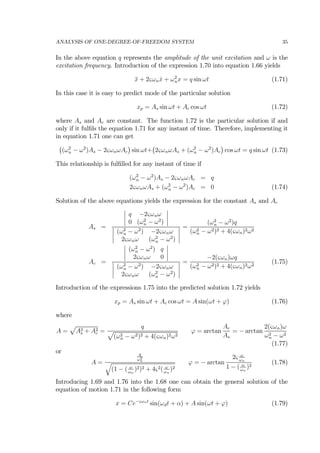
Introduction of the expressions 1.75 into the predicted solution 1.72 yields
xp = As sin ωt + Ac cos ωt = A sin(ωt + ϕ) (1.76)
where
A =
p
A2
s + A2
c =
q
p
(ω2
n − ω2)2 + 4(ςωn)2ω2
ϕ = arctan
Ac
As
= − arctan
2(ςωn)ω
ω2
n − ω2
(1.77)
or
A =
q
ω2
n
q
(1 − ( ω
ωn
)2)2 + 4ς2( ω
ωn
)2
ϕ = − arctan
2ς ω
ωn
1 − ( ω
ωn
)2
(1.78)
Introducing 1.69 and 1.76 into the 1.68 one can obtain the general solution of the
equation of motion 1.71 in the following form
x = Ce−ςωnt
sin(ωdt + α) + A sin(ωt + ϕ) (1.79)
ANALYSIS OF ONE-DEGREE-OF-FREEDOM SYSTEM 36
The constants C and α should be chosen to fullfil the required initial conditions.
For the following initial conditions
x |t=0= x0 ˙x |t=0= v0 (1.80)
one can get the following set of the algebraic equations for determination of the
parameters C and α
x0 = Co sin αo + A sin ϕ
v0 = −Coςωn sin αo + Coωd cos αo + Aω cos ϕ (1.81)
Introduction of the solution of the equations 1.81 (Co,αo) to the general solution,
yields particular solution of the non-homogeneous equation that represents the forced
vibration of the system considered.
x = Coe−ςωnt
sin(ωdt + αo) + A sin(ωt + ϕ) (1.82)
This solution, for the following numerical data ς = 0.1, ωn = 1[1/s], ω = 2[1/s],
Co = 1[m], αo = 1[rd], A = 0.165205[m], ϕ = 0.126835[rd] is shown in Fig. 26
(curve c).The solution 1.82 is assembled out of two terms. First term represents an
-0.6
-0.4
-0.2
0
0.2
0.4
0.6
0.8
1
20 40 60
x[m]
t[s]
transient state of the forced vibration steady state of the forced vibration
abc
A
Figure 26
oscillations with frequency equal to the natural frequency of the damped system ωd.
Motion represented by this term, due to the existing damping, decays to zero (curve
a in Fig. 1.82) and determines time of the transient state of the forced vibrations.
Hence, after an usually short time, the transient state changes into the steady state
represented by the second term in equation 1.82 (curve b in Fig. 1.82)
x = A sin(ωt + ϕ) (1.83)
This harmonic term has amplitude A determined by the formula 1.77. It does not
depend on the initial conditions and is called amplitude of the forced vibration. Mo-
tion approximated by the equation 1.83 is usually referred to as the system forced
vibration.
ANALYSIS OF ONE-DEGREE-OF-FREEDOM SYSTEM 37
Both, the exciting force f(t) = q sin ωt (1.70) and the (steady state) forced
vibration x = A sin(ωt + ϕ) (1.83) are harmonic. Therefore, they can be represented
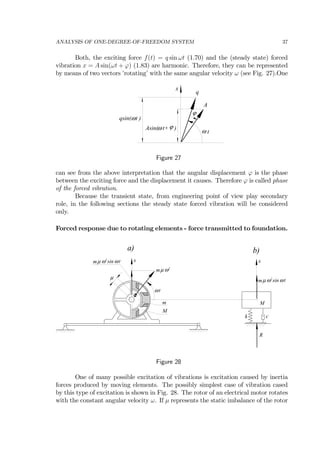
by means of two vectors ’rotating’ with the same angular velocity ω (see Fig. 27).One
x
A
ω t
ϕ
q
Asin( t+ )ϕω
qsin( t )ω
Figure 27
can see from the above interpretation that the angular displacement ϕ is the phase
between the exciting force and the displacement it causes. Therefore ϕ is called phase
of the forced vibration.
Because the transient state, from engineering point of view play secondary
role, in the following sections the steady state forced vibration will be considered
only.
Forced response due to rotating elements - force transmitted to foundation.
x
µ
ω t
mµ ω2
sinω t x
M
m
mµ ω2
sinω t
M
k c
R
mµ ω2
a) b)
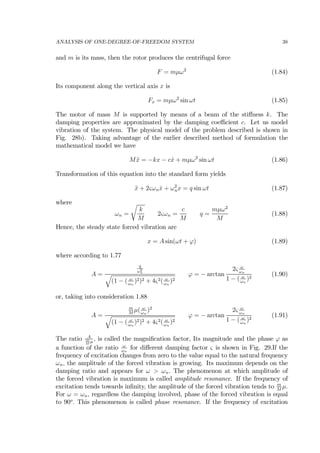
Figure 28
One of many possible excitation of vibrations is excitation caused by inertia
forces produced by moving elements. The possibly simplest case of vibration cased
by this type of excitation is shown in Fig. 28. The rotor of an electrical motor rotates
with the constant angular velocity ω. If µ represents the static imbalance of the rotor
ANALYSIS OF ONE-DEGREE-OF-FREEDOM SYSTEM 38
and m is its mass, then the rotor produces the centrifugal force
F = mµω2
(1.84)
Its component along the vertical axis x is
Fx = mµω2
sin ωt (1.85)
The motor of mass M is supported by means of a beam of the stiffness k. The
damping properties are approximated by the damping coefficient c. Let us model
vibration of the system. The physical model of the problem described is shown in
Fig. 28b). Taking advantage of the earlier described method of formulation the
mathematical model we have
M ¨x = −kx − c ˙x + mµω2
sin ωt (1.86)
Transformation of this equation into the standard form yields
¨x + 2ςωn ˙x + ω2
nx = q sin ωt (1.87)
where
ωn =
r
k
M
2ςωn =
c
M
q =
mµω2
M
(1.88)
Hence, the steady state forced vibration are
x = A sin(ωt + ϕ) (1.89)
where according to 1.77
A =
q
ω2
n
q
(1 − ( ω
ωn
)2)2 + 4ς2( ω
ωn
)2
ϕ = − arctan
2ς ω
ωn
1 − ( ω
ωn
)2
(1.90)
or, taking into consideration 1.88
A =
m
M
µ( ω
ωn
)2
q
(1 − ( ω
ωn
)2)2 + 4ς2( ω
ωn
)2
ϕ = − arctan
2ς ω
ωn
1 − ( ω
ωn
)2
(1.91)
The ratio A
m
M
µ
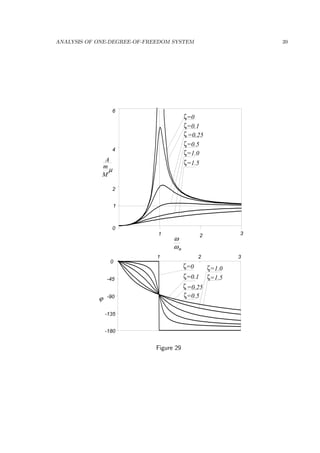
, is called the magnification factor, Its magnitude and the phase ϕ as
a function of the ratio ω
ωn
for different damping factor ς is shown in Fig. 29.If the
frequency of excitation changes from zero to the value equal to the natural frequency
ωn, the amplitude of the forced vibration is growing. Its maximum depends on the
damping ratio and appears for ω > ωn. The phenomenon at which amplitude of
the forced vibration is maximum is called amplitude resonance. If the frequency of
excitation tends towards infinity, the amplitude of the forced vibration tends to m
M
µ.
For ω = ωn, regardless the damping involved, phase of the forced vibration is equal
to 90o
. This phenomenon is called phase resonance. If the frequency of excitation
ANALYSIS OF ONE-DEGREE-OF-FREEDOM SYSTEM 39
0
2
4
6
1 2 3
-180
-135
-90
-45
0
1 2 3
=0ζ
=0.1ζ
=0.25ζ
=0.5ζ
=1.0ζ
=1.5ζ
ϕ
nω
ω
A
µ
m
M
1
=0ζ
=0.1ζ
=0.25ζ
=0.5ζ
=1.0ζ
=1.5ζ
Figure 29
ANALYSIS OF ONE-DEGREE-OF-FREEDOM SYSTEM 40
tends to infinity, the phase tends to 180o
. Hence the response of the system tends to
be in the anti-phase with the excitation.
The force transmitted to the foundation R, according to the physical model
shown in Fig. 28b) is
R(t) = kx + c ˙x = kA sin(ωt + ϕ) + cAω cos(ωt + ϕ) = A
√
k2 + c2ω2 sin(ωt + ϕ + δ)
(1.92)
The amplitude of the reaction is
|R| = A
√
k2 + c2ω2 = AM
p
ω4
n + 4ς2ω2
nω2 =
= mµω2
q
1 + 4ς2( ω
ωn
)2
q
(1 − ( ω
ωn
)2)2 + 4ς2( ω
ωn
)2
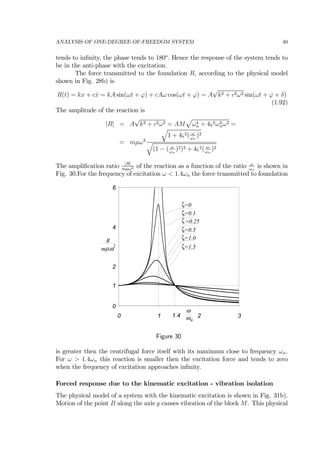
The amplification ratio |R|
mµω2 of the reaction as a function of the ratio ω
ωn
is shown in
Fig. 30.For the frequency of excitation ω < 1.4ωn the force transmitted to foundation
0
2
4
6
0 1 2 3
nω
ω
R
µm
2
ω
1
1.4
=0ζ
=0.1ζ
=0.25ζ
=0.5ζ
=1.0ζ
=1.5ζ
Figure 30
is greater then the centrifugal force itself with its maximum close to frequency ωn.
For ω > 1.4ωn this reaction is smaller then the excitation force and tends to zero
when the frequency of excitation approaches infinity.
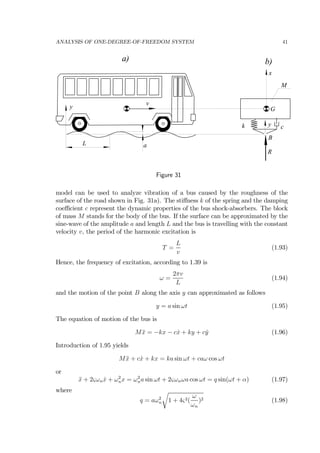
Forced response due to the kinematic excitation - vibration isolation
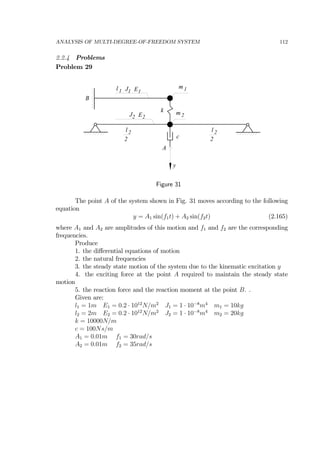
The physical model of a system with the kinematic excitation is shown in Fig. 31b).
Motion of the point B along the axis y causes vibration of the block M. This physical
ANALYSIS OF ONE-DEGREE-OF-FREEDOM SYSTEM 41
L
y
M
k cy
x
a
v
R
G
B
a) b)
Figure 31
model can be used to analyze vibration of a bus caused by the roughness of the
surface of the road shown in Fig. 31a). The stiffness k of the spring and the damping
coefficient c represent the dynamic properties of the bus shock-absorbers. The block
of mass M stands for the body of the bus. If the surface can be approximated by the
sine-wave of the amplitude a and length L and the bus is travelling with the constant
velocity v, the period of the harmonic excitation is
T =
L
v
(1.93)
Hence, the frequency of excitation, according to 1.39 is
ω =
2πv
L
(1.94)
and the motion of the point B along the axis y can approximated as follows
y = a sin ωt (1.95)
The equation of motion of the bus is
M ¨x = −kx − c ˙x + ky + c ˙y (1.96)
Introduction of 1.95 yields
M ¨x + c ˙x + kx = ka sin ωt + caω cos ωt
or
¨x + 2ςωn ˙x + ω2
nx = ω2
na sin ωt + 2ςωnωa cos ωt = q sin(ωt + α) (1.97)
where
q = aω2
n
r
1 + 4ς2(
ω
ωn
)2 (1.98)
ANALYSIS OF ONE-DEGREE-OF-FREEDOM SYSTEM 42
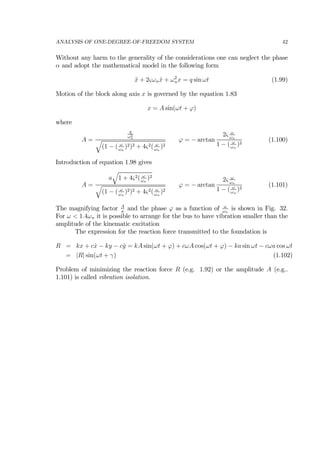
Without any harm to the generality of the considerations one can neglect the phase
α and adopt the mathematical model in the following form
¨x + 2ςωn ˙x + ω2
nx = q sin ωt (1.99)
Motion of the block along axis x is governed by the equation 1.83
x = A sin(ωt + ϕ)
where
A =
q
ω2
n
q
(1 − ( ω
ωn
)2)2 + 4ς2( ω
ωn
)2
ϕ = − arctan
2ς ω
ωn
1 − ( ω
ωn
)2
(1.100)
Introduction of equation 1.98 gives
A =
a
q
1 + 4ς2( ω
ωn
)2
q
(1 − ( ω
ωn
)2)2 + 4ς2( ω
ωn
)2
ϕ = − arctan
2ς ω
ωn
1 − ( ω
ωn
)2
(1.101)
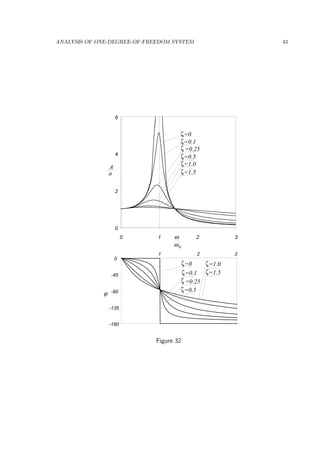
The magnifying factor A
a
and the phase ϕ as a function of ω
ωn
is shown in Fig. 32.
For ω < 1.4ωn it is possible to arrange for the bus to have vibration smaller than the
amplitude of the kinematic excitation
The expression for the reaction force transmitted to the foundation is
R = kx + c ˙x − ky − c ˙y = kA sin(ωt + ϕ) + cωA cos(ωt + ϕ) − ka sin ωt − cωa cos ωt
= |R| sin(ωt + γ) (1.102)
Problem of minimizing the reaction force R (e.g. 1.92) or the amplitude A (e.g..
1.101) is called vibration isolation.
ANALYSIS OF ONE-DEGREE-OF-FREEDOM SYSTEM 43
-180
-135
-90
-45
0
1 2 3
ϕ
nω
ω
A
a
0
2
4
6
0 1 2 3
=0ζ
=0.1ζ
=0.25ζ
=0.5ζ
=1.0ζ
=1.5ζ
=0ζ
=0.1ζ
=0.25ζ
=0.5ζ
=1.0ζ
=1.5ζ
Figure 32
ANALYSIS OF ONE-DEGREE-OF-FREEDOM SYSTEM 44
1.2.3 Problems
Free vibrations
Problem 9
1
2
H
k c
Figure 33
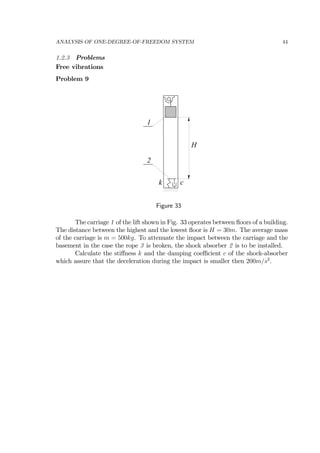
The carriage 1 of the lift shown in Fig. 33 operates between floors of a building.
The distance between the highest and the lowest floor is H = 30m. The average mass
of the carriage is m = 500kg. To attenuate the impact between the carriage and the
basement in the case the rope 3 is broken, the shock absorber 2 is to be installed.
Calculate the stiffness k and the damping coefficient c of the shock-absorber
which assure that the deceleration during the impact is smaller then 200m/s2
.
ANALYSIS OF ONE-DEGREE-OF-FREEDOM SYSTEM 45
Solution
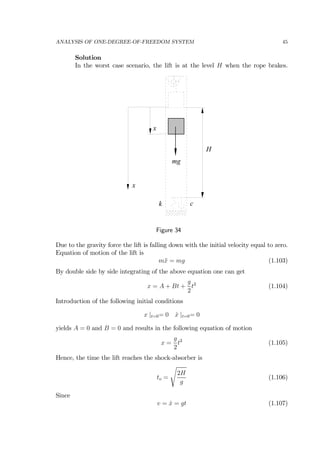
In the worst case scenario, the lift is at the level H when the rope brakes.
H
k c
x
x
mg
Figure 34
Due to the gravity force the lift is falling down with the initial velocity equal to zero.
Equation of motion of the lift is
m¨x = mg (1.103)
By double side by side integrating of the above equation one can get
x = A + Bt +
g
2
t2
(1.104)
Introduction of the following initial conditions
x |t=0= 0 ˙x |t=0= 0
yields A = 0 and B = 0 and results in the following equation of motion
x =
g
2
t2
(1.105)
Hence, the time the lift reaches the shock-absorber is
to =
s
2H
g
(1.106)
Since
v = ˙x = gt (1.107)
ANALYSIS OF ONE-DEGREE-OF-FREEDOM SYSTEM 46
the velocity of the lift at the time of the impact with the shock-absorber is
vo = ˙x |t=to =
p
2Hg (1.108)
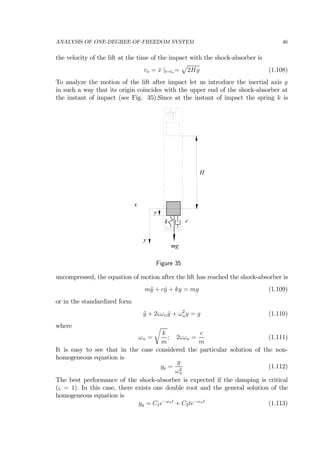
To analyze the motion of the lift after impact let us introduce the inertial axis y
in such a way that its origin coincides with the upper end of the shock-absorber at
the instant of impact (see Fig. 35).Since at the instant of impact the spring k is
H
k c
x
y
mg
y
Figure 35
uncompressed, the equation of motion after the lift has reached the shock-absorber is
m¨y + c ˙y + ky = mg (1.109)
or in the standardized form
¨y + 2ςωn ˙y + ω2
ny = g (1.110)
where
ωn =
r
k
m
; 2ςωn =
c
m
(1.111)
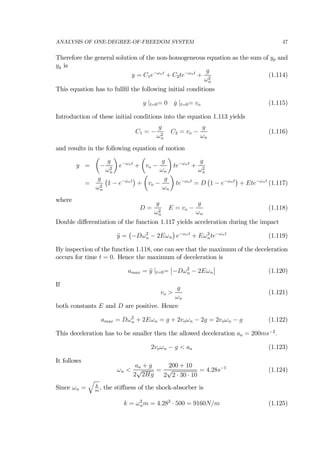
It is easy to see that in the case considered the particular solution of the non-
homogeneous equation is
yp =
g
ω2
n
(1.112)
The best performance of the shock-absorber is expected if the damping is critical
(ς = 1). In this case, there exists one double root and the general solution of the
homogeneous equation is
yg = C1e−ωnt
+ C2te−ωnt
(1.113)
ANALYSIS OF ONE-DEGREE-OF-FREEDOM SYSTEM 47
Therefore the general solution of the non-homogeneous equation as the sum of yp and
yg is
y = C1e−ωnt
+ C2te−ωnt
+
g
ω2
n
(1.114)
This equation has to fullfil the following initial conditions
y |t=0= 0 ˙y |t=0= vo (1.115)
Introduction of these initial conditions into the equation 1.113 yields
C1 = −
g
ω2
n
C2 = vo −
g
ωn
(1.116)
and results in the following equation of motion
y =
µ
−
g
ω2
n

e−ωnt
+
µ
vo −
g
ωn

te−ωnt
+
g
ω2
n
=
g
ω2
n
¡
1 − e−ωnt
¢
+
µ
vo −
g
ωn

te−ωnt
= D
¡
1 − e−ωnt
¢
+ Ete−ωnt
(1.117)
where
D =
g
ω2
n
E = vo −
g
ωn
(1.118)
Double differentiation of the function 1.117 yields acceleration during the impact
¨y =
¡
−Dω2
n − 2Eωn
¢
e−ωnt
+ Eω2
nte−ωnt
(1.119)
By inspection of the function 1.118, one can see that the maximum of the deceleration
occurs for time t = 0. Hence the maximum of deceleration is
amax = ¨y |t=0=
¯
¯−Dω2
n − 2Eωn
¯
¯ (1.120)
If
vo >
g
ωn
(1.121)
both constants E and D are positive. Hence
amax = Dω2
n + 2Eωn = g + 2voωn − 2g = 2voωn − g (1.122)
This deceleration has to be smaller then the allowed deceleration aa = 200ms−2
.
2voωn − g < aa (1.123)
It follows
ωn <
aa + g
2
√
2Hg
=
200 + 10
2
√
2 · 30 · 10
= 4.28s−1
(1.124)
Since ωn =
q
k
m
, the stiffness of the shock-absorber is
k = ω2
nm = 4.282
· 500 = 9160N/m (1.125)
ANALYSIS OF ONE-DEGREE-OF-FREEDOM SYSTEM 48
and the damping coefficient
c = 2ςωnm = 2 · 1 · 4.28 · 500 = 4280Ns/m (1.126)
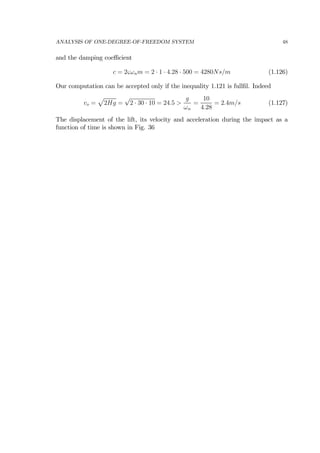
Our computation can be accepted only if the inequality 1.121 is fullfil. Indeed
vo =
p
2Hg =
√
2 · 30 · 10 = 24.5 >
g
ωn
=
10
4.28
= 2.4m/s (1.127)
The displacement of the lift, its velocity and acceleration during the impact as a
function of time is shown in Fig. 36
ANALYSIS OF ONE-DEGREE-OF-FREEDOM SYSTEM 49
displacement
time [s]
y [m]
0
0.5
1
1.5
2
2.5
0 0.25 0.5 0.75 1
v [m/s]
velocity
time [s]
-5
0
5
10
15
20
25
0.25 0.5 0.75 1
acceleration
time [s]
-200
-150
-100
-50
0
50
0.25 0.5 0.75 1
a [m/s ]2
Figure 36
ANALYSIS OF ONE-DEGREE-OF-FREEDOM SYSTEM 50
Problem 10
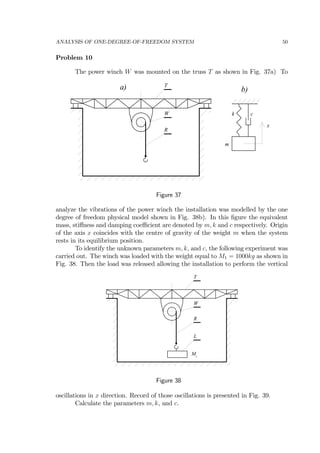
The power winch W was mounted on the truss T as shown in Fig. 37a) To
T
R
W k
m
c
x
a) b)
Figure 37
analyze the vibrations of the power winch the installation was modelled by the one
degree of freedom physical model shown in Fig. 38b). In this figure the equivalent
mass, stiffness and damping coefficient are denoted by m, k and c respectively. Origin
of the axis x coincides with the centre of gravity of the weight m when the system
rests in its equilibrium position.
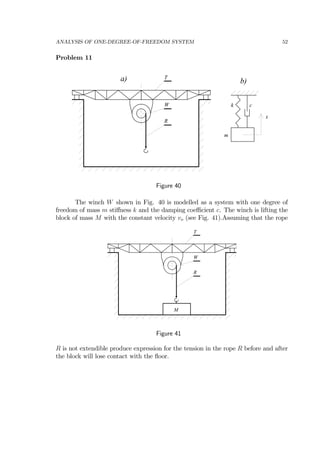
To identify the unknown parameters m, k, and c, the following experiment was
carried out. The winch was loaded with the weight equal to M1 = 1000kg as shown in
Fig. 38. Then the load was released allowing the installation to perform the vertical
T
R
W
Ml
L
Figure 38
oscillations in x direction. Record of those oscillations is presented in Fig. 39.
Calculate the parameters m, k, and c.
ANALYSIS OF ONE-DEGREE-OF-FREEDOM SYSTEM 51
431 2
time [s]
-0.003
-0.002
-0.001
0
0.001
0.002
0.003
x[m]
Figure 39
Answer
m = 7000kg; k = 3000000Nm−1
; c = 15000Nsm−1
ANALYSIS OF ONE-DEGREE-OF-FREEDOM SYSTEM 52
Problem 11
T
R
W k
m
c
x
a) b)
Figure 40
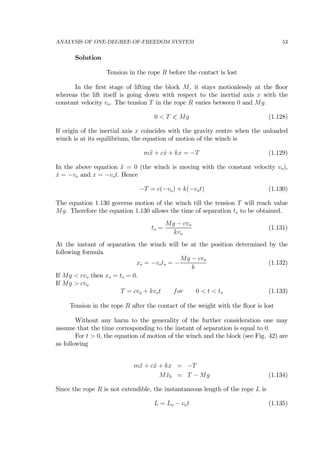
The winch W shown in Fig. 40 is modelled as a system with one degree of
freedom of mass m stiffness k and the damping coefficient c. The winch is lifting the
block of mass M with the constant velocity vo (see Fig. 41).Assuming that the rope
T
R
W
M
Figure 41
R is not extendible produce expression for the tension in the rope R before and after
the block will lose contact with the floor.
ANALYSIS OF ONE-DEGREE-OF-FREEDOM SYSTEM 53
Solution
Tension in the rope R before the contact is lost
In the first stage of lifting the block M, it stays motionlessly at the floor
whereas the lift itself is going down with respect to the inertial axis x with the
constant velocity vo. The tension T in the rope R varies between 0 and Mg.
0 < T 0 Mg (1.128)
If origin of the inertial axis x coincides with the gravity centre when the unloaded
winch is at its equilibrium, the equation of motion of the winch is
m¨x + c ˙x + kx = −T (1.129)
In the above equation ¨x = 0 (the winch is moving with the constant velocity vo),
˙x = −vo and x = −vot. Hence
−T = c(−vo) + k(−vot) (1.130)
The equation 1.130 governs motion of the winch till the tension T will reach value
Mg. Therefore the equation 1.130 allows the time of separation ts to be obtained.
ts =
Mg − cvo
kvo
(1.131)
At the instant of separation the winch will be at the position determined by the
following formula
xs = −vots = −
Mg − cvo
k
(1.132)
If Mg < cvo then xs = ts = 0.
If Mg > cvo
T = cvo + kvot for 0 < t < ts (1.133)
Tension in the rope R after the contact of the weight with the floor is lost
Without any harm to the generality of the further consideration one may
assume that the time corresponding to the instant of separation is equal to 0.
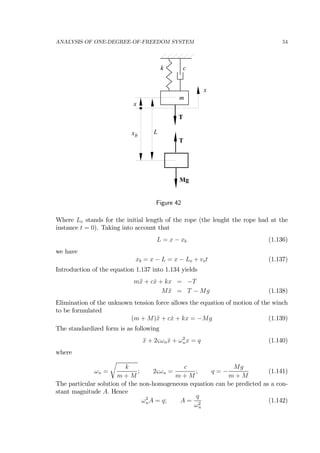
For t > 0, the equation of motion of the winch and the block (see Fig. 42) are
as following
m¨x + c ˙x + kx = −T
M ¨xb = T − Mg (1.134)
Since the rope R is not extendible, the instantaneous length of the rope L is
L = Lo − vot (1.135)
ANALYSIS OF ONE-DEGREE-OF-FREEDOM SYSTEM 54
k
m
c
x
T
T
Mg
x
xb
L
Figure 42
Where Lo stands for the initial length of the rope (the lenght the rope had at the
instance t = 0). Taking into account that
L = x − xb (1.136)
we have
xb = x − L = x − Lo + vot (1.137)
Introduction of the equation 1.137 into 1.134 yields
m¨x + c ˙x + kx = −T
M ¨x = T − Mg (1.138)
Elimination of the unknown tension force allows the equation of motion of the winch
to be formulated
(m + M)¨x + c ˙x + kx = −Mg (1.139)
The standardized form is as following
¨x + 2ςωn ˙x + ω2
nx = q (1.140)
where
ωn =
r
k
m + M
; 2ςωn =
c
m + M
; q = −
Mg
m + M
(1.141)
The particular solution of the non-homogeneous equation can be predicted as a con-
stant magnitude A. Hence
ω2
nA = q; A =
q
ω2
n
(1.142)
ANALYSIS OF ONE-DEGREE-OF-FREEDOM SYSTEM 55
The general solution of the mathematical model 1.140 is
x = e−ςωnt
(Cs sin ωdt + Cc cos ωdt) + A (1.143)
where
ωd = ωn
p
1 − ς2 (1.144)
This solution has to fulfill the following initial conditions
for t = 0 x = xs ˙x = −vo (1.145)
Introduction of these initial conditions into the solution 1.143 yields the following
expressions for the constants Cs and Cc
Cs =
−vo + ςωn(xs − A)
ωd
Cc = xs − A (1.146)
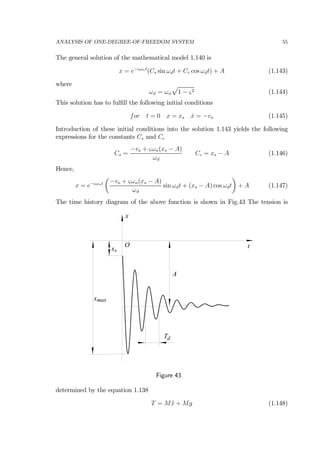
Hence,
x = e−ςωnt
µ
−vo + ςωn(xs − A)
ωd
sin ωdt + (xs − A) cos ωdt

+ A (1.147)
The time history diagram of the above function is shown in Fig.43 The tension is
x
txs
Td
xmax
A
O
Figure 43
determined by the equation 1.138
T = M ¨x + Mg (1.148)
ANALYSIS OF ONE-DEGREE-OF-FREEDOM SYSTEM 56
Double differentiation of the function 1.147 yields the wanted tension as a function
of time
T = Mg + Me−ςωnt
¡
Cs(ςωn)2
+ 2Ccςωnωd − Csω2
d
¢
sin ωdt
+Me−ςωnt
¡
Cc(ςωn)2
− 2Csςωnωd + Ccω2
d
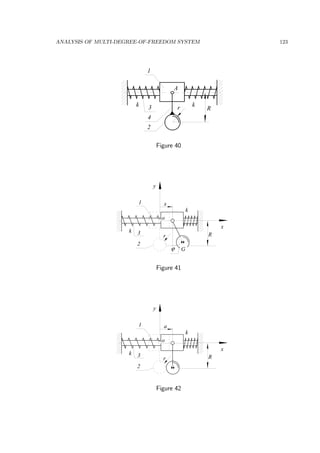
¢
cos ωdt (1.149)
ANALYSIS OF ONE-DEGREE-OF-FREEDOM SYSTEM 57
Forced vibration
Problem 12
E,I
M
m
ω t
l
c
µ
B
A
Figure 44
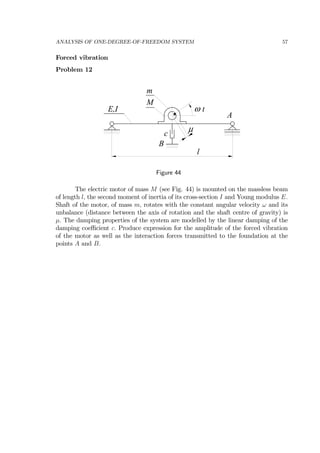
The electric motor of mass M (see Fig. 44) is mounted on the massless beam
of length l, the second moment of inertia of its cross-section I and Young modulus E.
Shaft of the motor, of mass m, rotates with the constant angular velocity ω and its
unbalance (distance between the axis of rotation and the shaft centre of gravity) is
µ. The damping properties of the system are modelled by the linear damping of the
damping coefficient c. Produce expression for the amplitude of the forced vibration
of the motor as well as the interaction forces transmitted to the foundation at the
points A and B.
ANALYSIS OF ONE-DEGREE-OF-FREEDOM SYSTEM 58
Solution
E,I
M
m
ω t
l
c
µ
x
m ωµ
2
A
B
Figure 45
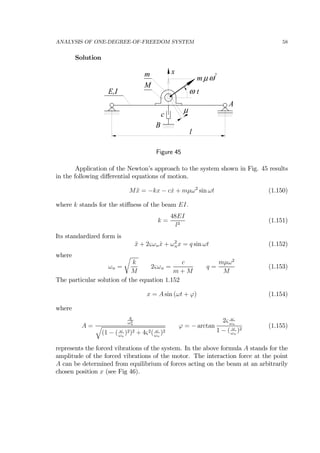
Application of the Newton’s approach to the system shown in Fig. 45 results
in the following differential equations of motion.
M ¨x = −kx − c ˙x + mµω2
sin ωt (1.150)
where k stands for the stiffness of the beam EI.
k =
48EI
l3
(1.151)
Its standardized form is
¨x + 2ςωn ˙x + ω2
nx = q sin ωt (1.152)
where
ωn =
r
k
M
2ςωn =
c
m + M
q =
mµω2
M
(1.153)
The particular solution of the equation 1.152
x = A sin (ωt + ϕ) (1.154)
where
A =
q
ω2
n
q
(1 − ( ω
ωn
)2)2 + 4ς2( ω
ωn
)2
ϕ = − arctan
2ς ω
ωn
1 − ( ω
ωn
)2
(1.155)
represents the forced vibrations of the system. In the above formula A stands for the
amplitude of the forced vibrations of the motor. The interaction force at the point
A can be determined from equilibrium of forces acting on the beam at an arbitrarily
chosen position x (see Fig 46).
ANALYSIS OF ONE-DEGREE-OF-FREEDOM SYSTEM 59
E,I
0.5k
l
x
x
x0.5kx
kx
A
D
Figure 46
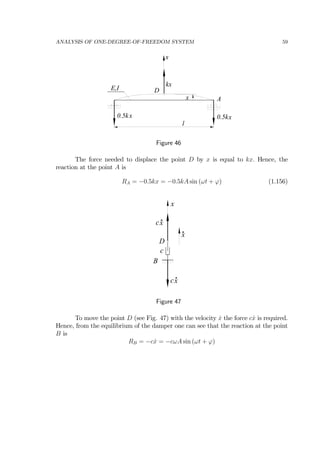
The force needed to displace the point D by x is equal to kx. Hence, the
reaction at the point A is
RA = −0.5kx = −0.5kA sin (ωt + ϕ) (1.156)
B
x
x
c
c
D
xc
x
Figure 47
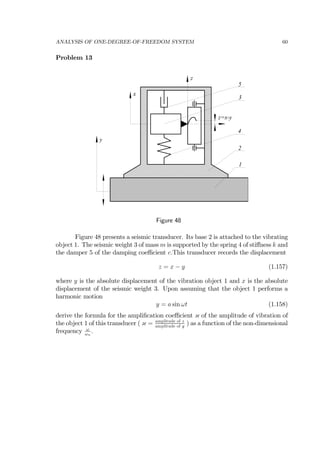
To move the point D (see Fig. 47) with the velocity ˙x the force c ˙x is required.
Hence, from the equilibrium of the damper one can see that the reaction at the point
B is
RB = −c ˙x = −cωA sin (ωt + ϕ)
ANALYSIS OF ONE-DEGREE-OF-FREEDOM SYSTEM 60
Problem 13
x
z
y
z=x-y
1
2
3
4
5
Figure 48
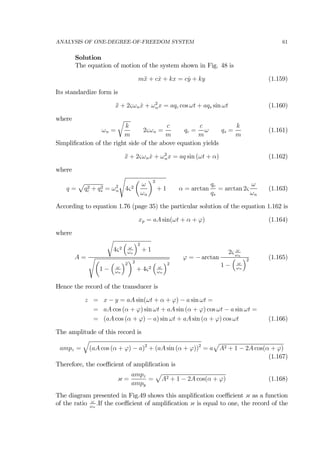
Figure 48 presents a seismic transducer. Its base 2 is attached to the vibrating
object 1. The seismic weight 3 of mass m is supported by the spring 4 of stiffness k and
the damper 5 of the damping coefficient c.This transducer records the displacement
z = x − y (1.157)
where y is the absolute displacement of the vibration object 1 and x is the absolute
displacement of the seismic weight 3. Upon assuming that the object 1 performs a
harmonic motion
y = a sin ωt (1.158)
derive the formula for the amplification coefficient κ of the amplitude of vibration of
the object 1 of this transducer ( κ = amplitude of z
amplitude of y
) as a function of the non-dimensional
frequency ω
ωn
.
ANALYSIS OF ONE-DEGREE-OF-FREEDOM SYSTEM 61
Solution
The equation of motion of the system shown in Fig. 48 is
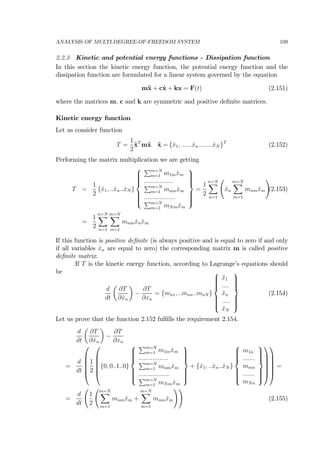
m¨x + c ˙x + kx = c ˙y + ky (1.159)
Its standardize form is
¨x + 2ςωn ˙x + ω2
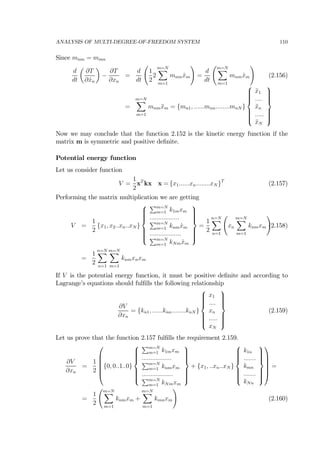
nx = aqc cos ωt + aqs sin ωt (1.160)
where
ωn =
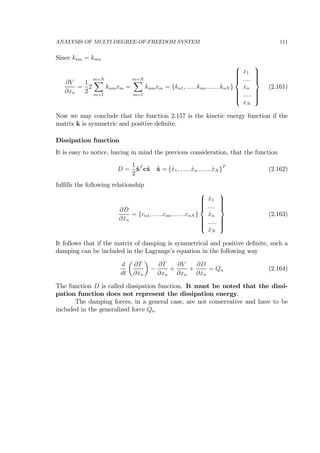
r
k
m
2ςωn =
c
m
qc =
c
m
ω qs =
k
m
(1.161)
Simplification of the right side of the above equation yields
¨x + 2ςωn ˙x + ω2
nx = aq sin (ωt + α) (1.162)
where
q =
p
q2
c + q2
s = ω2
n
s
4ς2
µ
ω
ωn
¶2
+ 1 α = arctan
qc
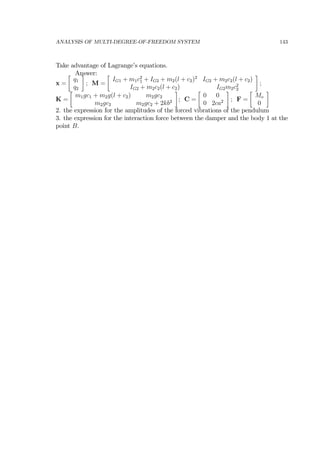
qs
= arctan 2ς
ω
ωn
(1.163)
According to equation 1.76 (page 35) the particular solution of the equation 1.162 is
xp = aA sin(ωt + α + ϕ) (1.164)
where
A =
r
4ς2
³
ω
ωn
´2
+ 1
sµ
1 −
³
ω
ωn
´2
¶2
+ 4ς2
³
ω
ωn
´2
ϕ = − arctan
2ς ω
ωn
1 −
³
ω
ωn
´2 (1.165)
Hence the record of the transducer is
z = x − y = aA sin(ωt + α + ϕ) − a sin ωt =
= aA cos (α + ϕ) sin ωt + aA sin (α + ϕ) cos ωt − a sin ωt =
= (aA cos (α + ϕ) − a) sin ωt + aA sin (α + ϕ) cos ωt (1.166)
The amplitude of this record is
ampz =
q
(aA cos (α + ϕ) − a)2
+ (aA sin (α + ϕ))2
= a
p
A2 + 1 − 2A cos(α + ϕ)
(1.167)
Therefore, the coefficient of amplification is
κ =
ampz
ampy
=
p
A2 + 1 − 2A cos(α + ϕ) (1.168)
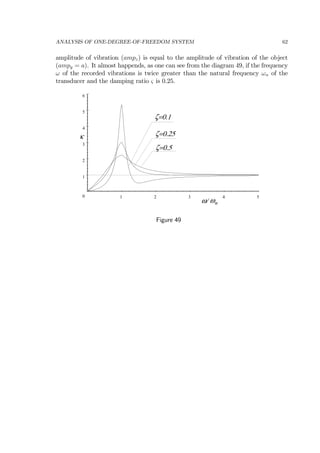
The diagram presented in Fig.49 shows this amplification coefficient κ as a function
of the ratio ω
ωn
.If the coefficient of amplification κ is equal to one, the record of the
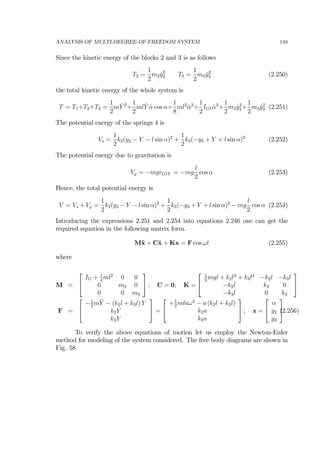
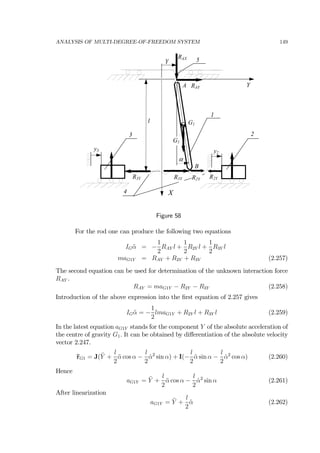
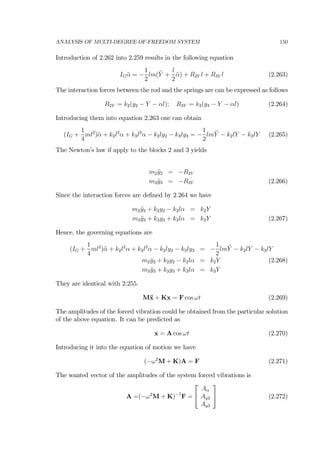
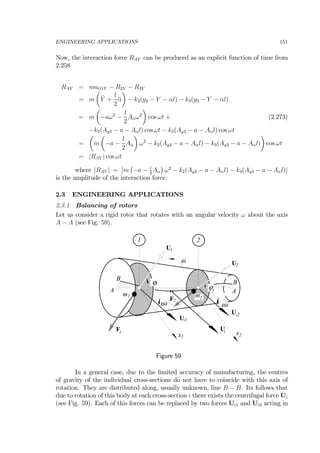
ANALYSIS OF ONE-DEGREE-OF-FREEDOM SYSTEM 62
amplitude of vibration (ampz) is equal to the amplitude of vibration of the object
(ampy = a). It almost happends, as one can see from the diagram 49, if the frequency
ω of the recorded vibrations is twice greater than the natural frequency ωn of the
transducer and the damping ratio ς is 0.25.
0
1
2
3
4
5
6
1 2 3 4 5
ω/ nω
κ
ζ=0.1
ζ=0.25
ζ=0.5
Figure 49
ANALYSIS OF ONE-DEGREE-OF-FREEDOM SYSTEM 63
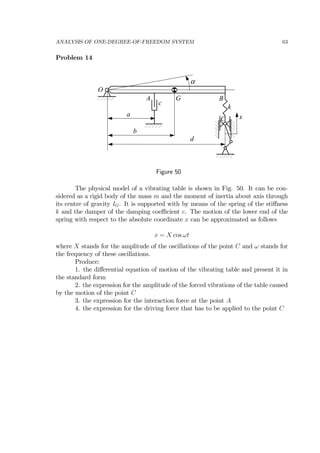
Problem 14
O
A B
α
xa
b
c
d
k
G
C
Figure 50
The physical model of a vibrating table is shown in Fig. 50. It can be con-
sidered as a rigid body of the mass m and the moment of inertia about axis through
its centre of gravity IG. It is supported with by means of the spring of the stiffness
k and the damper of the damping coefficient c. The motion of the lower end of the
spring with respect to the absolute coordinate x can be approximated as follows
x = X cos ωt
where X stands for the amplitude of the oscillations of the point C and ω stands for
the frequency of these oscillations.
Produce:
1. the differential equation of motion of the vibrating table and present it in
the standard form
2. the expression for the amplitude of the forced vibrations of the table caused
by the motion of the point C
3. the expression for the interaction force at the point A
4. the expression for the driving force that has to be applied to the point C
ANALYSIS OF ONE-DEGREE-OF-FREEDOM SYSTEM 64
Problem 15
Y
1
2 xG
G
L/2
L
A
B
C
c k
L/2
aα
Figure 51
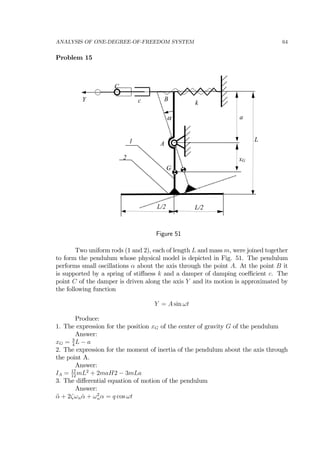
Two uniform rods (1 and 2), each of length L and mass m, were joined together
to form the pendulum whose physical model is depicted in Fig. 51. The pendulum
performs small oscillations α about the axis through the point A. At the point B it
is supported by a spring of stiffness k and a damper of damping coefficient c. The
point C of the damper is driven along the axis Y and its motion is approximated by
the following function
Y = A sin ωt
Produce:
1. The expression for the position xG of the center of gravity G of the pendulum
Answer:
xG = 3
4
L − a
2. The expression for the moment of inertia of the pendulum about the axis through
the point A.
Answer:
IA = 17
12
mL2
+ 2maH2 − 3mLa
3. The differential equation of motion of the pendulum
Answer:
¨α + 2ζωn ˙α + ω2
nα = q cos ωt
ANALYSIS OF ONE-DEGREE-OF-FREEDOM SYSTEM 65
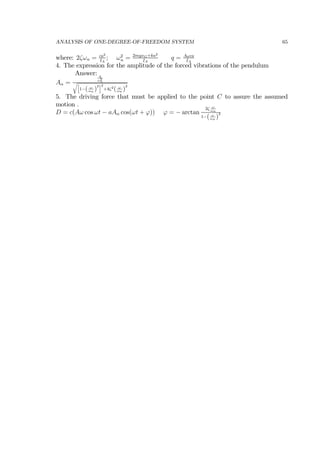
where: 2ζωn = ca2
IA
; ω2
n = 2mgxG+ka2
IA
q = Aωca
IA
4. The expression for the amplitude of the forced vibrations of the pendulum
Answer:
Aα =
q
ω2
n
1−( ω
ωn
)
2 2
+4ζ2
( ω
ωn
)
2
5. The driving force that must be applied to the point C to assure the assumed
motion .
D = c(Aω cos ωt − aAα cos(ωt + ϕ)) ϕ = − arctan
2ζ ω
ωn
1−( ω
ωn
)
2
Chapter 2
MECHANICAL VIBRATION OF MULTI-DEGREE-OF-FREEDOM
LINEAR SYSTEMS
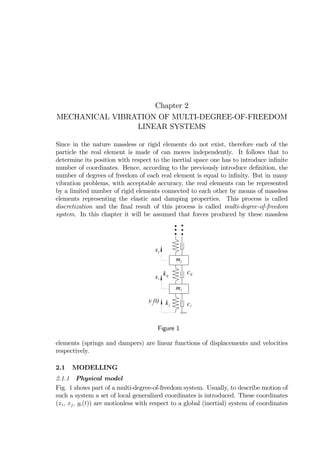
Since in the nature massless or rigid elements do not exist, therefore each of the
particle the real element is made of can moves independently. It follows that to
determine its position with respect to the inertial space one has to introduce infinite
number of coordinates. Hence, according to the previously introduce definition, the
number of degrees of freedom of each real element is equal to infinity. But in many
vibration problems, with acceptable accuracy, the real elements can be represented
by a limited number of rigid elements connected to each other by means of massless
elements representing the elastic and damping properties. This process is called
discretization and the final result of this process is called multi-degree-of-freedom
system. In this chapter it will be assumed that forces produced by these massless
mi
ki ci
mj
xi
kij
cij
xj
y (t)i
Figure 1
elements (springs and dampers) are linear functions of displacements and velocities
respectively.
2.1 MODELLING
2.1.1 Physical model
Fig. 1 shows part of a multi-degree-of-freedom system. Usually, to describe motion of
such a system a set of local generalized coordinates is introduced. These coordinates
(xi, xj, yi(t)) are motionless with respect to a global (inertial) system of coordinates
MODELLING 67
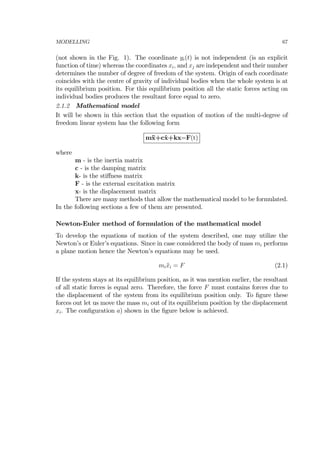
(not shown in the Fig. 1). The coordinate yi(t) is not independent (is an explicit
function of time) whereas the coordinates xi, and xj are independent and their number
determines the number of degree of freedom of the system. Origin of each coordinate
coincides with the centre of gravity of individual bodies when the whole system is at
its equilibrium position. For this equilibrium position all the static forces acting on
individual bodies produces the resultant force equal to zero.
2.1.2 Mathematical model
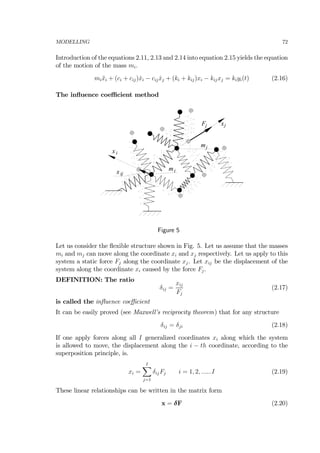
It will be shown in this section that the equation of motion of the multi-degree of
freedom linear system has the following form
m¨x+c˙x+kx=F(t)
where
m - is the inertia matrix
c - is the damping matrix
k- is the stiffness matrix
F - is the external excitation matrix
x- is the displacement matrix
There are many methods that allow the mathematical model to be formulated.
In the following sections a few of them are presented.
Newton-Euler method of formulation of the mathematical model
To develop the equations of motion of the system described, one may utilize the
Newton’s or Euler’s equations. Since in case considered the body of mass mi performs
a plane motion hence the Newton’s equations may be used.
mi ¨xi = F (2.1)
If the system stays at its equilibrium position, as it was mention earlier, the resultant
of all static forces is equal zero. Therefore, the force F must contains forces due to
the displacement of the system from its equilibrium position only. To figure these
forces out let us move the mass mi out of its equilibrium position by the displacement
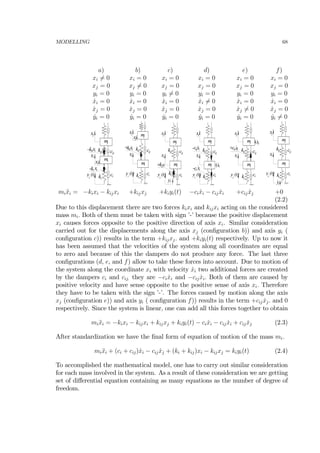
xi. The configuration a) shown in the figure below is achieved.
MODELLING 68
a)
xi 6= 0
xj = 0
yi = 0
˙xi = 0
˙xj = 0
˙yi = 0
b)
xi = 0
xj 6= 0
yi = 0
˙xi = 0
˙xj = 0
˙yi = 0
c)
xi = 0
xj = 0
yi 6= 0
˙xi = 0
˙xj = 0
˙yi = 0
d)
xi = 0
xj = 0
yi = 0
˙xi 6= 0
˙xj = 0
˙yi = 0
e)
xi = 0
xj = 0
yi = 0
˙xi = 0
˙xj 6= 0
˙yi = 0
f)
xi = 0
xj = 0
yi = 0
˙xi = 0
˙xj = 0
˙yi 6= 0
mi
ki
ci
mj
xi
kij cij
xj
y (t)i
xi
kij i- x
ki i- x
mi
ki
ci
mj
xi
kij cij
xj
y (t)i
xj
kij j+ x
mi
ki ci
mj
xi
kij cij
xj
y (t)i
yi
ki i+ y mi
ki
ci
mj
xi
kij cij
xj
y (t)i
xi
cij i- x
ci i- x
mi
ki
ci
mj
xi
kij cij
xj
y (t)i
xj
cij j+ x
mi
ki
ci
mj
xi
kij cij
xj
y (t)i
yj
mi¨xi = −kixi − kijxi +kijxj +kiyi(t) −ci ˙xi − cij ˙xi +cij ˙xj +0
(2.2)
Due to this displacement there are two forces kixi and kijxi acting on the considered
mass mi. Both of them must be taken with sign ’-’ because the positive displacement
xi causes forces opposite to the positive direction of axis xi. Similar consideration
carried out for the displacements along the axis xj (configuration b)) and axis yi (
configuration c)) results in the term +kijxj. and +kiyi(t) respectively. Up to now it
has been assumed that the velocities of the system along all coordinates are equal
to zero and because of this the dampers do not produce any force. The last three
configurations (d, e, and f) allow to take these forces into account. Due to motion of
the system along the coordinate xi with velocity ˙xi two additional forces are created
by the dampers ci and cij. they are −ci ˙xi and −cij ˙xi. Both of them are caused by
positive velocity and have sense opposite to the positive sense of axis xi. Therefore
they have to be taken with the sign ’-’. The forces caused by motion along the axis
xj (configuration e)) and axis yi ( configuration f)) results in the term +cij ˙xj. and 0
respectively. Since the system is linear, one can add all this forces together to obtain
mi¨xi = −kixi − kijxi + kijxj + kiyi(t) − ci ˙xi − cij ˙xi + cij ˙xj (2.3)
After standardization we have the final form of equation of motion of the mass mi.
mi¨xi + (ci + cij) ˙xi − cij ˙xj + (ki + kij)xi − kijxj = kiyi(t) (2.4)
To accomplished the mathematical model, one has to carry out similar consideration
for each mass involved in the system. As a result of these consideration we are getting
set of differential equation containing as many equations as the number of degree of
freedom.
MODELLING 69
Lagrange method of formulation of the mathematical model
The same set of equation of motion one can get by utilization of the Lagrange’s
equations
d
dt
(
∂
∂ ˙qm
T) −
∂
∂qm
T +
∂V
∂qm
= Qm m = 1, 2, ....M (2.5)
where
T - is the system kinetic energy function
V - stands for the potential energy function
Qm - is the generalized force along the generalized coordinate qm
The kinetic energy function of the system considered is equal to sum of the
kinetic energy of the individual rigid bodies the system is made of. Hence
T =
IX
i=1
⎛
⎝1
2
miv2
i +
1
2
£
ωix ωiy ωiz
¤
⎡
⎣
Iix 0 0
0 Iiy 0
0 0 Iiz
⎤
⎦
⎡
⎣
ωix
ωiy
ωiz
⎤
⎦
⎞
⎠ (2.6)
where
mi - mass of the rigid body
vi - absolute velocity of the centre of gravity of the body
ωix,ωiy,ωiz, - components of the absolute angular velocity of the body
Iix, Iiy, Iiz - The principal moments of inertia of the body about axes through
its centre of gravity
Potential energy function V for the gravity force acting on the link i shown in Fig. 2
is
Vi = migrGiZ (2.7)
Z
X
YO
rG
i
Gi
i
rGiZ
Figure 2
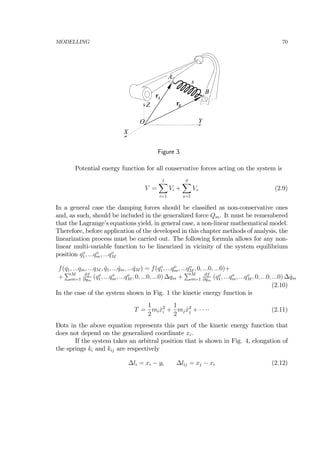
Potential energy for the spring s of stiffness ks and uncompressed length ls
(see Fig. 3) is
Vs =
1
2
ks(|rA − rB| − ls)2
(2.8)
MODELLING 70
Z
X
YO
A
B
s
rA
rB
Figure 3
Potential energy function for all conservative forces acting on the system is
V =
IX
i=1
Vi +
SX
s=1
Vs (2.9)
In a general case the damping forces should be classified as non-conservative ones
and, as such, should be included in the generalized force Qm. It must be remembered
that the Lagrange’s equations yield, in general case, a non-linear mathematical model.
Therefore, before application of the developed in this chapter methods of analysis, the
linearization process must be carried out. The following formula allows for any non-
linear multi-variable function to be linearized in vicinity of the system equilibrium
position qo
1, ...qo
m, ...qo
M
f(q1, ...qm, ...qM , ˙q1, ... ˙qm, ... ˙qM ) = f(qo
1, ...qo
m, ...qo
M , 0, ...0, ...0)+
+
PM
m=1
∂f
∂qm
(qo
1, ...qo
m, ...qo
M , 0, ...0, ...0) ∆qm +
PM
m=1
∂f
∂ ˙qm
(qo
1, ...qo
m, ...qo
M , 0, ...0, ...0) ∆ ˙qm
(2.10)
In the case of the system shown in Fig. 1 the kinetic energy function is
T =
1
2
mi ˙x2
i +
1
2
mj ˙x2
j + · · ·· (2.11)
Dots in the above equation represents this part of the kinetic energy function that
does not depend on the generalized coordinate xi.
If the system takes an arbitral position that is shown in Fig. 4, elongation of
the springs ki and kij are respectively
∆li = xi − yi ∆lij = xj − xi (2.12)
MODELLING 71
mi
ki ci
mj
xi
kij
cij
xj
y (t)i
mi
ki
ci
mj
xi
kij
cij
xj
y (t)i
xj
xi
y i
Figure 4
Therefore, the potential energy function is
V =
1
2
ki(xi − yi)2
+
1
2
kij(xj − xi)2
+ · · ·· (2.13)
Again, dots stands for this part of the potential energy function that does not depend
on the generalized coordinate xi. It should be noted that the above potential energy
function represents increment of the potential energy of the springs due to the dis-
placement of the system from its equilibrium position. Therefore the above function
does not include the potential energy due to the static deflection of the springs. It
follows that the conservative forces due to the static deflections can not be produced
from this potential energy function. They, together with the gravity forces, produce
resultant equal to zero. Hence, if the potential energy due to the static deflections is
not included in the function 2.13 the potential energy due to gravitation must not be
included in the function 2.13 either. If the potential energy due to the static deflec-
tions is included in the function 2.13 the potential energy due to gravitation must be
included in the function 2.13 too.
Generally, the force produced by the dampers is included in the generalized
force Qm. But, very often, for convenience, a damping function (dissipation function)
D is introduced into the Lagrange’s equation to produce the damping forces. The
function D does not represent the dissipation energy but has such a property that its
partial derivative produces the damping forces. The damping function is created by
analogy to the creation of the potential energy function. The stiffness k is replaced
by the damping coefficient c and the generalized displacements are replaced by the
generalized velocities. Hence, in the considered case, since the lower end of the damper
is motionless, the damping function is
D =
1
2
ci( ˙xi)2
+
1
2
cij( ˙xj − ˙xi)2
+ · · ·· (2.14)
The Lagrange’s equation with the damping function takes form
d
dt
(
∂
∂ ˙qm
T) −
∂
∂qm
T +
∂V
∂qm
+
∂D
∂ ˙qm
= Qm m = 1, 2, ....M (2.15)
MODELLING 72
Introduction of the equations 2.11, 2.13 and 2.14 into equation 2.15 yields the equation
of the motion of the mass mi.
mi¨xi + (ci + cij) ˙xi − cij ˙xj + (ki + kij)xi − kijxj = kiyi(t) (2.16)
The influence coefficient method
mj
mi
Fj xj
xi
xij
Figure 5
Let us consider the flexible structure shown in Fig. 5. Let us assume that the masses
mi and mj can move along the coordinate xi and xj respectively. Let us apply to this
system a static force Fj along the coordinate xj. Let xij be the displacement of the
system along the coordinate xi caused by the force Fj.
DEFINITION: The ratio
δij =
xij
Fj
(2.17)
is called the influence coefficient
It can be easily proved (see Maxwell’s reciprocity theorem) that for any structure
δij = δji (2.18)
If one apply forces along all I generalized coordinates xi along which the system
is allowed to move, the displacement along the i − th coordinate, according to the
superposition principle, is.
xi =
IX
j=1
δijFj i = 1, 2, ......I (2.19)
These linear relationships can be written in the matrix form
x = δF (2.20)
MODELLING 73
The inverse transformation permits to produce forces that have to act on the system
along the individual coordinates if the system is at an arbitrarily chosen position x.
F = δ−1
x (2.21)
The inverse matrix δ−1
is called stiffness matrix and will be denoted by k.
k = δ−1
(2.22)
Hence according to equation 2.21 is
Fi =
IX
j=1
kijxj (2.23)
If the system considered moves and its instantaneous position is determined by the
vector x (x1, ....xj, ...xJ ) the force that acts on the particle mi is
fi = −Fi = −
IX
j=1
kijxj (2.24)
Hence, application of the third Newton’s law to the particle i yields the equation of
its motion in the following form
mi ¨xi +
IX
j=1
kijxj = 0 (2.25)
MODELLING 74
2.1.3 Problems
Problem 16
l
12
R
Figure 6
The disk 1 of radius R, and mass m is attached to the massless beam 2 of
radius r, length l and the Young modulus E as shown in Fig. 6 Develop equations of
motion of this system.
MODELLING 75
Solution.
l
12
R
y
ϕy
z
Fd
Md
Figure 7
The motion of the disk shown in Fig. 7 is governed by Newton’s equations
m¨y = Fd
I ¨ϕy = Md (2.26)
In the above mathematical model
I = 1
4
mR2
- moment of inertia of the disk about axis x
Fd, Md - forces acting on the disk due to its interaction with the beam
The interaction forces Fd and Md can be expressed as a function of the dis-
placements y and ϕy by means of the influence coefficient method.
l
2
z
y
y
ϕy
M
Fs
s
Figure 8
If the beam is loaded with force Fs (see Fig. 8), the corresponding displace-
ments y and ϕy are
y =
l3
3EJ
Fs ϕy =
l2
2EJ
Fs (2.27)
If the beam is loaded with force Ms (see Fig. 8), the corresponding displacements y
and ϕy are
y =
l2
2EJ
Ms, ϕy =
l
EJ
Ms (2.28)
MODELLING 76
Hence the total displacement along coordinates y and ϕy are
y =
l3
3EJ
Fs +
l2
2EJ
Ms
ϕy =
l2
2EJ
Fs +
l
EJ
Ms (2.29)
or in matrix form ∙
y
ϕy
¸
=
∙ l3
3EJ
l2
2EJ
l2
2EJ
l
EJ
¸ ∙
Fs
Ms
¸
(2.30)
where
J =
π r4
4
(2.31)
The inverse transformation yields the wanted forces as function of the displacements
∙
Fs
Ms
¸
=
∙ l3
3EJ
l2
2EJ
l2
2EJ
l
EJ
¸−1 ∙
y
ϕy
¸
=
∙
k11 k12
k21 k22
¸ ∙
y
ϕy
¸
(2.32)
Since, according to the second Newton’s law
∙
Fd
Md
¸
= −
∙
Fs
Ms
¸
(2.33)
the equation of motion takes the following form
∙
m 0
0 I
¸ ∙
¨y
¨ϕy
¸
= −
∙
k11 k12
k21 k22
¸ ∙
y
ϕy
¸
(2.34)
Hence, the final mathematical model of the system considered is
m¨x + kx = 0 (2.35)
where
m =
∙
m 0
0 I
¸
; k =
∙
k11 k12
k21 k22
¸
; x =
∙
y
ϕy
¸
(2.36)
MODELLING 77
Problem 17
k
G
k1
l1
2
l2
Figure 9
A rigid beam of mass m and the moments of inertia I about axis through
its centre of gravity G is supported by massless springs k1, and as shown in Fig. 9.
Produce equations of motion of the system.
MODELLING 78
Solution.
k
G
y
1
l1 l2
k2
y
ϕ
y =y+ϕ l22ϕ l11
O
F
M
y =y-
Figure 10
The system has two degree of freedom. Let us then introduce the two coordi-
nates y and ϕ as shown in Fig. 10.
The force F and the moment M that act on the beam due to its motion along
coordinates y and ϕ are
F = −y1k1 − y2k2 = −(y − ϕl1)k1 − (y + ϕl2)k2
= −[(k1 + k2)y + (k2l2 − k1l1)ϕ]
M = +y1k1l1 − y2k2l2 = +(y − ϕl1)k1l1 − (y + ϕl2)k2l2
= −[(k2l2 − k1l1)y + (k1l2
1 + yk2l2
2)ϕ (2.37)
Hence, the generalized Newton’s equations yield
m¨y = F = −[(k11 + k2)y + (k2l2 − k1l1)ϕ]
I ¨ϕ = M = −[(k2l2 − k1l1)y + (k1l2
1 + yk2l2
2)ϕ (2.38)
The matrix form of the system equations of motion is
m¨x + kx = 0 (2.39)
where
m =
∙
m 0
0 I
¸
; k =
∙
k1 + k2 k2l2 − k1l1
k2l2 − k1l1 k1l2
1 + k2l2
2
¸
; x =
∙
y
ϕ
¸
(2.40)
MODELLING 79
Problem 18
1
2
k k Rr3
4
A
Figure 11
The link 1 of a mass m1, shown in Fig. 11), can move along the horizontal
slide and is supported by two springs 3 each of stiffness k. The ball 2 of mass m2
and a radius r and the massless rod 4 form a rigid body. This body is hinged to the
link 1 at the point A. All motion is in the vertical plane. Use Lagrange’s approach
to derive equations of small vibrations of the system about its equilibrium position.
I = 2
5
m2r2
– moment of inertia of the ball about axis through its centre of gravity.
MODELLING 80
Solution
1
2
k
k
Rr
3
x
y
x
o
G
rG
ϕ
Figure 12
The system has two degree of freedom and the two generalized coordinates x
and ϕ are shown in Fig. 12. The kinetic energy of the system T is equal to the sum
of the kinetic energy of the link 1 T1 and the link 2 T2.
T = T1 + T2 =
1
2
m1 ˙x2
+
1
2
m2v2
G +
1
2
I ˙ϕ2
(2.41)
The absolute velocity of the centre of gravity of the ball vG can be obtained by
differentiation of its absolute position vector. According to Fig .12, this position
vector is
rG = i(x + R sin ϕ) + j( − R cos ϕ) (2.42)
Hence
vG = ˙rG = i( ˙x + R ˙ϕ cos ϕ) + j(R ˙ϕ sin ϕ) (2.43)
The required squared magnitude of this velocity is
v2
G = ( ˙x + R ˙ϕ cos ϕ)2
+ (R ˙ϕ sin ϕ)2
= ˙x2
+ 2 ˙xR ˙ϕ cos ϕ + R2
˙ϕ2
(2.44)
Introduction of Eq. 2.44 into Eq. 2.41 yields the kinetic energy function of the system
as a function of the generalized coordinates x and ϕ.
T =
1
2
m1 ˙x2
+
1
2
m2( ˙x2
+ 2 ˙xR ˙ϕ cos ϕ + R2
˙ϕ2
) +
1
2
I ˙ϕ2
=
1
2
(m1 + m2) ˙x2
+ m2R ˙x ˙ϕ cos ϕ +
1
2
(m2R2
+ I) ˙ϕ2
(2.45)
The potential energy function is due the energy stored in the springs and the energy
due to gravitation.
V = 2
1
2
kx2
− m2gR cos ϕ (2.46)
MODELLING 81
In the case considered, the Lagrange’s equations can be adopted in the following form
d
dt
µ
∂T
∂ ˙x

−
∂T
∂x
+
∂V
∂x
= 0
d
dt
µ
∂T
∂ ˙ϕ

−
∂T
∂ϕ
+
∂V
∂ϕ
= 0 (2.47)
The individual terms that appeare in the above equation are
d
dt
µ
∂T
∂ ˙x

=
d
dt
((m1 + m2) ˙x + m2R ˙ϕ cos ϕ) =
= (m1 + m2)¨x + m2R¨ϕ cos ϕ − m2R ˙ϕ2
sin ϕ (2.48)
∂T
∂x
= 0 (2.49)
∂V
∂x
= 2kx (2.50)
d
dt
µ
∂T
∂ ˙ϕ

=
d
dt
¡
m2R ˙x cos ϕ + (m2R2
+ I) ˙ϕ
¢
=
= (m2R2
+ I)¨ϕ + m2R¨x cos ϕ − m2R ˙x ˙ϕ sin ϕ (2.51)
∂T
∂ϕ
= −m2R ˙x ˙ϕ sin ϕ (2.52)
∂V
∂ϕ
= m2gR sin ϕ (2.53)
Hence, according to Eq. 2.47, we have the following equations of motion
(m1 + m2)¨x + m2R¨ϕ cos ϕ − m2R ˙ϕ2
sin ϕ + 2kx = 0
(m2R2
+ I)¨ϕ + m2R¨x cos ϕ + m2gR sin ϕ = 0 (2.54)
For small magnitudes of x and ϕ, sinϕ ∼= ϕ, cos ϕ ∼= 1, ˙ϕ2 ∼= 0. Taking this into
account the linearized equations of motion are
(m1 + m2)¨x + m2R¨ϕ + 2kx = 0
(m2R2
+ I)¨ϕ + m2R¨x + m2gRϕ = 0 (2.55)
Their matrix form is
m¨x + kx = 0 (2.56)
where
m =
∙
m1 + m2 m2R
m2R m2R2
+ I
¸
, k =
∙
2k 0
0 m2gR
¸
, x =
∙
x
ϕ
¸
(2.57)
MODELLING 82
Problem 19
k k
k k
q
1
q
2 l
l
A1
A2
Figure 13
Two identical and uniform rods shown in Fig. 13, each of mass m and length l,
are joined together to form an inverse double pendulum. The pendulum is supported
by four springs, all of stiffness k, in such way that its vertical position (q1 = 0 and
q2 = 0) is its stable equilibrium position. Produce equation of small vibrations of the
pendulum about this equilibrium position.
MODELLING 83
Problem 20
l
1 2
EI
4
3 4
R
l3
GJo
Figure 14
The disk 1 of mass m1 and radius R shown in Fig. 14, is fasten to the massless
and flexible shaft 3. The left hand end of the massless and flexible beam 4 is rigidly
attached to the disk 1. At its right hand side the particle 2 of m2 is placed. Derive
equations for analysis of small vibrations of the system.
MODELLING 84
Problem 21
k
R
I2
R
k
I1
I3
J2l 2 G2J1l 1 G1
Figure 15
A belt gear was modelled as shown in Fig. 15. The shafts are assumed to
be massless and their length the second moment of inertia and the shear modulus is
denoted by l, J, and G respectively. The disks have moments of inertia I1, I2, and I3.
The belt is modelled as the spring of a stiffness k. Derive the differential equations
for the torsional vibrations of the system.
MODELLING 85
Problem 22
D
I1
I2
I3
J2l 2 G2J1l 1 G1
1 D2
Figure 16
In Fig. 16 the physical model of a gear box is presented. Derive equations for
the torsional vibrations of the gear box. The shafts the gears are mounted on are
massless.
MODELLING 86
Problem 23
B
O Y
X
C
α
ll
l
l l
l
A
12 34 56 7
Figure 17
Fig. 17 shows a mechanical system. Link 1 of the system is motionless with
respect to the inertial system of coordinates XY . The links 2 and 3 are hinged to
the link 1 at the point O. The links 4 and 5 join the links 2 and 3 with the collar 6.
The spring 7 has a stiffness k and its uncompressed length is equal to 2l. The system
has one degree of freedom and its position may be determined by one generalized
coordinate α. The links 4 5 and 6 are assumed to be massless. The links 2 and 3
can be treated as thin and uniform bars each of length 2l and mass m.
Derive equations of the small vibration of the system about its equilibrium
position.
MODELLING 87
Problem 24
m m m
T
l
4
l
4
l
4
l
4
Figure 18
Three beads, each of mass m are attached to the massless string shown in Fig.
18. The string has length l and is loaded with the tensile force T. Derive equation of
motion of the beads
MODELLING 88
Problem 25
Rq
1
q
2
l
m
Figure 19
On the massless string of length l the ball of mass m and radius R is suspended
(see Fig. 19). Derive equation of motion of the system.
MODELLING 89
Problem 26
k
c
m
ks1 s2k
2I1I1I 2I ii
R
Figure 20
Fig. 20 presents the physical model of a winch. The shafts of the torsional
stiffness ks1 and ks2 as well as the gear of ratio i are massless. To the right hand end
of the shaft ks2 the rotor of the moment of inertia I2 is attached. The left hand end
of the shaft ks1 is connected to the drum of the moment of inertia I1. The rope is
modelled as a massless spring of the stiffness k. At its end the block of mass m is
fastened. The damper of the damping coefficient c represents the damping properties
of the system.
Produce the differential equation of motion of the system.
MODELLING 90
Solution
k
c
m
ks1 s2k
2I1I2I ii
R
x
α1
α2
ϕ2
ϕ1
F
F
r2
r1
Figure 21
In Fig. 21 x, ϕ1and ϕ2 are the independant coordinates. Since the gear of the
gear ratio as well as the shafts of stiffness ks1 and ks2 are massless the coordinates
that specify the position of the of the gear α1 and α2 are not independent. They are
a function of the independent coordinates.
Let
i =
r1
r2
=
α2
α1
(2.58)
Application of the Newton’s law to the individual bodies yields equations of motion
in the following form.
m¨x = −kx + Rkϕ1 (2.59)
I1 ¨ϕ1 = +kRx − kR2
ϕ1 − cR2
˙ϕ1 − ks1ϕ1 + ks1α1 (2.60)
0¨α1 = −ks1α1 + ks1ϕ1 + Fr1 (2.61)
0¨α2 = −ks2α2 + ks2ϕ2 − Fr2 (2.62)
I2 ¨ϕ2 = −ks2ϕ2 + ks2α2 (2.63)
Introducing 2.58 into the equations 2.61 and 2.62 one can obtain
0 = −ks1α1 + ks1ϕ1 + iFr2 (2.64)
0 = −ks2iα1 + ks2ϕ2 − Fr2 (2.65)
Solving the above equations for α1 we have
α1 =
ks1ϕ1 + iks2ϕ2
ks1 + ks2i2
(2.66)
MODELLING 91
Hence, according to 2.58
α2 = iα1 =
iks1ϕ1 + i2
ks2ϕ2
ks1 + ks2i2
(2.67)
Introducing 2.66 and 2.67 into 2.60 and 2.63 one can get the equations of motion in
the following form
m¨x = −kx + Rkϕ1
I1 ¨ϕ1 = +kRx − kR2
ϕ1 − cR2
˙ϕ1 − ks1ϕ1 + ks1
ks1ϕ1 + iks2ϕ2
ks1 + ks2i2
(2.68)
¨ϕ2 = −ks2ϕ2 + ks2
iks1ϕ1 + i2
ks2ϕ2
ks1 + ks2i2
After standardization we have
m¨z + c˙z + kz = 0
where
m =
⎡
⎣
m 0 0
0 I1 0
0 0 I2i2
⎤
⎦ ; c =
⎡
⎣
0 0 0
0 cR2
0
0 0 0
⎤
⎦ ; (2.69)
k =
⎡
⎢
⎣
k −kR 0
−kR kR2
+ ks1ks2i2
ks1+ks2i2 − ks1ks2i2
ks1+ks2i2
0 − ks1ks2i2
ks1+ks2i2
ks1ks2i2
ks1+ks2i2
⎤
⎥
⎦ ; z =
⎡
⎣
x
ϕ1
ϕ2
i
⎤
⎦
MODELLING 92
Problem 27
Z
X
x
z
G
C
R
4R
3π
O
α
Figure 22
The semi-cylinder of mass m and radius R shown in Fig. 50 is free to roll
over the horizontal plane XY without slipping. The instantaneous angular position
of this semi-cylinder is determined by the angular displacement α. Produce
1. the equation of small oscillations of the semi-cylinder (take advantage of the
Lagrange’s equations)
Answer:¡
IG + mR2
¡
1 + 16
9π2 − 8
3π
¢¢
¨α + mgR(1 − 4
3π
)α = 0
where IG = 1
2
mR2
− m
¡4
3
R
π
¢2
2. the expression for period of these oscillations.
Answer:
T = 2π
mgR(1− 4
3π )
(IG+mR2
(1+ 16
9π2 − 8
3π ))
ANALYSIS OF MULTI-DEGREE-OF-FREEDOM SYSTEM 93
Problem 28
I1
I2
J3l3 G3
J1l1 G1
J2l2 G2
J4l4 G4
Figure 23
The two disks of moments of inertia I1 and I2 are join together by means of
the massless shafts as is shown in Fig. 51. The dynamic properties of the shafts are
determined by their lenghts l, the second moments of area J and the shear modulus
G. Produce the differential equations of motion.
2.2 ANALYSIS OF MULTI-DEGREE-OF-FREEDOM SYSTEM
The analysis carried out in the previous section leads to conclusion that the mathe-
matical model of the linear multi-degree-of -freedom system is as follows
m¨x + c˙x + kx = F(t) (2.70)
where
m - matrix of inertia
c - matrix of damping
k - matrix of stiffness
F(t)- vector of the external excitation
x- vector of the generalized coordinates
2.2.1 General case
In the general case of the multi-degree-of-freedom system the matrices c and k do not
necessary have to be symmetrical. Such a situation takes place, for example, if the
mechanical structure interacts with fluid or air (oil bearings, flatter of plane wings
etc.). Since the equation 2.70 is linear, its general solution is always equal to the sum
of the general solution of the homogeneous equation xg and the particular solution
of the non-homogeneous equation xp.
x = xg + xp (2.71)
The homogeneous equation
m¨x + c˙x + kx = 0 (2.72)
ANALYSIS OF MULTI-DEGREE-OF-FREEDOM SYSTEM 94
corresponds to the case when the excitation F(t) is not present. Therefore, its gen-
eral solution represents the free (natural) vibrations of the system. The particular
solution of the non-homogeneous equation 2.70 represents the vibrations caused by
the excitation force F(t). It is often refered to as the forced vibrations.
Free vibrations - natural frequencies- stability of the equilibrium position
To analyze the free vibrations let us transfer the homogeneous equation 2.72 to so
called state-space coordinates. Let
y = ˙x (2.73)
be the vector of the generalized velocities. Introduction of Eq. 2.73 into Eq. 2.72
yields the following set of the differential equations of first order.
˙x = y
˙y = −m−1
kx − m−1
cy (2.74)
The above equations can be rewritten as follows
˙z = Az (2.75)
where
z =
∙
x
y
¸
, A =
∙
0 1
−m−1
k −m−1
c
¸
(2.76)
Solution of the above equation can be predicted in the form 2.77.
z = z0ert
(2.77)
Introduction of Eq. 2.77 into Eq. 2.75 results in a set of the homogeneous algebraic
equations which are linear with respect to the vector z0.
[A − 1r] z0 = 0 (2.78)
The equations 2.78 have non-zero solution if and only if the characteristic determinant
is equal to 0.
|[A − 1r]| = 0 (2.79)
The process of searching for a solution of the equation 2.79 is called eigenvalue problem
and the process of searching for the corresponding vector z0 is called eigenvector
problem. Both of them can be easily solved by means of the commercially available
computer programs.
The roots rn are usually complex and conjugated.
rn = hn ± iωn n = 1.....N (2.80)
Their number N is equal to the number of degree of freedom of the system considered.
The particular solutions corresponding to the complex roots 2.80 are
zn1 = ehnt
(Re(z0n) cos ωnt − Im(z0n) sin ωnt)
zn2 = ehnt
(Re(z0n) sin ωnt + Im(z0n) cos ωnt) n = 1.....N (2.81)
ANALYSIS OF MULTI-DEGREE-OF-FREEDOM SYSTEM 95
In the above expressions Re(z0n ) and Im(z0n ) stand for the real and imaginary part
of the complex and conjugated eigenvector z0n associated with the nth
root of the
set 2.80 respectively. The particular solutions 2.81 allow to formulate the general
solution that approximates the system free vibrations..
z = [z11, z12,z21, z22,z31, z32,.....zn1, zn2,.........zN1, zN2] C (2.82)
As one can see from the formulae 2.81, the imaginary parts of roots rn represent
the natural frequencies of the system and their real parts represent rate of
decay of the free vibrations. The system with N degree of freedom possesses
N natural frequencies. The equation 2.82 indicates that the free motion of a multi-
degree-of-freedom system is a linear combination of the solutions 2.81.
A graphical interpretation of the solutions 2.81 is given in Fig. 24 for the
positive and negative magnitude of hn.The problem of searching for the vector of the
-20
-15
-10
-5
0
5
10
15
20
25
30
0.1 0.2 0.3 0.4 0.5 0.6 0.7 0.8 0.9 1 1.1 1.2 1.3 1.4 1.5 1.6 t
z
h>0
/π ω nnT = 2
-0.8
-0.6
-0.4
-0.2
0
0.2
0.4
0.6
0.8
1
0.1 0.2 0.3 0.4 0.5 0.6 0.7 0.8 0.9 1 1.1 1.2 1.3 1.4 1.5 1.6 t
z
/π ω nnT = 2
h<0
Figure 24
constant magnitudes C is called initial problem. In the general case, this problem is
difficult and goes beyond the scope of this lectures.
The roots 2.80 allow the stability of the system equilibrium position to be
determined.
If all roots rn of the equation 2.80 have negative real parts then the
equilibrium position of the system considered is stable.
If at least one root of the equation 2.80 has positive real part then
the equilibrium position of the system considered is unstable.
Forced vibrations - transfer functions
The response to the external excitation F(t) of a multi-degree-of-freedom system is
determined by the particular solution of the mathematical model 2.70.
m¨x + c˙x + kx = F(t) (2.83)
Let us assume that the excitation force F(t) is a sum of K addends. For the further
analysis let us assume that each of them has the following form
Fk
= Fk
o cos(ωt + ϕk
o) (2.84)
To facilitate the process of looking for the particular solution of equation 2.83, let us
introduce the complex excitation force by adding to the expression 2.84 the imaginary
part.
fk
= Fk
o cos(ωt + ϕk
o) + iFk
o sin(ωt + ϕk
o) (2.85)
ANALYSIS OF MULTI-DEGREE-OF-FREEDOM SYSTEM 96
The relationship between the complex excitation fk
and the real excitation is shown
in Fig. 25. According to Euler’s formula the complex excitation may be rewritten as
ω
k
f
t
0
k
F ϕ0
k
Re
Im
0
k
F cos( )ω t+ϕ0
k
k
F
ω t
ϕ0
k
ω t
0
k
F
Figure 25
follows
fk
= Fk
o ei(ωt+ϕk
o )
= Fk
o eiϕk
o eiωt
= fk
o eiωt
(2.86)
Here, fk
o is a complex number that depends on the amplitude and phase of the external
excitation. Introduction of Eq. 2.86 into Eq. 2.83 yields
m¨x + c˙x + kx = foeiωt
(2.87)
Now, the particular solution of Eq. 2.87 can be predicted in the complex form 2.88
xc
= aeiωt
(2.88)
ANALYSIS OF MULTI-DEGREE-OF-FREEDOM SYSTEM 97
Introduction of Eq. 2.88 into Eq. 2.87 produces set of the algebraic equations which
are linear with respect to the unknown vector a.
¡
−ω2
m + iωc + k
¢
a = fo (2.89)
Its solution is
a =
¡
−ω2
m + iωc + k
¢− 1
fo (2.90)
Therefore, according to Eq. 2.88, the response of the system xc
due to the complex
force f is
xc
= (Re(a) + i Im(a))(cos ωt + i sin ωt) (2.91)
Response of the system x due to the real excitation F is represented by the real part
of the solution 2.91.
x = Re(a) cos ωt − Im(a) sin ωt (2.92)
Motion of the system considered along the coordinate xk
, according to 2.92 is
xk
= xk
o cos(ωt + βk
) (2.93)
where
xk
o =
p
Re(ak)2 + Im(ak)2 βk
= arc tan
Im(ak
)
Re(ak)
(2.94)
It is easy to see from 2.91 that the amplitude of the forced vibration xk
o is equal to the
absolute value of the complex amplitude ak
, and its phase βk
is equal to the phase
between the complex amplitudes ak
and the vector eiωt
. This findings are presented
in Fig. 26.
The complex matrix
¡
−ω2
m + iωc + k
¢− 1
(2.95)
will be denoted by R(iω) and it is called matrix of transfer functions. It transfers,
according to 2.90, the vector of the complex excitation foeiωt
into the vector of the
complex displacement xc
= aeiωt
.
xc
= aeiωt
= R(iω)foeiωt
(2.96)
It is easy to see that the element Rpq(iω) of the matrix of transfer functions represents
the complex displacement (amplitude and phase) of the system along the coordinates
xp caused by the unit excitation 1eiωt
along the coordinate xq. Example of three
elements of a matrix of the transform functions are presented in Fig. 27. The first
two diagrams present the real and the imaginary parts of the complex transform
functions whereas the last two present its absolute value (amplitude) and phase.
ANALYSIS OF MULTI-DEGREE-OF-FREEDOM SYSTEM 98
ω
k
f
t
0
k
F
ϕ0
k
Re
Im
0
k
F cos( )ω t+ϕ0
k
k
F
ω t
ϕ0
k
ω t
0
k
F
β0
k
β0
k
0
k
x
0
k
x
0
k
x cos( )ω t+β0
k
k
x
k
a
Figure 26
ANALYSIS OF MULTI-DEGREE-OF-FREEDOM SYSTEM 99
-0.0003
-0.0002
-0.0001
0
0.0001
0.0002
0.0003
0.0004
0.0005
0.0006
500 1000 1500 frequency rad/s
transfer function m/N (imaginary part)
R(1,1)
R(1,2)
R(1,3)
-0.004
-0.003
-0.002
-0.001
0
0.001
0.002
0.003
500 1000 1500 frequency rad/s
transfer functions m/N (real parts)
R(1,1)
R(1,2)
R(1,3)
0
0.0005
0.001
0.0015
0.002
0.0025
0.003
0.0035
0
500 1000 1500 frequency rad/s
transfer function m/N (modulus)
R(1,1)
R(1,2)
R(1,3)
-4
-2
0
2
4
500 1000 1500 frequency rad/s
transfer functions m/N (phase)
R(1,1)
R(1,2)
R(1,3)
Figure 27
ANALYSIS OF MULTI-DEGREE-OF-FREEDOM SYSTEM 100
Experimental determination of the transfer functions
F(t)
x(t)
t
t
Fourier
transformation
F
x(p
q
p
q
( )
)
iω
iω
ω
ω
R
i pq
(iω )
___
x(p
)iω
Fq
( )iω
ω
Fq xq
xp
x p
Figure 28
In order to produce the transfer function between the coordinate xp and the coor-
dinate xq (see Fig. 28) let us apply force Fq(t) along the coordinate xq and record
it simultaneously with the system response xp(t) along the coordinate xp. Fourier
transformation applied to these functions
Fq(iω) =
Z +∞
−∞
e−iωt
Fq(t)dt
xp(iω) =
Z +∞
−∞
e−iωt
xp(t)dt (2.97)
yields the Fourier transforms in the frequency domain xp(iω) and Fq(iω). The am-
plitude of the complex functions xp(iω) and Fq(iω)
|xp(iω)| =
q
Re(xp(iω))2 + Im(xp(iω))2
|Fq(iω)| =
q
Re(Fq(iω))2 + Im(Fq(iω))2 (2.98)
ANALYSIS OF MULTI-DEGREE-OF-FREEDOM SYSTEM 101
represents the amplitude of displacement and force respectively as a function of the
frequency ω. The corresponding phases are determined by the following formulae.
ϕxp = arctan
Im(xp(iω))
Re(xp(iω))
ϕFq = arctan
Im(Fq(iω))
Re(Fq(iω))
(2.99)
These Fourier transforms allow the transfer function Rpq(iω) to be computed.
Rpq(iω) =
xp(iω)
Fq(iω)
(2.100)
The above formula determines response of the system along coordinate xp caused by
the harmonic excitation Fq along the coordinate xq.
xp(iω) = Rpq(iω)Fq(iω) (2.101)
Since the system considered is by assumption linear, the response along the coordinate
xp caused by set of forces acting along coordinates N coordinates xq, according to
the superposition principle, is
xp(iω) =
q=N
X
q=1
Rpq(iω)Fq(iω) q = 1....N (2.102)
Application of the above described experimental procedure to all coordinates involved
in the modelling (p = 1....N) allows to formulate the matrix of the transfer functions
Rpq(iω).The relationship above can be rewritten in the following matrix form
x(iω) = Rpq(iω)F(iω) p = 1....N, q = 1....N (2.103)
ANALYSIS OF MULTI-DEGREE-OF-FREEDOM SYSTEM 102
2.2.2 Modal analysis - case of small damping
In the following analysis it will be assumed that the matrices m, c and k are square
and symmetrical. Size of these matrices is N × N where N is the number of the
system degree of freedom. If the vector of the external excitation F(t) is equal to
zero, it is said that the system performs free vibrations. According to the above
definition the free vibrations are governed by the homogeneous set of equations
m¨x + c˙x + kx = 0 (2.104)
Free vibration of the undamped system - eigenvalue and eigenvector prob-
lem
If the damping is neglected the equation of the free vibrations is
m¨x + kx = 0 (2.105)
It is easy to see that
x = X cos ωt (2.106)
is a particular solution of the equation 2.105. Indeed, introduction of Eq. 2.106 into
2.105 yields
(−ω2
m + k)X cos ωt = 0 (2.107)
and the differential equation 2.105 is fulfilled for any instant of time if the following
set of the homogeneous algebraic equations is fulfilled.
(−ω2
m + k)X = 0 (2.108)
In turn, the above set of equations has the non-zero solutions if and only if its char-
acteristic determinant is equal to zero
¯
¯−ω2
m + k
¯
¯ = 0 (2.109)
The above characteristic equation, for any physical system, has N positive roots with
respect to the parameter ω2
. Hence, the parameter ω can take any of the following
values
±ω1, ±ω2, ±ω3, ..... ± ωn, .... ± ωN (2.110)
As one can see from Eq. 2.106, these parameters have the physical meaning only for
positive values. They represent frequencies of the system free vibrations. They are
called natural frequencies. The number of different natural frequencies is therefore
equal to the number of degree of freedom. For each of the possible natural frequencies
ωn the system of equations 2.108 becomes linearly dependent and therefore has infinite
number of solution Xn. Its follows that if Xn is a solution of Eq. 2.108, the vector
CnXn (2.111)
where Cn is arbitrarily chosen constant, is solution of the Eq. 2.108 too. The vec-
tor Xn represents so called natural mode of vibration associated with the natural
ANALYSIS OF MULTI-DEGREE-OF-FREEDOM SYSTEM 103
frequency ωn. It determines the shape that the system must possess to oscillate
harmonically with the frequency ωn.
For example, if a beam with four concentrated masses is considered (see Fig.
29) the vector Xn contains four numbers
Xn = [X1n, X2n, X3n, X4n]T
(2.112)
If the system is deflected according to the this vector and allowed to move with the
Tn
X1n
X2n
X3n
X4n
x
3nx = X cos t3n ωn
t
Figure 29
initial velocity equal to zero, it will oscillate with the frequency ωn. There are four
such a natural modes and four corresponding natural frequencies for this system.
The problem of the determination of the natural frequencies is called eigen-
value problem and searching for the corresponding natural modes is called eigenvector
problem. Therefore the natural frequencies are very often referred to as eigenvalue
and the natural modes as eigenvectors.
Now, one can say that the process of determination of the particular solution
xn= Xn cos ωnt (2.113)
of the equation 2.105 has been accomplished. There are N such particular solutions.
In similar manner one can prove that
xn= Xn sin ωnt (2.114)
is a particular solution too. Since the solutions ?? and 2.114 are linearly independent,
their linear combination forms the general solution of the equation 2.105
xn =
NX
n=1
(SnXn sin ωnt + CnXn cos ωnt) (2.115)
The 2N constants Sn and Cn should be chosen to satisfy the 2N initial conditions.
ANALYSIS OF MULTI-DEGREE-OF-FREEDOM SYSTEM 104
Properties of the natural modes.
Each eigenvector has to fulfill the Eq. 2.108. Hence,
−ω2
nmXn+kXn = 0
−ω2
mmXm+kXm = 0 (2.116)
Primultiplying the first equation by XT
m and the second equation by XT
n one can get
−ω2
nXT
mmXn+XT
mkXn = 0
−ω2
mXT
n mXm+XT
n kXm = 0 (2.117)
Since matrices m and k are symmetrical
XT
mkXn = XT
n kXm and XT
mmXn = XT
n mXm (2.118)
Now, primultiplying the first equation of set 2.117 by -1 and then adding them to-
gether we are getting
(ω2
n − ω2
m)XT
n mXm = 0 (2.119)
Since for n 6= m (ω2
n − ω2
m) 6= 0,
XT
n mXm = 0 for n 6= m (2.120)
If n = m, since (ω2
n − ω2
n) = 0, the product XT
n mXn does not have to be equal to
zero. Let this product be equal to λ2
n
XT
n mXn = λ2
n (2.121)
Division of the above equation by λ2
n yields
(
1
λn
XT
n )m(
1
λn
Xn) = 1 (2.122)
But according to 2.111 1
λn
Xn is eigenvector too. Let us denot it by Ξn
Ξn =
1
λn
Xn (2.123)
The process of producing of the eigenvectors Ξn is called normalization and the
eigenvector Ξn is called normalized eigenvector or normalized mode. According to
2.122,
ΞT
n mΞn = 1 (2.124)
Taking into account Eq’s 2.120 and 2.124 one can conclude that
ΞT
n mΞm =
½
0 if n 6= m
1 if n = m
¾
(2.125)
It is said that eigenvectors Ξn and Ξm that fulfill the above conditions are orthogonal
with respect to the inertia matrix m.
ANALYSIS OF MULTI-DEGREE-OF-FREEDOM SYSTEM 105
Owning to the above orthogonality condition, the second of the equations
2.117 yields
ΞT
n kΞm =
½
0 if n 6= m
ω2
n if n = m
¾
(2.126)
It means that the normalized modes are orthogonal with respect to the matrix of
stiffness.
The modal modes Ξn can be arranged in a square matrix of order N known
as the modal matrix Ξ .
Ξ = [Ξ1, Ξ2, .....Ξn, ......ΞN ] where N is number of degrees of freedom (2.127)
It is easy to see that the developed orthogonality conditions yields
ΞT
mΞ = 1
ΞT
kΞ = ω2
(2.128)
where ω2
is a square diagonal matrix containing the squared natural frequencies ω2
n
ω2
=
⎡
⎢
⎢
⎢
⎢
⎢
⎢
⎣
ω2
1 0 . 0 . 0
0 ω2
2 . 0 . 0
. . . . . .
0 0 . ω2
n . 0
. . . . . .
0 0 . 0 . ω2
N
⎤
⎥
⎥
⎥
⎥
⎥
⎥
⎦
(2.129)
Normal coordinates - modal damping
Motion of any real system is always associated with a dissipation of energy. Vibrations
of any mechanical structures are coupled with deflections of the elastic elements.
These deflections, in turn, cause friction between the particles the elements are made
of. The damping caused by such an internal friction and damping due to friction of
these elements against the surrounding medium is usually referred to as the structural
damping. In many cases, particularly if the system considered is furnished with
special devices design for dissipation of energy called dampers, the structural damping
can be omitted. But in case of absence of such devices, the structural damping has
to be taken into account. The structural damping is extremely difficult or simply
impossible to be predicted by means of any analytical methods. In such cases the
matrix of damping c (see Eq. 2.104) is assumed as the following combination of the
matrix of inertia m and stiffness k with the unknown coefficients µ and κ.
c =µm+κk (2.130)
This coefficients are to be determined experimentally.
It will be shown that application of the following linear transformation
x = Ξη (2.131)
ANALYSIS OF MULTI-DEGREE-OF-FREEDOM SYSTEM 106
to the mathematical model
m¨x + c˙x + kx = F(t) (2.132)
results in its decoupling. Indeed, introduction of the transformation 2.131 into 2.132
yields
mΞ¨η + cΞ ˙η + kΞη = F(t) (2.133)
Primultiplying both sides of the above equation by ΞT
we obtain
ΞT
mΞ¨η + ΞT
(µm+κk)Ξ ˙η + ΞT
kΞη = ΞT
F(t) (2.134)
Taking advantage of the orthogonality conditions 2.128 we are getting set of indepen-
dent equations
1¨η + γ ˙η + ω2
nη = ΞT
F(t) (2.135)
where
1 - the unit matrix
ω2
n and γ = (µ1+κω2
n) - diagonal matrices
Hence, each equation of the above set has the following form
¨ηn + 2ςnωn ˙ηn + ω2
nηn = ΞT
n F(t) n = 1, 2, ...N (2.136)
The coefficients ςn = (µ+κω2
n)/2ωn are often referred to as the modal damping ratio.
Solution of each of the above equations can be obtained independently and
according to the discussion carried out in the first chapter (page 30, Eq. 1.46) can
be written as follows
ηn = e−ςnωnt
(Csn sin ωdnt + Ccn cos ωdnt) + ηpn (2.137)
where ωdn = ωn
p
1 − ς2
n and ηpn stands for the particular solution of the non-
homogeneous equation 2.136. Problem of determination of this particular solution is
considered in the next section.
Introduction of the solutions 2.137 into equation 2.131 yields motion of the
system along the physical coordinates x.
Response to the harmonic excitation - transfer functions
Let us solve the Eq. 2.136 for response of the system due to the harmonic excitation
along coordinate xq. In this case the right hand side of the equation 2.136 takes form
ΞT
n F(t) = ΞT
n
⎡
⎢
⎢
⎢
⎢
⎣
0
.
Fqeiωt
.
0
⎤
⎥
⎥
⎥
⎥
⎦
= ΞqnFqeiωt
(2.138)
Hence
¨ηn + 2ςnωn ˙ηn + ω2
nηn = ΞqnFqeiωt
n = 1, 2, ...N (2.139)
ANALYSIS OF MULTI-DEGREE-OF-FREEDOM SYSTEM 107
Therefore
ηn =
ΞqnFq
ω2
n − ω2 + 2ςnωnωi
eiωt
n = 1, 2, ...N (2.140)
Since
x = Ξη (2.141)
response along coordinate xp
xp = eiωt
NX
n=1
ΞpnΞqnFq
ω2
n − ω2 + 2ςnωnωi
(2.142)
transfer function between coordinate p and the others
xp
Fqeiωt
=
NX
n=1
ΞpnΞqn
ω2
n − ω2 + 2ςnωnωi
q = 1, 2, .......N (2.143)
Rpq(iω) = xp
Fqeiωt =
PN
n=1
ΞpnΞqn((ω2
n−ω2)−2ςnωnωi)
(ω2
n−ω2)2+4ς2
nω2
nω2 =
=
PN
n=1
³
ΞpnΞqn(ω2
n−ω2)
(ω2
n−ω2)2+4ς2
nω2
nω2 + −2ΞpnΞqnςnωnωi
(ω2
n−ω2)2+4ς2
nω2
nω2
´
q = 1, 2, .......N
(2.144)
if ω ∼= ωn Rpq(iω) ∼=
ΞpnΞqn(ω2
n − ω2
)
4ς2
nω2
nω2
+
−ΞpnΞqni
2ςnωnω
q = 1, 2, .......N (2.145)
Determination of natural frequencies and modes from the transfer func-
tions
The transfer functions Rpq(iω) can be easily obtained by means of a simple exper-
iment (see page 100). They allow the natural frequencies, natural modes and the
modal damping to be identified. It can be seen from the equation 2.145 that the
real part of the transfer function Rpq(iω) is equal to zero for the frequency equal
to the natural frequency ωn. Hence the zero-points of the real part of the transfer
functions determine the system natural frequencies. From the same equation it is
apparent that the imaginary parts corresponding to ω ∼= ωn and measured for differ-
ent q = 1, 2, .......N, but for the same p yield the natural modes with accuracy to the
constant magnitude C = −2ςnω2
n
Ξpn
Ξnq = C Im(Rpq(iωn)) q = 1, 2, .......N (2.146)
Alternatively, The natural frequencies and the natural modes can be extracted from
diagrams of the magnitudes and phases of the transfer function.
The phase ϕ, since the real part of the transfer function is equal to zero for
ω = ωn, is equal to ±90o
ϕn = arctan
Im (Rpq(iωn))
Re (Rpq(iωn))
= ± arctan ∞ = ±90o
(2.147)
This property allows the natural frequencies to be determined.
ANALYSIS OF MULTI-DEGREE-OF-FREEDOM SYSTEM 108
Since the real part of the transfer function is equal to zero for ω = ωn, its
modulus is equal to the absolute value of imaginary part.
|Rpq(iω)| =
¯
¯
¯
¯
Ξpn
2ςnω2
n
Ξqn
¯
¯
¯
¯ (2.148)
Hence
Ξnq = C |Rpq(iω)| q = 1, 2, .......N (2.149)
where
C =
¯
¯
¯
¯
2ςnω2
n
Ξpn
¯
¯
¯
¯ (2.150)
Signe of the idividual elements Ξnq of the mode n is deremined by signe of the corre-
sponding phase ϕn = ±90o
An example of extracting the natural frequency and the corresponding natural
mode from the transfer functions is shown in Fig. 30
0
0.00005
0.0001
0.00015
0.0002
0.00025
1500 1600 1700 1800 frequency rad/s
transfer functions m/N (modulus)
R(1,1)
R(1,2)
R(1,3)
-4
-3
-2
-1
0
1
2
3
4
1500 1600 1700 1800 frequency rad/s
transfer functions m/N (phase)
R(1,1)
R(1,2)
R(1,3)
π/2
−π/2
1
2 3
natural frequency
natural mode
Figure 30
The demonstated in this chapter approach for solution of the vibration prob-
lems is referred to as modal analysis.
ANALYSIS OF MULTI-DEGREE-OF-FREEDOM SYSTEM 109
2.2.3 Kinetic and potential energy functions - Dissipation function
In this section the kinetic energy function, the potential energy function and the
dissipation function are formulated for a linear system governed by the equation
m¨x + c˙x + kx = F(t) (2.151)
where the matrices m, c and k are symmetric and positive definite matrices.
Kinetic energy function
Let us consider function
T =
1
2
˙xT
m˙x ˙x = { ˙x1, ...... ˙xn........ ˙xN }T
(2.152)
Performing the matrix multiplication we are getting
T =
1
2
{ ˙x1, .. ˙xn.. ˙xN }
⎧
⎪⎪⎪⎪⎨
⎪⎪⎪⎪⎩
Pm=N
m=1 m1m ˙xm
.................
Pm=N
m=1 mnm ˙xm
..................
Pm=N
m=1 mNm ˙xm
⎫
⎪⎪⎪⎪⎬
⎪⎪⎪⎪⎭
=
1
2
n=NX
n=1
Ã
˙xn
m=NX
m=1
mnm ˙xm
!
(2.153)
=
1
2
n=NX
n=1
m=NX
m=1
mnm ˙xn ˙xm
If this function is positive definite (is always positive and is equal to zero if and only
if all variables ˙xn are equal to zero) the corresponding matrix m is called positive
definite matrix.
If T is the kinetic energy function, according to Lagrange’s equations should
be
d
dt
µ
∂T
∂ ˙xn

−
∂T
∂xn
= {mn1, ..mnn..mnN }
⎧
⎪⎪⎪⎪⎨
⎪⎪⎪⎪⎩
¨x1
....
¨xn
.....
¨xN
⎫
⎪⎪⎪⎪⎬
⎪⎪⎪⎪⎭
(2.154)
Let us prove that the function 2.152 fulfills the requirement 2.154.
d
dt
µ
∂T
∂ ˙xn

−
∂T
∂xn
=
d
dt
⎛
⎜
⎜
⎜
⎜
⎝
1
2
⎛
⎜
⎜
⎜
⎜
⎝
{0, 0..1..0}
⎧
⎪⎪⎪⎪⎨
⎪⎪⎪⎪⎩
Pm=N
m=1 m1m ˙xm
.................
Pm=N
m=1 mnm ˙xm
..................
Pm=N
m=1 mNm ˙xm
⎫
⎪⎪⎪⎪⎬
⎪⎪⎪⎪⎭
+ { ˙x1, .. ˙xn.. ˙xN }
⎧
⎪⎪⎪⎪⎨
⎪⎪⎪⎪⎩
m1n
.......
mmn
.......
mNn
⎫
⎪⎪⎪⎪⎬
⎪⎪⎪⎪⎭
⎞
⎟
⎟
⎟
⎟
⎠
⎞
⎟
⎟
⎟
⎟
⎠
=
=
d
dt
Ã
1
2
Ãm=NX
m=1
mnm ˙xm +
m=NX
m=1
mmn ˙xm
!!
(2.155)
ANALYSIS OF MULTI-DEGREE-OF-FREEDOM SYSTEM 110
Since mnm = mmn
d
dt
µ
∂T
∂ ˙xn

−
∂T
∂xn
=
d
dt
Ã
1
2
2
m=NX
m=1
mnm ˙xm
!
=
d
dt
Ãm=NX
m=1
mnm ˙xm
!
(2.156)
=
m=NX
m=1
mnm ¨xm = {mn1, ......mnn........mnN }
⎧
⎪⎪⎪⎪⎨
⎪⎪⎪⎪⎩
¨x1
....
¨xn
.....
¨xN
⎫
⎪⎪⎪⎪⎬
⎪⎪⎪⎪⎭
Now we may conclude that the function 2.152 is the kinetic energy function if the
matrix m is symmetric and positive definite.
Potential energy function
Let us consider function
V =
1
2
xT
kx x = {x1......xn........xN }T
(2.157)
Performing the matrix multiplication we are getting
V =
1
2
{x1, x2..xn..xN }
⎧
⎪⎪⎪⎪⎨
⎪⎪⎪⎪⎩
Pm=N
m=1 k1mxm
.................
Pm=N
m=1 knm ˙xm
..................
Pm=N
m=1 kNm ˙xm
⎫
⎪⎪⎪⎪⎬
⎪⎪⎪⎪⎭
=
1
2
n=NX
n=1
Ã
xn
m=NX
m=1
knmxm
!
(2.158)
=
1
2
n=NX
n=1
m=NX
m=1
knmxnxm
If V is the potential energy function, it must be positive definite and according to
Lagrange’s equations should fulfills the following relationship
∂V
∂xn
= {kn1, ......knn........knN }
⎧
⎪⎪⎪⎪⎨
⎪⎪⎪⎪⎩
x1
....
xn
.....
xN
⎫
⎪⎪⎪⎪⎬
⎪⎪⎪⎪⎭
(2.159)
Let us prove that the function 2.157 fulfills the requirement 2.159.
∂V
∂xn
=
1
2
⎛
⎜
⎜
⎜
⎜
⎝
{0, 0..1..0}
⎧
⎪⎪⎪⎪⎨
⎪⎪⎪⎪⎩
Pm=N
m=1 k1mxm
.................
Pm=N
m=1 knmxm
..................
Pm=N
m=1 kNmxm
⎫
⎪⎪⎪⎪⎬
⎪⎪⎪⎪⎭
+ {x1, ..xn..xN }
⎧
⎪⎪⎪⎪⎨
⎪⎪⎪⎪⎩
k1n
.......
kmn
.......
kNn
⎫
⎪⎪⎪⎪⎬
⎪⎪⎪⎪⎭
⎞
⎟
⎟
⎟
⎟
⎠
=
=
1
2
Ãm=NX
m=1
knmxm +
m=NX
m=1
kmnxm
!
(2.160)
ANALYSIS OF MULTI-DEGREE-OF-FREEDOM SYSTEM 111
Since knm = kmn
∂V
∂xn
=
1
2
2
m=NX
m=1
knmxm =
m=NX
m=1
knmxm = {kn1, ......knn........knN }
⎧
⎪⎪⎪⎪⎨
⎪⎪⎪⎪⎩
x1
....
xn
.....
xN
⎫
⎪⎪⎪⎪⎬
⎪⎪⎪⎪⎭
(2.161)
Now we may conclude that the function 2.157 is the kinetic energy function if the
matrix k is symmetric and positive definite.
Dissipation function
It is easy to notice, having in mind the previous consideration, that the function
D =
1
2
˙xT
c˙x ˙x = { ˙x1, ...... ˙xn........ ˙xN }T
(2.162)
fulfills the following relationship
∂D
∂ ˙xn
= {cn1, ......cnn........cnN }
⎧
⎪⎪⎪⎪⎨
⎪⎪⎪⎪⎩
˙x1
....
˙xn
.....
˙xN
⎫
⎪⎪⎪⎪⎬
⎪⎪⎪⎪⎭
(2.163)
It follows that if the matrix of damping is symmetrical and positive definite, such a
damping can be included in the Lagrange’s equation in the following way
d
dt
µ
∂T
∂ ˙xn

−
∂T
∂xn
+
∂V
∂xn
+
∂D
∂ ˙xn
= Qn (2.164)
The function D is called dissipation function. It must be noted that the dissi-
pation function does not represent the dissipation energy.
The damping forces, in a general case, are not conservative and have to be
included in the generalized force Qn.
ANALYSIS OF MULTI-DEGREE-OF-FREEDOM SYSTEM 112
2.2.4 Problems
Problem 29
m1J1l 1 E1
J2 E2
m 2
k
l 2
2
l 2
2
A
c
y
B
Figure 31
The point A of the system shown in Fig. 31 moves according to the following
equation
y = A1 sin(f1t) + A2 sin(f2t) (2.165)
where A1 and A2 are amplitudes of this motion and f1 and f2 are the corresponding
frequencies.
Produce
1. the differential equations of motion
2. the natural frequencies
3. the steady state motion of the system due to the kinematic excitation y
4. the exciting force at the point A required to maintain the steady state
motion
5. the reaction force and the reaction moment at the point B. .
Given are:
l1 = 1m E1 = 0.2 · 1012
N/m2
J1 = 1 · 10−8
m4
m1 = 10kg
l2 = 2m E2 = 0.2 · 1012
N/m2
J2 = 1 · 10−8
m4
m2 = 20kg
k = 10000N/m
c = 100Ns/m
A1 = 0.01m f1 = 30rad/s
A2 = 0.01m f2 = 35rad/s
ANALYSIS OF MULTI-DEGREE-OF-FREEDOM SYSTEM 113
Solution
1. The differential equations of motion
m 1J1l 1 E1
J2 E2
m2
y1k
l 2
2
l 2
2
A
c
y
B
y2
Figure 32
Utilization of the Newton-Euler approach for modelling of the system shown
in Fig. 32 allows to develop its mathematical model.
m1 ¨y1 = −k1y1 − ky1 + ky2
m2 ¨y2 = −k2y2 − ky2 + ky1 − c ˙y2 + c ˙y (2.166)
Its matrix form is
∙
m1
m2
¸ ∙
¨y1
¨y2
¸
+
∙
0
c
¸ ∙
˙y1
˙y2
¸
+
∙
k + k1 −k
−k k + k2
¸ ∙
y1
y2
¸
=
∙
0
c ˙y
¸
(2.167)
or shorter
m¨y + c˙y + ky = F(t) (2.168)
where
m =
∙
m1 0
0 m2
¸
; c =
∙
0 0
0 c
¸
; k =
∙
k + k1 −k
−k k + k2
¸
; F(t) =
∙
0
c ˙y
¸
(2.169)
Taking into consideration Eq. 2.165, the excitation c ˙y is
c ˙y = cA1f1 cos(f1t) + cA2f2 cos(f2t) = a1 cos(f1t) + a2 cos(f2t) (2.170)
where
a1 = cA1f1; a2 = cA2f2
Introduction of Eq. 2.170 into the equation of motion 2.168 yields
m¨y + c˙y + ky = F1(t) + F2(t) (2.171)
ANALYSIS OF MULTI-DEGREE-OF-FREEDOM SYSTEM 114
where
F1(t) =
∙
0
a1 cos(f1t)
¸
; F2(t) =
∙
0
a2 cos(f2t)
¸
(2.172)
For the given numerical data the stiffness of the beam 1 at the point of attachment
of the mass 1 is
k1 =
3E1J1
l3
1
=
3 · 0.2 · 1012
· 1 · 10−8
13
= 6000N/m (2.173)
The stiffness of the beam 2 at the point of attachment of the mass 2 is
k2 =
48E2J2
l3
2
=
48 · 0.2 · 1012
· 1 · 10−8
23
= 12000N/m (2.174)
Hence
m =
∙
10 0
0 20
¸
; c =
∙
0 0
0 100
¸
; k =
∙
16000 −10000
−10000 22000
¸
F1(t) =
∙
0
30 cos(30t)
¸
; F2(t) =
∙
0
35 cos(35t)
¸ (2.175)
2. Free motion - the natural frequencies
To analyze the free vibrations let us transfer the homogeneous equation 2.171
to the state-space coordinates. The substitution
w = ˙y (2.176)
results in the following set of equations
˙z = Az (2.177)
where
z =
∙
y
w
¸
, A =
∙
0 1
−m−1
k −m−1
c
¸
=
⎡
⎢
⎢
⎣
0 0 1 0
0 0 0 1
−1600.0 1000 0 0
500 −1100 0 −5
⎤
⎥
⎥
⎦ (2.178)
Solution of the eigenvalue problem yields the following complex roots
ω1 = −1. 6741 ± 24. 483i
ω2 = −0. 8259 ± 45. 734i (2.179)
For underdamped system the imaginary part of the above roots represents the natural
frequency of the damped system. The real part indicates the rate of decay of the free
vibrations.
ANALYSIS OF MULTI-DEGREE-OF-FREEDOM SYSTEM 115
Solution of the eigenvector problem produces the following complex vectors.
Re z01 =
⎡
⎢
⎢
⎣
−1. 6392 × 10−2
−1. 7637 × 10−2
. 38263
. 35302
⎤
⎥
⎥
⎦ , Im z01 =
⎡
⎢
⎢
⎣
−1. 4508 × 10−2
−1. 3213 × 10−2
−. 37705
−. 40969
⎤
⎥
⎥
⎦
Re z02 =
⎡
⎢
⎢
⎣
1. 9755 × 10−2
−1. 0154 × 10−2
. 26033
−5. 9162 × 10−2
⎤
⎥
⎥
⎦ , Im z02 =
⎡
⎢
⎢
⎣
−6. 049 × 10−3
1. 477 × 10−3
. 90847
−. 46561
⎤
⎥
⎥
⎦ (2.180)
According to 2.81, the particular solutions are
z11 = eh1t
(Re(z01) cos ω1t − Im(z01) sin ω1t) =
= e−1. 6741t
⎛
⎜
⎜
⎝
⎡
⎢
⎢
⎣
−1. 6392 × 10−2
−1. 7637 × 10−2
. 38263
. 35302
⎤
⎥
⎥
⎦ cos 24. 483t −
⎡
⎢
⎢
⎣
−1. 4508 × 10−2
−1. 3213 × 10−2
−. 37705
−. 40969
⎤
⎥
⎥
⎦ sin 24. 483t
⎞
⎟
⎟
⎠
z12 = eh1t
(Re(z01) sin ω1t + Im(z01) cos ω1t) =
= e−1. 6741t
⎛
⎜
⎜
⎝
⎡
⎢
⎢
⎣
−1. 6392 × 10−2
−1. 7637 × 10−2
. 38263
. 35302
⎤
⎥
⎥
⎦ sin 24. 483t +
⎡
⎢
⎢
⎣
−1. 4508 × 10−2
−1. 3213 × 10−2
−. 37705
−. 40969
⎤
⎥
⎥
⎦ cos 24. 483t
⎞
⎟
⎟
⎠
z21 = eh2t
(Re(z02) cos ω2t − Im(z02) sin ω2t) =
= e−0. 8259t
⎛
⎜
⎜
⎝
⎡
⎢
⎢
⎣
1. 9755 × 10−2
−1. 0154 × 10−2
. 26033
−5. 9162 × 10−2
⎤
⎥
⎥
⎦ cos 45. 734t −
⎡
⎢
⎢
⎣
−6. 049 × 10−3
1. 477 × 10−3
. 90847
−. 46561
⎤
⎥
⎥
⎦ sin 45. 734t
⎞
⎟
⎟
⎠
z22 = eh2t
(Re(z02) sin ω2t + Im(z02) cos ω2t) =
= e−0. 8259t
⎛
⎜
⎜
⎝
⎡
⎢
⎢
⎣
1. 9755 × 10−2
−1. 0154 × 10−2
. 26033
−5. 9162 × 10−2
⎤
⎥
⎥
⎦ sin 45. 734t +
⎡
⎢
⎢
⎣
−6. 049 × 10−3
1. 477 × 10−3
. 90847
−. 46561
⎤
⎥
⎥
⎦ cos 45. 734t
⎞
⎟
⎟
⎠
(2.181)
The two first rows in the above solutions represent displacement along the coordinates
y1 and y2 respectively. The two last rows represents the generalized velocities along
the coordinates y1 and y2. Example of the motion along the coordinate y1, associated
with the particular solution z11 (y111) and z21 (y211)
y111 = e−1. 6741t
(−1. 6392 × 10−2
cos 24. 483t + 1. 4508 × 10−2
sin 24. 483t)
y211 = e−0. 8259t
(1. 9755 × 10−2
cos 45. 734t + 6. 049 × 10−3
sin 45. 734t) (2.182)
are presented in Fig 33.
ANALYSIS OF MULTI-DEGREE-OF-FREEDOM SYSTEM 116
t[s]43210
0.01
-0.01
-0.02
y111[m]
t[s]4320
0.01
-0.01
-0.02
y211[m]
1
Figure 33
ANALYSIS OF MULTI-DEGREE-OF-FREEDOM SYSTEM 117
3. The steady state motion of the system due to the kinematic excitation
According to the given data, motion of the point A is
y = 0.01 · sin(30 · t) + 0.01 · sin(35 · t) (2.183)
t[s]1.510.5
y[m]
0.01
0
-0.01
-0.02
Figure 34
The time history diagram of this motion is given in Fig. 34
The particular solution y, which represents the forced vibration, according to
the superposition rule, is
y = y1 + y2 (2.184)
where y1 is the particular solution of the equation 2.185
m¨y + c˙y + ky = F1(t) (2.185)
and y2 is the particular solution of the equation 2.186
m¨y + c˙y + ky = F2(t) (2.186)
To produce the particular solution of the equation 2.185 let us introduce the complex
excitation
Fc
1(t) =
∙
0
a1 cos(f1t) + ia1 sin(f1t)
¸
=
∙
0
a1eif1t
¸
=
∙
0
a1
¸
eif1t
=
= F10eif1t
=
∙
0
30
¸
ei30t
(2.187)
Hence the equation of motion takes form
m¨y + c˙y + ky = F10eif1t
(2.188)
Its particular solution is
yc
1 = yc
10eif1t
(2.189)
ANALYSIS OF MULTI-DEGREE-OF-FREEDOM SYSTEM 118
where
yc
10 = (−f2
1 m+if1c + k)−1
F10 =
=
µ
−302
∙
10 0
0 20
¸
+ 30i
∙
0 0
0 100
¸
+
∙
16000 −10000
−10000 22000
¸¶−1 ∙
0
30
¸
=
=
∙
−.00 384 − .00 112i
−2. 688 × 10−3
− 7. 84 × 10−4
i
¸
(2.190)
The motion of the system, as the real part of 2.189 is
y1 = Re
µ∙
−.00 384 − .00 112i
−2. 688 × 10−3
− 7. 84 × 10−4
i
¸
ei30t

=
∙
−.00 384 cos 30t + .00 112 sin 30t
−2. 688 × 10−3
cos 30t + 7. 84 × 10−4
sin 30t
¸
Similarly, one can obtained motion due to the excitation F2(t)
yc
20 = (−f2
2 m+if2c + k)−1
F20 =
=
µ
−352
∙
10 0
0 20
¸
+ 35i
∙
0 0
0 100
¸
+
∙
16000 −10000
−10000 22000
¸¶−1 ∙
0
35
¸
=
=
∙
−3. 1546 × 10−3
− 3. 7855 × 10−4
i
−1. 183 × 10−3
− 1. 4196 × 10−4
i
¸
(2.191)
Hence
y2 = Re
µ∙
−3. 1546 × 10−3
− 3. 7855 × 10−4
i
−1. 183 × 10−3
− 1. 4196 × 10−4
i
¸
ei35t

=
∙
−3. 1546 × 10−3
cos 35t + 3. 7855 × 10−4
sin 35t
−1. 183 × 10−3
cos 35t + 1. 4196 × 10−4
sin 35t
¸
(2.192)
The resultant motion of the system due to both components of excitation is
y = y1 + y2
=
∙
−.00 384 cos 30t + .00 112 sin 30t
−2. 688 × 10−3
cos 30t + 7. 84 × 10−4
sin 30t
¸
+
+
∙
−3. 1546 × 10−3
cos 35t + 3. 7855 × 10−4
sin 35t
−1. 183 × 10−3
cos 35t + 1. 4196 × 10−4
sin 35t
¸
=∙
−.00 38 cos 30t + .00 11 sin 30t − 3. 15 × 10−3
cos 35t + 3. 78 × 10−4
sin 35t
−2. 6 × 10⁻³
cos 30t + 7. 8 × 10⁻⁴
sin 30t − 1. 1 × 10⁻³
cos 35t + 1. 41 × 10−4
sin 35t
¸
(2.193)
This resultant motion of the system along the coordinates y1 and y2, computed
according to the equation 2.193, is shown in Fig. 35 and 36 respectively.
ANALYSIS OF MULTI-DEGREE-OF-FREEDOM SYSTEM 119
t[s]1.510.5
y1[m]
0.005
0
-0.005
-0.01
Figure 35
t[s]1.510.5
0.005
0
-0.005
-0.01
y2[m]
Figure 36
ANALYSIS OF MULTI-DEGREE-OF-FREEDOM SYSTEM 120
4. The exciting force at the point A required to maintain the steady
state motion
m 2
A
c
y
y2
y2
y
.
.
Figure 37
To develop the expression for the force necessary to move the point A according
to the assumed motion 2.183, let us consider the damper c shown in Fig. 37. If the
point A moves with the velocity ˙y and in the same time the mass m2 moves with the
velocity ˙y2, the relative velocity of the point A with respect to the mass m2 is
v = ˙y − ˙y2 (2.194)
Therefore, to realize this motion, it is necessary to apply at the point A the following
force
FA = c ( ˙y − ˙y2) (2.195)
Hence, according to the equation 2.183 and 2.193 we have
FA = 100( d
dt
(0.01 · sin 30t + 0.01 · sin 35t) +
− d
dt
(−2. 6 · 10−3
cos 30t + 7. 8 · 10−4
sin 30t+
−1. 1 · 10−3
cos 35t + 1. 4 · 10−4
sin 35t)) =
= 27. 648 cos 30t + 34. 503 cos 35t − 8. 064 sin 30t − 4. 1405 sin 35t[N]
(2.196)
Diagram of this force is presented in Fig.38
ANALYSIS OF MULTI-DEGREE-OF-FREEDOM SYSTEM 121
t[s]1.510.5
FA[N]
40
20
0
-20
-40
-60
Figure 38
5. The reaction force and the reaction moment at the point B.
RB
M B
P
J1l 1 E1
B
y1
Figure 39
According to Fig. 39
RB = P
MB = Pl1 (2.197)
where P is dependent on the instantaneous displacement y1. This relationship is
determined by the formula 2.173
P = k1y1 =
3E1J1
l3
1
y1 =
3 · 0.2 · 1012
· 1 · 10−8
13
= 6000y1 (2.198)
The motion along the coordinate y1 is determined by the function 2.193
y1 = −.00 38 cos 30t+.00 11 sin 30t−3. 15×10−3
cos 35t+3. 78×10−4
sin 35t (2.199)
Hence
RB=6000
¡
−.00 38 cos 30t+.00 11 sin 30t−3. 15×10−3
cos 35t + 3. 78×10−4
sin 35t
¢
MB=6000·1·
¡
−.00 38 cos 30t+.00 11 sin 30t−3. 15×10−3
cos 35t+3. 78×10−4
sin 35t
¢
(2.200)
ANALYSIS OF MULTI-DEGREE-OF-FREEDOM SYSTEM 122
Problem 30
The link 1 of a mass m1, shown in Fig. 40, can move along the horizontal
slide and is supported by two springs 3 each of stiffness k. The ball 2 of mass m2
and a radius r is hinged to the link 1 at the point A by means of the massless and
rigid rod 4. All motion is in the vertical plane. The equation of motion, in terms of
the coordinates x and ϕ (see Fig. 41) have been formulated in page 81 to be
m¨x + kx = 0 (2.201)
where
m =
∙
m1 + m2 m2R
m2R m2R2
+ I
¸
, k =
∙
2k 0
0 m2gR
¸
, x =
∙
x
ϕ
¸
, I =
2
5
m2r2
(2.202)
At the instant t = 0, the link 1 was placed to the position shown in Fig. 42 and
released with the initial velocity equal to zero.
For the following data:
m1 = 2 kg
m2 = 1 kg
R = 0.1 m
r = .05 m
k = 1000 N/m
a = 0.01 m
Produce:
1. the natural frequencies of the system
2. the normalized natural modes
3. the differential equation of motion in terms of the normal coordinates
4. the equation motion of the system along the coordinates x and ϕ due to
the given initial conditions.
ANALYSIS OF MULTI-DEGREE-OF-FREEDOM SYSTEM 123
1
2
k k
Rr3
4
A
Figure 40
1
2
k
k
Rr
3
x
y
x
o
Gϕ
Figure 41
1
2
k
k
Rr
3
x
y
a
o
Figure 42
ANALYSIS OF MULTI-DEGREE-OF-FREEDOM SYSTEM 124
Solution
1. The natural frequencies and the natural modes
According to the given numerical data the moment of inertia of the ball, the
inertia matrix and the stuffiness matrix are
I =
2
5
· 1 · 0.052
= 0.001 kgm2
m =
∙
2 + 1 1 · 0.1
1 · 0.1 1 · 0.12
+ 0.001
¸
=
∙
3.0 . 1
. 1 .0 11
¸
(2.203)
k =
∙
1000 0
0 1 · 10 · 0.1
¸
=
∙
1000.0 0
0 1.0
¸
According to 2.108 (page 102) one can write the following set of equations
(−ω2
nm + k)X = 0 (2.204)
where ω stands for the natural frequency and X is the corresponding natural mode.
Hence for the given numerical data we are getting
∙
−3.0ω2
n + 1000.0 −. 1ω2
n
−. 1ω2
n −.0 11ω2
n + 1.0
¸ ∙
X
Φ
¸
=
∙
0
0
¸
(2.205)
This set of equations has non-zero solution if and only if its determinant is equal to
zero. Hence the equation for the natural frequencies is.
¯
¯
¯
¯
∙
−3.0ω2
n + 1000.0 −. 1ω2
n
−. 1ω2
n −.0 11ω2
n + 1.0
¸¯
¯
¯
¯ = .0 23ω4
n − 14.0ω2
n + 1000.0 = 0 (2.206)
Its roots: £
22. 936 −22. 936 9. 091 3 −9. 091 3
¤
yield the wanted natural frequencies
ω1 = 9. 0913 ω2 = 22. 936 [s−1
] (2.207)
For ωn = ω1 = 9. 0913 the equations 2.205 become linearly dependent. Therefore,
one of the unknown can be chosen arbitrarily (e.g. X1 = 1) and the other may be
produced from the first equation of the set 2.205.
X1 = 1
−3.0X1ω2
1 + 1000.0X1 − . 1ω2
1Φ1 = 0 (2.208)
Φ1 =
1
. 1 · 9.09132
− 3.0 · 9.092
+ 1000.0) = 90.99
These two numbers form the first mode of vibrations corresponding to the first
natural frequency ω1.Similar consideration, carried out for the natural frequency
ω2 = 22. 936,yields the second mode.
X2 = 1
Φ2 =
1
. 1 · 22.9362
¡
−3.0 · 22.9362
+ 1000.0
¢
= −10.991 (2.209)
ANALYSIS OF MULTI-DEGREE-OF-FREEDOM SYSTEM 125
Now, one can create the modal matrix
X = [X1, X2] =
∙
1 1
90.99 −10.991
¸
(2.210)
In this case the modal matrix has two eigenvectors X1 and X2.
X1 =
∙
1
90.99
¸
; X2 =
∙
1
−10.991
¸
(2.211)
2. Normalization of the natural modes
According to 2.121 the normalization factor is
XT
n mXn = λ2
n (2.212)
Hence
λ2
1 =
£
1 90. 99
¤
∙
3.0 . 1
. 1 .0 11
¸ ∙
1
90.99
¸
= 112. 27
λ1 =
√
112. 27 = 10. 596 (2.213)
Division of the eigenvector X1 by the factor λ1 yields the normalized mode Ξ1.
Ξ1 =
1
10. 596
∙
1
90.99
¸
=
∙
9. 4375 × 10−2
8. 5872
¸
(2.214)
Similar procedure allows the second normalized mode to be obtained
λ2
2 =
£
1 −10.991
¤
∙
3.0 . 1
. 1 .0 11
¸ ∙
1
−10.991
¸
= 2. 1306
λ2 =
√
2. 1306 = 1. 4597
Ξ2 =
1
1. 4597
∙
1
−10.991
¸
=
∙
. 68507
−7. 5296
¸
(2.215)
These two vectors forms the normalized modal matrix Ξ.
Ξ =
∙
9. 4375 × 10−2
. 68507
8. 5872 −7. 5296
¸
(2.216)
The normalized eigenvectors must be orthogonal with respect to both the inertia
matrix and the stiffness matrix. Indeed.
ΞT
mΞ =
=
∙
9. 4375 × 10−2
8. 5872
. 68507 −7. 5296
¸ ∙
3.0 . 1
. 1 .0 11
¸ ∙
9. 4375 × 10−2
. 68507
8. 5872 −7. 5296
¸
=
∙
1 0
0 1
¸
(2.217)
ANALYSIS OF MULTI-DEGREE-OF-FREEDOM SYSTEM 126
and
ΞT
kΞ =
=
∙
9. 4375 × 10−2
8. 5872
. 68507 −7. 5296
¸ ∙
1000 0
0 1 · 10 · 0.1
¸ ∙
9. 4375 × 10−2
. 68507
8. 5872 −7. 5296
¸
=
∙
82. 647 0
0 526. 02
¸
=
∙
(9. 091)2
0
0 (22. 935)2
¸
=
∙
ω2
1 0
0 ω2
2
¸
(2.218)
3. The differential equation of motion in terms of the normal coordinates
Introducing the substitution 2.131
x = Ξη (2.219)
that in the case considered has the following form
∙
X
Φ
¸
= Ξη = Ξ
∙
η1
η2
¸
(2.220)
into 2.201 and premultiplying them from the left hand side by ΞT
we are getting the
differential equations of motion in terms of the normal coordinates η.
(ΞT
mΞ)¨η+(ΞT
kΞ)η = 0 (2.221)
Taking advantage of the orthogonality conditions, the equations of motion are of the
following form ∙
1 0
0 1
¸
¨η +
∙
(9. 091)2
0
0 (22. 935)2
¸
η = 0 (2.222)
or
¨η1 + (9. 091)2
η1 = 0
¨η2 + (22. 935)2
η2 = 0 (2.223)
The general solution of the above set of the differential equations, according to 1.36
is
η1 =
v01
ω1
sin ω1t + η01 cos ω1t
η2 =
v02
ω2
sin ω2t + η02 cos ω2t (2.224)
Where η01 and η02 stand for the initial position whereas v01 and v02 stand for the
initial velocity of the system along the normal coordinates. These initial conditions
must be formulated along the normal coordinates. It can be obtained by transforming
the initial conditions from the physical coordinates to the normal coordinates.
∙
η01
η02
¸
= Ξ−1
∙
Xo
Φo
¸
= Ξ−1
∙
a
0
¸
=
∙
1.142 .1039
1.3024 −1.4313 × 10⁻²
¸ ∙
0.01
0
¸
=
∙
.01142
1.3024 × 10⁻²
¸
(2.225)
ANALYSIS OF MULTI-DEGREE-OF-FREEDOM SYSTEM 127
∙
v01
v02
¸
=
∙
0
0
¸
(2.226)
Introduction of the above initial conditions into the equations 2.224 results in motion
of the system along the normal coordinates
η1 = η01 cos ω1t = .01142 cos 9.091t
η2 = η02 cos ω2t = 1.3024 × 10⁻²
cos 22.935t (2.227)
4. The equations of motion of the system along the coordinates x and ϕ
To produce equation of motion along the physical coordinates, one has to
transform the motion along the normal coordinates beck to the physical ones. Hence,
using the relationship 2.219, we are getting
∙
X
Φ
¸
= Ξη =
∙
9. 4375 × 10−2
. 68507
8. 5872 −7. 5296
¸ ∙
.01142 cos 9.091t
1.3024 × 10⁻²
cos 22.935t
¸
=
=
∙
1. 0778 × 10−3
cos 9. 091t + 8. 9224 × 10−3
cos 22. 935t
9. 8066 × 10−2
cos 9. 091t − 9. 8066 × 10−2
cos 22. 935t
¸
(2.228)
This motion is presented in Fig. 43 and 44
-0.01
-0.005
0
0.005
0.01
0.5 1 1.5 t[s]
X[m]
Figure 43
-0.15
-0.1
-0.05
0
0.05
0.1
0.15
0.2
0.5 1 1.5 t[s]
Φ [rad]
Figure 44
ANALYSIS OF MULTI-DEGREE-OF-FREEDOM SYSTEM 128
Problem 31
1
A
B
C D
F=F cos to ω
2
L
l
3
k c
M, IA
E,J
Figure 45
The rigid beam 1 of mass M, length L and the moment of inertia about
its point of rotation IA, is supported by means of the spring of stiffness k and the
damper of the damping coefficient c as shown in Fig. 45. The beam 2 is massless
and the Young’s modulus E and the second moment of area J determine its dynamic
properties. Its end D is fixed and the particle 3 of mass m is attached to the end C.
Derive an expression for the fixing moment and the fixing force at the point
D due to the exciting force F that is applied to the system at the point B.
ANALYSIS OF MULTI-DEGREE-OF-FREEDOM SYSTEM 129
Problem 32
1 2
O1 O2
a
b
k1 k2
k
c
ωF cos t1 1 ωF cos t2 2
A
IO1m1
IO2m2G1
G2
s1 s2
Figure 46
The two rods, 1 and 2, are suspended in the vertical plane as shown in Fig. 46.
Their mass and their moment of inertia about their points of rotation are respectively
m1, IO1, and m2, IO2. These rods are connected to each other by means of springs
of the stiffness k, k1, k2 and as well as the damper of the damping coefficient c. The
centres of gravity of these rods are denoted by G1 and G2 respectively. Vibrations of
the system are excited by the two harmonic forces of amplitudes F1, F2 and frequencies
ω1 and ω2.
Produce
1. the differential equation of the small vibrations of the system in the matrix form
Answer:
M¨x + C˙x + Kx = F
M =
∙
Io1 0
0 Io2
¸
; C =
∙
ca2
−ca2
−ca2
ca2
¸
; K =
∙
k1a2
+ kb2
+ m1gs1 −kb2
−kb2
k2a2
+ kb2
+ m2gs2
¸
;
x =
∙
ϕ1
ϕ2
¸
; F =
∙
F1b
0
¸
cos ω1t +
∙
0
−F2b
¸
cos ω2t
2. the expression for the forced vibrations of the rods
Answer:
X = X1 + X2
X1 - particular solutionof equation M¨x + C˙x + Kx =
∙
F1b
0
¸
cos ω1t
X2 - particular solutionof equation M¨x + C˙x + Kx =
∙
0
−F2b
¸
cos ω2t
3. the expression for the dynamic reaction at the point A.
Answer:
RA = Φ2ak2; Φ2 - the lower element of the matrix X
ANALYSIS OF MULTI-DEGREE-OF-FREEDOM SYSTEM 130
Problem 33
A
G
B
C
c1
k1
k2
c2
m2
D
m1,IAMm
a
b
h
µω
1
2
3
Figure 47
The rigid beam 1 (see Fig. 47) is hinged at the point A and is supported at
the point C by means of the spring of stiffness k1 and the damper of the damping
coefficient c1. Its mass and its moment of inertia about A are m1 and IA respectively.
The motor 3 is mounted on this beam. It can be approximated by a particle of the
mass M that is concentrated at the point G that is located by the dimensions h and
a. The rotor of this motor rotates with the constant velocity ω. Its mass is equal
to m and its unbalance is µ. To attenuate the vibrations of the beam the block 2
of mass m2 was attached. The damping coefficient of the damper between the beam
and the block is denoted by c2 and the stiffness of the supporting spring in denoted
by k2.
Produce
1. the differential equation of motion of the system and present it in the standard
matrix form.
Answer:
M¨x + C˙x + Kx = F
M =
∙
IA + M(h2
+ a2
) 0
0 m2
¸
; C =
∙
c1b2
+ c2a2
−c2a
−c2a c2
¸
; K =
∙
k1b 0
0 k2
¸
;
x =
∙
α
x
¸
; F =
∙
mµω2
√
h2 + a2
0
¸
cos ωt
ANALYSIS OF MULTI-DEGREE-OF-FREEDOM SYSTEM 131
α - the angular displacement of the beam1; x - the linear displacement of the block
2
2. Produce the expression for the interaction forces at the point A and D.
ANALYSIS OF MULTI-DEGREE-OF-FREEDOM SYSTEM 132
Problem 34
l l
C DA B
l
k
α
k
β
F
G
Figure 48
Three uniform platforms each of the length l, the mass m and the moment
of inertia about axis through its centre of gravity IG are hinged together to form a
bridge that is shown in Fig. 48. This bridge is supported by means of two springs
each of the stiffness k. This system has two degree of freedom and the two generalized
coordinates are denoted by α and β. There is an excitation force F applied at the
hinge C. This force can be adopted in the following form
F = Fo cos ωt
Produce:
1. the differential equations of motion of the system and present them in the standard
form
Answer:
M¨x + Kx = F
M =
∙ 2
3
−1
6
−1
6
2
3
¸
ml2
; K =
∙
1 0
0 1
¸
kl2
; x =
∙
α
β
¸
; F =
∙
0
Fol
¸
cos ωt
2. the equation for the natural frequencies of the system
Answer:
|K − 1ωn| = 0
3. the expression for the amplitude of the forced vibrations of the system
Answer:
X = [−ω2
M + K]
−1
∙
0
Fol
¸
cos ωt =
∙
A
B
¸
4. the expression for the interaction force between the spring attached to the hinge
B and the ground
Answer:
R = Akl cos ωt
ANALYSIS OF MULTI-DEGREE-OF-FREEDOM SYSTEM 133
Problem 35
A
k1
m1,IA
m
L
k cx
y
ϕ
B
1
2
Figure 49
Figure. 49 shows the physical model of a trolley. It was modelled as a system
with two degree of freedom. Its position is determined by two generalized coordinates
x and ϕ. The moment of inertia of he trolley about the point A is denoted by IA and
its mass by m1. The dynamic properties of the shock-absorber are approximated by
the spring of stiffness k and damper of the damping coefficient c. Mass of the wheels
2 are denoted by m and the stiffness of its tire is k1. Motion of the trolley is excited
by roughnees of the road. It causes motion of the point B according to the following
function.
y = A sin ωt
Produce:
1. the differential equation of motion of the system
2. the equation for the natural frequencies of the system
3. the expression for the amplitudes of the steady state vibration of the system
4. the expression for the amplitude of the interaction force between the tire
and suface of the road..
ANALYSIS OF MULTI-DEGREE-OF-FREEDOM SYSTEM 134
Problem 36
c1
k1
k2
c3
m1
m2,I2
1
2
3
m3
k3
r 4
y
A
B
Figure 50
In Fig. 50 the physical model of a winch is shown. The blocks 1 and 3 are
rigid and their masses are respectively m1 and m3 respectively. The rigid pulley 2
has radius r, mass m2 and the moment of inertia about its axis of rotation I2. The
elastic properties of the rope 4 are modeled by two springs of stiffness k1 and k2. The
point A moves with respect to the axis y according to the following equation.
y = a cos ωt
Produce:
1. the differential equation of motion of the system and present it in the following
matrix form.
M¨x + C˙x + Kx = F
ANALYSIS OF MULTI-DEGREE-OF-FREEDOM SYSTEM 135
Answer:
M =
⎡
⎣
m1 0 0
0 m2 + m3 0
0 0 I2
⎤
⎦ ; C =
⎡
⎣
c1 0 0
0 c3 0
0 0 0
⎤
⎦
K =
⎡
⎣
k1 −k1 −k1r
−k1 k1 + k2 + k3 k1r − k2r
−k1r k1r − k2r (k1 + k2) r2
⎤
⎦ F =
⎡
⎣
0
ak3
0
⎤
⎦ cos ωt; x =
⎡
⎣
x1
x2
ϕ
⎤
⎦
x1 - the linear displacement of the block 1
x2 - the linear displacement of the pulley 2 and the block 3
ϕ - the angular displacement of the pulley 2
2. the expression for the amplitudes of the forced vibrations of the system
Answer:
The particular solution xp of the equation M¨x + C˙x + Kx = F
The first element xp1 of the matrix xp represents displacement of the block 1
3. the expression for the interaction force at point B.
Answer
RB = c1 ˙xp1
ANALYSIS OF MULTI-DEGREE-OF-FREEDOM SYSTEM 136
Problem 37
k1 k2
I1
k3
I2 I3
D1
D2
T3
Figure 51
Figure 51 shows the physical model of a compressor. The disks of moment of
inertia I1, I2, and I3 are connected to each other by means of the massless shafts that
the torsional stiffness are k1, k2 and k3 respectively. The shaft k1 is connected to the
shaft k2 by means of the gear of ratio i = D1/D2. There is a torque T3 applied to the
disk I3. It can be approximated by the following function
T3 = T cos ωt
Produce:
1. the differential equation of motion of the system and present it in the following
matrix form.
M¨x + C˙x + Kx = F
2. the expression for the amplitudes of the forced vibrations of the system
3. the expression for the toque transmitted through the shaft k1.
ANALYSIS OF MULTI-DEGREE-OF-FREEDOM SYSTEM 137
Solution
k1 k2
I1
k3
I2 I3
D1
D2
T3
ϕ1
ϕ2
ϕ11
ϕ22
ϕ3
ϕ1
ϕ11
ϕ22
ϕ2
ϕ3
T3
F12
F21
Figure 52
To produce the equations of motion of the system one may split it into five
rigid bodies (Newton approach) and write the following set of equations
I1 ¨ϕ1 = −k1ϕ1 + k1ϕ11
0 = −k1ϕ11 + k1ϕ1 + F12
D1
2
0 = −k2ϕ22 + k2ϕ2 − F21
D2
2
(2.229)
I2 ¨ϕ2 = −(k2 + k3)ϕ2 + k2ϕ22 + k3ϕ3
I3 ¨ϕ3 = −k3ϕ3 + k3ϕ2 + T3
where F12 F21 stand for the interaction forces between the rear D1 and D2.
In the above equations not all variables are independent.
ϕ22 = iϕ11 (2.230)
Hence the equations can be rewritten as follows
I1 ¨ϕ1 = −k1ϕ1 + k1ϕ11
0 = −k1ϕ11 + k1ϕ1 + F12
D1
2
0 = −k2iϕ11 + k2ϕ2 − F21
D2
2
(2.231)
I2 ¨ϕ2 = −(k2 + k3)ϕ2 + k2iϕ11 + k3ϕ3
I3 ¨ϕ3 = −k3ϕ3 + k3ϕ2 + T3
According to the third Newton’s law we have
F12 = F21 (2.232)
ANALYSIS OF MULTI-DEGREE-OF-FREEDOM SYSTEM 138
Hence the second and third equation yields
F12 =
2
D1
(k1ϕ11 − k1ϕ1) =
2
D2
(−k2iϕ11 + k2ϕ2) = F21 (2.233)
k1ϕ11 − k1ϕ1 =
D1
D2
(−k2iϕ11 + k2ϕ2)
The equation 2.233 allows the angular displacement ϕ11 to be expressed in terms of
the displacements ϕ1and ϕ2.
ϕ11 =
k1
k1 + k2i2
ϕ1 +
ik2
k1 + k2i2
ϕ2 (2.234)
Introduction of this relationship into the first, second and fifth equation of the set
2.231 one can get
I1 ¨ϕ1 = −k1ϕ1 +
k2
1
k1 + k2i2
ϕ1 +
ik1k2
k1 + k2i2
ϕ2
I2 ¨ϕ2 = −(k2 + k3)ϕ2 +
k1k2i
k1 + k2i2
ϕ1 +
i2
k2
2
k1 + k2i2
ϕ2 + k3ϕ3 (2.235)
I3 ¨ϕ3 = −k3ϕ3 + k3ϕ2 + T3
or
µ
1
i2
I1

(i¨ϕ1) = −ke (iϕ1) + keϕ2
I2 ¨ϕ2 = −keϕ2 − k3ϕ2 + ke (iϕ1) + k3ϕ3 (2.236)
I3 ¨ϕ3 = −k3ϕ3 + k3ϕ2 + T3
where
ke =
k1k2
k1 + i2k2
(2.237)
The above set of equations can be now presented in the matrix form
M¨x + C˙x + Kx = F (2.238)
where
M =
⎡
⎣
1
i2 I1
I2
I3
⎤
⎦ ; C = 0; K =
⎡
⎣
ke −ke 0
−ke ke + k3 −k3
0 −k3 k3
⎤
⎦ ; x =
⎡
⎣
iϕ1
ϕ2
ϕ3
⎤
⎦
F =
⎡
⎣
0
0
T cos ωt
⎤
⎦ (2.239)
The same results one can get by means of the Lagrange’s equations
ANALYSIS OF MULTI-DEGREE-OF-FREEDOM SYSTEM 139
The kinetic energy function and the potential energy function of the system
considered are
T =
1
2
I1 ˙ϕ2
1 +
1
2
I2 ˙ϕ2
2 +
1
2
I3 ˙ϕ2
3
V =
1
2
k1(ϕ11 − ϕ1)2
+
1
2
k2(ϕ2 − ϕ22)2
+
1
2
k3(ϕ3 − ϕ2)2
=
=
1
2
k1(ϕ11 − ϕ1)2
+
1
2
k2(ϕ2 − iϕ11)2
+
1
2
k3(ϕ3 − ϕ2)2
Hence
d
dt
∂T
∂ ˙ϕ1
= I1 ¨ϕ1
d
dt
∂T
∂ ˙ϕ2
= I2 ¨ϕ2
d
dt
∂T
∂ ˙ϕ3
= I3 ¨ϕ3
∂T
∂ϕ1
= 0;
∂T
∂ϕ2
= 0;
∂T
∂ϕ3
= 0
∂V
∂ϕ1
=
1
2
k12(ϕ11 − ϕ1)
µ
∂ϕ11
∂ϕ1
− 1

+
1
2
k22(ϕ2 − iϕ11)
µ
−i
∂ϕ11
∂ϕ1

=
= i2
keϕ1 − ikeϕ2
∂V
∂ϕ2
=
1
2
k12(ϕ11 − ϕ1)
µ
∂ϕ11
∂ϕ2

+
1
2
k22(ϕ2 − iϕ11)
µ
1 − i
∂ϕ11
∂ϕ2

+
1
2
k32(ϕ3 − ϕ2) (−1) =
= −keiϕ1 + (ke + k3)ϕ2 − keϕ3
∂V
∂ϕ3
=
1
2
k32(ϕ3 − ϕ2) (1) =
= −k3ϕ2 + k3ϕ3
The virtual work produced by the impressed forces acting on the system is
δW = (0) ϕ1 + (0) ϕ2 + (T3) ϕ3
Introduction of the above expressions into the following Lagrange’s equations
d
dt
∂T
∂ ˙ϕ1
−
∂T
∂ϕ1
+
∂V
∂ϕ1
= Q1
d
dt
∂T
∂ ˙ϕ2
−
∂T
∂ϕ2
+
∂V
∂ϕ2
= Q2 (2.240)
d
dt
∂T
∂ ˙ϕ3
−
∂T
∂ϕ3
+
∂V
∂ϕ3
= Q3
ANALYSIS OF MULTI-DEGREE-OF-FREEDOM SYSTEM 140
yields the wanted equations of motion of the system considered
I1 ¨ϕ1 + keϕ1 − ikeϕ2 = 0
I2 ¨ϕ2 + −keiϕ1 + (ke + k3)ϕ2 − keϕ3 = 0
I3 ¨ϕ3 + −k3ϕ2 + k3ϕ3 = T3
or
µ
I1
i2

(¨ϕ1i) + ke (ϕ1i) − keϕ2 = 0
I2 ¨ϕ2 − ke (ϕ1i) + (ke + k3)ϕ2 − keϕ3 = 0 (2.241)
I3 ¨ϕ3 + −k3ϕ2 + k3ϕ3 = T3
They are identical with the equation 2.239.
It is easy to see that precisely the same equations possesses the system pre-
sented in Fig. 53
k1 k2
I1r=I1 / i2
k3
I2 I3
D1
D2
T3
ϕ1
ϕ2
ϕ3
I1
k1r=k1 / i2
ϕ1r= iϕ1
Figure 53
In this figure
ϕ1r = iϕ1; I1r =
I1
i2
; k1r =
k1
i2
(2.242)
stands for so called reduced displacement, reduced moment of inertia and reduced
stiffness. The equivalent stiffness of the shaft assembled of the shaft k2 and k1r can
be produced from the following equation
1
ke
=
1
k1r
+
1
k2
=
1
k1
i2
+
1
k2
(2.243)
It is
ke =
k1k2
k1 + i2k2
(2.244)
ANALYSIS OF MULTI-DEGREE-OF-FREEDOM SYSTEM 141
Hence, the equations of motion of the system presented in Fig. 53 are as follows
µ
I1
i2

(¨ϕ1i) + ke (ϕ1i) − keϕ2 = 0
I2 ¨ϕ2 − ke (ϕ1i) + (ke + k3)ϕ2 − keϕ3 = 0 (2.245)
I3 ¨ϕ3 + −k3ϕ2 + k3ϕ3 = T3
ANALYSIS OF MULTI-DEGREE-OF-FREEDOM SYSTEM 142
Problem 38
k
c1
G2
1
2
b
a
A
X
O
k
c2
c c
G1
l
q2
Y
B
M=Mocosωt
q1
q1
Figure 54
Two rigid bodies 1 and 2 were hinged together at the point A to form the
double pendulum whose physical model is shown in Fig.??. These bodies possess
masses m1 and m2 and the moments of inertia about the axis through their centers
of gravity (G1, G2) are I1 and I2 respectively. The system has two degrees of freedom
and the generalized coordinates are denoted by q1 and q2. Vibrations of the pendulum
about the horizontal axis Z are excited by the harmonic moment M applied to the
body 1.
Produce:
1. the differential equation of small oscillations of the pendulum and present it in the
following matrix form
M¨x + C˙x + Kx = F
ANALYSIS OF MULTI-DEGREE-OF-FREEDOM SYSTEM 143
Take advantage of Lagrange’s equations.
Answer:
x =
∙
q1
q2
¸
; M =
∙
IG1 + m1c2
1 + IG2 + m2(l + c2)2
IG2 + m2c2(l + c2)
IG2 + m2c2(l + c2) IG2m2c2
2
¸
;
K =
∙
m1gc1 + m2g(l + c2) m2gc2
m2gc2 m2gc2 + 2kb2
¸
; C =
∙
0 0
0 2ca2
¸
; F =
∙
Mo
0
¸
2. the expression for the amplitudes of the forced vibrations of the pendulum
3. the expression for the interaction force between the damper and the body 1 at the
point B.
ANALYSIS OF MULTI-DEGREE-OF-FREEDOM SYSTEM 144
Problem 39
kd
R
kv
x
d
X
b
a
Gr
Ω
X
kv cvcv
cd
α
e
l
V B
D
Figure 55
The assembly of the ventilator V and its base B (see Fig. 55) can be considered
as a rigid body. This assembly is free to rotate about the horizontal axis X-X and is
kept in the horizontal position by means of two springs each of stiffness kv and two
dampers each of the damping coefficient cv . Its moment of inertia about the axis
X-X is IX . The angular displacement α defines the instantaneous position of this
assembly.
The rotor R of the ventilator V possesses a mass mR and rotates with a
constant angular velocity Ω. Its centre of gravity Gr is located by the distances a
and b. This rotor is unbalanced and its centre of gravity is off from its axis of rotation
by µ.
This assembly is furnished with the dynamic absorber of vibrations. It is made
of the block D of mass md , the spring of stiffness kd and the damper of the damping
coefficient cd . The block D can translate along the inertial axis x only.
Produce:
1. The differential equation of small oscillations of the system shown in Fig.1 and
present it in the following matrix form
M¨x + C˙x + Kx = F
ANALYSIS OF MULTI-DEGREE-OF-FREEDOM SYSTEM 145
Answer.
M =
∙
Ix 0
0 m
¸
; C =
∙
2cve2
+ cdl2
−cdl
−cdl cd
¸
; K =
∙
2kvd2
+ kdl2
−kdl
−kdl kd
¸
;
x =
∙
α
x
¸
; F =
∙
mRµΩ2
√
a2 + b2
0
¸
cos Ωt
2. The expression for the amplitudes of the forced vibrations of the system along the
coordinates x and α
3. The expression for the force transmitted to foundation by the damper cv .
ANALYSIS OF MULTI-DEGREE-OF-FREEDOM SYSTEM 146
Problem 40
2
X
3
Y
1
α
l
A
B
G1
y3 y2
4
Y 5
Figure 56
The uniform rod 1 of mass m and length l shown in Fig. 56 is hinged at the
point A to the support 5. The support 5 moves along the horizontal axis Y according
to the following function
Y = a cos ωt
The lower end of the rod is connected to the blocks 2 and 3 by means of two springs 4
each of stiffness k. The blocks mass is m2 and m3 respectively. The system performs
small oscillation in the vertical plane XY . It possesses three degrees of freedom and
the three independent coordinates are denoted by y2 and y3.
Produce:
1. The differential equation of small oscillations of the and present it in the following
matrix form.
M¨x + C˙x + Kx = F
2. The expression for the amplitudes of the forced vibrations of the system.
3. The expression for the driving force that must be applied to the point A in order
to assure the assumed motion Y (t).
ANALYSIS OF MULTI-DEGREE-OF-FREEDOM SYSTEM 147
Solution
2
X
3
Y
1
α
l
A
B
G1
y3 y2
4
Y 5
rG1
Figure 57
Motion of the system is governed by the Lagrange equations.
d
dt
∂T
∂ ˙α
−
∂T
∂α
+
∂V
∂α
= 0
d
dt
∂T
∂ ˙y2
−
∂T
∂y2
+
∂V
∂y2
= 0 (2.246)
d
dt
∂T
∂ ˙y3
−
∂T
∂y3
+
∂V
∂y3
= 0
To produce the kinetic energy function T associated with the the rod 1, let us develop
the position vector of its centre of gravity G1.
rG1 = J(Y +
l
2
sin α) + I(
l
2
cos α) (2.247)
Its first derivative provide us with the absolute velocity of the centre of gravity.
˙rG1 = J( ˙Y +
l
2
˙α cos α) + I(−
l
2
˙α sin α) (2.248)
Hence, the kinetic energy of the rod is
T1 =
1
2
m
µ
( ˙Y +
l
2
˙α cos α)2
+ (−
l
2
˙α sin α)2

+
1
2
IG1 ˙α2
(2.249)
ANALYSIS OF MULTI-DEGREE-OF-FREEDOM SYSTEM 148
Since the kinetic energy of the blocks 2 and 3 is as follows
T2 =
1
2
m2 ˙y2
2 T3 =
1
2
m3 ˙y2
3 (2.250)
the total kinetic energy of the whole system is
T = T1+T2+T3 =
1
2
m ˙Y 2
+
1
2
ml ˙Y ˙α cos α+
1
8
ml2
˙α2
+
1
2
IG1 ˙α2
+
1
2
m2 ˙y2
2+
1
2
m3 ˙y2
3 (2.251)
The potential energy of the springs 4 is
Vs =
1
2
k2(y2 − Y − l sin α)2
+
1
2
k3(−y3 + Y + l sin α)2
(2.252)
The potential energy due to gravitation is
Vg = −mgrG1Y = −mg
l
2
cos α (2.253)
Hence, the total potential energy is
V = Vs + Vg =
1
2
k2(y2 − Y − l sin α)2
+
1
2
k3(−y3 + Y + l sin α)2
− mg
l
2
cos α (2.254)
Introducing the expressions 2.251 and 2.254 into equations 2.246 one can get the
required equation in the following matrix form.
M¨x + C˙x + Kx = F cos ωt (2.255)
where
M =
⎡
⎣
IG + 1
4
ml2
0 0
0 m2 0
0 0 m3
⎤
⎦ ; C = 0; K =
⎡
⎣
1
2
mgl + k2l2
+ k3l2
−k2l −k3l
−k2l k2 0
−k3l 0 k3
⎤
⎦
F =
⎡
⎣
−1
2
m¨Y − (k2l + k3l) Y
k2Y
k3Y
⎤
⎦ =
⎡
⎣
+1
2
mlaω2
− a (k2l + k3l)
k2a
k3a
⎤
⎦ ; x =
⎡
⎣
α
y2
y3
⎤
⎦(2.256)
To verify the above equations of motion let us employ the Newton-Euler
method for modeling of the system considered. The free body diagrams are shown in
Fig. 58
ANALYSIS OF MULTI-DEGREE-OF-FREEDOM SYSTEM 149
2
X
3
Y
1
α
l
A
B
G1
y3 y2
4
Y 5
RAY
RAX
R2Y R2YR3YR3Y
G1
Figure 58
For the rod one can produce the following two equations
IG ¨α = −
1
2
RAY l +
1
2
R2Y l +
1
2
R3Y l
maG1Y = RAY + R2Y + R3Y (2.257)
The second equation can be used for determination of the unknown interaction force
RAY .
RAY = maG1Y − R2Y − R3Y (2.258)
Introduction of the above expression into the first equation of 2.257 gives
IG ¨α = −
1
2
lmaG1Y + R2Y l + R3Y l (2.259)
In the latest equation aG1Y stands for the component Y of the absolute acceleration of
the centre of gravity G1. It can be obtained by differentiation of the absolute velocity
vector 2.247.
¨rG1 = J(¨Y +
l
2
¨α cos α −
l
2
˙α2
sin α) + I(−
l
2
¨α sin α −
l
2
˙α2
cos α) (2.260)
Hence
aG1Y = ¨Y +
l
2
¨α cos α −
l
2
˙α2
sin α (2.261)
After linearization
aG1Y = ¨Y +
l
2
¨α (2.262)
ANALYSIS OF MULTI-DEGREE-OF-FREEDOM SYSTEM 150
Introduction of 2.262 into 2.259 results in the following equation
IG ¨α = −
1
2
lm(¨Y +
l
2
¨α) + R2Y l + R3Y l (2.263)
The interaction forces between the rod and the springs are can be expressed as follows
R2Y = k2(y2 − Y − αl); R3Y = k3(y3 − Y − αl) (2.264)
Introducing them into equation 2.263 one can obtain
(IG +
1
4
ml2
)¨α + k2l2
α + k3l2
α − k2ly2 − k3ly3 = −
1
2
lm¨Y − k2lY − k3lY (2.265)
The Newton’s law if apply to the blocks 2 and 3 yields
m2 ¨y2 = −R2Y
m3 ¨y3 = −R3Y (2.266)
Since the interaction forces are defined by 2.264 we have
m2 ¨y2 + k2y2 − k2lα = k2Y
m3 ¨y3 + k3y3 + k3lα = k3Y (2.267)
Hence, the governing equations are
(IG +
1
4
ml2
)¨α + k2l2
α + k3l2
α − k2ly2 − k3ly3 = −
1
2
lm¨Y − k2lY − k3lY
m2 ¨y2 + k2y2 − k2lα = k2Y (2.268)
m3 ¨y3 + k3y3 + k3lα = k3Y
They are identical with 2.255.
M¨x + Kx = F cos ωt (2.269)
The amplitudes of the forced vibration could be obtained from the particular solution
of the above equation. It can be predicted as
x = A cos ωt (2.270)
Introducing it into the equation of motion we have
(−ω2
M + K)A = F (2.271)
The wanted vector of the amplitudes of the system forced vibrations is
A =(−ω2
M + K)−1
F =
⎡
⎣
Aα
Ay2
Ay3
⎤
⎦ (2.272)
ENGINEERING APPLICATIONS 151
Now, the interaction force RAY can be produced as an explicit function of time from
2.258
RAY = maG1Y − R2Y − R3Y
= m
µ
¨Y +
l
2
¨α

− k2(y2 − Y − αl) − k3(y3 − Y − αl)
= m
µ
−aω2
−
l
2
Aαω2

cos ωt + (2.273)
−k2(Ay2 − a − Aαl) cos ωt − k3(Ay3 − a − Aαl) cos ωt
=
µ
m
µ
−a −
l
2
Aα

ω2
− k2(Ay2 − a − Aαl) − k3(Ay3 − a − Aαl)

cos ωt
= |RAY | cos ωt
where |RAY | =
¯
¯m
¡
−a − l
2
Aα
¢
ω2
− k2(Ay2 − a − Aαl) − k3(Ay3 − a − Aαl)
¯
¯
is the amplitude of the interaction force.
2.3 ENGINEERING APPLICATIONS
2.3.1 Balancing of rotors
Let us consider a rigid rotor that rotates with an angular velocity ω about the axis
A − A (see Fig. 59).
U
ω
i
1 2
Ui1
Ui2
F1
F2
ϕ1
ϕ2A A
B
B
m1 m2
U1
U2
x1
x2
ωt ωt
Figure 59
In a general case, due to the limited accuracy of manufacturing, the centres
of gravity of the individual cross-sections do not have to coincide with this axis of
rotation. They are distributed along, usually unknown, line B − B. Its follows that
due to rotation of this body at each cross-section i there exists the centrifugal force Ui
(see Fig. 59). Each of this forces can be replaced by two forces Ui1 and Ui2 acting in
ENGINEERING APPLICATIONS 152
two arbitrarily chosen planes. Each of them is perpendicular to the axis of rotation,
therefore their resultants U1 and U2 are perpendicular to the axis of rotation too.
Hence, one can eliminate this unbalance of the rotor by means of two weights of
mass m1 and m2 attached at such a position that the centrifugal forces F1 and F2
balance the resultant forces U1 and U2. The process of searching for magnitude of
the unbalance forces U1 and U2 and their phases ϕ1 and ϕ2 is called balancing. The
balancing of a rotor can be performed with help of a specially design machines before
it is installed or can be carried out after its installation ’in its own bearings’. The
second approach for balancing rotors is consider in this section.
U2
ϕ2
x2
ω t
1 2
ω t
ϕ1
x1
U1ω t
3 4
x1 x2
x3
x4
t
x3
x3
β3
β4
β3
a 3
U1o U2o
ω t ω t
ω t
a 4
1 2
3 4
5
a3o
a 4o
Figure 60
Let us consider the rotating machine shown in Fig. 60. According to the
above discussion, if the rotor of this machine can be approximated by a rigid body,
the unbalance forces can be represented by forces U1and U2 in two arbitrarily chosen
plane. These two arbitrarily chosen planes,denoted in Fig. 60 by nubers 1 and 2, are
ENGINEERING APPLICATIONS 153
called balancing plane. Although the selection of the balancing planes is arbitrary,
there are numerous practical considerations for proper selection. For long rotors, for
example, the balancing planes should be chosen as far apart as possible. Furthermore,
these plane should offer an easy access and allow additional weights to be attached.
These unbalance forces excite vibrations of this machine. Let us arrange for these
vibrations to be recorded in two arbitrarily chosen planes. These planes, marked in
Fig. 60 by numbers 3 and 4, are called measurement planes. Let a3 and a4 be the
complex displacements measured in the measurement plasen along the coordinates
x3and x4 with help of the two transducers 3 and 4. The transducer 5, which is
called key phasor, creates a timing reference mark on the rotor. This mark, shown
in Fig. 60 by N, allows the phases of the unbalance forces (ϕ1, ϕ2) and the phases
of the recorded displacements (β1, β2) to be measured. The equation 2.96 offers
the relationship between the unknown unbalance forces U1and U2 and the measured
displacements a3and a4.
∙
a3
a4
¸
=
∙
R31(iω) R32(iω)
R41(iω) R42(iω)
¸ ∙
U1
U2
¸
(2.274)
where
a3 = a3oeiβ3 , a4 = a4oeiβ4 , U1 = U1oeiϕ1 , U2 = U2oeiϕ2 (2.275)
If the transfer functions Ri,j(iω) would be known, this relation would allow the un-
know magnitudes of the unbalance as well as their phases to be determined. In order
to identify the transfer functions two additional tests are required.
Test (1)
U2
ϕ2
x2
ω t
1 2
ω t
ϕ1
x1
U1ω t
3 4
x3
β4
β3
a 3
U1o U2o
ω t ω t
a 4
a3o
a 4o
µ (1)
m(1)
(1)
U
Uo
(1)
ϕ(1)
(1)
(1)
(1)
(1)
(1)
(1)
Figure 61
ENGINEERING APPLICATIONS 154
An additionl trial weight of mass m(1)
(see Fig 61) is attached in the balancing
plane 1 at the known (with respect to the key phasor’s mark) phase ϕ(1)
and the know
distance µ(1)
. The system is now excited by both the residual unbalance forces (U1
and U2) and the centrifugal force produced by the trial weight U(1)
. The amplitude
of this force U(1)
is
U(1)
o = m(1)
µ(1)
ω2
(2.276)
The response of the system is recorded in both measurment planes so the amplitudes
a
(1)
3o and a
(1)
4o as well as the phases β
(1)
3 and β
(1)
4 can be obtained. There is the following
relationship between the measured parameters and the transfer functions.
"
a
(1)
3
a
(1)
4
#
=
∙
R31(iω) R32(iω)
R41(iω) R42(iω)
¸ ∙
U1 + U(1)
U2
¸
(2.277)
a
(1)
3 = a
(1)
3o eiβ
(1)
3 , a
(1)
4 = a
(1)
4o eiβ
(1)
4 , U1 = U1oeiϕ1 , U2 = U2oeiϕ2 , U(1)
= U(1)
o eiϕ(1)
(2.278)
Test (2)
U2
ϕ2
x2
ω t
1 2
ω t
ϕ1
x1
U1ω t
3 4
x3
β4
β3
a 3
U1o U2o
ω t ω t
a 4
a3o
a 4o
µ (2)
m(2)
(2)
U
Uo
(2)
ϕ(2)
(2)
(2)
(2)
(2)
(2)
(2)
Figure 62
An additional trial weight of mass m(2)
(see Fig 62) is attached in the balancing
plane 2 at the known (with respect to the key phasor’s mark) phase ϕ(2)
and the know
distance µ(2)
. The system is now excited by both the residual unbalance forces (U1
and U2) and the centrifugal force produced by the trial weight U(2)
. The amplitude
of this force U(2)
is
U(2)
o = m(2)
µ(2)
ω2
(2.279)
The response of the system is recorded in both measurement planes so the amplitudes
a
(2)
3o and a
(2)
4o as well as the phases β
(2)
3 and β
(2)
4 can be obtained. There is the following
ENGINEERING APPLICATIONS 155
relationship between the measured parameters and the transfer functions.
"
a
(2)
3
a
(2)
4
#
=
∙
R31(iω) R32(iω)
R41(iω) R42(iω)
¸ ∙
U1
U2 + U(2)
¸
(2.280)
a
(2)
3 = a
(2)
3o eiβ
(2)
3 , a
(2)
4 = a
(2)
4o eiβ
(2)
4 , U1 = U1oeiϕ1 , U2 = U2oeiϕ2 , U(2)
= U(2)
o eiϕ(2)
(2.281)
The formulated equations 2.274, 2.277 and 2.280 allow the unknown transfer functions
and the wanted unbalances U1 and U2 to be computed. To achieve that let us subtract
the equations 2.274 from 2.277
Ã"
a
(1)
3
a
(1)
4
#
−
∙
a3
a4
¸!
=
∙
R31(iω) R32(iω)
R41(iω) R42(iω)
¸ µ∙
U1 + U(1)
U2
¸
−
∙
U1
U2
¸
"
a
(1)
3 − a3
a
(1)
4 − a4
#
=
∙
R31(iω) R32(iω)
R41(iω) R42(iω)
¸ ∙
U(1)
0
¸
"
a
(1)
3 − a3
a
(1)
4 − a4
#
=
∙
R31(iω)U(1)
R41(iω)U(1)
¸
R31(iω) =
a
(1)
3 − a3
U(1)
=
a
(1)
3o eiβ
(1)
3 − a3oeiβ3
U
(1)
o eiϕ(1)
R41(iω) =
a
(1)
4 − a4
U(1)
=
a
(1)
4o eiβ
(1)
4 − a4oeiβ4
U
(1)
o eiϕ(1)
(2.282)
Similarly, if one subtracts equations 2.274 from 2.280 one can get
R32(iω) =
a
(2)
3 − a3
U(2)
=
a
(2)
3o eiβ
(2)
3 − a3oeiβ3
U
(2)
o eiϕ(2)
R42(iω) =
a
(2)
4 − a4
U(2)
=
a
(2)
4o eiβ
(2)
4 − a4oeiβ4
U
(2)
o eiϕ(2)
(2.283)
Now, the wanted complex imbalances U1 and U2 in the plane 1 and 2 may be computed
from the equation 2.274
∙
U1
U2
¸
=
∙
R31(iω) R32(iω)
R41(iω) R42(iω)
¸−1 ∙
a3
a4
¸
(2.284)
where a3 and a4 represent the know response of the system without the additional
weights.
∙
U1
U2
¸
=
∙
R31(iω) R32(iω)
R41(iω) R42(iω)
¸−1 ∙
a3oeiβ3
a4oeiβ4
¸
=
∙
U1oeiϕ1
U2oeiϕ2
¸
(2.285)
ENGINEERING APPLICATIONS 156
The amplitudes U1o and U2o determine the weights m1 and m2 that should be attached
in the balancing planes
m1 =
U1
r1ω2
m2 =
U2
r2ω2
(2.286)
These weights, to balance the rotor, should be place at angular position (see Fig. 63)
β1 = 180o
+ ϕ1
β2 = 180o
+ ϕ2 (2.287)
1 2
ϕ1
3 4
β2
ω t ω t
β1
m2
r2r1
m1
ϕ2
x1
x2
U1
U1o U2o
U2
ω t
x1
x2
x3 x4
1 2
3 4
5
Figure 63
ENGINEERING APPLICATIONS 157
2.3.2 Dynamic absorber of vibrations
Let us consider vibration of the ventilator shown in Fig. 64a). Vibration of this
ventilator are due to the imbalance u if its rotor.
x
µ ω t
m µ ω2
cosω t x
M
m
m µ ω2
cosω t
M
K
m µω2
a) b)
r
r
r
r
Figure 64
Let us assume that the system has the following parameters:
M = 100 kg - total mass of the ventilator
mr = 20 kg - mass of rotor of the ventilator
K = 9000000 N/m - stiffness of the supporting beam
ω = 314 rad/s the ventilator’s operating speed
µ = .0001 m - distance between the axis of rotation and the centre of gravity
u = mrµ = 20 · .0001 = .00 2 kgm - imbalance of the rotor
The natural frequency of the system is
ωn =
r
K
M
=
r
9000000
100
= 300 (2.288)
Hence, within the range of the rotor angular speed 0 < ω < 500 the system can be
approximated by system with one degree of freedom. Its physical model is shown in
Fig. 64b). The following mathematical model
M ¨x + Kx = mrµω2
cos ωt (2.289)
¨x + ω2
nx = q cos ωt (2.290)
q =
u
M
ω2
=
0.002
100
ω2
= .0000 2ω2
(2.291)
allows the amplitude of the forced vibrations of the ventilator A to be predicted.
A =
¯
¯
¯
¯
q
ω2
n − ω2
¯
¯
¯
¯ =
¯
¯
¯
¯
.0000 2ω2
3002 − ω2
¯
¯
¯
¯ (2.292)
Its values, as a function of the angular speed of the rotor is shown in Fig. 65
ENGINEERING APPLICATIONS 158
0
0.0001
100 200 300 400
A1[m]
ω[ 1/s]
Figure 65
As it can be seen from this diagram, the ventilator develops large vibration in
vicinity of its working speed ω = 314 rad/s and has to pass the critical speed during
the run up. Such a solution is not acceptable. One of a possible way of reducing
these vibration is to furnish the ventilator with the absorber of vibration shown in
fig 66
x
µ ω t
m µ ω2
cosω t x
M
m
m µ ω 2
cosω t
M
K
m µ ω2
a) b)
ck
r
r
m
r
y
y
c
m
k
r
Figure 66
It comprises block of mass m, elastic element of stiffness k and damper of the
damping coefficient c. Application of the Newton’s - Euler’s method, results in the
following mathematical model.
M ¨x + (K + k)x − ky + c ˙x − c ˙y = uω2
cosωt
m¨y − kx + ky − c ˙x + c ˙y = 0 (2.293)
ENGINEERING APPLICATIONS 159
Its matrix form is
∙
M 0
0 m
¸ ∙
¨x
¨y
¸
+
∙
+c −c
−c +c
¸ ∙
˙x
˙y
¸
+
∙
K + k −k
−k +k
¸ ∙
x
y
¸
=
∙
uω2
cos ωt
0
¸
(2.294)
To analyze the forced vibrations let us introduce the complex excitation
∙
M 0
0 m
¸ ∙
¨x
¨y
¸
+
∙
+c −c
−c +c
¸ ∙
˙x
˙y
¸
+
∙
K + k −k
−k +k
¸ ∙
x
y
¸
=
=
∙
uω2
cos ωt + iuω2
sin ωt
0
¸
=
∙
uω2
eiωt
0
¸
=
∙
uω2
0
¸
eiωt
(2.295)
Introducing notations
m =
∙
M 0
0 m
¸
; c =
∙
+c −c
−c +c
¸
; k =
∙
K + k −k
−k +k
¸
; q =
∙
uω2
0
¸
; x =
∙
x
y
¸
(2.296)
The above equations takes form
m¨x + c˙x + kx = qeiωt
(2.297)
If one predicts the particular solution as
x = Aeiωt
(2.298)
and than introduces it into the equation 2.297 one obtains the formula for the am-
plitude of the forced vibration
A =
¯
¯(−ω2
m+iωc + k)−1
q
¯
¯ (2.299)
Remarkable results we are getting if parameters k and m of the absorber fulfill the
following relationship r
k
m
= ω = 314 (2.300)
To show it let us assume
m = 25 kg
and compute the value of the stiffness k from the formula 2.300
k = mω2
= 25 · 3142
= 2. 4649 × 106
N/m
Introduction of this data into equation 2.299 and the zero damping results in the
following response A1 and A2 of the system along the coordinates x and y respectively.
A =
∙
A1
A2
¸
=
¯
¯
¯
¯
¯
µ
−ω2
∙
100 0
0 25
¸
+ iω
∙
0 0
0 0
¸
+
∙
11.5 −2. 46
−2. 46 2. 46
¸
106
¶−1 ∙
0.002 · ω2
0
¸¯
¯
¯
¯
¯
(2.301)
Amplitude A1, representing vibrations of the ventilator, as a function of the angular
speed of its rotor is presented in Fig. 67:
ENGINEERING APPLICATIONS 160
0
0.0001
100 200 300 400
A1[m]
ω[1/s]
Figure 67
One can notice that the amplitude of vibration for the working speed ω = 314
rad/s is equal to zero. But the ventilator still has to pass resonance in vicinity of
ω = 240 rad/s. To improve the dynamic response, let us analyze the influence of the
damping coefficient c.
∙
A1
A2
¸
=
=
µ
−ω2
∙
100 0
0 25
¸
+ iω
∙
c c
c c
¸
103
+
∙
11.5 −2. 46
−2. 46 2. 46
¸
106
¶−1 ∙
0.002 · ω2
0
¸
(2.302)
The amplitudes of the forced vibration of the ventilator for different values of the
damping coefficient c, computed according to the formula 2.302 are collected in the
Table 1. It can be noticed, that by increasing the damping coefficient c one can lower
amplitude of vibrations in all region of frequency. The best results of attenuation of
vibrations can be achieved if the two local maxima are equal to each other. This case
is shown in the last raw of the table 1. Application of the absorber of vibrations offers
a safe operation in region of the angular speed 0 < ω < 500 rad/s. The amplitude is
less than 0.00004 m. Damping coefficient lager then 5000 results in increment of the
amplitude of the ventilator’s forced vibrations. If the damping tends to infinity, The
relative motion is ceased and the system behaves like the undamped system with one
degree of freedom.
ENGINEERING APPLICATIONS 161
.
Table 1
m = 25
k = 2. 46 × 106
c = 0
0
0.0001
100 200 300 400 ω[1/s]
A1[m]
m = 25
k = 2. 46 × 106
c = 1000
4003002001000
0.0001
0
A1[m]
ω[1/s]
m = 25
k = 2. 46 × 106
c = 2500
4003002001000
0.0001
0
A1[m]
ω[1/s]
m = 25
k = 2. 46 × 106
c = 5000
0
0.0001
100 200 300 400
0
A1[m]
ω[1/s
]
m = 25
k = 1.75 × 10⁶
c = 5000
0
0.0001
100 200 300 400
0
A1[m]
ω[1/s]
Chapter 3
VIBRATION OF CONTINUOUS SYSTEMS
3.1 MODELLING OF CONTINUOUS SYSTEMS
3.1.1 Modelling of strings, rods and shafts
Modelling of stings
y(z,t)∂
z∂
y(z,t) y(z,t)∂
z∂
2
y(z,t)∂
z∂ 2 dz+
T
dz T
T
f(z,t)
z
z
y
ρA(z), (z)
Figure 1
Strings are elastic elements that are subjected to tensile forces (see Fig. 1).
It is assumed that the tensile force T is large enough to neglect its variations due to
small motion of the string around its equilibrium position. In the Fig. 1 A(z) stands
for area of cross-section of the string and (z) is its density. Motion of the string is
caused by the unit vertical load f(z, t) that in a general case can be a function of
time t and the position z. Let us consider element dz of the sting. Its position is
determined by the coordinate z and its mass dm is
dm = A(z) (z)dz (3.1)
The free body diagram of this element is shown in Fig. 1. According to the second
Newton’s law
dm
∂2
y(z, t)
∂t2
= −T
∂y(z, t)
∂z
+ T
µ
∂y(z, t)
∂z
+
∂2
y(z, t)
∂z2
dz

+ f(z, t)dz (3.2)
MODELLING OF CONTINUOUS SYSTEMS 163
Introduction of Eq. 3.1 into Eq. 3.2 and its simplification yields
A(z) (z)
∂2
y(z, t)
∂t2
dz − T
∂2
y(z, t)
∂z2
dz = f(z, t)dz (3.3)
If one divide this equation by A(z) (z)dz it takes form
∂2
y(z, t)
∂t2
−
T
A(z) (z)
∂2
y(z, t)
∂z2
=
f(z, t)
A(z) (z)
(3.4)
If the string is uniform ( A and ρ are independent of z ) the equation of motion is
∂2
y(z, t)
∂t2
− λ2 ∂2
y(z, t)
∂z2
= q(z, t) (3.5)
where
λ2
=
T
A
; q(z, t) =
f(z, t)
A
(3.6)
Modelling of rods
y(z,t)
dz
f(z,t)
z
z
ρE(z), A(z), (z)
dz
F(z,t) F(z,t)∂
z∂
dz+F(z,t)
z
F(z,t)
F(z,t)
F(z,t)∂
z∂
dz+F(z,t)
Figure 2
MODELLING OF CONTINUOUS SYSTEMS 164
Rods are elastic elements that are subjected to the axial forces. Let as consider
a rod of the cross-section A(z), Young’s modulus E(z) and the density (z). Motion
of the rod is excited by the axial force f(z, t) that, in a general case, can be a function
of position z and time t. Let us consider the highlighted in Fig. 2 element dz. Its
instantaneous position is determined by the displacement y(z, t). Application of the
second Newton’s law to the free body diagram of the element yields.
dm
∂2
y(z, t)
∂t2
= −F(z, t) + F(z, t) +
∂F(z, t)
∂z
dz + f(z, t)dz (3.7)
The axial force F(z, t) is related to the elongation of the element by Hooke’s law
F(z, t) = A(z)E(z)
∂y(z,t)
∂z
dz
dz
= A(z)E(z)
∂y(z, t)
∂z
(3.8)
Upon introducing the above expression into Eq. 3.7 one may obtain
dm
∂2
y(z, t)
∂t2
−
∂
∂z
µ
A(z)E(z)
∂y(z, t)
∂z

dz = f(z, t)dz (3.9)
Since mass of the element is
dm = A(z) (z)dz (3.10)
the equation of motion of the element is
A(z) (z)
∂2
y(z, t)
∂t2
−
∂
∂z
µ
A(z)E(z)
∂y(z, t)
∂z

= f(z, t) (3.11)
If the rod is uniform ( A, E, are constant) one can get
∂2
y(z, t)
∂t2
− λ2 ∂2
y(z, t)
∂z2
= q(z, t) (3.12)
where
λ2
=
E
; q(z, t) =
f(z, t)
A
(3.13)
MODELLING OF CONTINUOUS SYSTEMS 165
Modelling of shafts
z
dzz
z
ρG(z), J(z), A(z), (z)
T(z,t)
(z,t)
(z,t)ϕ
(z,t)τ
T(z,t)∂
z∂
dz+T(z,t)
ϕ
(z,t)∂
z∂
dz+(z,t)
ϕ
ϕ
(z,t)ϕ
Figure 3
Shafts are elastic elements that are subjected to torques. Let us assume that the
torque τ(z, t) is distributed along the axis z and is a function of time t (see Fig. 3).
The shaft has the shear modulus G(z), the density (z), the cross-section area A(z)
and the second moment of area J(z). Due to the moment τ(z, t), the shaft performs
the torsional vibrations and the instantaneous angular position of the cross-section
at z is ϕ(z, t). The angular position at the distance z + dz is by the total differential
∂ϕ(z,t)
∂z
dz greater. Let us consider the element dz of the shaft. Its moment of inertia
about the axis z is
dI =
Z
A
r2
dA (z)dz = (z)dz
Z
A
r2
dA = J(z) (z)dz (3.14)
Owning to the generalized Newton’s law we can write the following equation
dI
∂2
ϕ(z, t)
∂t2
= −T(z, t) + T(z, t) +
∂T(z, t)
∂z
dz + τ(z, t)dz (3.15)
MODELLING OF CONTINUOUS SYSTEMS 166
After introduction of Eq. 3.14 and an elementary simplification the equation 3.15
takes form
J(z) (z)
∂2
ϕ(z, t)
∂t2
−
∂T(z, t)
∂z
= τ(z, t) (3.16)
If we introduce the relationship between the torque T(z, t) and the deflection ϕ(z, t)
∂ϕ(z, t)
∂z
dz =
T(z, t)dz
G(z)J(z)
(3.17)
into Eq. 3.16 we are getting
J(z) (z)
∂2
ϕ(z, t)
∂t2
−
∂
∂z
G(z)J(z)
µ
∂ϕ(z, t)
∂z

= τ(z, t) (3.18)
If J(z), (z) and G(z) are constant, the equation of motion takes form.
∂2
ϕ(z, t)
∂t2
− λ2 ∂2
ϕ(z, t)
∂z2
= q(z, t) (3.19)
where
λ2
=
G
; q(z, t) =
τ(z, t)
J
(3.20)
3.1.2 Modelling of beams
Beams are elastic elements that are subjected to lateral loads (forces or moments
that have their vectors perpendicular to the centre line of a beam). Let us consider
a beam of the second moment of area J(z), cross-section A(z), density (z) and the
Young’s modulus E(z). The beam performs vibrations due to the external distributed
unit load f(z, t). The instantaneous position of the element dz is highlighted in Fig.
4. The equation of motion of the beam in the z direction is
dm
∂2
y(z, t)
∂t2
= +V (z, t) − V (z, t) −
∂V (z, t)
∂z
dz + f(z, t)dz (3.21)
If one neglect the inertia moment associated with rotation of the element dz, sum of
the moments about the point G has to be equal to zero
V (z, t)
dz
2
+
µ
V (z, t) +
∂V (z, t)
∂z
dz

dz
2
+ M(z, t) −
µ
M(z, t) +
∂M(z, t)
∂z
dz

= 0
(3.22)
Simplification of the above equation and omission of the terms of order higher then
one with respect to dz, yields the relationship between the bending moment M and
the shearing force V.
V (z, t) =
∂M(z, t)
∂z
(3.23)
Since mass of the element dz is
dm = A(z) (z)dz (3.24)
MODELLING OF CONTINUOUS SYSTEMS 167
dz
f(z,t)
z
z
ρE(z),J(z), A(z), (z)
y(z,t)
y
M(z,t)
V(z,t)
V(z,t)∂
z∂
dz+V(z,t)
M(z,t)∂
z∂
dz+M(z,t)
G
f(z,t)
dz/2
Figure 4
and taking into account Eq. 3.23, one can get the equation of motion in the following
form
A(z) (z)
∂2
y(z, t)
∂t2
+
∂M2
(z, t)
∂z2
= f(z, t) (3.25)
The mechanics of solids offers the following relationship between the deflection of the
beam y(z, t) and the bending moment M(z, t).
M(z, t) = E(z)J(z)
∂2
y(z, t)
∂z2
(3.26)
Introduction of equation 3.26 into equation 3.25 yields
A(z) (z)
∂2
y(z, t)
∂t2
+
∂2
∂z2
µ
E(z)J(z)
∂2
y(z, t)
∂z2

= f(z, t) (3.27)
If the following parameters of the beam A, J, E and are constant, motion of the
beam is governed by the following equation
∂2
y(z, t)
∂t2
+ λ2 ∂4
y(z, t)
∂z4
= q(z, t) (3.28)
where
λ2
=
EJ
A
; q(z, t) =
f(z, t)
A
(3.29)
ANALYSIS OF CONTINUOUS SYSTEMS 168
3.2 ANALYSIS OF CONTINUOUS SYSTEMS
As could be seen from the previous section, vibrations of strings, rods and shafts are
described by the same mathematical model. Therefore, its analysis can be discussed
simultaneously. The strict solution can be produced only if parameters of the system
considered are constant. In this case the governing equation
∂2
y(z, t)
∂t2
− λ2 ∂2
y(z, t)
∂z2
= q(z, t) (3.30)
is classified as linear partial differential equation of two variables ( z and t ) with
constant coefficients ( λ2
). The general solution, a function of two variables, is sum
of the general solution of the homogeneous equation and the particular solution of
the non-homogeneous equation. If the external excitation q(z, t) = 0, the equation
3.30 describes the free vibration of the system due to a non-zero initial excitation
determined by the initial conditions.
3.2.1 Free vibration of strings, rods and shafts
The free vibrations (natural vibrations) are governed by the homogeneous equation
of Eq. 3.30
∂2
y(z, t)
∂t2
− λ2 ∂2
y(z, t)
∂z2
= 0 (3.31)
Boundary conditions - natural frequencies and natural modes
Let us predict the particular solution of the above equation in a form of the product
of two functions. One of them is a function of the position z and the other one is a
function of time t.
y(z, t) = Y (z) sin ωnt (3.32)
Introduction of the predicted solution 3.32 into equation 3.31 yields the following
ordinary differential equation
−ω2
nY (z) − λ2
Y II
(z) = 0 (3.33)
or
Y II
(z) + β2
nY (z) = 0 (3.34)
where
βn =
ωn
λ
(3.35)
The general solution of this equation is
Yn(z) = Sn sin βnz + Cn cos βnz (3.36)
where
βn = ωn
r
A
T
for strings (3.37)
βn = ωn
r
E
for rods (3.38)
ANALYSIS OF CONTINUOUS SYSTEMS 169
βn = ωn
r
G
for shafts (3.39)
The values for the parameter βn as well as the constants Sn and Cn should be chosen
to fulfill the boundary conditions. Some of the boundary conditions for strings, rods
and shafts are shown in the following table.
ANALYSIS OF CONTINUOUS SYSTEMS 170
Table 3.1
y
z
l
string
for z = 0 Yn = 0
for z = l Yn = 0
z
l
free-free rod
for z = 0 F = AEY I
n = 0
for z = l F = AEY I
n = 0
z
l
fixed-free rod
for z = 0 Yn = 0
for z = l F = AEY I
n = 0
z
l
k
fixed-elasticaly supported rod
for z = 0 Yn = 0
for z = l F = AEY I
n = −kYn
z
l
fixed-fixed rod
for z = 0 Yn = 0
for z = l Yn = 0
z
l
free-free shaft
for z = 0 T = GJY I
n = 0
for z = l T = GJY I
n = 0
z
l
fixed free shaft
for z = 0 Yn = 0
for z = l T = GJY I
n = 0
z
l
fixed-fixed shaft
for z = 0 Yn = 0
for z = l Yn = 0
ANALYSIS OF CONTINUOUS SYSTEMS 171
To demonstrate the way of the determination of the natural frequencies and
the corresponding natural modes, let us consider the fixed on both ends shaft (last
row of the above Table). For this case the boundary conditions are
for z = 0 Yn = 0
for z = l Yn = 0 (3.40)
Introduction of this boundary conditions into the solution 3.36, results in a set of two
homogeneous algebraic equations linear with respect to the constants Sn and Cn.
0 = 0 · Sn + 1 · Cn
0 = (sin βnl)Sn + (cos βnl)Cn (3.41)
Its matrix form is ∙
0 1
sin βnl cos βnl
¸ ∙
Sn
Cn
¸
=
∙
0
0
¸
(3.42)
This set of equations has non-zero solutions if and only if its characteristic determinant
is equal to zero. ¯
¯
¯
¯
0 1
sin βnl cos βnl
¯
¯
¯
¯ = 0 (3.43)
Hence, in this particular case we have
sin βnl = 0 (3.44)
This equation is called characteristic equation and has infinite number of solution.
Since βn and l are always positive, only positive roots of the above equation has the
physical meaning
β1 =
π
l
, β2 =
2π
l
, ........ βn =
nπ
l
, ........... n = 1, 2, ....∞ (3.45)
Taking advantage of equation 3.39 one can compute the natural frequencies to be
βn = ωn
p
G
ωn = βn
s
G
=
nπ
l
s
G
n = 1, 2, ....∞ (3.46)
For each of this natural frequencies the set of equations 3.41 becomes linearly de-
pendant and one of the constants can be chosen arbitrarily. If one choose arbitrarily
Sn,say Sn = 1, according to the first equation of the set 3.41, Cn has to be equal to
0. Therefore we can conclude that the predicted solution, according to 3.36, in the
case considered is
Yn(z) = sin βnz = sin
nπ
l
z n = 1, 2, ....∞ (3.47)
The functions Yn(z)are called eigenfunctions or natural modes and the corresponding
roots ωn are called eigenvalues or natural frequencies. The above analysis allows to
conclude that a continuous system possesses infinite number of the natural frequencies
and infinite number of the corresponding natural modes. The first mode is called
fundamental mode and the corresponding frequency is called fundamental natural
frequency. In the case of free vibrations of the shaft, the natural modes determine
the angular positions of the cross-section of the shaft ϕ(z). A few first of them are
shown in Fig. 5
ANALYSIS OF CONTINUOUS SYSTEMS 172
z
ϕ
-1
-0.5
0
0.5
1
0.2 0.4 0.6 0.8 1
z
l=1
(z)
Figure 5
Orthogonality of the natural modes
Let us consider two arbitrarily chosen natural modes Yi(z) and Yj(z). Both of them
must fulfill the equation 3.33
−ω2
nY (z) − λ2
Y II
(z) = 0
Hence
−ω2
i Yi(z) − λ2
Y II
i (z) = 0 (3.48)
−ω2
j Yj(z) − λ2
Y II
j (z) = 0 (3.49)
Premultiplying the equation 3.48 by Yj(z) and the equation 3.49 by Yi(z) and then
integrating them side by side one can get
ω2
i
Z l
0
Yi(z)Yj(z)dz + λ2
Z l
0
Y II
i (z)Yj(z)dz = 0
ω2
j
Z l
0
Yj(z)Yi(z)dz + λ2
Z l
0
Y II
j (z)Yi(z)dz = 0 (3.50)
The second integrals can be integrated by parts. Hence
ω2
i
Z l
0
Yi(z)Yj(z)dz + λ2
³
Y I
i (z)Yj(z)
¯
¯l
0
´
− λ2
Z l
0
Y I
i (z)Y I
j (z)dz = 0
ω2
j
Z l
0
Yj(z)Yi(z)dz + λ2
³
Y I
J (z)Yi(z)
¯
¯l
0
´
− λ2
Z l
0
Y I
i (z)Y I
j (z)dz = 0 (3.51)
Substraction of the second equation from the first one yields
¡
ω2
i − ω2
j
¢
Z l
0
Yj(z)Yi(z)dz + λ2
³¡
Y I
i (z)Yj(z)
¢¯
¯l
0
−
¡
Y I
J (z)Yi(z)
¢¯
¯l
0
´
= 0 (3.52)
ANALYSIS OF CONTINUOUS SYSTEMS 173
It is easy to show that for any boundary conditions the second expression is equal to
zero
¡
Y I
i (z)Yj(z)
¢¯
¯l
0
−
¡
Y I
J (z)Yi(z)
¢¯
¯l
0
= Y I
i (l)Yj(l)−Y I
i (0)Yj(0)−Y I
J (l)Yi(l)+Y I
J (0)Yi(0) = 0
(3.53)
Hence, Z l
0
Yj(z)Yi(z)dz = 0 (3.54)
The above property of the eigenfunctions is called orthogonality condition.
General solution of the homogeneous equation
According to 3.32 one of the particular solution of the equation 3.31 can be adopted
in the following form
y(z, t) = Y (z) sin ωnt (3.55)
At this stage of consideration the function Y (z) is known and we are able to produce
infinite number of such particular solutions.
yn(z, t) = Yn(z) sin ωnt n = 1, 2, 3.....∞ (3.56)
Since the equation 3.31 is of second order with respect to time, to fulfill initial con-
ditions we need second set of linearly independent solution. It the same manner as
it was done in the previous section one may prove that the following functions form
the required linearly independent set of solution.
yn(z, t) = Yn(z) cos ωnt n = 1, 2, 3.....∞ (3.57)
Hence, the general solution of the equation 3.31 eventually may be adopted in the
following form.
y(z, t) =
∞X
n=1
SnYn(z) sin ωnt + CnYn(z) cos ωnt (3.58)
This solution has to fulfill the initial conditions. The initial conditions determine the
initial position Y0(z) and the initial velocity V0(z) of the system considered for the
time t equal to zero.
y(z, 0) = Y0(z)
∂
∂t
y(z, 0) = V0(z) (3.59)
To produce the constant Snand Cn let us introduce the solution 3.58 into the above
initial conditions. This operation results in the following two equations.
Y0(z) =
∞X
n=1
CnYn(z)
V0(z) =
∞X
n=1
SnωnYn(z) (3.60)
ANALYSIS OF CONTINUOUS SYSTEMS 174
To determine the unknown constants Sn and Cn, let us multiply the above equations
by Ym(z) and then integrate them side by side
Z l
0
Y0(z)Ym(z)dz =
∞X
n=1
Cn
Z l
0
Yn(z)Ym(z)dz
Z l
0
V0(z)Ym(z)dz =
∞X
n=1
Snωn
Z l
0
Yn(z)Ym(z)dz (3.61)
Taking advantage of the developed orthogonality conditions 3.54 the wanted constants
Sn and Cn are
Cn =
R l
0
Y0(z)Yn(z)dz
R l
0
Y 2
n (z)dz
Sn =
1
ωn
R l
0
V0(z)Yn(z)dz
R l
0
Y 2
n (z)dz
(3.62)
For the example considered in the previous section the above formulae, according to
3.47, take form
Cn =
R l
0
Y0(z) sin nπ
l
zdz
R l
0
¡
sin nπ
l
z
¢2
dz
Sn =
1
ωn
R l
0
V0(z) sin nπ
l
zdz
R l
0
¡
sin nπ
l
z
¢2
dz
(3.63)
3.2.2 Free vibrations of beams
For the uniform beam the equation of motion was derived to be
∂2
y(z, t)
∂t2
+ λ2 ∂4
y(z, t)
∂z4
= q(z, t) (3.64)
This equation can be classified as linear partial differential equation of two variables
( z and t ) with constant coefficients ( λ2
). Its order with respect to time is 2 and
with respect to z is equal to 4. The general solution, a function of two variables, is
sum of the general solution of the homogeneous equation and the particular solution
of the non-homogeneous equation. If the external excitation q(z, t) = 0, the equation
3.64 describes the free vibration of the beam due to a non-zero initial conditions.
The free vibrations (natural vibrations) are governed by the homogeneous
equation of 3.64.
∂2
y(z, t)
∂t2
+ λ2 ∂4
y(z, t)
∂z4
= 0 (3.65)
Boundary conditions - natural frequencies and natural modes
Similarly to the analysis of strings and shafts, let us predict the solution of the above
equation in the form of a product of two functions. One of them is a function of the
position z and the other is the function of time t.
y(z, t) = Y (z) sin ωnt (3.66)
ANALYSIS OF CONTINUOUS SYSTEMS 175
Introduction of the predicted solution 3.66 into equation 3.65 yields the following
ordinary differential equation
−ω2
nY (z) + λ2
Y IV
(z) = 0 (3.67)
or
Y IV
(z) − β4
nY (z) = 0 (3.68)
where
β4
n =
ω2
n
λ2 =
Aρ
EJ
ω2
n (3.69)
The standard form of its particular solution is
Y (z) = erz
(3.70)
Introduction of this solution into the equation 3.68 yields the characteristic equation
r4
= β4
n (3.71)
Its roots
r1 = βn r2 = −βn r3 = iβn r2 = −iβn (3.72)
determine the set of the linearly independent particular solution.
Y1(z) = eβnz
Y2(z) = e−βnz
Y3(z) = eiβnz
Y1(z) = e−iβnz
(3.73)
Alternatively, one can choose their combinations as the set of the independent solu-
tions
Y1(z) =
eβnz
− e−βnz
2
= sinh βnz Y2(z) =
eβnz
+ e−βnz
2
= cosh βnz
Y3(z) =
eiβnz
− e−iβnz
2
= sin βnz Y2(z) =
eiβnz
+ e−iβnz
2
= cos βnz (3.74)
A graphical interpretation of these functions for βn = 1 is given in Fig. 6.
-4
-2
0
2
4
-4 -2 2 4 z
Y (z)
1
Y (z)
2
Y (z)
3
Y (z)
4
Figure 6
ANALYSIS OF CONTINUOUS SYSTEMS 176
The general solution of the equation 3.68, as a linear combination of these
particular solutions is
Yn(z) = An sinh βnz + Bn cosh βnz + Cn sin βnz + Dn cos βnz
(3.75)
Values for the parameter βn as well as for the constants An, Bn, Cn and Dn should
be chosen to fulfill boundary conditions. Since this equation is of fourth order, one
has to produce four boundary conditions reflecting the conditions at both ends of the
beam. They involve the function Y (z) and its first three derivatives with respect to
z.
Yn(z) = An sinh βnz + Bn cosh βnz + Cn sin βnz + Dn cos βnz
(3.76)
Y I
n (z) = Anβn cosh βnz + Bnβn sinh βnz + Cnβn cos βnz − Dnβn sin βnz
(3.77)
Y II
n (z) = Anβ2
n sinh βnz + Bnβ2
n cosh βnz − Cnβ2
n sin βnz − Dnβ2
n cos βnz
(3.78)
Y I
n (z) = Anβ3
n cosh βnz + Bnβ3
n sinh βnz − Cnβ3
n cos βnz = Dnβ3
n sin βnz
(3.79)
The boundary conditions for some cases of beams are shown in Table 3.2.
Table 3.2
z
l
Y
O
free-free beam
for z = 0 M(0) = EJY II
(0) = 0
for z = 0 V (0) = EJY III
(0) = 0
for z = l M(l) = EJY II
(l) = 0
for z = l V (l) = EJY III
(l) = 0
z
l
Y
O
fixed-free beam
for z = 0 Y (0) = 0
for z = 0 Y I
(0) = 0
for z = l M(l) = EJY II
(l) = 0
for z = l V (l) = EJY III
(l) = 0
z
l
Y
O
pined-fixed beam
for z = 0 Y (0) = 0
for z = 0 M(0) = EJY II
(0) = 0
for z = l Y (l) = 0
for z = l Y I
(l) = 0
z
l
Y
O
k k
elasticaly supported beam
for z = 0 M(0) = EJY II
(0) = 0
for z = 0 V (0) = EJY III
(0) = −kY (0)
for z = l M(l) = EJY II
(l) = 0
for z = l V (l) = EJY III
(l) = +kY (l)
ANALYSIS OF CONTINUOUS SYSTEMS 177
Let us take advantage of the boundary conditions corresponding to the free-
free beam in order to determine the natural frequencies and the natural modes.
for z = 0 M(0) = EJY II
(0) = 0
for z = 0 V (0) = EJY III
(0) = 0
for z = l M(l) = EJY II
(l) = 0
for z = l V (l) = EJY III
(l) = 0
(3.80)
Introduction of the functions 3.78 and 3.79 into the above boundary conditions results
in the following set of algebraic equations that are linear with respect to the constants
An, Bn, Cn and Dn.
⎡
⎢
⎢
⎣
0 β2
n 0 −β2
n
β3
n 0 −β3
n 0
β2
n sinh βnl β2
n cosh βnl −β2
n sin βnl −β2
n cos βnl
β3
n cosh βnl β3
n sinh βnl −β3
n cos βnl β3
n sin βnl
⎤
⎥
⎥
⎦
⎡
⎢
⎢
⎣
An
Bn
Cn
Dn
⎤
⎥
⎥
⎦ =
⎡
⎢
⎢
⎣
0
0
0
0
⎤
⎥
⎥
⎦ (3.81)
They have a non-zero solution if and only if their characteristic determinant is equal
to zero. This condition forms the characteristic equation
¯
¯
¯
¯
¯
¯
¯
¯
0 1 0 −1
1 0 −1 0
sinh βnl cosh βnl − sin βnl − cos βnl
cosh βnl sinh βnl − cos βnl sin βnl
¯
¯
¯
¯
¯
¯
¯
¯
= 0 (3.82)
that, after simplification, takes the following form
cosh βnl cos βnl − 1 = 0 (3.83)
This characteristic equation is transcendental and therefore has infinite number of
roots. Solution of this equation, within a limited range of the parameter βnl is shown
in Fig. 7
The first few roots are
β0l = 0 β1l = 4.73 β2l = 7.85 β3l = 11......... (3.84)
As one can see from the diagram 7, the characteristic equation has double root of zero
magnitude. Since the beam considered is free-free in space, this root is associated with
the possible translation and rotation of the beam as a rigid body. These two modes,
corresponding to the zero root are shown in Fig. 8a) and b). Modes corresponding
to the non-zero roots can be produced according to the following procedure.
For any root of the characteristic equation the set of equations 3.81, since
its characteristic determinant is zero, becomes linearly dependant. Therefore, it is
possible to choose arbitrarily one of the constants (for example An) and the other
can be obtained from three arbitrarily chosen equations 3.81. If we take advantage
of the second, third and fourth equation we are getting
⎡
⎣
0 −1 0
cosh βnl − sin βnl − cos βnl
sinh βnl − cos βnl sin βnl
⎤
⎦
⎡
⎣
Bn
Cn
Dn
⎤
⎦ = −
⎡
⎣
1
sinh βnl
cosh βnl
⎤
⎦ An (3.85)
ANALYSIS OF CONTINUOUS SYSTEMS 178
-20
-10
0
10
20
5 10 15 lβn
lβ1 lβ2 lβ3lβ0
cosh cos -1=0lβn lβn
Figure 7
Hence, for An = −1 we have
⎡
⎣
Bn
Cn
Dn
⎤
⎦ =
⎡
⎣
0 −1 0
cosh βnl − sin βnl − cos βnl
sinh βnl − cos βnl sin βnl
⎤
⎦
−1 ⎡
⎣
1
sinh βnl
cosh βnl
⎤
⎦ (3.86)
For the first non-zero root β1l = 4.73 the above set of equations yields values for
constants B1, C1 and D1
⎡
⎣
B1
C1
D1
⎤
⎦ =
⎡
⎣
0 −1 0
cosh 4.73 − sin 4.73 − cos 4.73
sinh 4.73 − cos 4.73 sin 4.73
⎤
⎦
−1 ⎡
⎣
1
sinh 4.73
cosh 4.73
⎤
⎦ =
⎡
⎣
1.017 8
−1.0
1.0177
⎤
⎦
(3.87)
Hence, the corresponding mode, according to Eq. 3.75 is
Y1(z) = −1.0 sinh 4.73z + 1.0178 cosh 4.73z − 1.0 sin 4.73z + 1.0177 cos 4.73z (3.88)
Its graphical representation is shown in Fig. 8c).
In the same manner one can produce modes for all the other characteristic
roots. Modes for β2l = 7.85 and β3l = 11 are shown in Fig. 8d) and e) respectively.
The formula 3.69 allows the natural frequencies to be computed.
ωn = β2
n
s
EJ
Aρ
=
(βnl)2
l2
s
EJ
Aρ
(3.89)
Eventually, taking into account the predicted solution 3.66, the particular solution is
y(z, t) = SnYn(z) sin ωnt (3.90)
ANALYSIS OF CONTINUOUS SYSTEMS 179
-2
-1
0
1
2
0.2 0.4 0.6 0.8 1z
-2
-1
0
1
2
0.2 0.4 0.6 0.8 1z
-2
-1
0
1
2
0.2 0.4 0.6 0.8 1z
-2
-1
0
1
2
0.2 0.4 0.6 0.8 1z
-2
-1
0
1
2
0.2 0.4 0.6 0.8 1z
0Y (z)
0Y (z)
1Y (z)
2Y (z)
3Y (z)
a)
b)
c)
d)
e)
Figure 8
ANALYSIS OF CONTINUOUS SYSTEMS 180
where Yn(z) and ωn are uniquely determined and Sn is an arbitrarily chosen constant.
In the same manner we can show that the function
y(z, t) = CnYn(z) cos ωnt (3.91)
is the linearly independent particular solution too. It follows that the following linear
combination n=∞X
n=1
Yn(z) (Sn sin ωnt + Cn cos ωnt) (3.92)
where
Y1(z) = −1.0 sinh 4.73z + 1.0178 cosh 4.73z − 1.0 sin 4.73z + 1.0177 cos 4.73z
Y2(z) = ..................... (3.93)
.....................
is the general solution of the equation 3.65. The constants Sn and Cn should be
chosen to fulfill the initial conditions.
Orthogonality of the natural modes Let us consider two arbitrarily cho-
sen natural modes Yi(z) and Yj(z). Both of them must fulfill the equation 3.67
−ω2
nY (z) + λ2
Y IV
(z) = 0
Hence
−ω2
i Yi(z) + λ2
Y IV
i (z) = 0 (3.94)
−ω2
j Yj(z) + λ2
Y IV
j (z) = 0 (3.95)
Premultiplying the equation 3.94 by Yj(z) and the equation 3.95 by Yi(z) and then
integrating them side by side one can get
−ω2
i
Z l
0
Yi(z)Yj(z)dz + λ2
Z l
0
Y IV
i (z)Yj(z)dz = 0
−ω2
j
Z l
0
Yj(z)Yi(z)dz + λ2
Z l
0
Y IV
j (z)Yi(z)dz = 0 (3.96)
The second integrals can be integrated by parts. Hence
−ω2
i
Z l
0
Yi(z)Yj(z)dz + λ2
³
Y III
i (z)Yj(z)
¯
¯l
0
´
− λ2
Z l
0
Y III
i (z)Y I
j (z)dz = 0
−ω2
j
Z l
0
Yj(z)Yi(z)dz + λ2
³
Y III
J (z)Yi(z)
¯
¯l
0
´
− λ2
Z l
0
Y III
i (z)Y I
j (z)dz = 0
(3.97)
ANALYSIS OF CONTINUOUS SYSTEMS 181
Let us apply the same procedure to the last integral again
−ω2
i
R l
0
Yi(z)Yj(z)dz + λ2
³
Y III
i (z)Yj(z)
¯
¯l
0
´
+
−λ2
³
Y II
i (z)Y I
j (z)
¯
¯l
0
´
+ λ2
R l
0
Y II
i (z)Y II
j (z)dz = 0
(3.98)
−ω2
j
R l
0
Yi(z)Yj(z)dz + λ2
³
Y III
j (z)Yi(z)
¯
¯l
0
´
+
−λ2
³
Y II
j (z)Y I
i (z)
¯
¯l
0
´
+ λ2
R l
0
Y II
i (z)Y II
j (z)dz = 0
Substraction of the second equation from the first one yields
¡
ω2
i − ω2
j
¢ R l
0
Yj(z)Yi(z)dz+
−λ2
³
Y III
i (z)Yj(z)
¯
¯l
0
´
+ λ2
³
Y II
i (z)Y I
j (z)
¯
¯l
0
´
+λ2
³
Y III
j (z)Yi(z)
¯
¯l
0
´
− λ2
³
Y II
j (z)Y I
i (z)
¯
¯l
0
´
= 0
(3.99)
The expression
−λ2
³
Y III
i (z)Yj(z)
¯
¯l
0
´
+λ2
³
Y II
i (z)Y I
j (z)
¯
¯l
0
´
+λ2
³
Y III
j (z)Yi(z)
¯
¯l
0
´
−λ2
³
Y II
j (z)Y I
i (z)
¯
¯l
0
´
(3.100)
depends exclusively on boundary conditions. It is easy to show that for any possible
boundary conditions this expression is equal to zero. Hence,
Z l
0
Yj(z)Yi(z)dz = 0 (3.101)
The above property of the natural modes is called orthogonality condition and play
a very important role in further development of the theory of vibrations.
ANALYSIS OF CONTINUOUS SYSTEMS 182
3.2.3 Problems
Problem 41
z
G1, A1, ρ1, J1
G2, A2, ρ2, J2
l1 l2
Figure 9
For the shaft shown in Fig. 9 produce equation for its natural frequencies.
ANALYSIS OF CONTINUOUS SYSTEMS 183
Solution
For
0 < z < l1 (3.102)
motion of the system, according to 3.19, is governed by the following equation
∂2
ϕ1(z, t)
∂t2
− λ2
1
∂2
ϕ1(z, t)
∂z2
= 0 (3.103)
where
λ2
1 =
G1
1
(3.104)
Similarly, one may say that within range
l1 < z < l1 + l2 (3.105)
motion of the shaft is governed by
∂2
ϕ2(z, t)
∂t2
− λ2
2
∂2
ϕ2(z, t)
∂z2
= 0 (3.106)
where
λ2
2 =
G2
2
(3.107)
Both parts of the shaft must have the same natural frequencies. Therefore the par-
ticular solution of the above equations must be of the following form
ϕ1(z, t) = Φ1(z) sin ωnt (3.108)
ϕ2(z, t) = Φ2(z) sin ωnt (3.109)
Introduction of these solutions into the equations of motion yields, according to 3.34,
ΦII
1 (z) + β2
n1Φ1(z) = 0 (3.110)
ΦII
2 (z) + β2
n2Φ2(z) = 0 (3.111)
where
βn1 =
ωn
λ1
βn2 =
ωn
λ2
(3.112)
These two equations are coupled together by the following boundary conditions
for z = 0 Φ1(0) = 0
for z = l1 Φ1(l1) = Φ2(l1)
for z = l1 G1J1ΦI
1(l1) = G2J2ΦI
2(l1)
for z = l1 + l2 ΦI
2(l1 + l2) = 0 (3.113)
The first boundary condition reflects the fact that the left hand end of the shaft is
fixed. The second and the third condition represent the continuity of the angular
ANALYSIS OF CONTINUOUS SYSTEMS 184
displacement and continuity of the torque. The last condition says that the torque
at the free end is zero. Since the general solution of equation 3.110 and 3.111are
Φ1(z) = Sn1 sin
ωn
λ1
z + Cn1 cos
ωn
λ1
z (3.114)
Φ2(z) = Sn2 sin
ωn
λ2
z + Cn2 cos
ωn
λ2
z (3.115)
the formulated boundary conditions results in the following set of equations
Cn1 = 0
Sn1 sin ωn
λ1
l1 + Cn1 cos ωn
λ1
l1 − Sn2 sin ωn
λ2
l2 − Cn2 cos ωn
λ2
l2 = 0
Sn1G1J1
ωn
λ1
cos ωn
λ1
l1 − Cn1G1J1
ωn
λ1
sin ωn
λ1
l1+
−Sn2G2J2
ωn
λ2
cos ωn
λ2
l1 + Cn2G2J2
ωn
λ2
sin ωn
λ2
l1 = 0
+Sn2
ωn
λ2
cos ωn
λ2
(l1 + l2) − Cn2
ωn
λ2
sin ωn
λ2
(l1 + l2) = 0
(3.116)
Its matrix for is
[A]
⎡
⎢
⎢
⎣
Sn1
Cn1
Sn2
Cn2
⎤
⎥
⎥
⎦ = 0 (3.117)
where
[A] =
⎡
⎢
⎢
⎣
0 1 0 0
sin ωn
λ1
l1 cos ωn
λ1
l1 − sin ωn
λ2
l2 − cos ωn
λ2
l2
G1J1
ωn
λ1
cos ωn
λ1
l1 −G1J1
ωn
λ1
sin ωn
λ1
l1 −G2J2
ωn
λ2
cos ωn
λ2
l1 G2J2
ωn
λ2
sin ωn
λ2
l1
0 0 ωn
λ2
cos ωn
λ2
(l1+l2) −ωn
λ2
sin ωn
λ2
(l1+l2)
⎤
⎥
⎥
⎦
This homogeneous set of equations has the non-zero solutions if and only if its char-
acteristic determinant is equal to zero.
¯
¯
¯
¯
¯
¯
¯
¯
0 1 0 0
sin ωn
λ1
l1 cos ωn
λ1
l1 − sin ωn
λ2
l2 − cos ωn
λ2
l2
G1J1
ωn
λ1
cos ωn
λ1
l1 −G1J1
ωn
λ1
sin ωn
λ1
l1 −G2J2
ωn
λ2
cos ωn
λ2
l1 G2J2
ωn
λ2
sin ωn
λ2
l1
0 0 ωn
λ2
cos ωn
λ2
(l1+l2) −ωn
λ2
sin ωn
λ2
(l1+l2)
¯
¯
¯
¯
¯
¯
¯
¯
= 0
(3.118)
Solution of this equation for the roots ωn yields the wanted natural frequencies of the
shaft.
ANALYSIS OF CONTINUOUS SYSTEMS 185
Problem 42
z
l
E , A , ρ
m
1
2
Figure 10
The uniform rod 1, shown in Fig. 10, is connected to the block 2 of mass
m. Compute the natural frequencies and the corresponding natural modes of this
assembly.
ANALYSIS OF CONTINUOUS SYSTEMS 186
Solution
The equation of motion of the rod, according to Eq. 3.12, is
∂2
y(z, t)
∂t2
− λ2 ∂2
y(z, t)
∂z2
= 0 (3.119)
where
λ2
=
E
(3.120)
To produce the boundary conditions let us consider the block 2 with the adjusted
infinitesimal element (see Fig. 11).
z
l
y(l,t)
y
m
F(l,t)
Figure 11
Equation of motion of the block, according to the Newton’s law, is
m
∂2
y(l, t)
∂t2
= −F(l, t) (3.121)
or, taking advantage of the relationship 3.8
m
∂2
y(z, t)
∂t2
¯
¯
¯
¯
z=l
= −AE
∂y(z, t)
∂z
¯
¯
¯
¯
z=l
(3.122)
This equation together with the condition corresponding to the upper end of the rod
y(0, t) = 0 (3.123)
forms boundary conditions for the equation 3.119.
(
y(0, t) = 0
m ∂2y(z,t)
∂t2
¯
¯
¯
z=l
= −AE ∂y(z,t)
∂z
¯
¯
¯
z=l
(3.124)
Introduction of the particular solution (see Eq. 3.32)
y(z, t) = Y (z) sin ωnt (3.125)
ANALYSIS OF CONTINUOUS SYSTEMS 187
into the equation of motion 3.119 and the boundary conditions 3.124 yields the ordi-
nary differential equation
Y II
(z) + β2
nY (z) = 0; βn =
ωn
λ
(3.126)
with boundary conditions
½
Y (0) = 0
mω2
nY (l) − AEY I
(l) = 0
(3.127)
The general solution of the equation 3.126, according to 3.36, is
Yn(z) = Sn sin βnz + Cn cos βnz (3.128)
Introduction of this solution into boundary conditions yields
½
Cn = 0
mω2
n (Sn sin βnz + Cn cos βnz) − AE (Snβn cos βnz − Cnβn sin βnz) = 0
(3.129)
or ¡
mω2
n sin βnz − AEβn cos βnz
¢
Sn = 0 (3.130)
Hence, the characteristic equation, after taking advantage of 3.126, is
mω2
n sin
ωn
λ
z − AE
ωn
λ
cos
ωn
λ
z = 0 (3.131)
or after simplification
tan
ωn
λ
l −
AE
λωnm
= 0 (3.132)
For the following numerical data
l = 1m
E = 2.1 × 10¹¹
N/m2
A = 25 × 10−4
m2
ρ = 7800kg/m3
λ =
q
E
ρ
= 5188.7m/s
mr = A × l × ρ = 19.5kg - mass of the rod
m = 20kg - mass of the block
the characteristic equation takes the following form
f(ωn) = tan
³ ωn
5188.7
´
−
5059.0
ωn
= 0 (3.133)
Its solution f(ω = 0 is shown in Fig. 12.
ANALYSIS OF CONTINUOUS SYSTEMS 188
-1
-0.5
0
0.5
1
5000 10000 15000 20000 25000 30000 ωn
f( )ωn
Figure 12
The first three natural frequencies, according to the diagram 12 are
ω1 = 4400, ω2 = 17720, ω1 = 33400 s−1
(3.134)
The corresponding natural modes, according to 3.128, are
Yn(z) = Sn sin βnz = Sn sin
ωn
λ
z = Sn sin
ωn
5188.7
z (3.135)
For the first three natural frequencies the corresponding natural modes
Y1(z) = sin
4400
5188.7
z Y2(z) = sin
17720
5188.7
z Y3(z) = sin
33400
5188.7
z (3.136)
are presented in Fig. 13, 14 and 15 respectively.If we neglect the mass of the rod, the
system becomes of one degree of freedom and its the only one natural frequency is
ω1 =
r
k
m
=
r
EA
lm
=
r
2.1 × 1011 × 25 × 10−4
20
= 5123s−1
(3.137)
and the corresponding mode is a straight line.
ANALYSIS OF CONTINUOUS SYSTEMS 189
-1
-0.5
0
0.5
1
0.2 0.4 0.6 0.8 1z
Y (z)
1
Figure 13
-1
-0.5
0
0.5
1
0.2 0.4 0.6 0.8 1z
Y (z)2
Figure 14
-1
-0.5
0
0.5
1
0.2 0.4 0.6 0.8 1z
Y (z)3
Figure 15
ANALYSIS OF CONTINUOUS SYSTEMS 190
Problem 43
Produce natural frequencies and the corresponding natural modes for the fixed-
elastically supported beam shown in Fig. 16
z
l
k
y
O
Figure 16
ANALYSIS OF CONTINUOUS SYSTEMS 191
Solution
According to the equation 3.65, the equation of motion of the beam is
∂2
y(z, t)
∂t2
+ λ2 ∂4
y(z, t)
∂z4
= 0 (3.138)
Its particular solution can be sought in the following form
y(z, t) = Yn(z) sin ωnt (3.139)
the above solution has to fulfill boundary conditions. At the left hand end the dis-
placement and gradient of the beam have to be equal to zero. Hence,
y(z, t)|z=0 = 0 (3.140)
∂y(z, t)
∂z
¯
¯
¯
¯
z=0
= 0 (3.141)
The right hand end, with the forces acting on it, is shown in Fig. 17. Equilibrium
z
l
k
y
O
z
dz
k y(z,t)|z=l
V(z,t)|z=l
M(z,t)|z=l
Figure 17
conditions for the element dz which have to be fulfill for any instant of time, forms
the boundary conditions associated with the right hand end
M(z, t)|z=l = E(z)J(z)
∂2
y(z, t)
∂z2
¯
¯
¯
¯
z=l
= 0 (3.142)
V (z, t)|z=l =
∂M(z, t)
∂z
¯
¯
¯
¯
z=l
=
∂
∂z
EJ
∂2
y(z, t)
∂z2
¯
¯
¯
¯
z=l
= ky(z, t)|z=l (3.143)
Introduction of the solution 3.139 into the above boundary conditions yields
Yn(z)|z=0 = 0
Y I
n (z)
¯
¯
z=0
= 0
Y II
n (z)
¯
¯
z=l
= 0
α Y III
n (z)
¯
¯
z=l
− Yn(z)|z=l = 0 (3.144)
ANALYSIS OF CONTINUOUS SYSTEMS 192
where
α =
EJ
k
(3.145)
According to the equations 3.76 to 3.79 the expressions for the natural modes Yn(z)
and their derivatives are
Yn(z) = An sinh βnz + Bn cosh βnz + Cn sin βnz + Dn cos βnz
Y I
n (z) = Anβn cosh βnz + Bnβn sinh βnz + Cnβn cos βnz − Dnβn sin βnz
Y II
n (z) = Anβ2
n sinh βnz + Bnβ2
n cosh βnz − Cnβ2
n sin βnz − Dnβ2
n cos βnz
Y III
n (z) = Anβ3
n cosh βnz + Bnβ3
n sinh βnz − Cnβ3
n cos βnz + Dnβ3
n sin βnz
(3.146)
where (see Eq. 3.69)
β4
n =
ω2
n
λ2 =
Aρ
EJ
ω2
n (3.147)
Introduction of the above expressions into the boundary conditions 3.144 results in
the following set of algebraic equations that is linear with respect to the constants
An, Bn, Cn and Dn.
Bn + Dn = 0
An + Cn = 0
Anβ2
n sinh βnl + Bnβ2
n cosh βnl − Cnβ2
n sin βnl − Dnβ2
n cos βnl = 0
Anβ3
nα cosh βnl + Bnβ3
nα sinh βnl − Cnβ3
nα cos βnl + Dnβ3
nα sin βnl
−(An sinh βnl + Bn cosh βnl + Cn sin βnl + Dn cos βnl) = 0
(3.148)
The matrix form of these equations is presented below
⎡
⎢
⎢
⎢
⎢
⎣
0 1 0 1
1 0 1 0
sinh βnl cosh βnl − sin βnl − cos βnl
β3
nα cosh βnl
− sinh βnl
β3
nα sinh βnl
− cosh βnl
−β3
nα cos βnl
− sin βnl
β3
nα sin βnl
− cos βnl
⎤
⎥
⎥
⎥
⎥
⎦
⎡
⎢
⎢
⎣
An
Bn
Cn
Dn
⎤
⎥
⎥
⎦ =
⎡
⎢
⎢
⎣
0
0
0
0
⎤
⎥
⎥
⎦
(3.149)
The non-zero solution of this set of equations exists if and only if its characteristic
determinant is equal to zero.
¯
¯
¯
¯
¯
¯
¯
¯
¯
¯
0 1 0 1
1 0 1 0
sinh βnl cosh βnl − sin βnl − cos βnl
β3
nα cosh βnl
− sinh βnl
β3
nα sinh βnl
− cosh βnl
−β3
nα cos βnl
− sin βnl
β3
nα sin βnl
− cos βnl
¯
¯
¯
¯
¯
¯
¯
¯
¯
¯
= 0 (3.150)
ANALYSIS OF CONTINUOUS SYSTEMS 193
For the following data
E = 2.1 × 10¹¹
N/m2
ρ = 7800kg/m3
A = 0.03 × 0.01 = 0.0003m2
J = 0.03×0.013
12
= 2.5 × 10⁻⁹
m4
k = 10000N/m
l = 1m
α = EJ
k
= 2.1×1011×2.5×10−9
10000
= 0.0525
the characteristic equation takes form
¯
¯
¯
¯
¯
¯
¯
¯
¯
¯
0 1 0 1
1 0 1 0
sinh βn cosh βn − sin βn − cos βn
.0525β3
n cosh βn
− sinh βn
.0525β3
n sinh βn
− cosh βn
−.0525β3
n cos βn
− sin βn
.0525β3
n sin βn
− cos βn
¯
¯
¯
¯
¯
¯
¯
¯
¯
¯
= 0
(3.151)
Solution of this equation for its roots βn is presented in Fig.18
-200
-100
0
100
200
2 4 6 8 β
n
Figure 18
From this diagram the first three roots are
β1 = 2.942m−1
β2 = 4.884m−1
(3.152)
β3 = 7.888m−1
The relationship 3.147
β4
n =
Aρ
EJ
ω2
n
ANALYSIS OF CONTINUOUS SYSTEMS 194
offers values for the wanted natural frequencies
ω1 =
s
β4
1EJ
Aρ
= 129.6s−1
ω2 =
s
β4
2EJ
Aρ
= 357.3s−1
(3.153)
ω2 =
s
β4
3EJ
Aρ
= 932.0s−1
For each of these roots the set of equations 3.149 becomes linearly dependant. Hence
one of the unknown constants can be chosen arbitrarily (e.g. Dn = 1) and the last
equation can be crossed out. The three remaining equations allow the constants An,
Bn, and Cn to be computed.
⎡
⎣
0 1 0 1
1 0 1 0
sinh βnl cosh βnl − sin βnl − cos βnl
⎤
⎦
⎡
⎢
⎢
⎣
An
Bn
Cn
1
⎤
⎥
⎥
⎦ =
⎡
⎣
0
0
0
⎤
⎦ (3.154)
⎡
⎣
0 1 0
1 0 1
sinh βnl cosh βnl − sin βnl
⎤
⎦
⎡
⎣
An
Bn
Cn
⎤
⎦ +
⎡
⎣
1
0
− cos βnl
⎤
⎦ =
⎡
⎣
0
0
0
⎤
⎦ (3.155)
⎡
⎣
An
Bn
Cn
⎤
⎦ = −
⎡
⎣
0 1 0
1 0 1
sinh βnl cosh βnl − sin βnl
⎤
⎦
−1 ⎡
⎣
1
0
− cos βnl
⎤
⎦ (3.156)
For the first three roots the numerical values of these constants are
⎡
⎣
A1
B1
C1
⎤
⎦ =
⎡
⎣
.883
−1.0
−.883
⎤
⎦ ;
⎡
⎣
A2
B2
C2
⎤
⎦ =
⎡
⎣
1.02
−1.0
−1.02
⎤
⎦ ;
⎡
⎣
A3
B3
C3
⎤
⎦ =
⎡
⎣
1.0
−1.0
−1.0
⎤
⎦ (3.157)
Introducing them into the first function of 3.146 and remembering that Dn = 1, we
are getting the corresponding natural modes
Y1(z) = .883 sinh 2.942z − 1.0 cosh 2.942z − .883 sin 2.942z + 1 cos 2.942z
Y2(z) = 1.02 sinh 4.884z − 1.0 cosh 4.884z − 1.02 sin 4.884z + 1 cos 4.884z
Y3(z) = 1.0 sinh 7.888z − 1.0 cosh 7.888z − 1.0 sin 7.888z + 1 cos 7.888z (3.158)
The graphical interpretation of these natural modes is given in Fig. 19
ANALYSIS OF CONTINUOUS SYSTEMS 195
-2
-1
0
1
2
0.2 0.4 0.6 0.8 1z
Y (z)21 3
Y (z)Y (z)
Figure 19
ANALYSIS OF CONTINUOUS SYSTEMS 196
Problem 44
ρ , G, Jo
l
k
L
k
1 2
z
2
Figure 20
The left hand end of the shaft 1 shown in Fig. 20 is fixed. Its right hand end is
supported by means of the massless and rigid beam 2 of length L that is connected to
two springs each of the stiffness k. Produce the equation for the natural frequencies
of the shaft.
Answer:
2GJo
kL2
ωn
λ
cot ωn
λ
l + 1 = 0 where λ2
= G
ρ
ANALYSIS OF CONTINUOUS SYSTEMS 197
Problem 45
ρ , G, Jo
l
1
2
z
2
Figure 21
Two rigid discs 2 (see Fig. 21) are joined together by means of the shaft 1 of
the length l. The moment of inertia of each disc about the axis z is I.
Produce the equation for the natural frequencies of the assembly.
Answer:¯
¯
¯
¯
βn αn
βn cos βnl − αn sin βnl −βn sin βnl − αn cos βnl
¯
¯
¯
¯ = 0
where βn = ωn
p
G
αn = Iω2
n
GJo
ANALYSIS OF CONTINUOUS SYSTEMS 198
Problem 46
y
z
l, E, J, A,ρ
l
Figure 22
The uniform beam is supported as shown in Fig. 22.
Produce the equations for the natural frequencies of this beam
Answer:
sinh βnl cos βnl − sin βnl cosh βnl = 0 βn =
pωn
λ
λ = EJ
Aρ
Solution
According to the equation 3.65, the equation of motion of the beam is
∂2
y(z, t)
∂t2
+ λ2 ∂4
y(z, t)
∂z4
= 0 (3.159)
Its particular solution can be sought in the following form
y(z, t) = Yn(z) sin ωnt (3.160)
the above solution has to fulfill boundary conditions. At the left hand end the dis-
placement and gradient of the beam have to be equal to zero. Hence,
y(z, t)|z=0 = 0 (3.161)
∂y(z, t)
∂z
¯
¯
¯
¯
z=0
= 0 (3.162)
The right hand end The displacement and the bending moment has to be equal to
zero. Hence,
y(z, t)|z=l = 0 (3.163)
M(z, t)|z=l = E(z)J(z)
∂2
y(z, t)
∂z2
¯
¯
¯
¯
z=l
= 0 (3.164)
Introduction of the solution 3.160 into the above boundary conditions yields
Yn(z)|z=0 = 0
Y I
n (z)
¯
¯
z=0
= 0
Yn(z)|z=l = 0
Y II
n (z)
¯
¯
z=l
= 0 (3.165)
ANALYSIS OF CONTINUOUS SYSTEMS 199
According to the equations 3.76 to 3.79 the expressions for the natural modes Yn(z)
and their derivatives are
Yn(z) = An sinh βnz + Bn cosh βnz + Cn sin βnz + Dn cos βnz
Y I
n (z) = Anβn cosh βnz + Bnβn sinh βnz + Cnβn cos βnz − Dnβn sin βnz
Y II
n (z) = Anβ2
n sinh βnz + Bnβ2
n cosh βnz − Cnβ2
n sin βnz − Dnβ2
n cos βnz
Y III
n (z) = Anβ3
n cosh βnz + Bnβ3
n sinh βnz − Cnβ3
n cos βnz + Dnβ3
n sin βnz
(3.166)
where (see Eq. 3.69)
β4
n =
ω2
n
λ2 =
Aρ
EJ
ω2
n (3.167)
Introduction of the above expressions into the boundary conditions 3.165 results in
the following set of algebraic equations that is linear with respect to the constants
An, Bn, Cn and Dn.
Bn + Dn = 0
An + Cn = 0
An sinh βnl + Bn cosh βnl + Cn sin βnl + Dn cos βnl = 0
Anβ2
n sinh βnl + Bnβ2
n cosh βnl − Cnβ2
n sin βnl − Dnβ2
n cos βnl = 0
(3.168)
The matrix form of these equations is presented below
⎡
⎢
⎢
⎣
0 1 0 1
1 0 1 0
sinh βnl cosh βnl sin βnl cos βnl
sinh βnl cosh βnl -sin βnl -cos βnl
⎤
⎥
⎥
⎦
⎡
⎢
⎢
⎣
An
Bn
Cn
Dn
⎤
⎥
⎥
⎦ =
⎡
⎢
⎢
⎣
0
0
0
0
⎤
⎥
⎥
⎦
(3.169)
The non-zero solution of this set of equations exists if and only if its characteristic
determinant is equal to zero.
¯
¯
¯
¯
¯
¯
¯
¯
0 1 0 1
1 0 1 0
sinh βnl cosh βnl sin βnl cos βnl
sinh βnl cosh βnl − sin βnl − cos βnl
¯
¯
¯
¯
¯
¯
¯
¯
= 0 (3.170)
A development of the above determinant results in the following equation for the
unknown parameter βnl
βnl sinh βnl cos βnl − sin βnl cosh βnl = 0 (3.171)
where:
ANALYSIS OF CONTINUOUS SYSTEMS 200
βn =
r
ωn
λ
λ =
EJ
Aρ
(3.172)
The roots βnl of the equation 3.171 allows the natural frequences to be produced
ωn = λβ2
n = λ
(βnl)2
l2
=
EJ
Aρl2
(βnl)2
(3.173)
ANALYSIS OF CONTINUOUS SYSTEMS 201
Problem 47
ρ , E, A
l
1
z
2
k
Figure 23
The uniform rod 1 shown in Fig. 23 is supported by means of the massless
spring of stiffness k.
Produce the equation for the natural frequencies.
Problem 48
y
z
l, E, J, A,ρ
l
Figure 24
ANALYSIS OF CONTINUOUS SYSTEMS 202
The uniform beam is supported as shown in Fig. 24.
Produce:
1. the boundary conditions for the equation (1)
Answer:
for z = 0 (1) Y = 0 (2) Y 00
= 0
for z = l (3) Y 0
= 0 (4) Y 000
= 0
2. the equations for the natural frequencies of this beam
Answer:
cosβl = 0
where β = 4
q
EJ
Aρω2
ANALYSIS OF CONTINUOUS SYSTEMS 203
Problem 49
ρ1 , G1, JO1
l
1 2
z
3
ρ2 , G2, JO2
Figure 25
The left hand ends of the two shafts (1 and 2) depicted in the Fig. 25 are
welded to a motionless wall. Their right hand ends are welded to the plate 3. The
moment of inertia of the plate about the axis z is Iz . This assembly performs the
torsional vibration about axis z. The dynamic properties of the shafts are defined
by their density ρ1 and ρ2 , their shear modulus G1 and G2 and the second polar
moment of area JO1 and JO2 respectively.
Produce the equation for the natural frequencies of the assembly described.
The differential equation of motion of a shaft is.
∂2
ϕ(z, t)
∂t2
− λ2 ∂2
ϕ(z, t)
∂z2
= 0
where
λ2
=
G
ρ
G - shear modulus
ρ — density
Answer:
β1 cot ωn
λ1
l+β2 cot ωn
λ2
l = 1; where; β1 = JO1ρ1
Iz
; β2 = JO2ρ2
Iz
; λ1 =
q
G1
ρ1
; λ2 =
q
G2
ρ2
ANALYSIS OF CONTINUOUS SYSTEMS 204
Problem 50
l
1 2
z
T
y
m
a
Figure 26
The string 1 shown in Fig.26 of length l, density ρ and area of its cross-section
A is under the constant tension T. At the position defined by the distance a the
element 2 is attached. This element can be treated as a particle of mass m.
Produce the equation for the natural frequencies of the system described.
ANALYSIS OF CONTINUOUS SYSTEMS 205
Solution
l
y1(z,t)
z
T
y
a
y2(z,t)
T T
az
z
tzy
=
∂
∂
|
),(1
az
z
tzy
=
∂
∂
|
),(2
y1(z,t)|z=a=y2(z,t)|z=a
Figure 27
Let the differential equation of motion of the uniform string in the region
0 < z < a (3.174)
be
∂2
y1(z, t)
∂t2
− λ2 ∂2
y1(z, t)
∂z2
= 0 (3.175)
where
λ2
=
T
Aρ
(3.176)
Similarly, in the region
a < z < l (3.177)
the equation of motion is
∂2
y2(z, t)
∂t2
− λ2 ∂2
y2(z, t)
∂z2
= 0 (3.178)
where
λ2
=
T
Aρ
(3.179)
Solutions of the above equations are of the following form
y1n(z, t) = Y1n(z) sin ωnt (3.180)
y2n(z, t) = Y2n(z) sin ωnt (3.181)
where ωn stands for the natural frequency that is common for both parts of the string.
ANALYSIS OF CONTINUOUS SYSTEMS 206
These solutions must fulfil boundary conditions (z = 0, z = l) and compati-
bility conditions at z = a. They are
y1n(z, t) |z=0 = 0 (3.182)
y1n(z, t) |z=a = y2n(z, t) |z=a (3.183)
m
∂2
y1(z, t)
∂t2
¯
¯
¯
¯
z=a
= −T
∂y1(z, t)
∂z
¯
¯
¯
¯
z=a
+ T
∂y2(z, t)
∂z
¯
¯
¯
¯
z=a
(3.184)
y2n(z, t) |z=l = 0 (3.185)
Introduction of the solutions 3.180 and 3.181 into the equations 3.175 and 3.178
results in the following set of differential equations
Y
00
1n(z) + β2
nY1n(z) = 0 (3.186)
Y
00
2n(z) + β2
nY2n(z) = 0 (3.187)
where
β2
n =
ω2
n
λ2 =
Aρω2
n
T
(3.188)
The general solution of these equations can be predicted as follows
Y1n(z) = S1n sin βnz + C1n cos βnz (3.189)
Y2n(z) = S2n sin βnz + C2n cos βnz (3.190)
Introduction of the solutions 3.180 into the conditions 3.181 yields
Y1n(z) |z=0 = 0 (3.191)
Y1n(z) |z=a = Y2n(z) |z=a (3.192)
−mω2
nY1n(z)
¯
¯
z=a
= −TY
0
1n(z)
¯
¯
¯
z=a
+ TY
0
2n(z)
¯
¯
¯
z=a
(3.193)
Y2n(z) |z=l = 0 (3.194)
Introduction of the solutions 3.189 and 3.190 into the conditions above one can get
the following set of homogeneous linear equations
(0) S1n + (1) C1n + (0) S2n + (0) C2n = 0
(sin βna) S1n + (cos βna) C1n − (sin βna) S2n − (cos βna) C2n = 0
(−mω2
n sin βna + Tβn cos βna) S1n + (−mω2
n sin βna − Tβn sin βna) C1n +
− (Tβn cos βna) S2n + (Tβn sin βna) C2n = 0
(0) S1n + (0) C1n + (sin βnl) S2n + (cos βnl) C2n = 0
(3.195)
This set of equations possesses non-trivial solutions if and only if its characteristic
determinant is equal to zero.
¯
¯
¯
¯
¯
¯
¯
¯
¯
¯
0 1 0 0
sin βna cos βna − sin βna − cos βna
−mω2
n sin βna +
+Tβn cos βna
−mω2
n sin βna +
−Tβn sin βna
−Tβn cos βna Tβn sin βna
0 0 sin βnl cos βnl
¯
¯
¯
¯
¯
¯
¯
¯
¯
¯
= 0
(3.196)
ANALYSIS OF CONTINUOUS SYSTEMS 207
Roots βn of the above equation, with help of the relationship 3.188 allow the
natural frequencies to be produced
ωn = βn
s
T
Aρ
ANALYSIS OF CONTINUOUS SYSTEMS 208
Problem 51
ρ1, A1
l2
1 2
z
T
y
l1
ρ2, A2
Figure 28
Two strings of length l1 and l2 are loaded with tension T. Their dynamic
properties are determined by the density and the area of their cross-section A.
Produce the natural frequencies of the system described and the corresponding
natural modes
ANALYSIS OF CONTINUOUS SYSTEMS 209
Solution
Let the differential equation of motion of the uniform string in the region
0 < z < l1 (3.197)
be
∂2
y1(z, t)
∂t2
− λ2 ∂2
y1(z, t)
∂z2
= 0 (3.198)
where
λ2
1 =
T
A1ρ1
(3.199)
Similarly, in the region
l1 < z < l1 + l2 (3.200)
the equation of motion is
∂2
y2(z, t)
∂t2
− λ2 ∂2
y2(z, t)
∂z2
= 0 (3.201)
where
λ2
2 =
T
A2ρ2
(3.202)
Solutions of the above equations are of the following form
y1n(z, t) = Y1n(z) sin ωnt
y2n(z, t) = Y2n(z) sin ωnt (3.203)
These solutions must fulfil boundary conditions (z = 0, z = l1 +l2) and compatibility
conditions at z = l1. They are
y1n(z, t) |z=0 = 0
y1n(z, t) |z=l1 = y2n(z, t) |z=l1+l2
dm
∂2
y1(z, t)
∂t2
¯
¯
¯
¯
z=l1
= −T
∂y1(z, t)
∂z
¯
¯
¯
¯
z=l1
+ T
∂y2(z, t)
∂z
¯
¯
¯
¯
z=l1
(3.204)
y2n(z, t) |z=l1+l2 = 0
The third condition we are getting by application of the Newton law to the element
of the string associated with z = l1. Since dm stands for an infinitesimal mass of this
element, the above conditions can rewritten as follows
y1n(z, t) |z=0 = 0
y1n(z, t) |z=l1 = y2n(z, t) |z=l1+l2
−
∂y1(z, t)
∂z
¯
¯
¯
¯
z=l1
+
∂y2(z, t)
∂z
¯
¯
¯
¯
z=l1
= 0 (3.205)
y2n(z, t) |z=l1+l2 = 0
ANALYSIS OF CONTINUOUS SYSTEMS 210
Introduction of the solutions 3.203 into the equations 3.198 and 3.201 results in the
following set of differential equations
Y
00
1n(z) + β2
n1Y1n(z) = 0 (3.206)
Y
00
2n(z) + β2
n2Y2n(z) = 0 (3.207)
where
β2
1n =
ω2
n
λ2
1
=
A1ρ1ω2
n
T
; β2
2n =
ω2
n
λ2
2
=
A2ρ2ω2
n
T
(3.208)
The general solution of these equations can be predicted as follows
Y1n(z) = S1n sin β1nz + C1n cos β1nz (3.209)
Y2n(z) = S2n sin β2nz + C2n cos β2nz (3.210)
Introduction of the solutions 3.203 into the conditions 3.205 yields
Y1n(z) |z=0 = 0
Y1n(z) |z=l1 = Y2n(z) |z=l1
−Y
0
1n(z)
¯
¯
¯
z=l1
+ Y
0
2n(z)
¯
¯
¯
z=l1
= 0 (3.211)
Y2n(z) |z=l1+l2 = 0
Introduction of the solutions 3.209 and 3.210 into the conditions above one can get
the following set of homogeneous linear equations
(0) S1n + (1) C1n + (0) S2n + (0) C2n = 0
(sin β1nl1) S1n + (cos β1nl1) C1n − (sin β2nl1) S2n − (cos β2nl1) C2n = 0
(β1n cos β1nl1) S1n − (β1n sin β1nl1) C1n − (β2n cos β2nl1) S2n + (β2n sin β2nl1) C2n = 0
(0) S1n + (0) C1n + (sin β2n(l1 + l2)) S2n + (cos β2n(l1 + l2)) C2n = 0
(3.212)
This set of equations possesses non-trivial solutions if and only if its characteristic
determinant is equal to zero.
¯
¯
¯
¯
¯
¯
¯
¯
0 1 0 0
sin β1nl1 cos β1nl1 − sin β2nl1 − cos β2nl1
β1n cos β1nl1 −β1n sin β1nl1 −β2n cos β2nl1 +β2n sin β2nl1
0 0 sin β2n(l1 + l2) cos β2n(l1 + l2)
¯
¯
¯
¯
¯
¯
¯
¯
= 0 (3.213)
Introducing 3.208 into the above equation we haveβ1n = ωn
λ2
¯
¯
¯
¯
¯
¯
¯
¯
0 1 0 0
sin ωn
λ1
l1 cos ωn
λ1
l1 − sin ωn
λ2
l1 − cos ωn
λ2
l1
ωn
λ1
cos ωn
λ1
l1 −ωn
λ1
sin ωn
λ1
l1 −ωn
λ2
cos ωn
λ2
l1 +ωn
λ2
sin ωn
λ2
l1
0 0 sin ωn
λ2
(l1 + l2) cos ωn
λ2
(l1 + l2)
¯
¯
¯
¯
¯
¯
¯
¯
= 0 (3.214)
Now, the equation can be solved for the natural frequencies of the string. The solution
is presented for the following set of numerical data.
ANALYSIS OF CONTINUOUS SYSTEMS 211
l1 = .5m, l2 = 1.m, 1 = 2 = 7800kg/m3
, A1 = 2 · 10−6
m2
, A2 = 1 · 10−6
m2
,
T = 500N.
λ1 =
q
T
A1ρ1
q
500
2·10−67800
= 179.03m/s, λ2 =
q
T
A2ρ2
=
q
500
1·10−67800
= 253.18m/s
¯
¯
¯
¯
¯
¯
¯
¯
0 1 0 0
sin
¡ .5
179
ωn
¢
cos
¡ .5
179
ωn
¢
− sin
¡ .5
253
ωn
¢
− cos
¡ .5
253
ωn
¢
1
179
cos
¡ .5
179
ωn
¢
− 1
179
sin
¡ .5
179
ωn
¢
− 1
253
cos
¡ .5
253
ωn
¢
+ 1
253
sin
¡ .5
253
ωn
¢
0 0 sin
¡ 1
253.
(.5 + 1.)ωn
¢
cos
¡ 1
253
(.5 + 1.)ωn
¢
¯
¯
¯
¯
¯
¯
¯
¯
= 0
(3.215)
The magnitude of the determinant as a function of the frequency ωn is presented in
Fig. 29
25002000150010005000
10
5
0
-5
-10
frequency [rad/s]frequency [rad/s]
Figure 29
It allows the natural frequencies to be determined. They are
ω1 = 483; ω2 = 920; ω3 = 1437; ω4 = 1861; ω5 = 2344[rad/s] (3.216)
The so far unknown constants S1n, C1n, S2n, C2n can be computed from the homo-
geneous set of linear equations 3.212. From the first equation one can see that the
constant C1n must be equal to zero
C1n = 0
(sin β1nl1) S1n − (sin β2nl1) S2n − (cos β2nl1) C2n = 0
(β1n cos β1nl1) S1n − (β2n cos β2nl1) S2n + (β2n sin β2nl1) C2n = 0
(0) S1n + (sin β2n(l1 + l2)) S2n + (cos β2n(l1 + l2)) C2n = 0
(3.217)
ANALYSIS OF CONTINUOUS SYSTEMS 212
Since the equations is linearly dependent for roots of its characteristic determinant,
one of them must be crossed out and one of the constant can be assumed arbitrarily.
Hence let us crossed out the second equation and assume C2n = 1.
C2n = 1
The set of equations for determination of the remaining constants S1n and S2nis
(sin β1nl1) S1n − (sin β2nl1) S2n = cos β2nl1
(0) S1n + (sin β2n(l1 + l2)) S2n = − cos β2n(l1 + l2)
Hence
S2n =
− cos β2n(l1 + l2)
sin β2n(l1 + l2)
S1n =
cos β2nl1 − (sin β2nl1) cos β2n(l1+l2)
sin β2n(l1+l2)
(sin β1nl1)
For n = 1, 2, 3 the constants S1n and S2nare
n = 1
ω1 = 483; β11 = ω1
λ1
= 483
179.03
= 2.697 β21 = ω1
λ2
= 483
253.18
= 1.91
S11 =
cos β21l1−(sin β21l1)
cos β21(l1+l2)
sin β21(l1+l2)
(sin β11l1)
=
cos 1.907·0.5−(sin 1.907·0.5)cos 1.907·1.5
sin 1.907·1.5
(sin 2.697·0.5)
= 3.48
S21 = − cos β21(l1+l2)
sin β21(l1+l2)
= − cos 1.907·1.5
sin 1.907·1.5
= 3.46Y11(z)
Y11(z) = S11 sin β11z = 3.48 sin 2.697z for 0 < z < 0.5
Y21(z) = S21 sin β21z + 1 cos β21z = 3.46 sin 1.91z + 1 cos 1.91z for 0.5 < z < 1.5
n = 2
ω2 = 920; β12 = ω2
λ1
= 920
179.03
= 5.13 β22 = ω2
λ2
= 920
253.18
= 3.63
S12 =
cos β22l1−(sin β22l1)
cos β22(l1+l2)
sin β22(l1+l2)
(sin β12l1)
=
cos 3.63·0.5−(sin 3.63·0.5)cos 3.63·1.5
sin 3.63·1.5
(sin 5.13·0.5)
= 1.15
S22 = − cos β22(l1+l2)
sin β22(l1+l2)
= − cos 3.63·1.5
sin 3.63·1.5
= 0.899
Y12(z) = S12 sin β12z = 1.15 sin 5.13z for 0 < z < 0.5
Y22(z) = S22 sin β22z + 1 cos β22z = 0.899 sin 3.63z + 1 cos 3.63z for0.5 < z < 1.5
n = 3
ω3 = 1437; β13 = ω3
λ1
= 1437
179.03
= 8.026 β23 = ω3
λ2
= 1437
253.18
= 5.67
S13 =
cos β23l1−(sin β23l1)
cos β23(l1+l2)
sin β23(l1+l2)
(sin β13l1)
=
cos 5.675·0.5−(sin 5.675·0.5)cos 5.675·1.5
sin 5.675·1.5
(sin 8.026·0.5)
= 0.944
S23 = − cos β23(l1+l2)
sin β23(l1+l2)
= − cos 5.675·1.5
sin 5.675·1.5
= 0.773
Y13(z) = S13 sin β13z = 0.944 sin 8.026z for 0 < z < 0.5
Y23(z) = S23 sin β23z + 1 cos β23z = 0.773 sin 5.67z + 1 cos 5.67z for 0.5 < z < 1.5
A plot of the natural modes is shown in Fig. 30
ANALYSIS OF CONTINUOUS SYSTEMS 213
natural m odes
-2
-1
0
1
2
3
4
0 0.5 1 1.5
z [m ]
Figure 30
DISCRETE MODEL OF THE FREE-FREE BEAMS 214
3.3 DISCRETE MODEL OF THE FREE-FREE BEAMS
The commercially available computer packages allow to produce stiffness and inertia
matrix of free in space beam along coordinates yn and ϕyn
(see Fig. 31) associated
with an arbitrary chosen number N of points. These distinguished points n are called
nodes.The most popular approaches for creation of the stiffness and inertia matrices
1 2 ......... n .............................................................. N
yn
ϕ
ny
Figure 31
are called Rigid Element Method and Finite Element Method.
3.3.1 Rigid Elements Method.
Inertia and stiffness matrix for the free-free beam
According to the Rigid Element Method, the beam is divided into a sufficient, for
necessary accuracy, number of segments I of constant cross-section (Fig . 32a))The
bending and shearing properties of each segment are represented by two springs of
stiffness kMi
and kTi
respectively (Fig. 32.b). Equivalence of both, the actual element
(Fig. 33a) and its model (Fig. 33b) requires equal angular deflection ( δri
= δei
)
caused by the same bending moment Mi.
Since:
δri
=
Mili
2EJi
and δei
=
Mi
2kMi
(3.218)
the bending stiffness is
kMi
=
EJi
li
(3.219)
Similarly, the equivalence of shearing deflections (yri
= yei
) caused by the same
shearing force Ti (Fig. 33c and Fig. 33d)
yri
= liγri
=
Tili
GAi
and yei
=
Ti
kTi
(3.220)
yields
kTi
=
GAi
li
(3.221)
The right hand part of the segment li−1 and the left hand part of the subsequent
segment li , form a section (Fig. 32c). Each section is considered rigid and its
inertia properties are represented by mass mi and moments of inertia Ii. In this
DISCRETE MODEL OF THE FREE-FREE BEAMS 215
.....
..... .....
.....
l l l
l
i-1 i i+1
i
kT i
kMi
Gi
mi
i
mi
i
y
kMi
kMi-1 kMi+1
kT i kT i
-1
+1
mi
i
+1
+1
l i ri li+1 ri+1
a)
b)
c)
d)
z z z z
z
l i-1/2 l /i 2
I
I I
Figure 32
kT i
Ti
Ti yei
yri
Ti
Ti
l il i
MiMi
δri
kMi
Mi Mi
δ ie
E,Ji G,Ai
a)
b)
c)
d)
δ ie2
Figure 33
DISCRETE MODEL OF THE FREE-FREE BEAMS 216
way a complete symmetry is obtained that gives simple programming for computer
analysis.
Application of the Lagrange’s equations to the physical model is shown in Fig.
32d) results in the following equations of motion.
m¨y + ky = 0 (3.222)
where:
m =
⎡
⎢
⎢
⎢
⎢
⎢
⎢
⎢
⎢
⎣
M1,1 .. 0 0 0 .. 0
˙. ˙.˙. ˙. ˙. ˙. ˙.˙. ˙.
0 .. Mi−1,i−1 0 0 .. 0
0 .. 0 Mi,i 0 .. 0
0 .. 0 0 Mi+1,i+1 .. 0
˙. ˙.˙. ˙. ˙. ˙. ˙.˙. ˙.
0 .. 0 0 0 .. MN,N
⎤
⎥
⎥
⎥
⎥
⎥
⎥
⎥
⎥
⎦
(3.223)
k =
⎡
⎢
⎢
⎢
⎢
⎢
⎢
⎢
⎢
⎣
K1,1 .. 0 0 0 .. 0
˙. ˙.˙. ˙. ˙. ˙. ˙.˙. ˙.
0 .. Ki−1,i−1 Ki−1,i 0 .. 0
0 .. Ki,i−1 Ki,i Ki,i+1 .. 0
0 .. 0 Ki+1,i Ki+1,i+1 .. 0
˙. ˙.˙. ˙. ˙. ˙. ˙.˙. ˙.
0 .. 0 0 0 .. KN,N
⎤
⎥
⎥
⎥
⎥
⎥
⎥
⎥
⎥
⎦
(3.224)
yb =
⎡
⎢
⎢
⎢
⎢
⎢
⎢
⎢
⎢
⎣
y1
:
yi−1
yi
yi+1
:
yN
⎤
⎥
⎥
⎥
⎥
⎥
⎥
⎥
⎥
⎦
(3.225)
N = I + 1 (3.226)
Mi,i =
∙
mi 0
0 Ii
¸
(3.227)
Ki,i−1 =
∙
−kTi−1
−kTi−1
zri−1
+kTi−1
zli
−kMi−1
+ kTi−1
zri−1
zli
¸
(3.228)
Ki,i =
∙
+kTi−1
+ kTi
+kTi−1
zli
+ kTi
zri
+kTi−1
zli
+ kTi
zri
+kMi−1
+ kTi−1
z2
li
+ kTi
z2
ri
¸
(3.229)
Ki,i+1 =
∙
−kTi
+kTi
zli+1
−kTi
zri
−kMi
+ kTi
zli+1
zri
¸
(3.230)
yi =
∙
yi
ϕyi
¸
(3.231)
The geometrical interpretation of the vector of coordinates 3.231 is given in Fig.
34.The coordinates yi, ϕyi are associated with nodes which are located at the centre
of gravity of the rigid elements.
DISCRETE MODEL OF THE FREE-FREE BEAMS 217
z
y
element 1 element Nelement i
node 1 node Nnode i
yi ϕ
yi
Oi
Figure 34
Introduction of the external forces
If there is a set of forces acting on the rigid element, each of them (e.g. Fi) can be
equivalently replaced by the force Fi applied to the node Oi and the moment Mi =
ai · Fi as shown in Fig. 35This equivalent set of forces along the nodal coordinates
z
y
element i
node i
yi ϕyi
Oi
ai
Fi
Fi
Mi
Figure 35
yi, ϕyi should be added to the mathematical model 3.232. In a general case these forces
can be independent of time (static forces) or they can depend on time (excitation
forces). Introducing notations Fs for the static forces and F(t) for the excitation
forces, the equation of motion of the free-free beam takes the following form.
m¨y + ky = Fs + F(t) (3.232)
3.3.2 Finite Elements Method.
Inertia and stiffness matrix for the free-free beam
According to the Finite Elements Method, the shaft is divided into a number of the
uniform and flexible elements. The i − th element is shown in Fig. 36.
DISCRETE MODEL OF THE FREE-FREE BEAMS 218
z
y
l
y
y
i
i2
i1
ϕyi1
ϕyi2
E Ji i Ai
ρi
1
2
Figure 36
In this figure Ei, Ji, Ai, and ρi stand for Young modulus, second moment of
area about the neutral axis, area of cross-section and the unit mass of the element.
The differential equation of the statically deflected line of the element in the plane
yz is
EiJi
d4
y(z)
dz4
= 0 (3.233)
Integration of the above equation four times yields
y(z) =
1
6
C1z3
+
1
2
C2z2
+ C3z + C4 (3.234)
The constants of integration Cj (j = 1, 2, 3, 4) must be chosen to fulfill the following
boundary conditions
y(z)|z=0 = yi1;
dy(z)
dz
¯
¯
¯
¯
z=0
= ϕyi1 y(z)|z=li
= yi2;
dy(z)
dz
¯
¯
¯
¯
z=li
= ϕyi2 (3.235)
The parameters yi1 and yi2 are called nodal displacements and the parameters ϕi1
and ϕi2 are called nodal rotations. The nodes are denoted by numbers 1 and 2. Intro-
duction of solution 3.234 into the above boundary conditions results in the following
set of algebraic equations linear with respect to the constants Cj.
⎡
⎢
⎢
⎣
0 0 0 1
0 0 1 0
1
6
l3
i
1
2
l2
i li 1
1
2
l2
i li 1 0
⎤
⎥
⎥
⎦
⎡
⎢
⎢
⎣
C1
C2
C3
C4
⎤
⎥
⎥
⎦ =
⎡
⎢
⎢
⎣
yi1
ϕyi1
yi2
ϕyi2
⎤
⎥
⎥
⎦ (3.236)
Its solution yields the integration constants Cj.
⎡
⎢
⎢
⎣
C1
C2
C3
C4
⎤
⎥
⎥
⎦ =
⎡
⎢
⎢
⎣
0 0 0 1
0 0 1 0
1
6
l3
i
1
2
l2
i li 1
1
2
l2
i li 1 0
⎤
⎥
⎥
⎦
−1 ⎡
⎢
⎢
⎣
yi1
ϕyi1
yi2
ϕyi2
⎤
⎥
⎥
⎦ =
⎡
⎢
⎢
⎢
⎣
6
l3
i
(2yi1 + liϕyi1 − 2yi2 + liϕyi2)
2
l2
i
(−3yi1 − 2liϕyi1 + 3yi2 − liϕyi2)
ϕyi1
yi1
⎤
⎥
⎥
⎥
⎦
(3.237)
DISCRETE MODEL OF THE FREE-FREE BEAMS 219
After introduction of Eq. 3.237 into the equation of the deflected line 3.234 one may
get it in the following form.
y(z) =
"
1 − 3
µ
z
li
¶2
+ 2
µ
z
li
¶3
#
yi1 +
"µ
z
li

− 2
µ
z
li
¶2
+
µ
z
li
¶3
#
liϕyi1
+
"
3
µ
z
li
¶2
− 2
µ
z
li
¶3
#
yi2 +
"
−
µ
z
li
¶2
+
µ
z
li
¶3
#
liϕyi2
= {H(z)}T
{y} (3.238)
where:
{H(z)} =
⎧
⎪⎪⎨
⎪⎪⎩
H1
H2li
H3
H4li
⎫
⎪⎪⎬
⎪⎪⎭
=
⎧
⎪⎪⎪⎪⎪⎪⎪⎪⎨
⎪⎪⎪⎪⎪⎪⎪⎪⎩
1 − 3
³
z
li
´2
+ 2
³
z
li
´3
∙³
z
li
´
− 2
³
z
li
´2
+
³
z
li
´3
¸
li
3
³
z
li
´2
− 2
³
z
li
´3
∙
−
³
z
li
´2
+
³
z
li
´3
¸
li
⎫
⎪⎪⎪⎪⎪⎪⎪⎪⎬
⎪⎪⎪⎪⎪⎪⎪⎪⎭
(3.239)
{y} =
⎧
⎪⎪⎨
⎪⎪⎩
yi1
ϕyi1
yi2
ϕyi2
⎫
⎪⎪⎬
⎪⎪⎭
(3.240)
Functions H1, H2, H3, H4 (see Eq. 3.239) are known as Hermite cubics or shape func-
tions. The matrix {y} contains the nodal coordinates. As it can be seen from Eq.
3.238 the deflected line of the finite element is assembled of terms which are linear
with respect to the nodal coordinates.
If the finite element performs motion with respect to the stationary system of
coordinates xyz, it is assumed that the motion in the plane yz can be approximated
by the following equation.
y(z, t) = {H(z)}T
{y (t)} (3.241)
As one can see from the equation 3.241, the dynamic deflection line is approximated
by the static deflection line. It should be noted that this assumption is acceptable
only if the considered element is reasonably short.
The following mathematical manipulations are aimed to replace the continues
mathematical model of the element considered
EiJi
∂4
y(z, t)
∂z4
− ρi
∂2
y(z, t)
∂t2
= 0 (3.242)
by its discreet representation along the nodal coordinates
[mi] {¨y (t)} + [ki] {y (t)} = 0. (3.243)
In the above equations ρi stands for the unit mass of the finite element and [mi] and
[ki] stands for the inertia and stiffness matrix respectively. These two matrices are
going to be developed from the two following criterions:
DISCRETE MODEL OF THE FREE-FREE BEAMS 220
1. The kinetic energy of the continues physical model of the finite element
must be equal to the kinetic energy of its discreet physical model.
2. The potential energy of the continues physical model of the finite element
must be equal to the potential energy of its discreet physical model.
The kinetic energy of the continues physical model of the finite element is
T =
1
2
Z li
0
ρi
µ
∂y(z, t)
∂t
¶2
dz
=
1
2
Z li
0
ρi
µ
∂y(z, t)
∂t
¶ µ
∂y(z, t)
∂t

dz
=
1
2
Z li
0
ρi
³
{ ˙y (t)}T
{H(z)}
´ ³
{H(z)}T
{ ˙y (t)}
´
dz
=
1
2
{ ˙y (t)}T
∙
ρi
Z li
0
{H(z)} {H(z)}T
dz
¸
{ ˙y (t)}
=
1
2
{ ˙y (t)}T
⎛
⎜
⎜
⎝ρi
Z li
0
⎡
⎢
⎢
⎣
H2
1 H1H2li H1H3 H1H4li
H2H1li H2
2 l2
i H2H3li H2H4l2
i
H3H1 H3H2li H2
3 H3H4li
H4H11li H4H2l2
i H4H3li H2
4 l2
i
⎤
⎥
⎥
⎦ dz
⎞
⎟
⎟
⎠ { ˙y (t)}
(3.244)
It is easy to see that the last row of Eq. 3.244 represents kinetic energy function
of the discreet physical model along the nodal coordinates yi1 ϕyi1 yi2 ϕyi2 with
the following matrix of inertia.
mi = ρi
Z li
0
⎡
⎢
⎢
⎣
H2
1 H1H2li H1H3 H1H4li
H2H1li H2
2 l2
i H2H3li H2H4l2
i
H3H1 H3H2li H2
3 H3H4li
H4H1li H4H2l2
i H4H3li H2
4 l2
i
⎤
⎥
⎥
⎦ dz
= ρili
⎡
⎢
⎢
⎣
13
35
11
210
li
9
70
− 13
420
li
11
210
li
1
105
l2
i
13
420
li − 1
140
l2
i
9
70
13
420
li
13
35
− 11
210
li
− 13
420
li − 1
140
l2
i − 11
210
li
1
105
l2
i
⎤
⎥
⎥
⎦
= mi
⎡
⎢
⎢
⎣
13
35
11
210
li
9
70
− 13
420
li
11
210
li
1
105
l2
i
13
420
li − 1
140
l2
i
9
70
13
420
li
13
35
− 11
210
li
− 13
420
li − 1
140
l2
i − 11
210
li
1
105
l2
i
⎤
⎥
⎥
⎦ (3.245)
In the last formula mi stands for mass of the finite element.
To take advantage of the second criterion let us produce expression for the
DISCRETE MODEL OF THE FREE-FREE BEAMS 221
potential energy function for the continues physical model of the finite element.
V =
1
2
Z li
0
EiJi
µ
∂2
y(z, t)
∂z2
¶2
dz
=
1
2
Z li
0
EiJi
µ
∂2
y(z, t)
∂z2
¶ µ
∂2
y(z, t)
∂z2

dz
=
1
2
Z li
0
EiJi
µ
{y (t)}T
½
d2
H(z)
dz2
¾¶ ý
d2
H(z)
dz2
¾T
{y (t)}
!
dz
=
1
2
{y (t)}T
"
EiJi
Z li
0
½
d2
H(z)
dz2
¾ ½
d2
H(z)
dz2
¾T
dz
#
{y (t)}
=
1
2
{y (t)}T
⎛
⎜
⎜
⎝EiJi
Z li
0
⎡
⎢
⎢
⎣
¡
H
00
1
¢2
H
00
1 H
00
2 li H
00
1 H
00
3 H
00
1 H
00
4 li
H
00
2 H
00
1 li (H
00
2 )2
l2
i H
00
2 H
00
3 li H
00
2 H
00
4 l2
i
H
00
3 H
00
1 H
00
3 H
00
2 li (H
00
3 )2
H
00
3 H
00
4 li
H
00
4 H
00
1 li H
00
4 H
00
2 l2
i H
00
4 H
00
3 li (H
00
4 )2
l2
i
⎤
⎥
⎥
⎦ dz
⎞
⎟
⎟
⎠ {y (t)}
(3.246)
As one can see from Eq. 3.246, to fulfill the second criterion, the stiffness matrix
along the nodal coordinates yi1 ϕyi1 yi2 ϕyi2 must be as follows.
ki = EiJi
Z li
0
⎡
⎢
⎢
⎣
¡
H
00
1
¢2
H
00
1 H
00
2 li H
00
1 H
00
3 H
00
1 H
00
4 li
H
00
2 H
00
1 li (H
00
2 )2
l2
i H
00
2 H
00
3 li H
00
2 H
00
4 l2
i
H
00
3 H
00
1 H
00
3 H
00
2 li (H
00
3 )2
H
00
3 H
00
4 li
H
00
4 H
00
1 li H
00
4 H
00
2 l2
i H
00
4 H
00
3 li (H
00
4 )2
l2
i
⎤
⎥
⎥
⎦ dz
=
EiJi
l3
i
⎡
⎢
⎢
⎣
12 6li −12 6li
6li 4l2
i −6li 2l2
i
−12 −6li 12 −6li
6li 2l2
i −6li 4l2
i
⎤
⎥
⎥
⎦ (3.247)
Hence, the mathematical model of the element considered can be written as
mi¨yi + kiyi = Ryi (3.248)
The vector Ri represents the interaction forces between the neighborhood elements.
Ryi =
£
Ryi1 Rϕyi1 Ryi2 Rϕyi2
¤T
(3.249)
In exactly the same manner one can create mathematical model for the next
to the right hand side element of the shaft, say element j.
mj ¨yj + kjyj = Ryj (3.250)
DISCRETE MODEL OF THE FREE-FREE BEAMS 222
where:
mj = mj
⎡
⎢
⎢
⎣
13
35
11
210
lj
9
70
− 13
420
lj
11
210
lj
1
105
l2
j
13
420
lj − 1
140
l2
j
9
70
13
420
lj
13
35
− 11
210
lj
− 13
420
lj − 1
140
l2
j − 11
210
lj
1
105
l2
j
⎤
⎥
⎥
⎦
kj =
EjAj
l3
j
⎡
⎢
⎢
⎣
12 6lj −12 6lj
6lj 4l2
j −6lj 2l2
j
−12 −6lj 12 −6lj
6lj 2l2
j −6lj 4l2
j
⎤
⎥
⎥
⎦ (3.251)
yj =
£
yj1 ϕyj1 yj2 ϕyj2
¤T
(3.252)
Ryi =
£
Ryj1 Rϕyj1 Ryj2 Rϕyj2
¤T
(3.253)
These two equations of motion (3.248 3.250), associated with the two elements i
and j, haveto fulfill the compatibility (continuity and equilibrium) conditions. These
conditions allow to join those two elements to create one mathematical model rep-
resenting both elements. In the case considered here, the compatibility conditions
between the two elements i and j correspond to the left hand side node of the ele-
ment i and the right hand side node of the element j. For these nodes the continuity
conditions take form ∙
yi2
ϕyi2
¸
=
∙
yj1
ϕyj1
¸
=
∙
yij
ϕyij
¸
(3.254)
and the equilibrium conditions are
∙
Ryi2
Rϕyi2
¸
+
∙
Ryj1
Rϕyj1
¸
=
∙
0
0
¸
(3.255)
They results in the following mathematical model of the joint elements.
mij¨yij + kijyij = Ryij (3.256)
where:
mij =
⎡
⎢
⎢
⎢
⎢
⎢
⎢
⎣
13
35
mi
11
210
limi
9
70
mi − 13
420
limi 0 0
11
210
limi
1
105
l2
i mi
13
420
limi − 1
140
l2
i mi 0 0
9
70
mi
13
420
limi
13
35
(mi + mj) 11
210
(−limi+ljmj) 9
70
mj − 13
420
ljmj
− 13
420
limi − 1
140
l2
i mi
11
210
(−limi+ljmj) 1
105
(l2
i mi+l2
j mj) 13
420
ljmj − 1
140
l2
j mj
0 0 9
70
mj
13
420
ljmj
13
35
mj − 11
210
ljmj
0 0 − 13
420
ljmj − 1
140
l2
j mj − 11
210
ljmj
1
105
l2
j mj
⎤
⎥
⎥
⎥
⎥
⎥
⎥
⎦
(3.257)
DISCRETE MODEL OF THE FREE-FREE BEAMS 223
kij =
⎡
⎢
⎢
⎢
⎢
⎢
⎢
⎢
⎢
⎢
⎢
⎣
12EiAi
l3
i
6EiAi
l2
i
−12EiAi
l3
i
6EiAi
l2
i
0 0
6EiAi
l2
i
4EiAi
li
−6EiAi
l2
i
2EiAi
li
0 0
−129EiAi
l3
i
−6EiAi
l2
i
12(EiAi
l3
i
+
EjAj
l3
j
) 6(−EiAi
l2
i
+
EjAj
l2
j
) −12
EjAj
l3
j
6
EjAj
l2
j
6EiAi
l2
i
2EiAi
li
6(−EiAi
l2
i
+
EjAj
l2
j
) 4(EiAi
li
+
EjAj
lj
) −6
EjAj
l2
j
2
EjAj
lj
0 0 −12
EjAj
l3
j
−6
EjAj
l2
j
12
EjAj
l3
j
−6
EjAj
l2
j
0 0 6
EjAj
l2
j
2
EjAj
lj
−6
EjAj
l2
j
4
EjAj
lj
⎤
⎥
⎥
⎥
⎥
⎥
⎥
⎥
⎥
⎥
⎥
⎦
(3.258)
yij =
£
yi1 ϕyi1 yij ϕyij yj2 ϕyj2
¤T
(3.259)
Rij =
£
Ryi1 Rϕyi1 0 0 Ryj2 Rϕyj2
¤T
(3.260)
Repetition of the described procedure to all elements of the shaft results in
the mathematical model of the shaft in the plane yz.
m¨y + ky = 0 (3.261)
The geometrical interpretation of the nodal coordinates appearing in the Eq. 3.259 is
given in Fig. 37.The coordinates yi, ϕyi are associated with nodes which are located
z
y
element 1 element N-1element i
node 1 node Nnode i
yi
ϕyi
Oi
Figure 37
at the ends of the finite elements.
Introduction of the external forces
Since the finite element is considered elastic, the treatment of the external forces
presented in the previous section can not be applied. In this case one has to take
advantage of the principle of the virtual work. It says that the virtual work produced
by a force Fi (see Fig. 38) on the displacement yi is equal to the virtual work produced
by a set of forces along the coordinates yi1 ϕyi1 yi2 ϕyi2. Hence
∂Wi = Fi · yi(ai, t) = {Fi1, Mi1, Fi2, Mi2}
⎧
⎪⎪⎨
⎪⎪⎩
yi1
ϕyi1
yi2
ϕyi2
⎫
⎪⎪⎬
⎪⎪⎭
(3.262)
DISCRETE MODEL OF THE FREE-FREE BEAMS 224
z
y
l
y
y
i
i2
i1
ϕyi1
ϕyi2
E Ji i Ai
ρi
1
2
Fi
ai
Figure 38
But according to 3.241
y(ai, t) = {H(ai)}T
{y (t)} =
⎧
⎪⎪⎪⎪⎪⎪⎪⎪⎨
⎪⎪⎪⎪⎪⎪⎪⎪⎩
1 − 3
³
ai
li
´2
+ 2
³
ai
li
´3
∙³
ai
li
´
− 2
³
ai
li
´2
+
³
ai
li
´3
¸
li
3
³
ai
li
´2
− 2
³
ai
li
´3
∙
−
³
ai
li
´2
+
³
ai
li
´3
¸
li
⎫
⎪⎪⎪⎪⎪⎪⎪⎪⎬
⎪⎪⎪⎪⎪⎪⎪⎪⎭
T
⎧
⎪⎪⎨
⎪⎪⎩
yi1
ϕyi1
yi2
ϕyi2
⎫
⎪⎪⎬
⎪⎪⎭
(3.263)
Introduction of the above expression into the expression for the virtual work yields
∂Wi = Fi ·
⎧
⎪⎪⎪⎪⎪⎪⎪⎪⎨
⎪⎪⎪⎪⎪⎪⎪⎪⎩
1 − 3
³
ai
li
´2
+ 2
³
ai
li
´3
∙³
ai
li
´
− 2
³
ai
li
´2
+
³
ai
li
´3
¸
li
3
³
ai
li
´2
− 2
³
ai
li
´3
∙
−
³
ai
li
´2
+
³
ai
li
´3
¸
li
⎫
⎪⎪⎪⎪⎪⎪⎪⎪⎬
⎪⎪⎪⎪⎪⎪⎪⎪⎭
T
⎧
⎪⎪⎨
⎪⎪⎩
yi1
ϕyi1
yi2
ϕyi2
⎫
⎪⎪⎬
⎪⎪⎭
(3.264)
Hence, the vector of forces along the nodal coordinates is
⎧
⎪⎪⎨
⎪⎪⎩
Fi1
Mi1
Fi2
Mi2
⎫
⎪⎪⎬
⎪⎪⎭
= Fi ·
⎧
⎪⎪⎪⎪⎪⎪⎪⎪⎨
⎪⎪⎪⎪⎪⎪⎪⎪⎩
1 − 3
³
ai
li
´2
+ 2
³
ai
li
´3
∙³
ai
li
´
− 2
³
ai
li
´2
+
³
ai
li
´3
¸
li
3
³
ai
li
´2
− 2
³
ai
li
´3
∙
−
³
ai
li
´2
+
³
ai
li
´3
¸
li
⎫
⎪⎪⎪⎪⎪⎪⎪⎪⎬
⎪⎪⎪⎪⎪⎪⎪⎪⎭
(3.265)
This forces have to be introduced into the equation of motion 3.261
m¨y + ky = Fs + F(t) (3.266)
where, similarly as before, Fs stands for the static forces and F(t) stands for the
excitation forces.
BOUNDARY CONDITIONS 225
3.4 BOUNDARY CONDITIONS
O
z
Oi
y
x
yi
xi
ϕyi
ϕxi
B
b
i
xi
byi
Figure 39
Let us assume that the free-free beam is rigidly supported upon several supports Bi
(see Fig. 39). The instantaneous position of these supports is determine with respect
to the stationary system of coordinates xyz by coordinates byi
(t) . Let us denote by
b vector of such coordinates.
b =
⎡
⎢
⎣
...
byi
(t)
...
⎤
⎥
⎦ (3.267)
Let us reorganize vector of coordinates of the shaft
y =
©
ϕxN , y1ϕy1, ......yN ϕyN
ªT
(3.268)
in such a way that its upper part yb contains coordinates along which the shaft is
rigidly supported and its lower part yr contains all the remaining coordinates
y =
∙
yb
yr
¸
(3.269)
Let us assume that the mathematical model of the beam
m¨y + ky = F (3.270)
is organized with respect to the above vector y of coordinates.
∙
mbb mbr
mrb mrr
¸ ∙
¨yb
¨yr
¸
+
∙
kbb kbr
krb krr
¸ ∙
yb
yr
¸
=
∙
Fb
Fr
¸
(3.271)
Partitioning of the above equations results in the following set of equations
mbb¨yb + mbr¨yr + kbbyb + kbryr = Fb
mrb¨yb + mrr¨yr + krbyb + krryr = Fr (3.272)
CONDENSATION OF THE DISCREET SYSTEMS 226
Motion of the beam along the coordinates yb is determined by the boundary condi-
tions 3.267. Hence, the vector yb in the mathematical model 3.272 must be replaced
by b.
mbb
¨b + mbr¨yr + kbbb + kbryr = Fb
mrb
¨b + mrr¨yr + krbb + krryr = Fr (3.273)
The second equation governs motion of the supported beam and can be rewritten as
follows
mrr¨yr + krryr = Fr − mrb
¨bb − krsbb (3.274)
The last two terms represent the kinemetic excitation of the beam cause by motion
of its supports. The vector b, in a general case, is a known function of time. Hence
the above equation can be solved. Let
yr = Yr(t) (3.275)
be a solution of this equation. This solution approximate motion of the beam along
the remining coordinates yr.
The vector Fb in the first equation of the set 3.273 represents the forces of
interaction between the moving beam and its supports. These interaction forces can
be now determined.
Fb = mbb
¨b + mbr
¨Yr + kbbb + kbrYr(t) (3.276)
3.5 CONDENSATION OF THE DISCREET SYSTEMS
In meny engineering problems, due to large number of the uniform sections of the
element to be modeld, number of the final elements is large too. It follows that the
size of the matrices involved in the discreet mathematical model
m¨y + c˙y + ky = F (3.277)
is too large to enable the necessary analysis of the mathematical model to be carried
out. In this section the procedures for reducing the size of mathematical models will
be developed.
Let us assume, that the equation 3.277 is arranged in such a way that the
coordinates which are to be eliminated due to the condensation procedure ye are
located in the upper part of the vector y and these which are to be retained for
further consideration yr are located in its lower part.
y =
∙
ye
yr
¸
(3.278)
Partitioning of the equations 3.277 yields
∙
mee mer
mre mrr
¸ ∙
¨ye
¨yr
¸
+
∙
cee cer
cre crr
¸ ∙
˙ye
˙yr
¸
+
∙
kee ker
kre krr
¸ ∙
ye
yr
¸
=
∙
Fe
Fr
¸
(3.279)
CONDENSATION OF THE DISCREET SYSTEMS 227
To eliminate the coordinates ye from the mathematical model 3.279, one have to
determine the relationship between the coordinates ye and the coordinates yr. One
of many possibilities is to assume that the coordinates ye are obeyed to the static
relationship. ∙
kee ker
kre krr
¸ ∙
ye
yr
¸
=
∙
0
0
¸
(3.280)
Hence, upon partitioning equation 3.280 one may obtain
keeye+keryr= 0 (3.281)
Therefore the sought relationship is
ye= hyr (3.282)
where
h = −k−1
ee ker (3.283)
Once the relationship is established, one may formulate the following criteria of con-
densation:
1. Kinetic energy of the system before and after condensation must be the
same.
2. Dissipation function of the system before and after condensation must be
the same.
3. Potential energy of the system before and after condensation must be the
same.
4. Virtual work done by all the external forces before and after condensation
must be the same.
3.5.1 Condensation of the inertia matrix.
According to the first criterion, the kinetic energy of the system before and after
condensation must be the same. The kinetic energy of the system before condensation
is
T =
1
2
£
˙yT
e ˙yT
r
¤
∙
mee mer
mre mrr
¸ ∙
˙ye
˙yr
¸
=
1
2
¡
˙yT
e mee ˙ye + ˙yT
e mer ˙yr + ˙yT
r mre ˙ye + ˙yT
r mrr ˙yr
¢
(3.284)
Introduction of 3.282 yields
T =
1
2
³
[h˙yr]T
meeh˙yr + [h˙yr]T
mer ˙yr + ˙yT
r mreh˙yr+˙yT
r mrr ˙yr
´
=
1
2
¡
˙yT
r hT
meeh˙yr+˙yT
r hT
mer ˙yr+˙yT
r mreh˙yr+˙yT
r mrr ˙yr
¢
=
1
2
¡
˙yT
r
£
hT
meeh + hT
mer+mreh + mrr
¤
˙yr
¢
(3.285)
Hence, if the kinetic energy after condensation is to be the same, the inertia matrix
after condensation mc must be equal to
mc= hT
meeh + hT
mer+mreh + mrr (3.286)
CONDENSATION OF THE DISCREET SYSTEMS 228
3.5.2 Condensation of the damping matrix.
Since formula for the dissipation function is of the same form as formula for the
kinetic energy, repetition of the above derivation leads to the following definition of
the condensed damping matrix
cc= hT
ceeh + hT
cer+creh + crr (3.287)
3.5.3 Condensation of the stiffness matrix.
Taking advantage from definition of potential energy of the system considered
V =
1
2
£
yT
e yT
r
¤
∙
kee ker
kre krr
¸ ∙
ye
yr
¸
=
1
2
¡
yT
e keeye + yT
e keryr + yT
r kreye + yT
r krryr
¢
(3.288)
one can arrive to conclusion that the condensed stiffness matrix is of the form 3.289
kc= hT
keeh + hT
ker+kreh + krr (3.289)
It is easy to show that sum of the first two terms in the above expression is equal to
zero. Indeed, according to 3.283, they can be transformed as following.
hT
keeh + hT
ker = (−k−1
ee ker)T
kee(−k−1
ee ker) + (−k−1
ee ker)T
ker
= −(−k−1
ee ker)T
ker + (−k−1
ee ker)T
ker = 0 (3.290)
Hence,
kc= kreh + krr (3.291)
3.5.4 Condensation of the external forces.
The virtual work performed by external forces F on the displacements y is
δW =
£
yT
e yT
r
¤
∙
Fe
Fr
¸
= yT
e Fe+yT
r Fr (3.292)
Introduction of 3.282 into the above equation yields
δW = (hyr)T
Fe+yT
r Fr =
¡
yT
r hT
¢
Fe+yT
r Fr= yT
r
¡
hT
Fe+Fr
¢
(3.293)
Hence,
Fc=
¡
hT
Fe+Fr
¢
(3.294)
The condensed mathematical model, according to the above consideration, can be
adopted as follows
mc¨yc+cc ˙yc+kcyc= Fc (3.295)
where
yc= yr (3.296)
The relationship 3.282
ye= hyc
permits to produce displacement along the ’cut off’ coordinates on the base of solution
of the equation 3.295
PROBLEMS 229
3.6 PROBLEMS
Problem 52
Produce the natural frequencies and the corresponding natural modes for the
fixed-elastically supported uniform beam shown in Fig. 40.
z
l
k
y
O
Figure 40
The exact solution of this problem is presented in page 191 for the following
data
E = 2.1 × 10¹¹
N/m2
ρ = 7800kg/m3
A = 0.03 × 0.01 = 0.0003m2
J = 0.03×0.013
12
= 2.5 × 10⁻⁹
m4
k = 10000N/m
l = 1m
α = EJ
k
= 2.1×1011×2.5×10−9
10000
= 0.0525
Use this data to produce the solution by means of approximation of this beam with
10 finite elements.
PROBLEMS 230
Solution
To create the mathematical model of the free-free beam, it was divided into
ten finite elements as shown in Fig. 41. The computed mathematical model is
z
l
y
O
y1
ϕ1
y2
ϕ2
y11
ϕ11
Figure 41
m¨y + ky = 0; y = {y1, ϕ1, y2, ϕ2, ......, y11, ϕ11}T
(3.297)
The influence of the spring can be represented by the force −ky11 acting along the
coordinate y11 (see Fig. 42).
z
l
-ky11y
O
y11
ϕ11
Figure 42
This force should be introduced to the right hand side of the equation 3.297.
m¨y + ky = −
⎡
⎢
⎢
⎢
⎢
⎣
0
0
....
ky11
0
⎤
⎥
⎥
⎥
⎥
⎦
=
⎡
⎢
⎢
⎢
⎢
⎣
0 0 .... .... 0
0 0 .... .... 0
.... .... .... .... ....
0 0 .... k 0
0 0 .... 0 0
⎤
⎥
⎥
⎥
⎥
⎦
⎡
⎢
⎢
⎢
⎢
⎣
y1
ϕ1
....
y11
ϕ11
⎤
⎥
⎥
⎥
⎥
⎦
= −k1y (3.298)
Therefore, the equation of the beam supported by the spring is
m¨y + ksy = 0 (3.299)
PROBLEMS 231
where
ks = k + k1 = k+
⎡
⎢
⎢
⎢
⎢
⎣
0 0 .... .... 0
0 0 .... .... 0
.... .... .... .... ....
0 0 .... k 0
0 0 .... 0 0
⎤
⎥
⎥
⎥
⎥
⎦
(3.300)
To introduce the boundary conditions associated with the left hand side of the beam,
let us partition the above mathematical model in such a manner that all the coordi-
nates involved in this boundary conditions are included in the vector y1.
∙
m11 m12
m21 m22
¸ ∙
¨y1
¨y2
¸
+
∙
ks11 ks12
ks21 ks22
¸ ∙
y1
y2
¸
=0 (3.301)
where
y1 = {y1, ϕ1}T
y2 = {y2, ϕ2, ...., y11, ϕ11}T
(3.302)
z
l
-ky11
y
O
y1=0
ϕ1=0
y2
ϕ2
y11
ϕ11
R
M
Figure 43
According to the boundary conditions (see Fig. 43)
y1 = {y1, ϕ1}T
= {0, 0}T
(3.303)
and
R1 = {R, M}T
(3.304)
Introduction of 3.303 and 3.304 into 3.301 yields
∙
m11 m12
m21 m22
¸ ∙
0
¨y2
¸
+
∙
ks11 ks12
ks21 ks22
¸ ∙
0
y2
¸
=
∙
R1
0
¸
(3.305)
This equation is equivalent to two equations as follows
m12¨y2 + ks12y2 = R1 (3.306)
m22¨y2 + ks22y2 = 0 (3.307)
PROBLEMS 232
The second equation 3.307 is the equation of motion of the supported beam. It was
solved for the natural modes and the natural frequencies. Results of this computation
is shown in Fig. 44 by boxes and in the first column of the Table below. This results
are compare with natural modes (continuous line in Fig. 44) and natural frequencies
(second column in the Table) obtained by solving the continuous mathematical model
( see problem page 190). The equation 3.306 allows the vector of the interation forces
R1 to be computed.
-2
-1
0
1
2
0.2 0.4 0.6 0.8 1
z
Y1(z)
z
l k
y
O
Y3(z)Y2(z)
Figure 44
Table
natural frequenciesof
the descreet system
[1/sec]
natural frequencies of
the continuous system
[1/sec]
1 129.5 129.65
2 357.6 357.3
3 933.4 932.0
PROBLEMS 233
Problem 53
The mathematical model of a free-free beam shown in Fig. 45 along coordi-
nates x1, x2, x3, x4 is as follows
m¨x + kx = 0 (3.308)
m =
⎡
⎢
⎢
⎣
m11 m12 m13 m14
m21 m22 m23 m24
m31 m32 m33 m34
m41 m42 m43 m44
⎤
⎥
⎥
⎦ ; k =
⎡
⎢
⎢
⎣
k11 k12 k13 m14
k21 k22 k23 k24
k31 k32 k33 k34
k41 k42 k43 k44
⎤
⎥
⎥
⎦ ; x =
⎡
⎢
⎢
⎣
x1
x2
x3
x4
⎤
⎥
⎥
⎦
(3.309)
x1 x2
x3 x4
1 2 3 4
Figure 45
This beam is supported upon three rigid pedestals along coordinates x1, x2, x3
as shown in Fig. 46.
1 2
3
Z
X
a
3
a sinωt2
Figure 46
The motion of these supports with respect to the inertial system of coordinate
XZ is given by the following equations
X1 = 0
X2 = a2 sin ωt
X3 = a3 (3.310)
Derive expressions for :
1. the static deflection curve,
2. the interaction forces between the beam and the supports
PROBLEMS 234
Solution
Partitioning of the equations 3.308 with respect to the vector of boundary
conditions 3.310 results in the following equation
m¨x + kx = R (3.311)
where ∙
m11 m12
m21 m22
¸ ∙
¨x1
¨x2
¸
+
∙
k11 k12
k21 k22
¸ ∙
x1
x2
¸
=
∙
R1
R2
¸
(3.312)
m11=
⎡
⎣
m11 m12 m13
m21 m22 m23
m31 m32 m33
⎤
⎦ ; m12=
⎡
⎣
m14
m24
m34
⎤
⎦ ; m21=
£
m41 m42 m43
¤
; m22= m44
(3.313)
k11=
⎡
⎣
k11 k12 k13
k21 k22 k23
k31 k32 k33
⎤
⎦ ; k12=
⎡
⎣
k14
k24
k34
⎤
⎦ ; k21=
£
k41 k42 k43
¤
; k22= k44
(3.314)
x1=
⎡
⎣
x1
x2
x3
⎤
⎦ ; x2=x4; R1=
⎡
⎣
R1
R2
R3
⎤
⎦ ; R2=0 (3.315)
or
m11¨x1 + m12¨x2 + k11x1 + k12x2 = R1 (3.316)
m21¨x1 + m22¨x2 + k21x1 + k22x2 = 0 (3.317)
Introduction of boundary conditions 3.310 into the equation 3.317 yields
m44¨x4 + k44x4 = −
£
m41 m42 m43
¤
⎡
⎣
¨x1
¨x2
¨x3
⎤
⎦ −
£
k41 k42 k43
¤
⎡
⎣
x1
x2
x3
⎤
⎦ (3.318)
where
⎡
⎣
¨x1
¨x2
¨x3
⎤
⎦ =
⎡
⎣
0
−a2ω2
sin ωt
0
⎤
⎦ ;
⎡
⎣
x1
x2
x3
⎤
⎦ =
⎡
⎣
0
a2 sin ωt
a3
⎤
⎦ (3.319)
or
m44¨x4 + k44x4 = (m42a2ω2
− k42a2) sin ωt − k43a3 (3.320)
The static deflection is due to the time independent term −k43a3 in the right hand
side of the equation 3.320.
m44¨x4 + k44x4 = −k43a3 (3.321)
The particular solution of the equation 3.321 is
x4 = xs (3.322)
k44xs = −k43a3 (3.323)
PROBLEMS 235
xs =
−k43a3
k44
(3.324)
Its graphical representation is given in Fig. 47
1 2
3
Z
X
a
3 4
xs
Figure 47
The forced response due to motion of the support 2 (X2 = a2 sin ωt) is repre-
sented by the particular solution due to the time dependant term.
m44¨x4 + k44x4 = (m42a2ω2
− k42a2) sin ωt (3.325)
For the above equation, the particular solution may be predicted as follows
x4 = xd sin ωt (3.326)
Implementation of the solution 3.326 into the equation 3.325 yields the wanted am-
plitude of the forced vibration xd.
xd =
(m42a2ω2
− k42a2)
−ω2m44 + k44
(3.327)
The resultant motion of the system considered is shown in Fig. 48
1 2
3
Z
X
a
3 4
xs
a sinωt2
x sinωtd
Figure 48
This motion causes interaction forces along these coordinates along which the
system is attached to the base. These forces can computed from equation 3.316.
m11¨x1 + m12¨x2 + k11x1 + k12x2 = R1 (3.328)
In this equation x1 stands for the given boundary conditions
x1 =
⎡
⎣
x1
x2
x3
⎤
⎦ =
⎡
⎣
0
a2 sin ωt
a3
⎤
⎦ ; ¨x1=
⎡
⎣
¨x1
¨x2
¨x3
⎤
⎦ =
⎡
⎣
0
−a2ω2
sin ωt
0
⎤
⎦ (3.329)
PROBLEMS 236
and x2 represents, known at this stage, motion of the system along the coordinate 4
x2 = x4 = xs + xd sin ωt ¨x2 = ¨x4 =
d2
dt2
(xs + xd sin ωt) = −xdω2
sin ωt; (3.330)
Hence, the wanted vector of interaction forces is as follows
R1 = m11
⎡
⎣
0
−a2ω2
sin ωt
0
⎤
⎦+k11
⎡
⎣
0
a2 sin ωt
a3
⎤
⎦+m12(−xdω2
sin ω)+k12(xs+xd sin ωt)
(3.331)
Part II
EXPERIMENTAL
INVESTIGATION
237
Chapter 4
MODAL ANALYSIS OF A SYSTEM WITH 3 DEGREES OF
FREEDOM
4.1 DESCRIPTION OF THE LABORATORY INSTALLATION
1 2 34 5 6 7 8
9 10 12
Figure 1
The vibrating object 2, 3, and 4 (see Fig.1) is attached to the base 1. It consists
of the three rectangular blocks 2 joint together by means of the two springs 3. The
spaces between the blocks 2 are filled in with the foam 4 in order to increase the
structural damping. The transducer 5 allows the acceleration of the highest block to
be measured in the horizontal direction. The hammer 6 is used to induce vibrations
of the object. It is furnished with the piezoelectric transducer 7 that permits the
impulse of the force applied to the object to be measured. The rubber tip 8 is used
MODELLING OF THE OBJECT 239
to smooth and extend the impulse of force. Both, the acceleration of the object and
the impulse of the force can be simultaneously recorded and stored in the memory
of the spectrum analyzer 10. These data allow the transfer functions to be produced
and sent to the personal computer 11 for further analysis.
4.2 MODELLING OF THE OBJECT
4.2.1 Physical model
x3 m3
k3
c3
x2 m2
k2
c2
x1 m1
k1
c1
Figure 2
The base 1, which is considered rigid and motionless, forms a reference system
for measuring its vibrations. The blocks 2 are assumed to be rigid and the springs 3 are
by assumption massless. Motion of the blocks is restricted to one horizontal direction
only. Hence, according to these assumptions, the system can be approximated by
three degrees of freedom physical model. The three independent coordinates x1, x2
and x3 are shown in Fig.2. Magnitudes of the stuffiness k1, k2 and k3 of the springs
can be analytically assessed. To this end let us consider one spring shown in Fig. 3
The differential equation of the deflection of the spring is
EJ
d2
x
dz2
= M − Fz =
FH
2
− Fz (4.1)
Double integration results in the following equation of the bending line.
EJ
dx
dz
=
FH
2
z −
F
2
z2
+ A (4.2)
EJx =
FH
4
z2
−
F
6
z3
+ Az + B (4.3)
MODELLING OF THE OBJECT 240
z
x
H
x(H)
z
w t
F
F
M=FH/2
M=FH/2
EJ
Figure 3
Taking advantage of the boundary conditions associated with the lower end of the
spring, one can arrived to the following expression for the bending line.
x =
1
EJ
µ
FH
4
z2
−
F
6
z3

(4.4)
Hence, the deflection of the upper end is
x(H) =
1
EJ
µ
FH
4
H2
−
F
6
H3

=
1
12EJ
FH3
(4.5)
Therefore the stiffness of one spring is
k =
F
x(H)
=
12EJ
H3
(4.6)
where
J =
wt3
12
(4.7)
Since we deal with a set of two springs between the blocks, the stiffness ki shown in
the physical model can be computed according to the following formula.
ki =
24EiJi
H3
i
(4.8)
4.2.2 Mathematical model
Application of the Newton’s equations to the developed physical model results in the
following set of differential equations
m1¨x1 + (c1 + c2) ˙x1 + (−c2) ˙x2 + (k1 + k2)x1 + (−k2)x2 = F1
m2¨x2 + (−c2) ˙x1 + (c2 + c3) ˙x2 + (−c3) ˙x3 + (−k2)x1 + (k2 + k3)x2 + (−k3)x3 = F2
m3¨x3 + (−c3) ˙x2 + c3 ˙x3 + (−k3)x2 + k3x3 = F3
ANALYSIS OF THE MATHEMATICAL MODEL 241
These equations can be rewritten as following
m¨x + c˙x + kx = F (4.9)
where
m =
⎡
⎣
m1 0 0
0 m2 0
0 0 m3
⎤
⎦ ; c =
⎡
⎣
c1 + c2 −c2 0
−c2 c2 + c3 −c3
0 −c3 c3
⎤
⎦
k =
⎡
⎣
k1 + k2 −k2 0
−k2 k2 + k3 −k3
0 −k3 k3
⎤
⎦ ; x =
⎡
⎣
x1
x2
x3
⎤
⎦ ; F =
⎡
⎣
F1
F2
F3
⎤
⎦ (4.10)
The vector F represents the external excitation that can be applied to the system.
4.3 ANALYSIS OF THE MATHEMATICAL MODEL
4.3.1 Natural frequencies and natural modes of the undamped system.
The matrix of inertia and the matrix of stiffness can be assessed from the dimensions
of the object. Hence, the natural frequencies and the corresponding natural modes
of the undamped system can be produced. Implementation of the particular solution
x = X cos ωt (4.11)
into the equation of the free motion of the undamped system
m¨x + kx = F (4.12)
results in a set of the algebraic equations that are linear with respect to the vector
X. ¡
−ω2
m + k
¢
X = 0 (4.13)
Solution of the eigenvalue and eigenvector problem yields the natural frequencies and
the corresponding natural modes.
±ω1, ±ω2, ±ω3 (4.14)
Ξ = [Ξ1, Ξ2, Ξ2] (4.15)
For detailed explanation see pages 102 to 105
4.3.2 Equations of motion in terms of the normal coordinates - transfer
functions
If one assume that the damping matrix is of the following form
c =µm+κk (4.16)
the equations of motion 4.9 can be expressed in terms of the normal coordinates
η = Ξ−1
x (see section normal coordinates - modal damping page 105)
¨ηn + 2ξnωn ˙ηn + ω2
nηn = ΞT
n F(t), n = 1, 2, 3 (4.17)
ANALYSIS OF THE MATHEMATICAL MODEL 242
The response of the system along the coordinate xp due to the harmonic excitation
Fqeiωt
along the coordinate xq, according to the formula 2.142 (page 107), is
xp = eiωt
NX
n=1
ΞpnΞqnFq
ω2
n − ω2 + 2ςnωnωi
(4.18)
Hence the acceleration along the coordinate xp as the second derivative with respect
to time, is
¨xp = −ω2
eiωt
NX
n=1
ΞpnΞqnFq
ω2
n − ω2 + 2ςnωnωi
(4.19)
It follows that the transfer function between the coordinate xp and xq, according to
2.144 is
Rpq(iω) =
¨xp
Fqeiωt
= −ω2 xp
Fqeiωt
=
= −ω2
NX
n=1
µ
ΞpnΞqn(ω2
n − ω2
)
(ω2
n − ω2)2 + 4ς2
nω2
nω2
+
−2ΞpnΞqnςnωnωi
(ω2
n − ω2)2 + 4ς2
nω2
nω2

q = 1, 2, 3
(4.20)
The modal damping ratios ς1, ς2 and ς3 are unknown and are to be identified by fitting
the analytical transfer functions into the experimental ones. Since the transducer
5 (Fig. 1) produces acceleration, the laboratory installation permits to obtain the
acceleration to force transfer function. The theory on the experimental determination
of the transfer functions is given in the section Experimental determination of the
transfer functions (page 100).
4.3.3 Extraction of the natural frequencies and the natural modes from
the transfer functions
The problem of determination of the natural frequencies and the natural modes from
the displacement - force transfer functions was explained in details in section
Determination of natural frequencies and modes from the transfer functions (page
107). Let us do similar manipulation on the acceleration - force transfer function.
First of all let us notice that
if ω ∼= ωn Rpq(iωn) ∼= −ω2
µ
ΞpnΞqn(ω2
n − ω2
)
4ς2
nω2
nω2
+
−ΞpnΞqni
2ςnωnω

q = 1, 2, 3 (4.21)
Since the real part of the transfer function is equal to zero for ω = ωn, its absolute
value is equal to the absolute value of the imaginary part.
|Rpq(iωn)| ∼=
¯
¯
¯
¯
ΞpnΞqn
2ςn
¯
¯
¯
¯ q = 1, 2, 3 (4.22)
and phase ϕ for ω = ωn
ϕ = arctan
Im(Rpq(iωn))
Re(Rpq(iωn))
= arctan ∞ = ±90o
(4.23)
EXPERIMENTAL INVESTIGATION 243
Hence, the frequencies ω corresponding to the phase ±90o
are the wanted natural
frequencies ωn.
Because ςn and Ξpn are constants, magnitudes of the absolute value of the
transfer functions for ω = ωn represents the modes Ξ1n, Ξ2n, Ξ3n associated with the
n − th natural frequency. An example of extracting the natural frequency and the
corresponding natural mode from the transfer function is shown in Fig. 4
0
0.00005
0.0001
0.00015
0.0002
0.00025
1500 1600 1700 1800 frequency rad/s
transfer functions m/N(modulus)
R(1,1)
R(1,2)
R(1,3)
-4
-3
-2
-1
0
1
2
3
4
1500 1600 1700 1800 frequency rad/s
transfer functions m/N (phase)
R(1,1)
R(1,2)
R(1,3)
π/2
−π/2
natural frequency natural mode
1
2
Figure 4
4.4 EXPERIMENTAL INVESTIGATION
4.4.1 Acquiring of the physical model initial parameters
The physical model is determined by the following parameters
m1, m2 m3 - masses of the blocks
k1, k2 k3 - stiffness of the springs
c1, c2 c3 - damping coefficients
EXPERIMENTAL INVESTIGATION 244
The blocks were weighted before assembly and their masses are
m1 = 0.670kg
m2 = 0.595kg
m3 = 0.595kg
The formula 4.7 and 4.8
ki =
24EJ
H3
i
; J =
wt3
12
(4.24)
allows the stiffness ki to be computed.
The following set of data is required
E = 0.21 × 10¹²
N/m2
w = ......................m to be measured during the laboratory session
t = ......................m to be measured during the laboratory session
H1 = ......................m to be measured during the laboratory session
H2 = ......................m to be measured during the laboratory session
H3 = ......................m to be measured during the laboratory session
The damping coefficients ci are difficult to be assessed. Alternatively the damping
properties of the system can be uniquely defined by means of the three modal damp-
ing ratios ς1, ς2 and ς3 (see equation 4.17). ξ = 1 corresponds to the critical damping.
Inspection of the free vibrations of the object lead to the conclusion that the damp-
ing is much smaller then the critical one. Hence, as the first approximation of the
damping, let us adopt the following damping ratios
ς1 = 0.01
ς2 = 0.01
ς2 = 0.01
4.4.2 Measurements of the transfer functions
According to the description given in section Experimental determination of the trans-
fer functions (page 100) to produce the transfer function Rpq(iω) you have to measure
response of the system along the coordinate xp due to impulse along the coordinate
xq. Since the transducer 5 (Fig. 1) is permanently attached to the mass m3 and the
impulse can be applied along the coordinates x1, x2 or x3, the laboratory installation
permits the following transfer functions to be obtained.
R31(iω) R32(iω) R33(iω) (4.25)
The hammer 6 should be used to introduce the impulse. To obtain a reliable result,
10 measurements are to be averaged to get one transfer function. These impulses
should be applied to the middle of the block. The spectrum analyzer must show the
’waiting for trigger’ sign before the subsequent impulse is applied.
As the equipment used is delicate and expensive, one has to observe the fol-
lowing;
1. always place the hammer on the pad provided when it is not used
2. when applying the impulse to the object make sure that the impulse is not
excessive
Harder impact does not produce better results.
EXPERIMENTAL INVESTIGATION 245
4.4.3 Identification of the physical model parameters
In a general case, the identification of a physical model parameters from the transfer
functions bases on a very complicated curve fitting procedures. In this experiment,
to fit the analytical transfer functions into the experimental one, we are going to use
the trial and error method. We assume that the following parameters
m1, m2, m3, H1, H2, H3, w, E (4.26)
were assessed with a sufficient accuracy. Uncertain are
t, ξ1, ξ2, ξ3 (4.27)
Use the parameter t to shift the natural frequencies (increment of t results in shift
of the natural frequencies to the right). Use the parameters ξi to align the picks of
the absolute values of the transfer functions (increment in the modal damping ratio
results in lowering the pick of the analytical transfer function). Work on one (say
R33(iω) transfer function only.
WORKSHEET 246
4.5 WORKSHEET
1. Initial parameters of physical model
Measure the missing parameters and insert them to the table below
m1 = 0.670kg
Mass of the block
1
H1 = ..................m
length of the spring
1
m2 = 0.595kg
Mass of the block
2
H2 = ..................m
length of the spring
2
m1 = 0.595kg
Mass of the block
3
H3 = ..................m
length of the spring
3
ξ1 = 0.01
damping ratio
of mode 1
E = 0.21 × 10¹²
N/m2 Young’s
modulus
ξ2 = 0.01
damping ratio
of mode 2
w = .....................m
width of the
springs
ξ3 = 0.01
damping ratio
of mode 3
t = .....................m
thickness of the
springs
Run program ’Prac3’∗
and choose menu ’Input data’ to enter the above data.
Set excitation coordinate 3, response coordinate 3.
Save the initial data.
2. Experimental acceleration-force transfer functions R33(iω)
Choose menu ’Frequency response measurements’
Set up the spectrum analyzer by execution of the sub-menu ’Setup analyzer’
Choose sub-menu ’Perform measurement’, execute it and apply 10 times im-
pulse along the coordinates 3
Choose sub-menu ’Time/Frequency domain toggle’ to see the measured trans-
fer function
Choose sub-menu ’Transfer TRF to computer’ and execute it
Exit menu ’Frequency response measurements’
Choose ’Response display/plot’ to display the transfer functions
3. Identification of the thickness t and the modal damping ratios ξi
You can see both the experimental and analytical transfer function R33(iω).
By varying t, ξ1, ξ2, ξ3 in the input data, try to fit the analytical data into the
experimental one. Use the parameter t to shift the natural frequencies (increment
of t results in shift of the natural frequencies to the right). Use the parameters ξi
to align the picks of the absolute values of the transfer functions (increment in the
modal damping ratio results in lowering the pick of the analytical transfer function).
∗
program designed by Dr. T. Chalko
WORKSHEET 247
Record the identified parameters in the following table
m1 = 0.670kg
Mass of the block
1
H1 = ..................m
length of the spring
1
m2 = 0.595kg
Mass of the block
2
H2 = ..................m
length of the spring
2
m1 = 0.595kg
Mass of the block
3
H3 = ..................m
length of the spring
3
ξ1 = 0.01
damping ratio
of mode 1
E = 0.21 × 10¹²
N/m2 Young’s
modulus
ξ2 = 0.01
damping ratio
of mode 2
w = .....................m
width of the
springs
ξ3 = 0.01
damping ratio
of mode 3
t = .....................m
thickness of the
springs
Save the identified parameters.
Plot the analytical and the experimental transfer function R33(iω)
4. Experimental and analytical transfer functions R31(iω) and R32(iω)
Choose menu ’Input data’ and set the excitation coordinate to 1 and the
response coordinate to 3
Repeat all steps of the section 2
Plot the transfer function R31(iω)
Choose menu ’Input data’ and set the excitation coordinate to 2 and the
response coordinate to 3
Repeat all steps of the section 2
Plot the transfer function R32(iω)
5. Natural frequencies and the corresponding natural modes
Choose menu ’Mode shapes display/plot’ to produce the analytical frequencies
and modes
Plot the natural modes
From plots of the experimental transfer functions R31(iω), R32(iω), R33(iω)
determine the natural frequencies and the natural modes
Insert the experimental and analytical frequencies into the table below
natural frequency
1
natural frequency
2
natural frequency
3
analytical ......................... ......................... .........................
experimental ......................... ......................... .........................
6. Conclusions

Mechanical vibration by janusz krodkiewski

  • 1.
    436-431 MECHANICS 4 UNIT2 MECHANICAL VIBRATION J.M. KRODKIEWSKI 2008 THE UNIVERSITY OF MELBOURNE Department of Mechanical and Manufacturing Engineering . 1
  • 2.
    2 MECHANICAL VIBRATIONS Copyright C2008 by J.M. Krodkiewski The University of Melbourne Department of Mechanical and Manufacturing Engineering
  • 3.
    CONTENTS 0.1 INTRODUCTION. .. . . . . . . . . . . . . . . . . . . . . . . . . . . 5 I MODELLING AND ANALYSIS 7 1 MECHANICAL VIBRATION OF ONE-DEGREE-OF-FREEDOM LINEAR SYSTEMS 9 1.1 MODELLING OF ONE-DEGREE-OF-FREEDOM SYSTEM . . . . 9 1.1.1 Physical model . . . . . . . . . . . . . . . . . . . . . . . . . 9 1.1.2 Mathematical model . . . . . . . . . . . . . . . . . . . . . 12 1.1.3 Problems . . . . . . . . . . . . . . . . . . . . . . . . . . . . . 16 1.2 ANALYSIS OF ONE-DEGREE-OF-FREEDOM SYSTEM . . . . . . 28 1.2.1 Free vibration . . . . . . . . . . . . . . . . . . . . . . . . . . 28 1.2.2 Forced vibration . . . . . . . . . . . . . . . . . . . . . . . . 34 1.2.3 Problems . . . . . . . . . . . . . . . . . . . . . . . . . . . . . 44 2 MECHANICAL VIBRATION OF MULTI-DEGREE-OF-FREEDOM LINEAR SYSTEMS 66 2.1 MODELLING . . . . . . . . . . . . . . . . . . . . . . . . . . . . . . . 66 2.1.1 Physical model . . . . . . . . . . . . . . . . . . . . . . . . . 66 2.1.2 Mathematical model . . . . . . . . . . . . . . . . . . . . . 67 2.1.3 Problems . . . . . . . . . . . . . . . . . . . . . . . . . . . . . 74 2.2 ANALYSIS OF MULTI-DEGREE-OF-FREEDOM SYSTEM . . . . . 93 2.2.1 General case . . . . . . . . . . . . . . . . . . . . . . . . . . 93 2.2.2 Modal analysis - case of small damping . . . . . . . . . . 102 2.2.3 Kinetic and potential energy functions - Dissipation function . . . . . . . . . . . . . . . . . . . . . . . . . . . . . 109 2.2.4 Problems . . . . . . . . . . . . . . . . . . . . . . . . . . . . . 112 2.3 ENGINEERING APPLICATIONS . . . . . . . . . . . . . . . . . . . 151 2.3.1 Balancing of rotors . . . . . . . . . . . . . . . . . . . . . . 151 2.3.2 Dynamic absorber of vibrations . . . . . . . . . . . . . . 157 3 VIBRATION OF CONTINUOUS SYSTEMS 162 3.1 MODELLING OF CONTINUOUS SYSTEMS . . . . . . . . . . . . . 162 3.1.1 Modelling of strings, rods and shafts . . . . . . . . . . . 162 3.1.2 Modelling of beams . . . . . . . . . . . . . . . . . . . . . . 166
  • 4.
    CONTENTS 4 3.2 ANALYSISOF CONTINUOUS SYSTEMS . . . . . . . . . . . . . . 168 3.2.1 Free vibration of strings, rods and shafts . . . . . . . . . 168 3.2.2 Free vibrations of beams . . . . . . . . . . . . . . . . . . . 174 3.2.3 Problems . . . . . . . . . . . . . . . . . . . . . . . . . . . . . 182 3.3 DISCRETE MODEL OF THE FREE-FREE BEAMS . . . . . . . . . 214 3.3.1 Rigid Elements Method. . . . . . . . . . . . . . . . . . . . 214 3.3.2 Finite Elements Method. . . . . . . . . . . . . . . . . . . . 217 3.4 BOUNDARY CONDITIONS . . . . . . . . . . . . . . . . . . . . . . . 225 3.5 CONDENSATION OF THE DISCREET SYSTEMS . . . . . . . . . 226 3.5.1 Condensation of the inertia matrix. . . . . . . . . . . . . 227 3.5.2 Condensation of the damping matrix. . . . . . . . . . . . 228 3.5.3 Condensation of the stiffness matrix. . . . . . . . . . . . 228 3.5.4 Condensation of the external forces. . . . . . . . . . . . . 228 3.6 PROBLEMS . . . . . . . . . . . . . . . . . . . . . . . . . . . . . . . . 229 II EXPERIMENTAL INVESTIGATION 237 4 MODAL ANALYSIS OF A SYSTEM WITH 3 DEGREES OF FREE- DOM 238 4.1 DESCRIPTION OF THE LABORATORY INSTALLATION . . . . . 238 4.2 MODELLING OF THE OBJECT . . . . . . . . . . . . . . . . . . . . 239 4.2.1 Physical model . . . . . . . . . . . . . . . . . . . . . . . . . 239 4.2.2 Mathematical model . . . . . . . . . . . . . . . . . . . . . 240 4.3 ANALYSIS OF THE MATHEMATICAL MODEL . . . . . . . . . . . 241 4.3.1 Natural frequencies and natural modes of the undamped system. . . . . . . . . . . . . . . . . . . . . . . . . . . . . . . 241 4.3.2 Equations of motion in terms of the normal coordinates - transfer functions . . . . . . . . . . . . . . . . . . . . . . 241 4.3.3 Extraction of the natural frequencies and the natural modes from the transfer functions . . . . . . . . . . . . . 242 4.4 EXPERIMENTAL INVESTIGATION . . . . . . . . . . . . . . . . . 243 4.4.1 Acquiring of the physical model initial parameters . . 243 4.4.2 Measurements of the transfer functions . . . . . . . . . . 244 4.4.3 Identification of the physical model parameters . . . . 245 4.5 WORKSHEET . . . . . . . . . . . . . . . . . . . . . . . . . . . . . . 246
  • 5.
    INTRODUCTION. 5 0.1 INTRODUCTION. Thepurpose of this text is to provide the students with the theoretical background and engineering applications of the theory of vibrations of mechanical systems. It is divided into two parts. Part one, Modelling and Analysis, is devoted to this solu- tion of these engineering problems that can be approximated by means of the linear models. The second part, Experimental Investigation, describes the laboratory work recommended for this course. Part one consists of four chapters. The first chapter, Mechanical Vibration of One-Degree-Of-Freedom Linear System, illustrates modelling and analysis of these engineering problems that can be approximated by means of the one degree of freedom system. Infor- mation included in this chapter, as a part of the second year subject Mechanics 1, where already conveyed to the students and are not to be lectured during this course. However, since this knowledge is essential for a proper understanding of the following material, students should study it in their own time. Chapter two is devoted to modeling and analysis of these mechanical systems that can be approximated by means of the Multi-Degree-Of-Freedom models. The Newton’s-Euler’s approach, Lagrange’s equations and the influence coefficients method are utilized for the purpose of creation of the mathematical model. The considerations are limited to the linear system only. In the general case of damping the process of looking for the natural frequencies and the system forced response is provided. Application of the modal analysis to the case of the small structural damping results in solution of the initial problem and the forced response. Dynamic balancing of the rotating elements and the passive control of vibrations by means of the dynamic absorber of vibrations illustrate application of the theory presented to the engineering problems. Chapter three, Vibration of Continuous Systems, is concerned with the problems of vibration associated with one-dimensional continuous systems such as string, rods, shafts, and beams. The natural frequencies and the natural modes are used for the exact solutions of the free and forced vibrations. This chapter forms a base for development of discretization methods presented in the next chapter In chapter four, Approximation of the Continuous Systems by Dis- crete Models, two the most important, for engineering applications, methods of approximation of the continuous systems by the discrete models are presented. The Rigid Element Method and the Final Element Method are explained and utilized to produce the inertia and stiffness matrices of the free-free beam. Employment of these matrices to the solution of the engineering problems is demonstrated on a number of examples. The presented condensation techniques allow to keep size of the discrete mathematical model on a reasonably low level. Each chapter is supplied with several engineering problems. Solution to some of them are provided. Solution to the other problems should be produced by students during tutorials and in their own time. Part two gives the theoretical background and description of the laboratory experiments. One of them is devoted to the experimental determination of the nat- ural modes and the corresponding natural frequencies of a Multi-Degree-Of-Freedom-
  • 6.
    INTRODUCTION. 6 System. Theother demonstrates the balancing techniques.
  • 7.
  • 8.
    8 Modelling is thepart of solution of an engineering problems that aims to- wards producing its mathematical description. This mathematical description can be obtained by taking advantage of the known laws of physics. These laws can not be directly applied to the real system. Therefore it is necessary to introduce many assumptions that simplify the engineering problems to such extend that the physic laws may be applied. This part of modelling is called creation of the physical model. Application of the physics law to the physical model yields the wanted mathematical description that is called mathematical model. Process of solving of the mathematical model is called analysis and yields solution to the problem considered. One of the most frequently encounter in engineering type of motion is the oscillatory motion of a mechanical system about its equilibrium position. Such a type of motion is called vibration. This part deals with study of linear vibrations of mechanical system.
  • 9.
    Chapter 1 MECHANICAL VIBRATIONOF ONE-DEGREE-OF-FREEDOM LINEAR SYSTEMS DEFINITION: Any oscillatory motion of a mechanical system about its equilibrium position is called vibration. 1.1 MODELLING OF ONE-DEGREE-OF-FREEDOM SYSTEM DEFINITION: Modelling is the part of solution of an engineering problem that aims for producing its mathematical description. The mathematical description of the engineering problem one can obtain by taking advantage of the known lows of physics. These lows can not be directly applied to the real system. Therefore it is necessary to introduce many assumptions that simplify the problem to such an extend that the physic laws may by apply. This part of modelling is called creation of the physical model. Application of the physics law to the physical model yields the wanted mathematical description which is called mathematical model. 1.1.1 Physical model As an example of vibration let us consider the vertical motion of the body 1 suspended on the rod 2 shown in Fig. 1. If the body is forced out from its equilibrium position and then it is released, each point of the system performs an independent oscillatory motion. Therefore, in general, one has to introduce an infinite number of independent coordinates xi to determine uniquely its motion. t xi i 1 2 Figure 1
  • 10.
    MODELLING OF ONE-DEGREE-OF-FREEDOMSYSTEM 10 DEFINITION: The number of independent coordinates one has to use to determine the position of a mechanical system is called number of degrees of freedom According to this definition each real system has an infinite number of degrees of freedom. Adaptation of certain assumptions, in many cases, may results in reduc- tion of this number of degrees of freedom. For example, if one assume that the rod 2 is massless and the body 1 is rigid, only one coordinate is sufficient to determine uniquely the whole system. The displacement x of the rigid body 1 can be chosen as the independent coordinate (see Fig. 2). t x i x ix 1 2 Figure 2 Position xi of all the other points of our system depends on x. If the rod is uniform, its instantaneous position as a function of x is shown in Fig. 2. The following analysis will be restricted to system with one degree of freedom only. To produce the equation of the vibration of the body 1, one has to produce its free body diagram. In the case considered the free body diagram is shown in Fig. 3. t x 1 R G Figure 3 The gravity force is denoted by G whereas the force R represents so called restoring force. In a general case, the restoring force R is a non-linear function of
  • 11.
    MODELLING OF ONE-DEGREE-OF-FREEDOMSYSTEM 11 the displacement x and the instantaneous velocity ˙x of the body 1 (R = R(x, ˙x)). The relationship between the restoring force R and the elongation x as well as the velocity ˙x is shown in Fig. 4a) and b) respectively. x x . R R 0 0 a) b) Figure 4 If it is possible to limit the consideration to vibration within a small vicinity of the system equilibrium position, the non-linear relationship, shown in Fig. 4 can be linearized. R=R(x, ˙x) ≈ kx + c ˙x (1.1) The first term represents the system elasticity and the second one reflects the system’s ability for dissipation of energy. k is called stiffness and c is called coefficient of damping. The future analysis will be limited to cases for which such a linearization is acceptable form the engineering point of view. Such cases usually are refer to as linear vibration and the system considered is call linear system. Result of this part of modelling is called physical model. The physical model that reflects all the above mention assumption is called one-degree-of-freedom linear system. For presentation of the physical model we use symbols shown in the Fig. 5.
  • 12.
    MODELLING OF ONE-DEGREE-OF-FREEDOMSYSTEM 12 m ϕ x m,I m k A, J, E ϕ k c ϕ .c rigid block of mass rigid body of mass m m and moment of inertia I particle of of mass m massless spring of stifness k massless beam area second moment of area and Young modulusA, J E (linear motion) (angular motion) (linear motion) massless spring of stifness k (angular motion) massless damper of damping coefficient c (linear motion) massless damper of damping coefficient c (angular motion) Figure 5 1.1.2 Mathematical model To analyze motion of a system it is necessary to develop a mathematical description that approximates its dynamic behavior. This mathematical description is referred to as the mathematical model. This mathematical model can be obtained by application of the known physic lows to the adopted physical model. The creation of the phys- ical model, has been explained in the previous section. In this section principle of producing of the mathematical model for the one-degree-of-freedom system is shown. Let us consider system shown in Fig. 6.
  • 13.
    MODELLING OF ONE-DEGREE-OF-FREEDOMSYSTEM 13 k m c x mg sk x Figure 6 Let as assume that the system is in an equilibrium. To develop the mathe- matical model we take advantage of Newton’s generalized equations. This require introduction of the absolute system of coordinates. In this chapter we are assuming that the origin of the absolute system of coordinates coincides with the centre of gravity of the body while the body stays at its equilibrium position as shown in Fig. 6. The resultant force of all static forces (in the example considered gravity force mg and interaction force due to the static elongation of spring kxs) is equal to zero. Therefore, these forces do not have to be included in the Newton’s equations. If the system is out of the equilibrium position (see Fig. 7) by a distance x, there is an increment in the interaction force between the spring and the block. This increment is called restoring force. k m c x mg sk x -kx=-kx x>0 x<0 kx=-kx Figure 7 In our case the magnitude of the restoring force is |FR| = k |x| If x > 0, the restoring force is opposite to the positive direction of axis x. Hence FR = −k |x| = −kx If x < 0, the restoring force has the same direction as axis x. Hence FR = +k |x| = −kx Therefore the restoring force always can be represented in the equation of motion by term FR = −kx (1.2)
  • 14.
    MODELLING OF ONE-DEGREE-OF-FREEDOMSYSTEM 14 k m c x mg sk x -cx=-cx x>0 x<0 . . . +cx=-cx . . . Figure 8 Creating the equation of motion one has to take into consideration the interac- tion force between the damper and the block considered (see Fig. 8). This interaction force is called damping force and its absolute value is |FD| = c | ˙x| . A very similar to the above consideration leads to conclusion that the damping force can be represented in the equation of motion by the following term FD = −c ˙x (1.3) k m c x F (t)ex Figure 9 The assumption that the system is linear allows to apply the superposition rules and add these forces together with the external force Fex(t) (see Fig. 9). Hence, the equation of motion of the block of mass m is m¨x = −kx − c ˙x + Fex(t) (1.4) Transformation of the above equation into the standard form yields ¨x + 2ςωn ˙x + ω2 nx = f(t) (1.5) where
  • 15.
    MODELLING OF ONE-DEGREE-OF-FREEDOMSYSTEM 15 ωn = r k m ; 2ςωn = c m ; f(t) = Fex(t) m (1.6) ωn - is called natural frequency of the undamped system ς - is called damping factor or damping ratio f(t) - is called unit external excitation The equation 1.5 is known as the mathematical model of the linear vibration of the one-degree-of-freedom system.
  • 16.
    MODELLING OF ONE-DEGREE-OF-FREEDOMSYSTEM 16 1.1.3 Problems Problem 1 A c y k1 k2 m Figure 10 The block of mass m (see Fig. 10)is restricted to move along the vertical axis. It is supported by the spring of stiffness k1, the spring of stiffness k2 and the damper of damping coefficient c. The upper end of the spring k2 moves along the inertial axis y and its motion is governed by the following equation yA = a sin ωt were a is the amplitude of motion and ω is its angular frequency. Produce the equation of motion of the block.
  • 17.
    MODELLING OF ONE-DEGREE-OF-FREEDOMSYSTEM 17 Solution A c y k1 k2 m x Figure 11 Let us introduce the inertial axis x in such a way that its origin coincides with the centre of gravity of the block 1 when the system is in its equilibrium position (see Fig. 11. Application of the Newton’s low results in the following equation of motion m¨x = −k2x − k1x + k2y − c ˙x (1.7) Its standard form is ¨x + 2ςωn ˙x + ω2 nx = q sin ωt (1.8) where ω2 n = k1 + k2 m 2ςωn = c m q = k2a m (1.9)
  • 18.
    MODELLING OF ONE-DEGREE-OF-FREEDOMSYSTEM 18 Problem 2 r R 1 2 Figure 12 The cylinder 1 (see Fig. 12) of mass m and radius r is plunged into a liquid of density d. The cylindric container 2 has a radius R. Produce the formula for the period of the vertical oscillation of the cylinder.
  • 19.
    MODELLING OF ONE-DEGREE-OF-FREEDOMSYSTEM 19 Solution r R x x G z V V 1 2 Figure 13 Let us introduce the inertial axis x in such a way that its origin coincides with the centre of gravity of the cylinder 1 when the system is in its equilibrium position (see Fig. 13. If the cylinder is displaced from its equilibrium position by a distance x, the hydrostatic force acting on the cylinder is reduced by ∆H = (x + z) dgπr2 (1.10) Since the volume V1 must be equal to the volume V2 we have V1 = πr2 x = V2 = π ¡ R2 − r2 ¢ z (1.11) Therefore z = r2 R2 − r2 x (1.12) Introducing the above relationship into the formula 1.10 one can get that ∆H = µ x + r2 R2 − r2 x ¶ dgπr2 = πdg µ R2 r2 R2 − r2 ¶ x (1.13) According to the Newton’s law we have m¨x = −dgπ µ R2 r2 R2 − r2 ¶ x (1.14) The standard form of this equation of motion is ¨x + ω2 nx = 0 (1.15) where ω2 n = dg m π µ R2 r2 R2 − r2 ¶ (1.16) The period of the free oscillation of the cylinder is Tn = 2π ωn = 2π Rr s m (R2 − r2) πdg = 2 Rr s mπ (R2 − r2) dg (1.17)
  • 20.
    MODELLING OF ONE-DEGREE-OF-FREEDOMSYSTEM 20 Problem 3 c R G D L m 1 Figure 14 The disk 1 of mass m and radius R (see Fig. 14) is supported by an elastic shaft of diameter D and length L. The elastic properties of the shaft are determined by the shear modulus G. The disk can oscillate about the vertical axis and the damping is modelled by the linear damper of a damping coefficient c. Produce equation of motion of the disk
  • 21.
    MODELLING OF ONE-DEGREE-OF-FREEDOMSYSTEM 21 Solution c R G D L m 1 ϕ Figure 15 Motion of the disk is governed by the generalized Newton’s equation I ¨ϕ = −ksϕ − cR2 ˙ϕ (1.18) where I = mR2 2 - the moment of inertia of the disk ks = T ϕ = T T L JG = JG L = πD4G 32L the stiffness of the rod Introduction of the above expressions into the equation 1.18 yields I ¨ϕ + cR2 ˙ϕ + πD4 G 32L ϕ = 0 (1.19) or ¨ϕ + 2ςωn ˙ϕ + ω2 nϕ = 0 (1.20) where ω2 n = πD4 G 32LI 2ςωn = cR2 I (1.21)
  • 22.
    MODELLING OF ONE-DEGREE-OF-FREEDOMSYSTEM 22 Problem 4 O k c l b a 1 m Figure 16 The thin and uniform plate 1 of mass m (see Fig. 16) can rotate about the horizontal axis O. The spring of stiffness k keeps it in the horizontal position. The damping coefficient c reflects dissipation of energy of the system. Produce the equation of motion of the plate.
  • 23.
    MODELLING OF ONE-DEGREE-OF-FREEDOMSYSTEM 23 Solution O k c l b a 1 m ϕ Figure 17 Motion of the plate along the coordinate ϕ (see Fig. 17) is govern by the generalized Newton’s equation I ¨ϕ = M (1.22) The moment of inertia of the plate 1 about its axis of rotation is I = mb2 6 (1.23) The moment which act on the plate due to the interaction with the spring k and the damper c is M = −kl2 ϕ − cb2 ˙ϕ (1.24) Hence mb2 6 ¨ϕ + kl2 ϕ + cb2 ˙ϕ = 0 (1.25) or ¨ϕ + 2ςωn ˙ϕ + ω2 nϕ = 0 (1.26) where ω2 n = 6kl2 mb2 2ςωn = 6c m (1.27)
  • 24.
    MODELLING OF ONE-DEGREE-OF-FREEDOMSYSTEM 24 Problem 5 E,I M m ω t l c µ Figure 18 The electric motor of mass M (see Fig. 18)is mounted on the massless beam of length l, the second moment of inertia of its cross-section I and the Young modulus E. The shaft of the motor has a mass m and rotates with the angular velocity ω. Its unbalance (the distance between the axis of rotation and the shaft centre of gravity) is µ. The damping properties of the system are modelled by the linear damping of the damping coefficient c. Produce the equation of motion of the system.
  • 25.
    MODELLING OF ONE-DEGREE-OF-FREEDOMSYSTEM 25 Problem 6 yA 0 c k d D l L Figure 19 The wheel shown in the Fig. 19 is made of the material of a density . It can oscillate about the horizontal axis O. The wheel is supported by the spring of stiffness k and the damper of the damping coefficient c. The right hand end of the damper moves along the horizontal axis y and its motion is given by the following equation y = a sin ωt Produce the equation of motion of the system
  • 26.
    MODELLING OF ONE-DEGREE-OF-FREEDOMSYSTEM 26 Problem 7 L r 1 2 Figure 20 The cylinder 1 of mass m is attached to the rigid and massless rod 2 to form the pendulum shown in the Fig. 20. Produce the formula for the period of oscillation of the pendulum.
  • 27.
    MODELLING OF ONE-DEGREE-OF-FREEDOMSYSTEM 27 Problem 8 O k c l b a 1 m Figure 21 The thin and uniform plate 1 (see Fig. 21) of mass m can rotate about the horizontal axis O. The spring of stiffness k keeps it in the horizontal position. The damping coefficient c reflects dissipation of energy of the system. Produce the formula for the natural frequency of the system.
  • 28.
    ANALYSIS OF ONE-DEGREE-OF-FREEDOMSYSTEM 28 1.2 ANALYSIS OF ONE-DEGREE-OF-FREEDOM SYSTEM 1.2.1 Free vibration DEFINITION: It is said that a system performs free vibration if there are no external forces (forces that are explicitly dependent on time) acting on this system. In this section, according to the above definition, it is assumed that the resul- tant of all external forces f(t) is equal to zero. Hence, the mathematical model that is analyzed in this section takes form ¨x + 2ςωn ˙x + ω2 nx = 0 (1.28) The equation 1.28 is classified as linear homogeneous ordinary differential equation of second order. If one assume that the damping ratio ς is equal to zero, the equation 1.28 governs the free motion of the undamped system. ¨x + ω2 nx = 0 (1.29) Free vibration of an undamped system The general solution of the homogeneous equation 1.29 is a linear combination of its two particular linearly independent solutions. These solutions can be obtained by means of the following procedure. The particular solution can be predicted in the form 1.30. x = eλt (1.30) Introduction of the solution 1.30 into the equation 1.29 yields the characteristic equa- tion λ2 + ω2 n = 0 (1.31) This characteristic equation has two roots λ1 = +iωn and λ2 = −iωn (1.32) Hence, in this case, the independent particular solution are x1 = sin ωnt and x2 = cos ωnt (1.33) Their linear combination is the wanted general solution and approximates the free vibration of the undamped system. x = Cs sin ωnt + Cc cos ωnt (1.34) The two constants Cs and Cc should be chosen to fulfill the initial conditions which reflect the way the free vibrations were initiated. To get an unique solution it is nec- essary to specify the initial position and the initial velocity of the system considered. Hence, let us assume that at the instant t = 0 the system was at the position x0 and was forced to move with the initial velocity v0. Introduction of these initial conditions
  • 29.
    ANALYSIS OF ONE-DEGREE-OF-FREEDOMSYSTEM 29 into the equation 1.34 results in two algebraic equation that are linear with respect to the unknown constants Cs and Cc. Cc = x0 Csωn = v0 (1.35) According to 1.34, the particular solution that represents the free vibration of the system is x = v0 ωn sin ωnt + x0 cos ωnt = = C sin(ωnt + α) (1.36) where C = s (x0)2 + µ v0 ωn ¶2 ; α = arctan à x0 v0 ωn ! (1.37) For ωn = 1[1/s], x0 = 1[m] v0 = 1[m/s] and ς = 0 the free motion is shown in Fig. 22 The free motion, in the case considered is periodic. 40 -1.5 -1 -0.5 0 0.5 1 10 20 30 50 x[m] t[s] C Tn α xo vo Figure 22 DEFINITION: The shortest time after which parameters of motion repeat themselves is called period and the motion is called periodic motion. According to this definition, since the sine function has a period equal to 2π, we have sin(ωn(t + Tn) + α) = sin(ωnt + α + 2π) (1.38)
  • 30.
    ANALYSIS OF ONE-DEGREE-OF-FREEDOMSYSTEM 30 Hence, the period of the undamped free vibrations is Tn = 2π ωn (1.39) Free vibration of a damped system If the damping ratio is not equal to zero, the equation of the free motion is ¨x + 2ςωn ˙x + ω2 nx = 0 (1.40) Introduction of the equation 1.30 into 1.40 yields the characteristic equation λ2 + 2ςωnλ + ω2 n = 0 (1.41) The characteristic equation has two roots λ1,2 = −2ςωn ± p (2ςωn)2 − 4ω2 n 2 = −ςωn ± ωn p ς2 − 1 (1.42) The particular solution depend on category of the above roots. Three cases are possible Case one - underdamped vibration If ς < 1, the characteristic equation has two complex conjugated roots and this case is often referred to as the underdamped vibration. λ1,2 = −ςωn ± iωn p 1 − ς2 = −ςωn ± iωd (1.43) where ωd = ωn p 1 − ς2 (1.44) The particular solutions are x1 = e−ςωnt sin ωdt and x2 = e−ςωnt cos ωdt (1.45) and their linear combination is x = e−ςωnt (Cs sin ωdt + Cc cos ωdt) (1.46) For the following initial conditions x |t=0= x0 ˙x |t=0= v0 (1.47) the two constants Cs and Cc are Cs = v0 + ςωnx0 ωd Cc = x0 (1.48)
  • 31.
    ANALYSIS OF ONE-DEGREE-OF-FREEDOMSYSTEM 31 Introduction of the expressions 1.48 into 1.46 produces the free motion in the following form x = e−ςωnt (Cs sin ωdt + Cc cos ωdt) = Ce−ςωnt sin(ωdt + α) (1.49) where C = sµ v0 + ςωnx0 ωd ¶2 + (x0)2 ; α = arctan x0ωd v0 + ςωnx0 ; ωd = ωn p 1 − ς2 (1.50) For ωn = 1[1/s], x0 = 1[m] v0 = 1[m/s] and ς = .1 the free motion is shown in Fig. 23In this case the motion is not periodic but the time Td (see Fig. 23) between every -1.5 -1 -0.5 0 0.5 1 10 20 30 40 50 x[m] t[s] Td Td x(t)x(t+ Td t xo vo ) Figure 23 second zero-point is constant and it is called period of the dumped vibration. It is easy to see from the expression 1.49 that Td = 2π ωd (1.51) DEFINITION: Natural logarithm of ratio of two displacements x(t) and x(t + Td) that are one period apart is called logarithmic decrement of damping and will be denoted by δ.
  • 32.
    ANALYSIS OF ONE-DEGREE-OF-FREEDOMSYSTEM 32 It will be shown that the logaritmic decrement is constant. Indeed δ = ln x (t) x (t + Td) = ln Ce−ςωnt sin(ωdt + α) Ce−ςωn(t+Td) sin(ωd(t + Td) + α) = = ln Ce−ςωnt sin(ωdt + α) Ce−ςωnte−ςωnTd sin(ωdt + 2π + α) = ςωnTd = 2πςωn ωd = 2πςωn ωn √ 1 − ς2 = = 2πς √ 1 − ς2 (1.52) This formula is frequently used for the experimental determination of the damping ratio ς. ς = δ p 4π2 + δ2 (1.53) The other parameter ωn that exists in the mathematical model 1.40 can be easily identified by measuring the period of the free motion Td. According to the formula 1.44 and 1.51 ωn = ωd √ 1 − ς2 = 2π Td √ 1 − ς2 (1.54) Case two - critically damped vibration If ς = 1, the characteristic equation has two real and equal one to each other roots and this case is often referred to as the critically damped vibration λ1,2 = −ςωn (1.55) The particular solutions are x1 = e−ςωnt and x2 = te−ςωnt (1.56) and their linear combination is x = Cse−ςωnt + Ccte−ςωnt (1.57) For the following initial conditions x |t=0= x0 ˙x |t=0= v0 (1.58) the two constants Cs and Cc are as follow Cs = x0 Cc = v0 + x0ωn (1.59) Introduction of the expressions 1.59 into 1.57 produces expression for the free motion in the following form x = e−ςωnt (x0 + t(v0 + x0ωn)) (1.60) For ωn = 1[1/s], x0 = 1[m] v0 = 1[m/s] and ς = 1. the free motion is shown in Fig. 24. The critical damping offers for the system the possibly faster return to its equilibrium position.
  • 33.
    ANALYSIS OF ONE-DEGREE-OF-FREEDOMSYSTEM 33 -1.5 -1 -0.5 0 0.5 1 10 20 30 40 50 x[m] t[s] vo xo Figure 24 Case three - overdamped vibration If ς > 1, the characteristic equation has two real roots and this case is often referred to as the overdamped vibration. λ1,2 = −ςωn ± ωn p ς2 − 1 = ωn(−ς ± p ς2 − 1) (1.61) The particular solutions are x1 = e−ωn(ς+ √ ς2−1)t and x2 = e−ωn(ς− √ ς2−1)t (1.62) and their linear combination is x = e−ωnt ³ Cseωn √ ς2−1)t + Cce−ωn √ ς2−1)t ´ (1.63) For the following initial conditions x |t=0= x0 ˙x |t=0= v0 (1.64) the two constants Cs and Cc are as follow Cs = + v0 ωn + x0(+ς + √ ς2 − 1) 2 √ ς2 − 1 Cc = − v0 ωn + x0(−ς + √ ς2 − 1) 2 √ ς2 − 1 (1.65) For ωn = 1[1/s], x0 = 1[m] v0 = 1[m/s] and ς = 5. the free motion is shown in Fig. 25
  • 34.
    ANALYSIS OF ONE-DEGREE-OF-FREEDOMSYSTEM 34 -1.5 -1 -0.5 0 0.5 1 10 20 30 40 50 x[m] t[s] vo xo Figure 25 1.2.2 Forced vibration In a general case motion of a vibrating system is due to both, the initial conditions and the exciting force. The mathematical model, according to the previous consideration, is the linear non-homogeneous differential equation of second order. ¨x + 2ςωn ˙x + ω2 nx = f(t) (1.66) where ωn = r k m ; 2ςωn = c m ; f(t) = Fex(t) m (1.67) The general solution of this mathematical model is a superposition of the general solution of the homogeneous equation xg and the particular solution of the non- homogeneous equation xp. x = xg + xp (1.68) The general solution of the homogeneous equation has been produced in the previous section and for the underdamped vibration it is xg = e−ςωnt (Cs sin ωdt + Cc cos ωdt) = Ce−ςωnt sin(ωdt + α) (1.69) To produce the particular solution of the non-homogeneous equation, let as assume that the excitation can be approximated by a harmonic function. Such a case is referred to as the harmonic excitation. f(t) = q sin ωt (1.70)
  • 35.
    ANALYSIS OF ONE-DEGREE-OF-FREEDOMSYSTEM 35 In the above equation q represents the amplitude of the unit excitation and ω is the excitation frequency. Introduction of the expression 1.70 into equation 1.66 yields ¨x + 2ςωn ˙x + ω2 nx = q sin ωt (1.71) In this case it is easy to predict mode of the particular solution xp = As sin ωt + Ac cos ωt (1.72) where As and Ac are constant. The function 1.72 is the particular solution if and only if it fulfils the equation 1.71 for any instant of time. Therefore, implementing it in equation 1.71 one can get ¡ (ω2 n − ω2 )As − 2ςωnωAc ¢ sin ωt+ ¡ 2ςωnωAs + (ω2 n − ω2 )Ac ¢ cos ωt = q sin ωt (1.73) This relationship is fulfilled for any instant of time if (ω2 n − ω2 )As − 2ςωnωAc = q 2ςωnωAs + (ω2 n − ω2 )Ac = 0 (1.74) Solution of the above equations yields the expression for the constant As and Ac As = ¯ ¯ ¯ ¯ q −2ςωnω 0 (ω2 n − ω2 ) ¯ ¯ ¯ ¯ ¯ ¯ ¯ ¯ (ω2 n − ω2 ) −2ςωnω 2ςωnω (ω2 n − ω2 ) ¯ ¯ ¯ ¯ = (ω2 n − ω2 )q (ω2 n − ω2)2 + 4(ςωn)2ω2 Ac = ¯ ¯ ¯ ¯ (ω2 n − ω2 ) q 2ςωnω 0 ¯ ¯ ¯ ¯ ¯ ¯ ¯ ¯ (ω2 n − ω2 ) −2ςωnω 2ςωnω (ω2 n − ω2 ) ¯ ¯ ¯ ¯ = −2(ςωn)ωq (ω2 n − ω2)2 + 4(ςωn)2ω2 (1.75) Introduction of the expressions 1.75 into the predicted solution 1.72 yields xp = As sin ωt + Ac cos ωt = A sin(ωt + ϕ) (1.76) where A = p A2 s + A2 c = q p (ω2 n − ω2)2 + 4(ςωn)2ω2 ϕ = arctan Ac As = − arctan 2(ςωn)ω ω2 n − ω2 (1.77) or A = q ω2 n q (1 − ( ω ωn )2)2 + 4ς2( ω ωn )2 ϕ = − arctan 2ς ω ωn 1 − ( ω ωn )2 (1.78) Introducing 1.69 and 1.76 into the 1.68 one can obtain the general solution of the equation of motion 1.71 in the following form x = Ce−ςωnt sin(ωdt + α) + A sin(ωt + ϕ) (1.79)
  • 36.
    ANALYSIS OF ONE-DEGREE-OF-FREEDOMSYSTEM 36 The constants C and α should be chosen to fullfil the required initial conditions. For the following initial conditions x |t=0= x0 ˙x |t=0= v0 (1.80) one can get the following set of the algebraic equations for determination of the parameters C and α x0 = Co sin αo + A sin ϕ v0 = −Coςωn sin αo + Coωd cos αo + Aω cos ϕ (1.81) Introduction of the solution of the equations 1.81 (Co,αo) to the general solution, yields particular solution of the non-homogeneous equation that represents the forced vibration of the system considered. x = Coe−ςωnt sin(ωdt + αo) + A sin(ωt + ϕ) (1.82) This solution, for the following numerical data ς = 0.1, ωn = 1[1/s], ω = 2[1/s], Co = 1[m], αo = 1[rd], A = 0.165205[m], ϕ = 0.126835[rd] is shown in Fig. 26 (curve c).The solution 1.82 is assembled out of two terms. First term represents an -0.6 -0.4 -0.2 0 0.2 0.4 0.6 0.8 1 20 40 60 x[m] t[s] transient state of the forced vibration steady state of the forced vibration abc A Figure 26 oscillations with frequency equal to the natural frequency of the damped system ωd. Motion represented by this term, due to the existing damping, decays to zero (curve a in Fig. 1.82) and determines time of the transient state of the forced vibrations. Hence, after an usually short time, the transient state changes into the steady state represented by the second term in equation 1.82 (curve b in Fig. 1.82) x = A sin(ωt + ϕ) (1.83) This harmonic term has amplitude A determined by the formula 1.77. It does not depend on the initial conditions and is called amplitude of the forced vibration. Mo- tion approximated by the equation 1.83 is usually referred to as the system forced vibration.
  • 37.
    ANALYSIS OF ONE-DEGREE-OF-FREEDOMSYSTEM 37 Both, the exciting force f(t) = q sin ωt (1.70) and the (steady state) forced vibration x = A sin(ωt + ϕ) (1.83) are harmonic. Therefore, they can be represented by means of two vectors ’rotating’ with the same angular velocity ω (see Fig. 27).One x A ω t ϕ q Asin( t+ )ϕω qsin( t )ω Figure 27 can see from the above interpretation that the angular displacement ϕ is the phase between the exciting force and the displacement it causes. Therefore ϕ is called phase of the forced vibration. Because the transient state, from engineering point of view play secondary role, in the following sections the steady state forced vibration will be considered only. Forced response due to rotating elements - force transmitted to foundation. x µ ω t mµ ω2 sinω t x M m mµ ω2 sinω t M k c R mµ ω2 a) b) Figure 28 One of many possible excitation of vibrations is excitation caused by inertia forces produced by moving elements. The possibly simplest case of vibration cased by this type of excitation is shown in Fig. 28. The rotor of an electrical motor rotates with the constant angular velocity ω. If µ represents the static imbalance of the rotor
  • 38.
    ANALYSIS OF ONE-DEGREE-OF-FREEDOMSYSTEM 38 and m is its mass, then the rotor produces the centrifugal force F = mµω2 (1.84) Its component along the vertical axis x is Fx = mµω2 sin ωt (1.85) The motor of mass M is supported by means of a beam of the stiffness k. The damping properties are approximated by the damping coefficient c. Let us model vibration of the system. The physical model of the problem described is shown in Fig. 28b). Taking advantage of the earlier described method of formulation the mathematical model we have M ¨x = −kx − c ˙x + mµω2 sin ωt (1.86) Transformation of this equation into the standard form yields ¨x + 2ςωn ˙x + ω2 nx = q sin ωt (1.87) where ωn = r k M 2ςωn = c M q = mµω2 M (1.88) Hence, the steady state forced vibration are x = A sin(ωt + ϕ) (1.89) where according to 1.77 A = q ω2 n q (1 − ( ω ωn )2)2 + 4ς2( ω ωn )2 ϕ = − arctan 2ς ω ωn 1 − ( ω ωn )2 (1.90) or, taking into consideration 1.88 A = m M µ( ω ωn )2 q (1 − ( ω ωn )2)2 + 4ς2( ω ωn )2 ϕ = − arctan 2ς ω ωn 1 − ( ω ωn )2 (1.91) The ratio A m M µ , is called the magnification factor, Its magnitude and the phase ϕ as a function of the ratio ω ωn for different damping factor ς is shown in Fig. 29.If the frequency of excitation changes from zero to the value equal to the natural frequency ωn, the amplitude of the forced vibration is growing. Its maximum depends on the damping ratio and appears for ω > ωn. The phenomenon at which amplitude of the forced vibration is maximum is called amplitude resonance. If the frequency of excitation tends towards infinity, the amplitude of the forced vibration tends to m M µ. For ω = ωn, regardless the damping involved, phase of the forced vibration is equal to 90o . This phenomenon is called phase resonance. If the frequency of excitation
  • 39.
    ANALYSIS OF ONE-DEGREE-OF-FREEDOMSYSTEM 39 0 2 4 6 1 2 3 -180 -135 -90 -45 0 1 2 3 =0ζ =0.1ζ =0.25ζ =0.5ζ =1.0ζ =1.5ζ ϕ nω ω A µ m M 1 =0ζ =0.1ζ =0.25ζ =0.5ζ =1.0ζ =1.5ζ Figure 29
  • 40.
    ANALYSIS OF ONE-DEGREE-OF-FREEDOMSYSTEM 40 tends to infinity, the phase tends to 180o . Hence the response of the system tends to be in the anti-phase with the excitation. The force transmitted to the foundation R, according to the physical model shown in Fig. 28b) is R(t) = kx + c ˙x = kA sin(ωt + ϕ) + cAω cos(ωt + ϕ) = A √ k2 + c2ω2 sin(ωt + ϕ + δ) (1.92) The amplitude of the reaction is |R| = A √ k2 + c2ω2 = AM p ω4 n + 4ς2ω2 nω2 = = mµω2 q 1 + 4ς2( ω ωn )2 q (1 − ( ω ωn )2)2 + 4ς2( ω ωn )2 The amplification ratio |R| mµω2 of the reaction as a function of the ratio ω ωn is shown in Fig. 30.For the frequency of excitation ω < 1.4ωn the force transmitted to foundation 0 2 4 6 0 1 2 3 nω ω R µm 2 ω 1 1.4 =0ζ =0.1ζ =0.25ζ =0.5ζ =1.0ζ =1.5ζ Figure 30 is greater then the centrifugal force itself with its maximum close to frequency ωn. For ω > 1.4ωn this reaction is smaller then the excitation force and tends to zero when the frequency of excitation approaches infinity. Forced response due to the kinematic excitation - vibration isolation The physical model of a system with the kinematic excitation is shown in Fig. 31b). Motion of the point B along the axis y causes vibration of the block M. This physical
  • 41.
    ANALYSIS OF ONE-DEGREE-OF-FREEDOMSYSTEM 41 L y M k cy x a v R G B a) b) Figure 31 model can be used to analyze vibration of a bus caused by the roughness of the surface of the road shown in Fig. 31a). The stiffness k of the spring and the damping coefficient c represent the dynamic properties of the bus shock-absorbers. The block of mass M stands for the body of the bus. If the surface can be approximated by the sine-wave of the amplitude a and length L and the bus is travelling with the constant velocity v, the period of the harmonic excitation is T = L v (1.93) Hence, the frequency of excitation, according to 1.39 is ω = 2πv L (1.94) and the motion of the point B along the axis y can approximated as follows y = a sin ωt (1.95) The equation of motion of the bus is M ¨x = −kx − c ˙x + ky + c ˙y (1.96) Introduction of 1.95 yields M ¨x + c ˙x + kx = ka sin ωt + caω cos ωt or ¨x + 2ςωn ˙x + ω2 nx = ω2 na sin ωt + 2ςωnωa cos ωt = q sin(ωt + α) (1.97) where q = aω2 n r 1 + 4ς2( ω ωn )2 (1.98)
  • 42.
    ANALYSIS OF ONE-DEGREE-OF-FREEDOMSYSTEM 42 Without any harm to the generality of the considerations one can neglect the phase α and adopt the mathematical model in the following form ¨x + 2ςωn ˙x + ω2 nx = q sin ωt (1.99) Motion of the block along axis x is governed by the equation 1.83 x = A sin(ωt + ϕ) where A = q ω2 n q (1 − ( ω ωn )2)2 + 4ς2( ω ωn )2 ϕ = − arctan 2ς ω ωn 1 − ( ω ωn )2 (1.100) Introduction of equation 1.98 gives A = a q 1 + 4ς2( ω ωn )2 q (1 − ( ω ωn )2)2 + 4ς2( ω ωn )2 ϕ = − arctan 2ς ω ωn 1 − ( ω ωn )2 (1.101) The magnifying factor A a and the phase ϕ as a function of ω ωn is shown in Fig. 32. For ω < 1.4ωn it is possible to arrange for the bus to have vibration smaller than the amplitude of the kinematic excitation The expression for the reaction force transmitted to the foundation is R = kx + c ˙x − ky − c ˙y = kA sin(ωt + ϕ) + cωA cos(ωt + ϕ) − ka sin ωt − cωa cos ωt = |R| sin(ωt + γ) (1.102) Problem of minimizing the reaction force R (e.g. 1.92) or the amplitude A (e.g.. 1.101) is called vibration isolation.
  • 43.
    ANALYSIS OF ONE-DEGREE-OF-FREEDOMSYSTEM 43 -180 -135 -90 -45 0 1 2 3 ϕ nω ω A a 0 2 4 6 0 1 2 3 =0ζ =0.1ζ =0.25ζ =0.5ζ =1.0ζ =1.5ζ =0ζ =0.1ζ =0.25ζ =0.5ζ =1.0ζ =1.5ζ Figure 32
  • 44.
    ANALYSIS OF ONE-DEGREE-OF-FREEDOMSYSTEM 44 1.2.3 Problems Free vibrations Problem 9 1 2 H k c Figure 33 The carriage 1 of the lift shown in Fig. 33 operates between floors of a building. The distance between the highest and the lowest floor is H = 30m. The average mass of the carriage is m = 500kg. To attenuate the impact between the carriage and the basement in the case the rope 3 is broken, the shock absorber 2 is to be installed. Calculate the stiffness k and the damping coefficient c of the shock-absorber which assure that the deceleration during the impact is smaller then 200m/s2 .
  • 45.
    ANALYSIS OF ONE-DEGREE-OF-FREEDOMSYSTEM 45 Solution In the worst case scenario, the lift is at the level H when the rope brakes. H k c x x mg Figure 34 Due to the gravity force the lift is falling down with the initial velocity equal to zero. Equation of motion of the lift is m¨x = mg (1.103) By double side by side integrating of the above equation one can get x = A + Bt + g 2 t2 (1.104) Introduction of the following initial conditions x |t=0= 0 ˙x |t=0= 0 yields A = 0 and B = 0 and results in the following equation of motion x = g 2 t2 (1.105) Hence, the time the lift reaches the shock-absorber is to = s 2H g (1.106) Since v = ˙x = gt (1.107)
  • 46.
    ANALYSIS OF ONE-DEGREE-OF-FREEDOMSYSTEM 46 the velocity of the lift at the time of the impact with the shock-absorber is vo = ˙x |t=to = p 2Hg (1.108) To analyze the motion of the lift after impact let us introduce the inertial axis y in such a way that its origin coincides with the upper end of the shock-absorber at the instant of impact (see Fig. 35).Since at the instant of impact the spring k is H k c x y mg y Figure 35 uncompressed, the equation of motion after the lift has reached the shock-absorber is m¨y + c ˙y + ky = mg (1.109) or in the standardized form ¨y + 2ςωn ˙y + ω2 ny = g (1.110) where ωn = r k m ; 2ςωn = c m (1.111) It is easy to see that in the case considered the particular solution of the non- homogeneous equation is yp = g ω2 n (1.112) The best performance of the shock-absorber is expected if the damping is critical (ς = 1). In this case, there exists one double root and the general solution of the homogeneous equation is yg = C1e−ωnt + C2te−ωnt (1.113)
  • 47.
    ANALYSIS OF ONE-DEGREE-OF-FREEDOMSYSTEM 47 Therefore the general solution of the non-homogeneous equation as the sum of yp and yg is y = C1e−ωnt + C2te−ωnt + g ω2 n (1.114) This equation has to fullfil the following initial conditions y |t=0= 0 ˙y |t=0= vo (1.115) Introduction of these initial conditions into the equation 1.113 yields C1 = − g ω2 n C2 = vo − g ωn (1.116) and results in the following equation of motion y = µ − g ω2 n ¶ e−ωnt + µ vo − g ωn ¶ te−ωnt + g ω2 n = g ω2 n ¡ 1 − e−ωnt ¢ + µ vo − g ωn ¶ te−ωnt = D ¡ 1 − e−ωnt ¢ + Ete−ωnt (1.117) where D = g ω2 n E = vo − g ωn (1.118) Double differentiation of the function 1.117 yields acceleration during the impact ¨y = ¡ −Dω2 n − 2Eωn ¢ e−ωnt + Eω2 nte−ωnt (1.119) By inspection of the function 1.118, one can see that the maximum of the deceleration occurs for time t = 0. Hence the maximum of deceleration is amax = ¨y |t=0= ¯ ¯−Dω2 n − 2Eωn ¯ ¯ (1.120) If vo > g ωn (1.121) both constants E and D are positive. Hence amax = Dω2 n + 2Eωn = g + 2voωn − 2g = 2voωn − g (1.122) This deceleration has to be smaller then the allowed deceleration aa = 200ms−2 . 2voωn − g < aa (1.123) It follows ωn < aa + g 2 √ 2Hg = 200 + 10 2 √ 2 · 30 · 10 = 4.28s−1 (1.124) Since ωn = q k m , the stiffness of the shock-absorber is k = ω2 nm = 4.282 · 500 = 9160N/m (1.125)
  • 48.
    ANALYSIS OF ONE-DEGREE-OF-FREEDOMSYSTEM 48 and the damping coefficient c = 2ςωnm = 2 · 1 · 4.28 · 500 = 4280Ns/m (1.126) Our computation can be accepted only if the inequality 1.121 is fullfil. Indeed vo = p 2Hg = √ 2 · 30 · 10 = 24.5 > g ωn = 10 4.28 = 2.4m/s (1.127) The displacement of the lift, its velocity and acceleration during the impact as a function of time is shown in Fig. 36
  • 49.
    ANALYSIS OF ONE-DEGREE-OF-FREEDOMSYSTEM 49 displacement time [s] y [m] 0 0.5 1 1.5 2 2.5 0 0.25 0.5 0.75 1 v [m/s] velocity time [s] -5 0 5 10 15 20 25 0.25 0.5 0.75 1 acceleration time [s] -200 -150 -100 -50 0 50 0.25 0.5 0.75 1 a [m/s ]2 Figure 36
  • 50.
    ANALYSIS OF ONE-DEGREE-OF-FREEDOMSYSTEM 50 Problem 10 The power winch W was mounted on the truss T as shown in Fig. 37a) To T R W k m c x a) b) Figure 37 analyze the vibrations of the power winch the installation was modelled by the one degree of freedom physical model shown in Fig. 38b). In this figure the equivalent mass, stiffness and damping coefficient are denoted by m, k and c respectively. Origin of the axis x coincides with the centre of gravity of the weight m when the system rests in its equilibrium position. To identify the unknown parameters m, k, and c, the following experiment was carried out. The winch was loaded with the weight equal to M1 = 1000kg as shown in Fig. 38. Then the load was released allowing the installation to perform the vertical T R W Ml L Figure 38 oscillations in x direction. Record of those oscillations is presented in Fig. 39. Calculate the parameters m, k, and c.
  • 51.
    ANALYSIS OF ONE-DEGREE-OF-FREEDOMSYSTEM 51 431 2 time [s] -0.003 -0.002 -0.001 0 0.001 0.002 0.003 x[m] Figure 39 Answer m = 7000kg; k = 3000000Nm−1 ; c = 15000Nsm−1
  • 52.
    ANALYSIS OF ONE-DEGREE-OF-FREEDOMSYSTEM 52 Problem 11 T R W k m c x a) b) Figure 40 The winch W shown in Fig. 40 is modelled as a system with one degree of freedom of mass m stiffness k and the damping coefficient c. The winch is lifting the block of mass M with the constant velocity vo (see Fig. 41).Assuming that the rope T R W M Figure 41 R is not extendible produce expression for the tension in the rope R before and after the block will lose contact with the floor.
  • 53.
    ANALYSIS OF ONE-DEGREE-OF-FREEDOMSYSTEM 53 Solution Tension in the rope R before the contact is lost In the first stage of lifting the block M, it stays motionlessly at the floor whereas the lift itself is going down with respect to the inertial axis x with the constant velocity vo. The tension T in the rope R varies between 0 and Mg. 0 < T 0 Mg (1.128) If origin of the inertial axis x coincides with the gravity centre when the unloaded winch is at its equilibrium, the equation of motion of the winch is m¨x + c ˙x + kx = −T (1.129) In the above equation ¨x = 0 (the winch is moving with the constant velocity vo), ˙x = −vo and x = −vot. Hence −T = c(−vo) + k(−vot) (1.130) The equation 1.130 governs motion of the winch till the tension T will reach value Mg. Therefore the equation 1.130 allows the time of separation ts to be obtained. ts = Mg − cvo kvo (1.131) At the instant of separation the winch will be at the position determined by the following formula xs = −vots = − Mg − cvo k (1.132) If Mg < cvo then xs = ts = 0. If Mg > cvo T = cvo + kvot for 0 < t < ts (1.133) Tension in the rope R after the contact of the weight with the floor is lost Without any harm to the generality of the further consideration one may assume that the time corresponding to the instant of separation is equal to 0. For t > 0, the equation of motion of the winch and the block (see Fig. 42) are as following m¨x + c ˙x + kx = −T M ¨xb = T − Mg (1.134) Since the rope R is not extendible, the instantaneous length of the rope L is L = Lo − vot (1.135)
  • 54.
    ANALYSIS OF ONE-DEGREE-OF-FREEDOMSYSTEM 54 k m c x T T Mg x xb L Figure 42 Where Lo stands for the initial length of the rope (the lenght the rope had at the instance t = 0). Taking into account that L = x − xb (1.136) we have xb = x − L = x − Lo + vot (1.137) Introduction of the equation 1.137 into 1.134 yields m¨x + c ˙x + kx = −T M ¨x = T − Mg (1.138) Elimination of the unknown tension force allows the equation of motion of the winch to be formulated (m + M)¨x + c ˙x + kx = −Mg (1.139) The standardized form is as following ¨x + 2ςωn ˙x + ω2 nx = q (1.140) where ωn = r k m + M ; 2ςωn = c m + M ; q = − Mg m + M (1.141) The particular solution of the non-homogeneous equation can be predicted as a con- stant magnitude A. Hence ω2 nA = q; A = q ω2 n (1.142)
  • 55.
    ANALYSIS OF ONE-DEGREE-OF-FREEDOMSYSTEM 55 The general solution of the mathematical model 1.140 is x = e−ςωnt (Cs sin ωdt + Cc cos ωdt) + A (1.143) where ωd = ωn p 1 − ς2 (1.144) This solution has to fulfill the following initial conditions for t = 0 x = xs ˙x = −vo (1.145) Introduction of these initial conditions into the solution 1.143 yields the following expressions for the constants Cs and Cc Cs = −vo + ςωn(xs − A) ωd Cc = xs − A (1.146) Hence, x = e−ςωnt µ −vo + ςωn(xs − A) ωd sin ωdt + (xs − A) cos ωdt ¶ + A (1.147) The time history diagram of the above function is shown in Fig.43 The tension is x txs Td xmax A O Figure 43 determined by the equation 1.138 T = M ¨x + Mg (1.148)
  • 56.
    ANALYSIS OF ONE-DEGREE-OF-FREEDOMSYSTEM 56 Double differentiation of the function 1.147 yields the wanted tension as a function of time T = Mg + Me−ςωnt ¡ Cs(ςωn)2 + 2Ccςωnωd − Csω2 d ¢ sin ωdt +Me−ςωnt ¡ Cc(ςωn)2 − 2Csςωnωd + Ccω2 d ¢ cos ωdt (1.149)
  • 57.
    ANALYSIS OF ONE-DEGREE-OF-FREEDOMSYSTEM 57 Forced vibration Problem 12 E,I M m ω t l c µ B A Figure 44 The electric motor of mass M (see Fig. 44) is mounted on the massless beam of length l, the second moment of inertia of its cross-section I and Young modulus E. Shaft of the motor, of mass m, rotates with the constant angular velocity ω and its unbalance (distance between the axis of rotation and the shaft centre of gravity) is µ. The damping properties of the system are modelled by the linear damping of the damping coefficient c. Produce expression for the amplitude of the forced vibration of the motor as well as the interaction forces transmitted to the foundation at the points A and B.
  • 58.
    ANALYSIS OF ONE-DEGREE-OF-FREEDOMSYSTEM 58 Solution E,I M m ω t l c µ x m ωµ 2 A B Figure 45 Application of the Newton’s approach to the system shown in Fig. 45 results in the following differential equations of motion. M ¨x = −kx − c ˙x + mµω2 sin ωt (1.150) where k stands for the stiffness of the beam EI. k = 48EI l3 (1.151) Its standardized form is ¨x + 2ςωn ˙x + ω2 nx = q sin ωt (1.152) where ωn = r k M 2ςωn = c m + M q = mµω2 M (1.153) The particular solution of the equation 1.152 x = A sin (ωt + ϕ) (1.154) where A = q ω2 n q (1 − ( ω ωn )2)2 + 4ς2( ω ωn )2 ϕ = − arctan 2ς ω ωn 1 − ( ω ωn )2 (1.155) represents the forced vibrations of the system. In the above formula A stands for the amplitude of the forced vibrations of the motor. The interaction force at the point A can be determined from equilibrium of forces acting on the beam at an arbitrarily chosen position x (see Fig 46).
  • 59.
    ANALYSIS OF ONE-DEGREE-OF-FREEDOMSYSTEM 59 E,I 0.5k l x x x0.5kx kx A D Figure 46 The force needed to displace the point D by x is equal to kx. Hence, the reaction at the point A is RA = −0.5kx = −0.5kA sin (ωt + ϕ) (1.156) B x x c c D xc x Figure 47 To move the point D (see Fig. 47) with the velocity ˙x the force c ˙x is required. Hence, from the equilibrium of the damper one can see that the reaction at the point B is RB = −c ˙x = −cωA sin (ωt + ϕ)
  • 60.
    ANALYSIS OF ONE-DEGREE-OF-FREEDOMSYSTEM 60 Problem 13 x z y z=x-y 1 2 3 4 5 Figure 48 Figure 48 presents a seismic transducer. Its base 2 is attached to the vibrating object 1. The seismic weight 3 of mass m is supported by the spring 4 of stiffness k and the damper 5 of the damping coefficient c.This transducer records the displacement z = x − y (1.157) where y is the absolute displacement of the vibration object 1 and x is the absolute displacement of the seismic weight 3. Upon assuming that the object 1 performs a harmonic motion y = a sin ωt (1.158) derive the formula for the amplification coefficient κ of the amplitude of vibration of the object 1 of this transducer ( κ = amplitude of z amplitude of y ) as a function of the non-dimensional frequency ω ωn .
  • 61.
    ANALYSIS OF ONE-DEGREE-OF-FREEDOMSYSTEM 61 Solution The equation of motion of the system shown in Fig. 48 is m¨x + c ˙x + kx = c ˙y + ky (1.159) Its standardize form is ¨x + 2ςωn ˙x + ω2 nx = aqc cos ωt + aqs sin ωt (1.160) where ωn = r k m 2ςωn = c m qc = c m ω qs = k m (1.161) Simplification of the right side of the above equation yields ¨x + 2ςωn ˙x + ω2 nx = aq sin (ωt + α) (1.162) where q = p q2 c + q2 s = ω2 n s 4ς2 µ ω ωn ¶2 + 1 α = arctan qc qs = arctan 2ς ω ωn (1.163) According to equation 1.76 (page 35) the particular solution of the equation 1.162 is xp = aA sin(ωt + α + ϕ) (1.164) where A = r 4ς2 ³ ω ωn ´2 + 1 sµ 1 − ³ ω ωn ´2 ¶2 + 4ς2 ³ ω ωn ´2 ϕ = − arctan 2ς ω ωn 1 − ³ ω ωn ´2 (1.165) Hence the record of the transducer is z = x − y = aA sin(ωt + α + ϕ) − a sin ωt = = aA cos (α + ϕ) sin ωt + aA sin (α + ϕ) cos ωt − a sin ωt = = (aA cos (α + ϕ) − a) sin ωt + aA sin (α + ϕ) cos ωt (1.166) The amplitude of this record is ampz = q (aA cos (α + ϕ) − a)2 + (aA sin (α + ϕ))2 = a p A2 + 1 − 2A cos(α + ϕ) (1.167) Therefore, the coefficient of amplification is κ = ampz ampy = p A2 + 1 − 2A cos(α + ϕ) (1.168) The diagram presented in Fig.49 shows this amplification coefficient κ as a function of the ratio ω ωn .If the coefficient of amplification κ is equal to one, the record of the
  • 62.
    ANALYSIS OF ONE-DEGREE-OF-FREEDOMSYSTEM 62 amplitude of vibration (ampz) is equal to the amplitude of vibration of the object (ampy = a). It almost happends, as one can see from the diagram 49, if the frequency ω of the recorded vibrations is twice greater than the natural frequency ωn of the transducer and the damping ratio ς is 0.25. 0 1 2 3 4 5 6 1 2 3 4 5 ω/ nω κ ζ=0.1 ζ=0.25 ζ=0.5 Figure 49
  • 63.
    ANALYSIS OF ONE-DEGREE-OF-FREEDOMSYSTEM 63 Problem 14 O A B α xa b c d k G C Figure 50 The physical model of a vibrating table is shown in Fig. 50. It can be con- sidered as a rigid body of the mass m and the moment of inertia about axis through its centre of gravity IG. It is supported with by means of the spring of the stiffness k and the damper of the damping coefficient c. The motion of the lower end of the spring with respect to the absolute coordinate x can be approximated as follows x = X cos ωt where X stands for the amplitude of the oscillations of the point C and ω stands for the frequency of these oscillations. Produce: 1. the differential equation of motion of the vibrating table and present it in the standard form 2. the expression for the amplitude of the forced vibrations of the table caused by the motion of the point C 3. the expression for the interaction force at the point A 4. the expression for the driving force that has to be applied to the point C
  • 64.
    ANALYSIS OF ONE-DEGREE-OF-FREEDOMSYSTEM 64 Problem 15 Y 1 2 xG G L/2 L A B C c k L/2 aα Figure 51 Two uniform rods (1 and 2), each of length L and mass m, were joined together to form the pendulum whose physical model is depicted in Fig. 51. The pendulum performs small oscillations α about the axis through the point A. At the point B it is supported by a spring of stiffness k and a damper of damping coefficient c. The point C of the damper is driven along the axis Y and its motion is approximated by the following function Y = A sin ωt Produce: 1. The expression for the position xG of the center of gravity G of the pendulum Answer: xG = 3 4 L − a 2. The expression for the moment of inertia of the pendulum about the axis through the point A. Answer: IA = 17 12 mL2 + 2maH2 − 3mLa 3. The differential equation of motion of the pendulum Answer: ¨α + 2ζωn ˙α + ω2 nα = q cos ωt
  • 65.
    ANALYSIS OF ONE-DEGREE-OF-FREEDOMSYSTEM 65 where: 2ζωn = ca2 IA ; ω2 n = 2mgxG+ka2 IA q = Aωca IA 4. The expression for the amplitude of the forced vibrations of the pendulum Answer: Aα = q ω2 n 1−( ω ωn ) 2 2 +4ζ2 ( ω ωn ) 2 5. The driving force that must be applied to the point C to assure the assumed motion . D = c(Aω cos ωt − aAα cos(ωt + ϕ)) ϕ = − arctan 2ζ ω ωn 1−( ω ωn ) 2
  • 66.
    Chapter 2 MECHANICAL VIBRATIONOF MULTI-DEGREE-OF-FREEDOM LINEAR SYSTEMS Since in the nature massless or rigid elements do not exist, therefore each of the particle the real element is made of can moves independently. It follows that to determine its position with respect to the inertial space one has to introduce infinite number of coordinates. Hence, according to the previously introduce definition, the number of degrees of freedom of each real element is equal to infinity. But in many vibration problems, with acceptable accuracy, the real elements can be represented by a limited number of rigid elements connected to each other by means of massless elements representing the elastic and damping properties. This process is called discretization and the final result of this process is called multi-degree-of-freedom system. In this chapter it will be assumed that forces produced by these massless mi ki ci mj xi kij cij xj y (t)i Figure 1 elements (springs and dampers) are linear functions of displacements and velocities respectively. 2.1 MODELLING 2.1.1 Physical model Fig. 1 shows part of a multi-degree-of-freedom system. Usually, to describe motion of such a system a set of local generalized coordinates is introduced. These coordinates (xi, xj, yi(t)) are motionless with respect to a global (inertial) system of coordinates
  • 67.
    MODELLING 67 (not shownin the Fig. 1). The coordinate yi(t) is not independent (is an explicit function of time) whereas the coordinates xi, and xj are independent and their number determines the number of degree of freedom of the system. Origin of each coordinate coincides with the centre of gravity of individual bodies when the whole system is at its equilibrium position. For this equilibrium position all the static forces acting on individual bodies produces the resultant force equal to zero. 2.1.2 Mathematical model It will be shown in this section that the equation of motion of the multi-degree of freedom linear system has the following form m¨x+c˙x+kx=F(t) where m - is the inertia matrix c - is the damping matrix k- is the stiffness matrix F - is the external excitation matrix x- is the displacement matrix There are many methods that allow the mathematical model to be formulated. In the following sections a few of them are presented. Newton-Euler method of formulation of the mathematical model To develop the equations of motion of the system described, one may utilize the Newton’s or Euler’s equations. Since in case considered the body of mass mi performs a plane motion hence the Newton’s equations may be used. mi ¨xi = F (2.1) If the system stays at its equilibrium position, as it was mention earlier, the resultant of all static forces is equal zero. Therefore, the force F must contains forces due to the displacement of the system from its equilibrium position only. To figure these forces out let us move the mass mi out of its equilibrium position by the displacement xi. The configuration a) shown in the figure below is achieved.
  • 68.
    MODELLING 68 a) xi 6=0 xj = 0 yi = 0 ˙xi = 0 ˙xj = 0 ˙yi = 0 b) xi = 0 xj 6= 0 yi = 0 ˙xi = 0 ˙xj = 0 ˙yi = 0 c) xi = 0 xj = 0 yi 6= 0 ˙xi = 0 ˙xj = 0 ˙yi = 0 d) xi = 0 xj = 0 yi = 0 ˙xi 6= 0 ˙xj = 0 ˙yi = 0 e) xi = 0 xj = 0 yi = 0 ˙xi = 0 ˙xj 6= 0 ˙yi = 0 f) xi = 0 xj = 0 yi = 0 ˙xi = 0 ˙xj = 0 ˙yi 6= 0 mi ki ci mj xi kij cij xj y (t)i xi kij i- x ki i- x mi ki ci mj xi kij cij xj y (t)i xj kij j+ x mi ki ci mj xi kij cij xj y (t)i yi ki i+ y mi ki ci mj xi kij cij xj y (t)i xi cij i- x ci i- x mi ki ci mj xi kij cij xj y (t)i xj cij j+ x mi ki ci mj xi kij cij xj y (t)i yj mi¨xi = −kixi − kijxi +kijxj +kiyi(t) −ci ˙xi − cij ˙xi +cij ˙xj +0 (2.2) Due to this displacement there are two forces kixi and kijxi acting on the considered mass mi. Both of them must be taken with sign ’-’ because the positive displacement xi causes forces opposite to the positive direction of axis xi. Similar consideration carried out for the displacements along the axis xj (configuration b)) and axis yi ( configuration c)) results in the term +kijxj. and +kiyi(t) respectively. Up to now it has been assumed that the velocities of the system along all coordinates are equal to zero and because of this the dampers do not produce any force. The last three configurations (d, e, and f) allow to take these forces into account. Due to motion of the system along the coordinate xi with velocity ˙xi two additional forces are created by the dampers ci and cij. they are −ci ˙xi and −cij ˙xi. Both of them are caused by positive velocity and have sense opposite to the positive sense of axis xi. Therefore they have to be taken with the sign ’-’. The forces caused by motion along the axis xj (configuration e)) and axis yi ( configuration f)) results in the term +cij ˙xj. and 0 respectively. Since the system is linear, one can add all this forces together to obtain mi¨xi = −kixi − kijxi + kijxj + kiyi(t) − ci ˙xi − cij ˙xi + cij ˙xj (2.3) After standardization we have the final form of equation of motion of the mass mi. mi¨xi + (ci + cij) ˙xi − cij ˙xj + (ki + kij)xi − kijxj = kiyi(t) (2.4) To accomplished the mathematical model, one has to carry out similar consideration for each mass involved in the system. As a result of these consideration we are getting set of differential equation containing as many equations as the number of degree of freedom.
  • 69.
    MODELLING 69 Lagrange methodof formulation of the mathematical model The same set of equation of motion one can get by utilization of the Lagrange’s equations d dt ( ∂ ∂ ˙qm T) − ∂ ∂qm T + ∂V ∂qm = Qm m = 1, 2, ....M (2.5) where T - is the system kinetic energy function V - stands for the potential energy function Qm - is the generalized force along the generalized coordinate qm The kinetic energy function of the system considered is equal to sum of the kinetic energy of the individual rigid bodies the system is made of. Hence T = IX i=1 ⎛ ⎝1 2 miv2 i + 1 2 £ ωix ωiy ωiz ¤ ⎡ ⎣ Iix 0 0 0 Iiy 0 0 0 Iiz ⎤ ⎦ ⎡ ⎣ ωix ωiy ωiz ⎤ ⎦ ⎞ ⎠ (2.6) where mi - mass of the rigid body vi - absolute velocity of the centre of gravity of the body ωix,ωiy,ωiz, - components of the absolute angular velocity of the body Iix, Iiy, Iiz - The principal moments of inertia of the body about axes through its centre of gravity Potential energy function V for the gravity force acting on the link i shown in Fig. 2 is Vi = migrGiZ (2.7) Z X YO rG i Gi i rGiZ Figure 2 Potential energy for the spring s of stiffness ks and uncompressed length ls (see Fig. 3) is Vs = 1 2 ks(|rA − rB| − ls)2 (2.8)
  • 70.
    MODELLING 70 Z X YO A B s rA rB Figure 3 Potentialenergy function for all conservative forces acting on the system is V = IX i=1 Vi + SX s=1 Vs (2.9) In a general case the damping forces should be classified as non-conservative ones and, as such, should be included in the generalized force Qm. It must be remembered that the Lagrange’s equations yield, in general case, a non-linear mathematical model. Therefore, before application of the developed in this chapter methods of analysis, the linearization process must be carried out. The following formula allows for any non- linear multi-variable function to be linearized in vicinity of the system equilibrium position qo 1, ...qo m, ...qo M f(q1, ...qm, ...qM , ˙q1, ... ˙qm, ... ˙qM ) = f(qo 1, ...qo m, ...qo M , 0, ...0, ...0)+ + PM m=1 ∂f ∂qm (qo 1, ...qo m, ...qo M , 0, ...0, ...0) ∆qm + PM m=1 ∂f ∂ ˙qm (qo 1, ...qo m, ...qo M , 0, ...0, ...0) ∆ ˙qm (2.10) In the case of the system shown in Fig. 1 the kinetic energy function is T = 1 2 mi ˙x2 i + 1 2 mj ˙x2 j + · · ·· (2.11) Dots in the above equation represents this part of the kinetic energy function that does not depend on the generalized coordinate xi. If the system takes an arbitral position that is shown in Fig. 4, elongation of the springs ki and kij are respectively ∆li = xi − yi ∆lij = xj − xi (2.12)
  • 71.
    MODELLING 71 mi ki ci mj xi kij cij xj y(t)i mi ki ci mj xi kij cij xj y (t)i xj xi y i Figure 4 Therefore, the potential energy function is V = 1 2 ki(xi − yi)2 + 1 2 kij(xj − xi)2 + · · ·· (2.13) Again, dots stands for this part of the potential energy function that does not depend on the generalized coordinate xi. It should be noted that the above potential energy function represents increment of the potential energy of the springs due to the dis- placement of the system from its equilibrium position. Therefore the above function does not include the potential energy due to the static deflection of the springs. It follows that the conservative forces due to the static deflections can not be produced from this potential energy function. They, together with the gravity forces, produce resultant equal to zero. Hence, if the potential energy due to the static deflections is not included in the function 2.13 the potential energy due to gravitation must not be included in the function 2.13 either. If the potential energy due to the static deflec- tions is included in the function 2.13 the potential energy due to gravitation must be included in the function 2.13 too. Generally, the force produced by the dampers is included in the generalized force Qm. But, very often, for convenience, a damping function (dissipation function) D is introduced into the Lagrange’s equation to produce the damping forces. The function D does not represent the dissipation energy but has such a property that its partial derivative produces the damping forces. The damping function is created by analogy to the creation of the potential energy function. The stiffness k is replaced by the damping coefficient c and the generalized displacements are replaced by the generalized velocities. Hence, in the considered case, since the lower end of the damper is motionless, the damping function is D = 1 2 ci( ˙xi)2 + 1 2 cij( ˙xj − ˙xi)2 + · · ·· (2.14) The Lagrange’s equation with the damping function takes form d dt ( ∂ ∂ ˙qm T) − ∂ ∂qm T + ∂V ∂qm + ∂D ∂ ˙qm = Qm m = 1, 2, ....M (2.15)
  • 72.
    MODELLING 72 Introduction ofthe equations 2.11, 2.13 and 2.14 into equation 2.15 yields the equation of the motion of the mass mi. mi¨xi + (ci + cij) ˙xi − cij ˙xj + (ki + kij)xi − kijxj = kiyi(t) (2.16) The influence coefficient method mj mi Fj xj xi xij Figure 5 Let us consider the flexible structure shown in Fig. 5. Let us assume that the masses mi and mj can move along the coordinate xi and xj respectively. Let us apply to this system a static force Fj along the coordinate xj. Let xij be the displacement of the system along the coordinate xi caused by the force Fj. DEFINITION: The ratio δij = xij Fj (2.17) is called the influence coefficient It can be easily proved (see Maxwell’s reciprocity theorem) that for any structure δij = δji (2.18) If one apply forces along all I generalized coordinates xi along which the system is allowed to move, the displacement along the i − th coordinate, according to the superposition principle, is. xi = IX j=1 δijFj i = 1, 2, ......I (2.19) These linear relationships can be written in the matrix form x = δF (2.20)
  • 73.
    MODELLING 73 The inversetransformation permits to produce forces that have to act on the system along the individual coordinates if the system is at an arbitrarily chosen position x. F = δ−1 x (2.21) The inverse matrix δ−1 is called stiffness matrix and will be denoted by k. k = δ−1 (2.22) Hence according to equation 2.21 is Fi = IX j=1 kijxj (2.23) If the system considered moves and its instantaneous position is determined by the vector x (x1, ....xj, ...xJ ) the force that acts on the particle mi is fi = −Fi = − IX j=1 kijxj (2.24) Hence, application of the third Newton’s law to the particle i yields the equation of its motion in the following form mi ¨xi + IX j=1 kijxj = 0 (2.25)
  • 74.
    MODELLING 74 2.1.3 Problems Problem16 l 12 R Figure 6 The disk 1 of radius R, and mass m is attached to the massless beam 2 of radius r, length l and the Young modulus E as shown in Fig. 6 Develop equations of motion of this system.
  • 75.
    MODELLING 75 Solution. l 12 R y ϕy z Fd Md Figure 7 Themotion of the disk shown in Fig. 7 is governed by Newton’s equations m¨y = Fd I ¨ϕy = Md (2.26) In the above mathematical model I = 1 4 mR2 - moment of inertia of the disk about axis x Fd, Md - forces acting on the disk due to its interaction with the beam The interaction forces Fd and Md can be expressed as a function of the dis- placements y and ϕy by means of the influence coefficient method. l 2 z y y ϕy M Fs s Figure 8 If the beam is loaded with force Fs (see Fig. 8), the corresponding displace- ments y and ϕy are y = l3 3EJ Fs ϕy = l2 2EJ Fs (2.27) If the beam is loaded with force Ms (see Fig. 8), the corresponding displacements y and ϕy are y = l2 2EJ Ms, ϕy = l EJ Ms (2.28)
  • 76.
    MODELLING 76 Hence thetotal displacement along coordinates y and ϕy are y = l3 3EJ Fs + l2 2EJ Ms ϕy = l2 2EJ Fs + l EJ Ms (2.29) or in matrix form ∙ y ϕy ¸ = ∙ l3 3EJ l2 2EJ l2 2EJ l EJ ¸ ∙ Fs Ms ¸ (2.30) where J = π r4 4 (2.31) The inverse transformation yields the wanted forces as function of the displacements ∙ Fs Ms ¸ = ∙ l3 3EJ l2 2EJ l2 2EJ l EJ ¸−1 ∙ y ϕy ¸ = ∙ k11 k12 k21 k22 ¸ ∙ y ϕy ¸ (2.32) Since, according to the second Newton’s law ∙ Fd Md ¸ = − ∙ Fs Ms ¸ (2.33) the equation of motion takes the following form ∙ m 0 0 I ¸ ∙ ¨y ¨ϕy ¸ = − ∙ k11 k12 k21 k22 ¸ ∙ y ϕy ¸ (2.34) Hence, the final mathematical model of the system considered is m¨x + kx = 0 (2.35) where m = ∙ m 0 0 I ¸ ; k = ∙ k11 k12 k21 k22 ¸ ; x = ∙ y ϕy ¸ (2.36)
  • 77.
    MODELLING 77 Problem 17 k G k1 l1 2 l2 Figure9 A rigid beam of mass m and the moments of inertia I about axis through its centre of gravity G is supported by massless springs k1, and as shown in Fig. 9. Produce equations of motion of the system.
  • 78.
    MODELLING 78 Solution. k G y 1 l1 l2 k2 y ϕ y=y+ϕ l22ϕ l11 O F M y =y- Figure 10 The system has two degree of freedom. Let us then introduce the two coordi- nates y and ϕ as shown in Fig. 10. The force F and the moment M that act on the beam due to its motion along coordinates y and ϕ are F = −y1k1 − y2k2 = −(y − ϕl1)k1 − (y + ϕl2)k2 = −[(k1 + k2)y + (k2l2 − k1l1)ϕ] M = +y1k1l1 − y2k2l2 = +(y − ϕl1)k1l1 − (y + ϕl2)k2l2 = −[(k2l2 − k1l1)y + (k1l2 1 + yk2l2 2)ϕ (2.37) Hence, the generalized Newton’s equations yield m¨y = F = −[(k11 + k2)y + (k2l2 − k1l1)ϕ] I ¨ϕ = M = −[(k2l2 − k1l1)y + (k1l2 1 + yk2l2 2)ϕ (2.38) The matrix form of the system equations of motion is m¨x + kx = 0 (2.39) where m = ∙ m 0 0 I ¸ ; k = ∙ k1 + k2 k2l2 − k1l1 k2l2 − k1l1 k1l2 1 + k2l2 2 ¸ ; x = ∙ y ϕ ¸ (2.40)
  • 79.
    MODELLING 79 Problem 18 1 2 kk Rr3 4 A Figure 11 The link 1 of a mass m1, shown in Fig. 11), can move along the horizontal slide and is supported by two springs 3 each of stiffness k. The ball 2 of mass m2 and a radius r and the massless rod 4 form a rigid body. This body is hinged to the link 1 at the point A. All motion is in the vertical plane. Use Lagrange’s approach to derive equations of small vibrations of the system about its equilibrium position. I = 2 5 m2r2 – moment of inertia of the ball about axis through its centre of gravity.
  • 80.
    MODELLING 80 Solution 1 2 k k Rr 3 x y x o G rG ϕ Figure 12 Thesystem has two degree of freedom and the two generalized coordinates x and ϕ are shown in Fig. 12. The kinetic energy of the system T is equal to the sum of the kinetic energy of the link 1 T1 and the link 2 T2. T = T1 + T2 = 1 2 m1 ˙x2 + 1 2 m2v2 G + 1 2 I ˙ϕ2 (2.41) The absolute velocity of the centre of gravity of the ball vG can be obtained by differentiation of its absolute position vector. According to Fig .12, this position vector is rG = i(x + R sin ϕ) + j( − R cos ϕ) (2.42) Hence vG = ˙rG = i( ˙x + R ˙ϕ cos ϕ) + j(R ˙ϕ sin ϕ) (2.43) The required squared magnitude of this velocity is v2 G = ( ˙x + R ˙ϕ cos ϕ)2 + (R ˙ϕ sin ϕ)2 = ˙x2 + 2 ˙xR ˙ϕ cos ϕ + R2 ˙ϕ2 (2.44) Introduction of Eq. 2.44 into Eq. 2.41 yields the kinetic energy function of the system as a function of the generalized coordinates x and ϕ. T = 1 2 m1 ˙x2 + 1 2 m2( ˙x2 + 2 ˙xR ˙ϕ cos ϕ + R2 ˙ϕ2 ) + 1 2 I ˙ϕ2 = 1 2 (m1 + m2) ˙x2 + m2R ˙x ˙ϕ cos ϕ + 1 2 (m2R2 + I) ˙ϕ2 (2.45) The potential energy function is due the energy stored in the springs and the energy due to gravitation. V = 2 1 2 kx2 − m2gR cos ϕ (2.46)
  • 81.
    MODELLING 81 In thecase considered, the Lagrange’s equations can be adopted in the following form d dt µ ∂T ∂ ˙x ¶ − ∂T ∂x + ∂V ∂x = 0 d dt µ ∂T ∂ ˙ϕ ¶ − ∂T ∂ϕ + ∂V ∂ϕ = 0 (2.47) The individual terms that appeare in the above equation are d dt µ ∂T ∂ ˙x ¶ = d dt ((m1 + m2) ˙x + m2R ˙ϕ cos ϕ) = = (m1 + m2)¨x + m2R¨ϕ cos ϕ − m2R ˙ϕ2 sin ϕ (2.48) ∂T ∂x = 0 (2.49) ∂V ∂x = 2kx (2.50) d dt µ ∂T ∂ ˙ϕ ¶ = d dt ¡ m2R ˙x cos ϕ + (m2R2 + I) ˙ϕ ¢ = = (m2R2 + I)¨ϕ + m2R¨x cos ϕ − m2R ˙x ˙ϕ sin ϕ (2.51) ∂T ∂ϕ = −m2R ˙x ˙ϕ sin ϕ (2.52) ∂V ∂ϕ = m2gR sin ϕ (2.53) Hence, according to Eq. 2.47, we have the following equations of motion (m1 + m2)¨x + m2R¨ϕ cos ϕ − m2R ˙ϕ2 sin ϕ + 2kx = 0 (m2R2 + I)¨ϕ + m2R¨x cos ϕ + m2gR sin ϕ = 0 (2.54) For small magnitudes of x and ϕ, sinϕ ∼= ϕ, cos ϕ ∼= 1, ˙ϕ2 ∼= 0. Taking this into account the linearized equations of motion are (m1 + m2)¨x + m2R¨ϕ + 2kx = 0 (m2R2 + I)¨ϕ + m2R¨x + m2gRϕ = 0 (2.55) Their matrix form is m¨x + kx = 0 (2.56) where m = ∙ m1 + m2 m2R m2R m2R2 + I ¸ , k = ∙ 2k 0 0 m2gR ¸ , x = ∙ x ϕ ¸ (2.57)
  • 82.
    MODELLING 82 Problem 19 kk k k q 1 q 2 l l A1 A2 Figure 13 Two identical and uniform rods shown in Fig. 13, each of mass m and length l, are joined together to form an inverse double pendulum. The pendulum is supported by four springs, all of stiffness k, in such way that its vertical position (q1 = 0 and q2 = 0) is its stable equilibrium position. Produce equation of small vibrations of the pendulum about this equilibrium position.
  • 83.
    MODELLING 83 Problem 20 l 12 EI 4 3 4 R l3 GJo Figure 14 The disk 1 of mass m1 and radius R shown in Fig. 14, is fasten to the massless and flexible shaft 3. The left hand end of the massless and flexible beam 4 is rigidly attached to the disk 1. At its right hand side the particle 2 of m2 is placed. Derive equations for analysis of small vibrations of the system.
  • 84.
    MODELLING 84 Problem 21 k R I2 R k I1 I3 J2l2 G2J1l 1 G1 Figure 15 A belt gear was modelled as shown in Fig. 15. The shafts are assumed to be massless and their length the second moment of inertia and the shear modulus is denoted by l, J, and G respectively. The disks have moments of inertia I1, I2, and I3. The belt is modelled as the spring of a stiffness k. Derive the differential equations for the torsional vibrations of the system.
  • 85.
    MODELLING 85 Problem 22 D I1 I2 I3 J2l2 G2J1l 1 G1 1 D2 Figure 16 In Fig. 16 the physical model of a gear box is presented. Derive equations for the torsional vibrations of the gear box. The shafts the gears are mounted on are massless.
  • 86.
    MODELLING 86 Problem 23 B OY X C α ll l l l l A 12 34 56 7 Figure 17 Fig. 17 shows a mechanical system. Link 1 of the system is motionless with respect to the inertial system of coordinates XY . The links 2 and 3 are hinged to the link 1 at the point O. The links 4 and 5 join the links 2 and 3 with the collar 6. The spring 7 has a stiffness k and its uncompressed length is equal to 2l. The system has one degree of freedom and its position may be determined by one generalized coordinate α. The links 4 5 and 6 are assumed to be massless. The links 2 and 3 can be treated as thin and uniform bars each of length 2l and mass m. Derive equations of the small vibration of the system about its equilibrium position.
  • 87.
    MODELLING 87 Problem 24 mm m T l 4 l 4 l 4 l 4 Figure 18 Three beads, each of mass m are attached to the massless string shown in Fig. 18. The string has length l and is loaded with the tensile force T. Derive equation of motion of the beads
  • 88.
    MODELLING 88 Problem 25 Rq 1 q 2 l m Figure19 On the massless string of length l the ball of mass m and radius R is suspended (see Fig. 19). Derive equation of motion of the system.
  • 89.
    MODELLING 89 Problem 26 k c m ks1s2k 2I1I1I 2I ii R Figure 20 Fig. 20 presents the physical model of a winch. The shafts of the torsional stiffness ks1 and ks2 as well as the gear of ratio i are massless. To the right hand end of the shaft ks2 the rotor of the moment of inertia I2 is attached. The left hand end of the shaft ks1 is connected to the drum of the moment of inertia I1. The rope is modelled as a massless spring of the stiffness k. At its end the block of mass m is fastened. The damper of the damping coefficient c represents the damping properties of the system. Produce the differential equation of motion of the system.
  • 90.
    MODELLING 90 Solution k c m ks1 s2k 2I1I2Iii R x α1 α2 ϕ2 ϕ1 F F r2 r1 Figure 21 In Fig. 21 x, ϕ1and ϕ2 are the independant coordinates. Since the gear of the gear ratio as well as the shafts of stiffness ks1 and ks2 are massless the coordinates that specify the position of the of the gear α1 and α2 are not independent. They are a function of the independent coordinates. Let i = r1 r2 = α2 α1 (2.58) Application of the Newton’s law to the individual bodies yields equations of motion in the following form. m¨x = −kx + Rkϕ1 (2.59) I1 ¨ϕ1 = +kRx − kR2 ϕ1 − cR2 ˙ϕ1 − ks1ϕ1 + ks1α1 (2.60) 0¨α1 = −ks1α1 + ks1ϕ1 + Fr1 (2.61) 0¨α2 = −ks2α2 + ks2ϕ2 − Fr2 (2.62) I2 ¨ϕ2 = −ks2ϕ2 + ks2α2 (2.63) Introducing 2.58 into the equations 2.61 and 2.62 one can obtain 0 = −ks1α1 + ks1ϕ1 + iFr2 (2.64) 0 = −ks2iα1 + ks2ϕ2 − Fr2 (2.65) Solving the above equations for α1 we have α1 = ks1ϕ1 + iks2ϕ2 ks1 + ks2i2 (2.66)
  • 91.
    MODELLING 91 Hence, accordingto 2.58 α2 = iα1 = iks1ϕ1 + i2 ks2ϕ2 ks1 + ks2i2 (2.67) Introducing 2.66 and 2.67 into 2.60 and 2.63 one can get the equations of motion in the following form m¨x = −kx + Rkϕ1 I1 ¨ϕ1 = +kRx − kR2 ϕ1 − cR2 ˙ϕ1 − ks1ϕ1 + ks1 ks1ϕ1 + iks2ϕ2 ks1 + ks2i2 (2.68) ¨ϕ2 = −ks2ϕ2 + ks2 iks1ϕ1 + i2 ks2ϕ2 ks1 + ks2i2 After standardization we have m¨z + c˙z + kz = 0 where m = ⎡ ⎣ m 0 0 0 I1 0 0 0 I2i2 ⎤ ⎦ ; c = ⎡ ⎣ 0 0 0 0 cR2 0 0 0 0 ⎤ ⎦ ; (2.69) k = ⎡ ⎢ ⎣ k −kR 0 −kR kR2 + ks1ks2i2 ks1+ks2i2 − ks1ks2i2 ks1+ks2i2 0 − ks1ks2i2 ks1+ks2i2 ks1ks2i2 ks1+ks2i2 ⎤ ⎥ ⎦ ; z = ⎡ ⎣ x ϕ1 ϕ2 i ⎤ ⎦
  • 92.
    MODELLING 92 Problem 27 Z X x z G C R 4R 3π O α Figure22 The semi-cylinder of mass m and radius R shown in Fig. 50 is free to roll over the horizontal plane XY without slipping. The instantaneous angular position of this semi-cylinder is determined by the angular displacement α. Produce 1. the equation of small oscillations of the semi-cylinder (take advantage of the Lagrange’s equations) Answer:¡ IG + mR2 ¡ 1 + 16 9π2 − 8 3π ¢¢ ¨α + mgR(1 − 4 3π )α = 0 where IG = 1 2 mR2 − m ¡4 3 R π ¢2 2. the expression for period of these oscillations. Answer: T = 2π mgR(1− 4 3π ) (IG+mR2 (1+ 16 9π2 − 8 3π ))
  • 93.
    ANALYSIS OF MULTI-DEGREE-OF-FREEDOMSYSTEM 93 Problem 28 I1 I2 J3l3 G3 J1l1 G1 J2l2 G2 J4l4 G4 Figure 23 The two disks of moments of inertia I1 and I2 are join together by means of the massless shafts as is shown in Fig. 51. The dynamic properties of the shafts are determined by their lenghts l, the second moments of area J and the shear modulus G. Produce the differential equations of motion. 2.2 ANALYSIS OF MULTI-DEGREE-OF-FREEDOM SYSTEM The analysis carried out in the previous section leads to conclusion that the mathe- matical model of the linear multi-degree-of -freedom system is as follows m¨x + c˙x + kx = F(t) (2.70) where m - matrix of inertia c - matrix of damping k - matrix of stiffness F(t)- vector of the external excitation x- vector of the generalized coordinates 2.2.1 General case In the general case of the multi-degree-of-freedom system the matrices c and k do not necessary have to be symmetrical. Such a situation takes place, for example, if the mechanical structure interacts with fluid or air (oil bearings, flatter of plane wings etc.). Since the equation 2.70 is linear, its general solution is always equal to the sum of the general solution of the homogeneous equation xg and the particular solution of the non-homogeneous equation xp. x = xg + xp (2.71) The homogeneous equation m¨x + c˙x + kx = 0 (2.72)
  • 94.
    ANALYSIS OF MULTI-DEGREE-OF-FREEDOMSYSTEM 94 corresponds to the case when the excitation F(t) is not present. Therefore, its gen- eral solution represents the free (natural) vibrations of the system. The particular solution of the non-homogeneous equation 2.70 represents the vibrations caused by the excitation force F(t). It is often refered to as the forced vibrations. Free vibrations - natural frequencies- stability of the equilibrium position To analyze the free vibrations let us transfer the homogeneous equation 2.72 to so called state-space coordinates. Let y = ˙x (2.73) be the vector of the generalized velocities. Introduction of Eq. 2.73 into Eq. 2.72 yields the following set of the differential equations of first order. ˙x = y ˙y = −m−1 kx − m−1 cy (2.74) The above equations can be rewritten as follows ˙z = Az (2.75) where z = ∙ x y ¸ , A = ∙ 0 1 −m−1 k −m−1 c ¸ (2.76) Solution of the above equation can be predicted in the form 2.77. z = z0ert (2.77) Introduction of Eq. 2.77 into Eq. 2.75 results in a set of the homogeneous algebraic equations which are linear with respect to the vector z0. [A − 1r] z0 = 0 (2.78) The equations 2.78 have non-zero solution if and only if the characteristic determinant is equal to 0. |[A − 1r]| = 0 (2.79) The process of searching for a solution of the equation 2.79 is called eigenvalue problem and the process of searching for the corresponding vector z0 is called eigenvector problem. Both of them can be easily solved by means of the commercially available computer programs. The roots rn are usually complex and conjugated. rn = hn ± iωn n = 1.....N (2.80) Their number N is equal to the number of degree of freedom of the system considered. The particular solutions corresponding to the complex roots 2.80 are zn1 = ehnt (Re(z0n) cos ωnt − Im(z0n) sin ωnt) zn2 = ehnt (Re(z0n) sin ωnt + Im(z0n) cos ωnt) n = 1.....N (2.81)
  • 95.
    ANALYSIS OF MULTI-DEGREE-OF-FREEDOMSYSTEM 95 In the above expressions Re(z0n ) and Im(z0n ) stand for the real and imaginary part of the complex and conjugated eigenvector z0n associated with the nth root of the set 2.80 respectively. The particular solutions 2.81 allow to formulate the general solution that approximates the system free vibrations.. z = [z11, z12,z21, z22,z31, z32,.....zn1, zn2,.........zN1, zN2] C (2.82) As one can see from the formulae 2.81, the imaginary parts of roots rn represent the natural frequencies of the system and their real parts represent rate of decay of the free vibrations. The system with N degree of freedom possesses N natural frequencies. The equation 2.82 indicates that the free motion of a multi- degree-of-freedom system is a linear combination of the solutions 2.81. A graphical interpretation of the solutions 2.81 is given in Fig. 24 for the positive and negative magnitude of hn.The problem of searching for the vector of the -20 -15 -10 -5 0 5 10 15 20 25 30 0.1 0.2 0.3 0.4 0.5 0.6 0.7 0.8 0.9 1 1.1 1.2 1.3 1.4 1.5 1.6 t z h>0 /π ω nnT = 2 -0.8 -0.6 -0.4 -0.2 0 0.2 0.4 0.6 0.8 1 0.1 0.2 0.3 0.4 0.5 0.6 0.7 0.8 0.9 1 1.1 1.2 1.3 1.4 1.5 1.6 t z /π ω nnT = 2 h<0 Figure 24 constant magnitudes C is called initial problem. In the general case, this problem is difficult and goes beyond the scope of this lectures. The roots 2.80 allow the stability of the system equilibrium position to be determined. If all roots rn of the equation 2.80 have negative real parts then the equilibrium position of the system considered is stable. If at least one root of the equation 2.80 has positive real part then the equilibrium position of the system considered is unstable. Forced vibrations - transfer functions The response to the external excitation F(t) of a multi-degree-of-freedom system is determined by the particular solution of the mathematical model 2.70. m¨x + c˙x + kx = F(t) (2.83) Let us assume that the excitation force F(t) is a sum of K addends. For the further analysis let us assume that each of them has the following form Fk = Fk o cos(ωt + ϕk o) (2.84) To facilitate the process of looking for the particular solution of equation 2.83, let us introduce the complex excitation force by adding to the expression 2.84 the imaginary part. fk = Fk o cos(ωt + ϕk o) + iFk o sin(ωt + ϕk o) (2.85)
  • 96.
    ANALYSIS OF MULTI-DEGREE-OF-FREEDOMSYSTEM 96 The relationship between the complex excitation fk and the real excitation is shown in Fig. 25. According to Euler’s formula the complex excitation may be rewritten as ω k f t 0 k F ϕ0 k Re Im 0 k F cos( )ω t+ϕ0 k k F ω t ϕ0 k ω t 0 k F Figure 25 follows fk = Fk o ei(ωt+ϕk o ) = Fk o eiϕk o eiωt = fk o eiωt (2.86) Here, fk o is a complex number that depends on the amplitude and phase of the external excitation. Introduction of Eq. 2.86 into Eq. 2.83 yields m¨x + c˙x + kx = foeiωt (2.87) Now, the particular solution of Eq. 2.87 can be predicted in the complex form 2.88 xc = aeiωt (2.88)
  • 97.
    ANALYSIS OF MULTI-DEGREE-OF-FREEDOMSYSTEM 97 Introduction of Eq. 2.88 into Eq. 2.87 produces set of the algebraic equations which are linear with respect to the unknown vector a. ¡ −ω2 m + iωc + k ¢ a = fo (2.89) Its solution is a = ¡ −ω2 m + iωc + k ¢− 1 fo (2.90) Therefore, according to Eq. 2.88, the response of the system xc due to the complex force f is xc = (Re(a) + i Im(a))(cos ωt + i sin ωt) (2.91) Response of the system x due to the real excitation F is represented by the real part of the solution 2.91. x = Re(a) cos ωt − Im(a) sin ωt (2.92) Motion of the system considered along the coordinate xk , according to 2.92 is xk = xk o cos(ωt + βk ) (2.93) where xk o = p Re(ak)2 + Im(ak)2 βk = arc tan Im(ak ) Re(ak) (2.94) It is easy to see from 2.91 that the amplitude of the forced vibration xk o is equal to the absolute value of the complex amplitude ak , and its phase βk is equal to the phase between the complex amplitudes ak and the vector eiωt . This findings are presented in Fig. 26. The complex matrix ¡ −ω2 m + iωc + k ¢− 1 (2.95) will be denoted by R(iω) and it is called matrix of transfer functions. It transfers, according to 2.90, the vector of the complex excitation foeiωt into the vector of the complex displacement xc = aeiωt . xc = aeiωt = R(iω)foeiωt (2.96) It is easy to see that the element Rpq(iω) of the matrix of transfer functions represents the complex displacement (amplitude and phase) of the system along the coordinates xp caused by the unit excitation 1eiωt along the coordinate xq. Example of three elements of a matrix of the transform functions are presented in Fig. 27. The first two diagrams present the real and the imaginary parts of the complex transform functions whereas the last two present its absolute value (amplitude) and phase.
  • 98.
    ANALYSIS OF MULTI-DEGREE-OF-FREEDOMSYSTEM 98 ω k f t 0 k F ϕ0 k Re Im 0 k F cos( )ω t+ϕ0 k k F ω t ϕ0 k ω t 0 k F β0 k β0 k 0 k x 0 k x 0 k x cos( )ω t+β0 k k x k a Figure 26
  • 99.
    ANALYSIS OF MULTI-DEGREE-OF-FREEDOMSYSTEM 99 -0.0003 -0.0002 -0.0001 0 0.0001 0.0002 0.0003 0.0004 0.0005 0.0006 500 1000 1500 frequency rad/s transfer function m/N (imaginary part) R(1,1) R(1,2) R(1,3) -0.004 -0.003 -0.002 -0.001 0 0.001 0.002 0.003 500 1000 1500 frequency rad/s transfer functions m/N (real parts) R(1,1) R(1,2) R(1,3) 0 0.0005 0.001 0.0015 0.002 0.0025 0.003 0.0035 0 500 1000 1500 frequency rad/s transfer function m/N (modulus) R(1,1) R(1,2) R(1,3) -4 -2 0 2 4 500 1000 1500 frequency rad/s transfer functions m/N (phase) R(1,1) R(1,2) R(1,3) Figure 27
  • 100.
    ANALYSIS OF MULTI-DEGREE-OF-FREEDOMSYSTEM 100 Experimental determination of the transfer functions F(t) x(t) t t Fourier transformation F x(p q p q ( ) ) iω iω ω ω R i pq (iω ) ___ x(p )iω Fq ( )iω ω Fq xq xp x p Figure 28 In order to produce the transfer function between the coordinate xp and the coor- dinate xq (see Fig. 28) let us apply force Fq(t) along the coordinate xq and record it simultaneously with the system response xp(t) along the coordinate xp. Fourier transformation applied to these functions Fq(iω) = Z +∞ −∞ e−iωt Fq(t)dt xp(iω) = Z +∞ −∞ e−iωt xp(t)dt (2.97) yields the Fourier transforms in the frequency domain xp(iω) and Fq(iω). The am- plitude of the complex functions xp(iω) and Fq(iω) |xp(iω)| = q Re(xp(iω))2 + Im(xp(iω))2 |Fq(iω)| = q Re(Fq(iω))2 + Im(Fq(iω))2 (2.98)
  • 101.
    ANALYSIS OF MULTI-DEGREE-OF-FREEDOMSYSTEM 101 represents the amplitude of displacement and force respectively as a function of the frequency ω. The corresponding phases are determined by the following formulae. ϕxp = arctan Im(xp(iω)) Re(xp(iω)) ϕFq = arctan Im(Fq(iω)) Re(Fq(iω)) (2.99) These Fourier transforms allow the transfer function Rpq(iω) to be computed. Rpq(iω) = xp(iω) Fq(iω) (2.100) The above formula determines response of the system along coordinate xp caused by the harmonic excitation Fq along the coordinate xq. xp(iω) = Rpq(iω)Fq(iω) (2.101) Since the system considered is by assumption linear, the response along the coordinate xp caused by set of forces acting along coordinates N coordinates xq, according to the superposition principle, is xp(iω) = q=N X q=1 Rpq(iω)Fq(iω) q = 1....N (2.102) Application of the above described experimental procedure to all coordinates involved in the modelling (p = 1....N) allows to formulate the matrix of the transfer functions Rpq(iω).The relationship above can be rewritten in the following matrix form x(iω) = Rpq(iω)F(iω) p = 1....N, q = 1....N (2.103)
  • 102.
    ANALYSIS OF MULTI-DEGREE-OF-FREEDOMSYSTEM 102 2.2.2 Modal analysis - case of small damping In the following analysis it will be assumed that the matrices m, c and k are square and symmetrical. Size of these matrices is N × N where N is the number of the system degree of freedom. If the vector of the external excitation F(t) is equal to zero, it is said that the system performs free vibrations. According to the above definition the free vibrations are governed by the homogeneous set of equations m¨x + c˙x + kx = 0 (2.104) Free vibration of the undamped system - eigenvalue and eigenvector prob- lem If the damping is neglected the equation of the free vibrations is m¨x + kx = 0 (2.105) It is easy to see that x = X cos ωt (2.106) is a particular solution of the equation 2.105. Indeed, introduction of Eq. 2.106 into 2.105 yields (−ω2 m + k)X cos ωt = 0 (2.107) and the differential equation 2.105 is fulfilled for any instant of time if the following set of the homogeneous algebraic equations is fulfilled. (−ω2 m + k)X = 0 (2.108) In turn, the above set of equations has the non-zero solutions if and only if its char- acteristic determinant is equal to zero ¯ ¯−ω2 m + k ¯ ¯ = 0 (2.109) The above characteristic equation, for any physical system, has N positive roots with respect to the parameter ω2 . Hence, the parameter ω can take any of the following values ±ω1, ±ω2, ±ω3, ..... ± ωn, .... ± ωN (2.110) As one can see from Eq. 2.106, these parameters have the physical meaning only for positive values. They represent frequencies of the system free vibrations. They are called natural frequencies. The number of different natural frequencies is therefore equal to the number of degree of freedom. For each of the possible natural frequencies ωn the system of equations 2.108 becomes linearly dependent and therefore has infinite number of solution Xn. Its follows that if Xn is a solution of Eq. 2.108, the vector CnXn (2.111) where Cn is arbitrarily chosen constant, is solution of the Eq. 2.108 too. The vec- tor Xn represents so called natural mode of vibration associated with the natural
  • 103.
    ANALYSIS OF MULTI-DEGREE-OF-FREEDOMSYSTEM 103 frequency ωn. It determines the shape that the system must possess to oscillate harmonically with the frequency ωn. For example, if a beam with four concentrated masses is considered (see Fig. 29) the vector Xn contains four numbers Xn = [X1n, X2n, X3n, X4n]T (2.112) If the system is deflected according to the this vector and allowed to move with the Tn X1n X2n X3n X4n x 3nx = X cos t3n ωn t Figure 29 initial velocity equal to zero, it will oscillate with the frequency ωn. There are four such a natural modes and four corresponding natural frequencies for this system. The problem of the determination of the natural frequencies is called eigen- value problem and searching for the corresponding natural modes is called eigenvector problem. Therefore the natural frequencies are very often referred to as eigenvalue and the natural modes as eigenvectors. Now, one can say that the process of determination of the particular solution xn= Xn cos ωnt (2.113) of the equation 2.105 has been accomplished. There are N such particular solutions. In similar manner one can prove that xn= Xn sin ωnt (2.114) is a particular solution too. Since the solutions ?? and 2.114 are linearly independent, their linear combination forms the general solution of the equation 2.105 xn = NX n=1 (SnXn sin ωnt + CnXn cos ωnt) (2.115) The 2N constants Sn and Cn should be chosen to satisfy the 2N initial conditions.
  • 104.
    ANALYSIS OF MULTI-DEGREE-OF-FREEDOMSYSTEM 104 Properties of the natural modes. Each eigenvector has to fulfill the Eq. 2.108. Hence, −ω2 nmXn+kXn = 0 −ω2 mmXm+kXm = 0 (2.116) Primultiplying the first equation by XT m and the second equation by XT n one can get −ω2 nXT mmXn+XT mkXn = 0 −ω2 mXT n mXm+XT n kXm = 0 (2.117) Since matrices m and k are symmetrical XT mkXn = XT n kXm and XT mmXn = XT n mXm (2.118) Now, primultiplying the first equation of set 2.117 by -1 and then adding them to- gether we are getting (ω2 n − ω2 m)XT n mXm = 0 (2.119) Since for n 6= m (ω2 n − ω2 m) 6= 0, XT n mXm = 0 for n 6= m (2.120) If n = m, since (ω2 n − ω2 n) = 0, the product XT n mXn does not have to be equal to zero. Let this product be equal to λ2 n XT n mXn = λ2 n (2.121) Division of the above equation by λ2 n yields ( 1 λn XT n )m( 1 λn Xn) = 1 (2.122) But according to 2.111 1 λn Xn is eigenvector too. Let us denot it by Ξn Ξn = 1 λn Xn (2.123) The process of producing of the eigenvectors Ξn is called normalization and the eigenvector Ξn is called normalized eigenvector or normalized mode. According to 2.122, ΞT n mΞn = 1 (2.124) Taking into account Eq’s 2.120 and 2.124 one can conclude that ΞT n mΞm = ½ 0 if n 6= m 1 if n = m ¾ (2.125) It is said that eigenvectors Ξn and Ξm that fulfill the above conditions are orthogonal with respect to the inertia matrix m.
  • 105.
    ANALYSIS OF MULTI-DEGREE-OF-FREEDOMSYSTEM 105 Owning to the above orthogonality condition, the second of the equations 2.117 yields ΞT n kΞm = ½ 0 if n 6= m ω2 n if n = m ¾ (2.126) It means that the normalized modes are orthogonal with respect to the matrix of stiffness. The modal modes Ξn can be arranged in a square matrix of order N known as the modal matrix Ξ . Ξ = [Ξ1, Ξ2, .....Ξn, ......ΞN ] where N is number of degrees of freedom (2.127) It is easy to see that the developed orthogonality conditions yields ΞT mΞ = 1 ΞT kΞ = ω2 (2.128) where ω2 is a square diagonal matrix containing the squared natural frequencies ω2 n ω2 = ⎡ ⎢ ⎢ ⎢ ⎢ ⎢ ⎢ ⎣ ω2 1 0 . 0 . 0 0 ω2 2 . 0 . 0 . . . . . . 0 0 . ω2 n . 0 . . . . . . 0 0 . 0 . ω2 N ⎤ ⎥ ⎥ ⎥ ⎥ ⎥ ⎥ ⎦ (2.129) Normal coordinates - modal damping Motion of any real system is always associated with a dissipation of energy. Vibrations of any mechanical structures are coupled with deflections of the elastic elements. These deflections, in turn, cause friction between the particles the elements are made of. The damping caused by such an internal friction and damping due to friction of these elements against the surrounding medium is usually referred to as the structural damping. In many cases, particularly if the system considered is furnished with special devices design for dissipation of energy called dampers, the structural damping can be omitted. But in case of absence of such devices, the structural damping has to be taken into account. The structural damping is extremely difficult or simply impossible to be predicted by means of any analytical methods. In such cases the matrix of damping c (see Eq. 2.104) is assumed as the following combination of the matrix of inertia m and stiffness k with the unknown coefficients µ and κ. c =µm+κk (2.130) This coefficients are to be determined experimentally. It will be shown that application of the following linear transformation x = Ξη (2.131)
  • 106.
    ANALYSIS OF MULTI-DEGREE-OF-FREEDOMSYSTEM 106 to the mathematical model m¨x + c˙x + kx = F(t) (2.132) results in its decoupling. Indeed, introduction of the transformation 2.131 into 2.132 yields mΞ¨η + cΞ ˙η + kΞη = F(t) (2.133) Primultiplying both sides of the above equation by ΞT we obtain ΞT mΞ¨η + ΞT (µm+κk)Ξ ˙η + ΞT kΞη = ΞT F(t) (2.134) Taking advantage of the orthogonality conditions 2.128 we are getting set of indepen- dent equations 1¨η + γ ˙η + ω2 nη = ΞT F(t) (2.135) where 1 - the unit matrix ω2 n and γ = (µ1+κω2 n) - diagonal matrices Hence, each equation of the above set has the following form ¨ηn + 2ςnωn ˙ηn + ω2 nηn = ΞT n F(t) n = 1, 2, ...N (2.136) The coefficients ςn = (µ+κω2 n)/2ωn are often referred to as the modal damping ratio. Solution of each of the above equations can be obtained independently and according to the discussion carried out in the first chapter (page 30, Eq. 1.46) can be written as follows ηn = e−ςnωnt (Csn sin ωdnt + Ccn cos ωdnt) + ηpn (2.137) where ωdn = ωn p 1 − ς2 n and ηpn stands for the particular solution of the non- homogeneous equation 2.136. Problem of determination of this particular solution is considered in the next section. Introduction of the solutions 2.137 into equation 2.131 yields motion of the system along the physical coordinates x. Response to the harmonic excitation - transfer functions Let us solve the Eq. 2.136 for response of the system due to the harmonic excitation along coordinate xq. In this case the right hand side of the equation 2.136 takes form ΞT n F(t) = ΞT n ⎡ ⎢ ⎢ ⎢ ⎢ ⎣ 0 . Fqeiωt . 0 ⎤ ⎥ ⎥ ⎥ ⎥ ⎦ = ΞqnFqeiωt (2.138) Hence ¨ηn + 2ςnωn ˙ηn + ω2 nηn = ΞqnFqeiωt n = 1, 2, ...N (2.139)
  • 107.
    ANALYSIS OF MULTI-DEGREE-OF-FREEDOMSYSTEM 107 Therefore ηn = ΞqnFq ω2 n − ω2 + 2ςnωnωi eiωt n = 1, 2, ...N (2.140) Since x = Ξη (2.141) response along coordinate xp xp = eiωt NX n=1 ΞpnΞqnFq ω2 n − ω2 + 2ςnωnωi (2.142) transfer function between coordinate p and the others xp Fqeiωt = NX n=1 ΞpnΞqn ω2 n − ω2 + 2ςnωnωi q = 1, 2, .......N (2.143) Rpq(iω) = xp Fqeiωt = PN n=1 ΞpnΞqn((ω2 n−ω2)−2ςnωnωi) (ω2 n−ω2)2+4ς2 nω2 nω2 = = PN n=1 ³ ΞpnΞqn(ω2 n−ω2) (ω2 n−ω2)2+4ς2 nω2 nω2 + −2ΞpnΞqnςnωnωi (ω2 n−ω2)2+4ς2 nω2 nω2 ´ q = 1, 2, .......N (2.144) if ω ∼= ωn Rpq(iω) ∼= ΞpnΞqn(ω2 n − ω2 ) 4ς2 nω2 nω2 + −ΞpnΞqni 2ςnωnω q = 1, 2, .......N (2.145) Determination of natural frequencies and modes from the transfer func- tions The transfer functions Rpq(iω) can be easily obtained by means of a simple exper- iment (see page 100). They allow the natural frequencies, natural modes and the modal damping to be identified. It can be seen from the equation 2.145 that the real part of the transfer function Rpq(iω) is equal to zero for the frequency equal to the natural frequency ωn. Hence the zero-points of the real part of the transfer functions determine the system natural frequencies. From the same equation it is apparent that the imaginary parts corresponding to ω ∼= ωn and measured for differ- ent q = 1, 2, .......N, but for the same p yield the natural modes with accuracy to the constant magnitude C = −2ςnω2 n Ξpn Ξnq = C Im(Rpq(iωn)) q = 1, 2, .......N (2.146) Alternatively, The natural frequencies and the natural modes can be extracted from diagrams of the magnitudes and phases of the transfer function. The phase ϕ, since the real part of the transfer function is equal to zero for ω = ωn, is equal to ±90o ϕn = arctan Im (Rpq(iωn)) Re (Rpq(iωn)) = ± arctan ∞ = ±90o (2.147) This property allows the natural frequencies to be determined.
  • 108.
    ANALYSIS OF MULTI-DEGREE-OF-FREEDOMSYSTEM 108 Since the real part of the transfer function is equal to zero for ω = ωn, its modulus is equal to the absolute value of imaginary part. |Rpq(iω)| = ¯ ¯ ¯ ¯ Ξpn 2ςnω2 n Ξqn ¯ ¯ ¯ ¯ (2.148) Hence Ξnq = C |Rpq(iω)| q = 1, 2, .......N (2.149) where C = ¯ ¯ ¯ ¯ 2ςnω2 n Ξpn ¯ ¯ ¯ ¯ (2.150) Signe of the idividual elements Ξnq of the mode n is deremined by signe of the corre- sponding phase ϕn = ±90o An example of extracting the natural frequency and the corresponding natural mode from the transfer functions is shown in Fig. 30 0 0.00005 0.0001 0.00015 0.0002 0.00025 1500 1600 1700 1800 frequency rad/s transfer functions m/N (modulus) R(1,1) R(1,2) R(1,3) -4 -3 -2 -1 0 1 2 3 4 1500 1600 1700 1800 frequency rad/s transfer functions m/N (phase) R(1,1) R(1,2) R(1,3) π/2 −π/2 1 2 3 natural frequency natural mode Figure 30 The demonstated in this chapter approach for solution of the vibration prob- lems is referred to as modal analysis.
  • 109.
    ANALYSIS OF MULTI-DEGREE-OF-FREEDOMSYSTEM 109 2.2.3 Kinetic and potential energy functions - Dissipation function In this section the kinetic energy function, the potential energy function and the dissipation function are formulated for a linear system governed by the equation m¨x + c˙x + kx = F(t) (2.151) where the matrices m, c and k are symmetric and positive definite matrices. Kinetic energy function Let us consider function T = 1 2 ˙xT m˙x ˙x = { ˙x1, ...... ˙xn........ ˙xN }T (2.152) Performing the matrix multiplication we are getting T = 1 2 { ˙x1, .. ˙xn.. ˙xN } ⎧ ⎪⎪⎪⎪⎨ ⎪⎪⎪⎪⎩ Pm=N m=1 m1m ˙xm ................. Pm=N m=1 mnm ˙xm .................. Pm=N m=1 mNm ˙xm ⎫ ⎪⎪⎪⎪⎬ ⎪⎪⎪⎪⎭ = 1 2 n=NX n=1 à ˙xn m=NX m=1 mnm ˙xm ! (2.153) = 1 2 n=NX n=1 m=NX m=1 mnm ˙xn ˙xm If this function is positive definite (is always positive and is equal to zero if and only if all variables ˙xn are equal to zero) the corresponding matrix m is called positive definite matrix. If T is the kinetic energy function, according to Lagrange’s equations should be d dt µ ∂T ∂ ˙xn ¶ − ∂T ∂xn = {mn1, ..mnn..mnN } ⎧ ⎪⎪⎪⎪⎨ ⎪⎪⎪⎪⎩ ¨x1 .... ¨xn ..... ¨xN ⎫ ⎪⎪⎪⎪⎬ ⎪⎪⎪⎪⎭ (2.154) Let us prove that the function 2.152 fulfills the requirement 2.154. d dt µ ∂T ∂ ˙xn ¶ − ∂T ∂xn = d dt ⎛ ⎜ ⎜ ⎜ ⎜ ⎝ 1 2 ⎛ ⎜ ⎜ ⎜ ⎜ ⎝ {0, 0..1..0} ⎧ ⎪⎪⎪⎪⎨ ⎪⎪⎪⎪⎩ Pm=N m=1 m1m ˙xm ................. Pm=N m=1 mnm ˙xm .................. Pm=N m=1 mNm ˙xm ⎫ ⎪⎪⎪⎪⎬ ⎪⎪⎪⎪⎭ + { ˙x1, .. ˙xn.. ˙xN } ⎧ ⎪⎪⎪⎪⎨ ⎪⎪⎪⎪⎩ m1n ....... mmn ....... mNn ⎫ ⎪⎪⎪⎪⎬ ⎪⎪⎪⎪⎭ ⎞ ⎟ ⎟ ⎟ ⎟ ⎠ ⎞ ⎟ ⎟ ⎟ ⎟ ⎠ = = d dt à 1 2 Ãm=NX m=1 mnm ˙xm + m=NX m=1 mmn ˙xm !! (2.155)
  • 110.
    ANALYSIS OF MULTI-DEGREE-OF-FREEDOMSYSTEM 110 Since mnm = mmn d dt µ ∂T ∂ ˙xn ¶ − ∂T ∂xn = d dt à 1 2 2 m=NX m=1 mnm ˙xm ! = d dt Ãm=NX m=1 mnm ˙xm ! (2.156) = m=NX m=1 mnm ¨xm = {mn1, ......mnn........mnN } ⎧ ⎪⎪⎪⎪⎨ ⎪⎪⎪⎪⎩ ¨x1 .... ¨xn ..... ¨xN ⎫ ⎪⎪⎪⎪⎬ ⎪⎪⎪⎪⎭ Now we may conclude that the function 2.152 is the kinetic energy function if the matrix m is symmetric and positive definite. Potential energy function Let us consider function V = 1 2 xT kx x = {x1......xn........xN }T (2.157) Performing the matrix multiplication we are getting V = 1 2 {x1, x2..xn..xN } ⎧ ⎪⎪⎪⎪⎨ ⎪⎪⎪⎪⎩ Pm=N m=1 k1mxm ................. Pm=N m=1 knm ˙xm .................. Pm=N m=1 kNm ˙xm ⎫ ⎪⎪⎪⎪⎬ ⎪⎪⎪⎪⎭ = 1 2 n=NX n=1 à xn m=NX m=1 knmxm ! (2.158) = 1 2 n=NX n=1 m=NX m=1 knmxnxm If V is the potential energy function, it must be positive definite and according to Lagrange’s equations should fulfills the following relationship ∂V ∂xn = {kn1, ......knn........knN } ⎧ ⎪⎪⎪⎪⎨ ⎪⎪⎪⎪⎩ x1 .... xn ..... xN ⎫ ⎪⎪⎪⎪⎬ ⎪⎪⎪⎪⎭ (2.159) Let us prove that the function 2.157 fulfills the requirement 2.159. ∂V ∂xn = 1 2 ⎛ ⎜ ⎜ ⎜ ⎜ ⎝ {0, 0..1..0} ⎧ ⎪⎪⎪⎪⎨ ⎪⎪⎪⎪⎩ Pm=N m=1 k1mxm ................. Pm=N m=1 knmxm .................. Pm=N m=1 kNmxm ⎫ ⎪⎪⎪⎪⎬ ⎪⎪⎪⎪⎭ + {x1, ..xn..xN } ⎧ ⎪⎪⎪⎪⎨ ⎪⎪⎪⎪⎩ k1n ....... kmn ....... kNn ⎫ ⎪⎪⎪⎪⎬ ⎪⎪⎪⎪⎭ ⎞ ⎟ ⎟ ⎟ ⎟ ⎠ = = 1 2 Ãm=NX m=1 knmxm + m=NX m=1 kmnxm ! (2.160)
  • 111.
    ANALYSIS OF MULTI-DEGREE-OF-FREEDOMSYSTEM 111 Since knm = kmn ∂V ∂xn = 1 2 2 m=NX m=1 knmxm = m=NX m=1 knmxm = {kn1, ......knn........knN } ⎧ ⎪⎪⎪⎪⎨ ⎪⎪⎪⎪⎩ x1 .... xn ..... xN ⎫ ⎪⎪⎪⎪⎬ ⎪⎪⎪⎪⎭ (2.161) Now we may conclude that the function 2.157 is the kinetic energy function if the matrix k is symmetric and positive definite. Dissipation function It is easy to notice, having in mind the previous consideration, that the function D = 1 2 ˙xT c˙x ˙x = { ˙x1, ...... ˙xn........ ˙xN }T (2.162) fulfills the following relationship ∂D ∂ ˙xn = {cn1, ......cnn........cnN } ⎧ ⎪⎪⎪⎪⎨ ⎪⎪⎪⎪⎩ ˙x1 .... ˙xn ..... ˙xN ⎫ ⎪⎪⎪⎪⎬ ⎪⎪⎪⎪⎭ (2.163) It follows that if the matrix of damping is symmetrical and positive definite, such a damping can be included in the Lagrange’s equation in the following way d dt µ ∂T ∂ ˙xn ¶ − ∂T ∂xn + ∂V ∂xn + ∂D ∂ ˙xn = Qn (2.164) The function D is called dissipation function. It must be noted that the dissi- pation function does not represent the dissipation energy. The damping forces, in a general case, are not conservative and have to be included in the generalized force Qn.
  • 112.
    ANALYSIS OF MULTI-DEGREE-OF-FREEDOMSYSTEM 112 2.2.4 Problems Problem 29 m1J1l 1 E1 J2 E2 m 2 k l 2 2 l 2 2 A c y B Figure 31 The point A of the system shown in Fig. 31 moves according to the following equation y = A1 sin(f1t) + A2 sin(f2t) (2.165) where A1 and A2 are amplitudes of this motion and f1 and f2 are the corresponding frequencies. Produce 1. the differential equations of motion 2. the natural frequencies 3. the steady state motion of the system due to the kinematic excitation y 4. the exciting force at the point A required to maintain the steady state motion 5. the reaction force and the reaction moment at the point B. . Given are: l1 = 1m E1 = 0.2 · 1012 N/m2 J1 = 1 · 10−8 m4 m1 = 10kg l2 = 2m E2 = 0.2 · 1012 N/m2 J2 = 1 · 10−8 m4 m2 = 20kg k = 10000N/m c = 100Ns/m A1 = 0.01m f1 = 30rad/s A2 = 0.01m f2 = 35rad/s
  • 113.
    ANALYSIS OF MULTI-DEGREE-OF-FREEDOMSYSTEM 113 Solution 1. The differential equations of motion m 1J1l 1 E1 J2 E2 m2 y1k l 2 2 l 2 2 A c y B y2 Figure 32 Utilization of the Newton-Euler approach for modelling of the system shown in Fig. 32 allows to develop its mathematical model. m1 ¨y1 = −k1y1 − ky1 + ky2 m2 ¨y2 = −k2y2 − ky2 + ky1 − c ˙y2 + c ˙y (2.166) Its matrix form is ∙ m1 m2 ¸ ∙ ¨y1 ¨y2 ¸ + ∙ 0 c ¸ ∙ ˙y1 ˙y2 ¸ + ∙ k + k1 −k −k k + k2 ¸ ∙ y1 y2 ¸ = ∙ 0 c ˙y ¸ (2.167) or shorter m¨y + c˙y + ky = F(t) (2.168) where m = ∙ m1 0 0 m2 ¸ ; c = ∙ 0 0 0 c ¸ ; k = ∙ k + k1 −k −k k + k2 ¸ ; F(t) = ∙ 0 c ˙y ¸ (2.169) Taking into consideration Eq. 2.165, the excitation c ˙y is c ˙y = cA1f1 cos(f1t) + cA2f2 cos(f2t) = a1 cos(f1t) + a2 cos(f2t) (2.170) where a1 = cA1f1; a2 = cA2f2 Introduction of Eq. 2.170 into the equation of motion 2.168 yields m¨y + c˙y + ky = F1(t) + F2(t) (2.171)
  • 114.
    ANALYSIS OF MULTI-DEGREE-OF-FREEDOMSYSTEM 114 where F1(t) = ∙ 0 a1 cos(f1t) ¸ ; F2(t) = ∙ 0 a2 cos(f2t) ¸ (2.172) For the given numerical data the stiffness of the beam 1 at the point of attachment of the mass 1 is k1 = 3E1J1 l3 1 = 3 · 0.2 · 1012 · 1 · 10−8 13 = 6000N/m (2.173) The stiffness of the beam 2 at the point of attachment of the mass 2 is k2 = 48E2J2 l3 2 = 48 · 0.2 · 1012 · 1 · 10−8 23 = 12000N/m (2.174) Hence m = ∙ 10 0 0 20 ¸ ; c = ∙ 0 0 0 100 ¸ ; k = ∙ 16000 −10000 −10000 22000 ¸ F1(t) = ∙ 0 30 cos(30t) ¸ ; F2(t) = ∙ 0 35 cos(35t) ¸ (2.175) 2. Free motion - the natural frequencies To analyze the free vibrations let us transfer the homogeneous equation 2.171 to the state-space coordinates. The substitution w = ˙y (2.176) results in the following set of equations ˙z = Az (2.177) where z = ∙ y w ¸ , A = ∙ 0 1 −m−1 k −m−1 c ¸ = ⎡ ⎢ ⎢ ⎣ 0 0 1 0 0 0 0 1 −1600.0 1000 0 0 500 −1100 0 −5 ⎤ ⎥ ⎥ ⎦ (2.178) Solution of the eigenvalue problem yields the following complex roots ω1 = −1. 6741 ± 24. 483i ω2 = −0. 8259 ± 45. 734i (2.179) For underdamped system the imaginary part of the above roots represents the natural frequency of the damped system. The real part indicates the rate of decay of the free vibrations.
  • 115.
    ANALYSIS OF MULTI-DEGREE-OF-FREEDOMSYSTEM 115 Solution of the eigenvector problem produces the following complex vectors. Re z01 = ⎡ ⎢ ⎢ ⎣ −1. 6392 × 10−2 −1. 7637 × 10−2 . 38263 . 35302 ⎤ ⎥ ⎥ ⎦ , Im z01 = ⎡ ⎢ ⎢ ⎣ −1. 4508 × 10−2 −1. 3213 × 10−2 −. 37705 −. 40969 ⎤ ⎥ ⎥ ⎦ Re z02 = ⎡ ⎢ ⎢ ⎣ 1. 9755 × 10−2 −1. 0154 × 10−2 . 26033 −5. 9162 × 10−2 ⎤ ⎥ ⎥ ⎦ , Im z02 = ⎡ ⎢ ⎢ ⎣ −6. 049 × 10−3 1. 477 × 10−3 . 90847 −. 46561 ⎤ ⎥ ⎥ ⎦ (2.180) According to 2.81, the particular solutions are z11 = eh1t (Re(z01) cos ω1t − Im(z01) sin ω1t) = = e−1. 6741t ⎛ ⎜ ⎜ ⎝ ⎡ ⎢ ⎢ ⎣ −1. 6392 × 10−2 −1. 7637 × 10−2 . 38263 . 35302 ⎤ ⎥ ⎥ ⎦ cos 24. 483t − ⎡ ⎢ ⎢ ⎣ −1. 4508 × 10−2 −1. 3213 × 10−2 −. 37705 −. 40969 ⎤ ⎥ ⎥ ⎦ sin 24. 483t ⎞ ⎟ ⎟ ⎠ z12 = eh1t (Re(z01) sin ω1t + Im(z01) cos ω1t) = = e−1. 6741t ⎛ ⎜ ⎜ ⎝ ⎡ ⎢ ⎢ ⎣ −1. 6392 × 10−2 −1. 7637 × 10−2 . 38263 . 35302 ⎤ ⎥ ⎥ ⎦ sin 24. 483t + ⎡ ⎢ ⎢ ⎣ −1. 4508 × 10−2 −1. 3213 × 10−2 −. 37705 −. 40969 ⎤ ⎥ ⎥ ⎦ cos 24. 483t ⎞ ⎟ ⎟ ⎠ z21 = eh2t (Re(z02) cos ω2t − Im(z02) sin ω2t) = = e−0. 8259t ⎛ ⎜ ⎜ ⎝ ⎡ ⎢ ⎢ ⎣ 1. 9755 × 10−2 −1. 0154 × 10−2 . 26033 −5. 9162 × 10−2 ⎤ ⎥ ⎥ ⎦ cos 45. 734t − ⎡ ⎢ ⎢ ⎣ −6. 049 × 10−3 1. 477 × 10−3 . 90847 −. 46561 ⎤ ⎥ ⎥ ⎦ sin 45. 734t ⎞ ⎟ ⎟ ⎠ z22 = eh2t (Re(z02) sin ω2t + Im(z02) cos ω2t) = = e−0. 8259t ⎛ ⎜ ⎜ ⎝ ⎡ ⎢ ⎢ ⎣ 1. 9755 × 10−2 −1. 0154 × 10−2 . 26033 −5. 9162 × 10−2 ⎤ ⎥ ⎥ ⎦ sin 45. 734t + ⎡ ⎢ ⎢ ⎣ −6. 049 × 10−3 1. 477 × 10−3 . 90847 −. 46561 ⎤ ⎥ ⎥ ⎦ cos 45. 734t ⎞ ⎟ ⎟ ⎠ (2.181) The two first rows in the above solutions represent displacement along the coordinates y1 and y2 respectively. The two last rows represents the generalized velocities along the coordinates y1 and y2. Example of the motion along the coordinate y1, associated with the particular solution z11 (y111) and z21 (y211) y111 = e−1. 6741t (−1. 6392 × 10−2 cos 24. 483t + 1. 4508 × 10−2 sin 24. 483t) y211 = e−0. 8259t (1. 9755 × 10−2 cos 45. 734t + 6. 049 × 10−3 sin 45. 734t) (2.182) are presented in Fig 33.
  • 116.
    ANALYSIS OF MULTI-DEGREE-OF-FREEDOMSYSTEM 116 t[s]43210 0.01 -0.01 -0.02 y111[m] t[s]4320 0.01 -0.01 -0.02 y211[m] 1 Figure 33
  • 117.
    ANALYSIS OF MULTI-DEGREE-OF-FREEDOMSYSTEM 117 3. The steady state motion of the system due to the kinematic excitation According to the given data, motion of the point A is y = 0.01 · sin(30 · t) + 0.01 · sin(35 · t) (2.183) t[s]1.510.5 y[m] 0.01 0 -0.01 -0.02 Figure 34 The time history diagram of this motion is given in Fig. 34 The particular solution y, which represents the forced vibration, according to the superposition rule, is y = y1 + y2 (2.184) where y1 is the particular solution of the equation 2.185 m¨y + c˙y + ky = F1(t) (2.185) and y2 is the particular solution of the equation 2.186 m¨y + c˙y + ky = F2(t) (2.186) To produce the particular solution of the equation 2.185 let us introduce the complex excitation Fc 1(t) = ∙ 0 a1 cos(f1t) + ia1 sin(f1t) ¸ = ∙ 0 a1eif1t ¸ = ∙ 0 a1 ¸ eif1t = = F10eif1t = ∙ 0 30 ¸ ei30t (2.187) Hence the equation of motion takes form m¨y + c˙y + ky = F10eif1t (2.188) Its particular solution is yc 1 = yc 10eif1t (2.189)
  • 118.
    ANALYSIS OF MULTI-DEGREE-OF-FREEDOMSYSTEM 118 where yc 10 = (−f2 1 m+if1c + k)−1 F10 = = µ −302 ∙ 10 0 0 20 ¸ + 30i ∙ 0 0 0 100 ¸ + ∙ 16000 −10000 −10000 22000 ¸¶−1 ∙ 0 30 ¸ = = ∙ −.00 384 − .00 112i −2. 688 × 10−3 − 7. 84 × 10−4 i ¸ (2.190) The motion of the system, as the real part of 2.189 is y1 = Re µ∙ −.00 384 − .00 112i −2. 688 × 10−3 − 7. 84 × 10−4 i ¸ ei30t ¶ = ∙ −.00 384 cos 30t + .00 112 sin 30t −2. 688 × 10−3 cos 30t + 7. 84 × 10−4 sin 30t ¸ Similarly, one can obtained motion due to the excitation F2(t) yc 20 = (−f2 2 m+if2c + k)−1 F20 = = µ −352 ∙ 10 0 0 20 ¸ + 35i ∙ 0 0 0 100 ¸ + ∙ 16000 −10000 −10000 22000 ¸¶−1 ∙ 0 35 ¸ = = ∙ −3. 1546 × 10−3 − 3. 7855 × 10−4 i −1. 183 × 10−3 − 1. 4196 × 10−4 i ¸ (2.191) Hence y2 = Re µ∙ −3. 1546 × 10−3 − 3. 7855 × 10−4 i −1. 183 × 10−3 − 1. 4196 × 10−4 i ¸ ei35t ¶ = ∙ −3. 1546 × 10−3 cos 35t + 3. 7855 × 10−4 sin 35t −1. 183 × 10−3 cos 35t + 1. 4196 × 10−4 sin 35t ¸ (2.192) The resultant motion of the system due to both components of excitation is y = y1 + y2 = ∙ −.00 384 cos 30t + .00 112 sin 30t −2. 688 × 10−3 cos 30t + 7. 84 × 10−4 sin 30t ¸ + + ∙ −3. 1546 × 10−3 cos 35t + 3. 7855 × 10−4 sin 35t −1. 183 × 10−3 cos 35t + 1. 4196 × 10−4 sin 35t ¸ =∙ −.00 38 cos 30t + .00 11 sin 30t − 3. 15 × 10−3 cos 35t + 3. 78 × 10−4 sin 35t −2. 6 × 10⁻³ cos 30t + 7. 8 × 10⁻⁴ sin 30t − 1. 1 × 10⁻³ cos 35t + 1. 41 × 10−4 sin 35t ¸ (2.193) This resultant motion of the system along the coordinates y1 and y2, computed according to the equation 2.193, is shown in Fig. 35 and 36 respectively.
  • 119.
    ANALYSIS OF MULTI-DEGREE-OF-FREEDOMSYSTEM 119 t[s]1.510.5 y1[m] 0.005 0 -0.005 -0.01 Figure 35 t[s]1.510.5 0.005 0 -0.005 -0.01 y2[m] Figure 36
  • 120.
    ANALYSIS OF MULTI-DEGREE-OF-FREEDOMSYSTEM 120 4. The exciting force at the point A required to maintain the steady state motion m 2 A c y y2 y2 y . . Figure 37 To develop the expression for the force necessary to move the point A according to the assumed motion 2.183, let us consider the damper c shown in Fig. 37. If the point A moves with the velocity ˙y and in the same time the mass m2 moves with the velocity ˙y2, the relative velocity of the point A with respect to the mass m2 is v = ˙y − ˙y2 (2.194) Therefore, to realize this motion, it is necessary to apply at the point A the following force FA = c ( ˙y − ˙y2) (2.195) Hence, according to the equation 2.183 and 2.193 we have FA = 100( d dt (0.01 · sin 30t + 0.01 · sin 35t) + − d dt (−2. 6 · 10−3 cos 30t + 7. 8 · 10−4 sin 30t+ −1. 1 · 10−3 cos 35t + 1. 4 · 10−4 sin 35t)) = = 27. 648 cos 30t + 34. 503 cos 35t − 8. 064 sin 30t − 4. 1405 sin 35t[N] (2.196) Diagram of this force is presented in Fig.38
  • 121.
    ANALYSIS OF MULTI-DEGREE-OF-FREEDOMSYSTEM 121 t[s]1.510.5 FA[N] 40 20 0 -20 -40 -60 Figure 38 5. The reaction force and the reaction moment at the point B. RB M B P J1l 1 E1 B y1 Figure 39 According to Fig. 39 RB = P MB = Pl1 (2.197) where P is dependent on the instantaneous displacement y1. This relationship is determined by the formula 2.173 P = k1y1 = 3E1J1 l3 1 y1 = 3 · 0.2 · 1012 · 1 · 10−8 13 = 6000y1 (2.198) The motion along the coordinate y1 is determined by the function 2.193 y1 = −.00 38 cos 30t+.00 11 sin 30t−3. 15×10−3 cos 35t+3. 78×10−4 sin 35t (2.199) Hence RB=6000 ¡ −.00 38 cos 30t+.00 11 sin 30t−3. 15×10−3 cos 35t + 3. 78×10−4 sin 35t ¢ MB=6000·1· ¡ −.00 38 cos 30t+.00 11 sin 30t−3. 15×10−3 cos 35t+3. 78×10−4 sin 35t ¢ (2.200)
  • 122.
    ANALYSIS OF MULTI-DEGREE-OF-FREEDOMSYSTEM 122 Problem 30 The link 1 of a mass m1, shown in Fig. 40, can move along the horizontal slide and is supported by two springs 3 each of stiffness k. The ball 2 of mass m2 and a radius r is hinged to the link 1 at the point A by means of the massless and rigid rod 4. All motion is in the vertical plane. The equation of motion, in terms of the coordinates x and ϕ (see Fig. 41) have been formulated in page 81 to be m¨x + kx = 0 (2.201) where m = ∙ m1 + m2 m2R m2R m2R2 + I ¸ , k = ∙ 2k 0 0 m2gR ¸ , x = ∙ x ϕ ¸ , I = 2 5 m2r2 (2.202) At the instant t = 0, the link 1 was placed to the position shown in Fig. 42 and released with the initial velocity equal to zero. For the following data: m1 = 2 kg m2 = 1 kg R = 0.1 m r = .05 m k = 1000 N/m a = 0.01 m Produce: 1. the natural frequencies of the system 2. the normalized natural modes 3. the differential equation of motion in terms of the normal coordinates 4. the equation motion of the system along the coordinates x and ϕ due to the given initial conditions.
  • 123.
    ANALYSIS OF MULTI-DEGREE-OF-FREEDOMSYSTEM 123 1 2 k k Rr3 4 A Figure 40 1 2 k k Rr 3 x y x o Gϕ Figure 41 1 2 k k Rr 3 x y a o Figure 42
  • 124.
    ANALYSIS OF MULTI-DEGREE-OF-FREEDOMSYSTEM 124 Solution 1. The natural frequencies and the natural modes According to the given numerical data the moment of inertia of the ball, the inertia matrix and the stuffiness matrix are I = 2 5 · 1 · 0.052 = 0.001 kgm2 m = ∙ 2 + 1 1 · 0.1 1 · 0.1 1 · 0.12 + 0.001 ¸ = ∙ 3.0 . 1 . 1 .0 11 ¸ (2.203) k = ∙ 1000 0 0 1 · 10 · 0.1 ¸ = ∙ 1000.0 0 0 1.0 ¸ According to 2.108 (page 102) one can write the following set of equations (−ω2 nm + k)X = 0 (2.204) where ω stands for the natural frequency and X is the corresponding natural mode. Hence for the given numerical data we are getting ∙ −3.0ω2 n + 1000.0 −. 1ω2 n −. 1ω2 n −.0 11ω2 n + 1.0 ¸ ∙ X Φ ¸ = ∙ 0 0 ¸ (2.205) This set of equations has non-zero solution if and only if its determinant is equal to zero. Hence the equation for the natural frequencies is. ¯ ¯ ¯ ¯ ∙ −3.0ω2 n + 1000.0 −. 1ω2 n −. 1ω2 n −.0 11ω2 n + 1.0 ¸¯ ¯ ¯ ¯ = .0 23ω4 n − 14.0ω2 n + 1000.0 = 0 (2.206) Its roots: £ 22. 936 −22. 936 9. 091 3 −9. 091 3 ¤ yield the wanted natural frequencies ω1 = 9. 0913 ω2 = 22. 936 [s−1 ] (2.207) For ωn = ω1 = 9. 0913 the equations 2.205 become linearly dependent. Therefore, one of the unknown can be chosen arbitrarily (e.g. X1 = 1) and the other may be produced from the first equation of the set 2.205. X1 = 1 −3.0X1ω2 1 + 1000.0X1 − . 1ω2 1Φ1 = 0 (2.208) Φ1 = 1 . 1 · 9.09132 − 3.0 · 9.092 + 1000.0) = 90.99 These two numbers form the first mode of vibrations corresponding to the first natural frequency ω1.Similar consideration, carried out for the natural frequency ω2 = 22. 936,yields the second mode. X2 = 1 Φ2 = 1 . 1 · 22.9362 ¡ −3.0 · 22.9362 + 1000.0 ¢ = −10.991 (2.209)
  • 125.
    ANALYSIS OF MULTI-DEGREE-OF-FREEDOMSYSTEM 125 Now, one can create the modal matrix X = [X1, X2] = ∙ 1 1 90.99 −10.991 ¸ (2.210) In this case the modal matrix has two eigenvectors X1 and X2. X1 = ∙ 1 90.99 ¸ ; X2 = ∙ 1 −10.991 ¸ (2.211) 2. Normalization of the natural modes According to 2.121 the normalization factor is XT n mXn = λ2 n (2.212) Hence λ2 1 = £ 1 90. 99 ¤ ∙ 3.0 . 1 . 1 .0 11 ¸ ∙ 1 90.99 ¸ = 112. 27 λ1 = √ 112. 27 = 10. 596 (2.213) Division of the eigenvector X1 by the factor λ1 yields the normalized mode Ξ1. Ξ1 = 1 10. 596 ∙ 1 90.99 ¸ = ∙ 9. 4375 × 10−2 8. 5872 ¸ (2.214) Similar procedure allows the second normalized mode to be obtained λ2 2 = £ 1 −10.991 ¤ ∙ 3.0 . 1 . 1 .0 11 ¸ ∙ 1 −10.991 ¸ = 2. 1306 λ2 = √ 2. 1306 = 1. 4597 Ξ2 = 1 1. 4597 ∙ 1 −10.991 ¸ = ∙ . 68507 −7. 5296 ¸ (2.215) These two vectors forms the normalized modal matrix Ξ. Ξ = ∙ 9. 4375 × 10−2 . 68507 8. 5872 −7. 5296 ¸ (2.216) The normalized eigenvectors must be orthogonal with respect to both the inertia matrix and the stiffness matrix. Indeed. ΞT mΞ = = ∙ 9. 4375 × 10−2 8. 5872 . 68507 −7. 5296 ¸ ∙ 3.0 . 1 . 1 .0 11 ¸ ∙ 9. 4375 × 10−2 . 68507 8. 5872 −7. 5296 ¸ = ∙ 1 0 0 1 ¸ (2.217)
  • 126.
    ANALYSIS OF MULTI-DEGREE-OF-FREEDOMSYSTEM 126 and ΞT kΞ = = ∙ 9. 4375 × 10−2 8. 5872 . 68507 −7. 5296 ¸ ∙ 1000 0 0 1 · 10 · 0.1 ¸ ∙ 9. 4375 × 10−2 . 68507 8. 5872 −7. 5296 ¸ = ∙ 82. 647 0 0 526. 02 ¸ = ∙ (9. 091)2 0 0 (22. 935)2 ¸ = ∙ ω2 1 0 0 ω2 2 ¸ (2.218) 3. The differential equation of motion in terms of the normal coordinates Introducing the substitution 2.131 x = Ξη (2.219) that in the case considered has the following form ∙ X Φ ¸ = Ξη = Ξ ∙ η1 η2 ¸ (2.220) into 2.201 and premultiplying them from the left hand side by ΞT we are getting the differential equations of motion in terms of the normal coordinates η. (ΞT mΞ)¨η+(ΞT kΞ)η = 0 (2.221) Taking advantage of the orthogonality conditions, the equations of motion are of the following form ∙ 1 0 0 1 ¸ ¨η + ∙ (9. 091)2 0 0 (22. 935)2 ¸ η = 0 (2.222) or ¨η1 + (9. 091)2 η1 = 0 ¨η2 + (22. 935)2 η2 = 0 (2.223) The general solution of the above set of the differential equations, according to 1.36 is η1 = v01 ω1 sin ω1t + η01 cos ω1t η2 = v02 ω2 sin ω2t + η02 cos ω2t (2.224) Where η01 and η02 stand for the initial position whereas v01 and v02 stand for the initial velocity of the system along the normal coordinates. These initial conditions must be formulated along the normal coordinates. It can be obtained by transforming the initial conditions from the physical coordinates to the normal coordinates. ∙ η01 η02 ¸ = Ξ−1 ∙ Xo Φo ¸ = Ξ−1 ∙ a 0 ¸ = ∙ 1.142 .1039 1.3024 −1.4313 × 10⁻² ¸ ∙ 0.01 0 ¸ = ∙ .01142 1.3024 × 10⁻² ¸ (2.225)
  • 127.
    ANALYSIS OF MULTI-DEGREE-OF-FREEDOMSYSTEM 127 ∙ v01 v02 ¸ = ∙ 0 0 ¸ (2.226) Introduction of the above initial conditions into the equations 2.224 results in motion of the system along the normal coordinates η1 = η01 cos ω1t = .01142 cos 9.091t η2 = η02 cos ω2t = 1.3024 × 10⁻² cos 22.935t (2.227) 4. The equations of motion of the system along the coordinates x and ϕ To produce equation of motion along the physical coordinates, one has to transform the motion along the normal coordinates beck to the physical ones. Hence, using the relationship 2.219, we are getting ∙ X Φ ¸ = Ξη = ∙ 9. 4375 × 10−2 . 68507 8. 5872 −7. 5296 ¸ ∙ .01142 cos 9.091t 1.3024 × 10⁻² cos 22.935t ¸ = = ∙ 1. 0778 × 10−3 cos 9. 091t + 8. 9224 × 10−3 cos 22. 935t 9. 8066 × 10−2 cos 9. 091t − 9. 8066 × 10−2 cos 22. 935t ¸ (2.228) This motion is presented in Fig. 43 and 44 -0.01 -0.005 0 0.005 0.01 0.5 1 1.5 t[s] X[m] Figure 43 -0.15 -0.1 -0.05 0 0.05 0.1 0.15 0.2 0.5 1 1.5 t[s] Φ [rad] Figure 44
  • 128.
    ANALYSIS OF MULTI-DEGREE-OF-FREEDOMSYSTEM 128 Problem 31 1 A B C D F=F cos to ω 2 L l 3 k c M, IA E,J Figure 45 The rigid beam 1 of mass M, length L and the moment of inertia about its point of rotation IA, is supported by means of the spring of stiffness k and the damper of the damping coefficient c as shown in Fig. 45. The beam 2 is massless and the Young’s modulus E and the second moment of area J determine its dynamic properties. Its end D is fixed and the particle 3 of mass m is attached to the end C. Derive an expression for the fixing moment and the fixing force at the point D due to the exciting force F that is applied to the system at the point B.
  • 129.
    ANALYSIS OF MULTI-DEGREE-OF-FREEDOMSYSTEM 129 Problem 32 1 2 O1 O2 a b k1 k2 k c ωF cos t1 1 ωF cos t2 2 A IO1m1 IO2m2G1 G2 s1 s2 Figure 46 The two rods, 1 and 2, are suspended in the vertical plane as shown in Fig. 46. Their mass and their moment of inertia about their points of rotation are respectively m1, IO1, and m2, IO2. These rods are connected to each other by means of springs of the stiffness k, k1, k2 and as well as the damper of the damping coefficient c. The centres of gravity of these rods are denoted by G1 and G2 respectively. Vibrations of the system are excited by the two harmonic forces of amplitudes F1, F2 and frequencies ω1 and ω2. Produce 1. the differential equation of the small vibrations of the system in the matrix form Answer: M¨x + C˙x + Kx = F M = ∙ Io1 0 0 Io2 ¸ ; C = ∙ ca2 −ca2 −ca2 ca2 ¸ ; K = ∙ k1a2 + kb2 + m1gs1 −kb2 −kb2 k2a2 + kb2 + m2gs2 ¸ ; x = ∙ ϕ1 ϕ2 ¸ ; F = ∙ F1b 0 ¸ cos ω1t + ∙ 0 −F2b ¸ cos ω2t 2. the expression for the forced vibrations of the rods Answer: X = X1 + X2 X1 - particular solutionof equation M¨x + C˙x + Kx = ∙ F1b 0 ¸ cos ω1t X2 - particular solutionof equation M¨x + C˙x + Kx = ∙ 0 −F2b ¸ cos ω2t 3. the expression for the dynamic reaction at the point A. Answer: RA = Φ2ak2; Φ2 - the lower element of the matrix X
  • 130.
    ANALYSIS OF MULTI-DEGREE-OF-FREEDOMSYSTEM 130 Problem 33 A G B C c1 k1 k2 c2 m2 D m1,IAMm a b h µω 1 2 3 Figure 47 The rigid beam 1 (see Fig. 47) is hinged at the point A and is supported at the point C by means of the spring of stiffness k1 and the damper of the damping coefficient c1. Its mass and its moment of inertia about A are m1 and IA respectively. The motor 3 is mounted on this beam. It can be approximated by a particle of the mass M that is concentrated at the point G that is located by the dimensions h and a. The rotor of this motor rotates with the constant velocity ω. Its mass is equal to m and its unbalance is µ. To attenuate the vibrations of the beam the block 2 of mass m2 was attached. The damping coefficient of the damper between the beam and the block is denoted by c2 and the stiffness of the supporting spring in denoted by k2. Produce 1. the differential equation of motion of the system and present it in the standard matrix form. Answer: M¨x + C˙x + Kx = F M = ∙ IA + M(h2 + a2 ) 0 0 m2 ¸ ; C = ∙ c1b2 + c2a2 −c2a −c2a c2 ¸ ; K = ∙ k1b 0 0 k2 ¸ ; x = ∙ α x ¸ ; F = ∙ mµω2 √ h2 + a2 0 ¸ cos ωt
  • 131.
    ANALYSIS OF MULTI-DEGREE-OF-FREEDOMSYSTEM 131 α - the angular displacement of the beam1; x - the linear displacement of the block 2 2. Produce the expression for the interaction forces at the point A and D.
  • 132.
    ANALYSIS OF MULTI-DEGREE-OF-FREEDOMSYSTEM 132 Problem 34 l l C DA B l k α k β F G Figure 48 Three uniform platforms each of the length l, the mass m and the moment of inertia about axis through its centre of gravity IG are hinged together to form a bridge that is shown in Fig. 48. This bridge is supported by means of two springs each of the stiffness k. This system has two degree of freedom and the two generalized coordinates are denoted by α and β. There is an excitation force F applied at the hinge C. This force can be adopted in the following form F = Fo cos ωt Produce: 1. the differential equations of motion of the system and present them in the standard form Answer: M¨x + Kx = F M = ∙ 2 3 −1 6 −1 6 2 3 ¸ ml2 ; K = ∙ 1 0 0 1 ¸ kl2 ; x = ∙ α β ¸ ; F = ∙ 0 Fol ¸ cos ωt 2. the equation for the natural frequencies of the system Answer: |K − 1ωn| = 0 3. the expression for the amplitude of the forced vibrations of the system Answer: X = [−ω2 M + K] −1 ∙ 0 Fol ¸ cos ωt = ∙ A B ¸ 4. the expression for the interaction force between the spring attached to the hinge B and the ground Answer: R = Akl cos ωt
  • 133.
    ANALYSIS OF MULTI-DEGREE-OF-FREEDOMSYSTEM 133 Problem 35 A k1 m1,IA m L k cx y ϕ B 1 2 Figure 49 Figure. 49 shows the physical model of a trolley. It was modelled as a system with two degree of freedom. Its position is determined by two generalized coordinates x and ϕ. The moment of inertia of he trolley about the point A is denoted by IA and its mass by m1. The dynamic properties of the shock-absorber are approximated by the spring of stiffness k and damper of the damping coefficient c. Mass of the wheels 2 are denoted by m and the stiffness of its tire is k1. Motion of the trolley is excited by roughnees of the road. It causes motion of the point B according to the following function. y = A sin ωt Produce: 1. the differential equation of motion of the system 2. the equation for the natural frequencies of the system 3. the expression for the amplitudes of the steady state vibration of the system 4. the expression for the amplitude of the interaction force between the tire and suface of the road..
  • 134.
    ANALYSIS OF MULTI-DEGREE-OF-FREEDOMSYSTEM 134 Problem 36 c1 k1 k2 c3 m1 m2,I2 1 2 3 m3 k3 r 4 y A B Figure 50 In Fig. 50 the physical model of a winch is shown. The blocks 1 and 3 are rigid and their masses are respectively m1 and m3 respectively. The rigid pulley 2 has radius r, mass m2 and the moment of inertia about its axis of rotation I2. The elastic properties of the rope 4 are modeled by two springs of stiffness k1 and k2. The point A moves with respect to the axis y according to the following equation. y = a cos ωt Produce: 1. the differential equation of motion of the system and present it in the following matrix form. M¨x + C˙x + Kx = F
  • 135.
    ANALYSIS OF MULTI-DEGREE-OF-FREEDOMSYSTEM 135 Answer: M = ⎡ ⎣ m1 0 0 0 m2 + m3 0 0 0 I2 ⎤ ⎦ ; C = ⎡ ⎣ c1 0 0 0 c3 0 0 0 0 ⎤ ⎦ K = ⎡ ⎣ k1 −k1 −k1r −k1 k1 + k2 + k3 k1r − k2r −k1r k1r − k2r (k1 + k2) r2 ⎤ ⎦ F = ⎡ ⎣ 0 ak3 0 ⎤ ⎦ cos ωt; x = ⎡ ⎣ x1 x2 ϕ ⎤ ⎦ x1 - the linear displacement of the block 1 x2 - the linear displacement of the pulley 2 and the block 3 ϕ - the angular displacement of the pulley 2 2. the expression for the amplitudes of the forced vibrations of the system Answer: The particular solution xp of the equation M¨x + C˙x + Kx = F The first element xp1 of the matrix xp represents displacement of the block 1 3. the expression for the interaction force at point B. Answer RB = c1 ˙xp1
  • 136.
    ANALYSIS OF MULTI-DEGREE-OF-FREEDOMSYSTEM 136 Problem 37 k1 k2 I1 k3 I2 I3 D1 D2 T3 Figure 51 Figure 51 shows the physical model of a compressor. The disks of moment of inertia I1, I2, and I3 are connected to each other by means of the massless shafts that the torsional stiffness are k1, k2 and k3 respectively. The shaft k1 is connected to the shaft k2 by means of the gear of ratio i = D1/D2. There is a torque T3 applied to the disk I3. It can be approximated by the following function T3 = T cos ωt Produce: 1. the differential equation of motion of the system and present it in the following matrix form. M¨x + C˙x + Kx = F 2. the expression for the amplitudes of the forced vibrations of the system 3. the expression for the toque transmitted through the shaft k1.
  • 137.
    ANALYSIS OF MULTI-DEGREE-OF-FREEDOMSYSTEM 137 Solution k1 k2 I1 k3 I2 I3 D1 D2 T3 ϕ1 ϕ2 ϕ11 ϕ22 ϕ3 ϕ1 ϕ11 ϕ22 ϕ2 ϕ3 T3 F12 F21 Figure 52 To produce the equations of motion of the system one may split it into five rigid bodies (Newton approach) and write the following set of equations I1 ¨ϕ1 = −k1ϕ1 + k1ϕ11 0 = −k1ϕ11 + k1ϕ1 + F12 D1 2 0 = −k2ϕ22 + k2ϕ2 − F21 D2 2 (2.229) I2 ¨ϕ2 = −(k2 + k3)ϕ2 + k2ϕ22 + k3ϕ3 I3 ¨ϕ3 = −k3ϕ3 + k3ϕ2 + T3 where F12 F21 stand for the interaction forces between the rear D1 and D2. In the above equations not all variables are independent. ϕ22 = iϕ11 (2.230) Hence the equations can be rewritten as follows I1 ¨ϕ1 = −k1ϕ1 + k1ϕ11 0 = −k1ϕ11 + k1ϕ1 + F12 D1 2 0 = −k2iϕ11 + k2ϕ2 − F21 D2 2 (2.231) I2 ¨ϕ2 = −(k2 + k3)ϕ2 + k2iϕ11 + k3ϕ3 I3 ¨ϕ3 = −k3ϕ3 + k3ϕ2 + T3 According to the third Newton’s law we have F12 = F21 (2.232)
  • 138.
    ANALYSIS OF MULTI-DEGREE-OF-FREEDOMSYSTEM 138 Hence the second and third equation yields F12 = 2 D1 (k1ϕ11 − k1ϕ1) = 2 D2 (−k2iϕ11 + k2ϕ2) = F21 (2.233) k1ϕ11 − k1ϕ1 = D1 D2 (−k2iϕ11 + k2ϕ2) The equation 2.233 allows the angular displacement ϕ11 to be expressed in terms of the displacements ϕ1and ϕ2. ϕ11 = k1 k1 + k2i2 ϕ1 + ik2 k1 + k2i2 ϕ2 (2.234) Introduction of this relationship into the first, second and fifth equation of the set 2.231 one can get I1 ¨ϕ1 = −k1ϕ1 + k2 1 k1 + k2i2 ϕ1 + ik1k2 k1 + k2i2 ϕ2 I2 ¨ϕ2 = −(k2 + k3)ϕ2 + k1k2i k1 + k2i2 ϕ1 + i2 k2 2 k1 + k2i2 ϕ2 + k3ϕ3 (2.235) I3 ¨ϕ3 = −k3ϕ3 + k3ϕ2 + T3 or µ 1 i2 I1 ¶ (i¨ϕ1) = −ke (iϕ1) + keϕ2 I2 ¨ϕ2 = −keϕ2 − k3ϕ2 + ke (iϕ1) + k3ϕ3 (2.236) I3 ¨ϕ3 = −k3ϕ3 + k3ϕ2 + T3 where ke = k1k2 k1 + i2k2 (2.237) The above set of equations can be now presented in the matrix form M¨x + C˙x + Kx = F (2.238) where M = ⎡ ⎣ 1 i2 I1 I2 I3 ⎤ ⎦ ; C = 0; K = ⎡ ⎣ ke −ke 0 −ke ke + k3 −k3 0 −k3 k3 ⎤ ⎦ ; x = ⎡ ⎣ iϕ1 ϕ2 ϕ3 ⎤ ⎦ F = ⎡ ⎣ 0 0 T cos ωt ⎤ ⎦ (2.239) The same results one can get by means of the Lagrange’s equations
  • 139.
    ANALYSIS OF MULTI-DEGREE-OF-FREEDOMSYSTEM 139 The kinetic energy function and the potential energy function of the system considered are T = 1 2 I1 ˙ϕ2 1 + 1 2 I2 ˙ϕ2 2 + 1 2 I3 ˙ϕ2 3 V = 1 2 k1(ϕ11 − ϕ1)2 + 1 2 k2(ϕ2 − ϕ22)2 + 1 2 k3(ϕ3 − ϕ2)2 = = 1 2 k1(ϕ11 − ϕ1)2 + 1 2 k2(ϕ2 − iϕ11)2 + 1 2 k3(ϕ3 − ϕ2)2 Hence d dt ∂T ∂ ˙ϕ1 = I1 ¨ϕ1 d dt ∂T ∂ ˙ϕ2 = I2 ¨ϕ2 d dt ∂T ∂ ˙ϕ3 = I3 ¨ϕ3 ∂T ∂ϕ1 = 0; ∂T ∂ϕ2 = 0; ∂T ∂ϕ3 = 0 ∂V ∂ϕ1 = 1 2 k12(ϕ11 − ϕ1) µ ∂ϕ11 ∂ϕ1 − 1 ¶ + 1 2 k22(ϕ2 − iϕ11) µ −i ∂ϕ11 ∂ϕ1 ¶ = = i2 keϕ1 − ikeϕ2 ∂V ∂ϕ2 = 1 2 k12(ϕ11 − ϕ1) µ ∂ϕ11 ∂ϕ2 ¶ + 1 2 k22(ϕ2 − iϕ11) µ 1 − i ∂ϕ11 ∂ϕ2 ¶ + 1 2 k32(ϕ3 − ϕ2) (−1) = = −keiϕ1 + (ke + k3)ϕ2 − keϕ3 ∂V ∂ϕ3 = 1 2 k32(ϕ3 − ϕ2) (1) = = −k3ϕ2 + k3ϕ3 The virtual work produced by the impressed forces acting on the system is δW = (0) ϕ1 + (0) ϕ2 + (T3) ϕ3 Introduction of the above expressions into the following Lagrange’s equations d dt ∂T ∂ ˙ϕ1 − ∂T ∂ϕ1 + ∂V ∂ϕ1 = Q1 d dt ∂T ∂ ˙ϕ2 − ∂T ∂ϕ2 + ∂V ∂ϕ2 = Q2 (2.240) d dt ∂T ∂ ˙ϕ3 − ∂T ∂ϕ3 + ∂V ∂ϕ3 = Q3
  • 140.
    ANALYSIS OF MULTI-DEGREE-OF-FREEDOMSYSTEM 140 yields the wanted equations of motion of the system considered I1 ¨ϕ1 + keϕ1 − ikeϕ2 = 0 I2 ¨ϕ2 + −keiϕ1 + (ke + k3)ϕ2 − keϕ3 = 0 I3 ¨ϕ3 + −k3ϕ2 + k3ϕ3 = T3 or µ I1 i2 ¶ (¨ϕ1i) + ke (ϕ1i) − keϕ2 = 0 I2 ¨ϕ2 − ke (ϕ1i) + (ke + k3)ϕ2 − keϕ3 = 0 (2.241) I3 ¨ϕ3 + −k3ϕ2 + k3ϕ3 = T3 They are identical with the equation 2.239. It is easy to see that precisely the same equations possesses the system pre- sented in Fig. 53 k1 k2 I1r=I1 / i2 k3 I2 I3 D1 D2 T3 ϕ1 ϕ2 ϕ3 I1 k1r=k1 / i2 ϕ1r= iϕ1 Figure 53 In this figure ϕ1r = iϕ1; I1r = I1 i2 ; k1r = k1 i2 (2.242) stands for so called reduced displacement, reduced moment of inertia and reduced stiffness. The equivalent stiffness of the shaft assembled of the shaft k2 and k1r can be produced from the following equation 1 ke = 1 k1r + 1 k2 = 1 k1 i2 + 1 k2 (2.243) It is ke = k1k2 k1 + i2k2 (2.244)
  • 141.
    ANALYSIS OF MULTI-DEGREE-OF-FREEDOMSYSTEM 141 Hence, the equations of motion of the system presented in Fig. 53 are as follows µ I1 i2 ¶ (¨ϕ1i) + ke (ϕ1i) − keϕ2 = 0 I2 ¨ϕ2 − ke (ϕ1i) + (ke + k3)ϕ2 − keϕ3 = 0 (2.245) I3 ¨ϕ3 + −k3ϕ2 + k3ϕ3 = T3
  • 142.
    ANALYSIS OF MULTI-DEGREE-OF-FREEDOMSYSTEM 142 Problem 38 k c1 G2 1 2 b a A X O k c2 c c G1 l q2 Y B M=Mocosωt q1 q1 Figure 54 Two rigid bodies 1 and 2 were hinged together at the point A to form the double pendulum whose physical model is shown in Fig.??. These bodies possess masses m1 and m2 and the moments of inertia about the axis through their centers of gravity (G1, G2) are I1 and I2 respectively. The system has two degrees of freedom and the generalized coordinates are denoted by q1 and q2. Vibrations of the pendulum about the horizontal axis Z are excited by the harmonic moment M applied to the body 1. Produce: 1. the differential equation of small oscillations of the pendulum and present it in the following matrix form M¨x + C˙x + Kx = F
  • 143.
    ANALYSIS OF MULTI-DEGREE-OF-FREEDOMSYSTEM 143 Take advantage of Lagrange’s equations. Answer: x = ∙ q1 q2 ¸ ; M = ∙ IG1 + m1c2 1 + IG2 + m2(l + c2)2 IG2 + m2c2(l + c2) IG2 + m2c2(l + c2) IG2m2c2 2 ¸ ; K = ∙ m1gc1 + m2g(l + c2) m2gc2 m2gc2 m2gc2 + 2kb2 ¸ ; C = ∙ 0 0 0 2ca2 ¸ ; F = ∙ Mo 0 ¸ 2. the expression for the amplitudes of the forced vibrations of the pendulum 3. the expression for the interaction force between the damper and the body 1 at the point B.
  • 144.
    ANALYSIS OF MULTI-DEGREE-OF-FREEDOMSYSTEM 144 Problem 39 kd R kv x d X b a Gr Ω X kv cvcv cd α e l V B D Figure 55 The assembly of the ventilator V and its base B (see Fig. 55) can be considered as a rigid body. This assembly is free to rotate about the horizontal axis X-X and is kept in the horizontal position by means of two springs each of stiffness kv and two dampers each of the damping coefficient cv . Its moment of inertia about the axis X-X is IX . The angular displacement α defines the instantaneous position of this assembly. The rotor R of the ventilator V possesses a mass mR and rotates with a constant angular velocity Ω. Its centre of gravity Gr is located by the distances a and b. This rotor is unbalanced and its centre of gravity is off from its axis of rotation by µ. This assembly is furnished with the dynamic absorber of vibrations. It is made of the block D of mass md , the spring of stiffness kd and the damper of the damping coefficient cd . The block D can translate along the inertial axis x only. Produce: 1. The differential equation of small oscillations of the system shown in Fig.1 and present it in the following matrix form M¨x + C˙x + Kx = F
  • 145.
    ANALYSIS OF MULTI-DEGREE-OF-FREEDOMSYSTEM 145 Answer. M = ∙ Ix 0 0 m ¸ ; C = ∙ 2cve2 + cdl2 −cdl −cdl cd ¸ ; K = ∙ 2kvd2 + kdl2 −kdl −kdl kd ¸ ; x = ∙ α x ¸ ; F = ∙ mRµΩ2 √ a2 + b2 0 ¸ cos Ωt 2. The expression for the amplitudes of the forced vibrations of the system along the coordinates x and α 3. The expression for the force transmitted to foundation by the damper cv .
  • 146.
    ANALYSIS OF MULTI-DEGREE-OF-FREEDOMSYSTEM 146 Problem 40 2 X 3 Y 1 α l A B G1 y3 y2 4 Y 5 Figure 56 The uniform rod 1 of mass m and length l shown in Fig. 56 is hinged at the point A to the support 5. The support 5 moves along the horizontal axis Y according to the following function Y = a cos ωt The lower end of the rod is connected to the blocks 2 and 3 by means of two springs 4 each of stiffness k. The blocks mass is m2 and m3 respectively. The system performs small oscillation in the vertical plane XY . It possesses three degrees of freedom and the three independent coordinates are denoted by y2 and y3. Produce: 1. The differential equation of small oscillations of the and present it in the following matrix form. M¨x + C˙x + Kx = F 2. The expression for the amplitudes of the forced vibrations of the system. 3. The expression for the driving force that must be applied to the point A in order to assure the assumed motion Y (t).
  • 147.
    ANALYSIS OF MULTI-DEGREE-OF-FREEDOMSYSTEM 147 Solution 2 X 3 Y 1 α l A B G1 y3 y2 4 Y 5 rG1 Figure 57 Motion of the system is governed by the Lagrange equations. d dt ∂T ∂ ˙α − ∂T ∂α + ∂V ∂α = 0 d dt ∂T ∂ ˙y2 − ∂T ∂y2 + ∂V ∂y2 = 0 (2.246) d dt ∂T ∂ ˙y3 − ∂T ∂y3 + ∂V ∂y3 = 0 To produce the kinetic energy function T associated with the the rod 1, let us develop the position vector of its centre of gravity G1. rG1 = J(Y + l 2 sin α) + I( l 2 cos α) (2.247) Its first derivative provide us with the absolute velocity of the centre of gravity. ˙rG1 = J( ˙Y + l 2 ˙α cos α) + I(− l 2 ˙α sin α) (2.248) Hence, the kinetic energy of the rod is T1 = 1 2 m µ ( ˙Y + l 2 ˙α cos α)2 + (− l 2 ˙α sin α)2 ¶ + 1 2 IG1 ˙α2 (2.249)
  • 148.
    ANALYSIS OF MULTI-DEGREE-OF-FREEDOMSYSTEM 148 Since the kinetic energy of the blocks 2 and 3 is as follows T2 = 1 2 m2 ˙y2 2 T3 = 1 2 m3 ˙y2 3 (2.250) the total kinetic energy of the whole system is T = T1+T2+T3 = 1 2 m ˙Y 2 + 1 2 ml ˙Y ˙α cos α+ 1 8 ml2 ˙α2 + 1 2 IG1 ˙α2 + 1 2 m2 ˙y2 2+ 1 2 m3 ˙y2 3 (2.251) The potential energy of the springs 4 is Vs = 1 2 k2(y2 − Y − l sin α)2 + 1 2 k3(−y3 + Y + l sin α)2 (2.252) The potential energy due to gravitation is Vg = −mgrG1Y = −mg l 2 cos α (2.253) Hence, the total potential energy is V = Vs + Vg = 1 2 k2(y2 − Y − l sin α)2 + 1 2 k3(−y3 + Y + l sin α)2 − mg l 2 cos α (2.254) Introducing the expressions 2.251 and 2.254 into equations 2.246 one can get the required equation in the following matrix form. M¨x + C˙x + Kx = F cos ωt (2.255) where M = ⎡ ⎣ IG + 1 4 ml2 0 0 0 m2 0 0 0 m3 ⎤ ⎦ ; C = 0; K = ⎡ ⎣ 1 2 mgl + k2l2 + k3l2 −k2l −k3l −k2l k2 0 −k3l 0 k3 ⎤ ⎦ F = ⎡ ⎣ −1 2 m¨Y − (k2l + k3l) Y k2Y k3Y ⎤ ⎦ = ⎡ ⎣ +1 2 mlaω2 − a (k2l + k3l) k2a k3a ⎤ ⎦ ; x = ⎡ ⎣ α y2 y3 ⎤ ⎦(2.256) To verify the above equations of motion let us employ the Newton-Euler method for modeling of the system considered. The free body diagrams are shown in Fig. 58
  • 149.
    ANALYSIS OF MULTI-DEGREE-OF-FREEDOMSYSTEM 149 2 X 3 Y 1 α l A B G1 y3 y2 4 Y 5 RAY RAX R2Y R2YR3YR3Y G1 Figure 58 For the rod one can produce the following two equations IG ¨α = − 1 2 RAY l + 1 2 R2Y l + 1 2 R3Y l maG1Y = RAY + R2Y + R3Y (2.257) The second equation can be used for determination of the unknown interaction force RAY . RAY = maG1Y − R2Y − R3Y (2.258) Introduction of the above expression into the first equation of 2.257 gives IG ¨α = − 1 2 lmaG1Y + R2Y l + R3Y l (2.259) In the latest equation aG1Y stands for the component Y of the absolute acceleration of the centre of gravity G1. It can be obtained by differentiation of the absolute velocity vector 2.247. ¨rG1 = J(¨Y + l 2 ¨α cos α − l 2 ˙α2 sin α) + I(− l 2 ¨α sin α − l 2 ˙α2 cos α) (2.260) Hence aG1Y = ¨Y + l 2 ¨α cos α − l 2 ˙α2 sin α (2.261) After linearization aG1Y = ¨Y + l 2 ¨α (2.262)
  • 150.
    ANALYSIS OF MULTI-DEGREE-OF-FREEDOMSYSTEM 150 Introduction of 2.262 into 2.259 results in the following equation IG ¨α = − 1 2 lm(¨Y + l 2 ¨α) + R2Y l + R3Y l (2.263) The interaction forces between the rod and the springs are can be expressed as follows R2Y = k2(y2 − Y − αl); R3Y = k3(y3 − Y − αl) (2.264) Introducing them into equation 2.263 one can obtain (IG + 1 4 ml2 )¨α + k2l2 α + k3l2 α − k2ly2 − k3ly3 = − 1 2 lm¨Y − k2lY − k3lY (2.265) The Newton’s law if apply to the blocks 2 and 3 yields m2 ¨y2 = −R2Y m3 ¨y3 = −R3Y (2.266) Since the interaction forces are defined by 2.264 we have m2 ¨y2 + k2y2 − k2lα = k2Y m3 ¨y3 + k3y3 + k3lα = k3Y (2.267) Hence, the governing equations are (IG + 1 4 ml2 )¨α + k2l2 α + k3l2 α − k2ly2 − k3ly3 = − 1 2 lm¨Y − k2lY − k3lY m2 ¨y2 + k2y2 − k2lα = k2Y (2.268) m3 ¨y3 + k3y3 + k3lα = k3Y They are identical with 2.255. M¨x + Kx = F cos ωt (2.269) The amplitudes of the forced vibration could be obtained from the particular solution of the above equation. It can be predicted as x = A cos ωt (2.270) Introducing it into the equation of motion we have (−ω2 M + K)A = F (2.271) The wanted vector of the amplitudes of the system forced vibrations is A =(−ω2 M + K)−1 F = ⎡ ⎣ Aα Ay2 Ay3 ⎤ ⎦ (2.272)
  • 151.
    ENGINEERING APPLICATIONS 151 Now,the interaction force RAY can be produced as an explicit function of time from 2.258 RAY = maG1Y − R2Y − R3Y = m µ ¨Y + l 2 ¨α ¶ − k2(y2 − Y − αl) − k3(y3 − Y − αl) = m µ −aω2 − l 2 Aαω2 ¶ cos ωt + (2.273) −k2(Ay2 − a − Aαl) cos ωt − k3(Ay3 − a − Aαl) cos ωt = µ m µ −a − l 2 Aα ¶ ω2 − k2(Ay2 − a − Aαl) − k3(Ay3 − a − Aαl) ¶ cos ωt = |RAY | cos ωt where |RAY | = ¯ ¯m ¡ −a − l 2 Aα ¢ ω2 − k2(Ay2 − a − Aαl) − k3(Ay3 − a − Aαl) ¯ ¯ is the amplitude of the interaction force. 2.3 ENGINEERING APPLICATIONS 2.3.1 Balancing of rotors Let us consider a rigid rotor that rotates with an angular velocity ω about the axis A − A (see Fig. 59). U ω i 1 2 Ui1 Ui2 F1 F2 ϕ1 ϕ2A A B B m1 m2 U1 U2 x1 x2 ωt ωt Figure 59 In a general case, due to the limited accuracy of manufacturing, the centres of gravity of the individual cross-sections do not have to coincide with this axis of rotation. They are distributed along, usually unknown, line B − B. Its follows that due to rotation of this body at each cross-section i there exists the centrifugal force Ui (see Fig. 59). Each of this forces can be replaced by two forces Ui1 and Ui2 acting in
  • 152.
    ENGINEERING APPLICATIONS 152 twoarbitrarily chosen planes. Each of them is perpendicular to the axis of rotation, therefore their resultants U1 and U2 are perpendicular to the axis of rotation too. Hence, one can eliminate this unbalance of the rotor by means of two weights of mass m1 and m2 attached at such a position that the centrifugal forces F1 and F2 balance the resultant forces U1 and U2. The process of searching for magnitude of the unbalance forces U1 and U2 and their phases ϕ1 and ϕ2 is called balancing. The balancing of a rotor can be performed with help of a specially design machines before it is installed or can be carried out after its installation ’in its own bearings’. The second approach for balancing rotors is consider in this section. U2 ϕ2 x2 ω t 1 2 ω t ϕ1 x1 U1ω t 3 4 x1 x2 x3 x4 t x3 x3 β3 β4 β3 a 3 U1o U2o ω t ω t ω t a 4 1 2 3 4 5 a3o a 4o Figure 60 Let us consider the rotating machine shown in Fig. 60. According to the above discussion, if the rotor of this machine can be approximated by a rigid body, the unbalance forces can be represented by forces U1and U2 in two arbitrarily chosen plane. These two arbitrarily chosen planes,denoted in Fig. 60 by nubers 1 and 2, are
  • 153.
    ENGINEERING APPLICATIONS 153 calledbalancing plane. Although the selection of the balancing planes is arbitrary, there are numerous practical considerations for proper selection. For long rotors, for example, the balancing planes should be chosen as far apart as possible. Furthermore, these plane should offer an easy access and allow additional weights to be attached. These unbalance forces excite vibrations of this machine. Let us arrange for these vibrations to be recorded in two arbitrarily chosen planes. These planes, marked in Fig. 60 by numbers 3 and 4, are called measurement planes. Let a3 and a4 be the complex displacements measured in the measurement plasen along the coordinates x3and x4 with help of the two transducers 3 and 4. The transducer 5, which is called key phasor, creates a timing reference mark on the rotor. This mark, shown in Fig. 60 by N, allows the phases of the unbalance forces (ϕ1, ϕ2) and the phases of the recorded displacements (β1, β2) to be measured. The equation 2.96 offers the relationship between the unknown unbalance forces U1and U2 and the measured displacements a3and a4. ∙ a3 a4 ¸ = ∙ R31(iω) R32(iω) R41(iω) R42(iω) ¸ ∙ U1 U2 ¸ (2.274) where a3 = a3oeiβ3 , a4 = a4oeiβ4 , U1 = U1oeiϕ1 , U2 = U2oeiϕ2 (2.275) If the transfer functions Ri,j(iω) would be known, this relation would allow the un- know magnitudes of the unbalance as well as their phases to be determined. In order to identify the transfer functions two additional tests are required. Test (1) U2 ϕ2 x2 ω t 1 2 ω t ϕ1 x1 U1ω t 3 4 x3 β4 β3 a 3 U1o U2o ω t ω t a 4 a3o a 4o µ (1) m(1) (1) U Uo (1) ϕ(1) (1) (1) (1) (1) (1) (1) Figure 61
  • 154.
    ENGINEERING APPLICATIONS 154 Anadditionl trial weight of mass m(1) (see Fig 61) is attached in the balancing plane 1 at the known (with respect to the key phasor’s mark) phase ϕ(1) and the know distance µ(1) . The system is now excited by both the residual unbalance forces (U1 and U2) and the centrifugal force produced by the trial weight U(1) . The amplitude of this force U(1) is U(1) o = m(1) µ(1) ω2 (2.276) The response of the system is recorded in both measurment planes so the amplitudes a (1) 3o and a (1) 4o as well as the phases β (1) 3 and β (1) 4 can be obtained. There is the following relationship between the measured parameters and the transfer functions. " a (1) 3 a (1) 4 # = ∙ R31(iω) R32(iω) R41(iω) R42(iω) ¸ ∙ U1 + U(1) U2 ¸ (2.277) a (1) 3 = a (1) 3o eiβ (1) 3 , a (1) 4 = a (1) 4o eiβ (1) 4 , U1 = U1oeiϕ1 , U2 = U2oeiϕ2 , U(1) = U(1) o eiϕ(1) (2.278) Test (2) U2 ϕ2 x2 ω t 1 2 ω t ϕ1 x1 U1ω t 3 4 x3 β4 β3 a 3 U1o U2o ω t ω t a 4 a3o a 4o µ (2) m(2) (2) U Uo (2) ϕ(2) (2) (2) (2) (2) (2) (2) Figure 62 An additional trial weight of mass m(2) (see Fig 62) is attached in the balancing plane 2 at the known (with respect to the key phasor’s mark) phase ϕ(2) and the know distance µ(2) . The system is now excited by both the residual unbalance forces (U1 and U2) and the centrifugal force produced by the trial weight U(2) . The amplitude of this force U(2) is U(2) o = m(2) µ(2) ω2 (2.279) The response of the system is recorded in both measurement planes so the amplitudes a (2) 3o and a (2) 4o as well as the phases β (2) 3 and β (2) 4 can be obtained. There is the following
  • 155.
    ENGINEERING APPLICATIONS 155 relationshipbetween the measured parameters and the transfer functions. " a (2) 3 a (2) 4 # = ∙ R31(iω) R32(iω) R41(iω) R42(iω) ¸ ∙ U1 U2 + U(2) ¸ (2.280) a (2) 3 = a (2) 3o eiβ (2) 3 , a (2) 4 = a (2) 4o eiβ (2) 4 , U1 = U1oeiϕ1 , U2 = U2oeiϕ2 , U(2) = U(2) o eiϕ(2) (2.281) The formulated equations 2.274, 2.277 and 2.280 allow the unknown transfer functions and the wanted unbalances U1 and U2 to be computed. To achieve that let us subtract the equations 2.274 from 2.277 Ã" a (1) 3 a (1) 4 # − ∙ a3 a4 ¸! = ∙ R31(iω) R32(iω) R41(iω) R42(iω) ¸ µ∙ U1 + U(1) U2 ¸ − ∙ U1 U2 ¸¶ " a (1) 3 − a3 a (1) 4 − a4 # = ∙ R31(iω) R32(iω) R41(iω) R42(iω) ¸ ∙ U(1) 0 ¸ " a (1) 3 − a3 a (1) 4 − a4 # = ∙ R31(iω)U(1) R41(iω)U(1) ¸ R31(iω) = a (1) 3 − a3 U(1) = a (1) 3o eiβ (1) 3 − a3oeiβ3 U (1) o eiϕ(1) R41(iω) = a (1) 4 − a4 U(1) = a (1) 4o eiβ (1) 4 − a4oeiβ4 U (1) o eiϕ(1) (2.282) Similarly, if one subtracts equations 2.274 from 2.280 one can get R32(iω) = a (2) 3 − a3 U(2) = a (2) 3o eiβ (2) 3 − a3oeiβ3 U (2) o eiϕ(2) R42(iω) = a (2) 4 − a4 U(2) = a (2) 4o eiβ (2) 4 − a4oeiβ4 U (2) o eiϕ(2) (2.283) Now, the wanted complex imbalances U1 and U2 in the plane 1 and 2 may be computed from the equation 2.274 ∙ U1 U2 ¸ = ∙ R31(iω) R32(iω) R41(iω) R42(iω) ¸−1 ∙ a3 a4 ¸ (2.284) where a3 and a4 represent the know response of the system without the additional weights. ∙ U1 U2 ¸ = ∙ R31(iω) R32(iω) R41(iω) R42(iω) ¸−1 ∙ a3oeiβ3 a4oeiβ4 ¸ = ∙ U1oeiϕ1 U2oeiϕ2 ¸ (2.285)
  • 156.
    ENGINEERING APPLICATIONS 156 Theamplitudes U1o and U2o determine the weights m1 and m2 that should be attached in the balancing planes m1 = U1 r1ω2 m2 = U2 r2ω2 (2.286) These weights, to balance the rotor, should be place at angular position (see Fig. 63) β1 = 180o + ϕ1 β2 = 180o + ϕ2 (2.287) 1 2 ϕ1 3 4 β2 ω t ω t β1 m2 r2r1 m1 ϕ2 x1 x2 U1 U1o U2o U2 ω t x1 x2 x3 x4 1 2 3 4 5 Figure 63
  • 157.
    ENGINEERING APPLICATIONS 157 2.3.2Dynamic absorber of vibrations Let us consider vibration of the ventilator shown in Fig. 64a). Vibration of this ventilator are due to the imbalance u if its rotor. x µ ω t m µ ω2 cosω t x M m m µ ω2 cosω t M K m µω2 a) b) r r r r Figure 64 Let us assume that the system has the following parameters: M = 100 kg - total mass of the ventilator mr = 20 kg - mass of rotor of the ventilator K = 9000000 N/m - stiffness of the supporting beam ω = 314 rad/s the ventilator’s operating speed µ = .0001 m - distance between the axis of rotation and the centre of gravity u = mrµ = 20 · .0001 = .00 2 kgm - imbalance of the rotor The natural frequency of the system is ωn = r K M = r 9000000 100 = 300 (2.288) Hence, within the range of the rotor angular speed 0 < ω < 500 the system can be approximated by system with one degree of freedom. Its physical model is shown in Fig. 64b). The following mathematical model M ¨x + Kx = mrµω2 cos ωt (2.289) ¨x + ω2 nx = q cos ωt (2.290) q = u M ω2 = 0.002 100 ω2 = .0000 2ω2 (2.291) allows the amplitude of the forced vibrations of the ventilator A to be predicted. A = ¯ ¯ ¯ ¯ q ω2 n − ω2 ¯ ¯ ¯ ¯ = ¯ ¯ ¯ ¯ .0000 2ω2 3002 − ω2 ¯ ¯ ¯ ¯ (2.292) Its values, as a function of the angular speed of the rotor is shown in Fig. 65
  • 158.
    ENGINEERING APPLICATIONS 158 0 0.0001 100200 300 400 A1[m] ω[ 1/s] Figure 65 As it can be seen from this diagram, the ventilator develops large vibration in vicinity of its working speed ω = 314 rad/s and has to pass the critical speed during the run up. Such a solution is not acceptable. One of a possible way of reducing these vibration is to furnish the ventilator with the absorber of vibration shown in fig 66 x µ ω t m µ ω2 cosω t x M m m µ ω 2 cosω t M K m µ ω2 a) b) ck r r m r y y c m k r Figure 66 It comprises block of mass m, elastic element of stiffness k and damper of the damping coefficient c. Application of the Newton’s - Euler’s method, results in the following mathematical model. M ¨x + (K + k)x − ky + c ˙x − c ˙y = uω2 cosωt m¨y − kx + ky − c ˙x + c ˙y = 0 (2.293)
  • 159.
    ENGINEERING APPLICATIONS 159 Itsmatrix form is ∙ M 0 0 m ¸ ∙ ¨x ¨y ¸ + ∙ +c −c −c +c ¸ ∙ ˙x ˙y ¸ + ∙ K + k −k −k +k ¸ ∙ x y ¸ = ∙ uω2 cos ωt 0 ¸ (2.294) To analyze the forced vibrations let us introduce the complex excitation ∙ M 0 0 m ¸ ∙ ¨x ¨y ¸ + ∙ +c −c −c +c ¸ ∙ ˙x ˙y ¸ + ∙ K + k −k −k +k ¸ ∙ x y ¸ = = ∙ uω2 cos ωt + iuω2 sin ωt 0 ¸ = ∙ uω2 eiωt 0 ¸ = ∙ uω2 0 ¸ eiωt (2.295) Introducing notations m = ∙ M 0 0 m ¸ ; c = ∙ +c −c −c +c ¸ ; k = ∙ K + k −k −k +k ¸ ; q = ∙ uω2 0 ¸ ; x = ∙ x y ¸ (2.296) The above equations takes form m¨x + c˙x + kx = qeiωt (2.297) If one predicts the particular solution as x = Aeiωt (2.298) and than introduces it into the equation 2.297 one obtains the formula for the am- plitude of the forced vibration A = ¯ ¯(−ω2 m+iωc + k)−1 q ¯ ¯ (2.299) Remarkable results we are getting if parameters k and m of the absorber fulfill the following relationship r k m = ω = 314 (2.300) To show it let us assume m = 25 kg and compute the value of the stiffness k from the formula 2.300 k = mω2 = 25 · 3142 = 2. 4649 × 106 N/m Introduction of this data into equation 2.299 and the zero damping results in the following response A1 and A2 of the system along the coordinates x and y respectively. A = ∙ A1 A2 ¸ = ¯ ¯ ¯ ¯ ¯ µ −ω2 ∙ 100 0 0 25 ¸ + iω ∙ 0 0 0 0 ¸ + ∙ 11.5 −2. 46 −2. 46 2. 46 ¸ 106 ¶−1 ∙ 0.002 · ω2 0 ¸¯ ¯ ¯ ¯ ¯ (2.301) Amplitude A1, representing vibrations of the ventilator, as a function of the angular speed of its rotor is presented in Fig. 67:
  • 160.
    ENGINEERING APPLICATIONS 160 0 0.0001 100200 300 400 A1[m] ω[1/s] Figure 67 One can notice that the amplitude of vibration for the working speed ω = 314 rad/s is equal to zero. But the ventilator still has to pass resonance in vicinity of ω = 240 rad/s. To improve the dynamic response, let us analyze the influence of the damping coefficient c. ∙ A1 A2 ¸ = = µ −ω2 ∙ 100 0 0 25 ¸ + iω ∙ c c c c ¸ 103 + ∙ 11.5 −2. 46 −2. 46 2. 46 ¸ 106 ¶−1 ∙ 0.002 · ω2 0 ¸ (2.302) The amplitudes of the forced vibration of the ventilator for different values of the damping coefficient c, computed according to the formula 2.302 are collected in the Table 1. It can be noticed, that by increasing the damping coefficient c one can lower amplitude of vibrations in all region of frequency. The best results of attenuation of vibrations can be achieved if the two local maxima are equal to each other. This case is shown in the last raw of the table 1. Application of the absorber of vibrations offers a safe operation in region of the angular speed 0 < ω < 500 rad/s. The amplitude is less than 0.00004 m. Damping coefficient lager then 5000 results in increment of the amplitude of the ventilator’s forced vibrations. If the damping tends to infinity, The relative motion is ceased and the system behaves like the undamped system with one degree of freedom.
  • 161.
    ENGINEERING APPLICATIONS 161 . Table1 m = 25 k = 2. 46 × 106 c = 0 0 0.0001 100 200 300 400 ω[1/s] A1[m] m = 25 k = 2. 46 × 106 c = 1000 4003002001000 0.0001 0 A1[m] ω[1/s] m = 25 k = 2. 46 × 106 c = 2500 4003002001000 0.0001 0 A1[m] ω[1/s] m = 25 k = 2. 46 × 106 c = 5000 0 0.0001 100 200 300 400 0 A1[m] ω[1/s ] m = 25 k = 1.75 × 10⁶ c = 5000 0 0.0001 100 200 300 400 0 A1[m] ω[1/s]
  • 162.
    Chapter 3 VIBRATION OFCONTINUOUS SYSTEMS 3.1 MODELLING OF CONTINUOUS SYSTEMS 3.1.1 Modelling of strings, rods and shafts Modelling of stings y(z,t)∂ z∂ y(z,t) y(z,t)∂ z∂ 2 y(z,t)∂ z∂ 2 dz+ T dz T T f(z,t) z z y ρA(z), (z) Figure 1 Strings are elastic elements that are subjected to tensile forces (see Fig. 1). It is assumed that the tensile force T is large enough to neglect its variations due to small motion of the string around its equilibrium position. In the Fig. 1 A(z) stands for area of cross-section of the string and (z) is its density. Motion of the string is caused by the unit vertical load f(z, t) that in a general case can be a function of time t and the position z. Let us consider element dz of the sting. Its position is determined by the coordinate z and its mass dm is dm = A(z) (z)dz (3.1) The free body diagram of this element is shown in Fig. 1. According to the second Newton’s law dm ∂2 y(z, t) ∂t2 = −T ∂y(z, t) ∂z + T µ ∂y(z, t) ∂z + ∂2 y(z, t) ∂z2 dz ¶ + f(z, t)dz (3.2)
  • 163.
    MODELLING OF CONTINUOUSSYSTEMS 163 Introduction of Eq. 3.1 into Eq. 3.2 and its simplification yields A(z) (z) ∂2 y(z, t) ∂t2 dz − T ∂2 y(z, t) ∂z2 dz = f(z, t)dz (3.3) If one divide this equation by A(z) (z)dz it takes form ∂2 y(z, t) ∂t2 − T A(z) (z) ∂2 y(z, t) ∂z2 = f(z, t) A(z) (z) (3.4) If the string is uniform ( A and ρ are independent of z ) the equation of motion is ∂2 y(z, t) ∂t2 − λ2 ∂2 y(z, t) ∂z2 = q(z, t) (3.5) where λ2 = T A ; q(z, t) = f(z, t) A (3.6) Modelling of rods y(z,t) dz f(z,t) z z ρE(z), A(z), (z) dz F(z,t) F(z,t)∂ z∂ dz+F(z,t) z F(z,t) F(z,t) F(z,t)∂ z∂ dz+F(z,t) Figure 2
  • 164.
    MODELLING OF CONTINUOUSSYSTEMS 164 Rods are elastic elements that are subjected to the axial forces. Let as consider a rod of the cross-section A(z), Young’s modulus E(z) and the density (z). Motion of the rod is excited by the axial force f(z, t) that, in a general case, can be a function of position z and time t. Let us consider the highlighted in Fig. 2 element dz. Its instantaneous position is determined by the displacement y(z, t). Application of the second Newton’s law to the free body diagram of the element yields. dm ∂2 y(z, t) ∂t2 = −F(z, t) + F(z, t) + ∂F(z, t) ∂z dz + f(z, t)dz (3.7) The axial force F(z, t) is related to the elongation of the element by Hooke’s law F(z, t) = A(z)E(z) ∂y(z,t) ∂z dz dz = A(z)E(z) ∂y(z, t) ∂z (3.8) Upon introducing the above expression into Eq. 3.7 one may obtain dm ∂2 y(z, t) ∂t2 − ∂ ∂z µ A(z)E(z) ∂y(z, t) ∂z ¶ dz = f(z, t)dz (3.9) Since mass of the element is dm = A(z) (z)dz (3.10) the equation of motion of the element is A(z) (z) ∂2 y(z, t) ∂t2 − ∂ ∂z µ A(z)E(z) ∂y(z, t) ∂z ¶ = f(z, t) (3.11) If the rod is uniform ( A, E, are constant) one can get ∂2 y(z, t) ∂t2 − λ2 ∂2 y(z, t) ∂z2 = q(z, t) (3.12) where λ2 = E ; q(z, t) = f(z, t) A (3.13)
  • 165.
    MODELLING OF CONTINUOUSSYSTEMS 165 Modelling of shafts z dzz z ρG(z), J(z), A(z), (z) T(z,t) (z,t) (z,t)ϕ (z,t)τ T(z,t)∂ z∂ dz+T(z,t) ϕ (z,t)∂ z∂ dz+(z,t) ϕ ϕ (z,t)ϕ Figure 3 Shafts are elastic elements that are subjected to torques. Let us assume that the torque τ(z, t) is distributed along the axis z and is a function of time t (see Fig. 3). The shaft has the shear modulus G(z), the density (z), the cross-section area A(z) and the second moment of area J(z). Due to the moment τ(z, t), the shaft performs the torsional vibrations and the instantaneous angular position of the cross-section at z is ϕ(z, t). The angular position at the distance z + dz is by the total differential ∂ϕ(z,t) ∂z dz greater. Let us consider the element dz of the shaft. Its moment of inertia about the axis z is dI = Z A r2 dA (z)dz = (z)dz Z A r2 dA = J(z) (z)dz (3.14) Owning to the generalized Newton’s law we can write the following equation dI ∂2 ϕ(z, t) ∂t2 = −T(z, t) + T(z, t) + ∂T(z, t) ∂z dz + τ(z, t)dz (3.15)
  • 166.
    MODELLING OF CONTINUOUSSYSTEMS 166 After introduction of Eq. 3.14 and an elementary simplification the equation 3.15 takes form J(z) (z) ∂2 ϕ(z, t) ∂t2 − ∂T(z, t) ∂z = τ(z, t) (3.16) If we introduce the relationship between the torque T(z, t) and the deflection ϕ(z, t) ∂ϕ(z, t) ∂z dz = T(z, t)dz G(z)J(z) (3.17) into Eq. 3.16 we are getting J(z) (z) ∂2 ϕ(z, t) ∂t2 − ∂ ∂z G(z)J(z) µ ∂ϕ(z, t) ∂z ¶ = τ(z, t) (3.18) If J(z), (z) and G(z) are constant, the equation of motion takes form. ∂2 ϕ(z, t) ∂t2 − λ2 ∂2 ϕ(z, t) ∂z2 = q(z, t) (3.19) where λ2 = G ; q(z, t) = τ(z, t) J (3.20) 3.1.2 Modelling of beams Beams are elastic elements that are subjected to lateral loads (forces or moments that have their vectors perpendicular to the centre line of a beam). Let us consider a beam of the second moment of area J(z), cross-section A(z), density (z) and the Young’s modulus E(z). The beam performs vibrations due to the external distributed unit load f(z, t). The instantaneous position of the element dz is highlighted in Fig. 4. The equation of motion of the beam in the z direction is dm ∂2 y(z, t) ∂t2 = +V (z, t) − V (z, t) − ∂V (z, t) ∂z dz + f(z, t)dz (3.21) If one neglect the inertia moment associated with rotation of the element dz, sum of the moments about the point G has to be equal to zero V (z, t) dz 2 + µ V (z, t) + ∂V (z, t) ∂z dz ¶ dz 2 + M(z, t) − µ M(z, t) + ∂M(z, t) ∂z dz ¶ = 0 (3.22) Simplification of the above equation and omission of the terms of order higher then one with respect to dz, yields the relationship between the bending moment M and the shearing force V. V (z, t) = ∂M(z, t) ∂z (3.23) Since mass of the element dz is dm = A(z) (z)dz (3.24)
  • 167.
    MODELLING OF CONTINUOUSSYSTEMS 167 dz f(z,t) z z ρE(z),J(z), A(z), (z) y(z,t) y M(z,t) V(z,t) V(z,t)∂ z∂ dz+V(z,t) M(z,t)∂ z∂ dz+M(z,t) G f(z,t) dz/2 Figure 4 and taking into account Eq. 3.23, one can get the equation of motion in the following form A(z) (z) ∂2 y(z, t) ∂t2 + ∂M2 (z, t) ∂z2 = f(z, t) (3.25) The mechanics of solids offers the following relationship between the deflection of the beam y(z, t) and the bending moment M(z, t). M(z, t) = E(z)J(z) ∂2 y(z, t) ∂z2 (3.26) Introduction of equation 3.26 into equation 3.25 yields A(z) (z) ∂2 y(z, t) ∂t2 + ∂2 ∂z2 µ E(z)J(z) ∂2 y(z, t) ∂z2 ¶ = f(z, t) (3.27) If the following parameters of the beam A, J, E and are constant, motion of the beam is governed by the following equation ∂2 y(z, t) ∂t2 + λ2 ∂4 y(z, t) ∂z4 = q(z, t) (3.28) where λ2 = EJ A ; q(z, t) = f(z, t) A (3.29)
  • 168.
    ANALYSIS OF CONTINUOUSSYSTEMS 168 3.2 ANALYSIS OF CONTINUOUS SYSTEMS As could be seen from the previous section, vibrations of strings, rods and shafts are described by the same mathematical model. Therefore, its analysis can be discussed simultaneously. The strict solution can be produced only if parameters of the system considered are constant. In this case the governing equation ∂2 y(z, t) ∂t2 − λ2 ∂2 y(z, t) ∂z2 = q(z, t) (3.30) is classified as linear partial differential equation of two variables ( z and t ) with constant coefficients ( λ2 ). The general solution, a function of two variables, is sum of the general solution of the homogeneous equation and the particular solution of the non-homogeneous equation. If the external excitation q(z, t) = 0, the equation 3.30 describes the free vibration of the system due to a non-zero initial excitation determined by the initial conditions. 3.2.1 Free vibration of strings, rods and shafts The free vibrations (natural vibrations) are governed by the homogeneous equation of Eq. 3.30 ∂2 y(z, t) ∂t2 − λ2 ∂2 y(z, t) ∂z2 = 0 (3.31) Boundary conditions - natural frequencies and natural modes Let us predict the particular solution of the above equation in a form of the product of two functions. One of them is a function of the position z and the other one is a function of time t. y(z, t) = Y (z) sin ωnt (3.32) Introduction of the predicted solution 3.32 into equation 3.31 yields the following ordinary differential equation −ω2 nY (z) − λ2 Y II (z) = 0 (3.33) or Y II (z) + β2 nY (z) = 0 (3.34) where βn = ωn λ (3.35) The general solution of this equation is Yn(z) = Sn sin βnz + Cn cos βnz (3.36) where βn = ωn r A T for strings (3.37) βn = ωn r E for rods (3.38)
  • 169.
    ANALYSIS OF CONTINUOUSSYSTEMS 169 βn = ωn r G for shafts (3.39) The values for the parameter βn as well as the constants Sn and Cn should be chosen to fulfill the boundary conditions. Some of the boundary conditions for strings, rods and shafts are shown in the following table.
  • 170.
    ANALYSIS OF CONTINUOUSSYSTEMS 170 Table 3.1 y z l string for z = 0 Yn = 0 for z = l Yn = 0 z l free-free rod for z = 0 F = AEY I n = 0 for z = l F = AEY I n = 0 z l fixed-free rod for z = 0 Yn = 0 for z = l F = AEY I n = 0 z l k fixed-elasticaly supported rod for z = 0 Yn = 0 for z = l F = AEY I n = −kYn z l fixed-fixed rod for z = 0 Yn = 0 for z = l Yn = 0 z l free-free shaft for z = 0 T = GJY I n = 0 for z = l T = GJY I n = 0 z l fixed free shaft for z = 0 Yn = 0 for z = l T = GJY I n = 0 z l fixed-fixed shaft for z = 0 Yn = 0 for z = l Yn = 0
  • 171.
    ANALYSIS OF CONTINUOUSSYSTEMS 171 To demonstrate the way of the determination of the natural frequencies and the corresponding natural modes, let us consider the fixed on both ends shaft (last row of the above Table). For this case the boundary conditions are for z = 0 Yn = 0 for z = l Yn = 0 (3.40) Introduction of this boundary conditions into the solution 3.36, results in a set of two homogeneous algebraic equations linear with respect to the constants Sn and Cn. 0 = 0 · Sn + 1 · Cn 0 = (sin βnl)Sn + (cos βnl)Cn (3.41) Its matrix form is ∙ 0 1 sin βnl cos βnl ¸ ∙ Sn Cn ¸ = ∙ 0 0 ¸ (3.42) This set of equations has non-zero solutions if and only if its characteristic determinant is equal to zero. ¯ ¯ ¯ ¯ 0 1 sin βnl cos βnl ¯ ¯ ¯ ¯ = 0 (3.43) Hence, in this particular case we have sin βnl = 0 (3.44) This equation is called characteristic equation and has infinite number of solution. Since βn and l are always positive, only positive roots of the above equation has the physical meaning β1 = π l , β2 = 2π l , ........ βn = nπ l , ........... n = 1, 2, ....∞ (3.45) Taking advantage of equation 3.39 one can compute the natural frequencies to be βn = ωn p G ωn = βn s G = nπ l s G n = 1, 2, ....∞ (3.46) For each of this natural frequencies the set of equations 3.41 becomes linearly de- pendant and one of the constants can be chosen arbitrarily. If one choose arbitrarily Sn,say Sn = 1, according to the first equation of the set 3.41, Cn has to be equal to 0. Therefore we can conclude that the predicted solution, according to 3.36, in the case considered is Yn(z) = sin βnz = sin nπ l z n = 1, 2, ....∞ (3.47) The functions Yn(z)are called eigenfunctions or natural modes and the corresponding roots ωn are called eigenvalues or natural frequencies. The above analysis allows to conclude that a continuous system possesses infinite number of the natural frequencies and infinite number of the corresponding natural modes. The first mode is called fundamental mode and the corresponding frequency is called fundamental natural frequency. In the case of free vibrations of the shaft, the natural modes determine the angular positions of the cross-section of the shaft ϕ(z). A few first of them are shown in Fig. 5
  • 172.
    ANALYSIS OF CONTINUOUSSYSTEMS 172 z ϕ -1 -0.5 0 0.5 1 0.2 0.4 0.6 0.8 1 z l=1 (z) Figure 5 Orthogonality of the natural modes Let us consider two arbitrarily chosen natural modes Yi(z) and Yj(z). Both of them must fulfill the equation 3.33 −ω2 nY (z) − λ2 Y II (z) = 0 Hence −ω2 i Yi(z) − λ2 Y II i (z) = 0 (3.48) −ω2 j Yj(z) − λ2 Y II j (z) = 0 (3.49) Premultiplying the equation 3.48 by Yj(z) and the equation 3.49 by Yi(z) and then integrating them side by side one can get ω2 i Z l 0 Yi(z)Yj(z)dz + λ2 Z l 0 Y II i (z)Yj(z)dz = 0 ω2 j Z l 0 Yj(z)Yi(z)dz + λ2 Z l 0 Y II j (z)Yi(z)dz = 0 (3.50) The second integrals can be integrated by parts. Hence ω2 i Z l 0 Yi(z)Yj(z)dz + λ2 ³ Y I i (z)Yj(z) ¯ ¯l 0 ´ − λ2 Z l 0 Y I i (z)Y I j (z)dz = 0 ω2 j Z l 0 Yj(z)Yi(z)dz + λ2 ³ Y I J (z)Yi(z) ¯ ¯l 0 ´ − λ2 Z l 0 Y I i (z)Y I j (z)dz = 0 (3.51) Substraction of the second equation from the first one yields ¡ ω2 i − ω2 j ¢ Z l 0 Yj(z)Yi(z)dz + λ2 ³¡ Y I i (z)Yj(z) ¢¯ ¯l 0 − ¡ Y I J (z)Yi(z) ¢¯ ¯l 0 ´ = 0 (3.52)
  • 173.
    ANALYSIS OF CONTINUOUSSYSTEMS 173 It is easy to show that for any boundary conditions the second expression is equal to zero ¡ Y I i (z)Yj(z) ¢¯ ¯l 0 − ¡ Y I J (z)Yi(z) ¢¯ ¯l 0 = Y I i (l)Yj(l)−Y I i (0)Yj(0)−Y I J (l)Yi(l)+Y I J (0)Yi(0) = 0 (3.53) Hence, Z l 0 Yj(z)Yi(z)dz = 0 (3.54) The above property of the eigenfunctions is called orthogonality condition. General solution of the homogeneous equation According to 3.32 one of the particular solution of the equation 3.31 can be adopted in the following form y(z, t) = Y (z) sin ωnt (3.55) At this stage of consideration the function Y (z) is known and we are able to produce infinite number of such particular solutions. yn(z, t) = Yn(z) sin ωnt n = 1, 2, 3.....∞ (3.56) Since the equation 3.31 is of second order with respect to time, to fulfill initial con- ditions we need second set of linearly independent solution. It the same manner as it was done in the previous section one may prove that the following functions form the required linearly independent set of solution. yn(z, t) = Yn(z) cos ωnt n = 1, 2, 3.....∞ (3.57) Hence, the general solution of the equation 3.31 eventually may be adopted in the following form. y(z, t) = ∞X n=1 SnYn(z) sin ωnt + CnYn(z) cos ωnt (3.58) This solution has to fulfill the initial conditions. The initial conditions determine the initial position Y0(z) and the initial velocity V0(z) of the system considered for the time t equal to zero. y(z, 0) = Y0(z) ∂ ∂t y(z, 0) = V0(z) (3.59) To produce the constant Snand Cn let us introduce the solution 3.58 into the above initial conditions. This operation results in the following two equations. Y0(z) = ∞X n=1 CnYn(z) V0(z) = ∞X n=1 SnωnYn(z) (3.60)
  • 174.
    ANALYSIS OF CONTINUOUSSYSTEMS 174 To determine the unknown constants Sn and Cn, let us multiply the above equations by Ym(z) and then integrate them side by side Z l 0 Y0(z)Ym(z)dz = ∞X n=1 Cn Z l 0 Yn(z)Ym(z)dz Z l 0 V0(z)Ym(z)dz = ∞X n=1 Snωn Z l 0 Yn(z)Ym(z)dz (3.61) Taking advantage of the developed orthogonality conditions 3.54 the wanted constants Sn and Cn are Cn = R l 0 Y0(z)Yn(z)dz R l 0 Y 2 n (z)dz Sn = 1 ωn R l 0 V0(z)Yn(z)dz R l 0 Y 2 n (z)dz (3.62) For the example considered in the previous section the above formulae, according to 3.47, take form Cn = R l 0 Y0(z) sin nπ l zdz R l 0 ¡ sin nπ l z ¢2 dz Sn = 1 ωn R l 0 V0(z) sin nπ l zdz R l 0 ¡ sin nπ l z ¢2 dz (3.63) 3.2.2 Free vibrations of beams For the uniform beam the equation of motion was derived to be ∂2 y(z, t) ∂t2 + λ2 ∂4 y(z, t) ∂z4 = q(z, t) (3.64) This equation can be classified as linear partial differential equation of two variables ( z and t ) with constant coefficients ( λ2 ). Its order with respect to time is 2 and with respect to z is equal to 4. The general solution, a function of two variables, is sum of the general solution of the homogeneous equation and the particular solution of the non-homogeneous equation. If the external excitation q(z, t) = 0, the equation 3.64 describes the free vibration of the beam due to a non-zero initial conditions. The free vibrations (natural vibrations) are governed by the homogeneous equation of 3.64. ∂2 y(z, t) ∂t2 + λ2 ∂4 y(z, t) ∂z4 = 0 (3.65) Boundary conditions - natural frequencies and natural modes Similarly to the analysis of strings and shafts, let us predict the solution of the above equation in the form of a product of two functions. One of them is a function of the position z and the other is the function of time t. y(z, t) = Y (z) sin ωnt (3.66)
  • 175.
    ANALYSIS OF CONTINUOUSSYSTEMS 175 Introduction of the predicted solution 3.66 into equation 3.65 yields the following ordinary differential equation −ω2 nY (z) + λ2 Y IV (z) = 0 (3.67) or Y IV (z) − β4 nY (z) = 0 (3.68) where β4 n = ω2 n λ2 = Aρ EJ ω2 n (3.69) The standard form of its particular solution is Y (z) = erz (3.70) Introduction of this solution into the equation 3.68 yields the characteristic equation r4 = β4 n (3.71) Its roots r1 = βn r2 = −βn r3 = iβn r2 = −iβn (3.72) determine the set of the linearly independent particular solution. Y1(z) = eβnz Y2(z) = e−βnz Y3(z) = eiβnz Y1(z) = e−iβnz (3.73) Alternatively, one can choose their combinations as the set of the independent solu- tions Y1(z) = eβnz − e−βnz 2 = sinh βnz Y2(z) = eβnz + e−βnz 2 = cosh βnz Y3(z) = eiβnz − e−iβnz 2 = sin βnz Y2(z) = eiβnz + e−iβnz 2 = cos βnz (3.74) A graphical interpretation of these functions for βn = 1 is given in Fig. 6. -4 -2 0 2 4 -4 -2 2 4 z Y (z) 1 Y (z) 2 Y (z) 3 Y (z) 4 Figure 6
  • 176.
    ANALYSIS OF CONTINUOUSSYSTEMS 176 The general solution of the equation 3.68, as a linear combination of these particular solutions is Yn(z) = An sinh βnz + Bn cosh βnz + Cn sin βnz + Dn cos βnz (3.75) Values for the parameter βn as well as for the constants An, Bn, Cn and Dn should be chosen to fulfill boundary conditions. Since this equation is of fourth order, one has to produce four boundary conditions reflecting the conditions at both ends of the beam. They involve the function Y (z) and its first three derivatives with respect to z. Yn(z) = An sinh βnz + Bn cosh βnz + Cn sin βnz + Dn cos βnz (3.76) Y I n (z) = Anβn cosh βnz + Bnβn sinh βnz + Cnβn cos βnz − Dnβn sin βnz (3.77) Y II n (z) = Anβ2 n sinh βnz + Bnβ2 n cosh βnz − Cnβ2 n sin βnz − Dnβ2 n cos βnz (3.78) Y I n (z) = Anβ3 n cosh βnz + Bnβ3 n sinh βnz − Cnβ3 n cos βnz = Dnβ3 n sin βnz (3.79) The boundary conditions for some cases of beams are shown in Table 3.2. Table 3.2 z l Y O free-free beam for z = 0 M(0) = EJY II (0) = 0 for z = 0 V (0) = EJY III (0) = 0 for z = l M(l) = EJY II (l) = 0 for z = l V (l) = EJY III (l) = 0 z l Y O fixed-free beam for z = 0 Y (0) = 0 for z = 0 Y I (0) = 0 for z = l M(l) = EJY II (l) = 0 for z = l V (l) = EJY III (l) = 0 z l Y O pined-fixed beam for z = 0 Y (0) = 0 for z = 0 M(0) = EJY II (0) = 0 for z = l Y (l) = 0 for z = l Y I (l) = 0 z l Y O k k elasticaly supported beam for z = 0 M(0) = EJY II (0) = 0 for z = 0 V (0) = EJY III (0) = −kY (0) for z = l M(l) = EJY II (l) = 0 for z = l V (l) = EJY III (l) = +kY (l)
  • 177.
    ANALYSIS OF CONTINUOUSSYSTEMS 177 Let us take advantage of the boundary conditions corresponding to the free- free beam in order to determine the natural frequencies and the natural modes. for z = 0 M(0) = EJY II (0) = 0 for z = 0 V (0) = EJY III (0) = 0 for z = l M(l) = EJY II (l) = 0 for z = l V (l) = EJY III (l) = 0 (3.80) Introduction of the functions 3.78 and 3.79 into the above boundary conditions results in the following set of algebraic equations that are linear with respect to the constants An, Bn, Cn and Dn. ⎡ ⎢ ⎢ ⎣ 0 β2 n 0 −β2 n β3 n 0 −β3 n 0 β2 n sinh βnl β2 n cosh βnl −β2 n sin βnl −β2 n cos βnl β3 n cosh βnl β3 n sinh βnl −β3 n cos βnl β3 n sin βnl ⎤ ⎥ ⎥ ⎦ ⎡ ⎢ ⎢ ⎣ An Bn Cn Dn ⎤ ⎥ ⎥ ⎦ = ⎡ ⎢ ⎢ ⎣ 0 0 0 0 ⎤ ⎥ ⎥ ⎦ (3.81) They have a non-zero solution if and only if their characteristic determinant is equal to zero. This condition forms the characteristic equation ¯ ¯ ¯ ¯ ¯ ¯ ¯ ¯ 0 1 0 −1 1 0 −1 0 sinh βnl cosh βnl − sin βnl − cos βnl cosh βnl sinh βnl − cos βnl sin βnl ¯ ¯ ¯ ¯ ¯ ¯ ¯ ¯ = 0 (3.82) that, after simplification, takes the following form cosh βnl cos βnl − 1 = 0 (3.83) This characteristic equation is transcendental and therefore has infinite number of roots. Solution of this equation, within a limited range of the parameter βnl is shown in Fig. 7 The first few roots are β0l = 0 β1l = 4.73 β2l = 7.85 β3l = 11......... (3.84) As one can see from the diagram 7, the characteristic equation has double root of zero magnitude. Since the beam considered is free-free in space, this root is associated with the possible translation and rotation of the beam as a rigid body. These two modes, corresponding to the zero root are shown in Fig. 8a) and b). Modes corresponding to the non-zero roots can be produced according to the following procedure. For any root of the characteristic equation the set of equations 3.81, since its characteristic determinant is zero, becomes linearly dependant. Therefore, it is possible to choose arbitrarily one of the constants (for example An) and the other can be obtained from three arbitrarily chosen equations 3.81. If we take advantage of the second, third and fourth equation we are getting ⎡ ⎣ 0 −1 0 cosh βnl − sin βnl − cos βnl sinh βnl − cos βnl sin βnl ⎤ ⎦ ⎡ ⎣ Bn Cn Dn ⎤ ⎦ = − ⎡ ⎣ 1 sinh βnl cosh βnl ⎤ ⎦ An (3.85)
  • 178.
    ANALYSIS OF CONTINUOUSSYSTEMS 178 -20 -10 0 10 20 5 10 15 lβn lβ1 lβ2 lβ3lβ0 cosh cos -1=0lβn lβn Figure 7 Hence, for An = −1 we have ⎡ ⎣ Bn Cn Dn ⎤ ⎦ = ⎡ ⎣ 0 −1 0 cosh βnl − sin βnl − cos βnl sinh βnl − cos βnl sin βnl ⎤ ⎦ −1 ⎡ ⎣ 1 sinh βnl cosh βnl ⎤ ⎦ (3.86) For the first non-zero root β1l = 4.73 the above set of equations yields values for constants B1, C1 and D1 ⎡ ⎣ B1 C1 D1 ⎤ ⎦ = ⎡ ⎣ 0 −1 0 cosh 4.73 − sin 4.73 − cos 4.73 sinh 4.73 − cos 4.73 sin 4.73 ⎤ ⎦ −1 ⎡ ⎣ 1 sinh 4.73 cosh 4.73 ⎤ ⎦ = ⎡ ⎣ 1.017 8 −1.0 1.0177 ⎤ ⎦ (3.87) Hence, the corresponding mode, according to Eq. 3.75 is Y1(z) = −1.0 sinh 4.73z + 1.0178 cosh 4.73z − 1.0 sin 4.73z + 1.0177 cos 4.73z (3.88) Its graphical representation is shown in Fig. 8c). In the same manner one can produce modes for all the other characteristic roots. Modes for β2l = 7.85 and β3l = 11 are shown in Fig. 8d) and e) respectively. The formula 3.69 allows the natural frequencies to be computed. ωn = β2 n s EJ Aρ = (βnl)2 l2 s EJ Aρ (3.89) Eventually, taking into account the predicted solution 3.66, the particular solution is y(z, t) = SnYn(z) sin ωnt (3.90)
  • 179.
    ANALYSIS OF CONTINUOUSSYSTEMS 179 -2 -1 0 1 2 0.2 0.4 0.6 0.8 1z -2 -1 0 1 2 0.2 0.4 0.6 0.8 1z -2 -1 0 1 2 0.2 0.4 0.6 0.8 1z -2 -1 0 1 2 0.2 0.4 0.6 0.8 1z -2 -1 0 1 2 0.2 0.4 0.6 0.8 1z 0Y (z) 0Y (z) 1Y (z) 2Y (z) 3Y (z) a) b) c) d) e) Figure 8
  • 180.
    ANALYSIS OF CONTINUOUSSYSTEMS 180 where Yn(z) and ωn are uniquely determined and Sn is an arbitrarily chosen constant. In the same manner we can show that the function y(z, t) = CnYn(z) cos ωnt (3.91) is the linearly independent particular solution too. It follows that the following linear combination n=∞X n=1 Yn(z) (Sn sin ωnt + Cn cos ωnt) (3.92) where Y1(z) = −1.0 sinh 4.73z + 1.0178 cosh 4.73z − 1.0 sin 4.73z + 1.0177 cos 4.73z Y2(z) = ..................... (3.93) ..................... is the general solution of the equation 3.65. The constants Sn and Cn should be chosen to fulfill the initial conditions. Orthogonality of the natural modes Let us consider two arbitrarily cho- sen natural modes Yi(z) and Yj(z). Both of them must fulfill the equation 3.67 −ω2 nY (z) + λ2 Y IV (z) = 0 Hence −ω2 i Yi(z) + λ2 Y IV i (z) = 0 (3.94) −ω2 j Yj(z) + λ2 Y IV j (z) = 0 (3.95) Premultiplying the equation 3.94 by Yj(z) and the equation 3.95 by Yi(z) and then integrating them side by side one can get −ω2 i Z l 0 Yi(z)Yj(z)dz + λ2 Z l 0 Y IV i (z)Yj(z)dz = 0 −ω2 j Z l 0 Yj(z)Yi(z)dz + λ2 Z l 0 Y IV j (z)Yi(z)dz = 0 (3.96) The second integrals can be integrated by parts. Hence −ω2 i Z l 0 Yi(z)Yj(z)dz + λ2 ³ Y III i (z)Yj(z) ¯ ¯l 0 ´ − λ2 Z l 0 Y III i (z)Y I j (z)dz = 0 −ω2 j Z l 0 Yj(z)Yi(z)dz + λ2 ³ Y III J (z)Yi(z) ¯ ¯l 0 ´ − λ2 Z l 0 Y III i (z)Y I j (z)dz = 0 (3.97)
  • 181.
    ANALYSIS OF CONTINUOUSSYSTEMS 181 Let us apply the same procedure to the last integral again −ω2 i R l 0 Yi(z)Yj(z)dz + λ2 ³ Y III i (z)Yj(z) ¯ ¯l 0 ´ + −λ2 ³ Y II i (z)Y I j (z) ¯ ¯l 0 ´ + λ2 R l 0 Y II i (z)Y II j (z)dz = 0 (3.98) −ω2 j R l 0 Yi(z)Yj(z)dz + λ2 ³ Y III j (z)Yi(z) ¯ ¯l 0 ´ + −λ2 ³ Y II j (z)Y I i (z) ¯ ¯l 0 ´ + λ2 R l 0 Y II i (z)Y II j (z)dz = 0 Substraction of the second equation from the first one yields ¡ ω2 i − ω2 j ¢ R l 0 Yj(z)Yi(z)dz+ −λ2 ³ Y III i (z)Yj(z) ¯ ¯l 0 ´ + λ2 ³ Y II i (z)Y I j (z) ¯ ¯l 0 ´ +λ2 ³ Y III j (z)Yi(z) ¯ ¯l 0 ´ − λ2 ³ Y II j (z)Y I i (z) ¯ ¯l 0 ´ = 0 (3.99) The expression −λ2 ³ Y III i (z)Yj(z) ¯ ¯l 0 ´ +λ2 ³ Y II i (z)Y I j (z) ¯ ¯l 0 ´ +λ2 ³ Y III j (z)Yi(z) ¯ ¯l 0 ´ −λ2 ³ Y II j (z)Y I i (z) ¯ ¯l 0 ´ (3.100) depends exclusively on boundary conditions. It is easy to show that for any possible boundary conditions this expression is equal to zero. Hence, Z l 0 Yj(z)Yi(z)dz = 0 (3.101) The above property of the natural modes is called orthogonality condition and play a very important role in further development of the theory of vibrations.
  • 182.
    ANALYSIS OF CONTINUOUSSYSTEMS 182 3.2.3 Problems Problem 41 z G1, A1, ρ1, J1 G2, A2, ρ2, J2 l1 l2 Figure 9 For the shaft shown in Fig. 9 produce equation for its natural frequencies.
  • 183.
    ANALYSIS OF CONTINUOUSSYSTEMS 183 Solution For 0 < z < l1 (3.102) motion of the system, according to 3.19, is governed by the following equation ∂2 ϕ1(z, t) ∂t2 − λ2 1 ∂2 ϕ1(z, t) ∂z2 = 0 (3.103) where λ2 1 = G1 1 (3.104) Similarly, one may say that within range l1 < z < l1 + l2 (3.105) motion of the shaft is governed by ∂2 ϕ2(z, t) ∂t2 − λ2 2 ∂2 ϕ2(z, t) ∂z2 = 0 (3.106) where λ2 2 = G2 2 (3.107) Both parts of the shaft must have the same natural frequencies. Therefore the par- ticular solution of the above equations must be of the following form ϕ1(z, t) = Φ1(z) sin ωnt (3.108) ϕ2(z, t) = Φ2(z) sin ωnt (3.109) Introduction of these solutions into the equations of motion yields, according to 3.34, ΦII 1 (z) + β2 n1Φ1(z) = 0 (3.110) ΦII 2 (z) + β2 n2Φ2(z) = 0 (3.111) where βn1 = ωn λ1 βn2 = ωn λ2 (3.112) These two equations are coupled together by the following boundary conditions for z = 0 Φ1(0) = 0 for z = l1 Φ1(l1) = Φ2(l1) for z = l1 G1J1ΦI 1(l1) = G2J2ΦI 2(l1) for z = l1 + l2 ΦI 2(l1 + l2) = 0 (3.113) The first boundary condition reflects the fact that the left hand end of the shaft is fixed. The second and the third condition represent the continuity of the angular
  • 184.
    ANALYSIS OF CONTINUOUSSYSTEMS 184 displacement and continuity of the torque. The last condition says that the torque at the free end is zero. Since the general solution of equation 3.110 and 3.111are Φ1(z) = Sn1 sin ωn λ1 z + Cn1 cos ωn λ1 z (3.114) Φ2(z) = Sn2 sin ωn λ2 z + Cn2 cos ωn λ2 z (3.115) the formulated boundary conditions results in the following set of equations Cn1 = 0 Sn1 sin ωn λ1 l1 + Cn1 cos ωn λ1 l1 − Sn2 sin ωn λ2 l2 − Cn2 cos ωn λ2 l2 = 0 Sn1G1J1 ωn λ1 cos ωn λ1 l1 − Cn1G1J1 ωn λ1 sin ωn λ1 l1+ −Sn2G2J2 ωn λ2 cos ωn λ2 l1 + Cn2G2J2 ωn λ2 sin ωn λ2 l1 = 0 +Sn2 ωn λ2 cos ωn λ2 (l1 + l2) − Cn2 ωn λ2 sin ωn λ2 (l1 + l2) = 0 (3.116) Its matrix for is [A] ⎡ ⎢ ⎢ ⎣ Sn1 Cn1 Sn2 Cn2 ⎤ ⎥ ⎥ ⎦ = 0 (3.117) where [A] = ⎡ ⎢ ⎢ ⎣ 0 1 0 0 sin ωn λ1 l1 cos ωn λ1 l1 − sin ωn λ2 l2 − cos ωn λ2 l2 G1J1 ωn λ1 cos ωn λ1 l1 −G1J1 ωn λ1 sin ωn λ1 l1 −G2J2 ωn λ2 cos ωn λ2 l1 G2J2 ωn λ2 sin ωn λ2 l1 0 0 ωn λ2 cos ωn λ2 (l1+l2) −ωn λ2 sin ωn λ2 (l1+l2) ⎤ ⎥ ⎥ ⎦ This homogeneous set of equations has the non-zero solutions if and only if its char- acteristic determinant is equal to zero. ¯ ¯ ¯ ¯ ¯ ¯ ¯ ¯ 0 1 0 0 sin ωn λ1 l1 cos ωn λ1 l1 − sin ωn λ2 l2 − cos ωn λ2 l2 G1J1 ωn λ1 cos ωn λ1 l1 −G1J1 ωn λ1 sin ωn λ1 l1 −G2J2 ωn λ2 cos ωn λ2 l1 G2J2 ωn λ2 sin ωn λ2 l1 0 0 ωn λ2 cos ωn λ2 (l1+l2) −ωn λ2 sin ωn λ2 (l1+l2) ¯ ¯ ¯ ¯ ¯ ¯ ¯ ¯ = 0 (3.118) Solution of this equation for the roots ωn yields the wanted natural frequencies of the shaft.
  • 185.
    ANALYSIS OF CONTINUOUSSYSTEMS 185 Problem 42 z l E , A , ρ m 1 2 Figure 10 The uniform rod 1, shown in Fig. 10, is connected to the block 2 of mass m. Compute the natural frequencies and the corresponding natural modes of this assembly.
  • 186.
    ANALYSIS OF CONTINUOUSSYSTEMS 186 Solution The equation of motion of the rod, according to Eq. 3.12, is ∂2 y(z, t) ∂t2 − λ2 ∂2 y(z, t) ∂z2 = 0 (3.119) where λ2 = E (3.120) To produce the boundary conditions let us consider the block 2 with the adjusted infinitesimal element (see Fig. 11). z l y(l,t) y m F(l,t) Figure 11 Equation of motion of the block, according to the Newton’s law, is m ∂2 y(l, t) ∂t2 = −F(l, t) (3.121) or, taking advantage of the relationship 3.8 m ∂2 y(z, t) ∂t2 ¯ ¯ ¯ ¯ z=l = −AE ∂y(z, t) ∂z ¯ ¯ ¯ ¯ z=l (3.122) This equation together with the condition corresponding to the upper end of the rod y(0, t) = 0 (3.123) forms boundary conditions for the equation 3.119. ( y(0, t) = 0 m ∂2y(z,t) ∂t2 ¯ ¯ ¯ z=l = −AE ∂y(z,t) ∂z ¯ ¯ ¯ z=l (3.124) Introduction of the particular solution (see Eq. 3.32) y(z, t) = Y (z) sin ωnt (3.125)
  • 187.
    ANALYSIS OF CONTINUOUSSYSTEMS 187 into the equation of motion 3.119 and the boundary conditions 3.124 yields the ordi- nary differential equation Y II (z) + β2 nY (z) = 0; βn = ωn λ (3.126) with boundary conditions ½ Y (0) = 0 mω2 nY (l) − AEY I (l) = 0 (3.127) The general solution of the equation 3.126, according to 3.36, is Yn(z) = Sn sin βnz + Cn cos βnz (3.128) Introduction of this solution into boundary conditions yields ½ Cn = 0 mω2 n (Sn sin βnz + Cn cos βnz) − AE (Snβn cos βnz − Cnβn sin βnz) = 0 (3.129) or ¡ mω2 n sin βnz − AEβn cos βnz ¢ Sn = 0 (3.130) Hence, the characteristic equation, after taking advantage of 3.126, is mω2 n sin ωn λ z − AE ωn λ cos ωn λ z = 0 (3.131) or after simplification tan ωn λ l − AE λωnm = 0 (3.132) For the following numerical data l = 1m E = 2.1 × 10¹¹ N/m2 A = 25 × 10−4 m2 ρ = 7800kg/m3 λ = q E ρ = 5188.7m/s mr = A × l × ρ = 19.5kg - mass of the rod m = 20kg - mass of the block the characteristic equation takes the following form f(ωn) = tan ³ ωn 5188.7 ´ − 5059.0 ωn = 0 (3.133) Its solution f(ω = 0 is shown in Fig. 12.
  • 188.
    ANALYSIS OF CONTINUOUSSYSTEMS 188 -1 -0.5 0 0.5 1 5000 10000 15000 20000 25000 30000 ωn f( )ωn Figure 12 The first three natural frequencies, according to the diagram 12 are ω1 = 4400, ω2 = 17720, ω1 = 33400 s−1 (3.134) The corresponding natural modes, according to 3.128, are Yn(z) = Sn sin βnz = Sn sin ωn λ z = Sn sin ωn 5188.7 z (3.135) For the first three natural frequencies the corresponding natural modes Y1(z) = sin 4400 5188.7 z Y2(z) = sin 17720 5188.7 z Y3(z) = sin 33400 5188.7 z (3.136) are presented in Fig. 13, 14 and 15 respectively.If we neglect the mass of the rod, the system becomes of one degree of freedom and its the only one natural frequency is ω1 = r k m = r EA lm = r 2.1 × 1011 × 25 × 10−4 20 = 5123s−1 (3.137) and the corresponding mode is a straight line.
  • 189.
    ANALYSIS OF CONTINUOUSSYSTEMS 189 -1 -0.5 0 0.5 1 0.2 0.4 0.6 0.8 1z Y (z) 1 Figure 13 -1 -0.5 0 0.5 1 0.2 0.4 0.6 0.8 1z Y (z)2 Figure 14 -1 -0.5 0 0.5 1 0.2 0.4 0.6 0.8 1z Y (z)3 Figure 15
  • 190.
    ANALYSIS OF CONTINUOUSSYSTEMS 190 Problem 43 Produce natural frequencies and the corresponding natural modes for the fixed- elastically supported beam shown in Fig. 16 z l k y O Figure 16
  • 191.
    ANALYSIS OF CONTINUOUSSYSTEMS 191 Solution According to the equation 3.65, the equation of motion of the beam is ∂2 y(z, t) ∂t2 + λ2 ∂4 y(z, t) ∂z4 = 0 (3.138) Its particular solution can be sought in the following form y(z, t) = Yn(z) sin ωnt (3.139) the above solution has to fulfill boundary conditions. At the left hand end the dis- placement and gradient of the beam have to be equal to zero. Hence, y(z, t)|z=0 = 0 (3.140) ∂y(z, t) ∂z ¯ ¯ ¯ ¯ z=0 = 0 (3.141) The right hand end, with the forces acting on it, is shown in Fig. 17. Equilibrium z l k y O z dz k y(z,t)|z=l V(z,t)|z=l M(z,t)|z=l Figure 17 conditions for the element dz which have to be fulfill for any instant of time, forms the boundary conditions associated with the right hand end M(z, t)|z=l = E(z)J(z) ∂2 y(z, t) ∂z2 ¯ ¯ ¯ ¯ z=l = 0 (3.142) V (z, t)|z=l = ∂M(z, t) ∂z ¯ ¯ ¯ ¯ z=l = ∂ ∂z EJ ∂2 y(z, t) ∂z2 ¯ ¯ ¯ ¯ z=l = ky(z, t)|z=l (3.143) Introduction of the solution 3.139 into the above boundary conditions yields Yn(z)|z=0 = 0 Y I n (z) ¯ ¯ z=0 = 0 Y II n (z) ¯ ¯ z=l = 0 α Y III n (z) ¯ ¯ z=l − Yn(z)|z=l = 0 (3.144)
  • 192.
    ANALYSIS OF CONTINUOUSSYSTEMS 192 where α = EJ k (3.145) According to the equations 3.76 to 3.79 the expressions for the natural modes Yn(z) and their derivatives are Yn(z) = An sinh βnz + Bn cosh βnz + Cn sin βnz + Dn cos βnz Y I n (z) = Anβn cosh βnz + Bnβn sinh βnz + Cnβn cos βnz − Dnβn sin βnz Y II n (z) = Anβ2 n sinh βnz + Bnβ2 n cosh βnz − Cnβ2 n sin βnz − Dnβ2 n cos βnz Y III n (z) = Anβ3 n cosh βnz + Bnβ3 n sinh βnz − Cnβ3 n cos βnz + Dnβ3 n sin βnz (3.146) where (see Eq. 3.69) β4 n = ω2 n λ2 = Aρ EJ ω2 n (3.147) Introduction of the above expressions into the boundary conditions 3.144 results in the following set of algebraic equations that is linear with respect to the constants An, Bn, Cn and Dn. Bn + Dn = 0 An + Cn = 0 Anβ2 n sinh βnl + Bnβ2 n cosh βnl − Cnβ2 n sin βnl − Dnβ2 n cos βnl = 0 Anβ3 nα cosh βnl + Bnβ3 nα sinh βnl − Cnβ3 nα cos βnl + Dnβ3 nα sin βnl −(An sinh βnl + Bn cosh βnl + Cn sin βnl + Dn cos βnl) = 0 (3.148) The matrix form of these equations is presented below ⎡ ⎢ ⎢ ⎢ ⎢ ⎣ 0 1 0 1 1 0 1 0 sinh βnl cosh βnl − sin βnl − cos βnl β3 nα cosh βnl − sinh βnl β3 nα sinh βnl − cosh βnl −β3 nα cos βnl − sin βnl β3 nα sin βnl − cos βnl ⎤ ⎥ ⎥ ⎥ ⎥ ⎦ ⎡ ⎢ ⎢ ⎣ An Bn Cn Dn ⎤ ⎥ ⎥ ⎦ = ⎡ ⎢ ⎢ ⎣ 0 0 0 0 ⎤ ⎥ ⎥ ⎦ (3.149) The non-zero solution of this set of equations exists if and only if its characteristic determinant is equal to zero. ¯ ¯ ¯ ¯ ¯ ¯ ¯ ¯ ¯ ¯ 0 1 0 1 1 0 1 0 sinh βnl cosh βnl − sin βnl − cos βnl β3 nα cosh βnl − sinh βnl β3 nα sinh βnl − cosh βnl −β3 nα cos βnl − sin βnl β3 nα sin βnl − cos βnl ¯ ¯ ¯ ¯ ¯ ¯ ¯ ¯ ¯ ¯ = 0 (3.150)
  • 193.
    ANALYSIS OF CONTINUOUSSYSTEMS 193 For the following data E = 2.1 × 10¹¹ N/m2 ρ = 7800kg/m3 A = 0.03 × 0.01 = 0.0003m2 J = 0.03×0.013 12 = 2.5 × 10⁻⁹ m4 k = 10000N/m l = 1m α = EJ k = 2.1×1011×2.5×10−9 10000 = 0.0525 the characteristic equation takes form ¯ ¯ ¯ ¯ ¯ ¯ ¯ ¯ ¯ ¯ 0 1 0 1 1 0 1 0 sinh βn cosh βn − sin βn − cos βn .0525β3 n cosh βn − sinh βn .0525β3 n sinh βn − cosh βn −.0525β3 n cos βn − sin βn .0525β3 n sin βn − cos βn ¯ ¯ ¯ ¯ ¯ ¯ ¯ ¯ ¯ ¯ = 0 (3.151) Solution of this equation for its roots βn is presented in Fig.18 -200 -100 0 100 200 2 4 6 8 β n Figure 18 From this diagram the first three roots are β1 = 2.942m−1 β2 = 4.884m−1 (3.152) β3 = 7.888m−1 The relationship 3.147 β4 n = Aρ EJ ω2 n
  • 194.
    ANALYSIS OF CONTINUOUSSYSTEMS 194 offers values for the wanted natural frequencies ω1 = s β4 1EJ Aρ = 129.6s−1 ω2 = s β4 2EJ Aρ = 357.3s−1 (3.153) ω2 = s β4 3EJ Aρ = 932.0s−1 For each of these roots the set of equations 3.149 becomes linearly dependant. Hence one of the unknown constants can be chosen arbitrarily (e.g. Dn = 1) and the last equation can be crossed out. The three remaining equations allow the constants An, Bn, and Cn to be computed. ⎡ ⎣ 0 1 0 1 1 0 1 0 sinh βnl cosh βnl − sin βnl − cos βnl ⎤ ⎦ ⎡ ⎢ ⎢ ⎣ An Bn Cn 1 ⎤ ⎥ ⎥ ⎦ = ⎡ ⎣ 0 0 0 ⎤ ⎦ (3.154) ⎡ ⎣ 0 1 0 1 0 1 sinh βnl cosh βnl − sin βnl ⎤ ⎦ ⎡ ⎣ An Bn Cn ⎤ ⎦ + ⎡ ⎣ 1 0 − cos βnl ⎤ ⎦ = ⎡ ⎣ 0 0 0 ⎤ ⎦ (3.155) ⎡ ⎣ An Bn Cn ⎤ ⎦ = − ⎡ ⎣ 0 1 0 1 0 1 sinh βnl cosh βnl − sin βnl ⎤ ⎦ −1 ⎡ ⎣ 1 0 − cos βnl ⎤ ⎦ (3.156) For the first three roots the numerical values of these constants are ⎡ ⎣ A1 B1 C1 ⎤ ⎦ = ⎡ ⎣ .883 −1.0 −.883 ⎤ ⎦ ; ⎡ ⎣ A2 B2 C2 ⎤ ⎦ = ⎡ ⎣ 1.02 −1.0 −1.02 ⎤ ⎦ ; ⎡ ⎣ A3 B3 C3 ⎤ ⎦ = ⎡ ⎣ 1.0 −1.0 −1.0 ⎤ ⎦ (3.157) Introducing them into the first function of 3.146 and remembering that Dn = 1, we are getting the corresponding natural modes Y1(z) = .883 sinh 2.942z − 1.0 cosh 2.942z − .883 sin 2.942z + 1 cos 2.942z Y2(z) = 1.02 sinh 4.884z − 1.0 cosh 4.884z − 1.02 sin 4.884z + 1 cos 4.884z Y3(z) = 1.0 sinh 7.888z − 1.0 cosh 7.888z − 1.0 sin 7.888z + 1 cos 7.888z (3.158) The graphical interpretation of these natural modes is given in Fig. 19
  • 195.
    ANALYSIS OF CONTINUOUSSYSTEMS 195 -2 -1 0 1 2 0.2 0.4 0.6 0.8 1z Y (z)21 3 Y (z)Y (z) Figure 19
  • 196.
    ANALYSIS OF CONTINUOUSSYSTEMS 196 Problem 44 ρ , G, Jo l k L k 1 2 z 2 Figure 20 The left hand end of the shaft 1 shown in Fig. 20 is fixed. Its right hand end is supported by means of the massless and rigid beam 2 of length L that is connected to two springs each of the stiffness k. Produce the equation for the natural frequencies of the shaft. Answer: 2GJo kL2 ωn λ cot ωn λ l + 1 = 0 where λ2 = G ρ
  • 197.
    ANALYSIS OF CONTINUOUSSYSTEMS 197 Problem 45 ρ , G, Jo l 1 2 z 2 Figure 21 Two rigid discs 2 (see Fig. 21) are joined together by means of the shaft 1 of the length l. The moment of inertia of each disc about the axis z is I. Produce the equation for the natural frequencies of the assembly. Answer:¯ ¯ ¯ ¯ βn αn βn cos βnl − αn sin βnl −βn sin βnl − αn cos βnl ¯ ¯ ¯ ¯ = 0 where βn = ωn p G αn = Iω2 n GJo
  • 198.
    ANALYSIS OF CONTINUOUSSYSTEMS 198 Problem 46 y z l, E, J, A,ρ l Figure 22 The uniform beam is supported as shown in Fig. 22. Produce the equations for the natural frequencies of this beam Answer: sinh βnl cos βnl − sin βnl cosh βnl = 0 βn = pωn λ λ = EJ Aρ Solution According to the equation 3.65, the equation of motion of the beam is ∂2 y(z, t) ∂t2 + λ2 ∂4 y(z, t) ∂z4 = 0 (3.159) Its particular solution can be sought in the following form y(z, t) = Yn(z) sin ωnt (3.160) the above solution has to fulfill boundary conditions. At the left hand end the dis- placement and gradient of the beam have to be equal to zero. Hence, y(z, t)|z=0 = 0 (3.161) ∂y(z, t) ∂z ¯ ¯ ¯ ¯ z=0 = 0 (3.162) The right hand end The displacement and the bending moment has to be equal to zero. Hence, y(z, t)|z=l = 0 (3.163) M(z, t)|z=l = E(z)J(z) ∂2 y(z, t) ∂z2 ¯ ¯ ¯ ¯ z=l = 0 (3.164) Introduction of the solution 3.160 into the above boundary conditions yields Yn(z)|z=0 = 0 Y I n (z) ¯ ¯ z=0 = 0 Yn(z)|z=l = 0 Y II n (z) ¯ ¯ z=l = 0 (3.165)
  • 199.
    ANALYSIS OF CONTINUOUSSYSTEMS 199 According to the equations 3.76 to 3.79 the expressions for the natural modes Yn(z) and their derivatives are Yn(z) = An sinh βnz + Bn cosh βnz + Cn sin βnz + Dn cos βnz Y I n (z) = Anβn cosh βnz + Bnβn sinh βnz + Cnβn cos βnz − Dnβn sin βnz Y II n (z) = Anβ2 n sinh βnz + Bnβ2 n cosh βnz − Cnβ2 n sin βnz − Dnβ2 n cos βnz Y III n (z) = Anβ3 n cosh βnz + Bnβ3 n sinh βnz − Cnβ3 n cos βnz + Dnβ3 n sin βnz (3.166) where (see Eq. 3.69) β4 n = ω2 n λ2 = Aρ EJ ω2 n (3.167) Introduction of the above expressions into the boundary conditions 3.165 results in the following set of algebraic equations that is linear with respect to the constants An, Bn, Cn and Dn. Bn + Dn = 0 An + Cn = 0 An sinh βnl + Bn cosh βnl + Cn sin βnl + Dn cos βnl = 0 Anβ2 n sinh βnl + Bnβ2 n cosh βnl − Cnβ2 n sin βnl − Dnβ2 n cos βnl = 0 (3.168) The matrix form of these equations is presented below ⎡ ⎢ ⎢ ⎣ 0 1 0 1 1 0 1 0 sinh βnl cosh βnl sin βnl cos βnl sinh βnl cosh βnl -sin βnl -cos βnl ⎤ ⎥ ⎥ ⎦ ⎡ ⎢ ⎢ ⎣ An Bn Cn Dn ⎤ ⎥ ⎥ ⎦ = ⎡ ⎢ ⎢ ⎣ 0 0 0 0 ⎤ ⎥ ⎥ ⎦ (3.169) The non-zero solution of this set of equations exists if and only if its characteristic determinant is equal to zero. ¯ ¯ ¯ ¯ ¯ ¯ ¯ ¯ 0 1 0 1 1 0 1 0 sinh βnl cosh βnl sin βnl cos βnl sinh βnl cosh βnl − sin βnl − cos βnl ¯ ¯ ¯ ¯ ¯ ¯ ¯ ¯ = 0 (3.170) A development of the above determinant results in the following equation for the unknown parameter βnl βnl sinh βnl cos βnl − sin βnl cosh βnl = 0 (3.171) where:
  • 200.
    ANALYSIS OF CONTINUOUSSYSTEMS 200 βn = r ωn λ λ = EJ Aρ (3.172) The roots βnl of the equation 3.171 allows the natural frequences to be produced ωn = λβ2 n = λ (βnl)2 l2 = EJ Aρl2 (βnl)2 (3.173)
  • 201.
    ANALYSIS OF CONTINUOUSSYSTEMS 201 Problem 47 ρ , E, A l 1 z 2 k Figure 23 The uniform rod 1 shown in Fig. 23 is supported by means of the massless spring of stiffness k. Produce the equation for the natural frequencies. Problem 48 y z l, E, J, A,ρ l Figure 24
  • 202.
    ANALYSIS OF CONTINUOUSSYSTEMS 202 The uniform beam is supported as shown in Fig. 24. Produce: 1. the boundary conditions for the equation (1) Answer: for z = 0 (1) Y = 0 (2) Y 00 = 0 for z = l (3) Y 0 = 0 (4) Y 000 = 0 2. the equations for the natural frequencies of this beam Answer: cosβl = 0 where β = 4 q EJ Aρω2
  • 203.
    ANALYSIS OF CONTINUOUSSYSTEMS 203 Problem 49 ρ1 , G1, JO1 l 1 2 z 3 ρ2 , G2, JO2 Figure 25 The left hand ends of the two shafts (1 and 2) depicted in the Fig. 25 are welded to a motionless wall. Their right hand ends are welded to the plate 3. The moment of inertia of the plate about the axis z is Iz . This assembly performs the torsional vibration about axis z. The dynamic properties of the shafts are defined by their density ρ1 and ρ2 , their shear modulus G1 and G2 and the second polar moment of area JO1 and JO2 respectively. Produce the equation for the natural frequencies of the assembly described. The differential equation of motion of a shaft is. ∂2 ϕ(z, t) ∂t2 − λ2 ∂2 ϕ(z, t) ∂z2 = 0 where λ2 = G ρ G - shear modulus ρ — density Answer: β1 cot ωn λ1 l+β2 cot ωn λ2 l = 1; where; β1 = JO1ρ1 Iz ; β2 = JO2ρ2 Iz ; λ1 = q G1 ρ1 ; λ2 = q G2 ρ2
  • 204.
    ANALYSIS OF CONTINUOUSSYSTEMS 204 Problem 50 l 1 2 z T y m a Figure 26 The string 1 shown in Fig.26 of length l, density ρ and area of its cross-section A is under the constant tension T. At the position defined by the distance a the element 2 is attached. This element can be treated as a particle of mass m. Produce the equation for the natural frequencies of the system described.
  • 205.
    ANALYSIS OF CONTINUOUSSYSTEMS 205 Solution l y1(z,t) z T y a y2(z,t) T T az z tzy = ∂ ∂ | ),(1 az z tzy = ∂ ∂ | ),(2 y1(z,t)|z=a=y2(z,t)|z=a Figure 27 Let the differential equation of motion of the uniform string in the region 0 < z < a (3.174) be ∂2 y1(z, t) ∂t2 − λ2 ∂2 y1(z, t) ∂z2 = 0 (3.175) where λ2 = T Aρ (3.176) Similarly, in the region a < z < l (3.177) the equation of motion is ∂2 y2(z, t) ∂t2 − λ2 ∂2 y2(z, t) ∂z2 = 0 (3.178) where λ2 = T Aρ (3.179) Solutions of the above equations are of the following form y1n(z, t) = Y1n(z) sin ωnt (3.180) y2n(z, t) = Y2n(z) sin ωnt (3.181) where ωn stands for the natural frequency that is common for both parts of the string.
  • 206.
    ANALYSIS OF CONTINUOUSSYSTEMS 206 These solutions must fulfil boundary conditions (z = 0, z = l) and compati- bility conditions at z = a. They are y1n(z, t) |z=0 = 0 (3.182) y1n(z, t) |z=a = y2n(z, t) |z=a (3.183) m ∂2 y1(z, t) ∂t2 ¯ ¯ ¯ ¯ z=a = −T ∂y1(z, t) ∂z ¯ ¯ ¯ ¯ z=a + T ∂y2(z, t) ∂z ¯ ¯ ¯ ¯ z=a (3.184) y2n(z, t) |z=l = 0 (3.185) Introduction of the solutions 3.180 and 3.181 into the equations 3.175 and 3.178 results in the following set of differential equations Y 00 1n(z) + β2 nY1n(z) = 0 (3.186) Y 00 2n(z) + β2 nY2n(z) = 0 (3.187) where β2 n = ω2 n λ2 = Aρω2 n T (3.188) The general solution of these equations can be predicted as follows Y1n(z) = S1n sin βnz + C1n cos βnz (3.189) Y2n(z) = S2n sin βnz + C2n cos βnz (3.190) Introduction of the solutions 3.180 into the conditions 3.181 yields Y1n(z) |z=0 = 0 (3.191) Y1n(z) |z=a = Y2n(z) |z=a (3.192) −mω2 nY1n(z) ¯ ¯ z=a = −TY 0 1n(z) ¯ ¯ ¯ z=a + TY 0 2n(z) ¯ ¯ ¯ z=a (3.193) Y2n(z) |z=l = 0 (3.194) Introduction of the solutions 3.189 and 3.190 into the conditions above one can get the following set of homogeneous linear equations (0) S1n + (1) C1n + (0) S2n + (0) C2n = 0 (sin βna) S1n + (cos βna) C1n − (sin βna) S2n − (cos βna) C2n = 0 (−mω2 n sin βna + Tβn cos βna) S1n + (−mω2 n sin βna − Tβn sin βna) C1n + − (Tβn cos βna) S2n + (Tβn sin βna) C2n = 0 (0) S1n + (0) C1n + (sin βnl) S2n + (cos βnl) C2n = 0 (3.195) This set of equations possesses non-trivial solutions if and only if its characteristic determinant is equal to zero. ¯ ¯ ¯ ¯ ¯ ¯ ¯ ¯ ¯ ¯ 0 1 0 0 sin βna cos βna − sin βna − cos βna −mω2 n sin βna + +Tβn cos βna −mω2 n sin βna + −Tβn sin βna −Tβn cos βna Tβn sin βna 0 0 sin βnl cos βnl ¯ ¯ ¯ ¯ ¯ ¯ ¯ ¯ ¯ ¯ = 0 (3.196)
  • 207.
    ANALYSIS OF CONTINUOUSSYSTEMS 207 Roots βn of the above equation, with help of the relationship 3.188 allow the natural frequencies to be produced ωn = βn s T Aρ
  • 208.
    ANALYSIS OF CONTINUOUSSYSTEMS 208 Problem 51 ρ1, A1 l2 1 2 z T y l1 ρ2, A2 Figure 28 Two strings of length l1 and l2 are loaded with tension T. Their dynamic properties are determined by the density and the area of their cross-section A. Produce the natural frequencies of the system described and the corresponding natural modes
  • 209.
    ANALYSIS OF CONTINUOUSSYSTEMS 209 Solution Let the differential equation of motion of the uniform string in the region 0 < z < l1 (3.197) be ∂2 y1(z, t) ∂t2 − λ2 ∂2 y1(z, t) ∂z2 = 0 (3.198) where λ2 1 = T A1ρ1 (3.199) Similarly, in the region l1 < z < l1 + l2 (3.200) the equation of motion is ∂2 y2(z, t) ∂t2 − λ2 ∂2 y2(z, t) ∂z2 = 0 (3.201) where λ2 2 = T A2ρ2 (3.202) Solutions of the above equations are of the following form y1n(z, t) = Y1n(z) sin ωnt y2n(z, t) = Y2n(z) sin ωnt (3.203) These solutions must fulfil boundary conditions (z = 0, z = l1 +l2) and compatibility conditions at z = l1. They are y1n(z, t) |z=0 = 0 y1n(z, t) |z=l1 = y2n(z, t) |z=l1+l2 dm ∂2 y1(z, t) ∂t2 ¯ ¯ ¯ ¯ z=l1 = −T ∂y1(z, t) ∂z ¯ ¯ ¯ ¯ z=l1 + T ∂y2(z, t) ∂z ¯ ¯ ¯ ¯ z=l1 (3.204) y2n(z, t) |z=l1+l2 = 0 The third condition we are getting by application of the Newton law to the element of the string associated with z = l1. Since dm stands for an infinitesimal mass of this element, the above conditions can rewritten as follows y1n(z, t) |z=0 = 0 y1n(z, t) |z=l1 = y2n(z, t) |z=l1+l2 − ∂y1(z, t) ∂z ¯ ¯ ¯ ¯ z=l1 + ∂y2(z, t) ∂z ¯ ¯ ¯ ¯ z=l1 = 0 (3.205) y2n(z, t) |z=l1+l2 = 0
  • 210.
    ANALYSIS OF CONTINUOUSSYSTEMS 210 Introduction of the solutions 3.203 into the equations 3.198 and 3.201 results in the following set of differential equations Y 00 1n(z) + β2 n1Y1n(z) = 0 (3.206) Y 00 2n(z) + β2 n2Y2n(z) = 0 (3.207) where β2 1n = ω2 n λ2 1 = A1ρ1ω2 n T ; β2 2n = ω2 n λ2 2 = A2ρ2ω2 n T (3.208) The general solution of these equations can be predicted as follows Y1n(z) = S1n sin β1nz + C1n cos β1nz (3.209) Y2n(z) = S2n sin β2nz + C2n cos β2nz (3.210) Introduction of the solutions 3.203 into the conditions 3.205 yields Y1n(z) |z=0 = 0 Y1n(z) |z=l1 = Y2n(z) |z=l1 −Y 0 1n(z) ¯ ¯ ¯ z=l1 + Y 0 2n(z) ¯ ¯ ¯ z=l1 = 0 (3.211) Y2n(z) |z=l1+l2 = 0 Introduction of the solutions 3.209 and 3.210 into the conditions above one can get the following set of homogeneous linear equations (0) S1n + (1) C1n + (0) S2n + (0) C2n = 0 (sin β1nl1) S1n + (cos β1nl1) C1n − (sin β2nl1) S2n − (cos β2nl1) C2n = 0 (β1n cos β1nl1) S1n − (β1n sin β1nl1) C1n − (β2n cos β2nl1) S2n + (β2n sin β2nl1) C2n = 0 (0) S1n + (0) C1n + (sin β2n(l1 + l2)) S2n + (cos β2n(l1 + l2)) C2n = 0 (3.212) This set of equations possesses non-trivial solutions if and only if its characteristic determinant is equal to zero. ¯ ¯ ¯ ¯ ¯ ¯ ¯ ¯ 0 1 0 0 sin β1nl1 cos β1nl1 − sin β2nl1 − cos β2nl1 β1n cos β1nl1 −β1n sin β1nl1 −β2n cos β2nl1 +β2n sin β2nl1 0 0 sin β2n(l1 + l2) cos β2n(l1 + l2) ¯ ¯ ¯ ¯ ¯ ¯ ¯ ¯ = 0 (3.213) Introducing 3.208 into the above equation we haveβ1n = ωn λ2 ¯ ¯ ¯ ¯ ¯ ¯ ¯ ¯ 0 1 0 0 sin ωn λ1 l1 cos ωn λ1 l1 − sin ωn λ2 l1 − cos ωn λ2 l1 ωn λ1 cos ωn λ1 l1 −ωn λ1 sin ωn λ1 l1 −ωn λ2 cos ωn λ2 l1 +ωn λ2 sin ωn λ2 l1 0 0 sin ωn λ2 (l1 + l2) cos ωn λ2 (l1 + l2) ¯ ¯ ¯ ¯ ¯ ¯ ¯ ¯ = 0 (3.214) Now, the equation can be solved for the natural frequencies of the string. The solution is presented for the following set of numerical data.
  • 211.
    ANALYSIS OF CONTINUOUSSYSTEMS 211 l1 = .5m, l2 = 1.m, 1 = 2 = 7800kg/m3 , A1 = 2 · 10−6 m2 , A2 = 1 · 10−6 m2 , T = 500N. λ1 = q T A1ρ1 q 500 2·10−67800 = 179.03m/s, λ2 = q T A2ρ2 = q 500 1·10−67800 = 253.18m/s ¯ ¯ ¯ ¯ ¯ ¯ ¯ ¯ 0 1 0 0 sin ¡ .5 179 ωn ¢ cos ¡ .5 179 ωn ¢ − sin ¡ .5 253 ωn ¢ − cos ¡ .5 253 ωn ¢ 1 179 cos ¡ .5 179 ωn ¢ − 1 179 sin ¡ .5 179 ωn ¢ − 1 253 cos ¡ .5 253 ωn ¢ + 1 253 sin ¡ .5 253 ωn ¢ 0 0 sin ¡ 1 253. (.5 + 1.)ωn ¢ cos ¡ 1 253 (.5 + 1.)ωn ¢ ¯ ¯ ¯ ¯ ¯ ¯ ¯ ¯ = 0 (3.215) The magnitude of the determinant as a function of the frequency ωn is presented in Fig. 29 25002000150010005000 10 5 0 -5 -10 frequency [rad/s]frequency [rad/s] Figure 29 It allows the natural frequencies to be determined. They are ω1 = 483; ω2 = 920; ω3 = 1437; ω4 = 1861; ω5 = 2344[rad/s] (3.216) The so far unknown constants S1n, C1n, S2n, C2n can be computed from the homo- geneous set of linear equations 3.212. From the first equation one can see that the constant C1n must be equal to zero C1n = 0 (sin β1nl1) S1n − (sin β2nl1) S2n − (cos β2nl1) C2n = 0 (β1n cos β1nl1) S1n − (β2n cos β2nl1) S2n + (β2n sin β2nl1) C2n = 0 (0) S1n + (sin β2n(l1 + l2)) S2n + (cos β2n(l1 + l2)) C2n = 0 (3.217)
  • 212.
    ANALYSIS OF CONTINUOUSSYSTEMS 212 Since the equations is linearly dependent for roots of its characteristic determinant, one of them must be crossed out and one of the constant can be assumed arbitrarily. Hence let us crossed out the second equation and assume C2n = 1. C2n = 1 The set of equations for determination of the remaining constants S1n and S2nis (sin β1nl1) S1n − (sin β2nl1) S2n = cos β2nl1 (0) S1n + (sin β2n(l1 + l2)) S2n = − cos β2n(l1 + l2) Hence S2n = − cos β2n(l1 + l2) sin β2n(l1 + l2) S1n = cos β2nl1 − (sin β2nl1) cos β2n(l1+l2) sin β2n(l1+l2) (sin β1nl1) For n = 1, 2, 3 the constants S1n and S2nare n = 1 ω1 = 483; β11 = ω1 λ1 = 483 179.03 = 2.697 β21 = ω1 λ2 = 483 253.18 = 1.91 S11 = cos β21l1−(sin β21l1) cos β21(l1+l2) sin β21(l1+l2) (sin β11l1) = cos 1.907·0.5−(sin 1.907·0.5)cos 1.907·1.5 sin 1.907·1.5 (sin 2.697·0.5) = 3.48 S21 = − cos β21(l1+l2) sin β21(l1+l2) = − cos 1.907·1.5 sin 1.907·1.5 = 3.46Y11(z) Y11(z) = S11 sin β11z = 3.48 sin 2.697z for 0 < z < 0.5 Y21(z) = S21 sin β21z + 1 cos β21z = 3.46 sin 1.91z + 1 cos 1.91z for 0.5 < z < 1.5 n = 2 ω2 = 920; β12 = ω2 λ1 = 920 179.03 = 5.13 β22 = ω2 λ2 = 920 253.18 = 3.63 S12 = cos β22l1−(sin β22l1) cos β22(l1+l2) sin β22(l1+l2) (sin β12l1) = cos 3.63·0.5−(sin 3.63·0.5)cos 3.63·1.5 sin 3.63·1.5 (sin 5.13·0.5) = 1.15 S22 = − cos β22(l1+l2) sin β22(l1+l2) = − cos 3.63·1.5 sin 3.63·1.5 = 0.899 Y12(z) = S12 sin β12z = 1.15 sin 5.13z for 0 < z < 0.5 Y22(z) = S22 sin β22z + 1 cos β22z = 0.899 sin 3.63z + 1 cos 3.63z for0.5 < z < 1.5 n = 3 ω3 = 1437; β13 = ω3 λ1 = 1437 179.03 = 8.026 β23 = ω3 λ2 = 1437 253.18 = 5.67 S13 = cos β23l1−(sin β23l1) cos β23(l1+l2) sin β23(l1+l2) (sin β13l1) = cos 5.675·0.5−(sin 5.675·0.5)cos 5.675·1.5 sin 5.675·1.5 (sin 8.026·0.5) = 0.944 S23 = − cos β23(l1+l2) sin β23(l1+l2) = − cos 5.675·1.5 sin 5.675·1.5 = 0.773 Y13(z) = S13 sin β13z = 0.944 sin 8.026z for 0 < z < 0.5 Y23(z) = S23 sin β23z + 1 cos β23z = 0.773 sin 5.67z + 1 cos 5.67z for 0.5 < z < 1.5 A plot of the natural modes is shown in Fig. 30
  • 213.
    ANALYSIS OF CONTINUOUSSYSTEMS 213 natural m odes -2 -1 0 1 2 3 4 0 0.5 1 1.5 z [m ] Figure 30
  • 214.
    DISCRETE MODEL OFTHE FREE-FREE BEAMS 214 3.3 DISCRETE MODEL OF THE FREE-FREE BEAMS The commercially available computer packages allow to produce stiffness and inertia matrix of free in space beam along coordinates yn and ϕyn (see Fig. 31) associated with an arbitrary chosen number N of points. These distinguished points n are called nodes.The most popular approaches for creation of the stiffness and inertia matrices 1 2 ......... n .............................................................. N yn ϕ ny Figure 31 are called Rigid Element Method and Finite Element Method. 3.3.1 Rigid Elements Method. Inertia and stiffness matrix for the free-free beam According to the Rigid Element Method, the beam is divided into a sufficient, for necessary accuracy, number of segments I of constant cross-section (Fig . 32a))The bending and shearing properties of each segment are represented by two springs of stiffness kMi and kTi respectively (Fig. 32.b). Equivalence of both, the actual element (Fig. 33a) and its model (Fig. 33b) requires equal angular deflection ( δri = δei ) caused by the same bending moment Mi. Since: δri = Mili 2EJi and δei = Mi 2kMi (3.218) the bending stiffness is kMi = EJi li (3.219) Similarly, the equivalence of shearing deflections (yri = yei ) caused by the same shearing force Ti (Fig. 33c and Fig. 33d) yri = liγri = Tili GAi and yei = Ti kTi (3.220) yields kTi = GAi li (3.221) The right hand part of the segment li−1 and the left hand part of the subsequent segment li , form a section (Fig. 32c). Each section is considered rigid and its inertia properties are represented by mass mi and moments of inertia Ii. In this
  • 215.
    DISCRETE MODEL OFTHE FREE-FREE BEAMS 215 ..... ..... ..... ..... l l l l i-1 i i+1 i kT i kMi Gi mi i mi i y kMi kMi-1 kMi+1 kT i kT i -1 +1 mi i +1 +1 l i ri li+1 ri+1 a) b) c) d) z z z z z l i-1/2 l /i 2 I I I Figure 32 kT i Ti Ti yei yri Ti Ti l il i MiMi δri kMi Mi Mi δ ie E,Ji G,Ai a) b) c) d) δ ie2 Figure 33
  • 216.
    DISCRETE MODEL OFTHE FREE-FREE BEAMS 216 way a complete symmetry is obtained that gives simple programming for computer analysis. Application of the Lagrange’s equations to the physical model is shown in Fig. 32d) results in the following equations of motion. m¨y + ky = 0 (3.222) where: m = ⎡ ⎢ ⎢ ⎢ ⎢ ⎢ ⎢ ⎢ ⎢ ⎣ M1,1 .. 0 0 0 .. 0 ˙. ˙.˙. ˙. ˙. ˙. ˙.˙. ˙. 0 .. Mi−1,i−1 0 0 .. 0 0 .. 0 Mi,i 0 .. 0 0 .. 0 0 Mi+1,i+1 .. 0 ˙. ˙.˙. ˙. ˙. ˙. ˙.˙. ˙. 0 .. 0 0 0 .. MN,N ⎤ ⎥ ⎥ ⎥ ⎥ ⎥ ⎥ ⎥ ⎥ ⎦ (3.223) k = ⎡ ⎢ ⎢ ⎢ ⎢ ⎢ ⎢ ⎢ ⎢ ⎣ K1,1 .. 0 0 0 .. 0 ˙. ˙.˙. ˙. ˙. ˙. ˙.˙. ˙. 0 .. Ki−1,i−1 Ki−1,i 0 .. 0 0 .. Ki,i−1 Ki,i Ki,i+1 .. 0 0 .. 0 Ki+1,i Ki+1,i+1 .. 0 ˙. ˙.˙. ˙. ˙. ˙. ˙.˙. ˙. 0 .. 0 0 0 .. KN,N ⎤ ⎥ ⎥ ⎥ ⎥ ⎥ ⎥ ⎥ ⎥ ⎦ (3.224) yb = ⎡ ⎢ ⎢ ⎢ ⎢ ⎢ ⎢ ⎢ ⎢ ⎣ y1 : yi−1 yi yi+1 : yN ⎤ ⎥ ⎥ ⎥ ⎥ ⎥ ⎥ ⎥ ⎥ ⎦ (3.225) N = I + 1 (3.226) Mi,i = ∙ mi 0 0 Ii ¸ (3.227) Ki,i−1 = ∙ −kTi−1 −kTi−1 zri−1 +kTi−1 zli −kMi−1 + kTi−1 zri−1 zli ¸ (3.228) Ki,i = ∙ +kTi−1 + kTi +kTi−1 zli + kTi zri +kTi−1 zli + kTi zri +kMi−1 + kTi−1 z2 li + kTi z2 ri ¸ (3.229) Ki,i+1 = ∙ −kTi +kTi zli+1 −kTi zri −kMi + kTi zli+1 zri ¸ (3.230) yi = ∙ yi ϕyi ¸ (3.231) The geometrical interpretation of the vector of coordinates 3.231 is given in Fig. 34.The coordinates yi, ϕyi are associated with nodes which are located at the centre of gravity of the rigid elements.
  • 217.
    DISCRETE MODEL OFTHE FREE-FREE BEAMS 217 z y element 1 element Nelement i node 1 node Nnode i yi ϕ yi Oi Figure 34 Introduction of the external forces If there is a set of forces acting on the rigid element, each of them (e.g. Fi) can be equivalently replaced by the force Fi applied to the node Oi and the moment Mi = ai · Fi as shown in Fig. 35This equivalent set of forces along the nodal coordinates z y element i node i yi ϕyi Oi ai Fi Fi Mi Figure 35 yi, ϕyi should be added to the mathematical model 3.232. In a general case these forces can be independent of time (static forces) or they can depend on time (excitation forces). Introducing notations Fs for the static forces and F(t) for the excitation forces, the equation of motion of the free-free beam takes the following form. m¨y + ky = Fs + F(t) (3.232) 3.3.2 Finite Elements Method. Inertia and stiffness matrix for the free-free beam According to the Finite Elements Method, the shaft is divided into a number of the uniform and flexible elements. The i − th element is shown in Fig. 36.
  • 218.
    DISCRETE MODEL OFTHE FREE-FREE BEAMS 218 z y l y y i i2 i1 ϕyi1 ϕyi2 E Ji i Ai ρi 1 2 Figure 36 In this figure Ei, Ji, Ai, and ρi stand for Young modulus, second moment of area about the neutral axis, area of cross-section and the unit mass of the element. The differential equation of the statically deflected line of the element in the plane yz is EiJi d4 y(z) dz4 = 0 (3.233) Integration of the above equation four times yields y(z) = 1 6 C1z3 + 1 2 C2z2 + C3z + C4 (3.234) The constants of integration Cj (j = 1, 2, 3, 4) must be chosen to fulfill the following boundary conditions y(z)|z=0 = yi1; dy(z) dz ¯ ¯ ¯ ¯ z=0 = ϕyi1 y(z)|z=li = yi2; dy(z) dz ¯ ¯ ¯ ¯ z=li = ϕyi2 (3.235) The parameters yi1 and yi2 are called nodal displacements and the parameters ϕi1 and ϕi2 are called nodal rotations. The nodes are denoted by numbers 1 and 2. Intro- duction of solution 3.234 into the above boundary conditions results in the following set of algebraic equations linear with respect to the constants Cj. ⎡ ⎢ ⎢ ⎣ 0 0 0 1 0 0 1 0 1 6 l3 i 1 2 l2 i li 1 1 2 l2 i li 1 0 ⎤ ⎥ ⎥ ⎦ ⎡ ⎢ ⎢ ⎣ C1 C2 C3 C4 ⎤ ⎥ ⎥ ⎦ = ⎡ ⎢ ⎢ ⎣ yi1 ϕyi1 yi2 ϕyi2 ⎤ ⎥ ⎥ ⎦ (3.236) Its solution yields the integration constants Cj. ⎡ ⎢ ⎢ ⎣ C1 C2 C3 C4 ⎤ ⎥ ⎥ ⎦ = ⎡ ⎢ ⎢ ⎣ 0 0 0 1 0 0 1 0 1 6 l3 i 1 2 l2 i li 1 1 2 l2 i li 1 0 ⎤ ⎥ ⎥ ⎦ −1 ⎡ ⎢ ⎢ ⎣ yi1 ϕyi1 yi2 ϕyi2 ⎤ ⎥ ⎥ ⎦ = ⎡ ⎢ ⎢ ⎢ ⎣ 6 l3 i (2yi1 + liϕyi1 − 2yi2 + liϕyi2) 2 l2 i (−3yi1 − 2liϕyi1 + 3yi2 − liϕyi2) ϕyi1 yi1 ⎤ ⎥ ⎥ ⎥ ⎦ (3.237)
  • 219.
    DISCRETE MODEL OFTHE FREE-FREE BEAMS 219 After introduction of Eq. 3.237 into the equation of the deflected line 3.234 one may get it in the following form. y(z) = " 1 − 3 µ z li ¶2 + 2 µ z li ¶3 # yi1 + "µ z li ¶ − 2 µ z li ¶2 + µ z li ¶3 # liϕyi1 + " 3 µ z li ¶2 − 2 µ z li ¶3 # yi2 + " − µ z li ¶2 + µ z li ¶3 # liϕyi2 = {H(z)}T {y} (3.238) where: {H(z)} = ⎧ ⎪⎪⎨ ⎪⎪⎩ H1 H2li H3 H4li ⎫ ⎪⎪⎬ ⎪⎪⎭ = ⎧ ⎪⎪⎪⎪⎪⎪⎪⎪⎨ ⎪⎪⎪⎪⎪⎪⎪⎪⎩ 1 − 3 ³ z li ´2 + 2 ³ z li ´3 ∙³ z li ´ − 2 ³ z li ´2 + ³ z li ´3 ¸ li 3 ³ z li ´2 − 2 ³ z li ´3 ∙ − ³ z li ´2 + ³ z li ´3 ¸ li ⎫ ⎪⎪⎪⎪⎪⎪⎪⎪⎬ ⎪⎪⎪⎪⎪⎪⎪⎪⎭ (3.239) {y} = ⎧ ⎪⎪⎨ ⎪⎪⎩ yi1 ϕyi1 yi2 ϕyi2 ⎫ ⎪⎪⎬ ⎪⎪⎭ (3.240) Functions H1, H2, H3, H4 (see Eq. 3.239) are known as Hermite cubics or shape func- tions. The matrix {y} contains the nodal coordinates. As it can be seen from Eq. 3.238 the deflected line of the finite element is assembled of terms which are linear with respect to the nodal coordinates. If the finite element performs motion with respect to the stationary system of coordinates xyz, it is assumed that the motion in the plane yz can be approximated by the following equation. y(z, t) = {H(z)}T {y (t)} (3.241) As one can see from the equation 3.241, the dynamic deflection line is approximated by the static deflection line. It should be noted that this assumption is acceptable only if the considered element is reasonably short. The following mathematical manipulations are aimed to replace the continues mathematical model of the element considered EiJi ∂4 y(z, t) ∂z4 − ρi ∂2 y(z, t) ∂t2 = 0 (3.242) by its discreet representation along the nodal coordinates [mi] {¨y (t)} + [ki] {y (t)} = 0. (3.243) In the above equations ρi stands for the unit mass of the finite element and [mi] and [ki] stands for the inertia and stiffness matrix respectively. These two matrices are going to be developed from the two following criterions:
  • 220.
    DISCRETE MODEL OFTHE FREE-FREE BEAMS 220 1. The kinetic energy of the continues physical model of the finite element must be equal to the kinetic energy of its discreet physical model. 2. The potential energy of the continues physical model of the finite element must be equal to the potential energy of its discreet physical model. The kinetic energy of the continues physical model of the finite element is T = 1 2 Z li 0 ρi µ ∂y(z, t) ∂t ¶2 dz = 1 2 Z li 0 ρi µ ∂y(z, t) ∂t ¶ µ ∂y(z, t) ∂t ¶ dz = 1 2 Z li 0 ρi ³ { ˙y (t)}T {H(z)} ´ ³ {H(z)}T { ˙y (t)} ´ dz = 1 2 { ˙y (t)}T ∙ ρi Z li 0 {H(z)} {H(z)}T dz ¸ { ˙y (t)} = 1 2 { ˙y (t)}T ⎛ ⎜ ⎜ ⎝ρi Z li 0 ⎡ ⎢ ⎢ ⎣ H2 1 H1H2li H1H3 H1H4li H2H1li H2 2 l2 i H2H3li H2H4l2 i H3H1 H3H2li H2 3 H3H4li H4H11li H4H2l2 i H4H3li H2 4 l2 i ⎤ ⎥ ⎥ ⎦ dz ⎞ ⎟ ⎟ ⎠ { ˙y (t)} (3.244) It is easy to see that the last row of Eq. 3.244 represents kinetic energy function of the discreet physical model along the nodal coordinates yi1 ϕyi1 yi2 ϕyi2 with the following matrix of inertia. mi = ρi Z li 0 ⎡ ⎢ ⎢ ⎣ H2 1 H1H2li H1H3 H1H4li H2H1li H2 2 l2 i H2H3li H2H4l2 i H3H1 H3H2li H2 3 H3H4li H4H1li H4H2l2 i H4H3li H2 4 l2 i ⎤ ⎥ ⎥ ⎦ dz = ρili ⎡ ⎢ ⎢ ⎣ 13 35 11 210 li 9 70 − 13 420 li 11 210 li 1 105 l2 i 13 420 li − 1 140 l2 i 9 70 13 420 li 13 35 − 11 210 li − 13 420 li − 1 140 l2 i − 11 210 li 1 105 l2 i ⎤ ⎥ ⎥ ⎦ = mi ⎡ ⎢ ⎢ ⎣ 13 35 11 210 li 9 70 − 13 420 li 11 210 li 1 105 l2 i 13 420 li − 1 140 l2 i 9 70 13 420 li 13 35 − 11 210 li − 13 420 li − 1 140 l2 i − 11 210 li 1 105 l2 i ⎤ ⎥ ⎥ ⎦ (3.245) In the last formula mi stands for mass of the finite element. To take advantage of the second criterion let us produce expression for the
  • 221.
    DISCRETE MODEL OFTHE FREE-FREE BEAMS 221 potential energy function for the continues physical model of the finite element. V = 1 2 Z li 0 EiJi µ ∂2 y(z, t) ∂z2 ¶2 dz = 1 2 Z li 0 EiJi µ ∂2 y(z, t) ∂z2 ¶ µ ∂2 y(z, t) ∂z2 ¶ dz = 1 2 Z li 0 EiJi µ {y (t)}T ½ d2 H(z) dz2 ¾¶ ý d2 H(z) dz2 ¾T {y (t)} ! dz = 1 2 {y (t)}T " EiJi Z li 0 ½ d2 H(z) dz2 ¾ ½ d2 H(z) dz2 ¾T dz # {y (t)} = 1 2 {y (t)}T ⎛ ⎜ ⎜ ⎝EiJi Z li 0 ⎡ ⎢ ⎢ ⎣ ¡ H 00 1 ¢2 H 00 1 H 00 2 li H 00 1 H 00 3 H 00 1 H 00 4 li H 00 2 H 00 1 li (H 00 2 )2 l2 i H 00 2 H 00 3 li H 00 2 H 00 4 l2 i H 00 3 H 00 1 H 00 3 H 00 2 li (H 00 3 )2 H 00 3 H 00 4 li H 00 4 H 00 1 li H 00 4 H 00 2 l2 i H 00 4 H 00 3 li (H 00 4 )2 l2 i ⎤ ⎥ ⎥ ⎦ dz ⎞ ⎟ ⎟ ⎠ {y (t)} (3.246) As one can see from Eq. 3.246, to fulfill the second criterion, the stiffness matrix along the nodal coordinates yi1 ϕyi1 yi2 ϕyi2 must be as follows. ki = EiJi Z li 0 ⎡ ⎢ ⎢ ⎣ ¡ H 00 1 ¢2 H 00 1 H 00 2 li H 00 1 H 00 3 H 00 1 H 00 4 li H 00 2 H 00 1 li (H 00 2 )2 l2 i H 00 2 H 00 3 li H 00 2 H 00 4 l2 i H 00 3 H 00 1 H 00 3 H 00 2 li (H 00 3 )2 H 00 3 H 00 4 li H 00 4 H 00 1 li H 00 4 H 00 2 l2 i H 00 4 H 00 3 li (H 00 4 )2 l2 i ⎤ ⎥ ⎥ ⎦ dz = EiJi l3 i ⎡ ⎢ ⎢ ⎣ 12 6li −12 6li 6li 4l2 i −6li 2l2 i −12 −6li 12 −6li 6li 2l2 i −6li 4l2 i ⎤ ⎥ ⎥ ⎦ (3.247) Hence, the mathematical model of the element considered can be written as mi¨yi + kiyi = Ryi (3.248) The vector Ri represents the interaction forces between the neighborhood elements. Ryi = £ Ryi1 Rϕyi1 Ryi2 Rϕyi2 ¤T (3.249) In exactly the same manner one can create mathematical model for the next to the right hand side element of the shaft, say element j. mj ¨yj + kjyj = Ryj (3.250)
  • 222.
    DISCRETE MODEL OFTHE FREE-FREE BEAMS 222 where: mj = mj ⎡ ⎢ ⎢ ⎣ 13 35 11 210 lj 9 70 − 13 420 lj 11 210 lj 1 105 l2 j 13 420 lj − 1 140 l2 j 9 70 13 420 lj 13 35 − 11 210 lj − 13 420 lj − 1 140 l2 j − 11 210 lj 1 105 l2 j ⎤ ⎥ ⎥ ⎦ kj = EjAj l3 j ⎡ ⎢ ⎢ ⎣ 12 6lj −12 6lj 6lj 4l2 j −6lj 2l2 j −12 −6lj 12 −6lj 6lj 2l2 j −6lj 4l2 j ⎤ ⎥ ⎥ ⎦ (3.251) yj = £ yj1 ϕyj1 yj2 ϕyj2 ¤T (3.252) Ryi = £ Ryj1 Rϕyj1 Ryj2 Rϕyj2 ¤T (3.253) These two equations of motion (3.248 3.250), associated with the two elements i and j, haveto fulfill the compatibility (continuity and equilibrium) conditions. These conditions allow to join those two elements to create one mathematical model rep- resenting both elements. In the case considered here, the compatibility conditions between the two elements i and j correspond to the left hand side node of the ele- ment i and the right hand side node of the element j. For these nodes the continuity conditions take form ∙ yi2 ϕyi2 ¸ = ∙ yj1 ϕyj1 ¸ = ∙ yij ϕyij ¸ (3.254) and the equilibrium conditions are ∙ Ryi2 Rϕyi2 ¸ + ∙ Ryj1 Rϕyj1 ¸ = ∙ 0 0 ¸ (3.255) They results in the following mathematical model of the joint elements. mij¨yij + kijyij = Ryij (3.256) where: mij = ⎡ ⎢ ⎢ ⎢ ⎢ ⎢ ⎢ ⎣ 13 35 mi 11 210 limi 9 70 mi − 13 420 limi 0 0 11 210 limi 1 105 l2 i mi 13 420 limi − 1 140 l2 i mi 0 0 9 70 mi 13 420 limi 13 35 (mi + mj) 11 210 (−limi+ljmj) 9 70 mj − 13 420 ljmj − 13 420 limi − 1 140 l2 i mi 11 210 (−limi+ljmj) 1 105 (l2 i mi+l2 j mj) 13 420 ljmj − 1 140 l2 j mj 0 0 9 70 mj 13 420 ljmj 13 35 mj − 11 210 ljmj 0 0 − 13 420 ljmj − 1 140 l2 j mj − 11 210 ljmj 1 105 l2 j mj ⎤ ⎥ ⎥ ⎥ ⎥ ⎥ ⎥ ⎦ (3.257)
  • 223.
    DISCRETE MODEL OFTHE FREE-FREE BEAMS 223 kij = ⎡ ⎢ ⎢ ⎢ ⎢ ⎢ ⎢ ⎢ ⎢ ⎢ ⎢ ⎣ 12EiAi l3 i 6EiAi l2 i −12EiAi l3 i 6EiAi l2 i 0 0 6EiAi l2 i 4EiAi li −6EiAi l2 i 2EiAi li 0 0 −129EiAi l3 i −6EiAi l2 i 12(EiAi l3 i + EjAj l3 j ) 6(−EiAi l2 i + EjAj l2 j ) −12 EjAj l3 j 6 EjAj l2 j 6EiAi l2 i 2EiAi li 6(−EiAi l2 i + EjAj l2 j ) 4(EiAi li + EjAj lj ) −6 EjAj l2 j 2 EjAj lj 0 0 −12 EjAj l3 j −6 EjAj l2 j 12 EjAj l3 j −6 EjAj l2 j 0 0 6 EjAj l2 j 2 EjAj lj −6 EjAj l2 j 4 EjAj lj ⎤ ⎥ ⎥ ⎥ ⎥ ⎥ ⎥ ⎥ ⎥ ⎥ ⎥ ⎦ (3.258) yij = £ yi1 ϕyi1 yij ϕyij yj2 ϕyj2 ¤T (3.259) Rij = £ Ryi1 Rϕyi1 0 0 Ryj2 Rϕyj2 ¤T (3.260) Repetition of the described procedure to all elements of the shaft results in the mathematical model of the shaft in the plane yz. m¨y + ky = 0 (3.261) The geometrical interpretation of the nodal coordinates appearing in the Eq. 3.259 is given in Fig. 37.The coordinates yi, ϕyi are associated with nodes which are located z y element 1 element N-1element i node 1 node Nnode i yi ϕyi Oi Figure 37 at the ends of the finite elements. Introduction of the external forces Since the finite element is considered elastic, the treatment of the external forces presented in the previous section can not be applied. In this case one has to take advantage of the principle of the virtual work. It says that the virtual work produced by a force Fi (see Fig. 38) on the displacement yi is equal to the virtual work produced by a set of forces along the coordinates yi1 ϕyi1 yi2 ϕyi2. Hence ∂Wi = Fi · yi(ai, t) = {Fi1, Mi1, Fi2, Mi2} ⎧ ⎪⎪⎨ ⎪⎪⎩ yi1 ϕyi1 yi2 ϕyi2 ⎫ ⎪⎪⎬ ⎪⎪⎭ (3.262)
  • 224.
    DISCRETE MODEL OFTHE FREE-FREE BEAMS 224 z y l y y i i2 i1 ϕyi1 ϕyi2 E Ji i Ai ρi 1 2 Fi ai Figure 38 But according to 3.241 y(ai, t) = {H(ai)}T {y (t)} = ⎧ ⎪⎪⎪⎪⎪⎪⎪⎪⎨ ⎪⎪⎪⎪⎪⎪⎪⎪⎩ 1 − 3 ³ ai li ´2 + 2 ³ ai li ´3 ∙³ ai li ´ − 2 ³ ai li ´2 + ³ ai li ´3 ¸ li 3 ³ ai li ´2 − 2 ³ ai li ´3 ∙ − ³ ai li ´2 + ³ ai li ´3 ¸ li ⎫ ⎪⎪⎪⎪⎪⎪⎪⎪⎬ ⎪⎪⎪⎪⎪⎪⎪⎪⎭ T ⎧ ⎪⎪⎨ ⎪⎪⎩ yi1 ϕyi1 yi2 ϕyi2 ⎫ ⎪⎪⎬ ⎪⎪⎭ (3.263) Introduction of the above expression into the expression for the virtual work yields ∂Wi = Fi · ⎧ ⎪⎪⎪⎪⎪⎪⎪⎪⎨ ⎪⎪⎪⎪⎪⎪⎪⎪⎩ 1 − 3 ³ ai li ´2 + 2 ³ ai li ´3 ∙³ ai li ´ − 2 ³ ai li ´2 + ³ ai li ´3 ¸ li 3 ³ ai li ´2 − 2 ³ ai li ´3 ∙ − ³ ai li ´2 + ³ ai li ´3 ¸ li ⎫ ⎪⎪⎪⎪⎪⎪⎪⎪⎬ ⎪⎪⎪⎪⎪⎪⎪⎪⎭ T ⎧ ⎪⎪⎨ ⎪⎪⎩ yi1 ϕyi1 yi2 ϕyi2 ⎫ ⎪⎪⎬ ⎪⎪⎭ (3.264) Hence, the vector of forces along the nodal coordinates is ⎧ ⎪⎪⎨ ⎪⎪⎩ Fi1 Mi1 Fi2 Mi2 ⎫ ⎪⎪⎬ ⎪⎪⎭ = Fi · ⎧ ⎪⎪⎪⎪⎪⎪⎪⎪⎨ ⎪⎪⎪⎪⎪⎪⎪⎪⎩ 1 − 3 ³ ai li ´2 + 2 ³ ai li ´3 ∙³ ai li ´ − 2 ³ ai li ´2 + ³ ai li ´3 ¸ li 3 ³ ai li ´2 − 2 ³ ai li ´3 ∙ − ³ ai li ´2 + ³ ai li ´3 ¸ li ⎫ ⎪⎪⎪⎪⎪⎪⎪⎪⎬ ⎪⎪⎪⎪⎪⎪⎪⎪⎭ (3.265) This forces have to be introduced into the equation of motion 3.261 m¨y + ky = Fs + F(t) (3.266) where, similarly as before, Fs stands for the static forces and F(t) stands for the excitation forces.
  • 225.
    BOUNDARY CONDITIONS 225 3.4BOUNDARY CONDITIONS O z Oi y x yi xi ϕyi ϕxi B b i xi byi Figure 39 Let us assume that the free-free beam is rigidly supported upon several supports Bi (see Fig. 39). The instantaneous position of these supports is determine with respect to the stationary system of coordinates xyz by coordinates byi (t) . Let us denote by b vector of such coordinates. b = ⎡ ⎢ ⎣ ... byi (t) ... ⎤ ⎥ ⎦ (3.267) Let us reorganize vector of coordinates of the shaft y = © ϕxN , y1ϕy1, ......yN ϕyN ªT (3.268) in such a way that its upper part yb contains coordinates along which the shaft is rigidly supported and its lower part yr contains all the remaining coordinates y = ∙ yb yr ¸ (3.269) Let us assume that the mathematical model of the beam m¨y + ky = F (3.270) is organized with respect to the above vector y of coordinates. ∙ mbb mbr mrb mrr ¸ ∙ ¨yb ¨yr ¸ + ∙ kbb kbr krb krr ¸ ∙ yb yr ¸ = ∙ Fb Fr ¸ (3.271) Partitioning of the above equations results in the following set of equations mbb¨yb + mbr¨yr + kbbyb + kbryr = Fb mrb¨yb + mrr¨yr + krbyb + krryr = Fr (3.272)
  • 226.
    CONDENSATION OF THEDISCREET SYSTEMS 226 Motion of the beam along the coordinates yb is determined by the boundary condi- tions 3.267. Hence, the vector yb in the mathematical model 3.272 must be replaced by b. mbb ¨b + mbr¨yr + kbbb + kbryr = Fb mrb ¨b + mrr¨yr + krbb + krryr = Fr (3.273) The second equation governs motion of the supported beam and can be rewritten as follows mrr¨yr + krryr = Fr − mrb ¨bb − krsbb (3.274) The last two terms represent the kinemetic excitation of the beam cause by motion of its supports. The vector b, in a general case, is a known function of time. Hence the above equation can be solved. Let yr = Yr(t) (3.275) be a solution of this equation. This solution approximate motion of the beam along the remining coordinates yr. The vector Fb in the first equation of the set 3.273 represents the forces of interaction between the moving beam and its supports. These interaction forces can be now determined. Fb = mbb ¨b + mbr ¨Yr + kbbb + kbrYr(t) (3.276) 3.5 CONDENSATION OF THE DISCREET SYSTEMS In meny engineering problems, due to large number of the uniform sections of the element to be modeld, number of the final elements is large too. It follows that the size of the matrices involved in the discreet mathematical model m¨y + c˙y + ky = F (3.277) is too large to enable the necessary analysis of the mathematical model to be carried out. In this section the procedures for reducing the size of mathematical models will be developed. Let us assume, that the equation 3.277 is arranged in such a way that the coordinates which are to be eliminated due to the condensation procedure ye are located in the upper part of the vector y and these which are to be retained for further consideration yr are located in its lower part. y = ∙ ye yr ¸ (3.278) Partitioning of the equations 3.277 yields ∙ mee mer mre mrr ¸ ∙ ¨ye ¨yr ¸ + ∙ cee cer cre crr ¸ ∙ ˙ye ˙yr ¸ + ∙ kee ker kre krr ¸ ∙ ye yr ¸ = ∙ Fe Fr ¸ (3.279)
  • 227.
    CONDENSATION OF THEDISCREET SYSTEMS 227 To eliminate the coordinates ye from the mathematical model 3.279, one have to determine the relationship between the coordinates ye and the coordinates yr. One of many possibilities is to assume that the coordinates ye are obeyed to the static relationship. ∙ kee ker kre krr ¸ ∙ ye yr ¸ = ∙ 0 0 ¸ (3.280) Hence, upon partitioning equation 3.280 one may obtain keeye+keryr= 0 (3.281) Therefore the sought relationship is ye= hyr (3.282) where h = −k−1 ee ker (3.283) Once the relationship is established, one may formulate the following criteria of con- densation: 1. Kinetic energy of the system before and after condensation must be the same. 2. Dissipation function of the system before and after condensation must be the same. 3. Potential energy of the system before and after condensation must be the same. 4. Virtual work done by all the external forces before and after condensation must be the same. 3.5.1 Condensation of the inertia matrix. According to the first criterion, the kinetic energy of the system before and after condensation must be the same. The kinetic energy of the system before condensation is T = 1 2 £ ˙yT e ˙yT r ¤ ∙ mee mer mre mrr ¸ ∙ ˙ye ˙yr ¸ = 1 2 ¡ ˙yT e mee ˙ye + ˙yT e mer ˙yr + ˙yT r mre ˙ye + ˙yT r mrr ˙yr ¢ (3.284) Introduction of 3.282 yields T = 1 2 ³ [h˙yr]T meeh˙yr + [h˙yr]T mer ˙yr + ˙yT r mreh˙yr+˙yT r mrr ˙yr ´ = 1 2 ¡ ˙yT r hT meeh˙yr+˙yT r hT mer ˙yr+˙yT r mreh˙yr+˙yT r mrr ˙yr ¢ = 1 2 ¡ ˙yT r £ hT meeh + hT mer+mreh + mrr ¤ ˙yr ¢ (3.285) Hence, if the kinetic energy after condensation is to be the same, the inertia matrix after condensation mc must be equal to mc= hT meeh + hT mer+mreh + mrr (3.286)
  • 228.
    CONDENSATION OF THEDISCREET SYSTEMS 228 3.5.2 Condensation of the damping matrix. Since formula for the dissipation function is of the same form as formula for the kinetic energy, repetition of the above derivation leads to the following definition of the condensed damping matrix cc= hT ceeh + hT cer+creh + crr (3.287) 3.5.3 Condensation of the stiffness matrix. Taking advantage from definition of potential energy of the system considered V = 1 2 £ yT e yT r ¤ ∙ kee ker kre krr ¸ ∙ ye yr ¸ = 1 2 ¡ yT e keeye + yT e keryr + yT r kreye + yT r krryr ¢ (3.288) one can arrive to conclusion that the condensed stiffness matrix is of the form 3.289 kc= hT keeh + hT ker+kreh + krr (3.289) It is easy to show that sum of the first two terms in the above expression is equal to zero. Indeed, according to 3.283, they can be transformed as following. hT keeh + hT ker = (−k−1 ee ker)T kee(−k−1 ee ker) + (−k−1 ee ker)T ker = −(−k−1 ee ker)T ker + (−k−1 ee ker)T ker = 0 (3.290) Hence, kc= kreh + krr (3.291) 3.5.4 Condensation of the external forces. The virtual work performed by external forces F on the displacements y is δW = £ yT e yT r ¤ ∙ Fe Fr ¸ = yT e Fe+yT r Fr (3.292) Introduction of 3.282 into the above equation yields δW = (hyr)T Fe+yT r Fr = ¡ yT r hT ¢ Fe+yT r Fr= yT r ¡ hT Fe+Fr ¢ (3.293) Hence, Fc= ¡ hT Fe+Fr ¢ (3.294) The condensed mathematical model, according to the above consideration, can be adopted as follows mc¨yc+cc ˙yc+kcyc= Fc (3.295) where yc= yr (3.296) The relationship 3.282 ye= hyc permits to produce displacement along the ’cut off’ coordinates on the base of solution of the equation 3.295
  • 229.
    PROBLEMS 229 3.6 PROBLEMS Problem52 Produce the natural frequencies and the corresponding natural modes for the fixed-elastically supported uniform beam shown in Fig. 40. z l k y O Figure 40 The exact solution of this problem is presented in page 191 for the following data E = 2.1 × 10¹¹ N/m2 ρ = 7800kg/m3 A = 0.03 × 0.01 = 0.0003m2 J = 0.03×0.013 12 = 2.5 × 10⁻⁹ m4 k = 10000N/m l = 1m α = EJ k = 2.1×1011×2.5×10−9 10000 = 0.0525 Use this data to produce the solution by means of approximation of this beam with 10 finite elements.
  • 230.
    PROBLEMS 230 Solution To createthe mathematical model of the free-free beam, it was divided into ten finite elements as shown in Fig. 41. The computed mathematical model is z l y O y1 ϕ1 y2 ϕ2 y11 ϕ11 Figure 41 m¨y + ky = 0; y = {y1, ϕ1, y2, ϕ2, ......, y11, ϕ11}T (3.297) The influence of the spring can be represented by the force −ky11 acting along the coordinate y11 (see Fig. 42). z l -ky11y O y11 ϕ11 Figure 42 This force should be introduced to the right hand side of the equation 3.297. m¨y + ky = − ⎡ ⎢ ⎢ ⎢ ⎢ ⎣ 0 0 .... ky11 0 ⎤ ⎥ ⎥ ⎥ ⎥ ⎦ = ⎡ ⎢ ⎢ ⎢ ⎢ ⎣ 0 0 .... .... 0 0 0 .... .... 0 .... .... .... .... .... 0 0 .... k 0 0 0 .... 0 0 ⎤ ⎥ ⎥ ⎥ ⎥ ⎦ ⎡ ⎢ ⎢ ⎢ ⎢ ⎣ y1 ϕ1 .... y11 ϕ11 ⎤ ⎥ ⎥ ⎥ ⎥ ⎦ = −k1y (3.298) Therefore, the equation of the beam supported by the spring is m¨y + ksy = 0 (3.299)
  • 231.
    PROBLEMS 231 where ks =k + k1 = k+ ⎡ ⎢ ⎢ ⎢ ⎢ ⎣ 0 0 .... .... 0 0 0 .... .... 0 .... .... .... .... .... 0 0 .... k 0 0 0 .... 0 0 ⎤ ⎥ ⎥ ⎥ ⎥ ⎦ (3.300) To introduce the boundary conditions associated with the left hand side of the beam, let us partition the above mathematical model in such a manner that all the coordi- nates involved in this boundary conditions are included in the vector y1. ∙ m11 m12 m21 m22 ¸ ∙ ¨y1 ¨y2 ¸ + ∙ ks11 ks12 ks21 ks22 ¸ ∙ y1 y2 ¸ =0 (3.301) where y1 = {y1, ϕ1}T y2 = {y2, ϕ2, ...., y11, ϕ11}T (3.302) z l -ky11 y O y1=0 ϕ1=0 y2 ϕ2 y11 ϕ11 R M Figure 43 According to the boundary conditions (see Fig. 43) y1 = {y1, ϕ1}T = {0, 0}T (3.303) and R1 = {R, M}T (3.304) Introduction of 3.303 and 3.304 into 3.301 yields ∙ m11 m12 m21 m22 ¸ ∙ 0 ¨y2 ¸ + ∙ ks11 ks12 ks21 ks22 ¸ ∙ 0 y2 ¸ = ∙ R1 0 ¸ (3.305) This equation is equivalent to two equations as follows m12¨y2 + ks12y2 = R1 (3.306) m22¨y2 + ks22y2 = 0 (3.307)
  • 232.
    PROBLEMS 232 The secondequation 3.307 is the equation of motion of the supported beam. It was solved for the natural modes and the natural frequencies. Results of this computation is shown in Fig. 44 by boxes and in the first column of the Table below. This results are compare with natural modes (continuous line in Fig. 44) and natural frequencies (second column in the Table) obtained by solving the continuous mathematical model ( see problem page 190). The equation 3.306 allows the vector of the interation forces R1 to be computed. -2 -1 0 1 2 0.2 0.4 0.6 0.8 1 z Y1(z) z l k y O Y3(z)Y2(z) Figure 44 Table natural frequenciesof the descreet system [1/sec] natural frequencies of the continuous system [1/sec] 1 129.5 129.65 2 357.6 357.3 3 933.4 932.0
  • 233.
    PROBLEMS 233 Problem 53 Themathematical model of a free-free beam shown in Fig. 45 along coordi- nates x1, x2, x3, x4 is as follows m¨x + kx = 0 (3.308) m = ⎡ ⎢ ⎢ ⎣ m11 m12 m13 m14 m21 m22 m23 m24 m31 m32 m33 m34 m41 m42 m43 m44 ⎤ ⎥ ⎥ ⎦ ; k = ⎡ ⎢ ⎢ ⎣ k11 k12 k13 m14 k21 k22 k23 k24 k31 k32 k33 k34 k41 k42 k43 k44 ⎤ ⎥ ⎥ ⎦ ; x = ⎡ ⎢ ⎢ ⎣ x1 x2 x3 x4 ⎤ ⎥ ⎥ ⎦ (3.309) x1 x2 x3 x4 1 2 3 4 Figure 45 This beam is supported upon three rigid pedestals along coordinates x1, x2, x3 as shown in Fig. 46. 1 2 3 Z X a 3 a sinωt2 Figure 46 The motion of these supports with respect to the inertial system of coordinate XZ is given by the following equations X1 = 0 X2 = a2 sin ωt X3 = a3 (3.310) Derive expressions for : 1. the static deflection curve, 2. the interaction forces between the beam and the supports
  • 234.
    PROBLEMS 234 Solution Partitioning ofthe equations 3.308 with respect to the vector of boundary conditions 3.310 results in the following equation m¨x + kx = R (3.311) where ∙ m11 m12 m21 m22 ¸ ∙ ¨x1 ¨x2 ¸ + ∙ k11 k12 k21 k22 ¸ ∙ x1 x2 ¸ = ∙ R1 R2 ¸ (3.312) m11= ⎡ ⎣ m11 m12 m13 m21 m22 m23 m31 m32 m33 ⎤ ⎦ ; m12= ⎡ ⎣ m14 m24 m34 ⎤ ⎦ ; m21= £ m41 m42 m43 ¤ ; m22= m44 (3.313) k11= ⎡ ⎣ k11 k12 k13 k21 k22 k23 k31 k32 k33 ⎤ ⎦ ; k12= ⎡ ⎣ k14 k24 k34 ⎤ ⎦ ; k21= £ k41 k42 k43 ¤ ; k22= k44 (3.314) x1= ⎡ ⎣ x1 x2 x3 ⎤ ⎦ ; x2=x4; R1= ⎡ ⎣ R1 R2 R3 ⎤ ⎦ ; R2=0 (3.315) or m11¨x1 + m12¨x2 + k11x1 + k12x2 = R1 (3.316) m21¨x1 + m22¨x2 + k21x1 + k22x2 = 0 (3.317) Introduction of boundary conditions 3.310 into the equation 3.317 yields m44¨x4 + k44x4 = − £ m41 m42 m43 ¤ ⎡ ⎣ ¨x1 ¨x2 ¨x3 ⎤ ⎦ − £ k41 k42 k43 ¤ ⎡ ⎣ x1 x2 x3 ⎤ ⎦ (3.318) where ⎡ ⎣ ¨x1 ¨x2 ¨x3 ⎤ ⎦ = ⎡ ⎣ 0 −a2ω2 sin ωt 0 ⎤ ⎦ ; ⎡ ⎣ x1 x2 x3 ⎤ ⎦ = ⎡ ⎣ 0 a2 sin ωt a3 ⎤ ⎦ (3.319) or m44¨x4 + k44x4 = (m42a2ω2 − k42a2) sin ωt − k43a3 (3.320) The static deflection is due to the time independent term −k43a3 in the right hand side of the equation 3.320. m44¨x4 + k44x4 = −k43a3 (3.321) The particular solution of the equation 3.321 is x4 = xs (3.322) k44xs = −k43a3 (3.323)
  • 235.
    PROBLEMS 235 xs = −k43a3 k44 (3.324) Itsgraphical representation is given in Fig. 47 1 2 3 Z X a 3 4 xs Figure 47 The forced response due to motion of the support 2 (X2 = a2 sin ωt) is repre- sented by the particular solution due to the time dependant term. m44¨x4 + k44x4 = (m42a2ω2 − k42a2) sin ωt (3.325) For the above equation, the particular solution may be predicted as follows x4 = xd sin ωt (3.326) Implementation of the solution 3.326 into the equation 3.325 yields the wanted am- plitude of the forced vibration xd. xd = (m42a2ω2 − k42a2) −ω2m44 + k44 (3.327) The resultant motion of the system considered is shown in Fig. 48 1 2 3 Z X a 3 4 xs a sinωt2 x sinωtd Figure 48 This motion causes interaction forces along these coordinates along which the system is attached to the base. These forces can computed from equation 3.316. m11¨x1 + m12¨x2 + k11x1 + k12x2 = R1 (3.328) In this equation x1 stands for the given boundary conditions x1 = ⎡ ⎣ x1 x2 x3 ⎤ ⎦ = ⎡ ⎣ 0 a2 sin ωt a3 ⎤ ⎦ ; ¨x1= ⎡ ⎣ ¨x1 ¨x2 ¨x3 ⎤ ⎦ = ⎡ ⎣ 0 −a2ω2 sin ωt 0 ⎤ ⎦ (3.329)
  • 236.
    PROBLEMS 236 and x2represents, known at this stage, motion of the system along the coordinate 4 x2 = x4 = xs + xd sin ωt ¨x2 = ¨x4 = d2 dt2 (xs + xd sin ωt) = −xdω2 sin ωt; (3.330) Hence, the wanted vector of interaction forces is as follows R1 = m11 ⎡ ⎣ 0 −a2ω2 sin ωt 0 ⎤ ⎦+k11 ⎡ ⎣ 0 a2 sin ωt a3 ⎤ ⎦+m12(−xdω2 sin ω)+k12(xs+xd sin ωt) (3.331)
  • 237.
  • 238.
    Chapter 4 MODAL ANALYSISOF A SYSTEM WITH 3 DEGREES OF FREEDOM 4.1 DESCRIPTION OF THE LABORATORY INSTALLATION 1 2 34 5 6 7 8 9 10 12 Figure 1 The vibrating object 2, 3, and 4 (see Fig.1) is attached to the base 1. It consists of the three rectangular blocks 2 joint together by means of the two springs 3. The spaces between the blocks 2 are filled in with the foam 4 in order to increase the structural damping. The transducer 5 allows the acceleration of the highest block to be measured in the horizontal direction. The hammer 6 is used to induce vibrations of the object. It is furnished with the piezoelectric transducer 7 that permits the impulse of the force applied to the object to be measured. The rubber tip 8 is used
  • 239.
    MODELLING OF THEOBJECT 239 to smooth and extend the impulse of force. Both, the acceleration of the object and the impulse of the force can be simultaneously recorded and stored in the memory of the spectrum analyzer 10. These data allow the transfer functions to be produced and sent to the personal computer 11 for further analysis. 4.2 MODELLING OF THE OBJECT 4.2.1 Physical model x3 m3 k3 c3 x2 m2 k2 c2 x1 m1 k1 c1 Figure 2 The base 1, which is considered rigid and motionless, forms a reference system for measuring its vibrations. The blocks 2 are assumed to be rigid and the springs 3 are by assumption massless. Motion of the blocks is restricted to one horizontal direction only. Hence, according to these assumptions, the system can be approximated by three degrees of freedom physical model. The three independent coordinates x1, x2 and x3 are shown in Fig.2. Magnitudes of the stuffiness k1, k2 and k3 of the springs can be analytically assessed. To this end let us consider one spring shown in Fig. 3 The differential equation of the deflection of the spring is EJ d2 x dz2 = M − Fz = FH 2 − Fz (4.1) Double integration results in the following equation of the bending line. EJ dx dz = FH 2 z − F 2 z2 + A (4.2) EJx = FH 4 z2 − F 6 z3 + Az + B (4.3)
  • 240.
    MODELLING OF THEOBJECT 240 z x H x(H) z w t F F M=FH/2 M=FH/2 EJ Figure 3 Taking advantage of the boundary conditions associated with the lower end of the spring, one can arrived to the following expression for the bending line. x = 1 EJ µ FH 4 z2 − F 6 z3 ¶ (4.4) Hence, the deflection of the upper end is x(H) = 1 EJ µ FH 4 H2 − F 6 H3 ¶ = 1 12EJ FH3 (4.5) Therefore the stiffness of one spring is k = F x(H) = 12EJ H3 (4.6) where J = wt3 12 (4.7) Since we deal with a set of two springs between the blocks, the stiffness ki shown in the physical model can be computed according to the following formula. ki = 24EiJi H3 i (4.8) 4.2.2 Mathematical model Application of the Newton’s equations to the developed physical model results in the following set of differential equations m1¨x1 + (c1 + c2) ˙x1 + (−c2) ˙x2 + (k1 + k2)x1 + (−k2)x2 = F1 m2¨x2 + (−c2) ˙x1 + (c2 + c3) ˙x2 + (−c3) ˙x3 + (−k2)x1 + (k2 + k3)x2 + (−k3)x3 = F2 m3¨x3 + (−c3) ˙x2 + c3 ˙x3 + (−k3)x2 + k3x3 = F3
  • 241.
    ANALYSIS OF THEMATHEMATICAL MODEL 241 These equations can be rewritten as following m¨x + c˙x + kx = F (4.9) where m = ⎡ ⎣ m1 0 0 0 m2 0 0 0 m3 ⎤ ⎦ ; c = ⎡ ⎣ c1 + c2 −c2 0 −c2 c2 + c3 −c3 0 −c3 c3 ⎤ ⎦ k = ⎡ ⎣ k1 + k2 −k2 0 −k2 k2 + k3 −k3 0 −k3 k3 ⎤ ⎦ ; x = ⎡ ⎣ x1 x2 x3 ⎤ ⎦ ; F = ⎡ ⎣ F1 F2 F3 ⎤ ⎦ (4.10) The vector F represents the external excitation that can be applied to the system. 4.3 ANALYSIS OF THE MATHEMATICAL MODEL 4.3.1 Natural frequencies and natural modes of the undamped system. The matrix of inertia and the matrix of stiffness can be assessed from the dimensions of the object. Hence, the natural frequencies and the corresponding natural modes of the undamped system can be produced. Implementation of the particular solution x = X cos ωt (4.11) into the equation of the free motion of the undamped system m¨x + kx = F (4.12) results in a set of the algebraic equations that are linear with respect to the vector X. ¡ −ω2 m + k ¢ X = 0 (4.13) Solution of the eigenvalue and eigenvector problem yields the natural frequencies and the corresponding natural modes. ±ω1, ±ω2, ±ω3 (4.14) Ξ = [Ξ1, Ξ2, Ξ2] (4.15) For detailed explanation see pages 102 to 105 4.3.2 Equations of motion in terms of the normal coordinates - transfer functions If one assume that the damping matrix is of the following form c =µm+κk (4.16) the equations of motion 4.9 can be expressed in terms of the normal coordinates η = Ξ−1 x (see section normal coordinates - modal damping page 105) ¨ηn + 2ξnωn ˙ηn + ω2 nηn = ΞT n F(t), n = 1, 2, 3 (4.17)
  • 242.
    ANALYSIS OF THEMATHEMATICAL MODEL 242 The response of the system along the coordinate xp due to the harmonic excitation Fqeiωt along the coordinate xq, according to the formula 2.142 (page 107), is xp = eiωt NX n=1 ΞpnΞqnFq ω2 n − ω2 + 2ςnωnωi (4.18) Hence the acceleration along the coordinate xp as the second derivative with respect to time, is ¨xp = −ω2 eiωt NX n=1 ΞpnΞqnFq ω2 n − ω2 + 2ςnωnωi (4.19) It follows that the transfer function between the coordinate xp and xq, according to 2.144 is Rpq(iω) = ¨xp Fqeiωt = −ω2 xp Fqeiωt = = −ω2 NX n=1 µ ΞpnΞqn(ω2 n − ω2 ) (ω2 n − ω2)2 + 4ς2 nω2 nω2 + −2ΞpnΞqnςnωnωi (ω2 n − ω2)2 + 4ς2 nω2 nω2 ¶ q = 1, 2, 3 (4.20) The modal damping ratios ς1, ς2 and ς3 are unknown and are to be identified by fitting the analytical transfer functions into the experimental ones. Since the transducer 5 (Fig. 1) produces acceleration, the laboratory installation permits to obtain the acceleration to force transfer function. The theory on the experimental determination of the transfer functions is given in the section Experimental determination of the transfer functions (page 100). 4.3.3 Extraction of the natural frequencies and the natural modes from the transfer functions The problem of determination of the natural frequencies and the natural modes from the displacement - force transfer functions was explained in details in section Determination of natural frequencies and modes from the transfer functions (page 107). Let us do similar manipulation on the acceleration - force transfer function. First of all let us notice that if ω ∼= ωn Rpq(iωn) ∼= −ω2 µ ΞpnΞqn(ω2 n − ω2 ) 4ς2 nω2 nω2 + −ΞpnΞqni 2ςnωnω ¶ q = 1, 2, 3 (4.21) Since the real part of the transfer function is equal to zero for ω = ωn, its absolute value is equal to the absolute value of the imaginary part. |Rpq(iωn)| ∼= ¯ ¯ ¯ ¯ ΞpnΞqn 2ςn ¯ ¯ ¯ ¯ q = 1, 2, 3 (4.22) and phase ϕ for ω = ωn ϕ = arctan Im(Rpq(iωn)) Re(Rpq(iωn)) = arctan ∞ = ±90o (4.23)
  • 243.
    EXPERIMENTAL INVESTIGATION 243 Hence,the frequencies ω corresponding to the phase ±90o are the wanted natural frequencies ωn. Because ςn and Ξpn are constants, magnitudes of the absolute value of the transfer functions for ω = ωn represents the modes Ξ1n, Ξ2n, Ξ3n associated with the n − th natural frequency. An example of extracting the natural frequency and the corresponding natural mode from the transfer function is shown in Fig. 4 0 0.00005 0.0001 0.00015 0.0002 0.00025 1500 1600 1700 1800 frequency rad/s transfer functions m/N(modulus) R(1,1) R(1,2) R(1,3) -4 -3 -2 -1 0 1 2 3 4 1500 1600 1700 1800 frequency rad/s transfer functions m/N (phase) R(1,1) R(1,2) R(1,3) π/2 −π/2 natural frequency natural mode 1 2 Figure 4 4.4 EXPERIMENTAL INVESTIGATION 4.4.1 Acquiring of the physical model initial parameters The physical model is determined by the following parameters m1, m2 m3 - masses of the blocks k1, k2 k3 - stiffness of the springs c1, c2 c3 - damping coefficients
  • 244.
    EXPERIMENTAL INVESTIGATION 244 Theblocks were weighted before assembly and their masses are m1 = 0.670kg m2 = 0.595kg m3 = 0.595kg The formula 4.7 and 4.8 ki = 24EJ H3 i ; J = wt3 12 (4.24) allows the stiffness ki to be computed. The following set of data is required E = 0.21 × 10¹² N/m2 w = ......................m to be measured during the laboratory session t = ......................m to be measured during the laboratory session H1 = ......................m to be measured during the laboratory session H2 = ......................m to be measured during the laboratory session H3 = ......................m to be measured during the laboratory session The damping coefficients ci are difficult to be assessed. Alternatively the damping properties of the system can be uniquely defined by means of the three modal damp- ing ratios ς1, ς2 and ς3 (see equation 4.17). ξ = 1 corresponds to the critical damping. Inspection of the free vibrations of the object lead to the conclusion that the damp- ing is much smaller then the critical one. Hence, as the first approximation of the damping, let us adopt the following damping ratios ς1 = 0.01 ς2 = 0.01 ς2 = 0.01 4.4.2 Measurements of the transfer functions According to the description given in section Experimental determination of the trans- fer functions (page 100) to produce the transfer function Rpq(iω) you have to measure response of the system along the coordinate xp due to impulse along the coordinate xq. Since the transducer 5 (Fig. 1) is permanently attached to the mass m3 and the impulse can be applied along the coordinates x1, x2 or x3, the laboratory installation permits the following transfer functions to be obtained. R31(iω) R32(iω) R33(iω) (4.25) The hammer 6 should be used to introduce the impulse. To obtain a reliable result, 10 measurements are to be averaged to get one transfer function. These impulses should be applied to the middle of the block. The spectrum analyzer must show the ’waiting for trigger’ sign before the subsequent impulse is applied. As the equipment used is delicate and expensive, one has to observe the fol- lowing; 1. always place the hammer on the pad provided when it is not used 2. when applying the impulse to the object make sure that the impulse is not excessive Harder impact does not produce better results.
  • 245.
    EXPERIMENTAL INVESTIGATION 245 4.4.3Identification of the physical model parameters In a general case, the identification of a physical model parameters from the transfer functions bases on a very complicated curve fitting procedures. In this experiment, to fit the analytical transfer functions into the experimental one, we are going to use the trial and error method. We assume that the following parameters m1, m2, m3, H1, H2, H3, w, E (4.26) were assessed with a sufficient accuracy. Uncertain are t, ξ1, ξ2, ξ3 (4.27) Use the parameter t to shift the natural frequencies (increment of t results in shift of the natural frequencies to the right). Use the parameters ξi to align the picks of the absolute values of the transfer functions (increment in the modal damping ratio results in lowering the pick of the analytical transfer function). Work on one (say R33(iω) transfer function only.
  • 246.
    WORKSHEET 246 4.5 WORKSHEET 1.Initial parameters of physical model Measure the missing parameters and insert them to the table below m1 = 0.670kg Mass of the block 1 H1 = ..................m length of the spring 1 m2 = 0.595kg Mass of the block 2 H2 = ..................m length of the spring 2 m1 = 0.595kg Mass of the block 3 H3 = ..................m length of the spring 3 ξ1 = 0.01 damping ratio of mode 1 E = 0.21 × 10¹² N/m2 Young’s modulus ξ2 = 0.01 damping ratio of mode 2 w = .....................m width of the springs ξ3 = 0.01 damping ratio of mode 3 t = .....................m thickness of the springs Run program ’Prac3’∗ and choose menu ’Input data’ to enter the above data. Set excitation coordinate 3, response coordinate 3. Save the initial data. 2. Experimental acceleration-force transfer functions R33(iω) Choose menu ’Frequency response measurements’ Set up the spectrum analyzer by execution of the sub-menu ’Setup analyzer’ Choose sub-menu ’Perform measurement’, execute it and apply 10 times im- pulse along the coordinates 3 Choose sub-menu ’Time/Frequency domain toggle’ to see the measured trans- fer function Choose sub-menu ’Transfer TRF to computer’ and execute it Exit menu ’Frequency response measurements’ Choose ’Response display/plot’ to display the transfer functions 3. Identification of the thickness t and the modal damping ratios ξi You can see both the experimental and analytical transfer function R33(iω). By varying t, ξ1, ξ2, ξ3 in the input data, try to fit the analytical data into the experimental one. Use the parameter t to shift the natural frequencies (increment of t results in shift of the natural frequencies to the right). Use the parameters ξi to align the picks of the absolute values of the transfer functions (increment in the modal damping ratio results in lowering the pick of the analytical transfer function). ∗ program designed by Dr. T. Chalko
  • 247.
    WORKSHEET 247 Record theidentified parameters in the following table m1 = 0.670kg Mass of the block 1 H1 = ..................m length of the spring 1 m2 = 0.595kg Mass of the block 2 H2 = ..................m length of the spring 2 m1 = 0.595kg Mass of the block 3 H3 = ..................m length of the spring 3 ξ1 = 0.01 damping ratio of mode 1 E = 0.21 × 10¹² N/m2 Young’s modulus ξ2 = 0.01 damping ratio of mode 2 w = .....................m width of the springs ξ3 = 0.01 damping ratio of mode 3 t = .....................m thickness of the springs Save the identified parameters. Plot the analytical and the experimental transfer function R33(iω) 4. Experimental and analytical transfer functions R31(iω) and R32(iω) Choose menu ’Input data’ and set the excitation coordinate to 1 and the response coordinate to 3 Repeat all steps of the section 2 Plot the transfer function R31(iω) Choose menu ’Input data’ and set the excitation coordinate to 2 and the response coordinate to 3 Repeat all steps of the section 2 Plot the transfer function R32(iω) 5. Natural frequencies and the corresponding natural modes Choose menu ’Mode shapes display/plot’ to produce the analytical frequencies and modes Plot the natural modes From plots of the experimental transfer functions R31(iω), R32(iω), R33(iω) determine the natural frequencies and the natural modes Insert the experimental and analytical frequencies into the table below natural frequency 1 natural frequency 2 natural frequency 3 analytical ......................... ......................... ......................... experimental ......................... ......................... ......................... 6. Conclusions