Aero631
Dr. Eng. Mohammad Tawfik
Vibration of Continuous
Structures
Aero631
Dr. Eng. Mohammad Tawfik
Objectives
• Derive the equation of motion for simple
structures
• Understand the concept of mode shapes
• Apply BC’s and IC’s to obtain structure
response
Aero631
Dr. Eng. Mohammad Tawfik
String and Cables
Aero631
Dr. Eng. Mohammad Tawfik
Strings and Cables
• This type of structures does not bare any
bending or compression loads
• It resists deformations only by inducing
tension stress
• Examples are the strings of musical
instruments, cables of bridges, and
elevator suspension cables
Aero631
Dr. Eng. Mohammad Tawfik
The string/cable equation
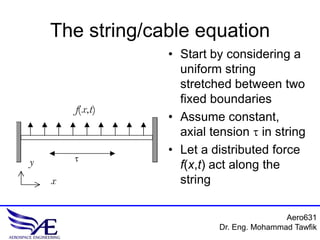
• Start by considering a
uniform string
stretched between two
fixed boundaries
• Assume constant,
axial tension  in string
• Let a distributed force
f(x,t) act along the
string
f(x,t)

x
y
Aero631
Dr. Eng. Mohammad Tawfik
Examine a small element of
string
xtxf
t
txw
xFy


),(sinsin
),(
2211
2
2




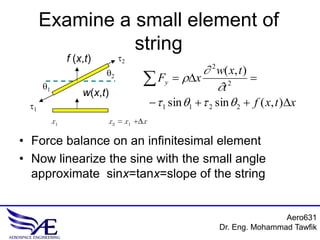
• Force balance on an infinitesimal element
• Now linearize the sine with the small angle
approximate sinx=tanx=slope of the string
1
2
2
1
x1 x2 = x1 +x
w(x,t)
f (x,t)
Aero631
Dr. Eng. Mohammad Tawfik


















)(
:about/ofseriesTaylortheRecall
2
1
112
xO
x
w
x
x
x
w
x
w
xxw
xxx












x
t
txw
xtxf
x
txw
x
txw
xx












2
2
),(
),(
),(),(
12









2
2
),(
),(
),(
t
txw
txf
x
txw
x 













x
t
txw
xtxfx
x
txw
x x






2
2
),(
),(
),(
1








Aero631
Dr. Eng. Mohammad Tawfik
0,0),(),0(
0at)()0,(),()0,(
,
),(),(
00
2
2
22
2



ttwtw
txwxwxwxw
c
x
txw
tc
txw
t








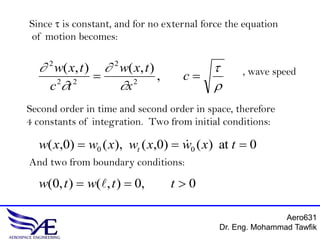
Since  is constant, and for no external force the equation
of motion becomes:
Second order in time and second order in space, therefore
4 constants of integration. Two from initial conditions:
And two from boundary conditions:
, wave speed
Aero631
Dr. Eng. Mohammad Tawfik
Physical quantities
• Deflection is w(x,t) in the y-direction
• The slope of the string is wx(x,t)
• The restoring force is wxx(x,t)
• The velocity is wt(x,t)
• The acceleration is wtt(x,t) at any point x
along the string at time t
Note that the above applies to cables as well as strings
Aero631
Dr. Eng. Mohammad Tawfik
Modes and Natural Frequencies
2
2
2
2
2
2
2
2
2
)(
)(
)(
)(
0
)(
)(
,
)(
)(
)(
)(
=and=where)()()()(
)()(),(










 





tTc
tT
xX
xX
xX
xX
dx
d
tTc
tT
xX
xX
dt
d
dx
d
tTxXtTxXc
tTxXtxw



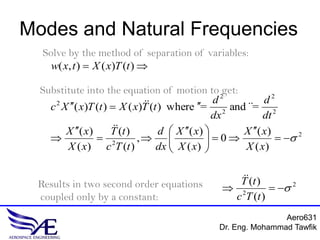
Solve by the method of separation of variables:
Substitute into the equation of motion to get:
Results in two second order equations
coupled only by a constant:
Aero631
Dr. Eng. Mohammad Tawfik
Solving the spatial equation:











n
aX
aX
XX
tTXtTX
aaxaxaxX
xXxX
n 









equationsticcharacteri
1
2
2121
2
0sin
0sin)(
0)0(
,0)(,0)0(
0)()(,0)()0(
nintegratioofconstantsareand,cossin)(
0)()(
Since T(t) is not zero
an infinite number of values of 
A second order equation with solution of the form:
Next apply the boundary conditions:
Aero631
Dr. Eng. Mohammad Tawfik
Also an eigenvalue problem
0)()0(,0)(,)(
ofvalueindexedtheofbecauseresultsindextheHere
sin)(,1,2,3=For
2
2











nnnnnn
nn
XXxXXX
x
n
x
n
axXn





The spatial solution becomes:
The spatial problem also can be written as:
Which is also an eigenvalue, eigenfunction problem where
 =2 is the eigenvalue and Xn is the eigenfunction.
Aero631
Dr. Eng. Mohammad Tawfik
Analogy to Matrix Eigenvalue
Problem
happenalsowillexpansionmodal
sfrequencieseigenvalueshapes,modebecomerseigenvecto
rolesametheplays
gnormalizinofconditiontheandresultsalsoityorthoganal
reigenvectoandalso)(
ioneigenfunctreigenvecto),(
operatormatrix,conditionsboundaryplus,2
2
xX
xX
x
A
n
ni






u
Aero631
Dr. Eng. Mohammad Tawfik
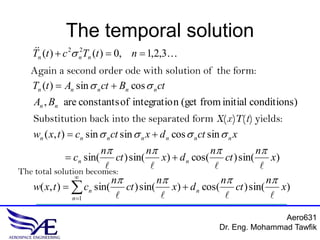
The temporal solution








1
22
)sin()cos()sin()sin(),(
)sin()cos()sin()sin(
sincossinsin),(
)conditionsinitialfrom(getnintegratioofconstantsare,
cossin)(
3,2,1,0)()(
n
nn
nn
nnnnnnn
nn
nnnnn
nnn
x
n
ct
n
dx
n
ct
n
ctxw
x
n
ct
n
dx
n
ct
n
c
xctdxctctxw
BA
ctBctAtT
ntTctT








Again a second order ode with solution of the form:
Substitution back into the separated form X(x)T(t) yields:
The total solution becomes:
Aero631
Dr. Eng. Mohammad Tawfik
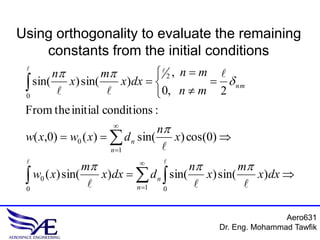
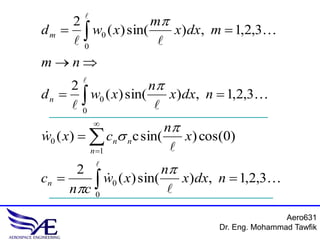
Using orthogonality to evaluate the remaining
constants from the initial conditions






















010
0
1
0
2
0
)sin()sin()sin()(
)0cos()sin()()0,(
:conditionsinitialtheFrom
2,0
,
)sin()sin(
dxx
m
x
n
ddxx
m
xw
x
n
dxwxw
mn
mn
dxx
m
x
n
n
n
n
n
nm




Aero631
Dr. Eng. Mohammad Tawfik












3,2,1,)sin()(
2
)0cos()sin(c)(
3,2,1,)sin()(
2
3,2,1,)sin()(
2
0
0
1
0
0
0
0
0











ndxx
n
xw
cn
c
x
n
cxw
ndxx
n
xwd
nm
mdxx
m
xwd
n
n
nn
n
m






Aero631
Dr. Eng. Mohammad Tawfik
A mode shape












t
c
xtxw
d
ndxx
n
xd
ncxw
nxxw
n
n









cos)sin(),(
1
3,2,0)sin()sin(
2
,0,0)(
1)=(ioneigenfunctfirsttheiswhich,sin)(
1
0
0
0
Causes vibration in the first mode
shape
Aero631
Dr. Eng. Mohammad Tawfik
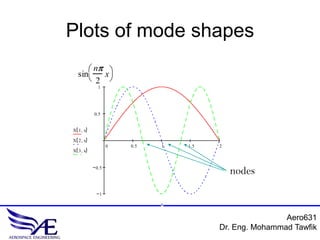
Plots of mode shapes
0 0.5 1 1.5 2
1
0.5
0.5
1
X ,1 x
X ,2 x
X ,3 x
x
sin
n
2
x




nodes
Aero631
Dr. Eng. Mohammad Tawfik
Homework #3
1. Solve the cable problem with one side
fixed and the other supported by a flexible
support with stiffness k N/m
2. Solve the cable problem for a cable that
is hanging from one end and the tension
is changing due to the weight  N/m
Aero631
Dr. Eng. Mohammad Tawfik
Bar Vibration
Aero631
Dr. Eng. Mohammad Tawfik
Bar Vibration
• The bar is a structural element that bears
compression and tension loads
• It deflects in the axial direction only
• Examples of bars may be the columns of
buildings, car shock absorbers, legs of
chairs and tables, and human legs!
Aero631
Dr. Eng. Mohammad Tawfik
Vibration of Rods and Bars
• Consider a small
element of the bar
• Deflection is now along
x (called longitudinal
vibration)
• F= ma on small element
yields the following:
x x +dx
w(x,t)
x
dx
F+dFF
Equilibrium
position
Infinitesimal
element
0 l
Aero631
Dr. Eng. Mohammad Tawfik
0
),(
:endfreeAt the
,0),0(:endclampedAt the
),(),(
constant)(
),(
)(
),(
)(
),(
)(
),(
)(
),(
)(
2
2
2
2
2
2
2
2

















xx
txw
EA
tw
t
txw
x
txwE
xA
t
txw
xA
x
txw
xEA
x
dx
x
txw
xEA
x
dF
x
txw
xEAF
t
txw
dxxAFdFF























Force balance:
Constitutive relation:
Aero631
Dr. Eng. Mohammad Tawfik
Note
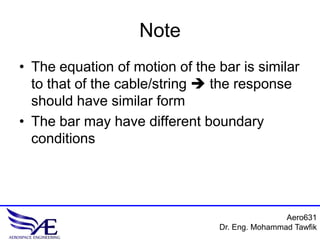
• The equation of motion of the bar is similar
to that of the cable/string  the response
should have similar form
• The bar may have different boundary
conditions
Aero631
Dr. Eng. Mohammad Tawfik
Homework #4
• Solve the equation of motion of a bar
with constant cross-section properties
with
1. Fixed-Fixed boundary conditions
2. Free-Free boundary conditions
• Compare the natural frequencies for all
three cases
Aero631
Dr. Eng. Mohammad Tawfik
Beam Vibration
Aero631
Dr. Eng. Mohammad Tawfik
Beam Vibration
• The beam element is the most famous
structural element as it presents a lot of
realistic structural elements
• It bears loads normal to its longitudinal
axis
• It resists deformations by inducing bending
stresses
Aero631
Dr. Eng. Mohammad Tawfik
Bending vibrations of a beam
2
2
),(
)(),(
aboutinertia
ofmomentareasect.-cross)(
modulusYoungs
)(stiffnessbending
x
txw
xEItxM
z
xI
E
xEI






Next sum forces in the y- direction (up, down)
Sum moments about the point Q
Use the moment given from
stenght of materials
Assume sides do not bend
(no shear deformation)
f (x,t)
w (x,t)
x
dx A(x)= h1h2
h1
h2
M(x,t)+Mx(x,t)dx
M(x,t)
V(x,t)
V(x,t)+Vx(x,t)dx
f(x,t)
w(x,t)
x x +dx
·Q
Aero631
Dr. Eng. Mohammad Tawfik
Summing forces and moments
0)(
2
),(),(
),(
),(
0
2
),(
),(
),(),(
),(
),(
),(
)(),(),(
),(
),(
2
2
2


































dx
txf
x
txV
dxtxVdx
x
txM
dx
dxtxf
dxdx
x
txV
txVtxMdx
x
txM
txM
t
txw
dxxAdxtxftxVdx
x
txV
txV













0
Aero631
Dr. Eng. Mohammad Tawfik
A
EI
c
x
txw
c
t
txw
txf
x
txw
xEI
xt
txw
xA
t
txw
dxxAdxtxfdx
x
txM
x
txM
txV




























,0
),(),(
),(
),(
)(
),(
)(
),(
)(),(
),(
),(
),(
4
4
2
2
2
2
2
2
2
2
2
2
2
2
2
Substitute into force balance equation yields:
Dividing by dx and substituting for M yields
Assume constant stiffness to get:
Aero631
Dr. Eng. Mohammad Tawfik
Boundary conditions (4)
0forceshear
0momentbending
endFree
2
2
2
2








x
w
EI
x
x
w
EI






0slope
0deflection
endfixed)(orClamped


x
w
w


0momentbending
0deflection
endsupported)simply(orPinned
2
2


x
w
EI
w


0forceshear
0slope
endSliding
2
2








x
w
EI
x
x
w






Aero631
Dr. Eng. Mohammad Tawfik
Solution of the time equation:
)()0,(),()0,(
:conditionsinitialTwo
cossin)(
0)()(
)(
)(
)(
)(
00
2
22
xwxwxwxw
tBtAtT
tTtT
tT
tT
xX
xX
c
t











Aero631
Dr. Eng. Mohammad Tawfik
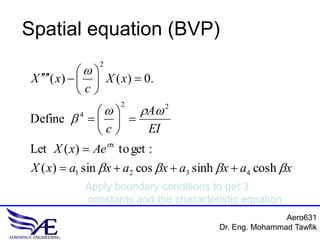
Spatial equation (BVP)
xaxaxaxaxX
AexX
EI
A
c
xX
c
xX
x





coshsinhcossin)(
:getto)(Let
Define
.0)()(
4321
22
4
2
















Apply boundary conditions to get 3
constants and the characteristic equation
Aero631
Dr. Eng. Mohammad Tawfik
Example: compute the mode shapes and
natural frequencies for a clamped-pinned
beam.
0)coshsinhcossin(
0)(
0coshsinhcossin
0)(
andend,pinnedAt the
0)(0)0(
00)0(
and0endfixedAt
4321
2
4321
31
42
















aaaa
XEI
aaaa
X
x
aaX
aaX
x
Aero631
Dr. Eng. Mohammad Tawfik


  






tanhtan
0)det(,
0
0
0
0
coshsinhcossin
coshsinhcossin
00
1010
4
3
2
1
2222








































BB
a
a
a
a
B
0a0a
a
The 4 boundary conditions in the 4 constants can be
written as the matrix equation:
The characteristic equation
Aero631
Dr. Eng. Mohammad Tawfik
Solve numerically to obtain solution to
transcendental equation
4
)14(
5
493361.16351768.13
210176.10068583.7926602.3
54
321









n
n
n


Next solve Ba=0 for 3 of the constants:
Aero631
Dr. Eng. Mohammad Tawfik
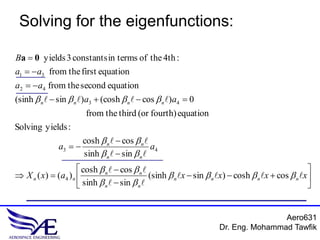
Solving for the eigenfunctions:

















xxxxaxX
aa
aa
aa
aa
B
nnnn
nn
nn
nn
nn
nn
nnnn












coscosh)sin(sinh
sinsinh
coscosh
)()(
sinsinh
coscosh
:yieldsSolving
equationfourth)(orthirdthefrom
0)cos(cosh)sinsinh(
equationsecondthefrom
equationfirstthefrom
:4ththeofin termsconstants3yields
4
43
43
42
31
0a
Aero631
Dr. Eng. Mohammad Tawfik
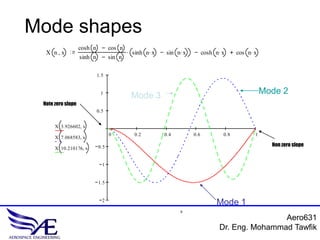
Mode shapes
X ,n x .cosh n cos n
sinh n sin n
sinh .n x sin .n x cosh .n x cos .n x
0 0.2 0.4 0.6 0.8 1
2
1.5
1
0.5
0.5
1
1.5
X ,3.926602 x
X ,7.068583 x
X ,10.210176 x
x
Mode 1
Mode 2
Mode 3
Note zero slope
Non zero slope
Aero631
Dr. Eng. Mohammad Tawfik
Summary of the Euler-Bernoulli
Beam
• Uniform along its span and slender
• Linear, homogenous, isotropic elastic
material without axial loads
• Plane sections remain plane
• Plane of symmetry is plane of vibration so
that rotation & translation decoupled
• Rotary inertia and shear deformation
neglected
Aero631
Dr. Eng. Mohammad Tawfik
Homework #5
• Get an expression for  for the cases of a
uniform Euler-Bernoulli beam with BC’s as
follows:
– Clamped-Clamped
– Pinned-Pinned
– Clamped-Free
– Free-Free

Vibration of Continuous Structures

  • 1.
    Aero631 Dr. Eng. MohammadTawfik Vibration of Continuous Structures
  • 2.
    Aero631 Dr. Eng. MohammadTawfik Objectives • Derive the equation of motion for simple structures • Understand the concept of mode shapes • Apply BC’s and IC’s to obtain structure response
  • 3.
    Aero631 Dr. Eng. MohammadTawfik String and Cables
  • 4.
    Aero631 Dr. Eng. MohammadTawfik Strings and Cables • This type of structures does not bare any bending or compression loads • It resists deformations only by inducing tension stress • Examples are the strings of musical instruments, cables of bridges, and elevator suspension cables
  • 5.
    Aero631 Dr. Eng. MohammadTawfik The string/cable equation • Start by considering a uniform string stretched between two fixed boundaries • Assume constant, axial tension  in string • Let a distributed force f(x,t) act along the string f(x,t)  x y
  • 6.
    Aero631 Dr. Eng. MohammadTawfik Examine a small element of string xtxf t txw xFy   ),(sinsin ),( 2211 2 2     • Force balance on an infinitesimal element • Now linearize the sine with the small angle approximate sinx=tanx=slope of the string 1 2 2 1 x1 x2 = x1 +x w(x,t) f (x,t)
  • 7.
    Aero631 Dr. Eng. MohammadTawfik                   )( :about/ofseriesTaylortheRecall 2 1 112 xO x w x x x w x w xxw xxx             x t txw xtxf x txw x txw xx             2 2 ),( ),( ),(),( 12          2 2 ),( ),( ),( t txw txf x txw x               x t txw xtxfx x txw x x       2 2 ),( ),( ),( 1        
  • 8.
    Aero631 Dr. Eng. MohammadTawfik 0,0),(),0( 0at)()0,(),()0,( , ),(),( 00 2 2 22 2    ttwtw txwxwxwxw c x txw tc txw t         Since  is constant, and for no external force the equation of motion becomes: Second order in time and second order in space, therefore 4 constants of integration. Two from initial conditions: And two from boundary conditions: , wave speed
  • 9.
    Aero631 Dr. Eng. MohammadTawfik Physical quantities • Deflection is w(x,t) in the y-direction • The slope of the string is wx(x,t) • The restoring force is wxx(x,t) • The velocity is wt(x,t) • The acceleration is wtt(x,t) at any point x along the string at time t Note that the above applies to cables as well as strings
  • 10.
    Aero631 Dr. Eng. MohammadTawfik Modes and Natural Frequencies 2 2 2 2 2 2 2 2 2 )( )( )( )( 0 )( )( , )( )( )( )( =and=where)()()()( )()(),(                  tTc tT xX xX xX xX dx d tTc tT xX xX dt d dx d tTxXtTxXc tTxXtxw    Solve by the method of separation of variables: Substitute into the equation of motion to get: Results in two second order equations coupled only by a constant:
  • 11.
    Aero631 Dr. Eng. MohammadTawfik Solving the spatial equation:            n aX aX XX tTXtTX aaxaxaxX xXxX n           equationsticcharacteri 1 2 2121 2 0sin 0sin)( 0)0( ,0)(,0)0( 0)()(,0)()0( nintegratioofconstantsareand,cossin)( 0)()( Since T(t) is not zero an infinite number of values of  A second order equation with solution of the form: Next apply the boundary conditions:
  • 12.
    Aero631 Dr. Eng. MohammadTawfik Also an eigenvalue problem 0)()0(,0)(,)( ofvalueindexedtheofbecauseresultsindextheHere sin)(,1,2,3=For 2 2            nnnnnn nn XXxXXX x n x n axXn      The spatial solution becomes: The spatial problem also can be written as: Which is also an eigenvalue, eigenfunction problem where  =2 is the eigenvalue and Xn is the eigenfunction.
  • 13.
    Aero631 Dr. Eng. MohammadTawfik Analogy to Matrix Eigenvalue Problem happenalsowillexpansionmodal sfrequencieseigenvalueshapes,modebecomerseigenvecto rolesametheplays gnormalizinofconditiontheandresultsalsoityorthoganal reigenvectoandalso)( ioneigenfunctreigenvecto),( operatormatrix,conditionsboundaryplus,2 2 xX xX x A n ni       u
  • 14.
    Aero631 Dr. Eng. MohammadTawfik The temporal solution         1 22 )sin()cos()sin()sin(),( )sin()cos()sin()sin( sincossinsin),( )conditionsinitialfrom(getnintegratioofconstantsare, cossin)( 3,2,1,0)()( n nn nn nnnnnnn nn nnnnn nnn x n ct n dx n ct n ctxw x n ct n dx n ct n c xctdxctctxw BA ctBctAtT ntTctT         Again a second order ode with solution of the form: Substitution back into the separated form X(x)T(t) yields: The total solution becomes:
  • 15.
    Aero631 Dr. Eng. MohammadTawfik Using orthogonality to evaluate the remaining constants from the initial conditions                       010 0 1 0 2 0 )sin()sin()sin()( )0cos()sin()()0,( :conditionsinitialtheFrom 2,0 , )sin()sin( dxx m x n ddxx m xw x n dxwxw mn mn dxx m x n n n n n nm    
  • 16.
    Aero631 Dr. Eng. MohammadTawfik             3,2,1,)sin()( 2 )0cos()sin(c)( 3,2,1,)sin()( 2 3,2,1,)sin()( 2 0 0 1 0 0 0 0 0            ndxx n xw cn c x n cxw ndxx n xwd nm mdxx m xwd n n nn n m      
  • 17.
    Aero631 Dr. Eng. MohammadTawfik A mode shape             t c xtxw d ndxx n xd ncxw nxxw n n          cos)sin(),( 1 3,2,0)sin()sin( 2 ,0,0)( 1)=(ioneigenfunctfirsttheiswhich,sin)( 1 0 0 0 Causes vibration in the first mode shape
  • 18.
    Aero631 Dr. Eng. MohammadTawfik Plots of mode shapes 0 0.5 1 1.5 2 1 0.5 0.5 1 X ,1 x X ,2 x X ,3 x x sin n 2 x     nodes
  • 19.
    Aero631 Dr. Eng. MohammadTawfik Homework #3 1. Solve the cable problem with one side fixed and the other supported by a flexible support with stiffness k N/m 2. Solve the cable problem for a cable that is hanging from one end and the tension is changing due to the weight  N/m
  • 20.
    Aero631 Dr. Eng. MohammadTawfik Bar Vibration
  • 21.
    Aero631 Dr. Eng. MohammadTawfik Bar Vibration • The bar is a structural element that bears compression and tension loads • It deflects in the axial direction only • Examples of bars may be the columns of buildings, car shock absorbers, legs of chairs and tables, and human legs!
  • 22.
    Aero631 Dr. Eng. MohammadTawfik Vibration of Rods and Bars • Consider a small element of the bar • Deflection is now along x (called longitudinal vibration) • F= ma on small element yields the following: x x +dx w(x,t) x dx F+dFF Equilibrium position Infinitesimal element 0 l
  • 23.
    Aero631 Dr. Eng. MohammadTawfik 0 ),( :endfreeAt the ,0),0(:endclampedAt the ),(),( constant)( ),( )( ),( )( ),( )( ),( )( ),( )( 2 2 2 2 2 2 2 2                  xx txw EA tw t txw x txwE xA t txw xA x txw xEA x dx x txw xEA x dF x txw xEAF t txw dxxAFdFF                        Force balance: Constitutive relation:
  • 24.
    Aero631 Dr. Eng. MohammadTawfik Note • The equation of motion of the bar is similar to that of the cable/string  the response should have similar form • The bar may have different boundary conditions
  • 25.
    Aero631 Dr. Eng. MohammadTawfik Homework #4 • Solve the equation of motion of a bar with constant cross-section properties with 1. Fixed-Fixed boundary conditions 2. Free-Free boundary conditions • Compare the natural frequencies for all three cases
  • 26.
    Aero631 Dr. Eng. MohammadTawfik Beam Vibration
  • 27.
    Aero631 Dr. Eng. MohammadTawfik Beam Vibration • The beam element is the most famous structural element as it presents a lot of realistic structural elements • It bears loads normal to its longitudinal axis • It resists deformations by inducing bending stresses
  • 28.
    Aero631 Dr. Eng. MohammadTawfik Bending vibrations of a beam 2 2 ),( )(),( aboutinertia ofmomentareasect.-cross)( modulusYoungs )(stiffnessbending x txw xEItxM z xI E xEI       Next sum forces in the y- direction (up, down) Sum moments about the point Q Use the moment given from stenght of materials Assume sides do not bend (no shear deformation) f (x,t) w (x,t) x dx A(x)= h1h2 h1 h2 M(x,t)+Mx(x,t)dx M(x,t) V(x,t) V(x,t)+Vx(x,t)dx f(x,t) w(x,t) x x +dx ·Q
  • 29.
    Aero631 Dr. Eng. MohammadTawfik Summing forces and moments 0)( 2 ),(),( ),( ),( 0 2 ),( ),( ),(),( ),( ),( ),( )(),(),( ),( ),( 2 2 2                                   dx txf x txV dxtxVdx x txM dx dxtxf dxdx x txV txVtxMdx x txM txM t txw dxxAdxtxftxVdx x txV txV              0
  • 30.
    Aero631 Dr. Eng. MohammadTawfik A EI c x txw c t txw txf x txw xEI xt txw xA t txw dxxAdxtxfdx x txM x txM txV                             ,0 ),(),( ),( ),( )( ),( )( ),( )(),( ),( ),( ),( 4 4 2 2 2 2 2 2 2 2 2 2 2 2 2 Substitute into force balance equation yields: Dividing by dx and substituting for M yields Assume constant stiffness to get:
  • 31.
    Aero631 Dr. Eng. MohammadTawfik Boundary conditions (4) 0forceshear 0momentbending endFree 2 2 2 2         x w EI x x w EI       0slope 0deflection endfixed)(orClamped   x w w   0momentbending 0deflection endsupported)simply(orPinned 2 2   x w EI w   0forceshear 0slope endSliding 2 2         x w EI x x w      
  • 32.
    Aero631 Dr. Eng. MohammadTawfik Solution of the time equation: )()0,(),()0,( :conditionsinitialTwo cossin)( 0)()( )( )( )( )( 00 2 22 xwxwxwxw tBtAtT tTtT tT tT xX xX c t           
  • 33.
    Aero631 Dr. Eng. MohammadTawfik Spatial equation (BVP) xaxaxaxaxX AexX EI A c xX c xX x      coshsinhcossin)( :getto)(Let Define .0)()( 4321 22 4 2                 Apply boundary conditions to get 3 constants and the characteristic equation
  • 34.
    Aero631 Dr. Eng. MohammadTawfik Example: compute the mode shapes and natural frequencies for a clamped-pinned beam. 0)coshsinhcossin( 0)( 0coshsinhcossin 0)( andend,pinnedAt the 0)(0)0( 00)0( and0endfixedAt 4321 2 4321 31 42                 aaaa XEI aaaa X x aaX aaX x
  • 35.
    Aero631 Dr. Eng. MohammadTawfik            tanhtan 0)det(, 0 0 0 0 coshsinhcossin coshsinhcossin 00 1010 4 3 2 1 2222                                         BB a a a a B 0a0a a The 4 boundary conditions in the 4 constants can be written as the matrix equation: The characteristic equation
  • 36.
    Aero631 Dr. Eng. MohammadTawfik Solve numerically to obtain solution to transcendental equation 4 )14( 5 493361.16351768.13 210176.10068583.7926602.3 54 321          n n n   Next solve Ba=0 for 3 of the constants:
  • 37.
    Aero631 Dr. Eng. MohammadTawfik Solving for the eigenfunctions:                  xxxxaxX aa aa aa aa B nnnn nn nn nn nn nn nnnn             coscosh)sin(sinh sinsinh coscosh )()( sinsinh coscosh :yieldsSolving equationfourth)(orthirdthefrom 0)cos(cosh)sinsinh( equationsecondthefrom equationfirstthefrom :4ththeofin termsconstants3yields 4 43 43 42 31 0a
  • 38.
    Aero631 Dr. Eng. MohammadTawfik Mode shapes X ,n x .cosh n cos n sinh n sin n sinh .n x sin .n x cosh .n x cos .n x 0 0.2 0.4 0.6 0.8 1 2 1.5 1 0.5 0.5 1 1.5 X ,3.926602 x X ,7.068583 x X ,10.210176 x x Mode 1 Mode 2 Mode 3 Note zero slope Non zero slope
  • 39.
    Aero631 Dr. Eng. MohammadTawfik Summary of the Euler-Bernoulli Beam • Uniform along its span and slender • Linear, homogenous, isotropic elastic material without axial loads • Plane sections remain plane • Plane of symmetry is plane of vibration so that rotation & translation decoupled • Rotary inertia and shear deformation neglected
  • 40.
    Aero631 Dr. Eng. MohammadTawfik Homework #5 • Get an expression for  for the cases of a uniform Euler-Bernoulli beam with BC’s as follows: – Clamped-Clamped – Pinned-Pinned – Clamped-Free – Free-Free