Pinning and facetting in lattice Boltzmann
simulations
Tim Reis
Oxford Centre for Collaborative Applied Mathematics
Mathematical Institute
University of Oxford
OCCAM/ICFD Lattice Boltzmann Workshop, September
2010
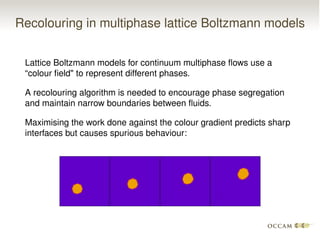
Recolouring in multiphase lattice Boltzmann models
Lattice Boltzmann models for continuum multiphase flows use a
“colour field" to represent different phases.
A recolouring algorithm is needed to encourage phase segregation
and maintain narrow boundaries between fluids.
Maximising the work done against the colour gradient predicts sharp
interfaces but causes spurious behaviour:
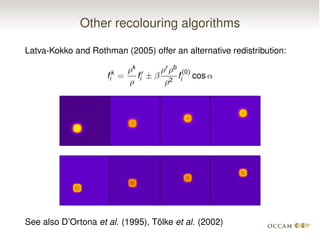
Other recolouring algorithms
Latva-Kokko and Rothman (2005) offer an alternative redistribution:
fk
i =
⇢k
⇢
f0
i ±
⇢r
⇢b
⇢2
f
(0)
i cos ↵
See also D’Ortona et al. (1995), Tölke et al. (2002)
Motivation
• Multiphase LBEs are prone to lattice pinning and facetting
(Latva-Kokko & Rothman (2005), Halliday et al. (2006)).
• Similar difficulties arise in combustion (Colella (1986), Pember
(1993)).
• Spurious phenomena associated with stiff source terms
investigated by LeVeque & Yee (1990).
• Unphysical behaviour can be corrected with a random projection
method (Bao & Jin (2000)).
• LB formulation of these models can shed light on pinning and
facetting.
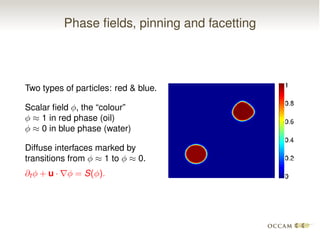
Phase fields, pinning and facetting
Two types of particles: red & blue.
Scalar field , the “colour”
⇡ 1 in red phase (oil)
⇡ 0 in blue phase (water)
Diffuse interfaces marked by
transitions from ⇡ 1 to ⇡ 0.
@t + u · r = S( ).
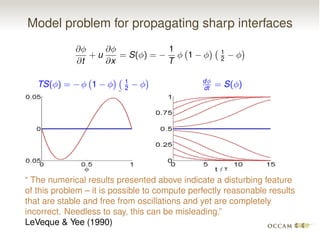
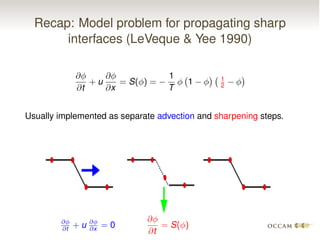
Model problem for propagating sharp interfaces
@
@t
+ u
@
@x
= S( ) =
1
T
1 1
2
TS( ) = 1 1
2
d
dt = S( )
“ The numerical results presented above indicate a disturbing feature
of this problem – it is possible to compute perfectly reasonable results
that are stable and free from oscillations and yet are completely
incorrect. Needless to say, this can be misleading.”
LeVeque & Yee (1990)
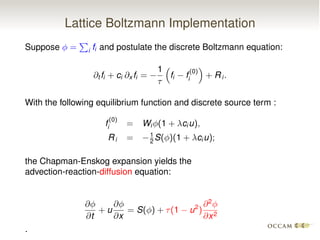
Lattice Boltzmann Implementation
Suppose =
P
i fi and postulate the discrete Boltzmann equation:
@t fi + ci @x fi =
1
⌧
⇣
fi f
(0)
i
⌘
+ Ri .
With the following equilibrium function and discrete source term :
f
(0)
i = Wi (1 + ci u),
Ri = 1
2 S( )(1 + ci u);
the Chapman-Enskog expansion yields the
advection-reaction-diffusion equation:
@
@t
+ u
@
@x
= S( ) + ⌧(1 u2
)
@2
@x2
.
Reduction to Fully Discrete Form
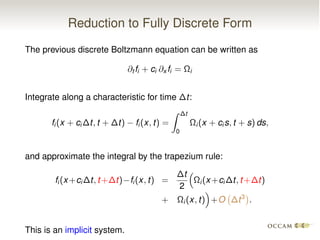
The previous discrete Boltzmann equation can be written as
@t fi + ci @x fi = ⌦i
Integrate along a characteristic for time t:
fi (x + ci t, t + t) fi (x, t) =
Z t
0
⌦i (x + ci s, t + s) ds,
and approximate the integral by the trapezium rule:
fi (x +ci t, t+ t) fi (x, t) =
t
2
⇣
⌦i (x +ci t, t+ t)
+ ⌦i (x, t)
⌘
+O t3
.
This is an implicit system.
Change of Variables
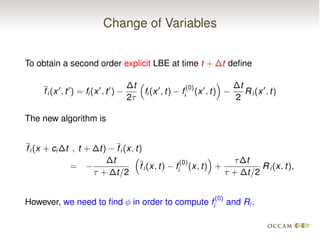
To obtain a second order explicit LBE at time t + t define
fi (x0
, t0
) = fi (x0
, t0
)
t
2⌧
⇣
fi (x0
, t) f
(0)
i (x0
, t)
⌘ t
2
Ri (x0
, t)
The new algorithm is
fi (x + ci t , t + t) fi (x, t)
=
t
⌧ + t/2
⇣
fi (x, t) f
(0)
i (x, t)
⌘
+
⌧ t
⌧ + t/2
Ri (x, t),
However, we need to find in order to compute f
(0)
i and Ri .
Reconstruction of
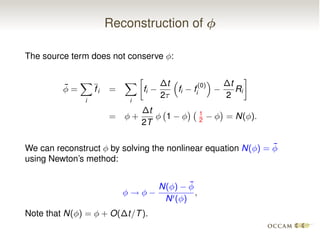
The source term does not conserve :
¯ =
X
i
fi =
X
i

fi
t
2⌧
⇣
fi f
(0)
i
⌘ t
2
Ri
= +
t
2T
1 1
2 = N( ).
We can reconstruct by solving the nonlinear equation N( ) = ¯
using Newton’s method:
!
N( ) ¯
N0( )
,
Note that N( ) = + O( t/T).
Lengthscale of Transition
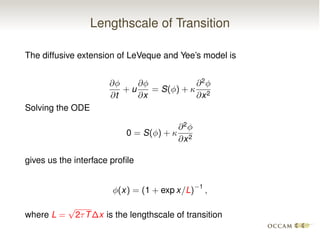
The diffusive extension of LeVeque and Yee’s model is
@
@t
+ u
@
@x
= S( ) + 
@2
@x2
Solving the ODE
0 = S( ) + 
@2
@x2
gives us the interface profile
(x) = (1 + exp x/L)
1
,
where L =
p
2⌧T x is the lengthscale of transition
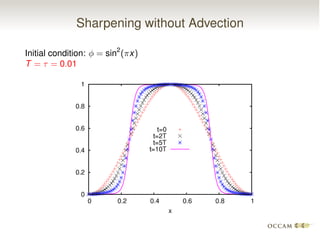
Sharpening without Advection
Initial condition: = sin2
(⇡x)
T = ⌧ = 0.01
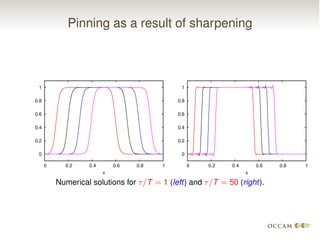
Pinning as a result of sharpening
Numerical solutions for ⌧/T = 1 (left) and ⌧/T = 50 (right).
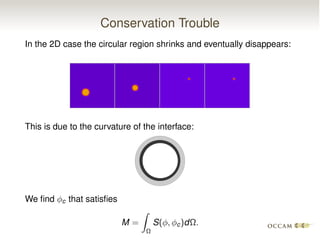
Conservation Trouble
In the 2D case the circular region shrinks and eventually disappears:
This is due to the curvature of the interface:
We find c that satisfies
M =
Z
⌦
S( , c)d⌦.
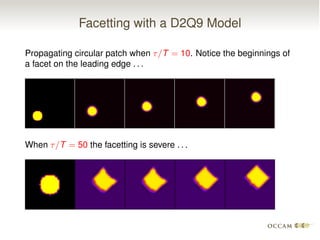
Facetting with a D2Q9 Model
Propagating circular patch when ⌧/T = 10. Notice the beginnings of
a facet on the leading edge . . .
When ⌧/T = 50 the facetting is severe . . .
Recap: Model problem for propagating sharp
interfaces (LeVeque & Yee 1990)
@
@t
+ u
@
@x
= S( ) =
1
T
1 1
2
Usually implemented as separate advection and sharpening steps.
@
@t + u @
@x = 0
@
@t
= S( )
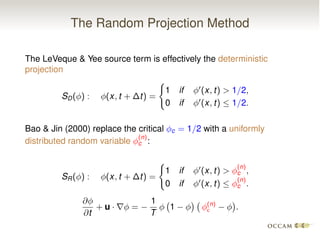
The Random Projection Method
The LeVeque & Yee source term is effectively the deterministic
projection
SD( ) : (x, t + t) =
(
1 if 0
(x, t) > 1/2,
0 if 0
(x, t)  1/2.
Bao & Jin (2000) replace the critical c = 1/2 with a uniformly
distributed random variable
(n)
c :
SR( ) : (x, t + t) =
(
1 if 0
(x, t) >
(n)
c ,
0 if 0
(x, t) 
(n)
c .
@
@t
+ u · r =
1
T
1 (n)
c .
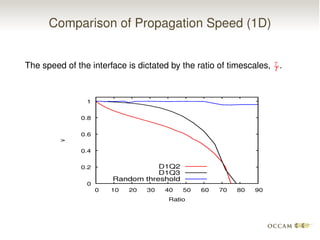
Comparison of Propagation Speed (1D)
The speed of the interface is dictated by the ratio of timescales, ⌧
T .
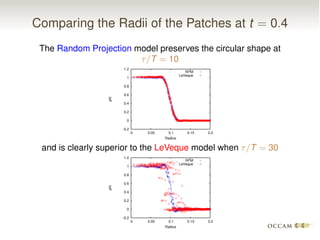
Comparing the Radii of the Patches at t = 0.4
The Random Projection model preserves the circular shape at
⌧/T = 10
and is clearly superior to the LeVeque model when ⌧/T = 30
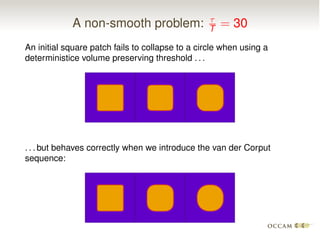
A non-smooth problem: ⌧
T = 30
An initial square patch fails to collapse to a circle when using a
deterministice volume preserving threshold . . .
. . . but behaves correctly when we introduce the van der Corput
sequence:
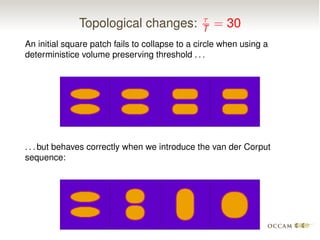
Topological changes: ⌧
T = 30
An initial square patch fails to collapse to a circle when using a
deterministice volume preserving threshold . . .
. . . but behaves correctly when we introduce the van der Corput
sequence:
A conservative scheme
If we assume L =
p
2⌧T x then
@
@n
= r · n = |r | =
(1 )
L
,
@2
@n2
=
(r · r)|r |
|r |
=
(1 )(1
2 )
L2
.
We can now show that a DBE of the form
@fi
@t
+ ci
@fi
@x
=
1
⌧
⇣
fi f
(0)
i
⌘
+ Wi
(1 )
L
ci · n
furnishes
@
@t
+ u
@
@x
= ⌧(1 u2
)r2
+ ⌧r2 (1 )(1
2 )
T
in the macroscopic limit.
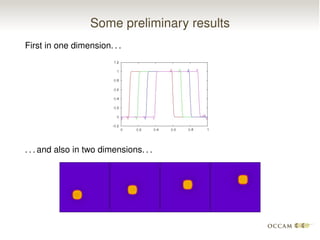
Some preliminary results
First in one dimension. . .
. . . and also in two dimensions. . .
Conclusion
• We have studied the combination of advection and sharpening of
the phase field that commonly arises in lattice Boltzmann models
for multiphase flows.
• Overly sharp phase boundaries can become pinned to the
lattice. This has been shown to be a purely kinematic effect.
• Replacing the threshold with a uniformly distributed
pseudo-random variable allows us to predict the correct
propagation speed at very sharp boundaries (⌧/T > 100).
• The onset of facetting is signifficanly delayed if we introduce a
random term into the volume-preserving multi-dimensional
extension.

Workshop presentations l_bworkshop_reis

  • 1.
    Pinning and facettingin lattice Boltzmann simulations Tim Reis Oxford Centre for Collaborative Applied Mathematics Mathematical Institute University of Oxford OCCAM/ICFD Lattice Boltzmann Workshop, September 2010
  • 2.
    Recolouring in multiphaselattice Boltzmann models Lattice Boltzmann models for continuum multiphase flows use a “colour field" to represent different phases. A recolouring algorithm is needed to encourage phase segregation and maintain narrow boundaries between fluids. Maximising the work done against the colour gradient predicts sharp interfaces but causes spurious behaviour:
  • 3.
    Other recolouring algorithms Latva-Kokkoand Rothman (2005) offer an alternative redistribution: fk i = ⇢k ⇢ f0 i ± ⇢r ⇢b ⇢2 f (0) i cos ↵ See also D’Ortona et al. (1995), Tölke et al. (2002)
  • 4.
    Motivation • Multiphase LBEsare prone to lattice pinning and facetting (Latva-Kokko & Rothman (2005), Halliday et al. (2006)). • Similar difficulties arise in combustion (Colella (1986), Pember (1993)). • Spurious phenomena associated with stiff source terms investigated by LeVeque & Yee (1990). • Unphysical behaviour can be corrected with a random projection method (Bao & Jin (2000)). • LB formulation of these models can shed light on pinning and facetting.
  • 5.
    Phase fields, pinningand facetting Two types of particles: red & blue. Scalar field , the “colour” ⇡ 1 in red phase (oil) ⇡ 0 in blue phase (water) Diffuse interfaces marked by transitions from ⇡ 1 to ⇡ 0. @t + u · r = S( ).
  • 6.
    Model problem forpropagating sharp interfaces @ @t + u @ @x = S( ) = 1 T 1 1 2 TS( ) = 1 1 2 d dt = S( ) “ The numerical results presented above indicate a disturbing feature of this problem – it is possible to compute perfectly reasonable results that are stable and free from oscillations and yet are completely incorrect. Needless to say, this can be misleading.” LeVeque & Yee (1990)
  • 7.
    Lattice Boltzmann Implementation Suppose= P i fi and postulate the discrete Boltzmann equation: @t fi + ci @x fi = 1 ⌧ ⇣ fi f (0) i ⌘ + Ri . With the following equilibrium function and discrete source term : f (0) i = Wi (1 + ci u), Ri = 1 2 S( )(1 + ci u); the Chapman-Enskog expansion yields the advection-reaction-diffusion equation: @ @t + u @ @x = S( ) + ⌧(1 u2 ) @2 @x2 .
  • 8.
    Reduction to FullyDiscrete Form The previous discrete Boltzmann equation can be written as @t fi + ci @x fi = ⌦i Integrate along a characteristic for time t: fi (x + ci t, t + t) fi (x, t) = Z t 0 ⌦i (x + ci s, t + s) ds, and approximate the integral by the trapezium rule: fi (x +ci t, t+ t) fi (x, t) = t 2 ⇣ ⌦i (x +ci t, t+ t) + ⌦i (x, t) ⌘ +O t3 . This is an implicit system.
  • 9.
    Change of Variables Toobtain a second order explicit LBE at time t + t define fi (x0 , t0 ) = fi (x0 , t0 ) t 2⌧ ⇣ fi (x0 , t) f (0) i (x0 , t) ⌘ t 2 Ri (x0 , t) The new algorithm is fi (x + ci t , t + t) fi (x, t) = t ⌧ + t/2 ⇣ fi (x, t) f (0) i (x, t) ⌘ + ⌧ t ⌧ + t/2 Ri (x, t), However, we need to find in order to compute f (0) i and Ri .
  • 10.
    Reconstruction of The sourceterm does not conserve : ¯ = X i fi = X i  fi t 2⌧ ⇣ fi f (0) i ⌘ t 2 Ri = + t 2T 1 1 2 = N( ). We can reconstruct by solving the nonlinear equation N( ) = ¯ using Newton’s method: ! N( ) ¯ N0( ) , Note that N( ) = + O( t/T).
  • 11.
    Lengthscale of Transition Thediffusive extension of LeVeque and Yee’s model is @ @t + u @ @x = S( ) +  @2 @x2 Solving the ODE 0 = S( ) +  @2 @x2 gives us the interface profile (x) = (1 + exp x/L) 1 , where L = p 2⌧T x is the lengthscale of transition
  • 12.
    Sharpening without Advection Initialcondition: = sin2 (⇡x) T = ⌧ = 0.01
  • 13.
    Pinning as aresult of sharpening Numerical solutions for ⌧/T = 1 (left) and ⌧/T = 50 (right).
  • 14.
    Conservation Trouble In the2D case the circular region shrinks and eventually disappears: This is due to the curvature of the interface: We find c that satisfies M = Z ⌦ S( , c)d⌦.
  • 15.
    Facetting with aD2Q9 Model Propagating circular patch when ⌧/T = 10. Notice the beginnings of a facet on the leading edge . . . When ⌧/T = 50 the facetting is severe . . .
  • 16.
    Recap: Model problemfor propagating sharp interfaces (LeVeque & Yee 1990) @ @t + u @ @x = S( ) = 1 T 1 1 2 Usually implemented as separate advection and sharpening steps. @ @t + u @ @x = 0 @ @t = S( )
  • 17.
    The Random ProjectionMethod The LeVeque & Yee source term is effectively the deterministic projection SD( ) : (x, t + t) = ( 1 if 0 (x, t) > 1/2, 0 if 0 (x, t)  1/2. Bao & Jin (2000) replace the critical c = 1/2 with a uniformly distributed random variable (n) c : SR( ) : (x, t + t) = ( 1 if 0 (x, t) > (n) c , 0 if 0 (x, t)  (n) c . @ @t + u · r = 1 T 1 (n) c .
  • 18.
    Comparison of PropagationSpeed (1D) The speed of the interface is dictated by the ratio of timescales, ⌧ T .
  • 19.
    Comparing the Radiiof the Patches at t = 0.4 The Random Projection model preserves the circular shape at ⌧/T = 10 and is clearly superior to the LeVeque model when ⌧/T = 30
  • 20.
    A non-smooth problem:⌧ T = 30 An initial square patch fails to collapse to a circle when using a deterministice volume preserving threshold . . . . . . but behaves correctly when we introduce the van der Corput sequence:
  • 21.
    Topological changes: ⌧ T= 30 An initial square patch fails to collapse to a circle when using a deterministice volume preserving threshold . . . . . . but behaves correctly when we introduce the van der Corput sequence:
  • 22.
    A conservative scheme Ifwe assume L = p 2⌧T x then @ @n = r · n = |r | = (1 ) L , @2 @n2 = (r · r)|r | |r | = (1 )(1 2 ) L2 . We can now show that a DBE of the form @fi @t + ci @fi @x = 1 ⌧ ⇣ fi f (0) i ⌘ + Wi (1 ) L ci · n furnishes @ @t + u @ @x = ⌧(1 u2 )r2 + ⌧r2 (1 )(1 2 ) T in the macroscopic limit.
  • 23.
    Some preliminary results Firstin one dimension. . . . . . and also in two dimensions. . .
  • 24.
    Conclusion • We havestudied the combination of advection and sharpening of the phase field that commonly arises in lattice Boltzmann models for multiphase flows. • Overly sharp phase boundaries can become pinned to the lattice. This has been shown to be a purely kinematic effect. • Replacing the threshold with a uniformly distributed pseudo-random variable allows us to predict the correct propagation speed at very sharp boundaries (⌧/T > 100). • The onset of facetting is signifficanly delayed if we introduce a random term into the volume-preserving multi-dimensional extension.