Phase diagram at finite T & μ
in strong coupling limit of
lattice QCD
Supervisor: Kazuyuki Kanaya(金谷 和至)

201020283 Jae Don Choi(崔 在敦)
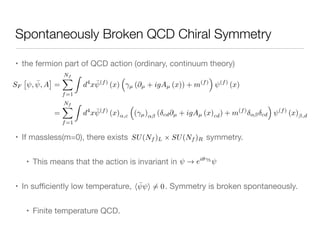
Spontaneously Broken QCD Chiral Symmetry
• the fermion part of QCD action (ordinary, continuum theory)

• If massless(m=0), there exists symmetry.

• This means that the action is invariant in 

• In sufficiently low temperature, . Symmetry is broken spontaneously.

• Finite temperature QCD.
SF
⇥
, ¯, A
⇤
=
Nf
X
f=1
Z
d4
x ¯(f)
(x)
⇣
µ (@µ + igAµ (x)) + m(f)
⌘
(f)
(x)
=
Nf
X
f=1
Z
d4
x ¯(f)
(x)↵,c
⇣
( µ)↵ ( cd@µ + igAµ (x)cd) + m(f)
↵ cd
⌘
(f)
(x) ,d
SU(Nf )L ⇥ SU(Nf )R
! ei✓ 5
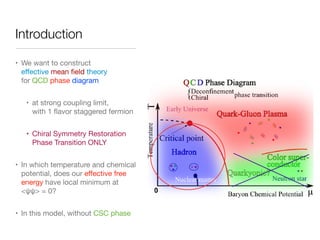
Introduction
• We want to construct
effective mean field theory
for QCD phase diagram

• at strong coupling limit,
with 1 flavor staggered fermion

• Chiral Symmetry Restoration
Phase Transition ONLY

• In which temperature and chemical
potential, does our effective free
energy have local minimum at
<ψψ> = 0?

• In this model, without CSC phase
On the Starting Line: Lattice QCD
• 1 flavor staggered fermion (4 flavor in continuum limit), color SU(3)

• Detail of action
Z =
Z
D [U0, Uj, , ¯] exp
"
S
(⌧)
F S
(s)
F
X
x
m0 ¯a
x
a
x SG
#
S
(⌧)
F =
1
2
X
x
h
eµ
¯xU0,x x+ˆ0 e µ
¯x+ˆ0U†
0,x x
i
S
(s)
F =
1
2
X
x,j
⌘j,x
h
¯xUj,x x+ˆj ¯x+ˆjU†
j,x x
i
⌘j,x = ( 1)
x0+x1+···xj 1
(j = 1, 2, 3) .
SG =
2Nc
g2

1
trc
2Nc
⇥
Uµ⌫,x + U†
µ⌫,x
⇤
! 0 g2
! 1
Strong coupling limit
Process
• Start with partition function.

• Path integral of spatial link variable 

• Bosonization: to make bilinear form in quark for path integral of

• Mean field approximation in auxiliary fields

• Execute integral of quark & temporal link variable

• acquisition of effective free energy

• Analyze in temperature and chemical potential
Uj,x
U0,x
¯,
¯,
Introduction
• Analytical approach (Kawamoto et al. ’07)

• 1 flavor staggered fermion (4 flavor in continuum limit), color SU(3)

• Detail of action
Z =
Z
D [U0, Uj, , ¯] exp
"
S
(⌧)
F S
(s)
F
X
x
m0 ¯a
x
a
x SG
#
Strong coupling limit
a⌧ = as = 1
S
(⌧)
F = a3
sa⌧
X
x
"
eµa⌧
¯xU0,x x+ˆ0 e µa⌧
¯x+ˆ0U†
0,x x
2a⌧
#
S
(s)
F = a3
sa⌧
X
x,j
⌘j,x
"
¯xUj,x x+ˆj ¯x+ˆjU†
j,x x
2as
#
⌘j,x = ( 1)
x0+x1+···xj 1
(j = 1, 2, 3) .
SG =
2Nc
g2

1
trc
2Nc
⇥
Uµ⌫,x + U†
µ⌫,x
⇤
! 0 g2
! 1
SU(3) Group Integral with Spatial Link Variable
• Kluberg-Stern et al. (’83)
Mx = ¯a
x
a
x
Bx =
1
Nc!
"a1a2···aNc a1 a2
· · · aNc
¯Bx =
1
Nc!
"a1a2···aNc
¯aNc
· · · ¯a2
¯a1
Z
D [Uj] e S
(s)
F =
Z
D [Uj] exp
2
4 1
2
·
X
x,j
⌘j,x
⇣
¯xUj,x x+ˆj ¯x+ˆjU†
j,x x
⌘
3
5
= exp
2
4
X
x
1
4Nc
dX
j=1
MxMx+ˆj
X
x
( 1)
Nc(Nc 1)
2
dX
j=1
⇣⌘j,x
2
⌘Nc
h
¯BxBx+ˆj + ( 1)
Nc ¯Bx+ˆjBx
i
X
x
N2
c · (Nc 2)! Nc!
32 · N2
c · Nc!
dX
j=1
M2
xM2
x+ˆj
X
x
2 · Nc! N3
c · (Nc 2)!
128 · N4
c · Nc!
dX
j=1
M3
xM3
x+ˆj
3
5
Systematic 1/d Expansion I
• At d (space dimension) →∞, mean field theory becomes exact.

• demand the leading order term be O(1) at d→∞ : Rescale quark field

x ! d
1
4
x
Mx =
p
d · [¯a
x
a
x]
Bx = d
Nc
4 ·

1
Nc!
"a1a2···aNc a1 a2
· · · aNc
¯Bx = d
Nc
4 ·

1
Nc!
"a1a2···aNc
¯aNc
· · · ¯a2
¯a1
Systematic 1/d Expansion II
• Then our result looks like

• Kluberg-Stern et al. (’83) : Contribution of higher order terms to Vacuum Expectation Value of chiral
condensate(<ψψ>) is small at zero temperature(T=0). (In d=4, about 7%)

• Usually, Analyzed only in O(1): Damgaard et al.(’84), Nishida(’04), Miura et al.(’07), Nakano et al.(’10),... etc.

• We want to investigate the baryon effect: We adopt not only O(1) but also O(1/√d) for our effective action.
Z
D [Uj] e S
(s)
F = exp
2
4
X
x
1
d
dX
j=1
⇢
1 ·
✓
1
4Nc
· MxMx+ˆj
◆
+
1
p
dNc 2
·
✓
( 1)
Nc(Nc 1)
2
⇣⌘j,x
2
⌘Nc
·
⇣
¯BxBx+ˆj + ( 1)
Nc ¯Bx+ˆjBx
⌘◆
+
1
d
·
✓
N2
c · (Nc 2)! Nc!
32 · N2
c · Nc!
· M2
xM2
x+ˆj
◆
+
1
d2
·
✓
2 · Nc! N3
c · (Nc 2)!
128 · N4
c · Nc!
· M3
xM3
x+ˆj
◆
O(1)
O(1/√d) @ Nc=3
O(1/d)
O(1/d^2)
After the Path Integral of Spatial Link Variable
• So far, our partition function

• Propagators and inner product
VM,xy =
1
2d
dX
j=1
⇣
y,x+ˆj + y,x ˆj
⌘
VB,xy = ( 1)
Nc(Nc 1)
2
dX
j=1
⇣⌘j,x
2
⌘Nc
⇣
y,x+ˆj + ( 1)
Nc
y,x ˆj
⌘
(A, V B) =
X
x,y
AxVxyBy
Z =
Z
D [U0, Uj, , ¯] exp
"
S
(⌧)
F
X
x
m0 ¯a
x
a
x S
(s)
F
#
⇡
Z
D [U0, , ¯] exp
"
S
(⌧)
F
X
x
m0Mx +
d
2Nc
·
1
2
(M, VM M) + ¯B, VBB
#
Bosonization: Introducing Auxiliary Fields
• We want the bilinear form of quark → Hubbard-Stratonovich transformation
Da;x =
2
"abc
b
x
c
x +
1
3
¯a
xbx
D†
a;x =
2
"abc ¯c
x ¯b
x +
1
3
¯bx
a
x
d
2Nc
·
1
2
(M, VM M)
2
2
(M, M)
↵2
2
(M, M) =
1
2
⇣
M, eVM M
⌘
¯b, V 1
B b g!! ¯b, b =
⇣
¯b, eV 1
B b
⌘
e( ¯B,VBB) = det VB
Z
D
⇥
¯b, b
⇤
e (¯b,V 1
B b)+(¯b,B)+( ¯B,b)
e( ¯B,b)+(¯b,B) =
Z
d
⇥
a, †
a
⇤
exp
"
†
a, a +
X
x
†
a;xDa;x + D†
a;x a;x
2
2
(M, M) +
X
x
1
9 2
Mx
¯bxbx
#
e
P
x
1
9 2 Mx
¯bxbx
=
Z
D [!] exp
"
1
2
(!, !) ↵
X
x
Mx + g!
¯bxbx !x
↵2
2
(M, M)
#
e
1
2 (M,eVM M) =
Z
D [ ] exp

1
2
⇣
, eVM
⌘ ⇣
, eVM M
⌘
Z =
Z
D [U0, , ¯] exp
"
S
(⌧)
F +
d
2Nc
·
1
2
(M, VM M) + ¯B, VBB
X
x
m0Mx
#
g! =
1
9↵ 2
free parameters α, γ
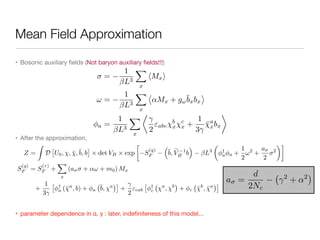
Mean Field Approximation
• Bosonic auxiliary fields (Not baryon auxiliary fields!!!)

• After the approximation,

• parameter dependence in α, γ : later, indefiniteness of this model...
Z =
Z
D
⇥
U0, , ¯,¯b, b
⇤
⇥ det VB ⇥ exp

S
(q)
F
⇣
¯b, eV 1
B b
⌘
L3
✓
†
a a +
1
2
!2
+
a
2
2
◆
S
(q)
F = S
(⌧)
F +
X
x
(a + ↵! + m0) Mx
+
1
3
⇥ †
a (¯a
, b) + a
¯b, a
⇤
+
2
"cab
⇥ †
c
a
, b
+ c ¯b
, ¯a
⇤
=
1
L3
X
x
hMxi
! =
1
L3
X
x
⌦
↵Mx + g!
¯bxbx
↵
a =
1
L3
X
x
⌧
2
"abc
b
x
c
x +
1
3
¯a
xbx
a =
d
2Nc
2
+ ↵2
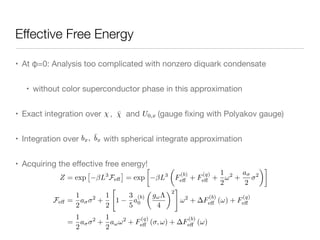
Effective Free Energy
• At φ=0: Analysis too complicated with nonzero diquark condensate

• without color superconductor phase in this approximation

• Exact integration over , and (gauge fixing with Polyakov gauge) 

• Integration over with spherical integrate approximation

• Acquiring the effective free energy!
Z = exp
⇥
L3
Fe↵
⇤
= exp

L3
✓
F
(b)
e↵ + F
(q)
e↵ +
1
2
!2
+
a
2
2
◆
Fe↵ =
1
2
a 2
+
1
2
"
1
3
5
a
(b)
0
✓
g!⇤
4
◆2
#
!2
+ F
(b)
e↵ (!) + F
(q)
e↵
=
1
2
a 2
+
1
2
a!!2
+ F
(q)
e↵ ( , !) + F
(b)
e↵ (!)
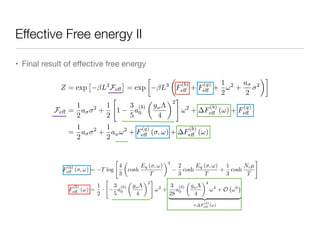
Effective Free energy II
• Final result of effective free energy
Z = exp
⇥
L3
Fe↵
⇤
= exp

L3
✓
F
(b)
e↵ + F
(q)
e↵ +
1
2
!2
+
a
2
2
◆
Fe↵ =
1
2
a 2
+
1
2
"
1
3
5
a
(b)
0
✓
g!⇤
4
◆2
#
!2
+ F
(b)
e↵ (!) + F
(q)
e↵
=
1
2
a 2
+
1
2
a!!2
+ F
(q)
e↵ ( , !) + F
(b)
e↵ (!)
F
(q)
e↵ ( , !) = T log
"
4
3
✓
cosh
Eq ( , !)
T
◆3
2
3
cosh
Eq ( , !)
T
+
1
3
cosh
Ncµ
T
#
F
(b)
e↵ (!) =
1
2
·
"
3
5
a
(b)
0
✓
g!⇤
4
◆2
#
!2
+
3
28
a
(b)
0
✓
g!⇤
4
◆4
!4
+ O !6
| {z }
= F
(b)
eff (!)
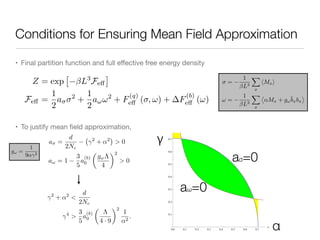
Conditions for Ensuring Mean Field Approximation
• Final partition function and full effective free energy density

• To justify mean field approximation,

=
1
L3
X
x
hMxi
! =
1
L3
X
x
⌦
↵Mx + g!
¯bxbx
↵
a =
d
2Nc
2
+ ↵2
> 0
a! = 1
3
5
a
(b)
0
✓
g!⇤
4
◆2
> 0
2
+ ↵2
<
d
2Nc
4
>
3
5
a
(b)
0
✓
⇤
4 · 9
◆2
1
↵2
.
Z = exp
⇥
L3
Fe↵
⇤
Fe↵ =
1
2
a 2
+
1
2
a!!2
+ F
(q)
e↵ ( , !) + F
(b)
e↵ (!)
0.0 0.1 0.2 0.3 0.4 0.5 0.6 0.7
a
0.1
0.2
0.3
0.4
0.5
0.6
0.7
g! =
1
9↵ 2
α
γ
aσ=0
aω=0
Equilibrium Condition
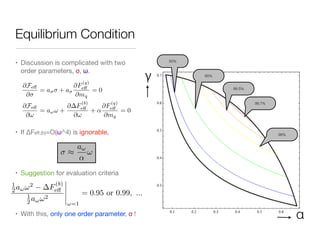
• Discussion is complicated with two
order parameters, σ, ω.

• If ΔFeff,(b)=O(ω^4) is ignorable,

• Suggestion for evaluation criteria

• With this, only one order parameter, σ !
@Fe↵
@
= a + a
@F
(q)
e↵
@mq
= 0
@Fe↵
@!
= a!! +
@ F
(b)
e↵
@!
+ ↵
@F
(q)
e↵
@mq
= 0
50%
95%
99%
99.5%
99.7%
⇡
a!
↵
!
α
γ
1
2 a!!2
F
(b)
e↵
1
2 a!!2
!=1
= 0.95 or 0.99, ...
Effective Free energy as a Function of σ
• (α, γ) = (0.2, 0.678233) : Kawamoto et al. (’07)
Feff / Tc
σ
Feff / Tc
σ
Feff / Tc
σ
2nd order phase transition
from T=0 (fixed at μ=0)
1st order phase transition
from μ=0 (fixed at T=0)
Around Tricritical point
from μ=0 (fixed at T=TTCP)
Indefiniteness from Parameter Dependence
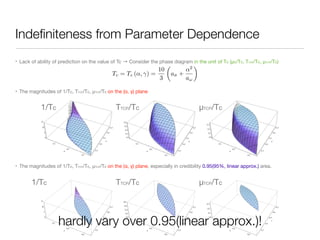
• Lack of ability of prediction on the value of Tc → Consider the phase diagram in the unit of Tc (μc/Tc, TTCP/Tc, μTCP/Tc)

• The magnitudes of 1/Tc, TTCP/Tc, μTCP/Tc on the (α, γ) plane

• The magnitudes of 1/Tc, TTCP/Tc, μTCP/Tc on the (α, γ) plane, especially in credibility 0.95(95%, linear approx.) area.

Tc = Tc (↵, ) =
10
3
✓
a +
↵2
a!
◆
1/Tc TTCP/Tc μTCP/Tc
0.2
0.4
0.6
a 0.3
0.4
0.5
0.6
0.7
g
0
5
10
15
0.2
0.4
0.6
a 0.3
0.4
0.5
0.6
0.7
g
0.0
0.2
0.4
0.6
0.8
0.2
0.4
0.6
a 0.3
0.4
0.5
0.6
0.7
g
0.0
0.1
0.2
0.3
Indefiniteness from Parameter Dependence
• Lack of ability of prediction on the value of Tc → Consider the phase diagram in the unit of Tc (μc/Tc, TTCP/Tc, μTCP/Tc)

• The magnitudes of 1/Tc, TTCP/Tc, μTCP/Tc on the (α, γ) plane

• The magnitudes of 1/Tc, TTCP/Tc, μTCP/Tc on the (α, γ) plane, especially in credibility 0.95(95%, linear approx.) area.

Tc = Tc (↵, ) =
10
3
✓
a +
↵2
a!
◆
1/Tc TTCP/Tc μTCP/Tc
0.2
0.4
0.6
a 0.3
0.4
0.5
0.6
0.7
g
0
5
10
15
0.2
0.4
0.6
a 0.3
0.4
0.5
0.6
0.7
g
0.0
0.2
0.4
0.6
0.8
0.2
0.4
0.6
a 0.3
0.4
0.5
0.6
0.7
g
0.0
0.1
0.2
0.3
hardly vary over 0.95(linear approx.)!
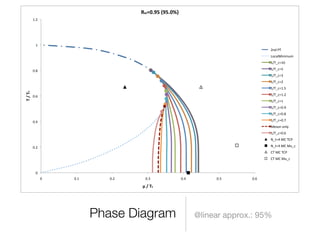
Phase Diagram @linear approx.: 95%
0"
0.2"
0.4"
0.6"
0.8"
1"
1.2"
0" 0.1" 0.2" 0.3" 0.4" 0.5" 0.6"
T"/"Tc"
μ"/"Tc"
Rω=0.95"(95.0%)"
2nd"PT"
LocalMinimum"
1/T_c=10"
1/T_c=5"
1/T_c=3"
1/T_c=2"
1/T_c=1.5"
1/T_c=1.2"
1/T_c=1"
1/T_c=0.9"
1/T_c=0.8"
1/T_c=0.7"
Meson"only"
1/T_c=0.6"
N_t=4"MC"TCP"
N_t=4"MC"Mu_c"
CT"MC"TCP"
CT"MC"Mu_c"
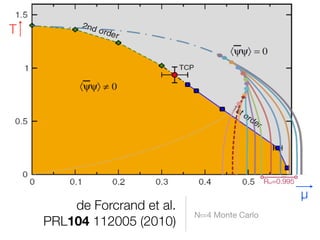
de Forcrand et al.
PRL104 112005 (2010)
Nt=4 Monte Carlo
Rω=0.995
μ
T
de Forcrand et al.
arXiv:1111.1434 (2011)
Continuous time Monte Carlo
T
μRω=0.995
Summary and Future Works
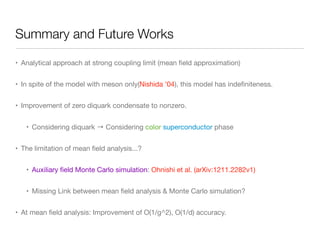
• Analytical approach at strong coupling limit (mean field approximation)

• In spite of the model with meson only(Nishida ’04), this model has indefiniteness.

• Improvement of zero diquark condensate to nonzero.

• Considering diquark → Considering color superconductor phase

• The limitation of mean field analysis...?

• Auxiliary field Monte Carlo simulation: Ohnishi et al. (arXiv:1211.2282v1)

• Missing Link between mean field analysis & Monte Carlo simulation?

• At mean field analysis: Improvement of O(1/g^2), O(1/d) accuracy.
ありがとうございました。
Thank you very much.

Phase diagram at finite T & Mu in strong coupling limit of lattice QCD

  • 1.
    Phase diagram atfinite T & μ in strong coupling limit of lattice QCD Supervisor: Kazuyuki Kanaya(金谷 和至) 201020283 Jae Don Choi(崔 在敦)
  • 2.
    Spontaneously Broken QCDChiral Symmetry • the fermion part of QCD action (ordinary, continuum theory) • If massless(m=0), there exists symmetry. • This means that the action is invariant in • In sufficiently low temperature, . Symmetry is broken spontaneously. • Finite temperature QCD. SF ⇥ , ¯, A ⇤ = Nf X f=1 Z d4 x ¯(f) (x) ⇣ µ (@µ + igAµ (x)) + m(f) ⌘ (f) (x) = Nf X f=1 Z d4 x ¯(f) (x)↵,c ⇣ ( µ)↵ ( cd@µ + igAµ (x)cd) + m(f) ↵ cd ⌘ (f) (x) ,d SU(Nf )L ⇥ SU(Nf )R ! ei✓ 5
  • 3.
    Introduction • We wantto construct effective mean field theory for QCD phase diagram • at strong coupling limit, with 1 flavor staggered fermion • Chiral Symmetry Restoration Phase Transition ONLY • In which temperature and chemical potential, does our effective free energy have local minimum at <ψψ> = 0? • In this model, without CSC phase
  • 4.
    On the StartingLine: Lattice QCD • 1 flavor staggered fermion (4 flavor in continuum limit), color SU(3) • Detail of action Z = Z D [U0, Uj, , ¯] exp " S (⌧) F S (s) F X x m0 ¯a x a x SG # S (⌧) F = 1 2 X x h eµ ¯xU0,x x+ˆ0 e µ ¯x+ˆ0U† 0,x x i S (s) F = 1 2 X x,j ⌘j,x h ¯xUj,x x+ˆj ¯x+ˆjU† j,x x i ⌘j,x = ( 1) x0+x1+···xj 1 (j = 1, 2, 3) . SG = 2Nc g2  1 trc 2Nc ⇥ Uµ⌫,x + U† µ⌫,x ⇤ ! 0 g2 ! 1 Strong coupling limit
  • 5.
    Process • Start withpartition function. • Path integral of spatial link variable • Bosonization: to make bilinear form in quark for path integral of • Mean field approximation in auxiliary fields • Execute integral of quark & temporal link variable • acquisition of effective free energy • Analyze in temperature and chemical potential Uj,x U0,x ¯, ¯,
  • 6.
    Introduction • Analytical approach(Kawamoto et al. ’07) • 1 flavor staggered fermion (4 flavor in continuum limit), color SU(3) • Detail of action Z = Z D [U0, Uj, , ¯] exp " S (⌧) F S (s) F X x m0 ¯a x a x SG # Strong coupling limit a⌧ = as = 1 S (⌧) F = a3 sa⌧ X x " eµa⌧ ¯xU0,x x+ˆ0 e µa⌧ ¯x+ˆ0U† 0,x x 2a⌧ # S (s) F = a3 sa⌧ X x,j ⌘j,x " ¯xUj,x x+ˆj ¯x+ˆjU† j,x x 2as # ⌘j,x = ( 1) x0+x1+···xj 1 (j = 1, 2, 3) . SG = 2Nc g2  1 trc 2Nc ⇥ Uµ⌫,x + U† µ⌫,x ⇤ ! 0 g2 ! 1
  • 7.
    SU(3) Group Integralwith Spatial Link Variable • Kluberg-Stern et al. (’83) Mx = ¯a x a x Bx = 1 Nc! "a1a2···aNc a1 a2 · · · aNc ¯Bx = 1 Nc! "a1a2···aNc ¯aNc · · · ¯a2 ¯a1 Z D [Uj] e S (s) F = Z D [Uj] exp 2 4 1 2 · X x,j ⌘j,x ⇣ ¯xUj,x x+ˆj ¯x+ˆjU† j,x x ⌘ 3 5 = exp 2 4 X x 1 4Nc dX j=1 MxMx+ˆj X x ( 1) Nc(Nc 1) 2 dX j=1 ⇣⌘j,x 2 ⌘Nc h ¯BxBx+ˆj + ( 1) Nc ¯Bx+ˆjBx i X x N2 c · (Nc 2)! Nc! 32 · N2 c · Nc! dX j=1 M2 xM2 x+ˆj X x 2 · Nc! N3 c · (Nc 2)! 128 · N4 c · Nc! dX j=1 M3 xM3 x+ˆj 3 5
  • 8.
    Systematic 1/d ExpansionI • At d (space dimension) →∞, mean field theory becomes exact. • demand the leading order term be O(1) at d→∞ : Rescale quark field x ! d 1 4 x Mx = p d · [¯a x a x] Bx = d Nc 4 ·  1 Nc! "a1a2···aNc a1 a2 · · · aNc ¯Bx = d Nc 4 ·  1 Nc! "a1a2···aNc ¯aNc · · · ¯a2 ¯a1
  • 9.
    Systematic 1/d ExpansionII • Then our result looks like • Kluberg-Stern et al. (’83) : Contribution of higher order terms to Vacuum Expectation Value of chiral condensate(<ψψ>) is small at zero temperature(T=0). (In d=4, about 7%) • Usually, Analyzed only in O(1): Damgaard et al.(’84), Nishida(’04), Miura et al.(’07), Nakano et al.(’10),... etc. • We want to investigate the baryon effect: We adopt not only O(1) but also O(1/√d) for our effective action. Z D [Uj] e S (s) F = exp 2 4 X x 1 d dX j=1 ⇢ 1 · ✓ 1 4Nc · MxMx+ˆj ◆ + 1 p dNc 2 · ✓ ( 1) Nc(Nc 1) 2 ⇣⌘j,x 2 ⌘Nc · ⇣ ¯BxBx+ˆj + ( 1) Nc ¯Bx+ˆjBx ⌘◆ + 1 d · ✓ N2 c · (Nc 2)! Nc! 32 · N2 c · Nc! · M2 xM2 x+ˆj ◆ + 1 d2 · ✓ 2 · Nc! N3 c · (Nc 2)! 128 · N4 c · Nc! · M3 xM3 x+ˆj ◆ O(1) O(1/√d) @ Nc=3 O(1/d) O(1/d^2)
  • 10.
    After the PathIntegral of Spatial Link Variable • So far, our partition function • Propagators and inner product VM,xy = 1 2d dX j=1 ⇣ y,x+ˆj + y,x ˆj ⌘ VB,xy = ( 1) Nc(Nc 1) 2 dX j=1 ⇣⌘j,x 2 ⌘Nc ⇣ y,x+ˆj + ( 1) Nc y,x ˆj ⌘ (A, V B) = X x,y AxVxyBy Z = Z D [U0, Uj, , ¯] exp " S (⌧) F X x m0 ¯a x a x S (s) F # ⇡ Z D [U0, , ¯] exp " S (⌧) F X x m0Mx + d 2Nc · 1 2 (M, VM M) + ¯B, VBB #
  • 11.
    Bosonization: Introducing AuxiliaryFields • We want the bilinear form of quark → Hubbard-Stratonovich transformation Da;x = 2 "abc b x c x + 1 3 ¯a xbx D† a;x = 2 "abc ¯c x ¯b x + 1 3 ¯bx a x d 2Nc · 1 2 (M, VM M) 2 2 (M, M) ↵2 2 (M, M) = 1 2 ⇣ M, eVM M ⌘ ¯b, V 1 B b g!! ¯b, b = ⇣ ¯b, eV 1 B b ⌘ e( ¯B,VBB) = det VB Z D ⇥ ¯b, b ⇤ e (¯b,V 1 B b)+(¯b,B)+( ¯B,b) e( ¯B,b)+(¯b,B) = Z d ⇥ a, † a ⇤ exp " † a, a + X x † a;xDa;x + D† a;x a;x 2 2 (M, M) + X x 1 9 2 Mx ¯bxbx # e P x 1 9 2 Mx ¯bxbx = Z D [!] exp " 1 2 (!, !) ↵ X x Mx + g! ¯bxbx !x ↵2 2 (M, M) # e 1 2 (M,eVM M) = Z D [ ] exp  1 2 ⇣ , eVM ⌘ ⇣ , eVM M ⌘ Z = Z D [U0, , ¯] exp " S (⌧) F + d 2Nc · 1 2 (M, VM M) + ¯B, VBB X x m0Mx # g! = 1 9↵ 2 free parameters α, γ
  • 12.
    Mean Field Approximation •Bosonic auxiliary fields (Not baryon auxiliary fields!!!) • After the approximation, • parameter dependence in α, γ : later, indefiniteness of this model... Z = Z D ⇥ U0, , ¯,¯b, b ⇤ ⇥ det VB ⇥ exp  S (q) F ⇣ ¯b, eV 1 B b ⌘ L3 ✓ † a a + 1 2 !2 + a 2 2 ◆ S (q) F = S (⌧) F + X x (a + ↵! + m0) Mx + 1 3 ⇥ † a (¯a , b) + a ¯b, a ⇤ + 2 "cab ⇥ † c a , b + c ¯b , ¯a ⇤ = 1 L3 X x hMxi ! = 1 L3 X x ⌦ ↵Mx + g! ¯bxbx ↵ a = 1 L3 X x ⌧ 2 "abc b x c x + 1 3 ¯a xbx a = d 2Nc 2 + ↵2
  • 13.
    Effective Free Energy •At φ=0: Analysis too complicated with nonzero diquark condensate • without color superconductor phase in this approximation • Exact integration over , and (gauge fixing with Polyakov gauge) • Integration over with spherical integrate approximation • Acquiring the effective free energy! Z = exp ⇥ L3 Fe↵ ⇤ = exp  L3 ✓ F (b) e↵ + F (q) e↵ + 1 2 !2 + a 2 2 ◆ Fe↵ = 1 2 a 2 + 1 2 " 1 3 5 a (b) 0 ✓ g!⇤ 4 ◆2 # !2 + F (b) e↵ (!) + F (q) e↵ = 1 2 a 2 + 1 2 a!!2 + F (q) e↵ ( , !) + F (b) e↵ (!)
  • 14.
    Effective Free energyII • Final result of effective free energy Z = exp ⇥ L3 Fe↵ ⇤ = exp  L3 ✓ F (b) e↵ + F (q) e↵ + 1 2 !2 + a 2 2 ◆ Fe↵ = 1 2 a 2 + 1 2 " 1 3 5 a (b) 0 ✓ g!⇤ 4 ◆2 # !2 + F (b) e↵ (!) + F (q) e↵ = 1 2 a 2 + 1 2 a!!2 + F (q) e↵ ( , !) + F (b) e↵ (!) F (q) e↵ ( , !) = T log " 4 3 ✓ cosh Eq ( , !) T ◆3 2 3 cosh Eq ( , !) T + 1 3 cosh Ncµ T # F (b) e↵ (!) = 1 2 · " 3 5 a (b) 0 ✓ g!⇤ 4 ◆2 # !2 + 3 28 a (b) 0 ✓ g!⇤ 4 ◆4 !4 + O !6 | {z } = F (b) eff (!)
  • 15.
    Conditions for EnsuringMean Field Approximation • Final partition function and full effective free energy density • To justify mean field approximation, = 1 L3 X x hMxi ! = 1 L3 X x ⌦ ↵Mx + g! ¯bxbx ↵ a = d 2Nc 2 + ↵2 > 0 a! = 1 3 5 a (b) 0 ✓ g!⇤ 4 ◆2 > 0 2 + ↵2 < d 2Nc 4 > 3 5 a (b) 0 ✓ ⇤ 4 · 9 ◆2 1 ↵2 . Z = exp ⇥ L3 Fe↵ ⇤ Fe↵ = 1 2 a 2 + 1 2 a!!2 + F (q) e↵ ( , !) + F (b) e↵ (!) 0.0 0.1 0.2 0.3 0.4 0.5 0.6 0.7 a 0.1 0.2 0.3 0.4 0.5 0.6 0.7 g! = 1 9↵ 2 α γ aσ=0 aω=0
  • 16.
    Equilibrium Condition • Discussionis complicated with two order parameters, σ, ω. • If ΔFeff,(b)=O(ω^4) is ignorable, • Suggestion for evaluation criteria • With this, only one order parameter, σ ! @Fe↵ @ = a + a @F (q) e↵ @mq = 0 @Fe↵ @! = a!! + @ F (b) e↵ @! + ↵ @F (q) e↵ @mq = 0 50% 95% 99% 99.5% 99.7% ⇡ a! ↵ ! α γ 1 2 a!!2 F (b) e↵ 1 2 a!!2 !=1 = 0.95 or 0.99, ...
  • 17.
    Effective Free energyas a Function of σ • (α, γ) = (0.2, 0.678233) : Kawamoto et al. (’07) Feff / Tc σ Feff / Tc σ Feff / Tc σ 2nd order phase transition from T=0 (fixed at μ=0) 1st order phase transition from μ=0 (fixed at T=0) Around Tricritical point from μ=0 (fixed at T=TTCP)
  • 18.
    Indefiniteness from ParameterDependence • Lack of ability of prediction on the value of Tc → Consider the phase diagram in the unit of Tc (μc/Tc, TTCP/Tc, μTCP/Tc) • The magnitudes of 1/Tc, TTCP/Tc, μTCP/Tc on the (α, γ) plane • The magnitudes of 1/Tc, TTCP/Tc, μTCP/Tc on the (α, γ) plane, especially in credibility 0.95(95%, linear approx.) area. Tc = Tc (↵, ) = 10 3 ✓ a + ↵2 a! ◆ 1/Tc TTCP/Tc μTCP/Tc 1/Tc TTCP/Tc μTCP/Tc 0.2 0.4 0.6 a 0.3 0.4 0.5 0.6 0.7 g 0 5 10 15 0.2 0.4 0.6 a 0.3 0.4 0.5 0.6 0.7 g 0.0 0.2 0.4 0.6 0.8 0.2 0.4 0.6 a 0.3 0.4 0.5 0.6 0.7 g 0.0 0.1 0.2 0.3
  • 19.
    Indefiniteness from ParameterDependence • Lack of ability of prediction on the value of Tc → Consider the phase diagram in the unit of Tc (μc/Tc, TTCP/Tc, μTCP/Tc) • The magnitudes of 1/Tc, TTCP/Tc, μTCP/Tc on the (α, γ) plane • The magnitudes of 1/Tc, TTCP/Tc, μTCP/Tc on the (α, γ) plane, especially in credibility 0.95(95%, linear approx.) area. Tc = Tc (↵, ) = 10 3 ✓ a + ↵2 a! ◆ 1/Tc TTCP/Tc μTCP/Tc 1/Tc TTCP/Tc μTCP/Tc 0.2 0.4 0.6 a 0.3 0.4 0.5 0.6 0.7 g 0 5 10 15 0.2 0.4 0.6 a 0.3 0.4 0.5 0.6 0.7 g 0.0 0.2 0.4 0.6 0.8 0.2 0.4 0.6 a 0.3 0.4 0.5 0.6 0.7 g 0.0 0.1 0.2 0.3 hardly vary over 0.95(linear approx.)!
  • 20.
    Phase Diagram @linearapprox.: 95% 0" 0.2" 0.4" 0.6" 0.8" 1" 1.2" 0" 0.1" 0.2" 0.3" 0.4" 0.5" 0.6" T"/"Tc" μ"/"Tc" Rω=0.95"(95.0%)" 2nd"PT" LocalMinimum" 1/T_c=10" 1/T_c=5" 1/T_c=3" 1/T_c=2" 1/T_c=1.5" 1/T_c=1.2" 1/T_c=1" 1/T_c=0.9" 1/T_c=0.8" 1/T_c=0.7" Meson"only" 1/T_c=0.6" N_t=4"MC"TCP" N_t=4"MC"Mu_c" CT"MC"TCP" CT"MC"Mu_c"
  • 21.
    de Forcrand etal. PRL104 112005 (2010) Nt=4 Monte Carlo Rω=0.995 μ T
  • 22.
    de Forcrand etal. arXiv:1111.1434 (2011) Continuous time Monte Carlo T μRω=0.995
  • 23.
    Summary and FutureWorks • Analytical approach at strong coupling limit (mean field approximation) • In spite of the model with meson only(Nishida ’04), this model has indefiniteness. • Improvement of zero diquark condensate to nonzero. • Considering diquark → Considering color superconductor phase • The limitation of mean field analysis...? • Auxiliary field Monte Carlo simulation: Ohnishi et al. (arXiv:1211.2282v1) • Missing Link between mean field analysis & Monte Carlo simulation? • At mean field analysis: Improvement of O(1/g^2), O(1/d) accuracy.
  • 24.