ELECTRONIC SKIN
ELECTRONIC SKIN:
• What is electronic skin ?
• A thin layer of material containing electronic sensors that is designed to
mimic some of the properties of human skin, especially its sensitivity to
pressure and temperature.
• Electronic skin refers to flexible ,stretchable and self-
healing electronics that are able to mimic functionalities of
human or animal skin.
HISTROY:
• The idea of creating artificial skin was obtained by science
fiction movies like terminator ,artificial skin can be obtained in
the form of electronic skin.
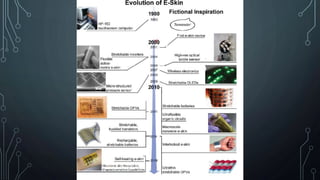
DEVELOPMENT OF E-SKIN:
• 2010:
Attaching nanowire transistors to sticky substrate, embedded in thin pressure
sensitive rubber-capable of sensing wide range of pressures(California
University)
First prototype for e-skin.
• 2011:
Stretchable solar cell used to power the electronic skin(Stanford)
• 2013
Created an electronic skin that lights up when touched (UC Berkeley)
2018
Self healingand Fully recyclable 'electronic skin’
An electronic skin (e-skin) with magnetosensitive capabilities, sensitive
enough to detect and digitize body motion in the Earth’s magnetic field.
MATERIALS:
• As electronic skin should be flexible and stretchable with
different sensors so for this goal following material can be used
:
• Graphene-Based Active Materials
• Organic and Polymer-Based Active Materials
• CNT-Based Active Materials
• Nanowire (NW)-Based Active Materials
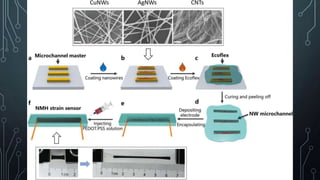
SCHEMATIC DIAGRAM OF THE FABRICATION
PROCESS FOR THE NANOWIRE-MICROFLUIDIC
HYBRID (NMH) STRAIN SENSOR.
•
1-Attach PI(polymide) tape to a glass substrate.
2-Deposit nanowires or nanotubes onto the PI tape to form conductive thin films. Scanning electron
microscopy (SEM) images of the synthesized copper, silver nanowires, or carbon nanotubes are shown
above (the scale bars represent 400 nm).
3-Pour and impregnate the conductive thin film with uncured Ecoflex.
4-Peel off the Ecoflex film after curing.
5-Attach silver wires and encapsulate.
6 Inject the PEDOT:PSS(poly(3,4-ethylenedioxythiophene):polystyrene sulfonate ) solution and seal
the channel with Ecoflex.
RESULTS
• (1) polyimide (PI) tape is attached to a glass substrate to create
microchannels.
• (2) A nanowire suspension solution is deposited on the PI tape to form
conductive thin films.
• (3) The Ecoflex prepolymer is spin-coated onto the film and cured.
• (4) The Ecoflex film is peeled off the substrate to form microchannels.
• (5) Silver wires are connected at both ends of the microchannels to form
contacts, and then, another Ecoflex slab is used to cover the device.
• (6) The PEDOT:PSS solution is injected into the microchannels using a
syringe. Then, a NMH strain sensor with a conductive nanowire network and
a conductive solution is created.
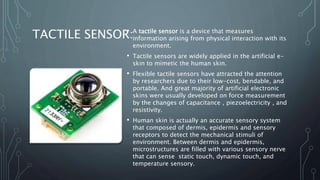
TACTILE SENSOR:• A tactile sensor is a device that measures
information arising from physical interaction with its
environment.
• Tactile sensors are widely applied in the artificial e-
skin to mimetic the human skin.
• Flexible tactile sensors have attracted the attention
by researchers due to their low-cost, bendable, and
portable. And great majority of artificial electronic
skins were usually developed on force measurement
by the changes of capacitance , piezoelectricity , and
resistivity.
• Human skin is actually an accurate sensory system
that composed of dermis, epidermis and sensory
receptors to detect the mechanical stimuli of
environment. Between dermis and epidermis,
microstructures are filled with various sensory nerve
that can sense static touch, dynamic touch, and
temperature sensory.
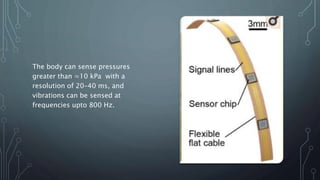
The body can sense pressures
greater than ≈10 kPa with a
resolution of 20–40 ms, and
vibrations can be sensed at
frequencies upto 800 Hz.
SELF-HEALING
• While naturally occurring human skin has the ability to repair
itself after incurring mechanical damage.
• For artificial skin, the ability to repair both mechanical and
electrical damage would be highly advantageous for practical
applications.
• Two strategies used to incorporate self-healing properties in
materials
1) the use of materials loaded with healing agents
2) the use of materials containing dynamic reversible bonds
Healing agents
• the charge transfer salts tetrathiafulvanene(TTF) and
tetracyanoquinodimethane (TCNQ) insert into poly(urea-
formaldehyde) core-shell microcapsules. If the material cracks
inside, the capsules break open, the repair material "wicks" out, and
the crack seals up.
• The material no longer possesses selfhealing properties after the first
use.
Reversible dynamic bonds
• To address this consideration, the use of reversible dynamic bonds
for multi-use self-healing applications has been investigated.
• It is preferable to have materials that self-heal with the need for
external stimulants (such as light, heat, solvents, water).
POLYMERS
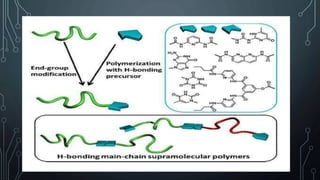
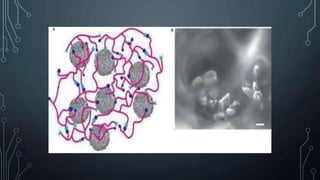
• The noncovalent interactions make supramolecular polymers
more dynamic and reversible. These interactions include
hydrogen bonding, π-π interaction, metal coordination.
• Compared with self-healing materials based on covalent bonds,
these supramolecular polymers-based self-healing materials
can quickly restore the initial structure
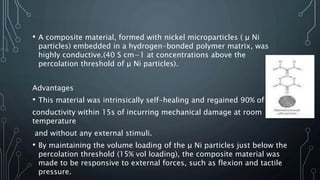
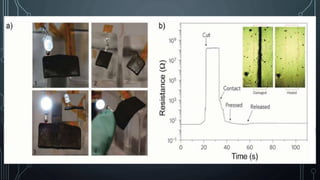
• A composite material, formed with nickel microparticles ( μ Ni
particles) embedded in a hydrogen-bonded polymer matrix, was
highly conductive.(40 S cm−1 at concentrations above the
percolation threshold of μ Ni particles).
Advantages
• This material was intrinsically self-healing and regained 90% of its
conductivity within 15s of incurring mechanical damage at room
temperature
and without any external stimuli.
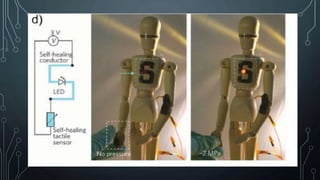
• By maintaining the volume loading of the μ Ni particles just below the
percolation threshold (15% vol loading), the composite material was
made to be responsive to external forces, such as flexion and tactile
pressure.
SELF-POWERING
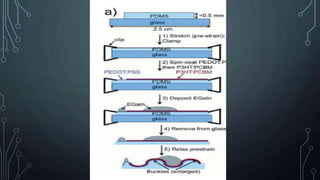
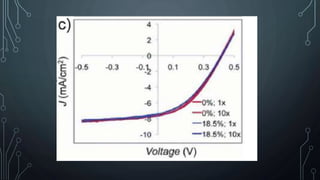
• The OPVs were fabricated directly on a prestretched elastomeric
substrate, with a spin-coated PEDOT:PSS anode, a blend of
P3HT and PCBM as the active layer, and an EGaIn cathode.
Releasing the prestrain formed buckles in the device.
Other Methods:
• Technologies for harnessing mechanical energy include both
dielectric elastomer generators and piezoelectric generators.
• Dielectric elastomer generators consist of an elastomeric
dielectric coated with two highly compliant electrodes, The
electrodes are charged by applying a voltage in the compressed
state. Relaxation of the elastomer increases the voltage,
producing higher energy charges that are harvested
• Piezoelectricity (also called the piezoelectric effect) is the
appearance of an electrical potential (a voltage, in other words)
across the sides of a crystal when you subject it to mechanical
stress (by squeezing it).
ELECTRONIC SKIN (E-SKIN) WITH
MAGNETOSENSITIVE CAPABILITIES
• sensitive enough to detect and digitize body motion in the
Earth's magnetic field.
• this e-skin is extremely thin and malleable, it can easily be
affixed to human skin to create a bionic analog of a compass.
• it takes is a sliver of polymer foil, no more than a thousandth of a
millimeter thick, attached to a finger -- and the Earth's magnetic
field.
• The foil is equipped with magnetic field sensors that can pick up
geomagnetic fields. these fields are about 40 to 60 microtesla -- that
is 1,000 times weaker than a magnetic field of a typical fridge
magnet
• Therefore, if he or the body part hosting the sensor changes
orientation, the sensor captures the motion, which is then transferred
and digitized to operate in the virtual world.
CONCLUSION
• 1) enable highly the development of interactive and versatile
robots that are capable of performing complex tasks in less

structured environments;
• 2) facilitate conformable displays and optics;
• 3) revolutionize healthcare by providing biomimetic prostheses,
constant health monitoring technologies, and unprecedented
diagnostic and treatment profi ciency.
THANK
YOU
ANYQUERIES¿

E skin presentation

  • 1.
  • 2.
    ELECTRONIC SKIN: • Whatis electronic skin ? • A thin layer of material containing electronic sensors that is designed to mimic some of the properties of human skin, especially its sensitivity to pressure and temperature. • Electronic skin refers to flexible ,stretchable and self- healing electronics that are able to mimic functionalities of human or animal skin.
  • 3.
    HISTROY: • The ideaof creating artificial skin was obtained by science fiction movies like terminator ,artificial skin can be obtained in the form of electronic skin.
  • 5.
    DEVELOPMENT OF E-SKIN: •2010: Attaching nanowire transistors to sticky substrate, embedded in thin pressure sensitive rubber-capable of sensing wide range of pressures(California University) First prototype for e-skin. • 2011: Stretchable solar cell used to power the electronic skin(Stanford) • 2013 Created an electronic skin that lights up when touched (UC Berkeley) 2018 Self healingand Fully recyclable 'electronic skin’ An electronic skin (e-skin) with magnetosensitive capabilities, sensitive enough to detect and digitize body motion in the Earth’s magnetic field.
  • 6.
    MATERIALS: • As electronicskin should be flexible and stretchable with different sensors so for this goal following material can be used : • Graphene-Based Active Materials • Organic and Polymer-Based Active Materials • CNT-Based Active Materials • Nanowire (NW)-Based Active Materials
  • 7.
    SCHEMATIC DIAGRAM OFTHE FABRICATION PROCESS FOR THE NANOWIRE-MICROFLUIDIC HYBRID (NMH) STRAIN SENSOR. • 1-Attach PI(polymide) tape to a glass substrate. 2-Deposit nanowires or nanotubes onto the PI tape to form conductive thin films. Scanning electron microscopy (SEM) images of the synthesized copper, silver nanowires, or carbon nanotubes are shown above (the scale bars represent 400 nm). 3-Pour and impregnate the conductive thin film with uncured Ecoflex. 4-Peel off the Ecoflex film after curing. 5-Attach silver wires and encapsulate. 6 Inject the PEDOT:PSS(poly(3,4-ethylenedioxythiophene):polystyrene sulfonate ) solution and seal the channel with Ecoflex.
  • 9.
    RESULTS • (1) polyimide(PI) tape is attached to a glass substrate to create microchannels. • (2) A nanowire suspension solution is deposited on the PI tape to form conductive thin films. • (3) The Ecoflex prepolymer is spin-coated onto the film and cured. • (4) The Ecoflex film is peeled off the substrate to form microchannels. • (5) Silver wires are connected at both ends of the microchannels to form contacts, and then, another Ecoflex slab is used to cover the device. • (6) The PEDOT:PSS solution is injected into the microchannels using a syringe. Then, a NMH strain sensor with a conductive nanowire network and a conductive solution is created.
  • 10.
    TACTILE SENSOR:• Atactile sensor is a device that measures information arising from physical interaction with its environment. • Tactile sensors are widely applied in the artificial e- skin to mimetic the human skin. • Flexible tactile sensors have attracted the attention by researchers due to their low-cost, bendable, and portable. And great majority of artificial electronic skins were usually developed on force measurement by the changes of capacitance , piezoelectricity , and resistivity. • Human skin is actually an accurate sensory system that composed of dermis, epidermis and sensory receptors to detect the mechanical stimuli of environment. Between dermis and epidermis, microstructures are filled with various sensory nerve that can sense static touch, dynamic touch, and temperature sensory.
  • 11.
    The body cansense pressures greater than ≈10 kPa with a resolution of 20–40 ms, and vibrations can be sensed at frequencies upto 800 Hz.
  • 12.
    SELF-HEALING • While naturallyoccurring human skin has the ability to repair itself after incurring mechanical damage. • For artificial skin, the ability to repair both mechanical and electrical damage would be highly advantageous for practical applications. • Two strategies used to incorporate self-healing properties in materials 1) the use of materials loaded with healing agents 2) the use of materials containing dynamic reversible bonds
  • 13.
    Healing agents • thecharge transfer salts tetrathiafulvanene(TTF) and tetracyanoquinodimethane (TCNQ) insert into poly(urea- formaldehyde) core-shell microcapsules. If the material cracks inside, the capsules break open, the repair material "wicks" out, and the crack seals up. • The material no longer possesses selfhealing properties after the first use. Reversible dynamic bonds • To address this consideration, the use of reversible dynamic bonds for multi-use self-healing applications has been investigated. • It is preferable to have materials that self-heal with the need for external stimulants (such as light, heat, solvents, water).
  • 14.
    POLYMERS • The noncovalentinteractions make supramolecular polymers more dynamic and reversible. These interactions include hydrogen bonding, π-π interaction, metal coordination. • Compared with self-healing materials based on covalent bonds, these supramolecular polymers-based self-healing materials can quickly restore the initial structure
  • 16.
    • A compositematerial, formed with nickel microparticles ( μ Ni particles) embedded in a hydrogen-bonded polymer matrix, was highly conductive.(40 S cm−1 at concentrations above the percolation threshold of μ Ni particles). Advantages • This material was intrinsically self-healing and regained 90% of its conductivity within 15s of incurring mechanical damage at room temperature and without any external stimuli. • By maintaining the volume loading of the μ Ni particles just below the percolation threshold (15% vol loading), the composite material was made to be responsive to external forces, such as flexion and tactile pressure.
  • 20.
    SELF-POWERING • The OPVswere fabricated directly on a prestretched elastomeric substrate, with a spin-coated PEDOT:PSS anode, a blend of P3HT and PCBM as the active layer, and an EGaIn cathode. Releasing the prestrain formed buckles in the device.
  • 23.
    Other Methods: • Technologiesfor harnessing mechanical energy include both dielectric elastomer generators and piezoelectric generators. • Dielectric elastomer generators consist of an elastomeric dielectric coated with two highly compliant electrodes, The electrodes are charged by applying a voltage in the compressed state. Relaxation of the elastomer increases the voltage, producing higher energy charges that are harvested • Piezoelectricity (also called the piezoelectric effect) is the appearance of an electrical potential (a voltage, in other words) across the sides of a crystal when you subject it to mechanical stress (by squeezing it).
  • 24.
    ELECTRONIC SKIN (E-SKIN)WITH MAGNETOSENSITIVE CAPABILITIES • sensitive enough to detect and digitize body motion in the Earth's magnetic field. • this e-skin is extremely thin and malleable, it can easily be affixed to human skin to create a bionic analog of a compass.
  • 25.
    • it takesis a sliver of polymer foil, no more than a thousandth of a millimeter thick, attached to a finger -- and the Earth's magnetic field. • The foil is equipped with magnetic field sensors that can pick up geomagnetic fields. these fields are about 40 to 60 microtesla -- that is 1,000 times weaker than a magnetic field of a typical fridge magnet • Therefore, if he or the body part hosting the sensor changes orientation, the sensor captures the motion, which is then transferred and digitized to operate in the virtual world.
  • 26.
    CONCLUSION • 1) enablehighly the development of interactive and versatile robots that are capable of performing complex tasks in less structured environments; • 2) facilitate conformable displays and optics; • 3) revolutionize healthcare by providing biomimetic prostheses, constant health monitoring technologies, and unprecedented diagnostic and treatment profi ciency.
  • 27.
  • 28.