Government polytechnic,
Berhampur
“Electronic Skin”
A
Seminar report
on
CONTENTS
Introduction Electronic Skin Idea
Developments
of e-skin
Working Applications
Advantages Disadvantages Uses
Future scope Conclusion
INTRODUCTION
Electronic plays a
very important
role in developing
simple devices
used for any
purpose.
Materials which
mimic the Human
skin in one or
more ways.
The best achievements
as well the future
example of integrated
electronics in the
medical filed is the
electronic skin.
ELECTRONIC
SKIN
• It made from biocompatible silicon rubber with
pressure sensitive sensors.
• It can measure electrical activity of the heart, brain
waves and other vital signs.
• Ultra thin skin turn on hand.
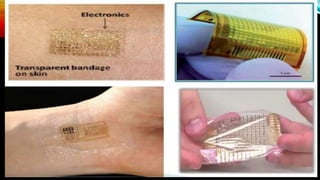
• e-skin can be directly laminated on the surface of
the skin, allowing us to electronically functionalize
human skin.
• It attached to the skin like a stick on the tattoo.
IDEA
It borrowed directly kids temporary transfer tattoos.
It attaches through the weak forces of van de wals interactions.
Circuitry “spider web” of materials.
Narrow snake like silicon filaments that serve as wired connected to tiny the sensors
designed to monitor particular bodily functions.
Development of e-skin
2010:
• Attaching nanowire transistor to sticky substrate, embedded in thin pressure sensitive rubber capable of
sensing wide range of pressure (California university)
• First prototype for e-skin
2011 :
• Stretchable solar cell used to power the electronic skin (Stanford)
2012 :
• Self healing capacity
• Made by nickel and plastic
WORKING
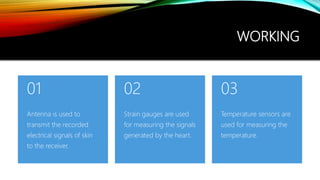
Antenna is used to
transmit the recorded
electrical signals of skin
to the receiver.
01
Strain gauges are used
for measuring the signals
generated by the heart.
02
Temperature sensors are
used for measuring the
temperature.
03
APPLICATION
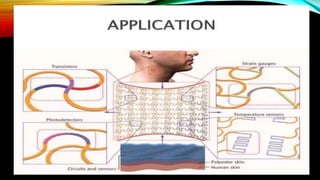
It takes the signals from the body and transfer
them to the device.
Localized electrical stimulation “ smart
temperature changes across the wound.
Muscle contractions in the neck can control the
mouse in computer game.
ADVANTAGE
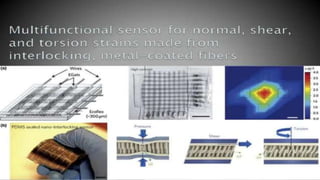
• Stretchable sensor system able to measure
pressure.
• Strain composed of bucket CNT-based electrodes.
• The right-most pane depicts the pressure
distribution measured by pressing on the center
pixel.
• Recent devices have already surpassed the
capabilities of biological skin in terms of sensitivity,
spatial resolution, and stretchability.
DISADVANTAGE
Cost is very high Single use
USES
Robotics
Health
applications
Smart
wallpapers
E-Papers Single use
FUTURE SCOPE
• In future even virtual screen may be placed on the device for
knowing our body function.
• It has bright future in robotics industries to make it sensible
also.
CONCLUSION
The electronics skin id one
such device that depicts
beauty of electronics and
it's used in daily life.
The electronics devices
more demand in the
when they are compact in
size and best in
REFERENCES
• https://www.slideshare.net/mdazim8/electronic-skin
• https://www.slideshare.net/foysalmd/e-skinpptx
THANK YOU

Electronic skin

  • 1.
  • 2.
    CONTENTS Introduction Electronic SkinIdea Developments of e-skin Working Applications Advantages Disadvantages Uses Future scope Conclusion
  • 3.
    INTRODUCTION Electronic plays a veryimportant role in developing simple devices used for any purpose. Materials which mimic the Human skin in one or more ways. The best achievements as well the future example of integrated electronics in the medical filed is the electronic skin.
  • 4.
    ELECTRONIC SKIN • It madefrom biocompatible silicon rubber with pressure sensitive sensors. • It can measure electrical activity of the heart, brain waves and other vital signs. • Ultra thin skin turn on hand. • e-skin can be directly laminated on the surface of the skin, allowing us to electronically functionalize human skin. • It attached to the skin like a stick on the tattoo.
  • 5.
    IDEA It borrowed directlykids temporary transfer tattoos. It attaches through the weak forces of van de wals interactions. Circuitry “spider web” of materials. Narrow snake like silicon filaments that serve as wired connected to tiny the sensors designed to monitor particular bodily functions.
  • 8.
    Development of e-skin 2010: •Attaching nanowire transistor to sticky substrate, embedded in thin pressure sensitive rubber capable of sensing wide range of pressure (California university) • First prototype for e-skin 2011 : • Stretchable solar cell used to power the electronic skin (Stanford) 2012 : • Self healing capacity • Made by nickel and plastic
  • 9.
    WORKING Antenna is usedto transmit the recorded electrical signals of skin to the receiver. 01 Strain gauges are used for measuring the signals generated by the heart. 02 Temperature sensors are used for measuring the temperature. 03
  • 10.
    APPLICATION It takes thesignals from the body and transfer them to the device. Localized electrical stimulation “ smart temperature changes across the wound. Muscle contractions in the neck can control the mouse in computer game.
  • 13.
    ADVANTAGE • Stretchable sensorsystem able to measure pressure. • Strain composed of bucket CNT-based electrodes. • The right-most pane depicts the pressure distribution measured by pressing on the center pixel. • Recent devices have already surpassed the capabilities of biological skin in terms of sensitivity, spatial resolution, and stretchability.
  • 14.
  • 15.
  • 16.
    FUTURE SCOPE • Infuture even virtual screen may be placed on the device for knowing our body function. • It has bright future in robotics industries to make it sensible also.
  • 17.
    CONCLUSION The electronics skinid one such device that depicts beauty of electronics and it's used in daily life. The electronics devices more demand in the when they are compact in size and best in
  • 18.
  • 19.