


HBASE @ FLIPBOARD
What is Flipboard?
Publications
People
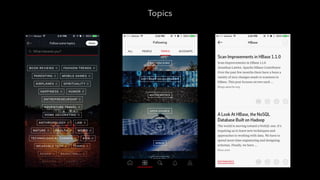
Topics
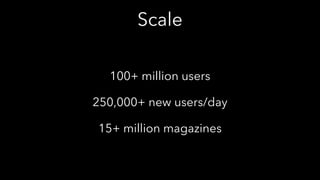
Scale
100+ million users
250,000+ new users/day
15+ million magazines
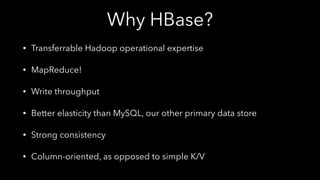
Why HBase?
• Transferrable Hadoop operational expertise
• MapReduce!
• Write throughput
• Better elasticity than MySQL, our other primary data store
• Strong consistency
• Column-oriented, as opposed to simple K/V
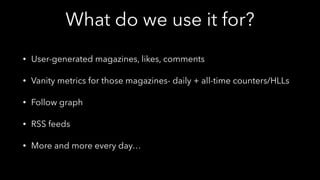
What do we use it for?
• User-generated magazines, likes, comments
• Vanity metrics for those magazines- daily + all-time counters/HLLs
• Follow graph
• RSS feeds
• More and more every day…
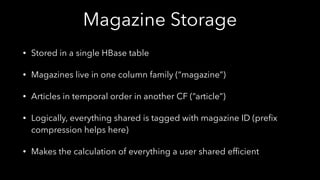
Magazine Storage
• Stored in a single HBase table
• Magazines live in one column family (“magazine”)
• Articles in temporal order in another CF (“article”)
• Logically, everything shared is tagged with magazine ID (prefix
compression helps here)
• Makes the calculation of everything a user shared efficient
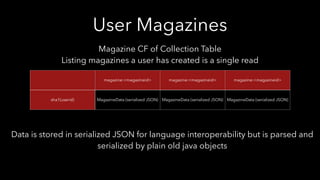
User Magazines
magazine:<magazineid> magazine:<magazineid> magazine:<magazineid>
sha1(userid) MagazineData (serialized JSON) MagazineData (serialized JSON) MagazineData (serialized JSON)
Magazine CF of Collection Table
Listing magazines a user has created is a single read
Data is stored in serialized JSON for language interoperability but is parsed and
serialized by plain old java objects
User Magazines
[Reverse Unix TS]:
[magazineid]
[Reverse Unix TS]:
[magazineid]
sha1(userid)
Article Data(Serialized
JSON)
Article Data(Serialized
JSON)
Articles CF of Collection Table
Kept in temporal order so that most recently shared articles are first
Access patterns are usually newest first.
HBase Filters are used to slice wide rows.
User Magazines
like:[userid] reflip:[new article id]
comment:[timestamp]
[userid]
Article
ID
JSON (who/when)
JSON (where it was
reflipped)
JSON (comment/person)
Social Activity
One cell per like, since you can only do it once per user
Can be many comment and reflip cells by one user per article
Alternative orderings can be computed from Elasticsearch indexes
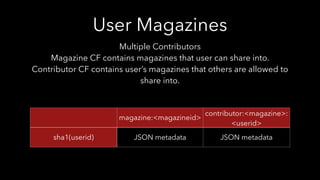
User Magazines
magazine:<magazineid>
contributor:<magazine>:
<userid>
sha1(userid) JSON metadata JSON metadata
Multiple Contributors
Magazine CF contains magazines that user can share into.
Contributor CF contains user’s magazines that others are allowed to
share into.
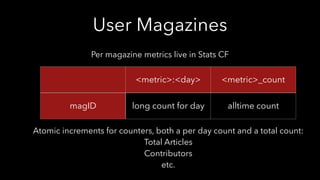
User Magazines
<metric>:<day> <metric>_count
magID long count for day alltime count
Per magazine metrics live in Stats CF
Atomic increments for counters, both a per day count and a total count:
Total Articles
Contributors
etc.
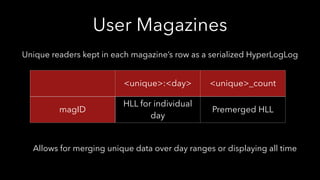
User Magazines
<unique>:<day> <unique>_count
magID
HLL for individual
day
Premerged HLL
Unique readers kept in each magazine’s row as a serialized HyperLogLog
Allows for merging unique data over day ranges or displaying all time
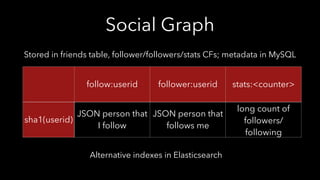
Social Graph
follow:userid follower:userid stats:<counter>
sha1(userid)
JSON person that
I follow
JSON person that
follows me
long count of
followers/
following
Stored in friends table, follower/followers/stats CFs; metadata in MySQL
Alternative indexes in Elasticsearch
HBase Table Access Patterns
• Tables optimized for application access patterns (“design for the questions, not the
answers”)
• Fetching an individual magazine- collection table, magazine CF, [magazine ID] -> cell
• Fetching an individual article - article table, article:[article ID] cell
• Fetch an article’s stats - article table, article:stats cells
• Fetching a magazine’s articles: collection table, article CF, with cell limit and column
qualifier starts with magazine id
• Fetching a user’s magazines- collection table, magazine CF, [magazine ID] in the CQ
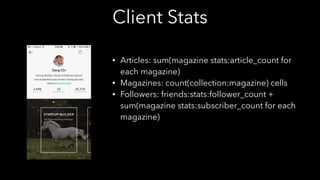
Client Stats
• Articles: sum(magazine stats:article_count for
each magazine)
• Magazines: count(collection:magazine) cells
• Followers: friends:stats:follower_count +
sum(magazine stats:subscriber_count for each
magazine)
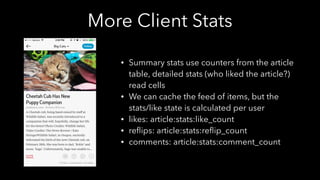
More Client Stats
• Summary stats use counters from the article
table, detailed stats (who liked the article?)
read cells
• We can cache the feed of items, but the
stats/like state is calculated per user
• likes: article:stats:like_count
• reflips: article:stats:reflip_count
• comments: article:stats:comment_count
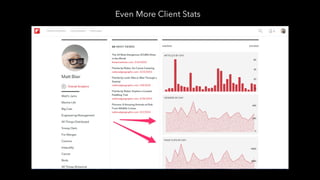
Even More Client Stats
AsyncHBase Usage
• Our fork adds column filters on wide rows- we’d like to get these upstream
• Stats requests require scatter/gather reads for several tables, sometimes over
multiple HBase clusters
• HBaseAsync requests are grouped into a single Deferred
• Most requests are a get on a single row, no multi row scans
• Most requests wait once until the results are returned or a deadline expires
• If data is returned late or HBase regions are not available, partial calculations are
allowed (we just display the stats we’ve got)
Handling HBase Failures
• Most patterns are read before write which causes early failure
• We can tolerate some data loss (atomic increments, vanity stats)
• Individual servers track inflight requests to HBase, slow puts and gets, and report
to Graphite
• Various levels of caching allow HBase recovery/region reassignment without end
users noticing
• Read Only mode - writes are stopped at the application layer
• Ability to switch to replica under duress
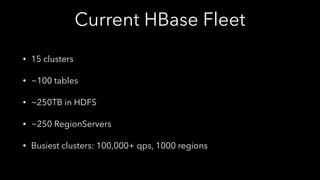
Current HBase Fleet
• 15 clusters
• ~100 tables
• ~250TB in HDFS
• ~250 RegionServers
• Busiest clusters: 100,000+ qps, 1000 regions
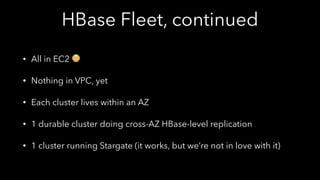
HBase Fleet, continued
• All in EC2 😳
• Nothing in VPC, yet
• Each cluster lives within an AZ
• 1 durable cluster doing cross-AZ HBase-level replication
• 1 cluster running Stargate (it works, but we’re not in love with it)
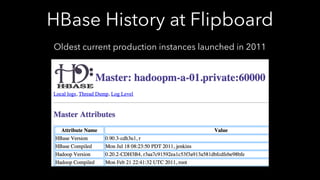
HBase History at Flipboard
Oldest current production instances launched in 2011
(This cluster is going away soon 😀)
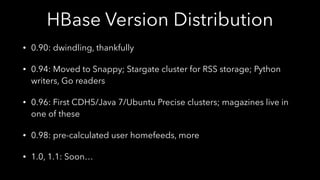
HBase Version Distribution
• 0.90: dwindling, thankfully
• 0.94: Moved to Snappy; Stargate cluster for RSS storage; Python
writers, Go readers
• 0.96: First CDH5/Java 7/Ubuntu Precise clusters; magazines live in
one of these
• 0.98: pre-calculated user homefeeds, more
• 1.0, 1.1: Soon…
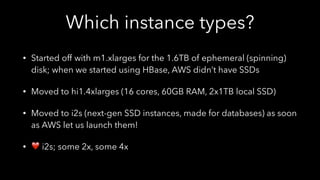
Which instance types?
• Started off with m1.xlarges for the 1.6TB of ephemeral (spinning)
disk; when we started using HBase, AWS didn’t have SSDs
• Moved to hi1.4xlarges (16 cores, 60GB RAM, 2x1TB local SSD)
• Moved to i2s (next-gen SSD instances, made for databases) as soon
as AWS let us launch them!
• ❤ i2s; some 2x, some 4x
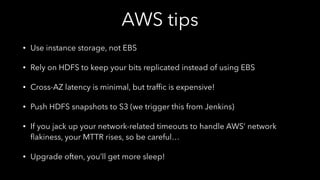
AWS tips
• Use instance storage, not EBS
• Rely on HDFS to keep your bits replicated instead of using EBS
• Cross-AZ latency is minimal, but traffic is expensive!
• Push HDFS snapshots to S3 (we trigger this from Jenkins)
• If you jack up your network-related timeouts to handle AWS’ network
flakiness, your MTTR rises, so be careful…
• Upgrade often, you’ll get more sleep!
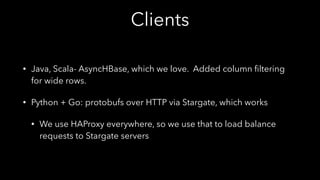
Clients
• Java, Scala- AsyncHBase, which we love. Added column filtering
for wide rows.
• Python + Go: protobufs over HTTP via Stargate, which works
• We use HAProxy everywhere, so we use that to load balance
requests to Stargate servers
What’s next for HBase at Flipboard?
• Moar HBase
• 1.0, now that CDH has it in 5.4.0; 1.1 when CDH gets it, hopefully soon…
• Region replicas (HBASE-10070) will help with use cases that can tolerate timeline consistency; 1.1
will have many improvements here
• Compaction throttling! (HBASE-8329)
• Java 8 + G1, Ubuntu Trusty, 3.13 kernel
• EC2 placement groups + VPC enhanced networking, once we’re in (no charge for these)
• HTrace (we use a little Zipkin, would love to get more HBase visibility)
• Multitenancy improvements in Apache HBase will help us put more customers on a cluster
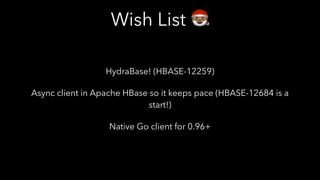
Wish List $
HydraBase! (HBASE-12259)
Async client in Apache HBase so it keeps pace (HBASE-12684 is a
start!)
Native Go client for 0.96+
Thanks!
• Matt Blair (@mb on Flipboard, @mattyblair on Twitter)
• Jason Culverhouse (@jsonculverhouse on both)
• Sang Chi (@sangchi on Flipboard, @sandbreaker on Twitter)

HBaseCon 2015: HBase @ Flipboard

  • 1.
  • 2.
  • 4.
  • 5.
  • 6.
  • 7.
    Scale 100+ million users 250,000+new users/day 15+ million magazines
  • 8.
    Why HBase? • TransferrableHadoop operational expertise • MapReduce! • Write throughput • Better elasticity than MySQL, our other primary data store • Strong consistency • Column-oriented, as opposed to simple K/V
  • 9.
    What do weuse it for? • User-generated magazines, likes, comments • Vanity metrics for those magazines- daily + all-time counters/HLLs • Follow graph • RSS feeds • More and more every day…
  • 10.
    Magazine Storage • Storedin a single HBase table • Magazines live in one column family (“magazine”) • Articles in temporal order in another CF (“article”) • Logically, everything shared is tagged with magazine ID (prefix compression helps here) • Makes the calculation of everything a user shared efficient
  • 11.
    User Magazines magazine:<magazineid> magazine:<magazineid>magazine:<magazineid> sha1(userid) MagazineData (serialized JSON) MagazineData (serialized JSON) MagazineData (serialized JSON) Magazine CF of Collection Table Listing magazines a user has created is a single read Data is stored in serialized JSON for language interoperability but is parsed and serialized by plain old java objects
  • 12.
    User Magazines [Reverse UnixTS]: [magazineid] [Reverse Unix TS]: [magazineid] sha1(userid) Article Data(Serialized JSON) Article Data(Serialized JSON) Articles CF of Collection Table Kept in temporal order so that most recently shared articles are first Access patterns are usually newest first. HBase Filters are used to slice wide rows.
  • 13.
    User Magazines like:[userid] reflip:[newarticle id] comment:[timestamp] [userid] Article ID JSON (who/when) JSON (where it was reflipped) JSON (comment/person) Social Activity One cell per like, since you can only do it once per user Can be many comment and reflip cells by one user per article Alternative orderings can be computed from Elasticsearch indexes
  • 14.
    User Magazines magazine:<magazineid> contributor:<magazine>: <userid> sha1(userid) JSONmetadata JSON metadata Multiple Contributors Magazine CF contains magazines that user can share into. Contributor CF contains user’s magazines that others are allowed to share into.
  • 15.
    User Magazines <metric>:<day> <metric>_count magIDlong count for day alltime count Per magazine metrics live in Stats CF Atomic increments for counters, both a per day count and a total count: Total Articles Contributors etc.
  • 16.
    User Magazines <unique>:<day> <unique>_count magID HLLfor individual day Premerged HLL Unique readers kept in each magazine’s row as a serialized HyperLogLog Allows for merging unique data over day ranges or displaying all time
  • 17.
    Social Graph follow:userid follower:useridstats:<counter> sha1(userid) JSON person that I follow JSON person that follows me long count of followers/ following Stored in friends table, follower/followers/stats CFs; metadata in MySQL Alternative indexes in Elasticsearch
  • 18.
    HBase Table AccessPatterns • Tables optimized for application access patterns (“design for the questions, not the answers”) • Fetching an individual magazine- collection table, magazine CF, [magazine ID] -> cell • Fetching an individual article - article table, article:[article ID] cell • Fetch an article’s stats - article table, article:stats cells • Fetching a magazine’s articles: collection table, article CF, with cell limit and column qualifier starts with magazine id • Fetching a user’s magazines- collection table, magazine CF, [magazine ID] in the CQ
  • 19.
    Client Stats • Articles:sum(magazine stats:article_count for each magazine) • Magazines: count(collection:magazine) cells • Followers: friends:stats:follower_count + sum(magazine stats:subscriber_count for each magazine)
  • 20.
    More Client Stats •Summary stats use counters from the article table, detailed stats (who liked the article?) read cells • We can cache the feed of items, but the stats/like state is calculated per user • likes: article:stats:like_count • reflips: article:stats:reflip_count • comments: article:stats:comment_count
  • 21.
  • 22.
    AsyncHBase Usage • Ourfork adds column filters on wide rows- we’d like to get these upstream • Stats requests require scatter/gather reads for several tables, sometimes over multiple HBase clusters • HBaseAsync requests are grouped into a single Deferred • Most requests are a get on a single row, no multi row scans • Most requests wait once until the results are returned or a deadline expires • If data is returned late or HBase regions are not available, partial calculations are allowed (we just display the stats we’ve got)
  • 23.
    Handling HBase Failures •Most patterns are read before write which causes early failure • We can tolerate some data loss (atomic increments, vanity stats) • Individual servers track inflight requests to HBase, slow puts and gets, and report to Graphite • Various levels of caching allow HBase recovery/region reassignment without end users noticing • Read Only mode - writes are stopped at the application layer • Ability to switch to replica under duress
  • 24.
    Current HBase Fleet •15 clusters • ~100 tables • ~250TB in HDFS • ~250 RegionServers • Busiest clusters: 100,000+ qps, 1000 regions
  • 25.
    HBase Fleet, continued •All in EC2 😳 • Nothing in VPC, yet • Each cluster lives within an AZ • 1 durable cluster doing cross-AZ HBase-level replication • 1 cluster running Stargate (it works, but we’re not in love with it)
  • 26.
    HBase History atFlipboard Oldest current production instances launched in 2011
  • 27.
    (This cluster isgoing away soon 😀)
  • 28.
    HBase Version Distribution •0.90: dwindling, thankfully • 0.94: Moved to Snappy; Stargate cluster for RSS storage; Python writers, Go readers • 0.96: First CDH5/Java 7/Ubuntu Precise clusters; magazines live in one of these • 0.98: pre-calculated user homefeeds, more • 1.0, 1.1: Soon…
  • 29.
    Which instance types? •Started off with m1.xlarges for the 1.6TB of ephemeral (spinning) disk; when we started using HBase, AWS didn’t have SSDs • Moved to hi1.4xlarges (16 cores, 60GB RAM, 2x1TB local SSD) • Moved to i2s (next-gen SSD instances, made for databases) as soon as AWS let us launch them! • ❤ i2s; some 2x, some 4x
  • 30.
    AWS tips • Useinstance storage, not EBS • Rely on HDFS to keep your bits replicated instead of using EBS • Cross-AZ latency is minimal, but traffic is expensive! • Push HDFS snapshots to S3 (we trigger this from Jenkins) • If you jack up your network-related timeouts to handle AWS’ network flakiness, your MTTR rises, so be careful… • Upgrade often, you’ll get more sleep!
  • 31.
    Clients • Java, Scala-AsyncHBase, which we love. Added column filtering for wide rows. • Python + Go: protobufs over HTTP via Stargate, which works • We use HAProxy everywhere, so we use that to load balance requests to Stargate servers
  • 32.
    What’s next forHBase at Flipboard? • Moar HBase • 1.0, now that CDH has it in 5.4.0; 1.1 when CDH gets it, hopefully soon… • Region replicas (HBASE-10070) will help with use cases that can tolerate timeline consistency; 1.1 will have many improvements here • Compaction throttling! (HBASE-8329) • Java 8 + G1, Ubuntu Trusty, 3.13 kernel • EC2 placement groups + VPC enhanced networking, once we’re in (no charge for these) • HTrace (we use a little Zipkin, would love to get more HBase visibility) • Multitenancy improvements in Apache HBase will help us put more customers on a cluster
  • 33.
    Wish List $ HydraBase!(HBASE-12259) Async client in Apache HBase so it keeps pace (HBASE-12684 is a start!) Native Go client for 0.96+
  • 34.
    Thanks! • Matt Blair(@mb on Flipboard, @mattyblair on Twitter) • Jason Culverhouse (@jsonculverhouse on both) • Sang Chi (@sangchi on Flipboard, @sandbreaker on Twitter)