Sustainable and inclusive transformation of
animal food systems
Jimmy Smith, Director General
International Livestock Research Institute (ILRI)
CGIAR System Council meeting
16 May 2019
Addis Ababa, Ethiopia
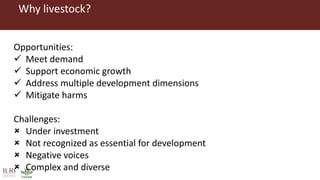
Why livestock?
Opportunities:
 Meet demand
 Support economic growth
 Address multiple development dimensions
 Mitigate harms
Challenges:
 Under investment
 Not recognized as essential for development
 Negative voices
 Complex and diverse
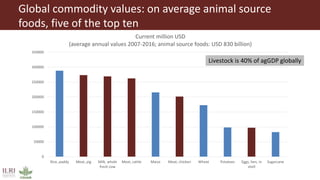
Global commodity values: on average animal source
foods, five of the top ten
0
50000
100000
150000
200000
250000
300000
350000
Rice, paddy Meat, pig Milk, whole
fresh cow
Meat, cattle Maize Meat, chicken Wheat Potatoes Eggs, hen, in
shell
Sugarcane
Current million USD
(average annual values 2007-2016; animal source foods: USD 830 billion)
Livestock is 40% of agGDP globally
0
50
100
150
200
250
E.Asia
Pacific
China
South
Asia
SSA
High
income
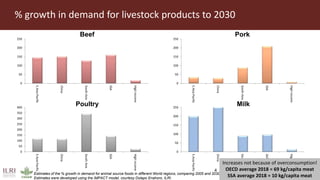
% growth in demand for livestock products to 2030
4
0
50
100
150
200
250
E.Asia
Pacific
China
South
Asia
SSA
High
income
0
50
100
150
200
250
300
350
400
E.Asia
Pacific
China
South
Asia
SSA
High
income
0
50
100
150
200
250
E.Asia
Pacific
China
South
Asia
SSA
High
income
Estimates of the % growth in demand for animal source foods in different World regions, comparing 2005 and 2030.
Estimates were developed using the IMPACT model, courtesy Dolapo Enahoro, ILRI.
Beef Pork
Poultry Milk
Increases not because of overconsumption!
OECD average 2018 = 69 kg/capita meat
SSA average 2018 = 10 kg/capita meat
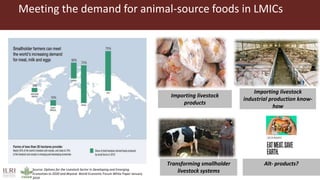
Meeting the demand for animal-source foods in LMICs
Importing livestock
products
Importing livestock
industrial production know-
how
Transforming smallholder
livestock systems
Alt- products?
Source: Options for the Livestock Sector in Developing and Emerging
Economies to 2030 and Beyond. World Economic Forum White Paper January
2019
Livestock and development
Provides food and nutritional security
BUT overconsumption is often associated with
obesity and non-communicable diseases
Powers economic development
BUT equitable development can be a challenge
Improves human health
BUT animal-human/emerging diseases
and unsafe foods need to be addressed
Enhances the environment
BUT pollution, land/water degradation,
GHG emissions and biodiversity losses
must be greatly reduced
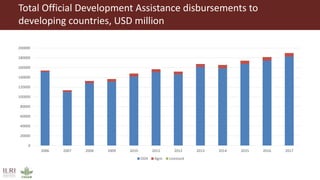
Total Official Development Assistance disbursements to
developing countries, USD million
0
20000
40000
60000
80000
100000
120000
140000
160000
180000
200000
2006 2007 2008 2009 2010 2011 2012 2013 2014 2015 2016 2017
ODA Agric Livestock
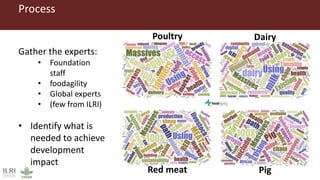
Process
Gather the experts:
• Foundation
staff
• foodagility
• Global experts
• (few from ILRI)
• Identify what is
needed to achieve
development
impact
Poultry Dairy
Red meat Pig
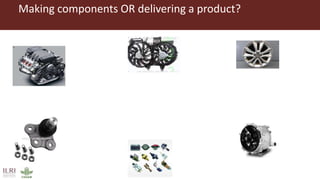
Making components OR delivering a product?
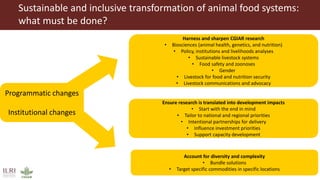
Sustainable and inclusive transformation of animal food systems:
what must be done?
Harness and sharpen CGIAR research
• Biosciences (animal health, genetics, and nutrition)
• Policy, institutions and livelihoods analyses
• Sustainable livestock systems
• Food safety and zoonoses
• Gender
• Livestock for food and nutrition security
• Livestock communications and advocacy
Ensure research is translated into development impacts
• Start with the end in mind
• Tailor to national and regional priorities
• Intentional partnerships for delivery
• Influence investment priorities
• Support capacity development
Account for diversity and complexity
• Bundle solutions
• Target specific commodities in specific locations
Programmatic changes
Institutional changes
FACILITATE
public-private
partnerships to
deliver
solutions at
scale
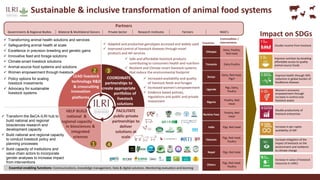
Sustainable & inclusive transformation of animal food systems
Impact on SDGs
Improve health through 50%
reduction in global burden of
foodborne diseases
Improve nutrition by doubling
affordable access to quality
animal-source foods
Women’s economic
empowerment through
increase in control over
livestock assets
Increase in value of livestock
resources in LMICs
Increase mitigation of the
impact of livestock on the
environment and resilience
to climate change
Increase in per-capita
availability of ASF.
Countries
Commodities /
interventions
Poultry, Red
meat
Dairy, Poultry,
Red meat
Pigs, Dairy,
Poultry
Poultry, Red
meat
Dairy Poultry
Dairy, Red meat,
Pigs?
Pigs, Red meat
Pigs, Red meat,
Poultry
Pigs, Red meat
Pigs, Red meat.
Poultry
Burkina Faso
Ethiopia
Uganda
Nigeria
Tanzania
Kenya
India
Vietnam
Nepal
Others
Essential enabling functions: Communications, knowledge management, Data & digital solutions, Monitoring evaluation and learning
 Policy options for scaling
livestock investments
 Advocacy for sustainable
livestock systems
 Safe and affordable livestock products
contributing to consumers health and nutrition
 Resilient and Climate smart livestock systems
that reduce the environmental footprint
 Transform the BeCA-ILRI hub to
build national and regional
biosciences research and
development capacity
 Build national and regional capacity
to conduct livestock policy and
planning processes
 Build capacity of institutions and
value chain actors to incorporate
gender analyses to increase impact
from interventions
 Adapted and productive genotypes accessed and widely used
 Improved control of livestock diseases through novel
products and AH services
 Increased availability and quality
of livestock feeds and forages
 Increased women’s empowerment
 Evidence based policies,
regulations and public and private
investment
COORDINATE
partnerships to
create appropriate
Double productivity of
livestock enterprises
Double income from livestock
Partners
Governments & Regional Bodies Bilateral & Multilateral Donors Research Institutes
Private Sector NGO’s
Farmers
LEAD livestock
technology R&D
& crosscutting
HELP BUILD
national &
regional capacity
 Transforming animal health solutions and services
 Safeguarding animal health at scale
 Excellence in precision breeding and genetic gains
 Innovative feed and forage solutions
 Climate-smart livestock solutions
 Animal-source food systems and solutions
 Women empowerment through livestock
1
2 3
4
in biosciences &
integrated
sciences
innovation
platforms
portfolios of
livestock
solutions
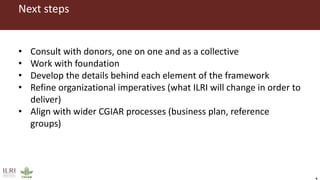
Next steps
• Consult with donors, one on one and as a collective
• Work with foundation
• Develop the details behind each element of the framework
• Refine organizational imperatives (what ILRI will change in order to
deliver)
• Align with wider CGIAR processes (business plan, reference
groups)
This presentation is licensed for use under the Creative Commons Attribution 4.0 International Licence.
better lives through livestock
ilri.org
ILRI thanks all donors and organizations who globally supported its work through their contributions to the CGIAR system

Sustainable and inclusive transformation of animal food systems

  • 1.
    Sustainable and inclusivetransformation of animal food systems Jimmy Smith, Director General International Livestock Research Institute (ILRI) CGIAR System Council meeting 16 May 2019 Addis Ababa, Ethiopia
  • 2.
    Why livestock? Opportunities:  Meetdemand  Support economic growth  Address multiple development dimensions  Mitigate harms Challenges:  Under investment  Not recognized as essential for development  Negative voices  Complex and diverse
  • 3.
    Global commodity values:on average animal source foods, five of the top ten 0 50000 100000 150000 200000 250000 300000 350000 Rice, paddy Meat, pig Milk, whole fresh cow Meat, cattle Maize Meat, chicken Wheat Potatoes Eggs, hen, in shell Sugarcane Current million USD (average annual values 2007-2016; animal source foods: USD 830 billion) Livestock is 40% of agGDP globally
  • 4.
    0 50 100 150 200 250 E.Asia Pacific China South Asia SSA High income % growth indemand for livestock products to 2030 4 0 50 100 150 200 250 E.Asia Pacific China South Asia SSA High income 0 50 100 150 200 250 300 350 400 E.Asia Pacific China South Asia SSA High income 0 50 100 150 200 250 E.Asia Pacific China South Asia SSA High income Estimates of the % growth in demand for animal source foods in different World regions, comparing 2005 and 2030. Estimates were developed using the IMPACT model, courtesy Dolapo Enahoro, ILRI. Beef Pork Poultry Milk Increases not because of overconsumption! OECD average 2018 = 69 kg/capita meat SSA average 2018 = 10 kg/capita meat
  • 5.
    Meeting the demandfor animal-source foods in LMICs Importing livestock products Importing livestock industrial production know- how Transforming smallholder livestock systems Alt- products? Source: Options for the Livestock Sector in Developing and Emerging Economies to 2030 and Beyond. World Economic Forum White Paper January 2019
  • 6.
    Livestock and development Providesfood and nutritional security BUT overconsumption is often associated with obesity and non-communicable diseases Powers economic development BUT equitable development can be a challenge Improves human health BUT animal-human/emerging diseases and unsafe foods need to be addressed Enhances the environment BUT pollution, land/water degradation, GHG emissions and biodiversity losses must be greatly reduced
  • 7.
    Total Official DevelopmentAssistance disbursements to developing countries, USD million 0 20000 40000 60000 80000 100000 120000 140000 160000 180000 200000 2006 2007 2008 2009 2010 2011 2012 2013 2014 2015 2016 2017 ODA Agric Livestock
  • 8.
    Process Gather the experts: •Foundation staff • foodagility • Global experts • (few from ILRI) • Identify what is needed to achieve development impact Poultry Dairy Red meat Pig
  • 9.
    Making components ORdelivering a product?
  • 10.
    Making components ORdelivering a product?
  • 11.
    Sustainable and inclusivetransformation of animal food systems: what must be done? Harness and sharpen CGIAR research • Biosciences (animal health, genetics, and nutrition) • Policy, institutions and livelihoods analyses • Sustainable livestock systems • Food safety and zoonoses • Gender • Livestock for food and nutrition security • Livestock communications and advocacy Ensure research is translated into development impacts • Start with the end in mind • Tailor to national and regional priorities • Intentional partnerships for delivery • Influence investment priorities • Support capacity development Account for diversity and complexity • Bundle solutions • Target specific commodities in specific locations Programmatic changes Institutional changes
  • 12.
    FACILITATE public-private partnerships to deliver solutions at scale Sustainable& inclusive transformation of animal food systems Impact on SDGs Improve health through 50% reduction in global burden of foodborne diseases Improve nutrition by doubling affordable access to quality animal-source foods Women’s economic empowerment through increase in control over livestock assets Increase in value of livestock resources in LMICs Increase mitigation of the impact of livestock on the environment and resilience to climate change Increase in per-capita availability of ASF. Countries Commodities / interventions Poultry, Red meat Dairy, Poultry, Red meat Pigs, Dairy, Poultry Poultry, Red meat Dairy Poultry Dairy, Red meat, Pigs? Pigs, Red meat Pigs, Red meat, Poultry Pigs, Red meat Pigs, Red meat. Poultry Burkina Faso Ethiopia Uganda Nigeria Tanzania Kenya India Vietnam Nepal Others Essential enabling functions: Communications, knowledge management, Data & digital solutions, Monitoring evaluation and learning  Policy options for scaling livestock investments  Advocacy for sustainable livestock systems  Safe and affordable livestock products contributing to consumers health and nutrition  Resilient and Climate smart livestock systems that reduce the environmental footprint  Transform the BeCA-ILRI hub to build national and regional biosciences research and development capacity  Build national and regional capacity to conduct livestock policy and planning processes  Build capacity of institutions and value chain actors to incorporate gender analyses to increase impact from interventions  Adapted and productive genotypes accessed and widely used  Improved control of livestock diseases through novel products and AH services  Increased availability and quality of livestock feeds and forages  Increased women’s empowerment  Evidence based policies, regulations and public and private investment COORDINATE partnerships to create appropriate Double productivity of livestock enterprises Double income from livestock Partners Governments & Regional Bodies Bilateral & Multilateral Donors Research Institutes Private Sector NGO’s Farmers LEAD livestock technology R&D & crosscutting HELP BUILD national & regional capacity  Transforming animal health solutions and services  Safeguarding animal health at scale  Excellence in precision breeding and genetic gains  Innovative feed and forage solutions  Climate-smart livestock solutions  Animal-source food systems and solutions  Women empowerment through livestock 1 2 3 4 in biosciences & integrated sciences innovation platforms portfolios of livestock solutions
  • 13.
    Next steps • Consultwith donors, one on one and as a collective • Work with foundation • Develop the details behind each element of the framework • Refine organizational imperatives (what ILRI will change in order to deliver) • Align with wider CGIAR processes (business plan, reference groups)
  • 14.
    This presentation islicensed for use under the Creative Commons Attribution 4.0 International Licence. better lives through livestock ilri.org ILRI thanks all donors and organizations who globally supported its work through their contributions to the CGIAR system