Better lives through livestock
Transforming livestock farming: key elements for
medium scale enterprises
Jimmy Smith
Director General
International Livestock Research Institute (ILRI) Kenya
9th International conference on appropriate technology
Workshop: appropriate technology for medium-scale farmers
Virtual, 23 November 2020
2
Overview
• Context
• Integrated crop livestock farms: circular bioeconomy in action
• Using the latest science to find appropriate livestock genetics
solutions
The livestock opportunity in LMICs - economic and livelihoods impacts
0
50000
100000
150000
200000
250000
300000
350000
Rice, paddy Meat, pig Milk, whole
fresh cow
Meat, cattle Maize Meat,
chicken
Wheat Potatoes Eggs, hen,
in shell
Sugarcane
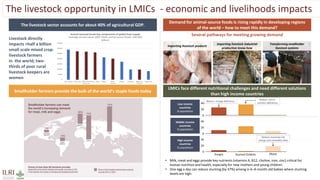
Animal Sourced Foods key components of global food supply
(average annual values 2007-2016; animal source foods: USD 830
billion)
The livestock sector accounts for about 40% of agricultural GDP.
LMICs face different nutritional challenges and need different solutions
than high income countries
Demand for animal-source foods is rising rapidly in developing regions
of the world – how to meet this demand?
Smallholder farmers provide the bulk of the world’s staple foods today
Livestock directly
impacts >half a billion
small scale mixed crop-
livestock farmers
in the world; two-
thirds of poor rural
livestock keepers are
women
Several pathways for meeting growing demand
Importing livestock products
Importing livestock industrial
production know-how
Transforming smallholder
livestock systems
• Milk, meat and eggs provide key nutrients (vitamins A, B12, choline, iron, zinc) critical for
human nutrition and health, especially for new mothers and young children.
• One egg a day can reduce stunting (by 47%) among in 6–9-month-old babies where stunting
levels are high.
40
0
20
Hungry Obese
Stunted Children
0
20
40
20
0
40
Reduce energy deficiency
Reduce micro-
nutrient deficiency
Reduce excessive net
energy and unhealthy diets
Low income
countries
% population
Middle income
countries
% population
High income
countries
% population
Livestock and development
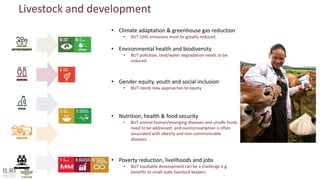
• Climate adaptation & greenhouse gas reduction
• BUT GHG emissions must be greatly reduced
• Environmental health and biodiversity
• BUT pollution, land/water degradation needs to be
reduced
• Gender equity, youth and social inclusion
• BUT needs new approaches to equity
• Nutrition, health & food security
• BUT animal-human/emerging diseases and unsafe foods
need to be addressed and overconsumption is often
associated with obesity and non-communicable
diseases
• Poverty reduction, livelihoods and jobs
• BUT equitable development can be a challenge e.g.
benefits to small scale livestock keepers
0
10
20
30
40
50
S.Asia dairy E.Africa dairy W.Africa beef W.Africa
s.ruminants
S'n Africa
small
ruminants
%
potential
gain
from
interventions
Genetics
Health
Feed
0
10
20
30
40
50
S.Asia dairy E.Africa
dairy
W.Africa
beef
W.Africa
s.ruminants
S'n Africa
small
%
potential
gain
from
interventions
Mkt access
Input delivery
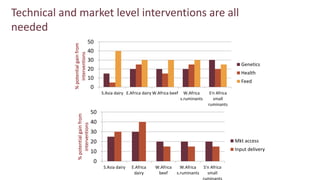
Technical and market level interventions are all
needed
6
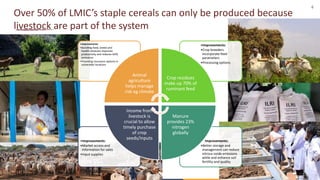
Over 50% of LMIC’s staple cereals can only be produced because
livestock are part of the system
• Improvements:
•Better storage and
management can reduce
nitrous oxide emissions
while and enhance soil
fertility and quality
•Improvements:
•Market access and
information for sales
•Input supplies
•Improvements:
•Crop breeders
incorporate feed
parameters
•Processing options
•Improvements:
• Bundling feed, breed and
health solutions improves
productivity and reduces GHG
emissions
• Providing insurance options in
vulnerable locations
Animal
agriculture
helps manage
risk eg climate
Crop residues
make up 70% of
ruminant feed
Manure
provides 23%
nitrogen
globally
Income from
livestock is
crucial to allow
timely purchase
of crop
seeds/inputs
7
0
1000
2000
3000
4000
5000
Harsh Poor Good
Yield
(l)
Production environment
Indigenous
X-bred
Exotic
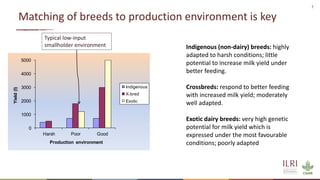
Indigenous (non-dairy) breeds: highly
adapted to harsh conditions; little
potential to increase milk yield under
better feeding.
Crossbreds: respond to better feeding
with increased milk yield; moderately
well adapted.
Exotic dairy breeds: very high genetic
potential for milk yield which is
expressed under the most favourable
conditions; poorly adapted
Matching of breeds to production environment is key
Typical low-input
smallholder environment
8
Country Data platforms
Data Extraction
API Management
System Administration
Data Validation
User
management
Data
Analytics
Other
Database
integration
Data feedback
systems
API
API
Mobile
applications
Web
applications
Farm Data Capture
Individual farmers
Extension personnel
Service providers
National governments
Livestock stakeholders
Big Data systems
API
API
API
DATA PLATFORM KLBA, AVCD
i-Cow
Cooperatives
ADGG LSF
i-Cow
Interherd
ADGG
i-Cow
Interherd
ADGG
SRUC
i-Cow
ODK
i-Cow
Designed apps
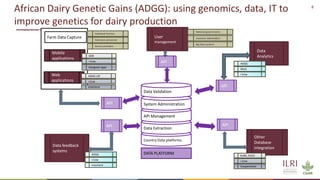
African Dairy Genetic Gains (ADGG): using genomics, data, IT to
improve genetics for dairy production
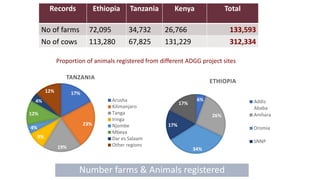
Records Ethiopia Tanzania Kenya Total
No of farms 72,095 34,732 26,766 133,593
No of cows 113,280 67,825 131,229 312,334
17%
23%
19%
9%
4%
12%
4%
12%
TANZANIA
Arusha
Kilimanjaro
Tanga
Iringa
Njombe
Mbeya
Dar es Salaam
Other regions
6%
26%
34%
17%
17%
ETHIOPIA
Addis
Ababa
Amhara
Oromia
SNNP
Proportion of animals registered from different ADGG project sites
Number farms & Animals registered
10
11
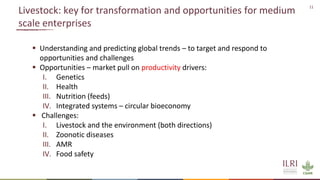
Livestock: key for transformation and opportunities for medium
scale enterprises
 Understanding and predicting global trends – to target and respond to
opportunities and challenges
 Opportunities – market pull on productivity drivers:
I. Genetics
II. Health
III. Nutrition (feeds)
IV. Integrated systems – circular bioeconomy
 Challenges:
I. Livestock and the environment (both directions)
II. Zoonotic diseases
III. AMR
IV. Food safety
THANK YOU

Transforming livestock farming: Key elements for medium scale enterprises

  • 1.
    Better lives throughlivestock Transforming livestock farming: key elements for medium scale enterprises Jimmy Smith Director General International Livestock Research Institute (ILRI) Kenya 9th International conference on appropriate technology Workshop: appropriate technology for medium-scale farmers Virtual, 23 November 2020
  • 2.
    2 Overview • Context • Integratedcrop livestock farms: circular bioeconomy in action • Using the latest science to find appropriate livestock genetics solutions
  • 3.
    The livestock opportunityin LMICs - economic and livelihoods impacts 0 50000 100000 150000 200000 250000 300000 350000 Rice, paddy Meat, pig Milk, whole fresh cow Meat, cattle Maize Meat, chicken Wheat Potatoes Eggs, hen, in shell Sugarcane Animal Sourced Foods key components of global food supply (average annual values 2007-2016; animal source foods: USD 830 billion) The livestock sector accounts for about 40% of agricultural GDP. LMICs face different nutritional challenges and need different solutions than high income countries Demand for animal-source foods is rising rapidly in developing regions of the world – how to meet this demand? Smallholder farmers provide the bulk of the world’s staple foods today Livestock directly impacts >half a billion small scale mixed crop- livestock farmers in the world; two- thirds of poor rural livestock keepers are women Several pathways for meeting growing demand Importing livestock products Importing livestock industrial production know-how Transforming smallholder livestock systems • Milk, meat and eggs provide key nutrients (vitamins A, B12, choline, iron, zinc) critical for human nutrition and health, especially for new mothers and young children. • One egg a day can reduce stunting (by 47%) among in 6–9-month-old babies where stunting levels are high. 40 0 20 Hungry Obese Stunted Children 0 20 40 20 0 40 Reduce energy deficiency Reduce micro- nutrient deficiency Reduce excessive net energy and unhealthy diets Low income countries % population Middle income countries % population High income countries % population
  • 4.
    Livestock and development •Climate adaptation & greenhouse gas reduction • BUT GHG emissions must be greatly reduced • Environmental health and biodiversity • BUT pollution, land/water degradation needs to be reduced • Gender equity, youth and social inclusion • BUT needs new approaches to equity • Nutrition, health & food security • BUT animal-human/emerging diseases and unsafe foods need to be addressed and overconsumption is often associated with obesity and non-communicable diseases • Poverty reduction, livelihoods and jobs • BUT equitable development can be a challenge e.g. benefits to small scale livestock keepers
  • 5.
    0 10 20 30 40 50 S.Asia dairy E.Africadairy W.Africa beef W.Africa s.ruminants S'n Africa small ruminants % potential gain from interventions Genetics Health Feed 0 10 20 30 40 50 S.Asia dairy E.Africa dairy W.Africa beef W.Africa s.ruminants S'n Africa small % potential gain from interventions Mkt access Input delivery Technical and market level interventions are all needed
  • 6.
    6 Over 50% ofLMIC’s staple cereals can only be produced because livestock are part of the system • Improvements: •Better storage and management can reduce nitrous oxide emissions while and enhance soil fertility and quality •Improvements: •Market access and information for sales •Input supplies •Improvements: •Crop breeders incorporate feed parameters •Processing options •Improvements: • Bundling feed, breed and health solutions improves productivity and reduces GHG emissions • Providing insurance options in vulnerable locations Animal agriculture helps manage risk eg climate Crop residues make up 70% of ruminant feed Manure provides 23% nitrogen globally Income from livestock is crucial to allow timely purchase of crop seeds/inputs
  • 7.
    7 0 1000 2000 3000 4000 5000 Harsh Poor Good Yield (l) Productionenvironment Indigenous X-bred Exotic Indigenous (non-dairy) breeds: highly adapted to harsh conditions; little potential to increase milk yield under better feeding. Crossbreds: respond to better feeding with increased milk yield; moderately well adapted. Exotic dairy breeds: very high genetic potential for milk yield which is expressed under the most favourable conditions; poorly adapted Matching of breeds to production environment is key Typical low-input smallholder environment
  • 8.
    8 Country Data platforms DataExtraction API Management System Administration Data Validation User management Data Analytics Other Database integration Data feedback systems API API Mobile applications Web applications Farm Data Capture Individual farmers Extension personnel Service providers National governments Livestock stakeholders Big Data systems API API API DATA PLATFORM KLBA, AVCD i-Cow Cooperatives ADGG LSF i-Cow Interherd ADGG i-Cow Interherd ADGG SRUC i-Cow ODK i-Cow Designed apps African Dairy Genetic Gains (ADGG): using genomics, data, IT to improve genetics for dairy production
  • 9.
    Records Ethiopia TanzaniaKenya Total No of farms 72,095 34,732 26,766 133,593 No of cows 113,280 67,825 131,229 312,334 17% 23% 19% 9% 4% 12% 4% 12% TANZANIA Arusha Kilimanjaro Tanga Iringa Njombe Mbeya Dar es Salaam Other regions 6% 26% 34% 17% 17% ETHIOPIA Addis Ababa Amhara Oromia SNNP Proportion of animals registered from different ADGG project sites Number farms & Animals registered
  • 10.
  • 11.
    11 Livestock: key fortransformation and opportunities for medium scale enterprises  Understanding and predicting global trends – to target and respond to opportunities and challenges  Opportunities – market pull on productivity drivers: I. Genetics II. Health III. Nutrition (feeds) IV. Integrated systems – circular bioeconomy  Challenges: I. Livestock and the environment (both directions) II. Zoonotic diseases III. AMR IV. Food safety
  • 12.

Editor's Notes

  • #6 Staal, S., Poole, J., Baltenweck, I., Mwacharo, J., Notenbaert, A., Randolph, T., Thorpe, W., Nzuma, J. and Herrero, M. 2009. Targeting strategic investment in livestock development as a vehicle for rural livelihoods. Bill and Melinda Gates Foundation – ILRI Knowledge Generation Project Report. Nairobi, Kenya: ILRI.
  • #7 On manure: Liu, E. et al., “Long‑Term Effect of Manure and Fertilizer on Soil Organic Carbon Pools in Dryland Farming in Northwest China”, Plos one, Vol. 8, No. 2, 2013. Pelster, D. et al., “Methane and Nitrous Oxide Emissions from Cattle Excreta on an East African Grassland”, Journal of Environmental Quality, Vol. 45, No. 5, 2016.
  • #8 On this slide the key point is that in good environments , purebred exotics massively outperform crossbreds or indigenous. In typical smallholder environments pure exotics do not perform well and crossbreds excel. i.e. massive G*E. Note that this slide was developed based on global literature on dairy crossbreed and illustrates the situation where the indigenous cattle have very low milk potential. It should be pointed out than in India there are indigenous dairy breeds that have good milk potential so that the relationship between crossbreds and some indigenous breeds is different to that shown here. Also there is a continuum between poor and good environments and as the environment improves, so exotics perform better compared to crossbreds/indigenous.