Contents
Unsupervised Learning
Beatrice van Eden
Machine Learning Reading group
Introductory Theme
2
Contents
 Introduction
 Unsupervised Learning concepts
 Clustering the idea
 Basic clustering problem
 Algorithms
 Single linkage clustering (SLC)
 Issues with SLC
 K-means clustering
 K-means in Euclidean space
 K-means as optimization
 Soft clustering
 Expectation Maximization (EM)
 Clustering properties and impossibilities
Charles Isbell Michael Littman
Andrew Ng
https://www.coursera.org/learn/machine-learning/home/info
https://www.udacity.com/course/machine-learning-
supervised-learning--ud675
3
Introduction
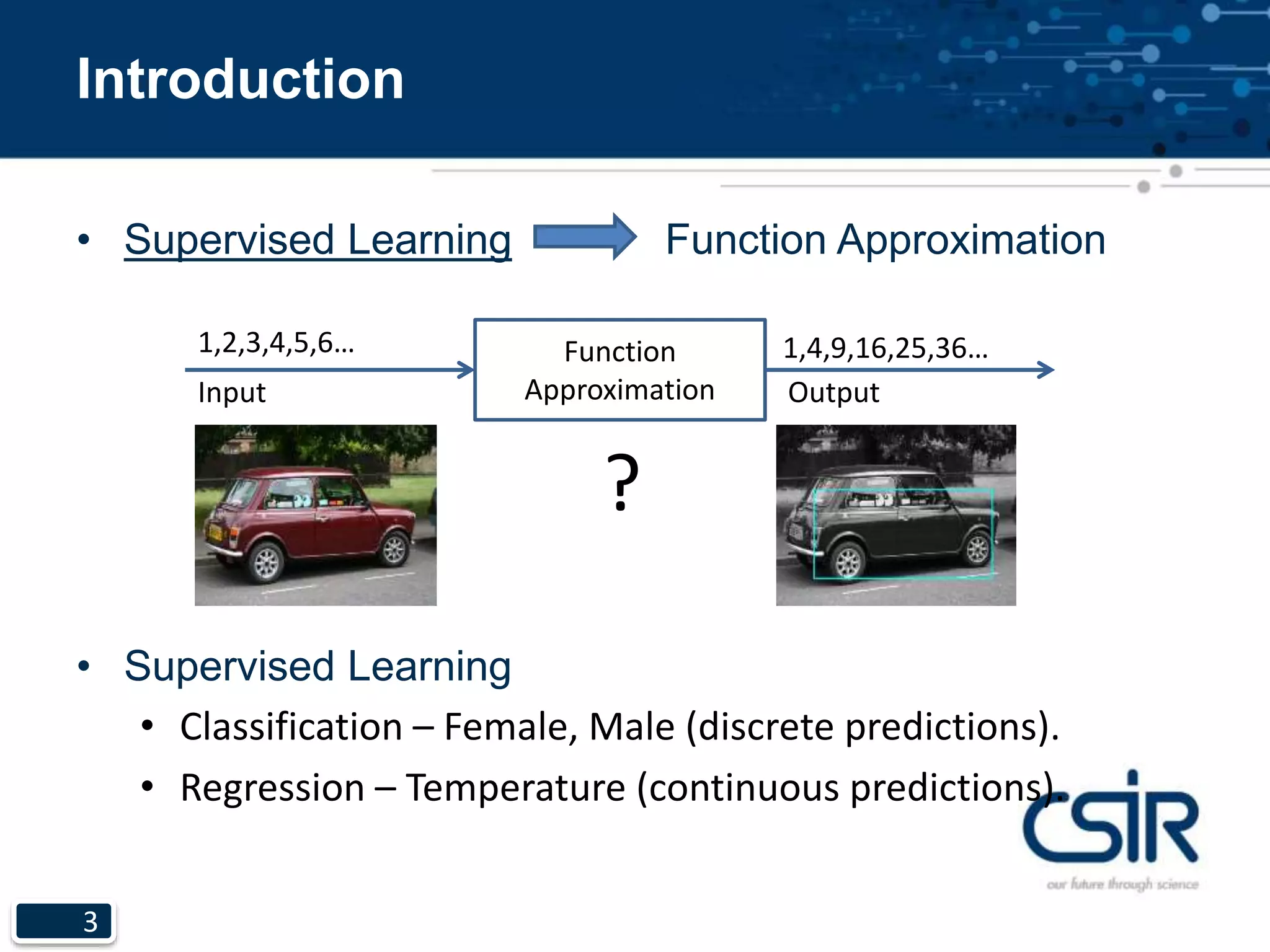
• Supervised Learning Function Approximation
• Supervised Learning
• Classification – Female, Male (discrete predictions).
• Regression – Temperature (continuous predictions).
Function
Approximation
1,2,3,4,5,6… 1,4,9,16,25,36…
Input Output
?
4
Why Unsupervised Learning?
• Unsupervised Learning Pre-processing
• Try to find hidden structure
Finding Structure
Function
Approximation
Pixels Summaries Labels
UL SL
5
Introduction
• Optimization
• SL - Label data well
• UL - Cluster scores well
• Data is important
• Algorithms are important
6
Clustering
• Clustering is the task of grouping a set of objects in
such a way that objects in the same group are more
similar to each other than to those in other
groups/clusters.
7
Clustering
• Basic clustering problem
• Given: set of objects 𝑋
Inter-object distances D(X, Y) = 𝐷 𝑌, 𝑋 , 𝑋, 𝑌𝜖𝑋
• Output: Partition 𝑃 𝐷(𝑋) = 𝑃 𝐷(𝑌) if 𝑋 and 𝑌 in same
cluster
• Extreme clustering algorithm: ∀ 𝑋 𝑃 𝐷(𝑋) = 1, ∀ 𝑋 𝑃 𝐷(𝑋) = X
(Humans), (Each Unique)
8
Clustering
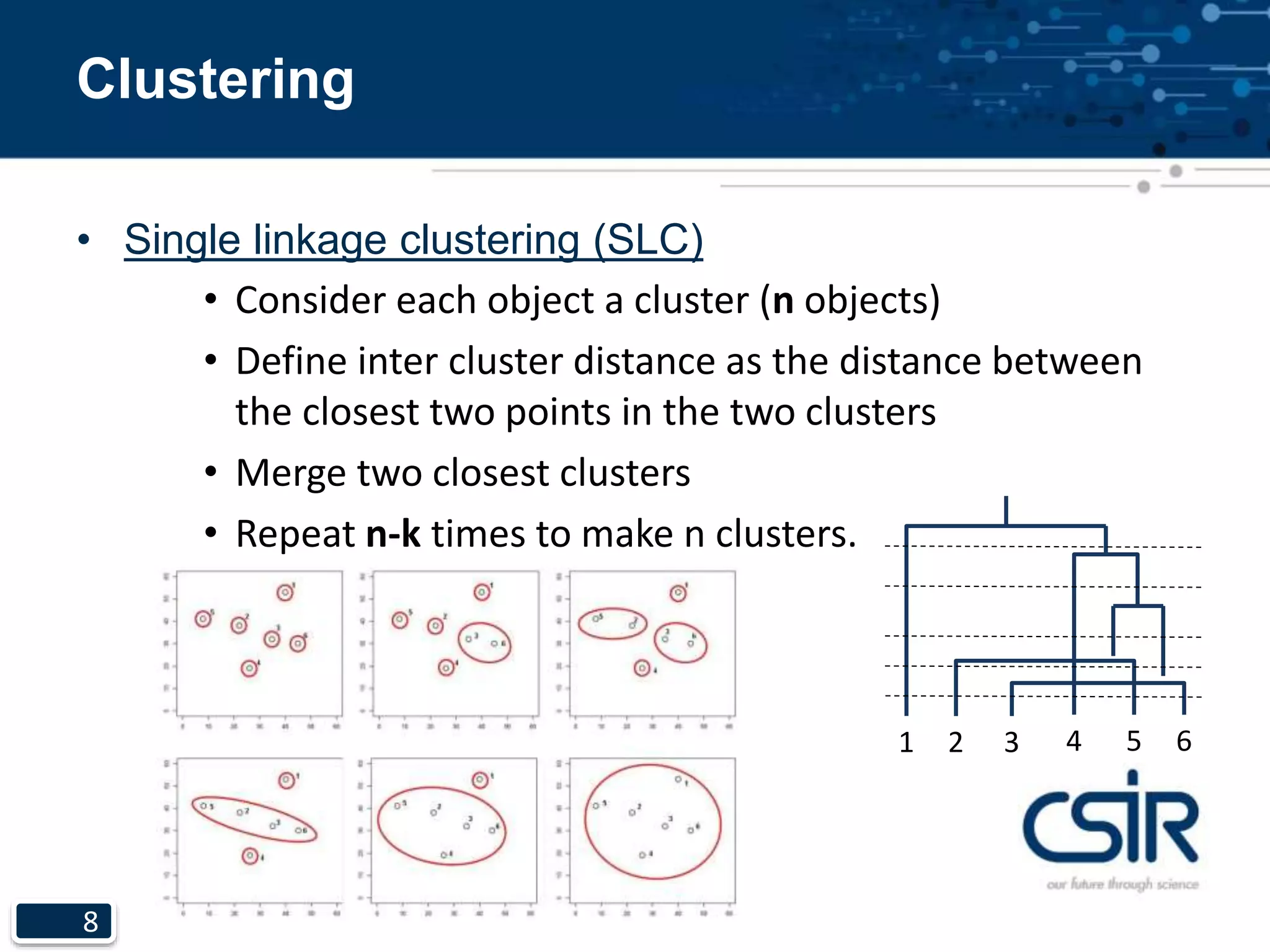
• Single linkage clustering (SLC)
• Consider each object a cluster (n objects)
• Define inter cluster distance as the distance between
the closest two points in the two clusters
• Merge two closest clusters
• Repeat n-k times to make n clusters.
1 6542 3
9
Clustering
• Issues with SLC
K=2
X
10
Clustering
• K-means clustering
• Pick k “centres” (at random)
• Each centre “claims” its closest points
• Recompute the centre by averaging the clustered
points
• Repeat until convergence (does it always converge and
give good answers)
11
Clustering
• K-means in Euclidean space
• 𝐴 = 𝑃 𝑡 𝑋 : Partition/Cluster of objects 𝑋
• 𝐶𝑖 : Set of all points in cluster 𝑖 = 𝑋 𝑠. 𝑡. 𝑃 𝑋 = 𝑖
• 𝐶𝑒𝑛𝑡𝑒𝑟𝑖 = 𝑦𝜖𝐶𝑖
𝑦
𝐶 𝑖
• 𝐶𝑒𝑛𝑡𝑒𝑟𝑖 → 𝑃 𝑡 = 𝑎𝑟𝑔𝑚𝑖𝑛 𝑋𝐶𝑒𝑛𝑡𝑒𝑟𝑖
2
𝐶𝑒𝑛𝑡𝑒𝑟𝑖 =
𝑦𝜖𝐶𝑖
𝑦
𝐶 𝑖
t
t
t
t t-1
2
t
t
12
Clustering
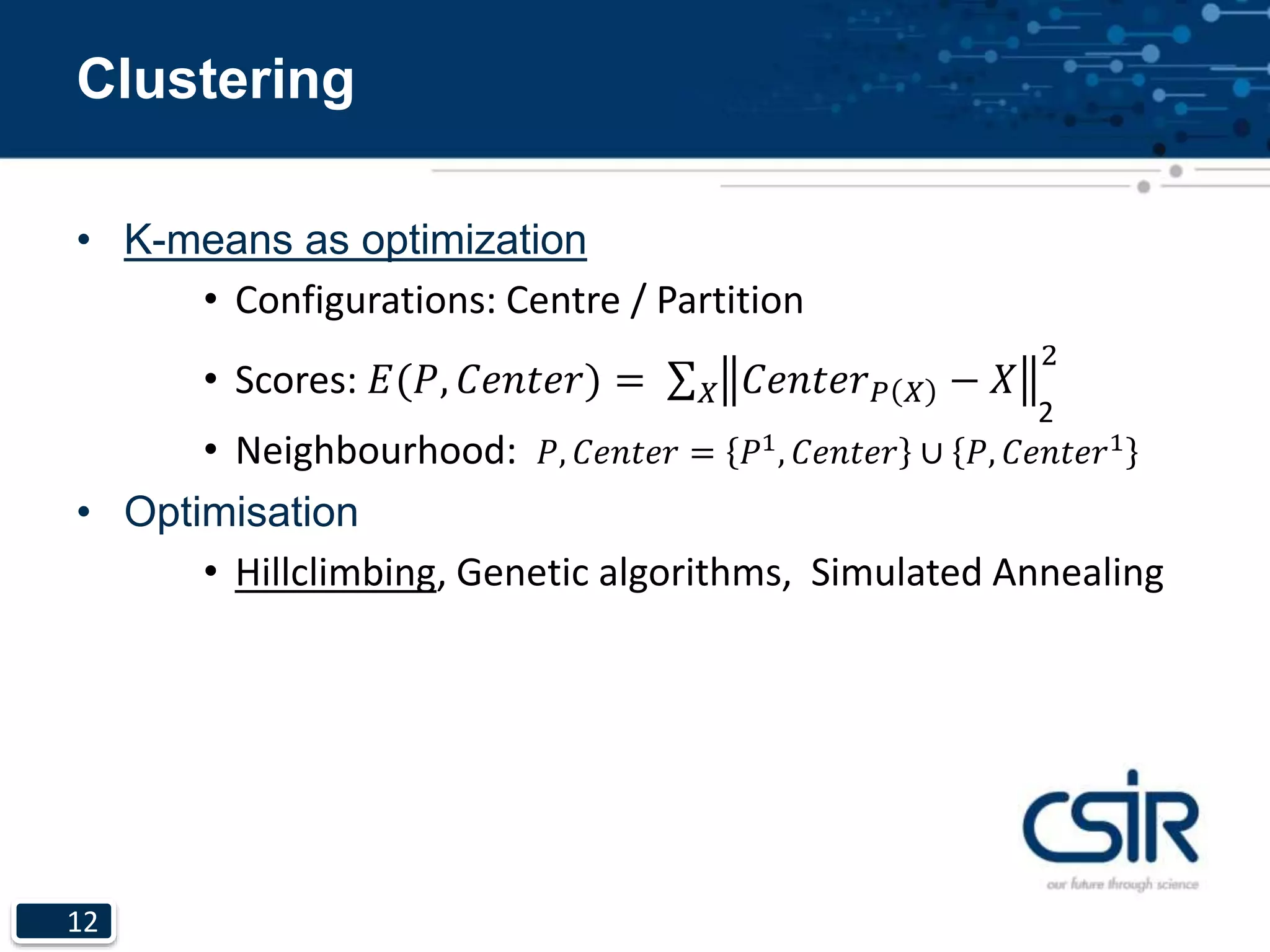
• K-means as optimization
• Configurations: Centre / Partition
• Scores: 𝐸(𝑃, 𝐶𝑒𝑛𝑡𝑒𝑟) = 𝑋 𝐶𝑒𝑛𝑡𝑒𝑟 𝑃 𝑋 − 𝑋
2
• Neighbourhood: 𝑃, 𝐶𝑒𝑛𝑡𝑒𝑟 = 𝑃1, 𝐶𝑒𝑛𝑡𝑒𝑟 ∪ 𝑃, 𝐶𝑒𝑛𝑡𝑒𝑟1
• Optimisation
• Hillclimbing, Genetic algorithms, Simulated Annealing
2
13
Clustering
• Soft clustering
• If k=2 what happens to d?
• Can d be shared between clusters?
• Assume the data was generated by
– Select one of k Gaussians distributions, know the variance,
sampled from uniformly
– Sample Xi from that Gaussian
– Repeat n times
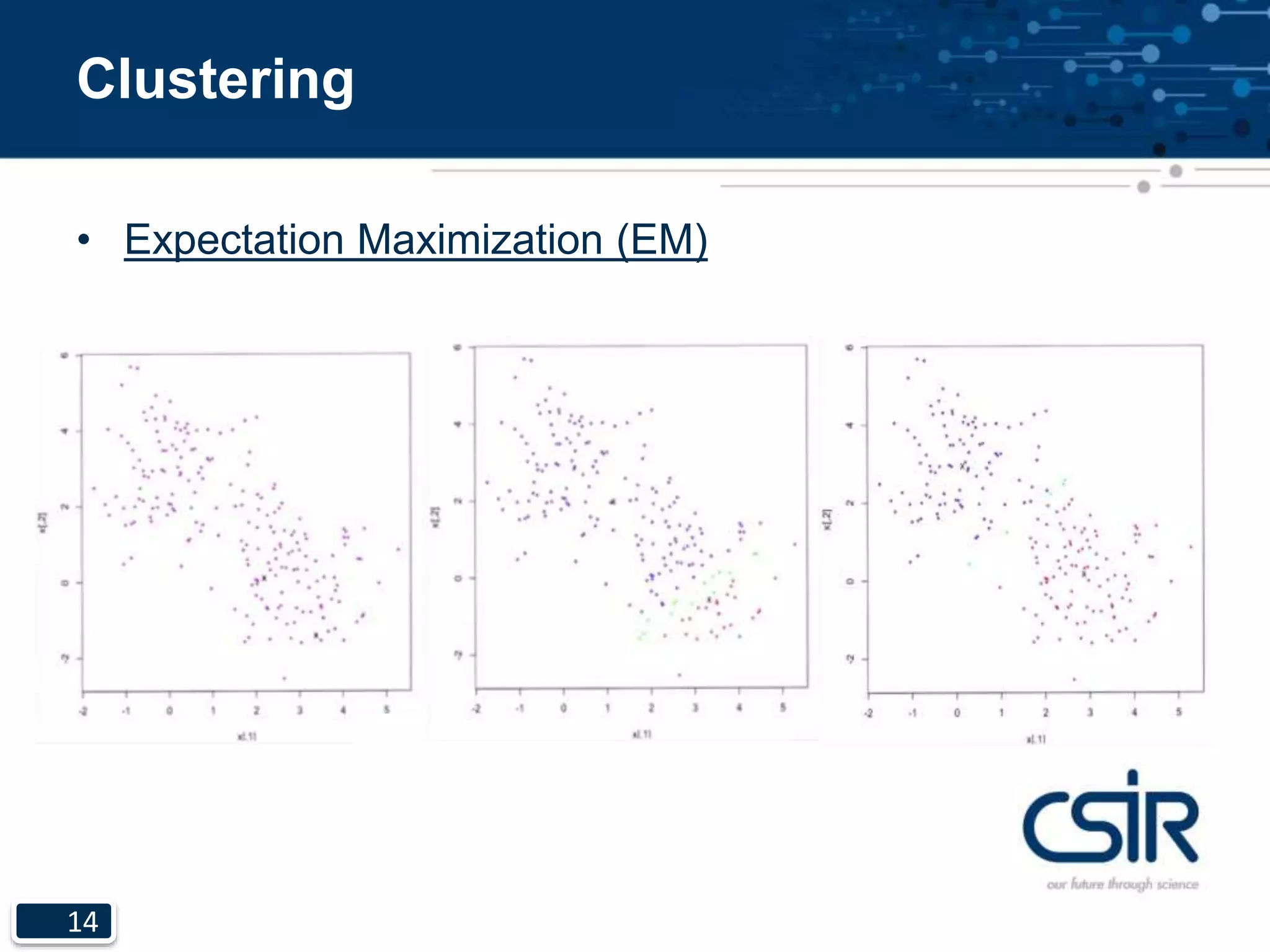
• Task: find a hypothesis h=<µ1,...,µk> (means of distribution)
that maximizes the probability of the data
14
Clustering
• Expectation Maximization (EM)
15
Clustering
• Clustering properties
• Richness: For any assignment of objects to clusters there is
some distance matrix D such that PD returns that cluster
• Scale-invariance: Scaling distances by a positive value does
not change the clustering
• Consistency: Shrinking intra cluster distances and
expanding inter cluster distances does not change the
cluster
• Impossibility theorem
• No clustering algorithm can achieve all three properties
16
Conclusion
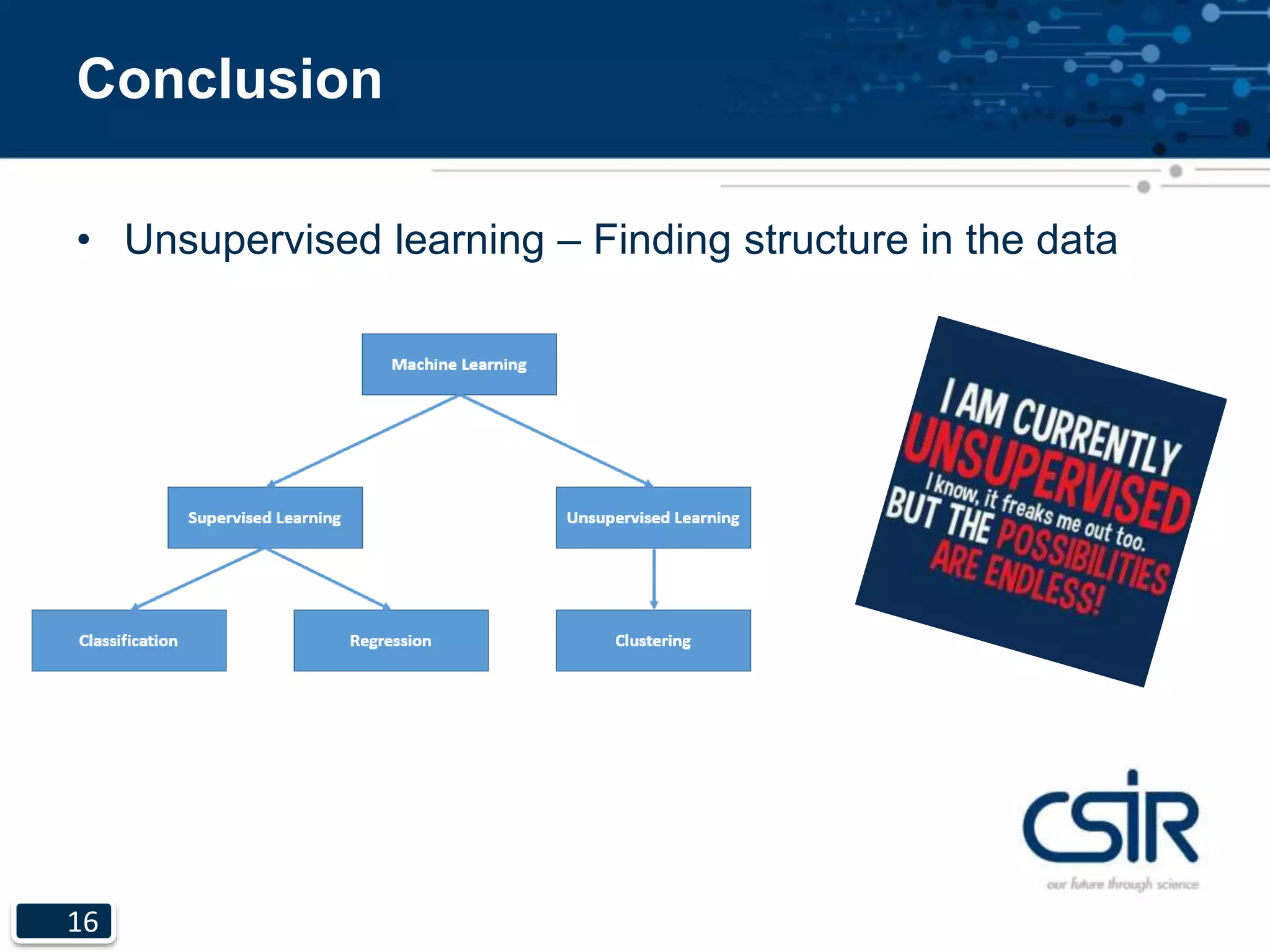
• Unsupervised learning – Finding structure in the data
Thank you
Name (email@csir.co.za)

US learning

  • 1.
    Contents Unsupervised Learning Beatrice vanEden Machine Learning Reading group Introductory Theme
  • 2.
    2 Contents  Introduction  UnsupervisedLearning concepts  Clustering the idea  Basic clustering problem  Algorithms  Single linkage clustering (SLC)  Issues with SLC  K-means clustering  K-means in Euclidean space  K-means as optimization  Soft clustering  Expectation Maximization (EM)  Clustering properties and impossibilities Charles Isbell Michael Littman Andrew Ng https://www.coursera.org/learn/machine-learning/home/info https://www.udacity.com/course/machine-learning- supervised-learning--ud675
  • 3.
    3 Introduction • Supervised LearningFunction Approximation • Supervised Learning • Classification – Female, Male (discrete predictions). • Regression – Temperature (continuous predictions). Function Approximation 1,2,3,4,5,6… 1,4,9,16,25,36… Input Output ?
  • 4.
    4 Why Unsupervised Learning? •Unsupervised Learning Pre-processing • Try to find hidden structure Finding Structure Function Approximation Pixels Summaries Labels UL SL
  • 5.
    5 Introduction • Optimization • SL- Label data well • UL - Cluster scores well • Data is important • Algorithms are important
  • 6.
    6 Clustering • Clustering isthe task of grouping a set of objects in such a way that objects in the same group are more similar to each other than to those in other groups/clusters.
  • 7.
    7 Clustering • Basic clusteringproblem • Given: set of objects 𝑋 Inter-object distances D(X, Y) = 𝐷 𝑌, 𝑋 , 𝑋, 𝑌𝜖𝑋 • Output: Partition 𝑃 𝐷(𝑋) = 𝑃 𝐷(𝑌) if 𝑋 and 𝑌 in same cluster • Extreme clustering algorithm: ∀ 𝑋 𝑃 𝐷(𝑋) = 1, ∀ 𝑋 𝑃 𝐷(𝑋) = X (Humans), (Each Unique)
  • 8.
    8 Clustering • Single linkageclustering (SLC) • Consider each object a cluster (n objects) • Define inter cluster distance as the distance between the closest two points in the two clusters • Merge two closest clusters • Repeat n-k times to make n clusters. 1 6542 3
  • 9.
  • 10.
    10 Clustering • K-means clustering •Pick k “centres” (at random) • Each centre “claims” its closest points • Recompute the centre by averaging the clustered points • Repeat until convergence (does it always converge and give good answers)
  • 11.
    11 Clustering • K-means inEuclidean space • 𝐴 = 𝑃 𝑡 𝑋 : Partition/Cluster of objects 𝑋 • 𝐶𝑖 : Set of all points in cluster 𝑖 = 𝑋 𝑠. 𝑡. 𝑃 𝑋 = 𝑖 • 𝐶𝑒𝑛𝑡𝑒𝑟𝑖 = 𝑦𝜖𝐶𝑖 𝑦 𝐶 𝑖 • 𝐶𝑒𝑛𝑡𝑒𝑟𝑖 → 𝑃 𝑡 = 𝑎𝑟𝑔𝑚𝑖𝑛 𝑋𝐶𝑒𝑛𝑡𝑒𝑟𝑖 2 𝐶𝑒𝑛𝑡𝑒𝑟𝑖 = 𝑦𝜖𝐶𝑖 𝑦 𝐶 𝑖 t t t t t-1 2 t t
  • 12.
    12 Clustering • K-means asoptimization • Configurations: Centre / Partition • Scores: 𝐸(𝑃, 𝐶𝑒𝑛𝑡𝑒𝑟) = 𝑋 𝐶𝑒𝑛𝑡𝑒𝑟 𝑃 𝑋 − 𝑋 2 • Neighbourhood: 𝑃, 𝐶𝑒𝑛𝑡𝑒𝑟 = 𝑃1, 𝐶𝑒𝑛𝑡𝑒𝑟 ∪ 𝑃, 𝐶𝑒𝑛𝑡𝑒𝑟1 • Optimisation • Hillclimbing, Genetic algorithms, Simulated Annealing 2
  • 13.
    13 Clustering • Soft clustering •If k=2 what happens to d? • Can d be shared between clusters? • Assume the data was generated by – Select one of k Gaussians distributions, know the variance, sampled from uniformly – Sample Xi from that Gaussian – Repeat n times • Task: find a hypothesis h=<µ1,...,µk> (means of distribution) that maximizes the probability of the data
  • 14.
  • 15.
    15 Clustering • Clustering properties •Richness: For any assignment of objects to clusters there is some distance matrix D such that PD returns that cluster • Scale-invariance: Scaling distances by a positive value does not change the clustering • Consistency: Shrinking intra cluster distances and expanding inter cluster distances does not change the cluster • Impossibility theorem • No clustering algorithm can achieve all three properties
  • 16.
    16 Conclusion • Unsupervised learning– Finding structure in the data
  • 17.