Learning to Solve Circuit-SAT:
an Unsupervised
Differentiable Approach
Saeed Amizadeh, Sergiy Matusevych and Markus Weimer
Microsoft
ICLR 2019
Outline
• Abstract
• Introduction
• Background
• DAG embedding
• Application to the Circuit-SAT problem
• Experimental evaluation
• Discussion
Abstract
• New trend of applying rich neural architectures to solve classical
combinatorial optimization problems.
• Propose a neural framework that can learn to solve the Circuit-SAT
problem.
• Rich embedding architecture that encode the problem structure
• Differentiable training procedure that mimics RL
• Train the model directly toward solving the SAT problem
• Show the superior out-of-sample generalization performance
compared to NeuroSAT method.
Introduction
• The emergence of neural models for learning how to solve the
classical combinatorial optimization problems.
• In practice, for a given class of combinatorial problems, the
problem instances are typically drawn from a certain (unknown)
distribution.
• If there are sufficient number of problem instances, ML (DL) is
capable of extracting the common structures among these
instances and produce models that would outperform the carefully
hand-crafted algorithms.
• Supervised learning
• Be shown to be effective for various NP-complete problems.
• The resulted model is bounded by greedy strategy (sub-optimal in
general).
• Reinforcement learning
• Learn the optimal decision and search heuristics beyond the greedy
strategy.
• Challenging work to train such model.
• Propose a neural Circuit-SAT training the model directly toward
the end goal.
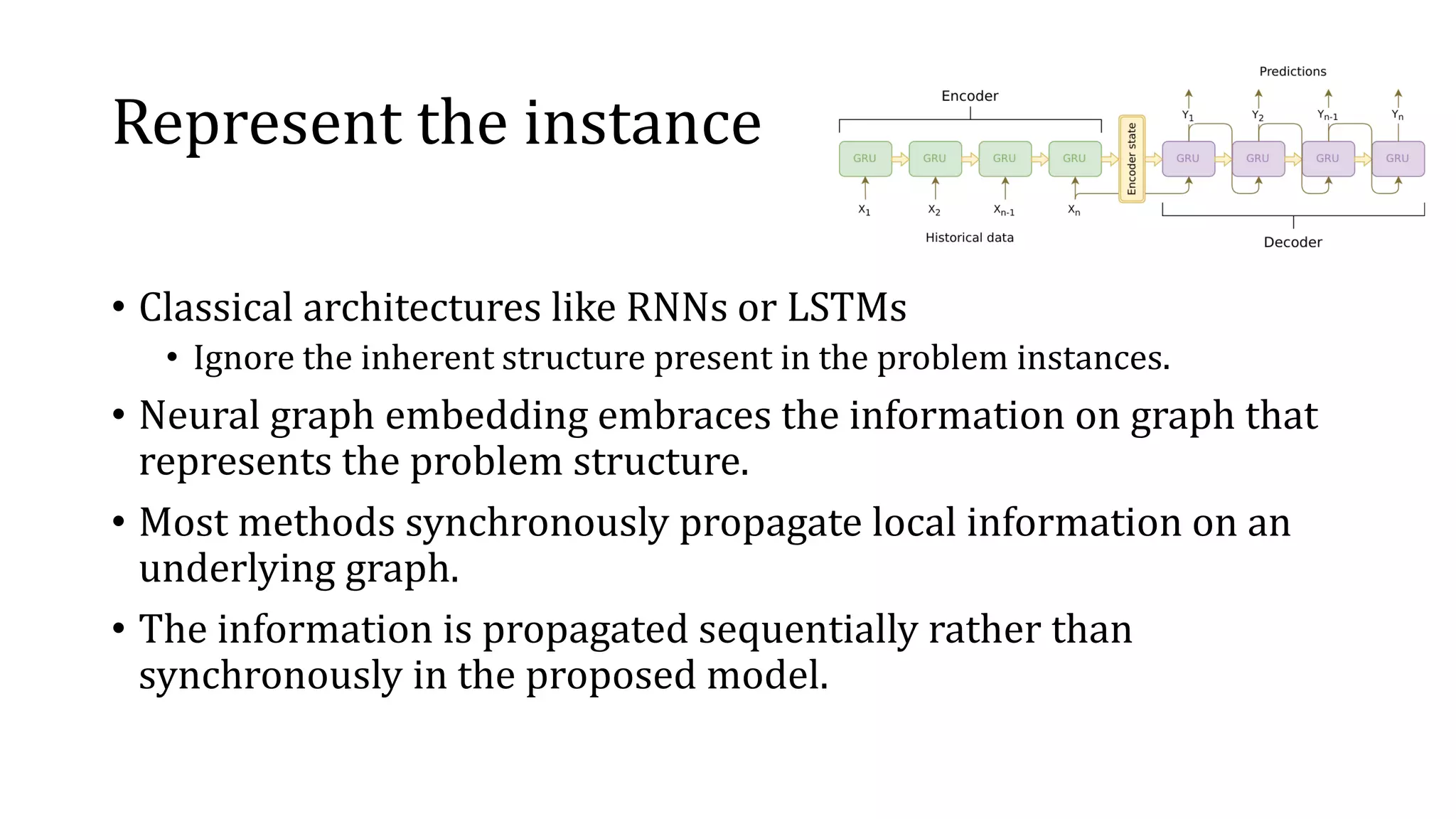
Represent the instance
• Classical architectures like RNNs or LSTMs
• Ignore the inherent structure present in the problem instances.
• Neural graph embedding embraces the information on graph that
represents the problem structure.
• Most methods synchronously propagate local information on an
underlying graph.
• The information is propagated sequentially rather than
synchronously in the proposed model.
Background
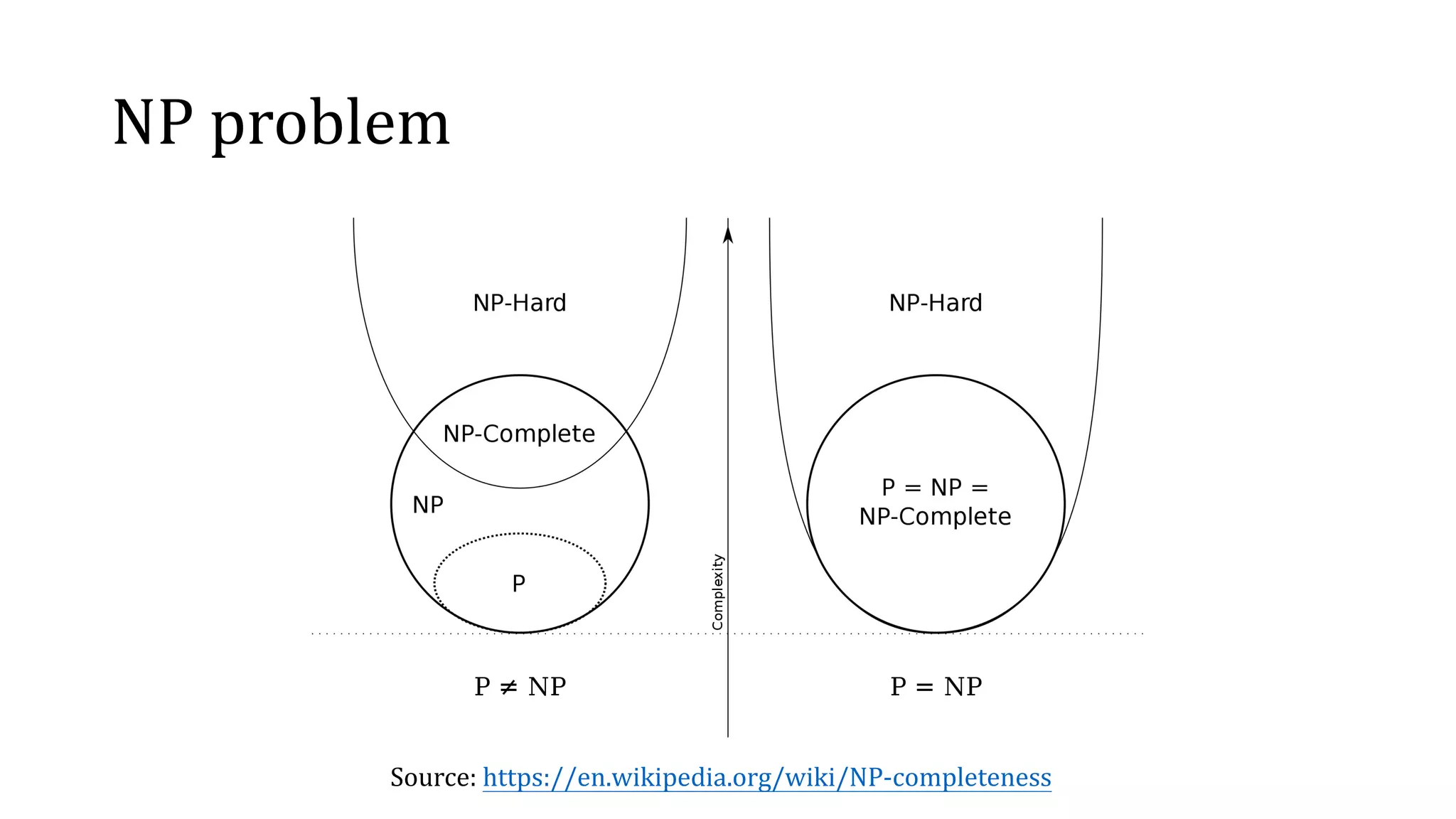
NP problem
Source: https://en.wikipedia.org/wiki/NP-completeness
SAT
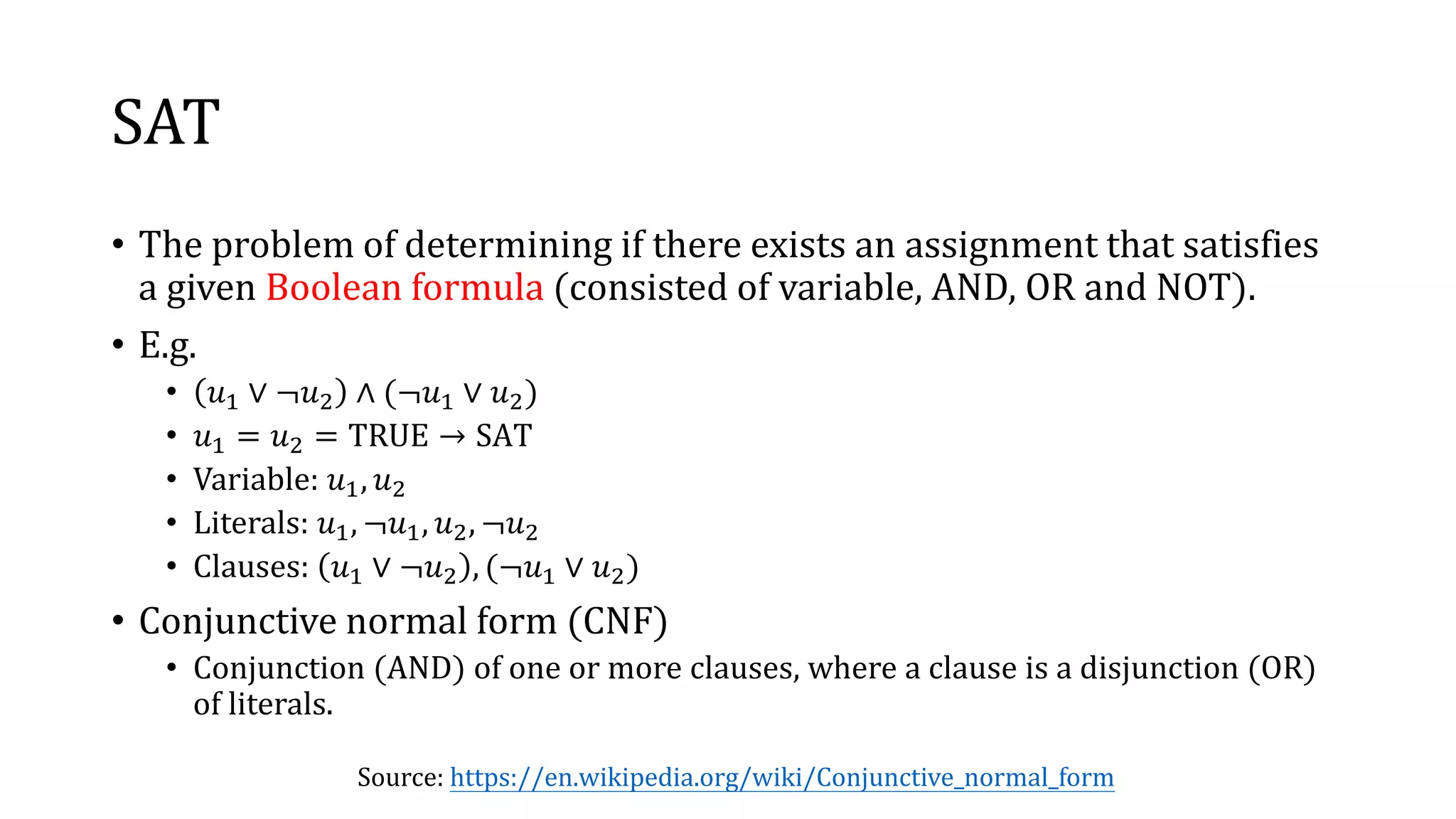
• The problem of determining if there exists an assignment that satisfies
a given Boolean formula (consisted of variable, AND, OR and NOT).
• E.g.
• 𝑢1 ∨ ¬𝑢2 ∧ (¬𝑢1 ∨ 𝑢2)
• 𝑢1 = 𝑢2 = TRUE → SAT
• Variable: 𝑢1, 𝑢2
• Literals: 𝑢1, ¬𝑢1, 𝑢2, ¬𝑢2
• Clauses: 𝑢1 ∨ ¬𝑢2 , (¬𝑢1 ∨ 𝑢2)
• Conjunctive normal form (CNF)
• Conjunction (AND) of one or more clauses, where a clause is a disjunction (OR)
of literals.
Source: https://en.wikipedia.org/wiki/Conjunctive_normal_form
Circuit-SAT
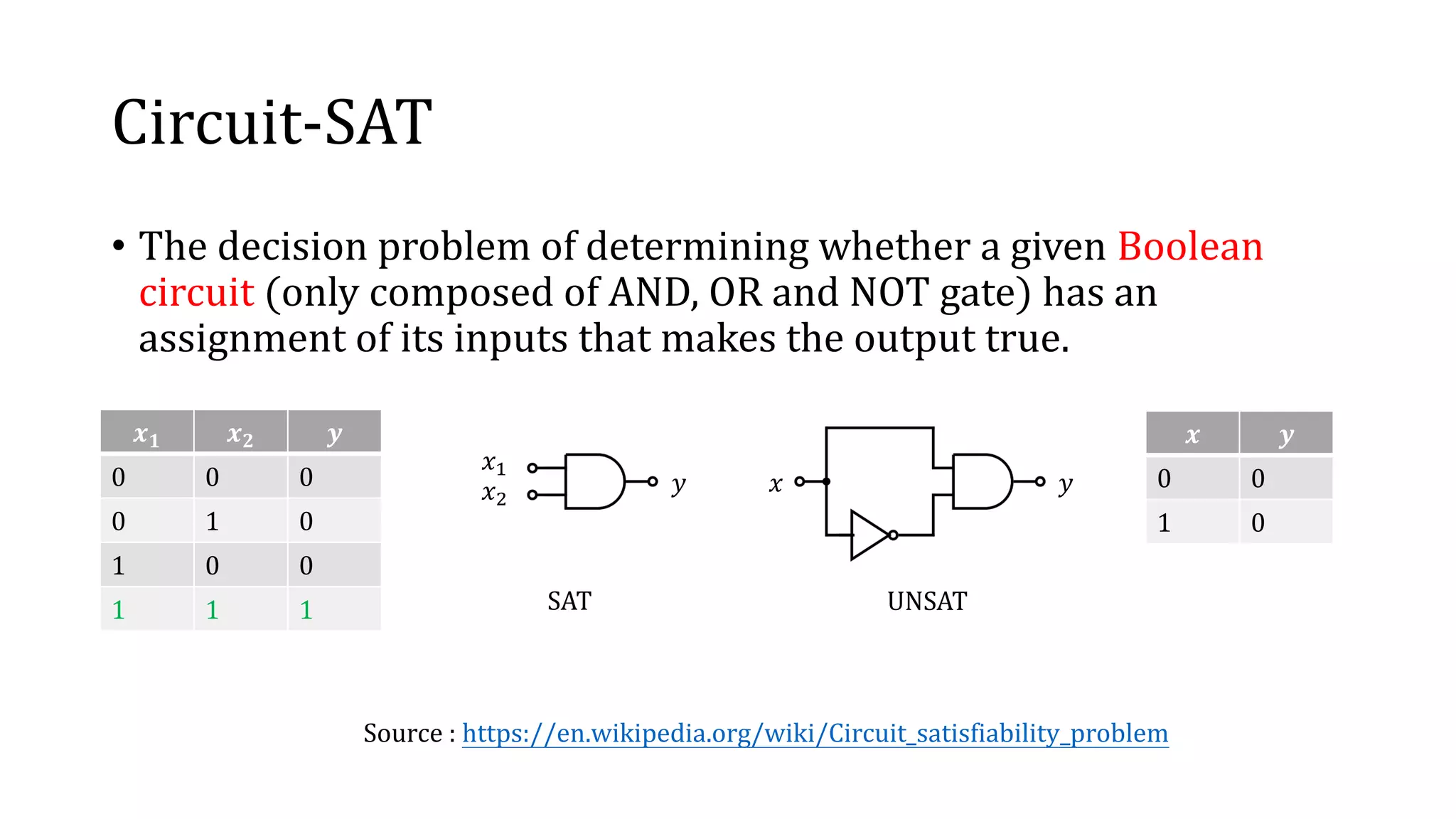
• The decision problem of determining whether a given Boolean
circuit (only composed of AND, OR and NOT gate) has an
assignment of its inputs that makes the output true.
Source : https://en.wikipedia.org/wiki/Circuit_satisfiability_problem
𝒙 𝟏 𝒙 𝟐 𝒚
0 0 0
0 1 0
1 0 0
1 1 1
𝒙 𝒚
0 0
1 0
𝑥1
𝑥2
𝑦 𝑦𝑥
SAT UNSAT
NeuroSAT (Selsam et al. (2018))
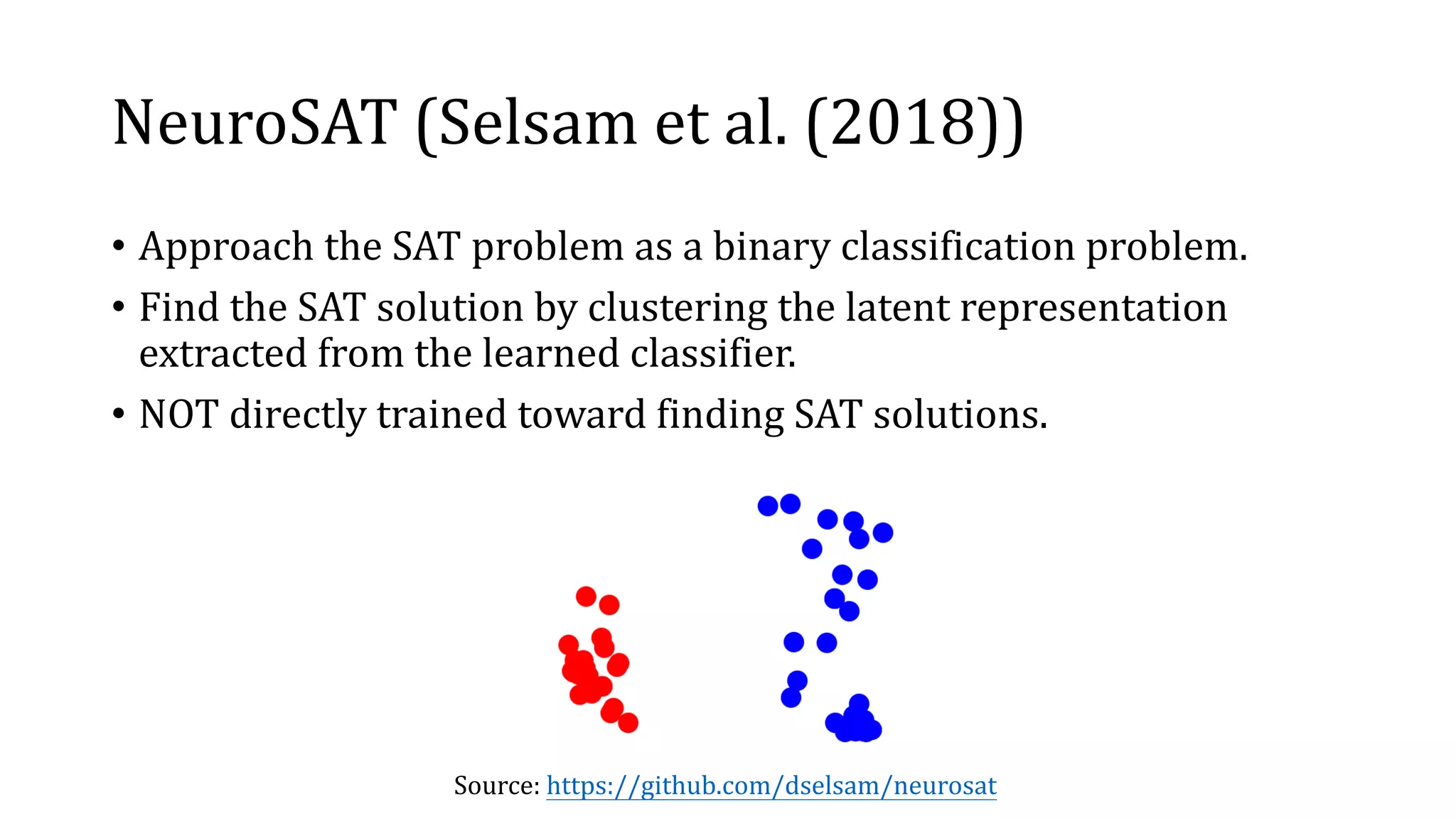
• Approach the SAT problem as a binary classification problem.
• Find the SAT solution by clustering the latent representation
extracted from the learned classifier.
• NOT directly trained toward finding SAT solutions.
Source: https://github.com/dselsam/neurosat
Direct Acyclic Graph (DAG)
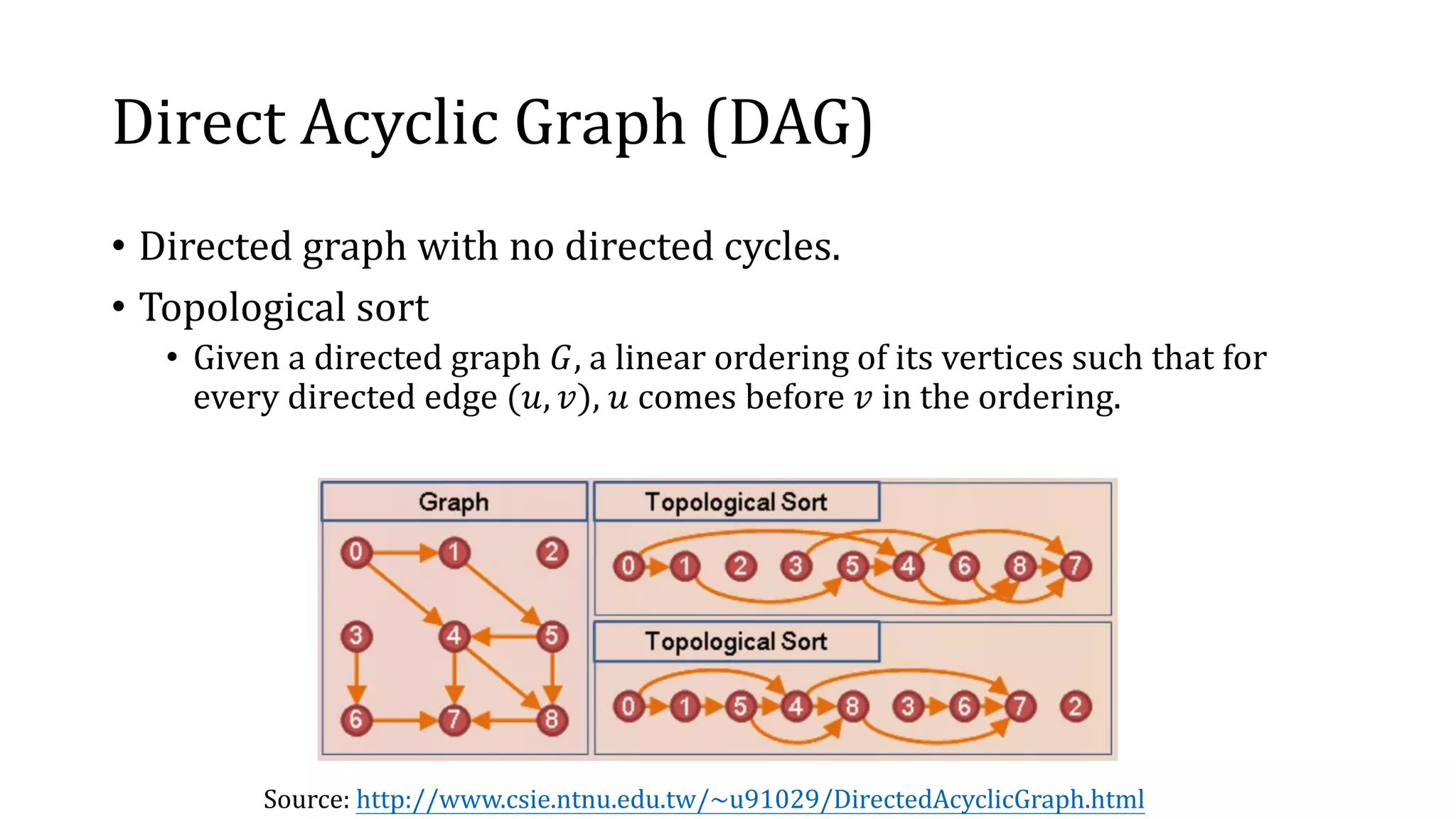
• Directed graph with no directed cycles.
• Topological sort
• Given a directed graph 𝐺, a linear ordering of its vertices such that for
every directed edge (𝑢, 𝑣), 𝑢 comes before 𝑣 in the ordering.
Source: http://www.csie.ntnu.edu.tw/~u91029/DirectedAcyclicGraph.html
DAG embedding
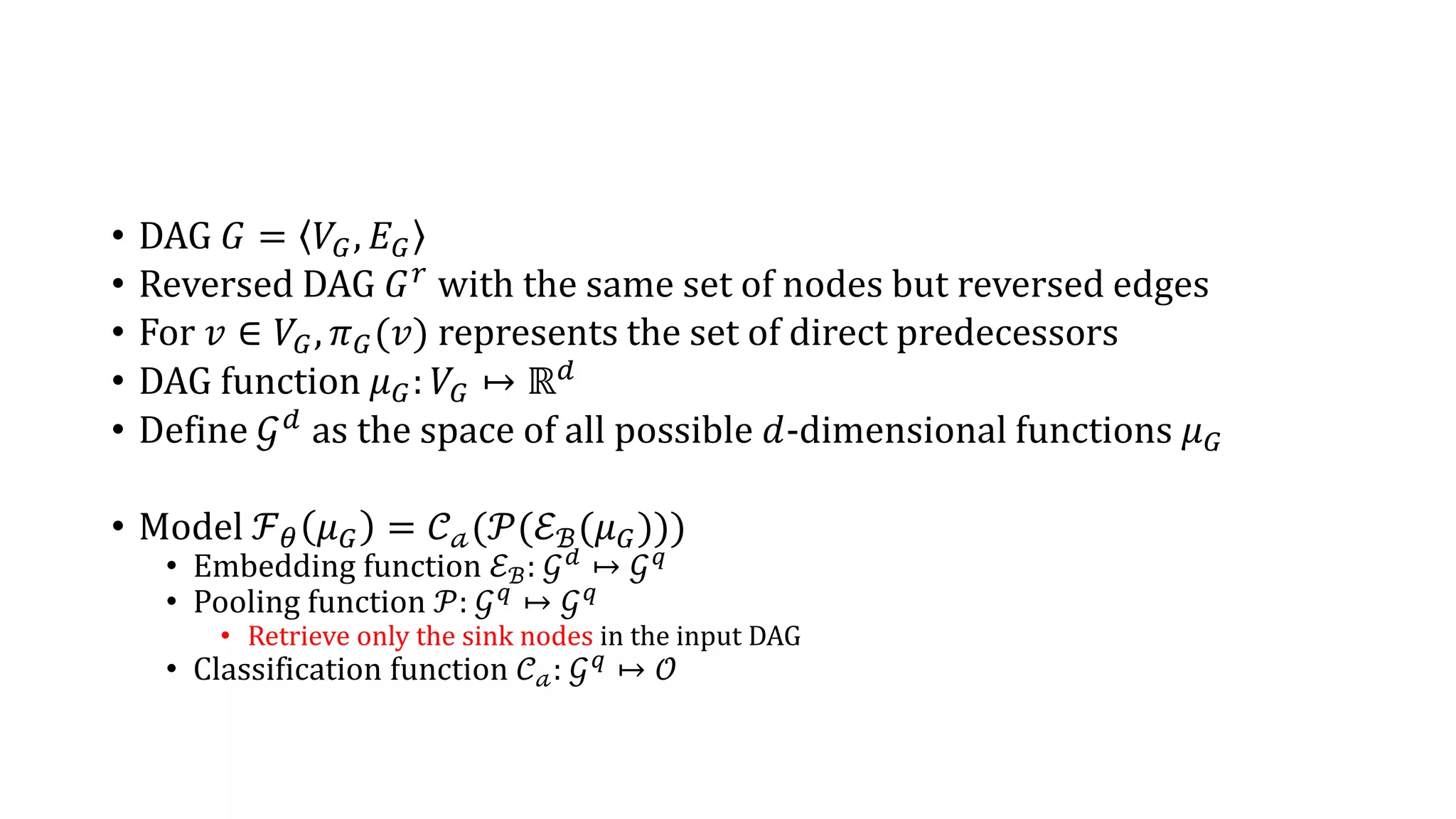
• DAG 𝐺 = 𝑉𝐺, 𝐸 𝐺
• Reversed DAG 𝐺 𝑟
with the same set of nodes but reversed edges
• For 𝑣 ∈ 𝑉𝐺, 𝜋 𝐺(𝑣) represents the set of direct predecessors
• DAG function 𝜇 𝐺: 𝑉𝐺 ↦ ℝ 𝑑
• Define 𝒢 𝑑 as the space of all possible 𝑑-dimensional functions 𝜇 𝐺
• Model ℱ 𝜃 𝜇 𝐺 = 𝒞 𝒶(𝒫(ℰℬ(𝜇 𝐺)))
• Embedding function ℰℬ: 𝒢 𝑑
↦ 𝒢 𝑞
• Pooling function 𝒫: 𝒢 𝑞
↦ 𝒢 𝑞
• Retrieve only the sink nodes in the input DAG
• Classification function 𝒞 𝒶: 𝒢 𝑞
↦ 𝒪
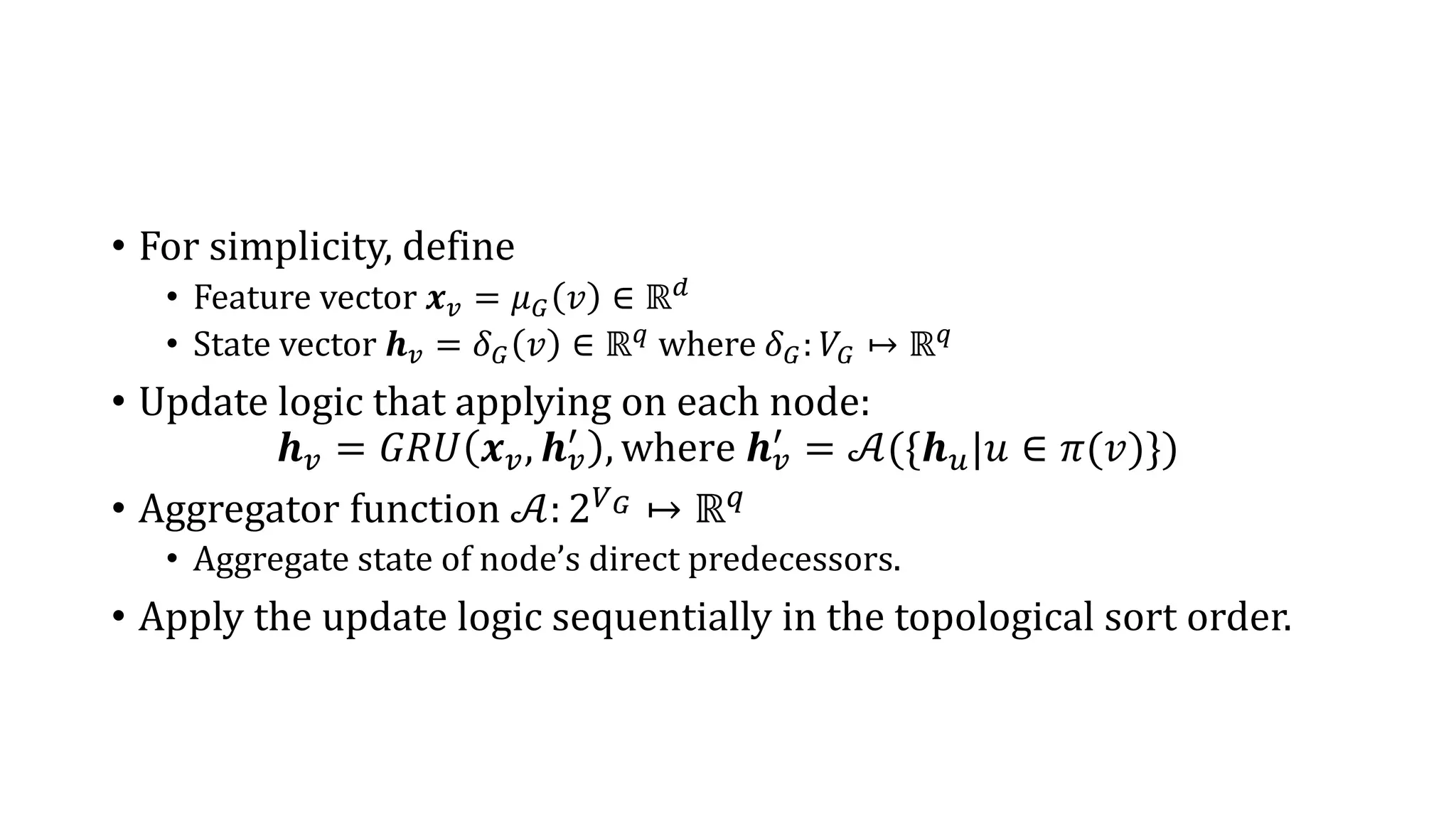
• For simplicity, define
• Feature vector 𝒙 𝑣 = 𝜇 𝐺 𝑣 ∈ ℝ 𝑑
• State vector 𝒉 𝑣 = 𝛿 𝐺 𝑣 ∈ ℝ 𝑞 where 𝛿 𝐺: 𝑉𝐺 ↦ ℝ 𝑞
• Update logic that applying on each node:
𝒉 𝑣 = 𝐺𝑅𝑈 𝒙 𝑣, 𝒉 𝑣
′
, where 𝒉 𝑣
′
= 𝒜({𝒉 𝑢|𝑢 ∈ 𝜋(𝑣)})
• Aggregator function 𝒜: 2 𝑉 𝐺 ↦ ℝ 𝑞
• Aggregate state of node’s direct predecessors.
• Apply the update logic sequentially in the topological sort order.
Deep-Gated DAG Recursive Neural
Network (DG-DAGRNN)
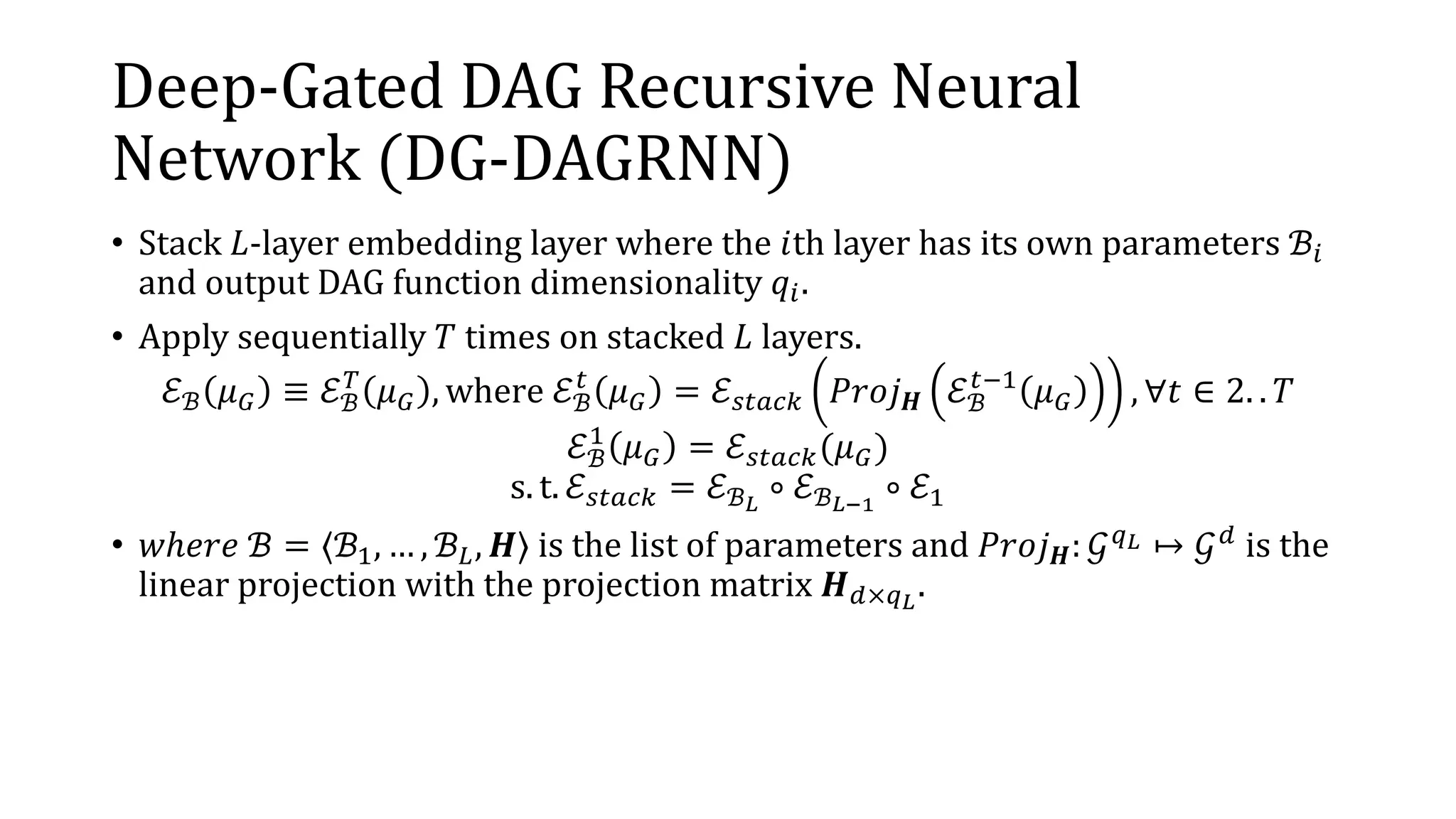
• Stack 𝐿-layer embedding layer where the 𝑖th layer has its own parameters ℬ𝑖
and output DAG function dimensionality 𝑞𝑖.
• Apply sequentially 𝑇 times on stacked 𝐿 layers.
ℰℬ 𝜇 𝐺 ≡ ℰℬ
𝑇
𝜇 𝐺 , where ℰℬ
𝑡
𝜇 𝐺 = ℰ 𝑠𝑡𝑎𝑐𝑘 𝑃𝑟𝑜𝑗 𝑯 ℰℬ
𝑡−1
𝜇 𝐺 , ∀𝑡 ∈ 2. . 𝑇
ℰℬ
1
𝜇 𝐺 = ℰ 𝑠𝑡𝑎𝑐𝑘(𝜇 𝐺)
s. t. ℰ 𝑠𝑡𝑎𝑐𝑘 = ℰℬ 𝐿
∘ ℰℬ 𝐿−1
∘ ℰ1
• 𝑤ℎ𝑒𝑟𝑒 ℬ = 〈ℬ1, … , ℬ 𝐿, 𝑯〉 is the list of parameters and 𝑃𝑟𝑜𝑗 𝑯: 𝒢 𝑞 𝐿 ↦ 𝒢 𝑑 is the
linear projection with the projection matrix 𝑯 𝑑×𝑞 𝐿
.
Application to Circuit-SAT
problem
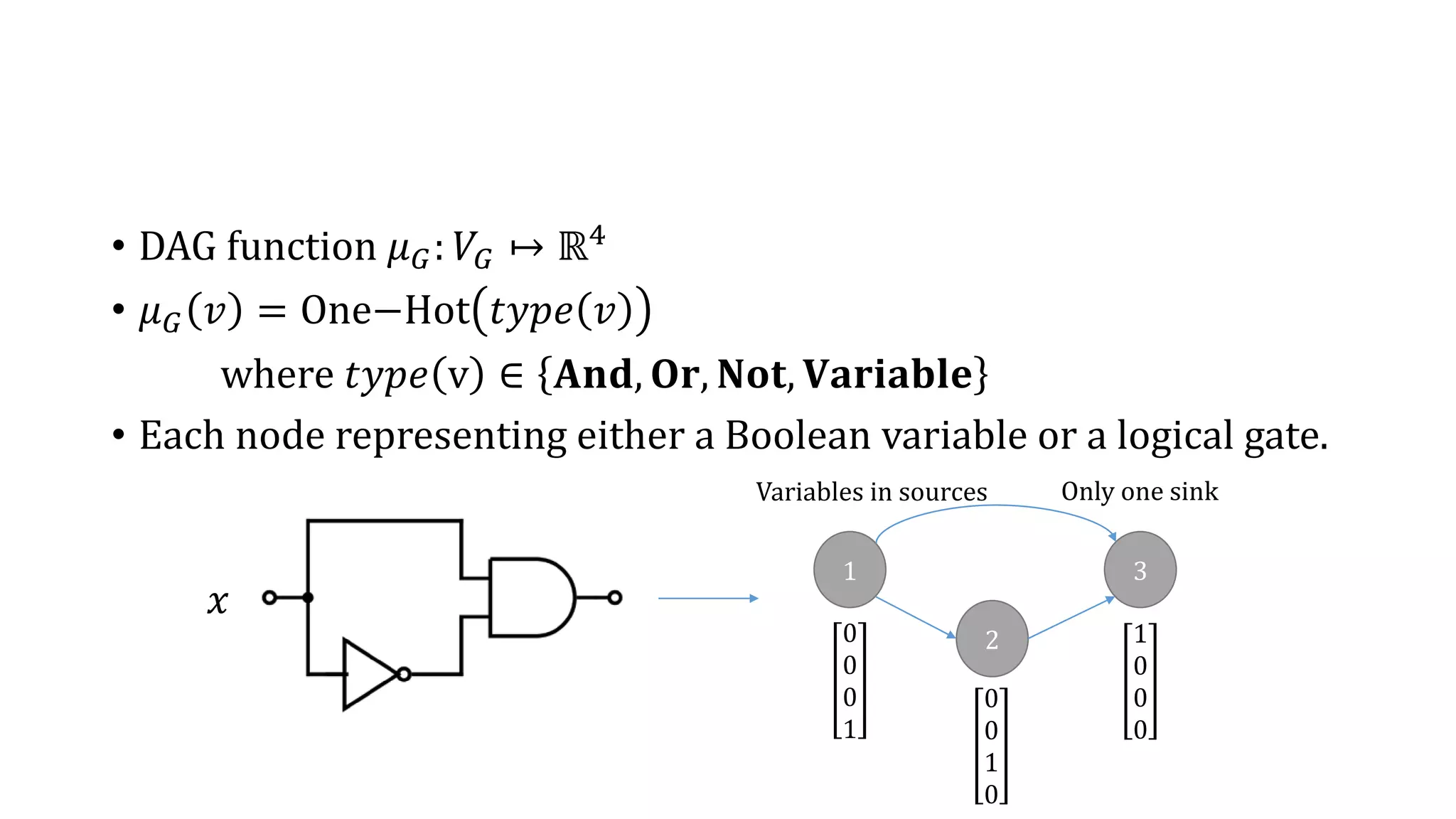
• DAG function 𝜇 𝐺: 𝑉𝐺 ↦ ℝ4
• 𝜇 𝐺 𝑣 = One−Hot 𝑡𝑦𝑝𝑒 𝑣
where 𝑡𝑦𝑝𝑒 v ∈ 𝐀𝐧𝐝, 𝐎𝐫, 𝐍𝐨𝐭, 𝐕𝐚𝐫𝐢𝐚𝐛𝐥𝐞
• Each node representing either a Boolean variable or a logical gate.
𝑥
1
2
3
0
0
0
1
0
0
1
0
1
0
0
0
Variables in sources Only one sink
Solver Network
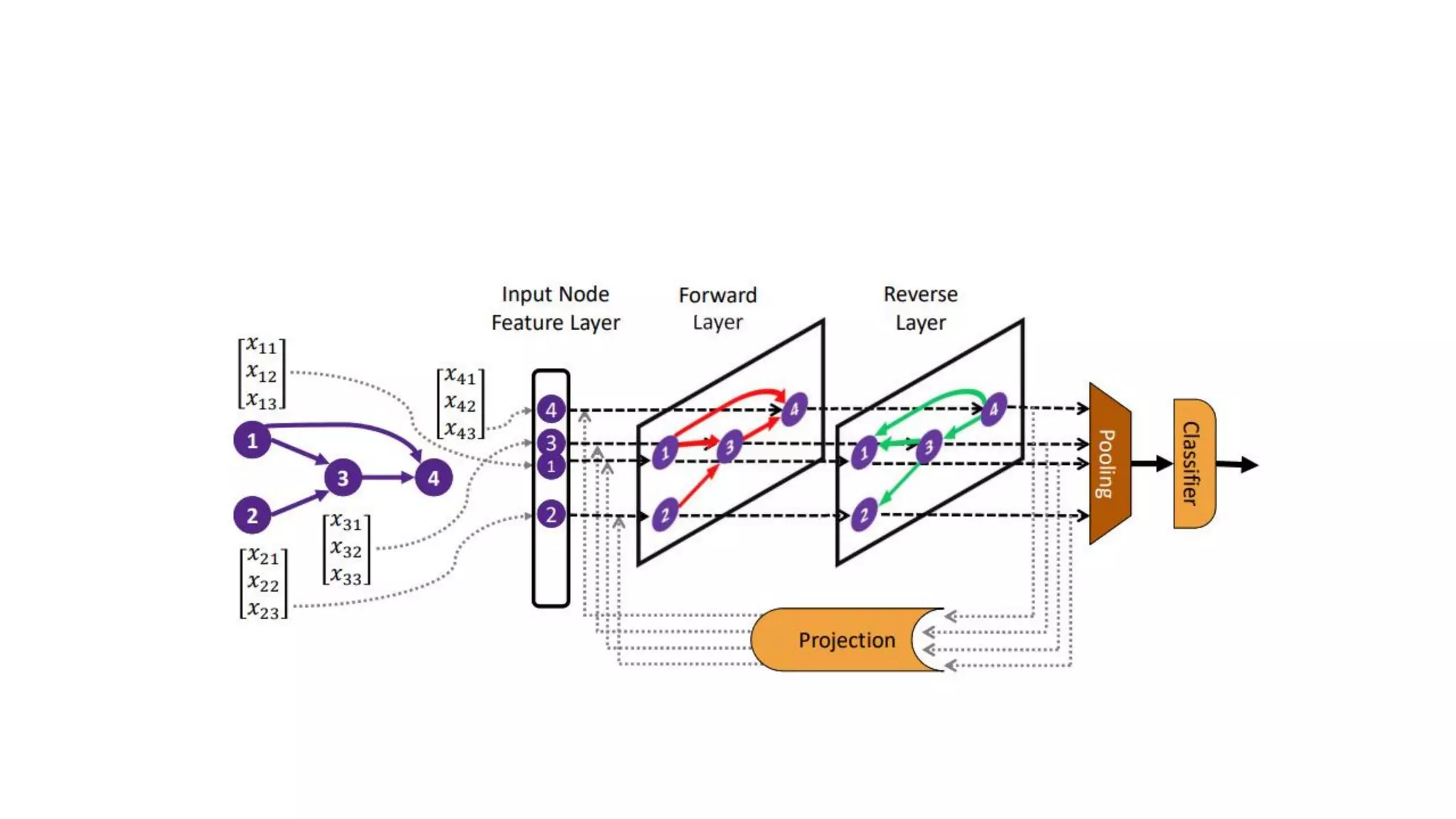
• Embedding function ℰℬ:
• multi-layer recursive embedding with interleaving forward and
reversed layers
• Last layer is a reversed layer so we can read the output from
Variable nodes.
• Output space encode the soft assignment (in range [0−1]) to the
corresponding variable node in the input circuit.
• ℱ 𝜃 acts as policy network.
Pooling: Retrieve only the sink nodes
Evaluator Network
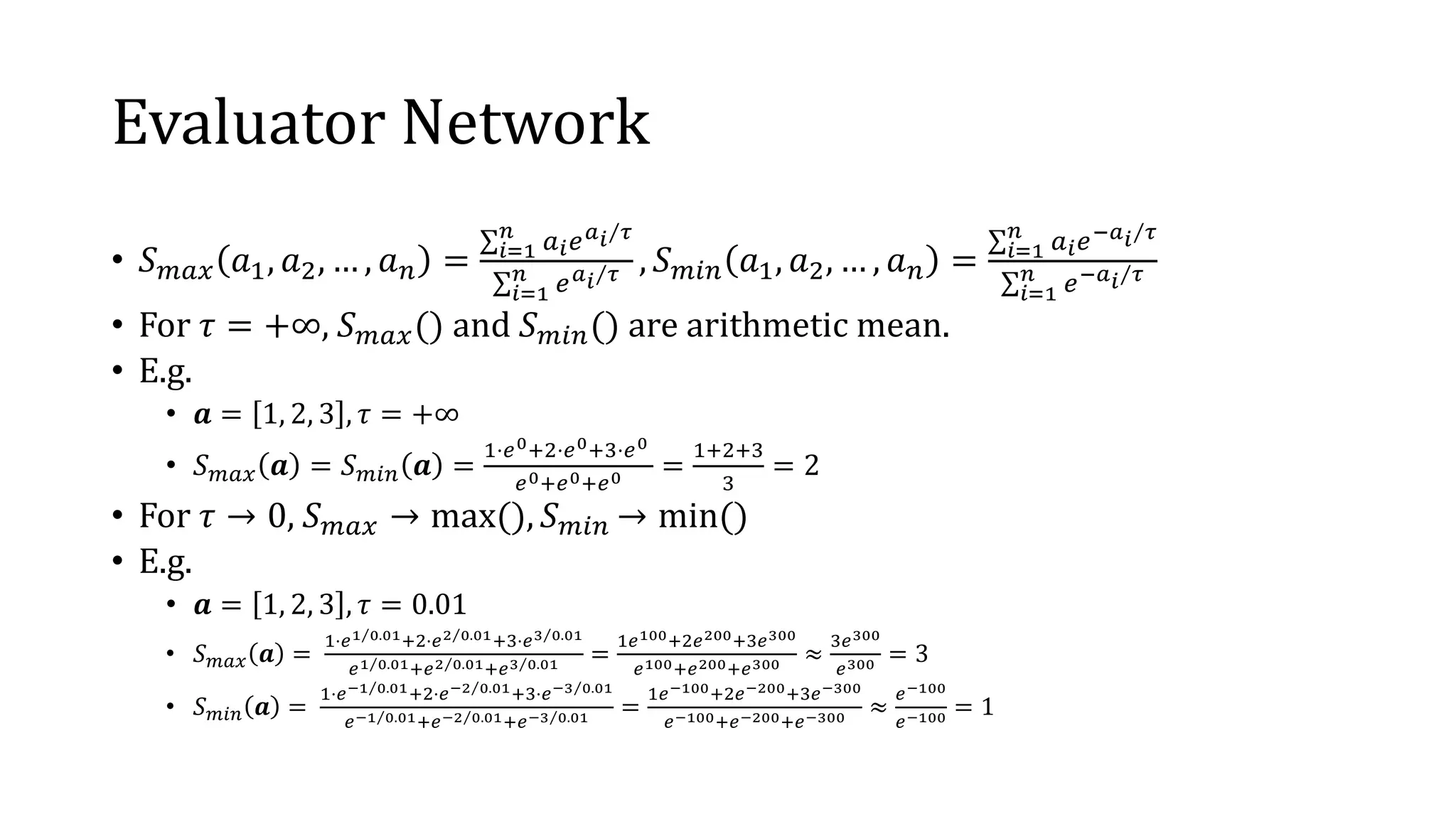
• 𝑆 𝑚𝑎𝑥 𝑎1, 𝑎2, … , 𝑎 𝑛 =
σ 𝑖=1
𝑛
𝑎 𝑖 𝑒 Τ𝑎 𝑖 𝜏
σ𝑖=1
𝑛
𝑒 Τ𝑎 𝑖 𝜏 , 𝑆 𝑚𝑖𝑛 𝑎1, 𝑎2, … , 𝑎 𝑛 =
σ 𝑖=1
𝑛
𝑎 𝑖 𝑒 Τ−𝑎 𝑖 𝜏
σ𝑖=1
𝑛
𝑒− Τ𝑎 𝑖 𝜏
• For 𝜏 = +∞, 𝑆 𝑚𝑎𝑥() and 𝑆 𝑚𝑖𝑛() are arithmetic mean.
• E.g.
• 𝒂 = 1, 2, 3 , 𝜏 = +∞
• 𝑆 𝑚𝑎𝑥 𝒂 = 𝑆 𝑚𝑖𝑛 𝒂 =
1⋅𝑒0+2⋅𝑒0+3⋅𝑒0
𝑒0+𝑒0+𝑒0 =
1+2+3
3
= 2
• For 𝜏 → 0, 𝑆 𝑚𝑎𝑥 → max(), 𝑆 𝑚𝑖𝑛 → min()
• E.g.
• 𝒂 = 1, 2, 3 , 𝜏 = 0.01
• 𝑆 𝑚𝑎𝑥 𝒂 =
1⋅𝑒 Τ1 0.01+2⋅𝑒 Τ2 0.01+3⋅𝑒 Τ3 0.01
𝑒 Τ1 0.01+𝑒 Τ2 0.01+𝑒 Τ3 0.01 =
1𝑒100+2𝑒200+3𝑒300
𝑒100+𝑒200+𝑒300 ≈
3𝑒300
𝑒300 = 3
• 𝑆 𝑚𝑖𝑛 𝒂 =
1⋅𝑒 Τ−1 0.01+2⋅𝑒 Τ−2 0.01+3⋅𝑒 Τ−3 0.01
𝑒 Τ−1 0.01+𝑒 Τ−2 0.01+𝑒 Τ−3 0.01 =
1𝑒−100+2𝑒−200+3𝑒−300
𝑒−100+𝑒−200+𝑒−300 ≈
𝑒−100
𝑒−100 = 1
Evaluator Network (cont’d)
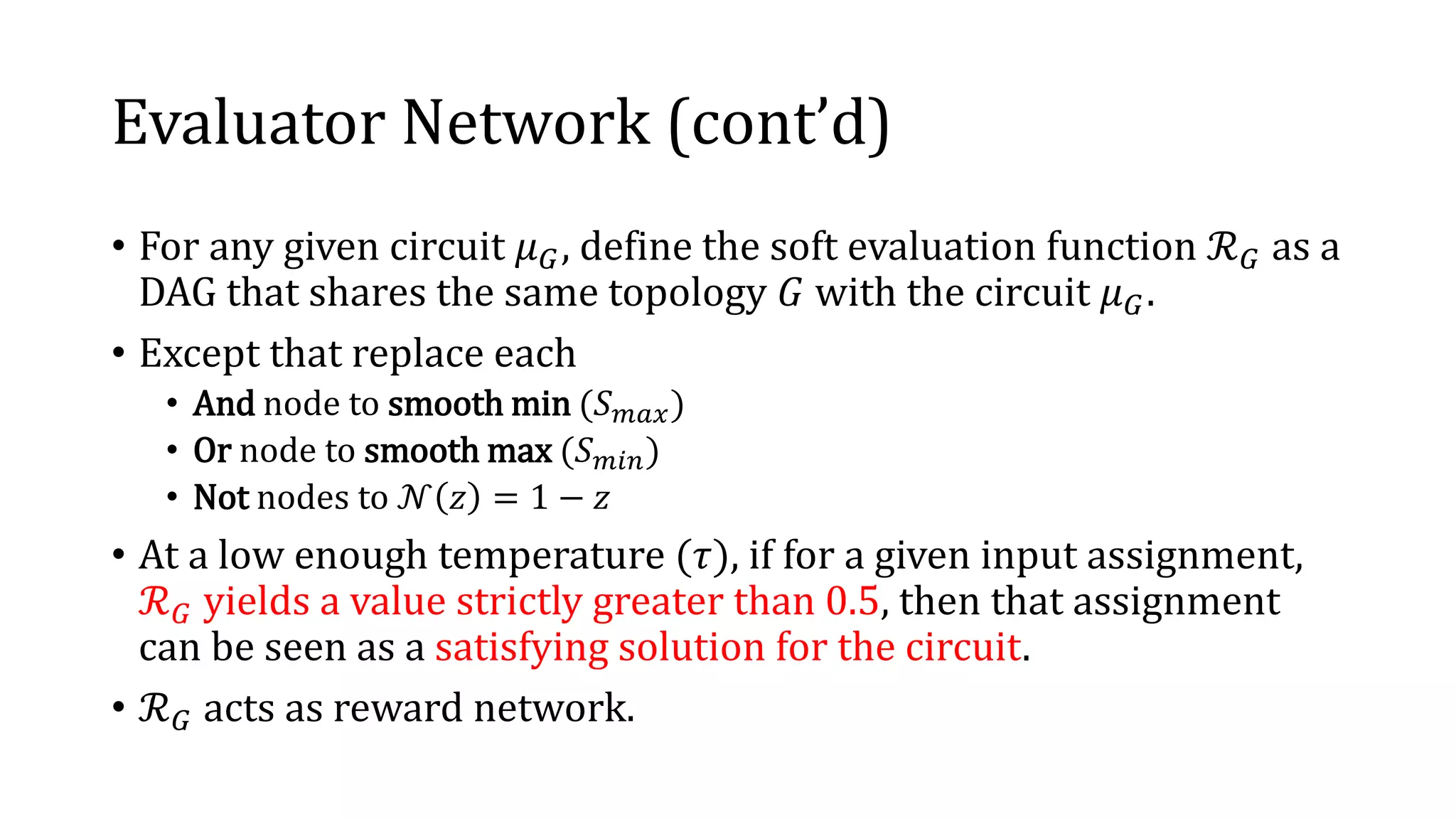
• For any given circuit 𝜇 𝐺, define the soft evaluation function ℛ 𝐺 as a
DAG that shares the same topology 𝐺 with the circuit 𝜇 𝐺.
• Except that replace each
• And node to smooth min (𝑆 𝑚𝑎𝑥)
• Or node to smooth max (𝑆 𝑚𝑖𝑛)
• Not nodes to 𝒩 𝑧 = 1 − 𝑧
• At a low enough temperature (𝜏), if for a given input assignment,
ℛ 𝐺 yields a value strictly greater than 0.5, then that assignment
can be seen as a satisfying solution for the circuit.
• ℛ 𝐺 acts as reward network.
Optimization
• 𝒮 𝜃: 𝒢 ↦ [0, 1] as 𝑆 𝜃 𝜇 𝐺 = ℛ 𝐺(ℱ 𝜃(𝜇 𝐺))
• Use the policy network to produce assignment and feed to reward
network to validate the satisfiability.
• Minimize the loss function
ℒ 𝑠 =
1−𝑠 𝜅
1−𝑠 𝜅+𝑠 𝜅 where 𝑠 = 𝒮 𝜃(𝜇 𝐺) and 𝜅 ≥ 1
• Could be seen as the portion of un-satisfiability.
Experimental evaluation
• Baseline: NeuroSAT
• Assume input problems come in CNF.
• Convert the input CNF into circuit before feeding to proposed
model (DG-DAGRNN).
• Use the same generation process in NeuroSAT to produce the
random dataset.
• 300K SAT and UNSAT pairs
• Number of Boolean variables: 3 to 10
• Performance metric: the percentage of SAT problems in the test
set that each model can actually find a SAT solution for.
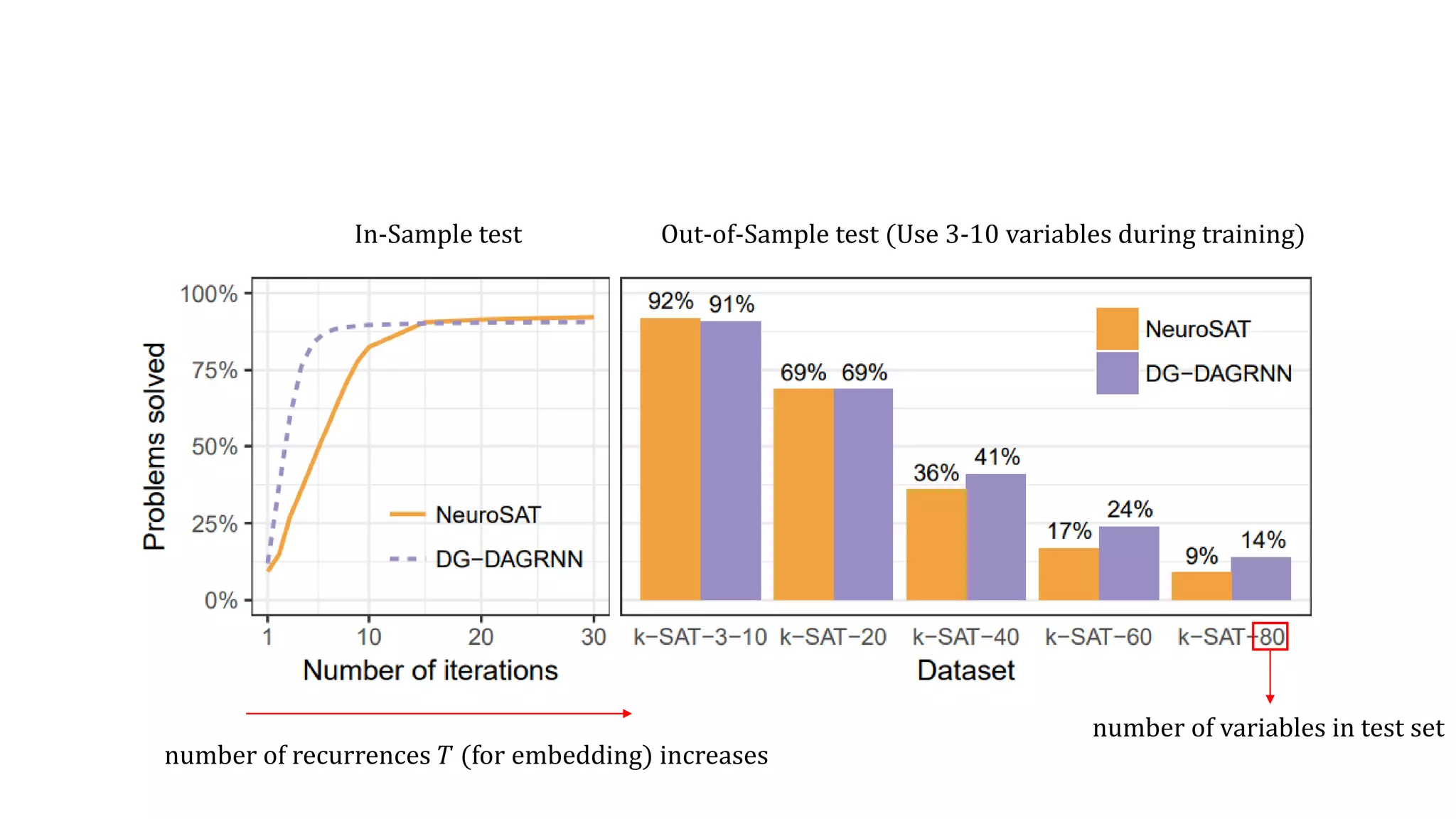
number of recurrences 𝑇 (for embedding) increases
In-Sample test Out-of-Sample test (Use 3-10 variables during training)
number of variables in test set
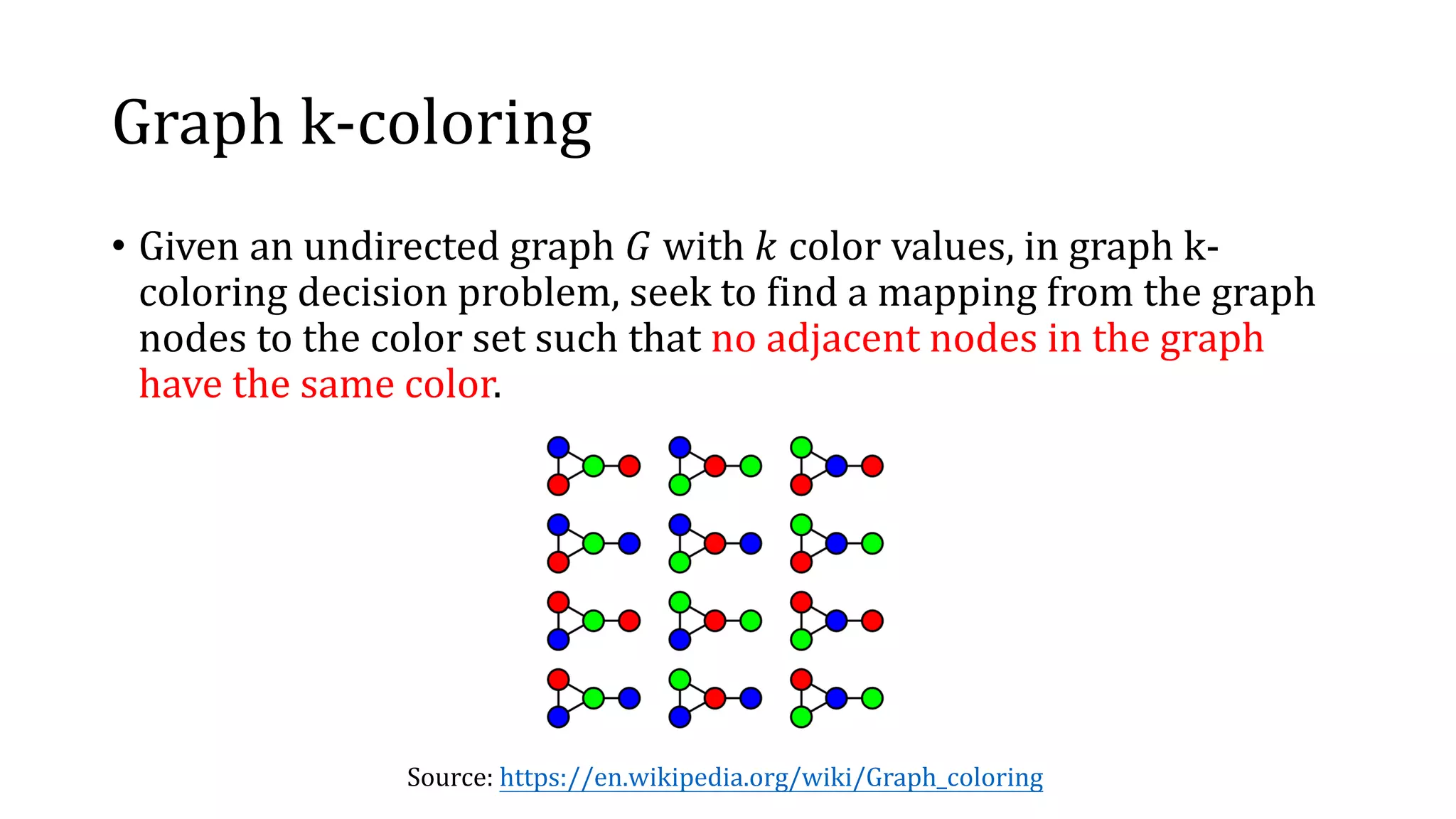
Graph k-coloring
• Given an undirected graph 𝐺 with 𝑘 color values, in graph k-
coloring decision problem, seek to find a mapping from the graph
nodes to the color set such that no adjacent nodes in the graph
have the same color.
Source: https://en.wikipedia.org/wiki/Graph_coloring
Graph k-coloring (cont’d)
• Given a graph with 𝑁 nodes and maximum 𝑘 allowed colors,
• Define 𝑥𝑖𝑗 for 1 ≤ 𝑖 ≤ 𝑁 and 1 ≤ 𝑗 ≤ 𝑘, where 𝑥𝑖𝑗 = 1 indicates
that the 𝑖th node is colored by the 𝑗th color.
• Transform the problem to SAT problem with Boolean CNF:
• ⋀𝑖=1
𝑁
(⋁𝑗=1
𝑘
𝑥𝑖𝑗) ∧ [⋀ 𝑝,𝑞 ∈𝐸(⋀𝑗=1
𝑘
(¬𝑥 𝑝𝑗 ∨ ¬𝑥 𝑞𝑗))]
• Left set of clauses (red): ensure that each node of the graph takes at least
one color.
• Right set of clauses (blue): constrain that the neighboring nodes cannot
take the same color. 𝒙 𝒑𝒋 𝒙 𝒒𝒋 (¬𝑥 𝑝𝑗 ∨ ¬𝑥 𝑞𝑗)
0 0 1
0 1 1
1 0 1
1 1 0
Example
blue green red
1 T F F
2 F F T
3 F T F
4 F F T
1
3
2
4
⋀𝑖=1
𝑁
(⋁𝑗=1
𝑘
𝑥𝑖𝑗) ∧ [⋀ 𝑝,𝑞 ∈𝐸(⋀𝑗=1
𝑘
(¬𝑥 𝑝𝑗 ∨ ¬𝑥 𝑞𝑗))]
colornode
• Dataset 1
• number of nodes: 6-10
• edge percentage: 37%
• Generate random graph from 6 different distributions and then pair with random k color in
the range of 2 ≤ 𝑘 ≤ 4.
• Dataset 2
• Generate random trees with the same node number in dataset 1.
• Add random edges to graph until it become UNSAT.
• Remove the last added edge to form SAT problem.
• Proposed model could solve 48% and 27% in Dataset 1 and Dataset 2, respectively.
• Surprisingly, NeuroSAT could not solve any problems, which does not consist to
original paper.
• NeuroSAT may be sensitive to the change of problem distribution.
Discussion
• Propose a neural framework for efficiently learning a Circuit-SAT
solver.
• Rely on DAG-embedding architecture and efficient training
procedure.
• Solve the SAT problem in a fewer number of iterations compared
to the baseline.

Paper study: Learning to solve circuit sat

  • 1.
    Learning to SolveCircuit-SAT: an Unsupervised Differentiable Approach Saeed Amizadeh, Sergiy Matusevych and Markus Weimer Microsoft ICLR 2019
  • 2.
    Outline • Abstract • Introduction •Background • DAG embedding • Application to the Circuit-SAT problem • Experimental evaluation • Discussion
  • 3.
    Abstract • New trendof applying rich neural architectures to solve classical combinatorial optimization problems. • Propose a neural framework that can learn to solve the Circuit-SAT problem. • Rich embedding architecture that encode the problem structure • Differentiable training procedure that mimics RL • Train the model directly toward solving the SAT problem • Show the superior out-of-sample generalization performance compared to NeuroSAT method.
  • 4.
  • 5.
    • The emergenceof neural models for learning how to solve the classical combinatorial optimization problems. • In practice, for a given class of combinatorial problems, the problem instances are typically drawn from a certain (unknown) distribution. • If there are sufficient number of problem instances, ML (DL) is capable of extracting the common structures among these instances and produce models that would outperform the carefully hand-crafted algorithms.
  • 6.
    • Supervised learning •Be shown to be effective for various NP-complete problems. • The resulted model is bounded by greedy strategy (sub-optimal in general). • Reinforcement learning • Learn the optimal decision and search heuristics beyond the greedy strategy. • Challenging work to train such model. • Propose a neural Circuit-SAT training the model directly toward the end goal.
  • 7.
    Represent the instance •Classical architectures like RNNs or LSTMs • Ignore the inherent structure present in the problem instances. • Neural graph embedding embraces the information on graph that represents the problem structure. • Most methods synchronously propagate local information on an underlying graph. • The information is propagated sequentially rather than synchronously in the proposed model.
  • 8.
  • 9.
  • 10.
    SAT • The problemof determining if there exists an assignment that satisfies a given Boolean formula (consisted of variable, AND, OR and NOT). • E.g. • 𝑢1 ∨ ¬𝑢2 ∧ (¬𝑢1 ∨ 𝑢2) • 𝑢1 = 𝑢2 = TRUE → SAT • Variable: 𝑢1, 𝑢2 • Literals: 𝑢1, ¬𝑢1, 𝑢2, ¬𝑢2 • Clauses: 𝑢1 ∨ ¬𝑢2 , (¬𝑢1 ∨ 𝑢2) • Conjunctive normal form (CNF) • Conjunction (AND) of one or more clauses, where a clause is a disjunction (OR) of literals. Source: https://en.wikipedia.org/wiki/Conjunctive_normal_form
  • 11.
    Circuit-SAT • The decisionproblem of determining whether a given Boolean circuit (only composed of AND, OR and NOT gate) has an assignment of its inputs that makes the output true. Source : https://en.wikipedia.org/wiki/Circuit_satisfiability_problem 𝒙 𝟏 𝒙 𝟐 𝒚 0 0 0 0 1 0 1 0 0 1 1 1 𝒙 𝒚 0 0 1 0 𝑥1 𝑥2 𝑦 𝑦𝑥 SAT UNSAT
  • 12.
    NeuroSAT (Selsam etal. (2018)) • Approach the SAT problem as a binary classification problem. • Find the SAT solution by clustering the latent representation extracted from the learned classifier. • NOT directly trained toward finding SAT solutions. Source: https://github.com/dselsam/neurosat
  • 13.
    Direct Acyclic Graph(DAG) • Directed graph with no directed cycles. • Topological sort • Given a directed graph 𝐺, a linear ordering of its vertices such that for every directed edge (𝑢, 𝑣), 𝑢 comes before 𝑣 in the ordering. Source: http://www.csie.ntnu.edu.tw/~u91029/DirectedAcyclicGraph.html
  • 14.
  • 15.
    • DAG 𝐺= 𝑉𝐺, 𝐸 𝐺 • Reversed DAG 𝐺 𝑟 with the same set of nodes but reversed edges • For 𝑣 ∈ 𝑉𝐺, 𝜋 𝐺(𝑣) represents the set of direct predecessors • DAG function 𝜇 𝐺: 𝑉𝐺 ↦ ℝ 𝑑 • Define 𝒢 𝑑 as the space of all possible 𝑑-dimensional functions 𝜇 𝐺 • Model ℱ 𝜃 𝜇 𝐺 = 𝒞 𝒶(𝒫(ℰℬ(𝜇 𝐺))) • Embedding function ℰℬ: 𝒢 𝑑 ↦ 𝒢 𝑞 • Pooling function 𝒫: 𝒢 𝑞 ↦ 𝒢 𝑞 • Retrieve only the sink nodes in the input DAG • Classification function 𝒞 𝒶: 𝒢 𝑞 ↦ 𝒪
  • 16.
    • For simplicity,define • Feature vector 𝒙 𝑣 = 𝜇 𝐺 𝑣 ∈ ℝ 𝑑 • State vector 𝒉 𝑣 = 𝛿 𝐺 𝑣 ∈ ℝ 𝑞 where 𝛿 𝐺: 𝑉𝐺 ↦ ℝ 𝑞 • Update logic that applying on each node: 𝒉 𝑣 = 𝐺𝑅𝑈 𝒙 𝑣, 𝒉 𝑣 ′ , where 𝒉 𝑣 ′ = 𝒜({𝒉 𝑢|𝑢 ∈ 𝜋(𝑣)}) • Aggregator function 𝒜: 2 𝑉 𝐺 ↦ ℝ 𝑞 • Aggregate state of node’s direct predecessors. • Apply the update logic sequentially in the topological sort order.
  • 17.
    Deep-Gated DAG RecursiveNeural Network (DG-DAGRNN) • Stack 𝐿-layer embedding layer where the 𝑖th layer has its own parameters ℬ𝑖 and output DAG function dimensionality 𝑞𝑖. • Apply sequentially 𝑇 times on stacked 𝐿 layers. ℰℬ 𝜇 𝐺 ≡ ℰℬ 𝑇 𝜇 𝐺 , where ℰℬ 𝑡 𝜇 𝐺 = ℰ 𝑠𝑡𝑎𝑐𝑘 𝑃𝑟𝑜𝑗 𝑯 ℰℬ 𝑡−1 𝜇 𝐺 , ∀𝑡 ∈ 2. . 𝑇 ℰℬ 1 𝜇 𝐺 = ℰ 𝑠𝑡𝑎𝑐𝑘(𝜇 𝐺) s. t. ℰ 𝑠𝑡𝑎𝑐𝑘 = ℰℬ 𝐿 ∘ ℰℬ 𝐿−1 ∘ ℰ1 • 𝑤ℎ𝑒𝑟𝑒 ℬ = 〈ℬ1, … , ℬ 𝐿, 𝑯〉 is the list of parameters and 𝑃𝑟𝑜𝑗 𝑯: 𝒢 𝑞 𝐿 ↦ 𝒢 𝑑 is the linear projection with the projection matrix 𝑯 𝑑×𝑞 𝐿 .
  • 19.
  • 20.
    • DAG function𝜇 𝐺: 𝑉𝐺 ↦ ℝ4 • 𝜇 𝐺 𝑣 = One−Hot 𝑡𝑦𝑝𝑒 𝑣 where 𝑡𝑦𝑝𝑒 v ∈ 𝐀𝐧𝐝, 𝐎𝐫, 𝐍𝐨𝐭, 𝐕𝐚𝐫𝐢𝐚𝐛𝐥𝐞 • Each node representing either a Boolean variable or a logical gate. 𝑥 1 2 3 0 0 0 1 0 0 1 0 1 0 0 0 Variables in sources Only one sink
  • 21.
    Solver Network • Embeddingfunction ℰℬ: • multi-layer recursive embedding with interleaving forward and reversed layers • Last layer is a reversed layer so we can read the output from Variable nodes. • Output space encode the soft assignment (in range [0−1]) to the corresponding variable node in the input circuit. • ℱ 𝜃 acts as policy network. Pooling: Retrieve only the sink nodes
  • 22.
    Evaluator Network • 𝑆𝑚𝑎𝑥 𝑎1, 𝑎2, … , 𝑎 𝑛 = σ 𝑖=1 𝑛 𝑎 𝑖 𝑒 Τ𝑎 𝑖 𝜏 σ𝑖=1 𝑛 𝑒 Τ𝑎 𝑖 𝜏 , 𝑆 𝑚𝑖𝑛 𝑎1, 𝑎2, … , 𝑎 𝑛 = σ 𝑖=1 𝑛 𝑎 𝑖 𝑒 Τ−𝑎 𝑖 𝜏 σ𝑖=1 𝑛 𝑒− Τ𝑎 𝑖 𝜏 • For 𝜏 = +∞, 𝑆 𝑚𝑎𝑥() and 𝑆 𝑚𝑖𝑛() are arithmetic mean. • E.g. • 𝒂 = 1, 2, 3 , 𝜏 = +∞ • 𝑆 𝑚𝑎𝑥 𝒂 = 𝑆 𝑚𝑖𝑛 𝒂 = 1⋅𝑒0+2⋅𝑒0+3⋅𝑒0 𝑒0+𝑒0+𝑒0 = 1+2+3 3 = 2 • For 𝜏 → 0, 𝑆 𝑚𝑎𝑥 → max(), 𝑆 𝑚𝑖𝑛 → min() • E.g. • 𝒂 = 1, 2, 3 , 𝜏 = 0.01 • 𝑆 𝑚𝑎𝑥 𝒂 = 1⋅𝑒 Τ1 0.01+2⋅𝑒 Τ2 0.01+3⋅𝑒 Τ3 0.01 𝑒 Τ1 0.01+𝑒 Τ2 0.01+𝑒 Τ3 0.01 = 1𝑒100+2𝑒200+3𝑒300 𝑒100+𝑒200+𝑒300 ≈ 3𝑒300 𝑒300 = 3 • 𝑆 𝑚𝑖𝑛 𝒂 = 1⋅𝑒 Τ−1 0.01+2⋅𝑒 Τ−2 0.01+3⋅𝑒 Τ−3 0.01 𝑒 Τ−1 0.01+𝑒 Τ−2 0.01+𝑒 Τ−3 0.01 = 1𝑒−100+2𝑒−200+3𝑒−300 𝑒−100+𝑒−200+𝑒−300 ≈ 𝑒−100 𝑒−100 = 1
  • 23.
    Evaluator Network (cont’d) •For any given circuit 𝜇 𝐺, define the soft evaluation function ℛ 𝐺 as a DAG that shares the same topology 𝐺 with the circuit 𝜇 𝐺. • Except that replace each • And node to smooth min (𝑆 𝑚𝑎𝑥) • Or node to smooth max (𝑆 𝑚𝑖𝑛) • Not nodes to 𝒩 𝑧 = 1 − 𝑧 • At a low enough temperature (𝜏), if for a given input assignment, ℛ 𝐺 yields a value strictly greater than 0.5, then that assignment can be seen as a satisfying solution for the circuit. • ℛ 𝐺 acts as reward network.
  • 24.
    Optimization • 𝒮 𝜃:𝒢 ↦ [0, 1] as 𝑆 𝜃 𝜇 𝐺 = ℛ 𝐺(ℱ 𝜃(𝜇 𝐺)) • Use the policy network to produce assignment and feed to reward network to validate the satisfiability. • Minimize the loss function ℒ 𝑠 = 1−𝑠 𝜅 1−𝑠 𝜅+𝑠 𝜅 where 𝑠 = 𝒮 𝜃(𝜇 𝐺) and 𝜅 ≥ 1 • Could be seen as the portion of un-satisfiability.
  • 25.
  • 26.
    • Baseline: NeuroSAT •Assume input problems come in CNF. • Convert the input CNF into circuit before feeding to proposed model (DG-DAGRNN). • Use the same generation process in NeuroSAT to produce the random dataset. • 300K SAT and UNSAT pairs • Number of Boolean variables: 3 to 10 • Performance metric: the percentage of SAT problems in the test set that each model can actually find a SAT solution for.
  • 27.
    number of recurrences𝑇 (for embedding) increases In-Sample test Out-of-Sample test (Use 3-10 variables during training) number of variables in test set
  • 28.
    Graph k-coloring • Givenan undirected graph 𝐺 with 𝑘 color values, in graph k- coloring decision problem, seek to find a mapping from the graph nodes to the color set such that no adjacent nodes in the graph have the same color. Source: https://en.wikipedia.org/wiki/Graph_coloring
  • 29.
    Graph k-coloring (cont’d) •Given a graph with 𝑁 nodes and maximum 𝑘 allowed colors, • Define 𝑥𝑖𝑗 for 1 ≤ 𝑖 ≤ 𝑁 and 1 ≤ 𝑗 ≤ 𝑘, where 𝑥𝑖𝑗 = 1 indicates that the 𝑖th node is colored by the 𝑗th color. • Transform the problem to SAT problem with Boolean CNF: • ⋀𝑖=1 𝑁 (⋁𝑗=1 𝑘 𝑥𝑖𝑗) ∧ [⋀ 𝑝,𝑞 ∈𝐸(⋀𝑗=1 𝑘 (¬𝑥 𝑝𝑗 ∨ ¬𝑥 𝑞𝑗))] • Left set of clauses (red): ensure that each node of the graph takes at least one color. • Right set of clauses (blue): constrain that the neighboring nodes cannot take the same color. 𝒙 𝒑𝒋 𝒙 𝒒𝒋 (¬𝑥 𝑝𝑗 ∨ ¬𝑥 𝑞𝑗) 0 0 1 0 1 1 1 0 1 1 1 0
  • 30.
    Example blue green red 1T F F 2 F F T 3 F T F 4 F F T 1 3 2 4 ⋀𝑖=1 𝑁 (⋁𝑗=1 𝑘 𝑥𝑖𝑗) ∧ [⋀ 𝑝,𝑞 ∈𝐸(⋀𝑗=1 𝑘 (¬𝑥 𝑝𝑗 ∨ ¬𝑥 𝑞𝑗))] colornode
  • 31.
    • Dataset 1 •number of nodes: 6-10 • edge percentage: 37% • Generate random graph from 6 different distributions and then pair with random k color in the range of 2 ≤ 𝑘 ≤ 4. • Dataset 2 • Generate random trees with the same node number in dataset 1. • Add random edges to graph until it become UNSAT. • Remove the last added edge to form SAT problem. • Proposed model could solve 48% and 27% in Dataset 1 and Dataset 2, respectively. • Surprisingly, NeuroSAT could not solve any problems, which does not consist to original paper. • NeuroSAT may be sensitive to the change of problem distribution.
  • 32.
    Discussion • Propose aneural framework for efficiently learning a Circuit-SAT solver. • Rely on DAG-embedding architecture and efficient training procedure. • Solve the SAT problem in a fewer number of iterations compared to the baseline.