Clustering on Database Systems 
Vahid Mirjalili 
Michigan State University
Clustering 
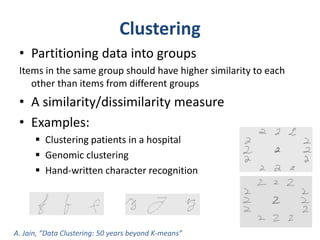
• Partitioning data into groups 
Items in the same group should have higher similarity to each 
other than items from different groups 
• A similarity/dissimilarity measure 
• Examples: 
 Clustering patients in a hospital 
 Genomic clustering 
 Hand-written character recognition 
A. Jain, “Data Clustering: 50 years beyond K-means”
Clustering vs. Classification 
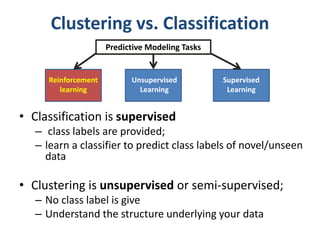
Reinforcement 
learning 
Predictive Modeling Tasks 
Unsupervised 
Learning 
• Classification is supervised 
Supervised 
Learning 
– class labels are provided; 
– learn a classifier to predict class labels of novel/unseen 
data 
• Clustering is unsupervised or semi-supervised; 
– No class label is give 
– Understand the structure underlying your data
Clustering Approaches 
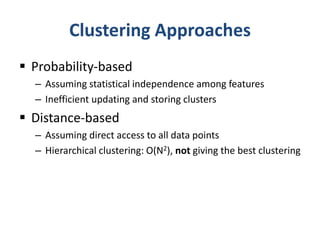
 Probability-based 
– Assuming statistical independence among features 
– Inefficient updating and storing clusters 
 Distance-based 
– Assuming direct access to all data points 
– Hierarchical clustering: O(N2), not giving the best clustering
Distance-Based Clustering Algorithms 
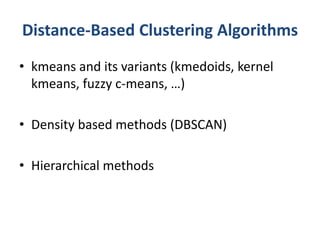
• kmeans and its variants (kmedoids, kernel 
kmeans, fuzzy c-means, …) 
• Density based methods (DBSCAN) 
• Hierarchical methods
Challenges 
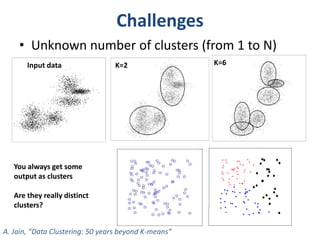
• Unknown number of clusters (from 1 to N) 
Input data K=2 K=6 
You always get some 
output as clusters 
Are they really distinct 
clusters? 
A. Jain, “Data Clustering: 50 years beyond K-means”
Challenges 
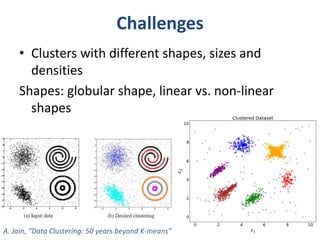
• Clusters with different shapes, sizes and 
densities 
Shapes: globular shape, linear vs. non-linear 
shapes 
A. Jain, “Data Clustering: 50 years beyond K-means”
Standard K-Means Algorithm 
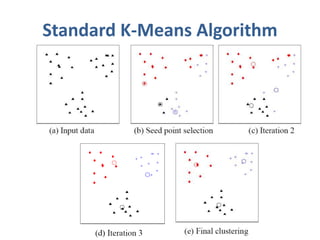
• Find initial Cluster centroids randomly 
• An iterative algorithm 
1. Assignment step: assign each data point the 
cluster whose mean is closest (smallest distance) 
2. Update step: update the mean (centroid) of each 
cluster 
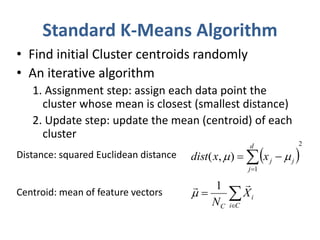
Distance: squared Euclidean distance 
( , )  
dist x   x  
 
j j  1  
 
Centroid: mean of feature vectors  
 
 
i C 
 
i 
C 
X 
N 
2 
  
1 
d 
j
Standard K-Means Algorithm
Problem in Database-oriented 
Clustering 
• Low memory available compared to size of 
dataset  data doesn’t fit in main memory 
• High I/O 
• Necessary to avoid too many iterations
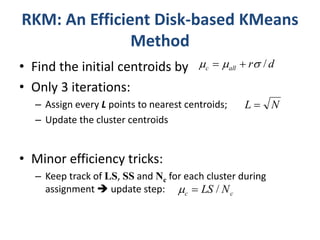
RKM: An Efficient Disk-based KMeans 
Method 
• Find the initial centroids by 
• Only 3 iterations: 
r d c all      / 
– Assign every L points to nearest centroids; 
– Update the cluster centroids 
• Minor efficiency tricks: 
N L  
– Keep track of LS, SS and Nc for each cluster during 
assignment  update step: 
c c   LS / N
Implementation of RKM: 
storing data matrices 
• D  input dataset 
• Pj 
 cluster j (for j in [1..k]) 
• Mj, Qj, Nj 
 Linear Sum, Squared Sum, cluster 
size 
• Cj, Rj, Wj 
 Centroids, Variances, Weights 
(accessed during update step) 
C  
M / 
N 
j j j 
R  Q / N  
M M / 
N 
 
 
 
j j l 
l k 
j 
t 
j j j j j 
W N N 
1.. 
2 
/
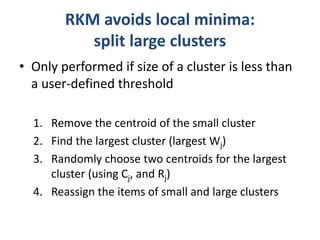
RKM avoids local minima: 
split large clusters 
• Only performed if size of a cluster is less than 
a user-defined threshold 
1. Remove the centroid of the small cluster 
2. Find the largest cluster (largest Wj) 
3. Randomly choose two centroids for the largest 
cluster (using Cj, and Rj) 
4. Reassign the items of small and large clusters
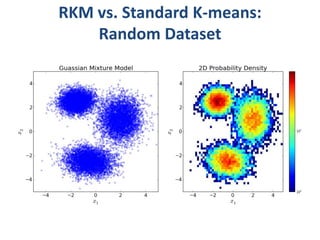
RKM vs. Standard K-means: 
Random Dataset
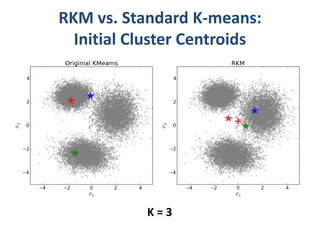
RKM vs. Standard K-means: 
Initial Cluster Centroids 
K = 3
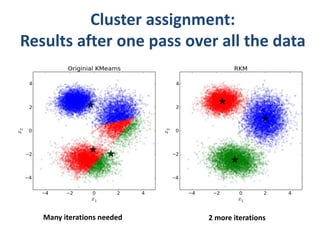
Cluster assignment: 
Results after one pass over all the data 
Many iterations needed 2 more iterations
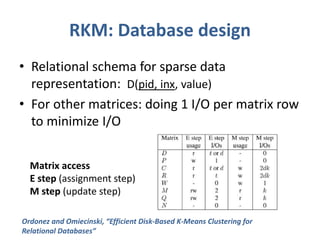
RKM: Database design 
• Relational schema for sparse data 
representation: D(pid, inx, value) 
• For other matrices: doing 1 I/O per matrix row 
to minimize I/O 
Matrix access 
E step (assignment step) 
M step (update step) 
Ordonez and Omiecinski, “Efficient Disk-Based K-Means Clustering for 
Relational Databases”
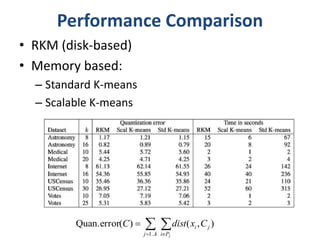
Performance Comparison 
• RKM (disk-based) 
• Memory based: 
– Standard K-means 
– Scalable K-means 
  
  
C dist x C 
Quan.error( )  
( , ) 
j k i P 
i j 
j 
1..
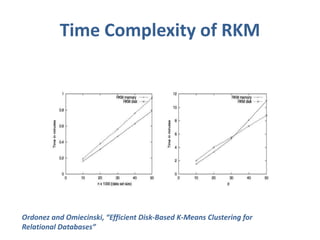
Time Complexity of RKM 
Ordonez and Omiecinski, “Efficient Disk-Based K-Means Clustering for 
Relational Databases”
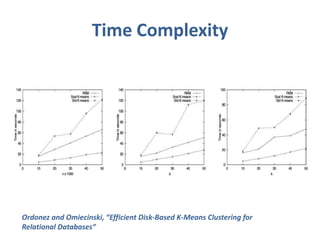
Time Complexity 
Ordonez and Omiecinski, “Efficient Disk-Based K-Means Clustering for 
Relational Databases”
Conclusion 
• RKM resolve some of the limitations of K-means 
• RKM limits disk access (I/O) 
• Final clustering is achieved with 3 iterations 
• On large datasets RKM outperforms standard K-means 
• Other limitations of K-means clustering still 
remain
Read more … 
General implementation in IPython notebook: 
http://goo.gl/YZScH9 
http://www.vahidmirjalili.com

Clustering on database systems rkm

  • 1.
    Clustering on DatabaseSystems Vahid Mirjalili Michigan State University
  • 2.
    Clustering • Partitioningdata into groups Items in the same group should have higher similarity to each other than items from different groups • A similarity/dissimilarity measure • Examples:  Clustering patients in a hospital  Genomic clustering  Hand-written character recognition A. Jain, “Data Clustering: 50 years beyond K-means”
  • 3.
    Clustering vs. Classification Reinforcement learning Predictive Modeling Tasks Unsupervised Learning • Classification is supervised Supervised Learning – class labels are provided; – learn a classifier to predict class labels of novel/unseen data • Clustering is unsupervised or semi-supervised; – No class label is give – Understand the structure underlying your data
  • 4.
    Clustering Approaches Probability-based – Assuming statistical independence among features – Inefficient updating and storing clusters  Distance-based – Assuming direct access to all data points – Hierarchical clustering: O(N2), not giving the best clustering
  • 5.
    Distance-Based Clustering Algorithms • kmeans and its variants (kmedoids, kernel kmeans, fuzzy c-means, …) • Density based methods (DBSCAN) • Hierarchical methods
  • 6.
    Challenges • Unknownnumber of clusters (from 1 to N) Input data K=2 K=6 You always get some output as clusters Are they really distinct clusters? A. Jain, “Data Clustering: 50 years beyond K-means”
  • 7.
    Challenges • Clusterswith different shapes, sizes and densities Shapes: globular shape, linear vs. non-linear shapes A. Jain, “Data Clustering: 50 years beyond K-means”
  • 8.
    Standard K-Means Algorithm • Find initial Cluster centroids randomly • An iterative algorithm 1. Assignment step: assign each data point the cluster whose mean is closest (smallest distance) 2. Update step: update the mean (centroid) of each cluster Distance: squared Euclidean distance ( , )  dist x   x   j j  1   Centroid: mean of feature vectors    i C  i C X N 2   1 d j
  • 9.
  • 10.
    Problem in Database-oriented Clustering • Low memory available compared to size of dataset  data doesn’t fit in main memory • High I/O • Necessary to avoid too many iterations
  • 11.
    RKM: An EfficientDisk-based KMeans Method • Find the initial centroids by • Only 3 iterations: r d c all      / – Assign every L points to nearest centroids; – Update the cluster centroids • Minor efficiency tricks: N L  – Keep track of LS, SS and Nc for each cluster during assignment  update step: c c   LS / N
  • 12.
    Implementation of RKM: storing data matrices • D  input dataset • Pj  cluster j (for j in [1..k]) • Mj, Qj, Nj  Linear Sum, Squared Sum, cluster size • Cj, Rj, Wj  Centroids, Variances, Weights (accessed during update step) C  M / N j j j R  Q / N  M M / N    j j l l k j t j j j j j W N N 1.. 2 /
  • 13.
    RKM avoids localminima: split large clusters • Only performed if size of a cluster is less than a user-defined threshold 1. Remove the centroid of the small cluster 2. Find the largest cluster (largest Wj) 3. Randomly choose two centroids for the largest cluster (using Cj, and Rj) 4. Reassign the items of small and large clusters
  • 14.
    RKM vs. StandardK-means: Random Dataset
  • 15.
    RKM vs. StandardK-means: Initial Cluster Centroids K = 3
  • 16.
    Cluster assignment: Resultsafter one pass over all the data Many iterations needed 2 more iterations
  • 17.
    RKM: Database design • Relational schema for sparse data representation: D(pid, inx, value) • For other matrices: doing 1 I/O per matrix row to minimize I/O Matrix access E step (assignment step) M step (update step) Ordonez and Omiecinski, “Efficient Disk-Based K-Means Clustering for Relational Databases”
  • 18.
    Performance Comparison •RKM (disk-based) • Memory based: – Standard K-means – Scalable K-means     C dist x C Quan.error( )  ( , ) j k i P i j j 1..
  • 19.
    Time Complexity ofRKM Ordonez and Omiecinski, “Efficient Disk-Based K-Means Clustering for Relational Databases”
  • 20.
    Time Complexity Ordonezand Omiecinski, “Efficient Disk-Based K-Means Clustering for Relational Databases”
  • 21.
    Conclusion • RKMresolve some of the limitations of K-means • RKM limits disk access (I/O) • Final clustering is achieved with 3 iterations • On large datasets RKM outperforms standard K-means • Other limitations of K-means clustering still remain
  • 22.
    Read more … General implementation in IPython notebook: http://goo.gl/YZScH9 http://www.vahidmirjalili.com