






















Tips on using my ppt.
1. You can freely download, edit, modify and put your
name etc.
2. Don’t be concerned about number of slides. Half the
slides are blanks except for the title.
3. First show the blank slides (eg. Aetiology ) > Ask
students what they already know about ethology of
today's topic. > Then show next slide which enumerates
aetiologies.
4. At the end rerun the show – show blank> ask questions >
show next slide.
5. This will be an ACTIVE LEARNING SESSION x
three revisions.
6. Good for self study also. Good for self study also.
Display blank slide> Think what you already know about
this > Read next slide.
Kidney infection or pyelonephritis
• Definition:
Pyelonephritis is an infection of the
kidney and the ureters.
Introduction
Introduction
• Acute pyelonephritis is a potentially organ-
and/or life-threatening infection that often
leads to renal scarring.
• Acute pyelonephritis results from bacterial
invasion of the renal parenchyma. Bacteria
usually reach the kidney by ascending from
the lower urinary tract.
• Bacteria may also reach the kidney via the
bloodstream.
Causes
Causes
• 1- urinary tract infection, in the presence of
occasional or persistent back flow of urine
from the bladder into the ureters or kidney
pelvis (vesicoureteric reflux), calculous or
obstruction to urine flow
• 2.Hematogenous – via blood supply.
Classification of pyelonephritis
Acute uncomplicated pyelonephritis
sudden development of kidney
inflammation).
Chronic pyelonephritis (a long-standing
infection that does not clear
Clinical features
Clinical features
• More common in females.
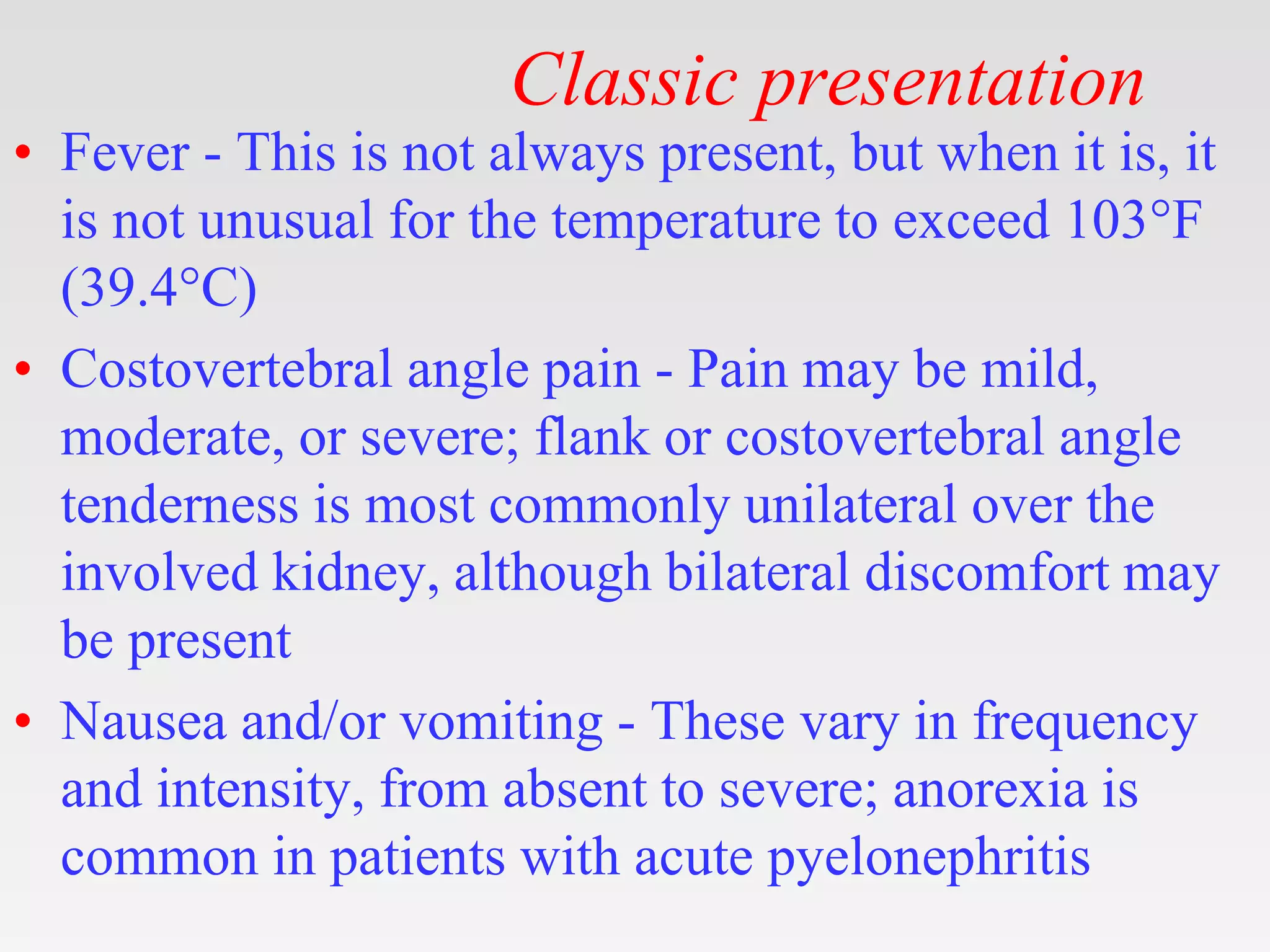
Classic presentation
• Fever - This is not always present, but when it is, it
is not unusual for the temperature to exceed 103°F
(39.4°C)
• Costovertebral angle pain - Pain may be mild,
moderate, or severe; flank or costovertebral angle
tenderness is most commonly unilateral over the
involved kidney, although bilateral discomfort may
be present
• Nausea and/or vomiting - These vary in frequency
and intensity, from absent to severe; anorexia is
common in patients with acute pyelonephritis
Clinical features
Clinical features
• Symptoms of acute pyelonephritis usually
develop over hours or over the course of a
day but may not occur at the same time. If
the patient is male, elderly, or a child or has
had symptoms for more than 7 days, the
infection should be considered complicated
until proven otherwise.
Clinical features
• Followed by lower tract sypmtoms-
– Frequency
– Dysuria
Child
Child
• The classic manifestations of acute
pyelonephritis observed in adults are often
absent in children, particularly neonates and
infants. In children aged 2 years or younger,
the most common signs and symptoms of
urinary tract infection (UTI) are as follows:
• Failure to thrive
• Feeding difficulty
• Fever
• Vomiting
Elderly
Elderly
Elderly patients may present with typical
manifestations of pyelonephritis, or they
may experience the following:
• Fever
• Mental status change
• Decompensation in another organ system
• Generalized deterioration
Complicated pyelonephritis
• A history of the following indicates an
increased risk of complicated
pyelonephritis:
– Structural abnormalities of the urinary tract
– Functional abnormalities of the urinary tract
– Metabolic abnormalities predisposing to UTIs
– Recent antibiotic use
– Recent urinary tract instrumentation
DD
DD
• Acute Abdomen and Pregnancy
• Acute Bacterial Prostatitis
• Appendicitis
• Cervicitis
• Chronic Bacterial Prostatitis
• Chronic Pyelonephritis
• Cystitis in Females
• Endometritis
• Pelvic Inflammatory Disease
• Urethritis
Diagnostic studies
•
• -A urinalysis commonly reveals white blood
cells (WBCs) or red blood cells (RBCs),
Bacteriuria>Gram’s stain
• -A urine culture may reveal bacteria in the
urine> Antibiotic sensitivity test
• A blood culture may show an infection.
• -An intravenous pyelogram (IVP) or CECT
scan of the abdomen may show enlarged
kidneys with poor flow of dye through the
kidneys.
• Abd. USG
• Scintigraphy
Diagnostic studies
• Experience with magnetic resonance
imaging (MRI) in evaluating acute
pyelonephritis is limited but growing. MRI
can detect renal infection or masses and
urinary obstruction, and it can evaluate the
renal vasculature.
• In perinephric abscess, MRI may help
define extension better than CT scan. As
there is no radiation exposure, MRI can be
used in pregnancy.
Diagnostic studies
• CT urography and MR urography are evolving
modalities that surpass intravenous urography,
which was the prior mainstay of urinary tract
imaging.
• CT urography provides a detailed anatomic
depiction of the urinary tract.
• MR urography has the advantage of not using
ionizing radiation and has the potential to provide
more functional information than CT. However, MR
urography is less established than CT urography and
is less reliable in providing diagnostic image quality.
Pathology of Ac. Pyelonephritis
• Histologic Findings
– Features of acute pyelonephritis include
suppurative necrosis or abscess formation
within the renal substance.
Treatment
Treatment
• The goals of treatment are control of the
infection and reduction of symptoms.
• Acute symptoms usually resolve within 48 to 72
after appropriate treatment.
• Due to the high mortality rate in the elderly
population and the risk of permanent kidney
damage prompt treatment is recommended.
Treatment
• Ambulatory younger women who present with
signs and symptoms of uncomplicated acute
pyelonephritis may be candidates for outpatient
therapy.
• They must be otherwise healthy and must not be
pregnant.
• Vigorous oral or IV fluids, antipyretic, pain
medication, and a dose of parenteral antibiotics.
Treatment
• Admission is usually appropriate for
patients who are severely ill, pregnant, or
elderly or who have co morbid disorders
Treatment
• Emergency surgery
– fever or positive blood culture results
persisting longer than 48 hours;
– in a patient whose condition deteriorates
– patient who appears toxic for longer than 72
hours
Treatment
• After recovery –
Elective surgery for
congenital anomalies,
fistulae involving the urogenital tract,
prostatic hypertrophy,
renal calculi,
vesicoureteric reflux.
Treatment
• Antibiotics are selected to treat the infection.
Organisms implicated
• E.coli
• Proteus
• Klebsiella
• Pseudomonas
Treatment
Antibiotic selection is typically empirical
The pathogen in community-acquired
infections is usually E coli or other
Enterobacteriaceae.
fluoroquinolones,
cephalosporins,
penicillins,
extended-spectrum penicillins,
carbapenems,
and aminoglycosides.
Treatment
If enterococci are suggested on the basis of
Gram stain results,
ampicillin
vancomycin
If any doubt exists as to the diagnosis,
coverage of both Enterobacteriaceae and
enterococci is acceptable.
Treatment
• There is a higher incidence of enterococcal
infections in hospitalized and other
institutionalized patients.
– Ampicillin or amoxicillin
– If the patient is allergic to penicillin,
vancomycin should be substituted.
Treatment
• In choosing an empirical antibiotic regimen,
consideration should include the local anti-
biogram and drug-resistance rates.
Treatment
• Patient characteristics should also be
considered. For example, patients who have
been frequently exposed to antibiotics (e.g.,
solid-organ transplant and hematopoietic
transplant patients) or are from institutional
facilities are at a greater risk for infection
with drug-resistant pathogens, such as
extended-spectrum beta-lactamase–
producing or carbapenemase-producing
organisms.
Treatment
• Regimens for complicated cases
• With complicated acute pyelonephritis, treat
patients parenterally until defervescence
and improvement in the clinical condition
warrants changing to oral antibiotics.
Complete the course of therapy with an oral
agent selected on the basis of culture .
Treatment
• Regimens for complicated cases
• Ampicillin and an aminoglycoside
• Cefepime
• Imipenem
• Meropenem
• Piperacillin-tazobactam
• Ticarcillin-clavulanate
• If the patient is allergic to penicillin-
vancomycin.
• Vancomycin or linezolid are options if
enterococci are a consideration.
Treatment
• Outpatient Treatment for Pyelonephritis
First-line therapy
• ciprofloxacin
If fluoroquinolone resistance
• ceftriaxone
• gentamicin or tobramycin or amikacin
Treatment
• Second-line therapy
– trimethoprim/sulfamethoxazole
• Alternative therapy
– Amoxicillin-clavulanate
– Cefaclor
Treatment
• Acute pyelonephritis has customarily been
treated with 14 days of antibiotics.
However, evidence suggests that in young,
healthy women who are receiving a
fluoroquinolone, including ciprofloxacin,
the course of treatment can be shortened to
7 days.
• Young, healthy males should complete a
14-day course.
Operative Therapy
Operative Therapy
• Drainage of perinephric abscess.
• Nephrectomy
Calculi-Related Infections
In the presence of acute infection, calculi must
be removed immediately using cystoscopy
or open surgical procedure.Mere
observation is not recommended,
Options include extracorporeal shockwave
lithotripsy (ESWL), endoscopic methods,
percutaneous methods, and open surgery.
• Complications:
• Complications:
• Recurrence of pyelonephritis.
• Perinephric abscess (infection around
the kidney).
• Sepsis .
• Acute renal failure.
• Chronic renal failure.
Gram negative septicemia
• Septic Shock
• SIRS
• Sepsis
Prevention
Prevention
• Increasing the intake of fluids to
encourage frequent urination that
flushes bacteria from the bladder.
• Chemoprophylaxis
prevention
• Prompt and complete treatment of cystitis
pyelonephritis. Chronic or recurrent urinary tract
infection of the kidneys.
•
• Preventive measures may reduce symptoms and
prevent recurrence of infection. Keeping the
genital area clean and remembering to from front
to back
• Urinating immediately after sexual intercourse
may help eliminate any bacteria
Get this ppt in mobile
1. Download Microsoft
PowerPoint from play
store.
2. Open Google assistant
3. Open Google lens.
4. Scan qr code from
next slide.
Get my ppt collection
• https://www.slideshare.net/drpradeeppande/
edit_my_uploads
• https://www.dropbox.com/sh/x600md3cvj8
5woy/AACVMHuQtvHvl_K8ehc3ltkEa?dl
=0
• https://www.facebook.com/doctorpradeeppa
nde/?ref=pages_you_manage

Pyelonephritis.pptx

  • 1.
    Tips on usingmy ppt. 1. You can freely download, edit, modify and put your name etc. 2. Don’t be concerned about number of slides. Half the slides are blanks except for the title. 3. First show the blank slides (eg. Aetiology ) > Ask students what they already know about ethology of today's topic. > Then show next slide which enumerates aetiologies. 4. At the end rerun the show – show blank> ask questions > show next slide. 5. This will be an ACTIVE LEARNING SESSION x three revisions. 6. Good for self study also. Good for self study also. Display blank slide> Think what you already know about this > Read next slide.
  • 2.
    Kidney infection orpyelonephritis
  • 3.
    Kidney infection orpyelonephritis • Definition: Pyelonephritis is an infection of the kidney and the ureters.
  • 4.
  • 5.
    Introduction • Acute pyelonephritisis a potentially organ- and/or life-threatening infection that often leads to renal scarring. • Acute pyelonephritis results from bacterial invasion of the renal parenchyma. Bacteria usually reach the kidney by ascending from the lower urinary tract. • Bacteria may also reach the kidney via the bloodstream.
  • 6.
  • 7.
    Causes • 1- urinarytract infection, in the presence of occasional or persistent back flow of urine from the bladder into the ureters or kidney pelvis (vesicoureteric reflux), calculous or obstruction to urine flow • 2.Hematogenous – via blood supply.
  • 8.
  • 9.
    Classification of pyelonephritis Acuteuncomplicated pyelonephritis sudden development of kidney inflammation). Chronic pyelonephritis (a long-standing infection that does not clear
  • 10.
  • 11.
    Clinical features • Morecommon in females.
  • 12.
  • 13.
    Classic presentation • Fever- This is not always present, but when it is, it is not unusual for the temperature to exceed 103°F (39.4°C) • Costovertebral angle pain - Pain may be mild, moderate, or severe; flank or costovertebral angle tenderness is most commonly unilateral over the involved kidney, although bilateral discomfort may be present • Nausea and/or vomiting - These vary in frequency and intensity, from absent to severe; anorexia is common in patients with acute pyelonephritis
  • 14.
  • 15.
    Clinical features • Symptomsof acute pyelonephritis usually develop over hours or over the course of a day but may not occur at the same time. If the patient is male, elderly, or a child or has had symptoms for more than 7 days, the infection should be considered complicated until proven otherwise.
  • 16.
    Clinical features • Followedby lower tract sypmtoms- – Frequency – Dysuria
  • 17.
  • 18.
    Child • The classicmanifestations of acute pyelonephritis observed in adults are often absent in children, particularly neonates and infants. In children aged 2 years or younger, the most common signs and symptoms of urinary tract infection (UTI) are as follows: • Failure to thrive • Feeding difficulty • Fever • Vomiting
  • 19.
  • 20.
    Elderly Elderly patients maypresent with typical manifestations of pyelonephritis, or they may experience the following: • Fever • Mental status change • Decompensation in another organ system • Generalized deterioration
  • 21.
  • 22.
    Complicated pyelonephritis • Ahistory of the following indicates an increased risk of complicated pyelonephritis: – Structural abnormalities of the urinary tract – Functional abnormalities of the urinary tract – Metabolic abnormalities predisposing to UTIs – Recent antibiotic use – Recent urinary tract instrumentation
  • 23.
  • 24.
    DD • Acute Abdomenand Pregnancy • Acute Bacterial Prostatitis • Appendicitis • Cervicitis • Chronic Bacterial Prostatitis • Chronic Pyelonephritis • Cystitis in Females • Endometritis • Pelvic Inflammatory Disease • Urethritis
  • 25.
    Diagnostic studies • • -Aurinalysis commonly reveals white blood cells (WBCs) or red blood cells (RBCs), Bacteriuria>Gram’s stain • -A urine culture may reveal bacteria in the urine> Antibiotic sensitivity test • A blood culture may show an infection. • -An intravenous pyelogram (IVP) or CECT scan of the abdomen may show enlarged kidneys with poor flow of dye through the kidneys. • Abd. USG • Scintigraphy
  • 26.
    Diagnostic studies • Experiencewith magnetic resonance imaging (MRI) in evaluating acute pyelonephritis is limited but growing. MRI can detect renal infection or masses and urinary obstruction, and it can evaluate the renal vasculature. • In perinephric abscess, MRI may help define extension better than CT scan. As there is no radiation exposure, MRI can be used in pregnancy.
  • 27.
    Diagnostic studies • CTurography and MR urography are evolving modalities that surpass intravenous urography, which was the prior mainstay of urinary tract imaging. • CT urography provides a detailed anatomic depiction of the urinary tract. • MR urography has the advantage of not using ionizing radiation and has the potential to provide more functional information than CT. However, MR urography is less established than CT urography and is less reliable in providing diagnostic image quality.
  • 28.
    Pathology of Ac.Pyelonephritis
  • 29.
    Pathology of Ac.Pyelonephritis • Histologic Findings – Features of acute pyelonephritis include suppurative necrosis or abscess formation within the renal substance.
  • 30.
  • 31.
    Treatment • The goalsof treatment are control of the infection and reduction of symptoms. • Acute symptoms usually resolve within 48 to 72 after appropriate treatment. • Due to the high mortality rate in the elderly population and the risk of permanent kidney damage prompt treatment is recommended.
  • 32.
    Treatment • Ambulatory youngerwomen who present with signs and symptoms of uncomplicated acute pyelonephritis may be candidates for outpatient therapy. • They must be otherwise healthy and must not be pregnant. • Vigorous oral or IV fluids, antipyretic, pain medication, and a dose of parenteral antibiotics.
  • 33.
    Treatment • Admission isusually appropriate for patients who are severely ill, pregnant, or elderly or who have co morbid disorders
  • 34.
    Treatment • Emergency surgery –fever or positive blood culture results persisting longer than 48 hours; – in a patient whose condition deteriorates – patient who appears toxic for longer than 72 hours
  • 35.
    Treatment • After recovery– Elective surgery for congenital anomalies, fistulae involving the urogenital tract, prostatic hypertrophy, renal calculi, vesicoureteric reflux.
  • 36.
    Treatment • Antibiotics areselected to treat the infection.
  • 37.
  • 38.
    Organisms implicated • E.coli •Proteus • Klebsiella • Pseudomonas
  • 39.
    Treatment Antibiotic selection istypically empirical The pathogen in community-acquired infections is usually E coli or other Enterobacteriaceae. fluoroquinolones, cephalosporins, penicillins, extended-spectrum penicillins, carbapenems, and aminoglycosides.
  • 40.
    Treatment If enterococci aresuggested on the basis of Gram stain results, ampicillin vancomycin If any doubt exists as to the diagnosis, coverage of both Enterobacteriaceae and enterococci is acceptable.
  • 41.
    Treatment • There isa higher incidence of enterococcal infections in hospitalized and other institutionalized patients. – Ampicillin or amoxicillin – If the patient is allergic to penicillin, vancomycin should be substituted.
  • 42.
    Treatment • In choosingan empirical antibiotic regimen, consideration should include the local anti- biogram and drug-resistance rates.
  • 43.
    Treatment • Patient characteristicsshould also be considered. For example, patients who have been frequently exposed to antibiotics (e.g., solid-organ transplant and hematopoietic transplant patients) or are from institutional facilities are at a greater risk for infection with drug-resistant pathogens, such as extended-spectrum beta-lactamase– producing or carbapenemase-producing organisms.
  • 44.
    Treatment • Regimens forcomplicated cases • With complicated acute pyelonephritis, treat patients parenterally until defervescence and improvement in the clinical condition warrants changing to oral antibiotics. Complete the course of therapy with an oral agent selected on the basis of culture .
  • 45.
    Treatment • Regimens forcomplicated cases • Ampicillin and an aminoglycoside • Cefepime • Imipenem • Meropenem • Piperacillin-tazobactam • Ticarcillin-clavulanate • If the patient is allergic to penicillin- vancomycin. • Vancomycin or linezolid are options if enterococci are a consideration.
  • 46.
    Treatment • Outpatient Treatmentfor Pyelonephritis First-line therapy • ciprofloxacin If fluoroquinolone resistance • ceftriaxone • gentamicin or tobramycin or amikacin
  • 47.
    Treatment • Second-line therapy –trimethoprim/sulfamethoxazole • Alternative therapy – Amoxicillin-clavulanate – Cefaclor
  • 48.
    Treatment • Acute pyelonephritishas customarily been treated with 14 days of antibiotics. However, evidence suggests that in young, healthy women who are receiving a fluoroquinolone, including ciprofloxacin, the course of treatment can be shortened to 7 days. • Young, healthy males should complete a 14-day course.
  • 49.
  • 50.
    Operative Therapy • Drainageof perinephric abscess. • Nephrectomy
  • 51.
    Calculi-Related Infections In thepresence of acute infection, calculi must be removed immediately using cystoscopy or open surgical procedure.Mere observation is not recommended, Options include extracorporeal shockwave lithotripsy (ESWL), endoscopic methods, percutaneous methods, and open surgery.
  • 52.
  • 53.
    • Complications: • Recurrenceof pyelonephritis. • Perinephric abscess (infection around the kidney). • Sepsis . • Acute renal failure. • Chronic renal failure.
  • 54.
  • 55.
    Gram negative septicemia •Septic Shock • SIRS • Sepsis
  • 56.
  • 57.
    Prevention • Increasing theintake of fluids to encourage frequent urination that flushes bacteria from the bladder. • Chemoprophylaxis
  • 58.
    prevention • Prompt andcomplete treatment of cystitis pyelonephritis. Chronic or recurrent urinary tract infection of the kidneys. • • Preventive measures may reduce symptoms and prevent recurrence of infection. Keeping the genital area clean and remembering to from front to back • Urinating immediately after sexual intercourse may help eliminate any bacteria
  • 59.
    Get this pptin mobile 1. Download Microsoft PowerPoint from play store. 2. Open Google assistant 3. Open Google lens. 4. Scan qr code from next slide.
  • 62.
    Get my pptcollection • https://www.slideshare.net/drpradeeppande/ edit_my_uploads • https://www.dropbox.com/sh/x600md3cvj8 5woy/AACVMHuQtvHvl_K8ehc3ltkEa?dl =0 • https://www.facebook.com/doctorpradeeppa nde/?ref=pages_you_manage

Editor's Notes

  • #2 drpradeeppande@gmail.com 7697305442
  • #62 drpradeeppande@gmail.com 7697305442