UROGENTAL SYSTEM
QURATULAIN MUGHAL
BATCH IV
DOCTOR OF PHYSICAL THERAPY
ISRA UNIVERSITY
1
CONTENTS
Male reproductive system
Urinary system of male and
female
Female reproductive
system
Clinical examination
Pathologies 2
UROGENITAL SYSTEM
 It’s a combination of urinary and reproductive
system.
3
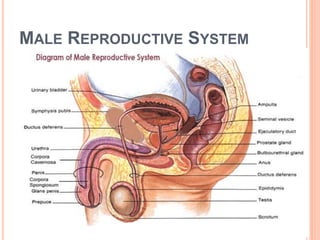
MALE REPRODUCTIVE SYSTEM
4
TESTES
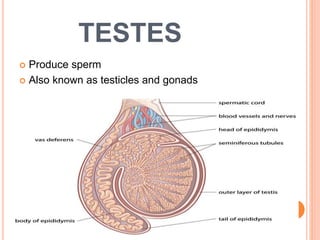
 Produce sperm
 Also known as testicles and gonads
5
VAS DEFERENS
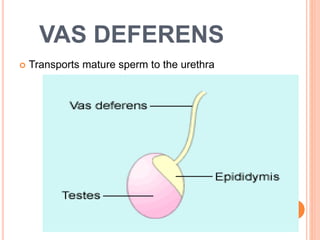
 Transports mature sperm to the urethra
6
EPIDIDYMIS
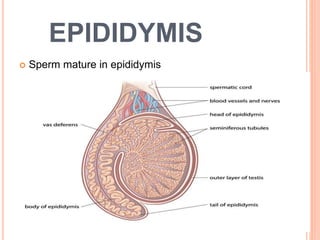
 Sperm mature in epididymis
7
SEMINAL VESICLES
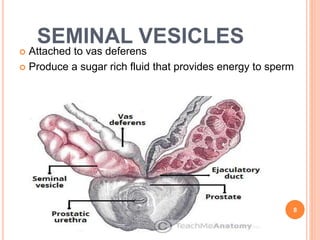
 Attached to vas deferens
 Produce a sugar rich fluid that provides energy to sperm
8
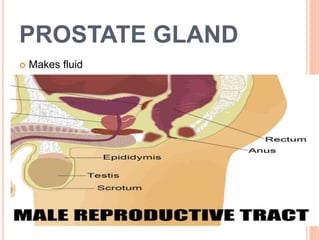
PROSTATE GLAND
 Makes fluid
9
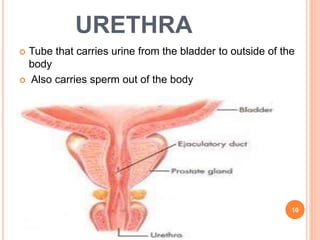
URETHRA
 Tube that carries urine from the bladder to outside of the
body
 Also carries sperm out of the body
10
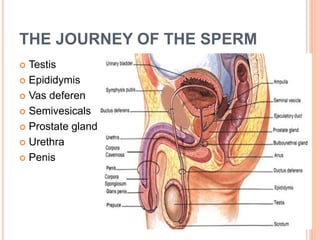
THE JOURNEY OF THE SPERM
 Testis
 Epididymis
 Vas deferen
 Semivesicals
 Prostate gland
 Urethra
 Penis
11
12
PENIS
MALFORMATIONS
 Hypospadias
 the more common of the two conditions, the abnormal
opening of the urethra is on the ventral aspect of the
penis anywhere along the shaft
 Epispadias
 the abnormal urethral orifice is on the dorsal aspect of
the penis.
13
INFLAMMATORY LESIONS
Balanitis and balanoposthitis
 refer to local inflammation of the glans
penis and of the overlying prepuce,
respectively.
 Candida albicans, anaerobic bacteria,
Gardnerella, and pyogenic bacteria.
 poor local hygiene in uncircumcised
males, with accumulations of
desquamated epithelial cells, sweat, and
debris, termed smegma, acting as a
local irritant.
14
Phimosis
 condition in which the prepuce cannot be retracted
easily over the glans penis.
 most cases are acquired from scarring of the prepuce
secondary to previous episodes of balanoposthitis.
15
NEOPLASMS
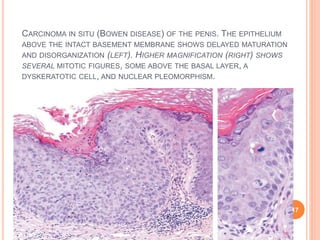
 Squamous cell carcinoma in situ of the penis
 Bowendisease
 older uncircumcised males
 grossly as a solitary plaque on the shaft of the penis.
 Histologic examination reveals morphologically
malignant cells throughout the epidermis with no
invasion of the underlying stroma
16
CARCINOMA IN SITU (BOWEN DISEASE) OF THE PENIS. THE EPITHELIUM
ABOVE THE INTACT BASEMENT MEMBRANE SHOWS DELAYED MATURATION
AND DISORGANIZATION (LEFT). HIGHER MAGNIFICATION (RIGHT) SHOWS
SEVERAL MITOTIC FIGURES, SOME ABOVE THE BASAL LAYER, A
DYSKERATOTIC CELL, AND NUCLEAR PLEOMORPHISM.
17
PROSTATITIS
Categories:
acute bacterial prostatitis (2% to 5% of cases)
 caused by the same organisms associated with
other acute urinary tract infections
 is associated with fever, chills, and dysuria; it may
be complicated by sepsis. On rectal examination,
the prostate is exquisitely tender and boggy.
chronic bacterial prostatitis (2% to 5% of cases)
 also caused by common uropathogen
 is associated with recurrent urinary tract infections
bracketed by asymptomatic periods. Presenting
manifestations may include with low back pain,
dysuria, and perineal and suprapubic discomfort.
18
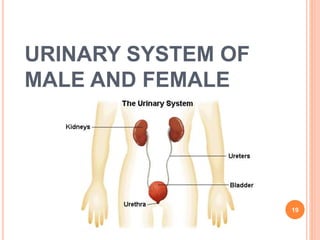
URINARY SYSTEM OF
MALE AND FEMALE
19
URINARY SYSTEM
 Kidneys (2)
 Most important excretory organ
 Eliminate waste
 Ureters (2)
 Bladder (1)
 Urethra (1)
 Nephron Unit
 Functional unit of the kidney
 Formation of urine
 Tubular and vascular structures
20
KIDNEY LOCATION AND
PROTECTION
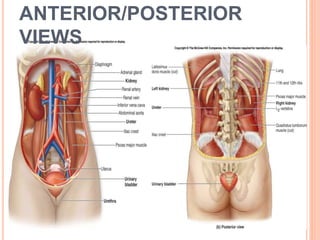
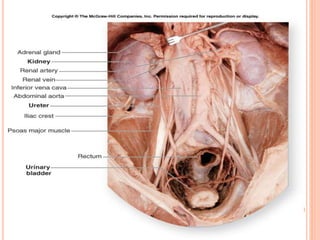
 Kidneys are located in the posterior wall of the
abdominal cavity
 In the retroperitoneal space
 Connective tissue (renal fascia) hold the kidneys in
place
 Adipose tissue cushion the kidneys
 The lower rib cage partially enclose the kidney and
protect them
21
ANTERIOR/POSTERIOR
VIEWS
22
23
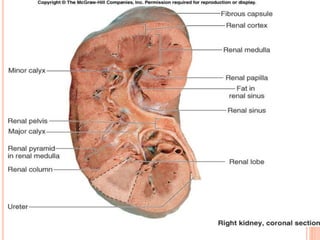
KIDNEY STRUCTURES
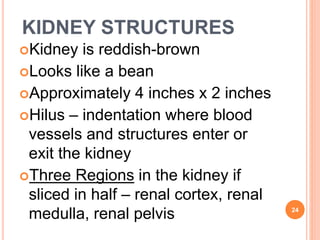
Kidney is reddish-brown
Looks like a bean
Approximately 4 inches x 2 inches
Hilus – indentation where blood
vessels and structures enter or
exit the kidney
Three Regions in the kidney if
sliced in half – renal cortex, renal
medulla, renal pelvis 24
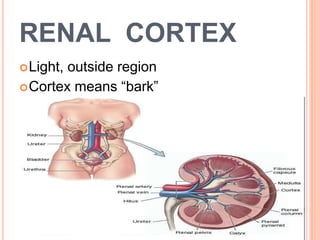
RENAL CORTEX
Light, outside region
Cortex means “bark”
25
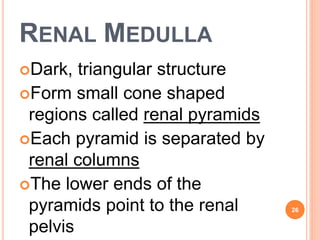
RENAL MEDULLA
Dark, triangular structure
Form small cone shaped
regions called renal pyramids
Each pyramid is separated by
renal columns
The lower ends of the
pyramids point to the renal
pelvis
26
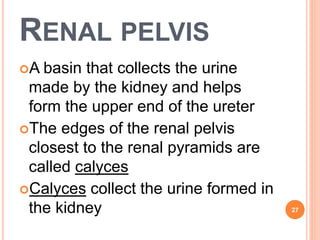
RENAL PELVIS
A basin that collects the urine
made by the kidney and helps
form the upper end of the ureter
The edges of the renal pelvis
closest to the renal pyramids are
called calyces
Calyces collect the urine formed in
the kidney 27
28
HOW DO THEY WORK?
 Need a blood supply
 Brought to the kidney via the renal artery
 Renal artery stems from the abdominal aorta
 20-25% of cardiac output goes to the kidneys
 Smaller arteries supply blood to the nephron unit
 Blood leaves the kidney via the renal veins
 The renal veins empty into the inferior vena cava
29
FUNCTIONS OF THE KIDNEYS
 Excrete nitrogenous waste from the body
 Urea
 Ammonia
 Creatinine
 Regulate blood volume
 Help regulate electrolyte content of the blood
 Regulate acid-base balance (pH)
 Regulate blood pressure
 Regulates red blood cell production
30
THE FORMATION OF URINE
The Nephron Unit
Each kidney contains about 1 million
nephron units
The number does not increase after
birth
They cannot be replaced if damaged
2 parts
 Tubular component (renal tubule)
 Vascular component 31
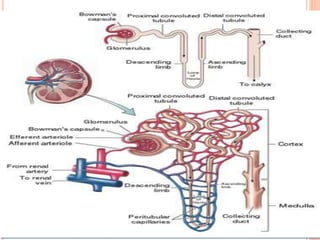
RENAL TUBULES
Glomerular capsule (Bowman’s
Capsule) – “C” shaped capsule
surrounding the glomerulus
Glomerulus – cluster of capillaries
 Proximal convoluted tubule
 Loop of Henle – ascending and
descending limb
 Distal Convoluted tubule
 Collecting duct 32
33
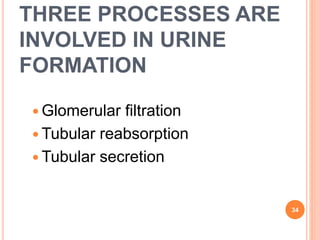
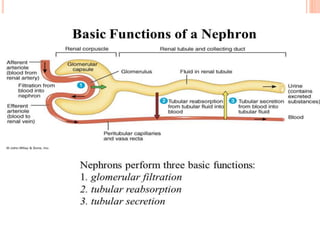
THREE PROCESSES ARE
INVOLVED IN URINE
FORMATION
 Glomerular filtration
 Tubular reabsorption
 Tubular secretion
34
35
RENAL VASCULATURE
 Receives blood from the renal artery
 Renal artery branches into the afferent arterioles
 Afferent arterioles feed into Bowman’s capsule
 The efferent arterioles exit Bowman’s capsule
 The efferent arterioles form the peritubular
capillaries
 The peritubular capillaries empty into the
venules, large veins, and then into the renal
veins
 It is imperative you know the relationship
between the tubular and vascular structures.
36
COMPOSITION OF URINE
 Sterile
 95 % water
 Nitrogen containing waste – urea, uric acid,
ammonia, creatinine
 Electrolytes
 Light yellow color of urine is due to a pigment called
urochrome
 Urochrome is formed from the breakdown of
hemoglobin in the liver
37
URINE CHARACTERISTICS
 Amount – 1500 ml in 24 hours
 pH – average 6.0
 Color – yellow (amber, straw colored, concentrated,
orange, brown, red, sediment, clear or cloudy)
 Dehydrated = deep yellow, dark
 Overhydrated = pale yellow, colorless
38
ABNORMAL CONSTITUENTS OF URINE
 Albumin (protein)
 Glucose
 Red blood cells
 Hemoglobin
 White blood cells
 Ketone bodies
 Bilirubin
39
URINE TESTING
 Urinalysis
 Microscopic exam
 Culture and sensitivity
 Urine dipstick
 Urine Drug and alcohol screening
 24 hour urine testing
40
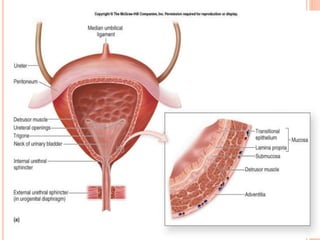
THE BLADDER
 Stores urine temporarily until elimination
 Located behind the symphasis pubis
 A distended bladder or full bladder can be
palpated above the syphasis in the abdominal
cavity.
 Bladder has 4 layers
 Mucous membrane
 Submucosa
 Detrusor muscle – involuntary smooth muscle
 Serosa
 Contain rugae to allow for stretching
 Trigone – triangular area in the floor of the
bladder 41
42
URINATION – “MICTURITION”
 Expelling urine from the bladder
 The urge to urinate (void) happened at about 200
ml of urine in the bladder
 At about 300 ml urine in the bladder, the urge
becomes more uncomfortable
 Moderately full = 500 ml urine
 Overdistended bladder may have over 1000 ml
urine
 Bacteria in your bladder doubles every 4 hours.
 Stimulated by stretch receptors
43
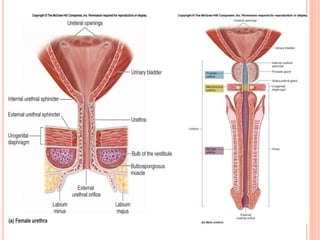
URETHRA
 Carries urine from the bladder to the outside of the
body
 Internal sphincter prevents urine from emptying;
composed of smooth muscle; involuntary
 External sphincter at the upper portion of the
urethra allows you to resist the urge to urinate;
composed of skeletal muscle; voluntary
 Female – short, opens to the outside at the urethral
meatus
 Male – longer, passes through the prostate gland;
carries urine and sperm
44
45
46
URINARY RETENTION AND
SUPPRESSION
Retention - Inability to void
 Post operative; anesthesia
 Bladder dysfunction
Suppression – no urine formation
 Kidney dysfunction
47
DISORDERS OF THE URINARY SYSTEM
 Glomerulonephritis
 Polycystic Kidney
 Pyelonephritis
 Renal Calculi – kidney stones
 Renal Failure
 UTI – urinary tract infection
48
AS WE AGE
By age 80 there is a 50% reduction in
nephron units; therefore a decreased
ability to concentrate urine
Urinary bladder shrinks and becomes less
able to contract and relax; therefore the
elderly must void frequently
Bladder infection incidence increases
Increase in bladder incontinence due to
weakened muscles 49
SIGNS AND SYMPTOMS
 Urgency
 Frequency
 Burning sensation
 Hesitancy
 Genital pain
 Lesions
 Genital swelling
 Penile discharge
 Urinary symptoms 50
HISTORY
WHAT CAN THE HISTORY TELL YOU
ABOUT THE MALE GENITOURINARY
SYSTEM?
 Biographical data
 Current health status
 Past health history
 Family history
 Review of systems
 Psychosocial history
51
PHYSICAL ASSESSMENT
Anatomical landmarks: external--note position of
structures; internal-- visualize underlying structures
Approach: inspection, palpation
52
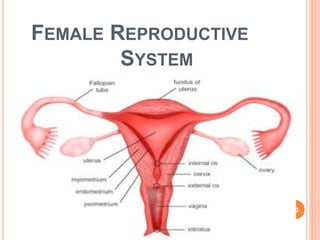
FEMALE REPRODUCTIVE
SYSTEM
53
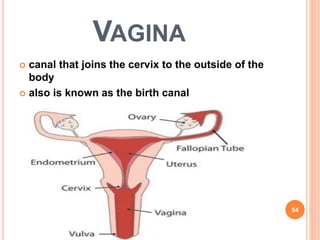
VAGINA
 canal that joins the cervix to the outside of the
body
 also is known as the birth canal
54
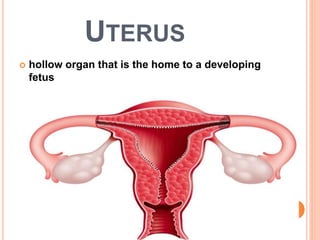
UTERUS
 hollow organ that is the home to a developing
fetus
55
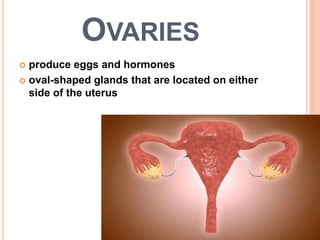
OVARIES
 produce eggs and hormones
 oval-shaped glands that are located on either
side of the uterus
56
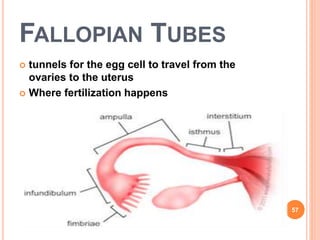
FALLOPIAN TUBES
 tunnels for the egg cell to travel from the
ovaries to the uterus
 Where fertilization happens
57
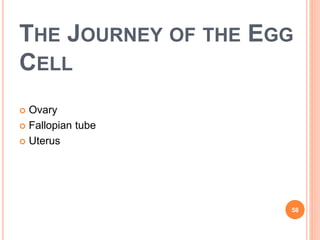
THE JOURNEY OF THE EGG
CELL
 Ovary
 Fallopian tube
 Uterus
58
59
PELVIC INFLAMMATORY
DISEASE
An inflammatory process
involving pathogenic invasion
of the fallopian tubes or
ovaries or both, as well as any
vascular or supporting
structures within the pelvis,
except the uterus. 60
SYMPTOMS
low-grade fever, pelvic pain,
abdominal pain, a “bearing
down backache, foul-smelling
vaginal discharge, nausea, etc.
Future infertility may develop
as complications
61
ENDOMETRIOSIS
during menstrual period,
endometrial cells are
stimulated by ovarian
hormone
Bleeding into surrounding
tissue occurs, causing
inflammation 62
SIGNS AND SYMPTOMS
 Discomforts of pelvic area before menses,
becoming worse during menstrual flow, and
diminishing as flow ceases .
 Fatigue
63
VAGINITIS
Inflammation of the vaginal mucosal
64
DYSMENORRHEA
Painful menstruation, also called
“menstrual cramps”
Signs and symptoms
 Subjective: headache, backache,
abdominal pain, chills, nausea
 Objective: fever, vomiting
65
AMENORRHEA
Absence of menstruation
66
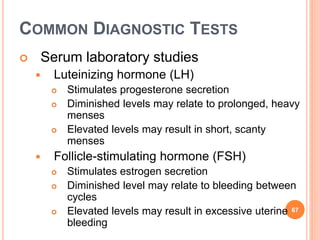
COMMON DIAGNOSTIC TESTS
 Serum laboratory studies
 Luteinizing hormone (LH)
 Stimulates progesterone secretion
 Diminished levels may relate to prolonged, heavy
menses
 Elevated levels may result in short, scanty
menses
 Follicle-stimulating hormone (FSH)
 Stimulates estrogen secretion
 Diminished level may relate to bleeding between
cycles
 Elevated levels may result in excessive uterine
bleeding
67
COMMON DIAGNOSTIC TESTS
 Laparoscopy: visualization of the
pelvic structures with a lighted
laparoscope inserted through
the abdominal wall
 Culdoscopy: visualization of the
ovaries, fallopian tubes, and
fallopian tubes, and uterus with
a lighted instrument inserted
through the vaginal tract 68
Ultrasonography
 A sound frequency that reflects an
image of the pelvic structures
 An aid in confirming ovarian and
uterine tumors
69
70
71

Urogenital system

  • 1.
    UROGENTAL SYSTEM QURATULAIN MUGHAL BATCHIV DOCTOR OF PHYSICAL THERAPY ISRA UNIVERSITY 1
  • 2.
    CONTENTS Male reproductive system Urinarysystem of male and female Female reproductive system Clinical examination Pathologies 2
  • 3.
    UROGENITAL SYSTEM  It’sa combination of urinary and reproductive system. 3
  • 4.
  • 5.
    TESTES  Produce sperm Also known as testicles and gonads 5
  • 6.
    VAS DEFERENS  Transportsmature sperm to the urethra 6
  • 7.
  • 8.
    SEMINAL VESICLES  Attachedto vas deferens  Produce a sugar rich fluid that provides energy to sperm 8
  • 9.
  • 10.
    URETHRA  Tube thatcarries urine from the bladder to outside of the body  Also carries sperm out of the body 10
  • 11.
    THE JOURNEY OFTHE SPERM  Testis  Epididymis  Vas deferen  Semivesicals  Prostate gland  Urethra  Penis 11
  • 12.
  • 13.
    PENIS MALFORMATIONS  Hypospadias  themore common of the two conditions, the abnormal opening of the urethra is on the ventral aspect of the penis anywhere along the shaft  Epispadias  the abnormal urethral orifice is on the dorsal aspect of the penis. 13
  • 14.
    INFLAMMATORY LESIONS Balanitis andbalanoposthitis  refer to local inflammation of the glans penis and of the overlying prepuce, respectively.  Candida albicans, anaerobic bacteria, Gardnerella, and pyogenic bacteria.  poor local hygiene in uncircumcised males, with accumulations of desquamated epithelial cells, sweat, and debris, termed smegma, acting as a local irritant. 14
  • 15.
    Phimosis  condition inwhich the prepuce cannot be retracted easily over the glans penis.  most cases are acquired from scarring of the prepuce secondary to previous episodes of balanoposthitis. 15
  • 16.
    NEOPLASMS  Squamous cellcarcinoma in situ of the penis  Bowendisease  older uncircumcised males  grossly as a solitary plaque on the shaft of the penis.  Histologic examination reveals morphologically malignant cells throughout the epidermis with no invasion of the underlying stroma 16
  • 17.
    CARCINOMA IN SITU(BOWEN DISEASE) OF THE PENIS. THE EPITHELIUM ABOVE THE INTACT BASEMENT MEMBRANE SHOWS DELAYED MATURATION AND DISORGANIZATION (LEFT). HIGHER MAGNIFICATION (RIGHT) SHOWS SEVERAL MITOTIC FIGURES, SOME ABOVE THE BASAL LAYER, A DYSKERATOTIC CELL, AND NUCLEAR PLEOMORPHISM. 17
  • 18.
    PROSTATITIS Categories: acute bacterial prostatitis(2% to 5% of cases)  caused by the same organisms associated with other acute urinary tract infections  is associated with fever, chills, and dysuria; it may be complicated by sepsis. On rectal examination, the prostate is exquisitely tender and boggy. chronic bacterial prostatitis (2% to 5% of cases)  also caused by common uropathogen  is associated with recurrent urinary tract infections bracketed by asymptomatic periods. Presenting manifestations may include with low back pain, dysuria, and perineal and suprapubic discomfort. 18
  • 19.
  • 20.
    URINARY SYSTEM  Kidneys(2)  Most important excretory organ  Eliminate waste  Ureters (2)  Bladder (1)  Urethra (1)  Nephron Unit  Functional unit of the kidney  Formation of urine  Tubular and vascular structures 20
  • 21.
    KIDNEY LOCATION AND PROTECTION Kidneys are located in the posterior wall of the abdominal cavity  In the retroperitoneal space  Connective tissue (renal fascia) hold the kidneys in place  Adipose tissue cushion the kidneys  The lower rib cage partially enclose the kidney and protect them 21
  • 22.
  • 23.
  • 24.
    KIDNEY STRUCTURES Kidney isreddish-brown Looks like a bean Approximately 4 inches x 2 inches Hilus – indentation where blood vessels and structures enter or exit the kidney Three Regions in the kidney if sliced in half – renal cortex, renal medulla, renal pelvis 24
  • 25.
    RENAL CORTEX Light, outsideregion Cortex means “bark” 25
  • 26.
    RENAL MEDULLA Dark, triangularstructure Form small cone shaped regions called renal pyramids Each pyramid is separated by renal columns The lower ends of the pyramids point to the renal pelvis 26
  • 27.
    RENAL PELVIS A basinthat collects the urine made by the kidney and helps form the upper end of the ureter The edges of the renal pelvis closest to the renal pyramids are called calyces Calyces collect the urine formed in the kidney 27
  • 28.
  • 29.
    HOW DO THEYWORK?  Need a blood supply  Brought to the kidney via the renal artery  Renal artery stems from the abdominal aorta  20-25% of cardiac output goes to the kidneys  Smaller arteries supply blood to the nephron unit  Blood leaves the kidney via the renal veins  The renal veins empty into the inferior vena cava 29
  • 30.
    FUNCTIONS OF THEKIDNEYS  Excrete nitrogenous waste from the body  Urea  Ammonia  Creatinine  Regulate blood volume  Help regulate electrolyte content of the blood  Regulate acid-base balance (pH)  Regulate blood pressure  Regulates red blood cell production 30
  • 31.
    THE FORMATION OFURINE The Nephron Unit Each kidney contains about 1 million nephron units The number does not increase after birth They cannot be replaced if damaged 2 parts  Tubular component (renal tubule)  Vascular component 31
  • 32.
    RENAL TUBULES Glomerular capsule(Bowman’s Capsule) – “C” shaped capsule surrounding the glomerulus Glomerulus – cluster of capillaries  Proximal convoluted tubule  Loop of Henle – ascending and descending limb  Distal Convoluted tubule  Collecting duct 32
  • 33.
  • 34.
    THREE PROCESSES ARE INVOLVEDIN URINE FORMATION  Glomerular filtration  Tubular reabsorption  Tubular secretion 34
  • 35.
  • 36.
    RENAL VASCULATURE  Receivesblood from the renal artery  Renal artery branches into the afferent arterioles  Afferent arterioles feed into Bowman’s capsule  The efferent arterioles exit Bowman’s capsule  The efferent arterioles form the peritubular capillaries  The peritubular capillaries empty into the venules, large veins, and then into the renal veins  It is imperative you know the relationship between the tubular and vascular structures. 36
  • 37.
    COMPOSITION OF URINE Sterile  95 % water  Nitrogen containing waste – urea, uric acid, ammonia, creatinine  Electrolytes  Light yellow color of urine is due to a pigment called urochrome  Urochrome is formed from the breakdown of hemoglobin in the liver 37
  • 38.
    URINE CHARACTERISTICS  Amount– 1500 ml in 24 hours  pH – average 6.0  Color – yellow (amber, straw colored, concentrated, orange, brown, red, sediment, clear or cloudy)  Dehydrated = deep yellow, dark  Overhydrated = pale yellow, colorless 38
  • 39.
    ABNORMAL CONSTITUENTS OFURINE  Albumin (protein)  Glucose  Red blood cells  Hemoglobin  White blood cells  Ketone bodies  Bilirubin 39
  • 40.
    URINE TESTING  Urinalysis Microscopic exam  Culture and sensitivity  Urine dipstick  Urine Drug and alcohol screening  24 hour urine testing 40
  • 41.
    THE BLADDER  Storesurine temporarily until elimination  Located behind the symphasis pubis  A distended bladder or full bladder can be palpated above the syphasis in the abdominal cavity.  Bladder has 4 layers  Mucous membrane  Submucosa  Detrusor muscle – involuntary smooth muscle  Serosa  Contain rugae to allow for stretching  Trigone – triangular area in the floor of the bladder 41
  • 42.
  • 43.
    URINATION – “MICTURITION” Expelling urine from the bladder  The urge to urinate (void) happened at about 200 ml of urine in the bladder  At about 300 ml urine in the bladder, the urge becomes more uncomfortable  Moderately full = 500 ml urine  Overdistended bladder may have over 1000 ml urine  Bacteria in your bladder doubles every 4 hours.  Stimulated by stretch receptors 43
  • 44.
    URETHRA  Carries urinefrom the bladder to the outside of the body  Internal sphincter prevents urine from emptying; composed of smooth muscle; involuntary  External sphincter at the upper portion of the urethra allows you to resist the urge to urinate; composed of skeletal muscle; voluntary  Female – short, opens to the outside at the urethral meatus  Male – longer, passes through the prostate gland; carries urine and sperm 44
  • 45.
  • 46.
  • 47.
    URINARY RETENTION AND SUPPRESSION Retention- Inability to void  Post operative; anesthesia  Bladder dysfunction Suppression – no urine formation  Kidney dysfunction 47
  • 48.
    DISORDERS OF THEURINARY SYSTEM  Glomerulonephritis  Polycystic Kidney  Pyelonephritis  Renal Calculi – kidney stones  Renal Failure  UTI – urinary tract infection 48
  • 49.
    AS WE AGE Byage 80 there is a 50% reduction in nephron units; therefore a decreased ability to concentrate urine Urinary bladder shrinks and becomes less able to contract and relax; therefore the elderly must void frequently Bladder infection incidence increases Increase in bladder incontinence due to weakened muscles 49
  • 50.
    SIGNS AND SYMPTOMS Urgency  Frequency  Burning sensation  Hesitancy  Genital pain  Lesions  Genital swelling  Penile discharge  Urinary symptoms 50
  • 51.
    HISTORY WHAT CAN THEHISTORY TELL YOU ABOUT THE MALE GENITOURINARY SYSTEM?  Biographical data  Current health status  Past health history  Family history  Review of systems  Psychosocial history 51
  • 52.
    PHYSICAL ASSESSMENT Anatomical landmarks:external--note position of structures; internal-- visualize underlying structures Approach: inspection, palpation 52
  • 53.
  • 54.
    VAGINA  canal thatjoins the cervix to the outside of the body  also is known as the birth canal 54
  • 55.
    UTERUS  hollow organthat is the home to a developing fetus 55
  • 56.
    OVARIES  produce eggsand hormones  oval-shaped glands that are located on either side of the uterus 56
  • 57.
    FALLOPIAN TUBES  tunnelsfor the egg cell to travel from the ovaries to the uterus  Where fertilization happens 57
  • 58.
    THE JOURNEY OFTHE EGG CELL  Ovary  Fallopian tube  Uterus 58
  • 59.
  • 60.
    PELVIC INFLAMMATORY DISEASE An inflammatoryprocess involving pathogenic invasion of the fallopian tubes or ovaries or both, as well as any vascular or supporting structures within the pelvis, except the uterus. 60
  • 61.
    SYMPTOMS low-grade fever, pelvicpain, abdominal pain, a “bearing down backache, foul-smelling vaginal discharge, nausea, etc. Future infertility may develop as complications 61
  • 62.
    ENDOMETRIOSIS during menstrual period, endometrialcells are stimulated by ovarian hormone Bleeding into surrounding tissue occurs, causing inflammation 62
  • 63.
    SIGNS AND SYMPTOMS Discomforts of pelvic area before menses, becoming worse during menstrual flow, and diminishing as flow ceases .  Fatigue 63
  • 64.
  • 65.
    DYSMENORRHEA Painful menstruation, alsocalled “menstrual cramps” Signs and symptoms  Subjective: headache, backache, abdominal pain, chills, nausea  Objective: fever, vomiting 65
  • 66.
  • 67.
    COMMON DIAGNOSTIC TESTS Serum laboratory studies  Luteinizing hormone (LH)  Stimulates progesterone secretion  Diminished levels may relate to prolonged, heavy menses  Elevated levels may result in short, scanty menses  Follicle-stimulating hormone (FSH)  Stimulates estrogen secretion  Diminished level may relate to bleeding between cycles  Elevated levels may result in excessive uterine bleeding 67
  • 68.
    COMMON DIAGNOSTIC TESTS Laparoscopy: visualization of the pelvic structures with a lighted laparoscope inserted through the abdominal wall  Culdoscopy: visualization of the ovaries, fallopian tubes, and fallopian tubes, and uterus with a lighted instrument inserted through the vaginal tract 68
  • 69.
    Ultrasonography  A soundfrequency that reflects an image of the pelvic structures  An aid in confirming ovarian and uterine tumors 69
  • 70.
  • 71.