


Therapeutic Exercise:
Foundational Concepts
Dr. QURATULAIN MUGHAL
DPT (2019)
ISRA UNIVERSITY
1Dr. QURATULAIN MUGHAL
CONTENTS
 THERAPEUTIC EXERCISE: IMPACT ON PHYSICAL
FUNCTION
 DEFINITION OF THERAPEUTIC EXERCISE
 ASPECTS OF PHYSICAL FUNCTION:
KEY TERMS
 ASPECTS OF PHYSICAL FUNCTION: DEFINITION
OF KEY TERMS
 TYPES OF THERAPEUTIC EXERCISE
INTERVENTION
 EXERCISE SAFETY
2Dr. QURATULAIN MUGHAL
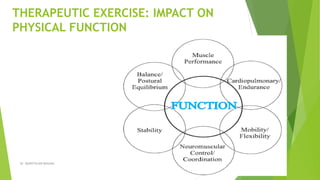
THERAPEUTIC EXERCISE: IMPACT ON
PHYSICAL FUNCTION
3Dr. QURATULAIN MUGHAL
DEFINITION OF THERAPEUTIC EXERCISE
 It is the systematic, planned performance of
bodily movements, postures, or physical activities
intended to provide a patient/client with the
means to:
 Remediate or prevent impairments.
 Improve, restore, or enhance physical function.
 Prevent or reduce health-related risk factors.
 Optimize overall health status, fitness, or sense
of well-being.
Dr. QURATULAIN MUGHAL 4
Q:WHO DESIGNED PROGRAM? AND FOR WHOM?
Therapeutic exercise programs designed by physical
therapists are individualized to the unique needs of each
patient or client.
Q: WHAT DOES PATIENT MEAN?
An individual with impairments and functional limitations
diagnosed by a physical therapist who is receiving physical
therapy care to improve function and prevent disability.
Q: WHAT DOES CLIENT MEAN?
An individual without diagnosed dysfunction who engages in
physical therapy services to promote health and wellness
and to prevent dysfunction.
Dr. QURATULAIN MUGHAL 5
ASPECTS OF PHYSICAL FUNCTION:
KEY TERMS
1. Balance
2. Cardiopulmonary fitness
3. Coordination
4. Flexibility
5. Mobility
6. Muscle performance
7. Neuromuscular control
8. Postural control, postural stability, and equilibrium
9. Stability
Dr. QURATULAIN MUGHAL 6
ASPECTS OF PHYSICAL FUNCTION:
DEFINITION OF KEY TERMS
1.Balance
 The ability to move the body in equilibrium with
gravity via interaction of the sensory and motor
systems.
2. Cardiopulmonary fitness
 The ability to perform low intensity, repetitive,
total body movements (walking, jogging, cycling,
swimming) over an extended period of time.
 It is also known as cardiopulmonary endurance.Dr. QURATULAIN MUGHAL 7
3.Coordination
 The correct timing (conscious or automatic Level) and
sequencing of muscle firing combined with the
appropriate intensity of muscular contraction leading
to the effective initiation, guiding, and grading of
movement.
4.Flexibility
 The ability to move freely, without restriction.
5. Mobility
 The ability of structures or segments of the body to
move or be moved in order to allow the occurrence of
range of motion.
 It can be AROM or PROM.
Dr. QURATULAIN MUGHAL 8
6. Muscle performance
 The capacity of muscle to produce tension and do physical work.
 Muscle performance encompasses strength, power, and muscular
endurance.
7. Neuromuscular control
 Interaction of the sensory and motor systems.
8. Postural control, postural stability, and equilibrium
 Used interchangeably with static or dynamic balance.
9. Stability
 The ability of the neuromuscular system to hold a proximal or distal
body segment in a stationary position or to control a stable base
during superimposed movement.
 Joint stability: is the maintenance of proper alignment of bony
partners of a joint by means of passive and dynamic components.
Dr. QURATULAIN MUGHAL 9
TYPES OF THERAPEUTIC EXERCISE
INTERVENTION
 Aerobic conditioning and reconditioning
 Muscle performance exercises: strength, power, and endurance training
 Stretching techniques including muscle-lengthening procedures and joint mobilization
techniques
 Neuromuscular control, inhibition, and facilitation techniques and posture awareness
training
 Postural control, body mechanics, and stabilization exercises
 Balance exercises and agility training
 Relaxation exercises
 Breathing exercises and ventilatory muscle training
 Task-specific functional training
Dr. QURATULAIN MUGHAL 10
EXERCISE SAFETY
 Patient’s safety
 Therapist safety
Dr. QURATULAIN MUGHAL 11
REFERENCE
Dr. QURATULAIN MUGHAL 12
ASSIGNMENT
Q: DEFINITION OF FOLLOWING:
 Health status
 Fitness
 Sense of well-being
 Intensity
 Grading of movement
 Muscular Strength
 Muscular Power
 Muscular endurance
 Static balance
 Dynamic balance
Dr. QURATULAIN MUGHAL 13

Therapeutic exercise foundation concepts

  • 1.
    Therapeutic Exercise: Foundational Concepts Dr.QURATULAIN MUGHAL DPT (2019) ISRA UNIVERSITY 1Dr. QURATULAIN MUGHAL
  • 2.
    CONTENTS  THERAPEUTIC EXERCISE:IMPACT ON PHYSICAL FUNCTION  DEFINITION OF THERAPEUTIC EXERCISE  ASPECTS OF PHYSICAL FUNCTION: KEY TERMS  ASPECTS OF PHYSICAL FUNCTION: DEFINITION OF KEY TERMS  TYPES OF THERAPEUTIC EXERCISE INTERVENTION  EXERCISE SAFETY 2Dr. QURATULAIN MUGHAL
  • 3.
    THERAPEUTIC EXERCISE: IMPACTON PHYSICAL FUNCTION 3Dr. QURATULAIN MUGHAL
  • 4.
    DEFINITION OF THERAPEUTICEXERCISE  It is the systematic, planned performance of bodily movements, postures, or physical activities intended to provide a patient/client with the means to:  Remediate or prevent impairments.  Improve, restore, or enhance physical function.  Prevent or reduce health-related risk factors.  Optimize overall health status, fitness, or sense of well-being. Dr. QURATULAIN MUGHAL 4
  • 5.
    Q:WHO DESIGNED PROGRAM?AND FOR WHOM? Therapeutic exercise programs designed by physical therapists are individualized to the unique needs of each patient or client. Q: WHAT DOES PATIENT MEAN? An individual with impairments and functional limitations diagnosed by a physical therapist who is receiving physical therapy care to improve function and prevent disability. Q: WHAT DOES CLIENT MEAN? An individual without diagnosed dysfunction who engages in physical therapy services to promote health and wellness and to prevent dysfunction. Dr. QURATULAIN MUGHAL 5
  • 6.
    ASPECTS OF PHYSICALFUNCTION: KEY TERMS 1. Balance 2. Cardiopulmonary fitness 3. Coordination 4. Flexibility 5. Mobility 6. Muscle performance 7. Neuromuscular control 8. Postural control, postural stability, and equilibrium 9. Stability Dr. QURATULAIN MUGHAL 6
  • 7.
    ASPECTS OF PHYSICALFUNCTION: DEFINITION OF KEY TERMS 1.Balance  The ability to move the body in equilibrium with gravity via interaction of the sensory and motor systems. 2. Cardiopulmonary fitness  The ability to perform low intensity, repetitive, total body movements (walking, jogging, cycling, swimming) over an extended period of time.  It is also known as cardiopulmonary endurance.Dr. QURATULAIN MUGHAL 7
  • 8.
    3.Coordination  The correcttiming (conscious or automatic Level) and sequencing of muscle firing combined with the appropriate intensity of muscular contraction leading to the effective initiation, guiding, and grading of movement. 4.Flexibility  The ability to move freely, without restriction. 5. Mobility  The ability of structures or segments of the body to move or be moved in order to allow the occurrence of range of motion.  It can be AROM or PROM. Dr. QURATULAIN MUGHAL 8
  • 9.
    6. Muscle performance The capacity of muscle to produce tension and do physical work.  Muscle performance encompasses strength, power, and muscular endurance. 7. Neuromuscular control  Interaction of the sensory and motor systems. 8. Postural control, postural stability, and equilibrium  Used interchangeably with static or dynamic balance. 9. Stability  The ability of the neuromuscular system to hold a proximal or distal body segment in a stationary position or to control a stable base during superimposed movement.  Joint stability: is the maintenance of proper alignment of bony partners of a joint by means of passive and dynamic components. Dr. QURATULAIN MUGHAL 9
  • 10.
    TYPES OF THERAPEUTICEXERCISE INTERVENTION  Aerobic conditioning and reconditioning  Muscle performance exercises: strength, power, and endurance training  Stretching techniques including muscle-lengthening procedures and joint mobilization techniques  Neuromuscular control, inhibition, and facilitation techniques and posture awareness training  Postural control, body mechanics, and stabilization exercises  Balance exercises and agility training  Relaxation exercises  Breathing exercises and ventilatory muscle training  Task-specific functional training Dr. QURATULAIN MUGHAL 10
  • 11.
    EXERCISE SAFETY  Patient’ssafety  Therapist safety Dr. QURATULAIN MUGHAL 11
  • 12.
  • 13.
    ASSIGNMENT Q: DEFINITION OFFOLLOWING:  Health status  Fitness  Sense of well-being  Intensity  Grading of movement  Muscular Strength  Muscular Power  Muscular endurance  Static balance  Dynamic balance Dr. QURATULAIN MUGHAL 13