1
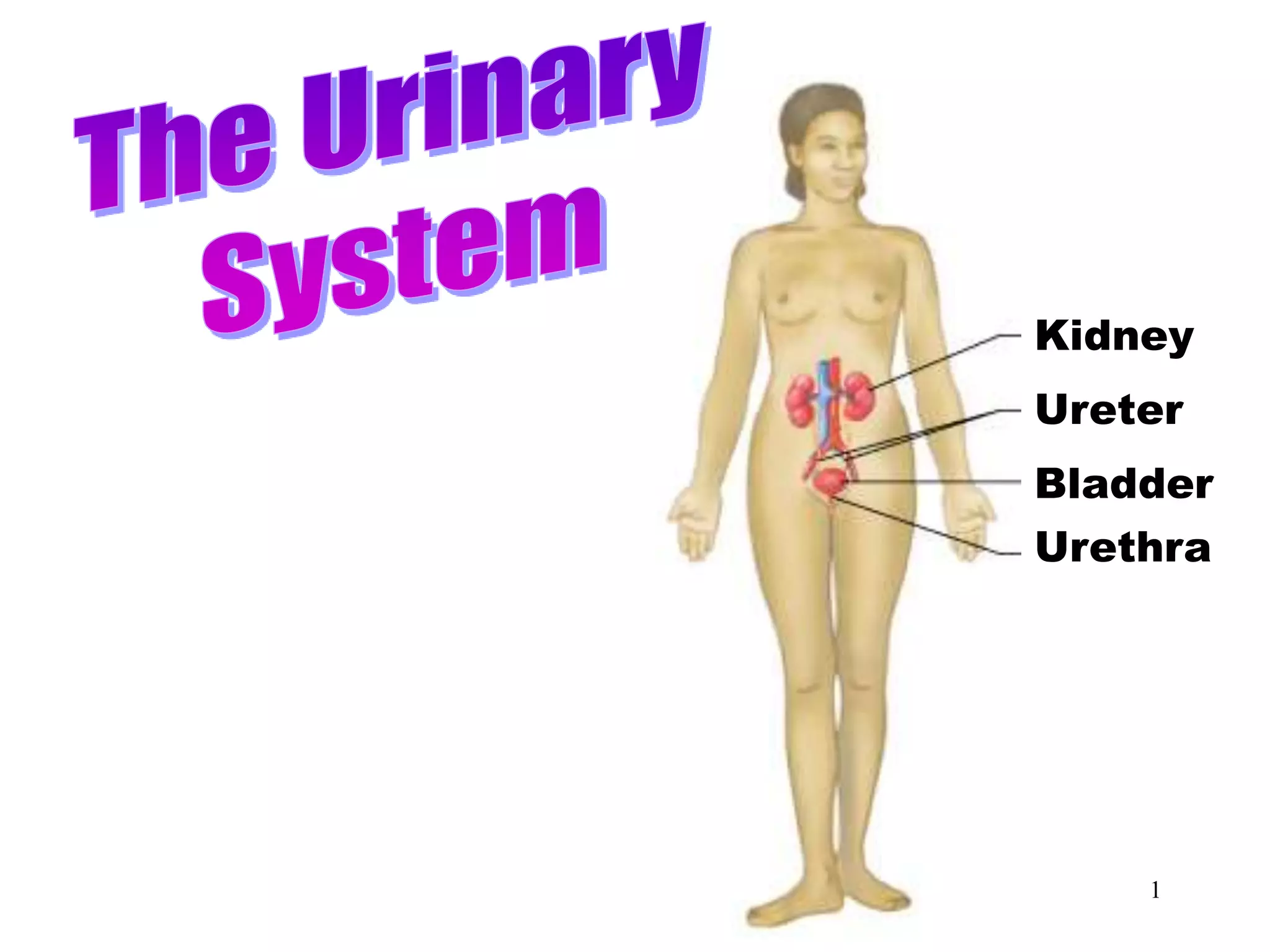
Urinary System
Urethra
Kidney
Ureter
Bladder
2
Objectives
After studying this chapter, you will be able
to:
•Name the parts of the urinary system and discuss
the function of each part
•Define combining forms used in building words that
relate to the urinary system
•Identify the meaning of related abbreviations
•Name the common diagnoses, clinical procedures,
and laboratory tests used in treating disorders of
the urinary system
3
Objectives Part 2
•List and define the major pathological conditions
of the urinary system
•Explain the meaning of surgical terms related to
the urinary system
•Recognize common pharmacological agents used
in treating the urinary system
4
Structure and Function
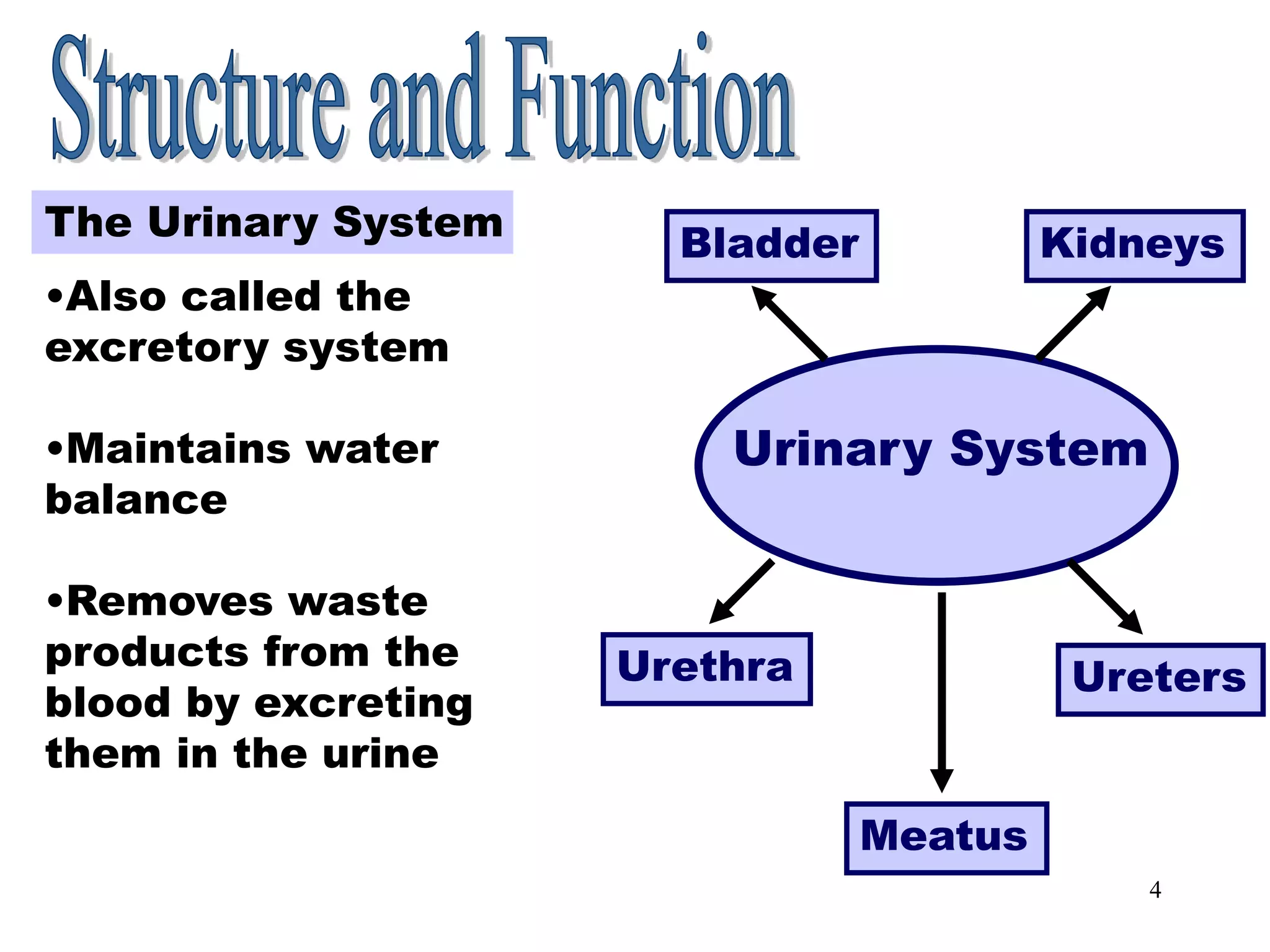
Urinary System
The Urinary System
•Also called the
excretory system
•Maintains water
balance
•Removes waste
products from the
blood by excreting
them in the urine
Bladder Kidneys
Urethra Ureters
Meatus
5
Kidneys
Kidneys
The kidneys are bean-shaped organs located in the
retroperitoneal portion of the abdominal cavity on
either side of the vertebral column.
Two Primary Functions
•To form urine for excretion
•To retain essential substances the body needs in
the process called reabsorption
6
Parts of the Kidney
kidney
Kidneys filter about 1700
liters of blood daily in the
average adult.
Parts of the kidneys
•Cortex
-outer protective portion
•Medulla
-inner soft portion
•Hilum
-a depression located in the middle of the
concave side of the kidney where blood
vessels, nerves, and the ureters enter and
exit the kidneys
cortex
medulla
hilum
7
Urine Production
Urine is produced by filtration of:
•water
•salts
•sugar
•urea
•creatine
•uric acid
Each kidney contains more than 1 million nephrons
which are the functional units of the kidneys.
Blood Flow through the Kidneys
Blood enters through the renal artery arterioles
Each arteriole leads to a nephron renal corpuscle
(which has a group of capillaries called the glomerulus)
The glomerulus filters fluid from the blood, and
is the first place where urine is formed in the
kidneys.
8
Structure and Function
•Blood flows through the
glomerulus at a constant
rate.
•Each glomerulus is
surrounded by a capsule
known as Bowman’s
capsule.
•Blood then passes into
the renal tubules where
some substances are
reabsorbed and the
remaining become urine.
Urine
Flow
Blood
Flow
Glomeruli
9
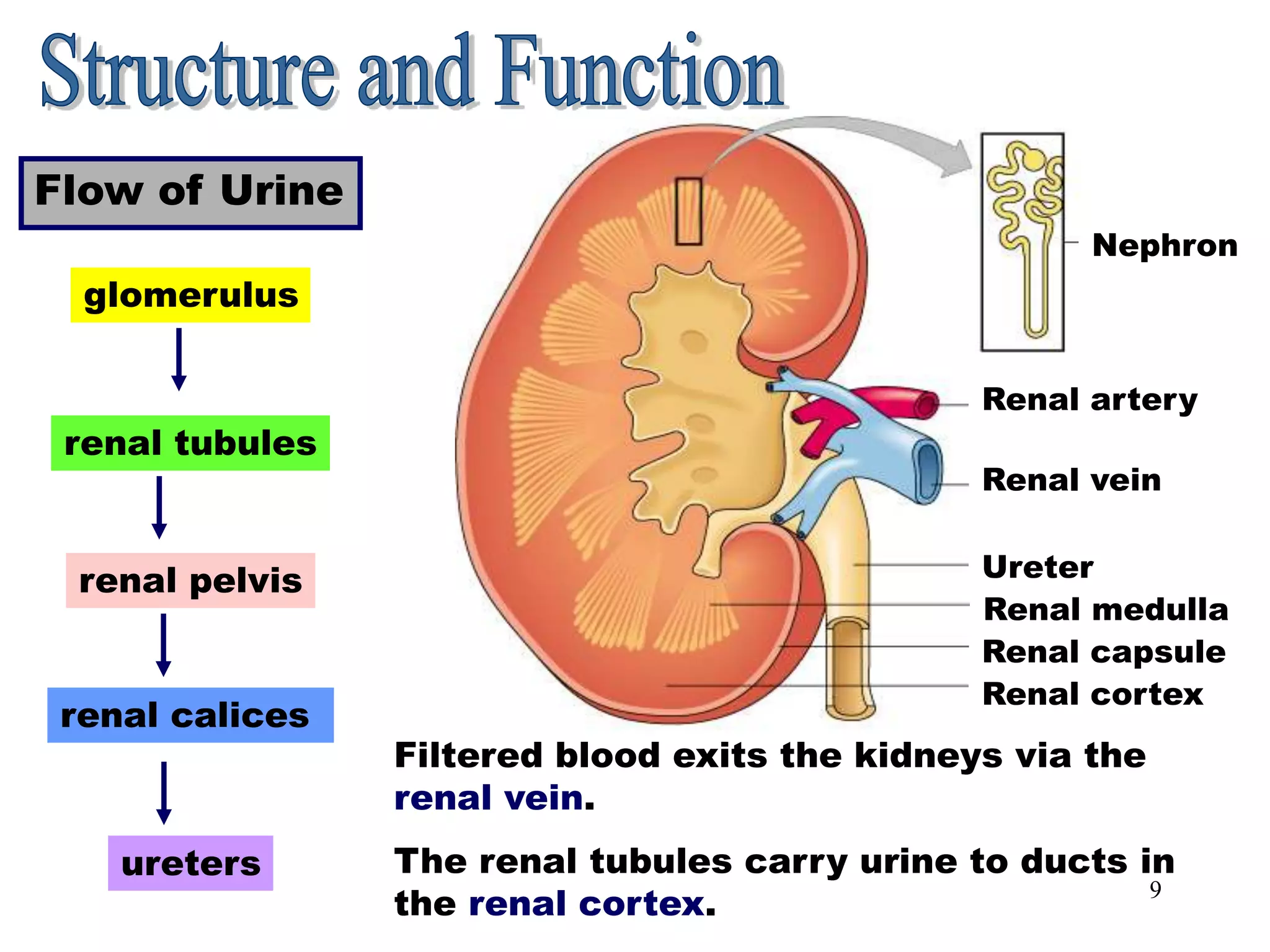
Flow of Urine
Flow of Urine
glomerulus
renal tubules
renal pelvis
renal calices
ureters The renal tubules carry urine to ducts in
the renal cortex.
Renal cortex
Renal capsule
Renal medulla
Ureter
Renal vein
Renal artery
Nephron
Filtered blood exits the kidneys via the
renal vein.
10
Ureters
Ureters
•A tube approximately 6 to 7 inches long attached
to each kidney
•Made up of three layers of tissue
-smooth muscle
-fibrous tissue
-mucous layer
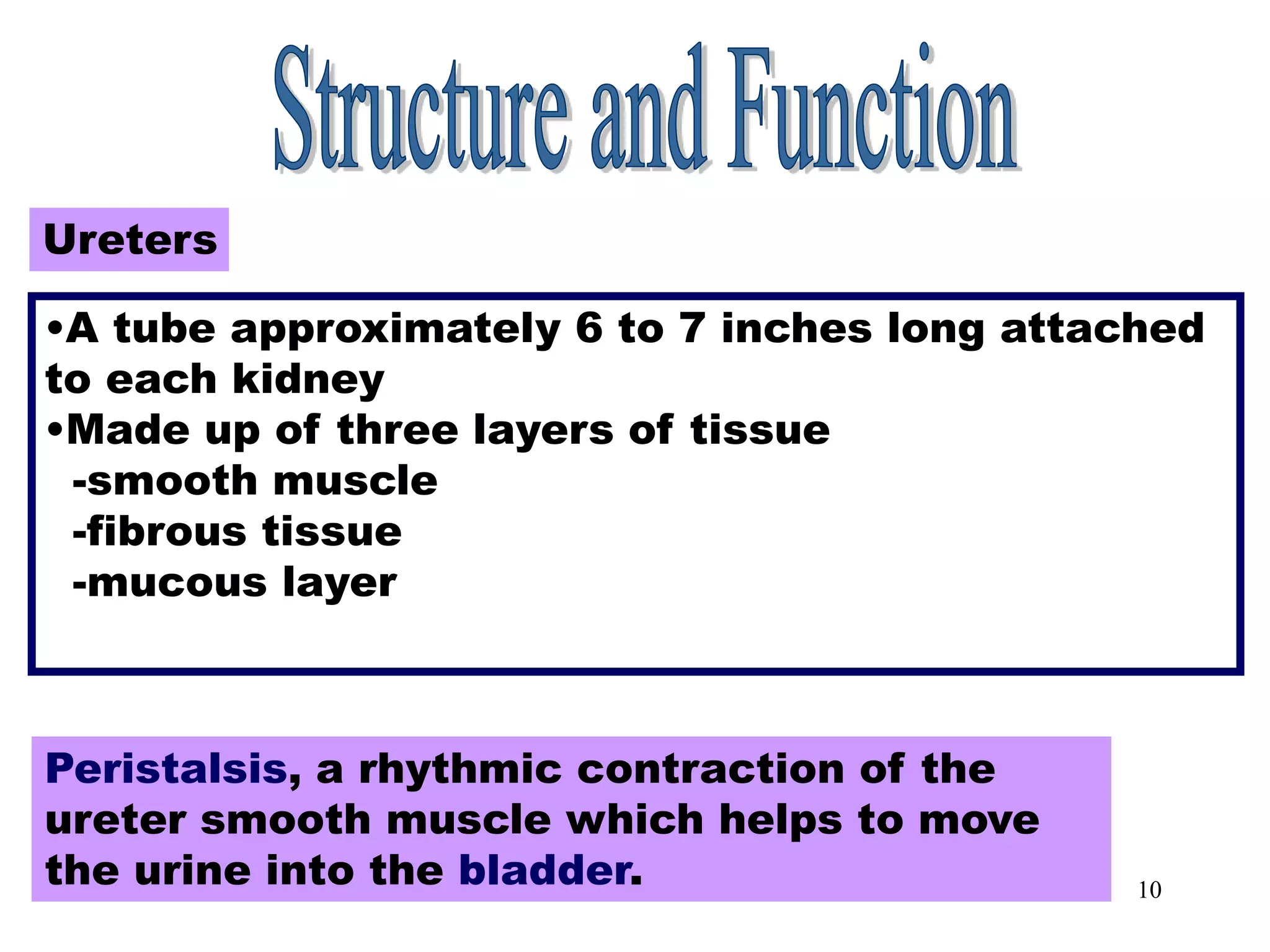
Peristalsis, a rhythmic contraction of the
ureter smooth muscle which helps to move
the urine into the bladder.
11
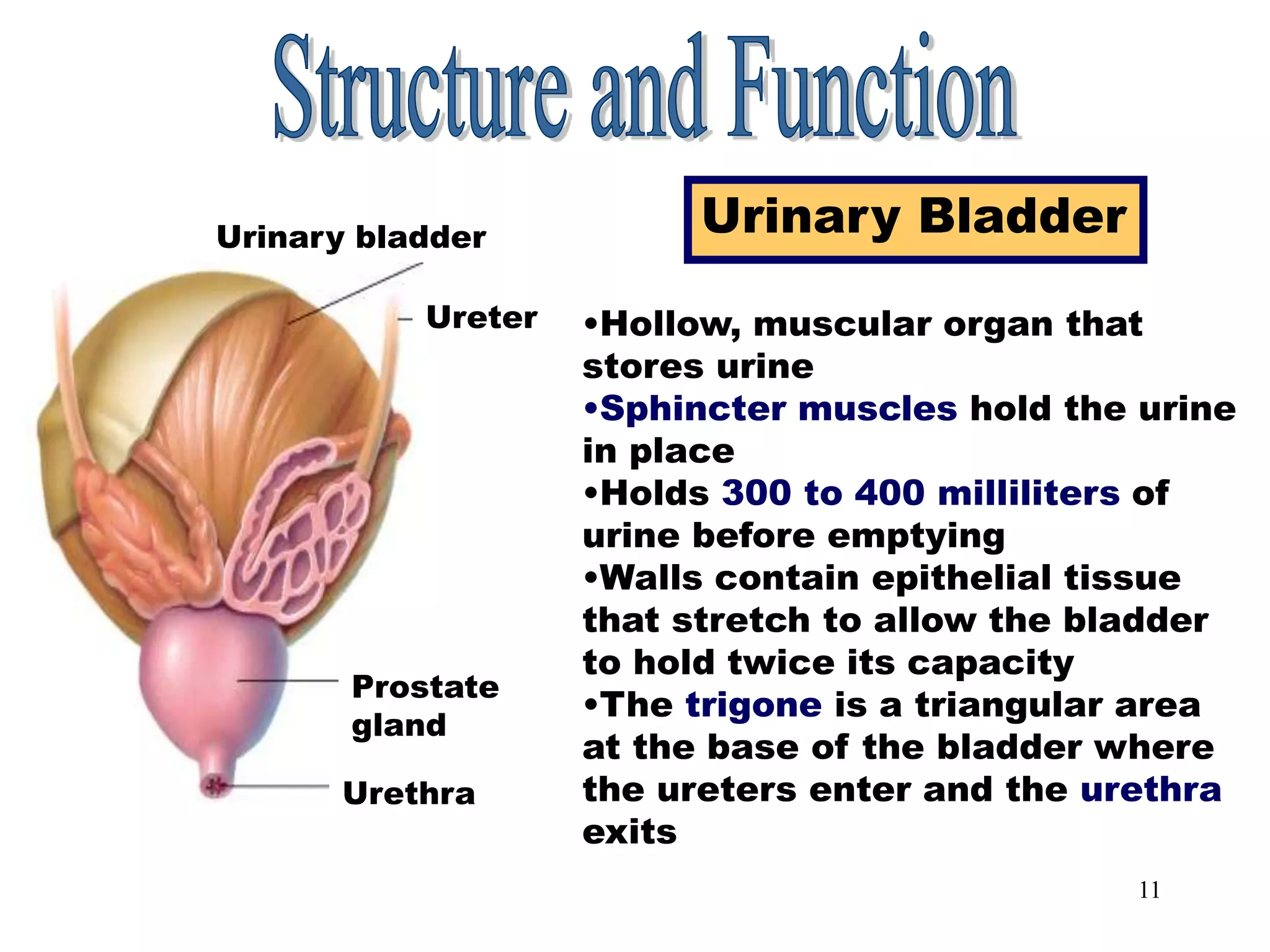
Urinary Bladder
Urinary Bladder
•Hollow, muscular organ that
stores urine
•Sphincter muscles hold the urine
in place
•Holds 300 to 400 milliliters of
urine before emptying
•Walls contain epithelial tissue
that stretch to allow the bladder
to hold twice its capacity
•The trigone is a triangular area
at the base of the bladder where
the ureters enter and the urethra
exits
Urethra
Prostate
gland
Ureter
Urinary bladder
12
Urethra
Urethra
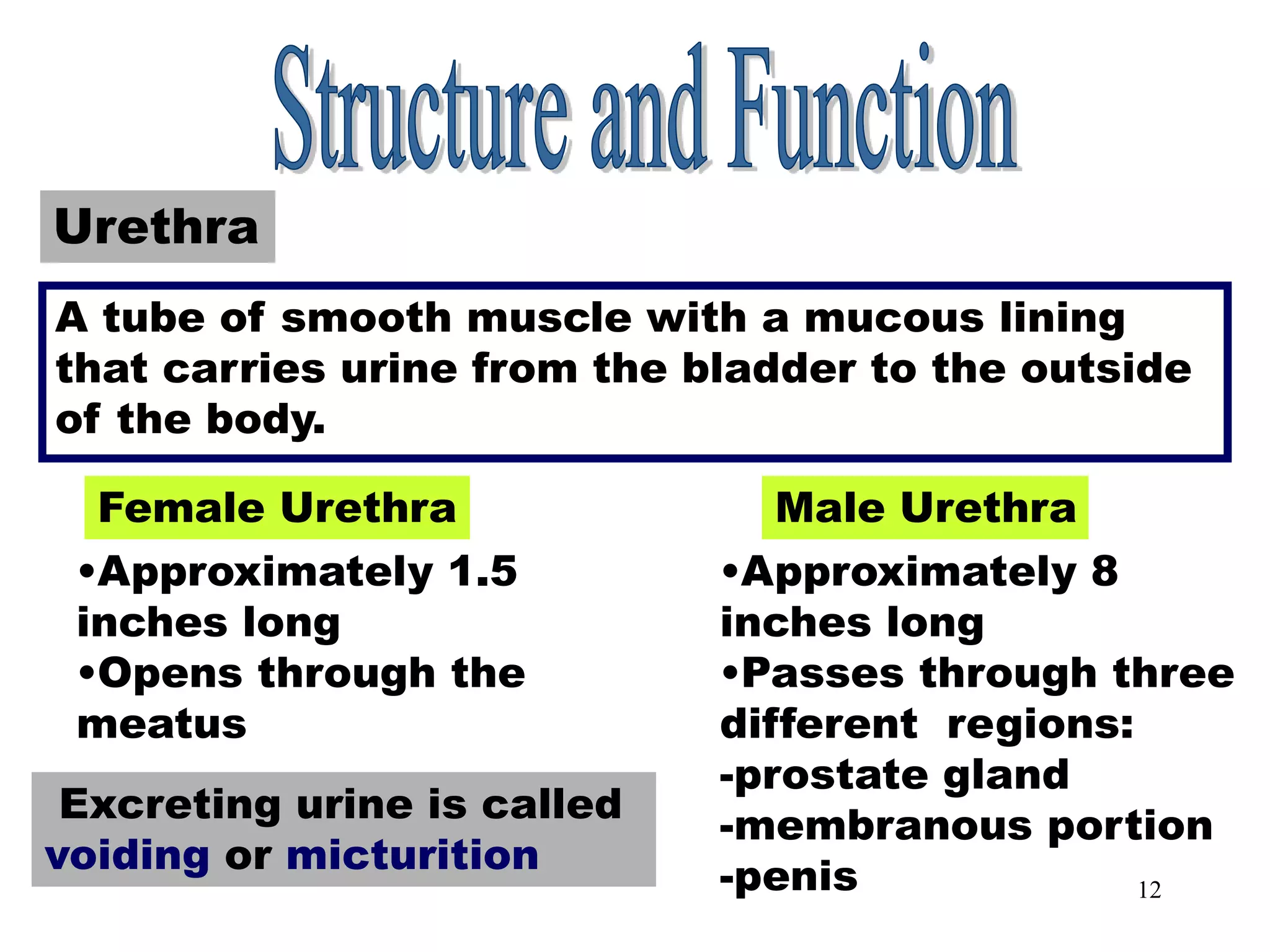
A tube of smooth muscle with a mucous lining
that carries urine from the bladder to the outside
of the body.
Female Urethra Male Urethra
•Approximately 1.5
inches long
•Opens through the
meatus
•Approximately 8
inches long
•Passes through three
different regions:
-prostate gland
-membranous portion
-penis
Excreting urine is called
voiding or micturition
13
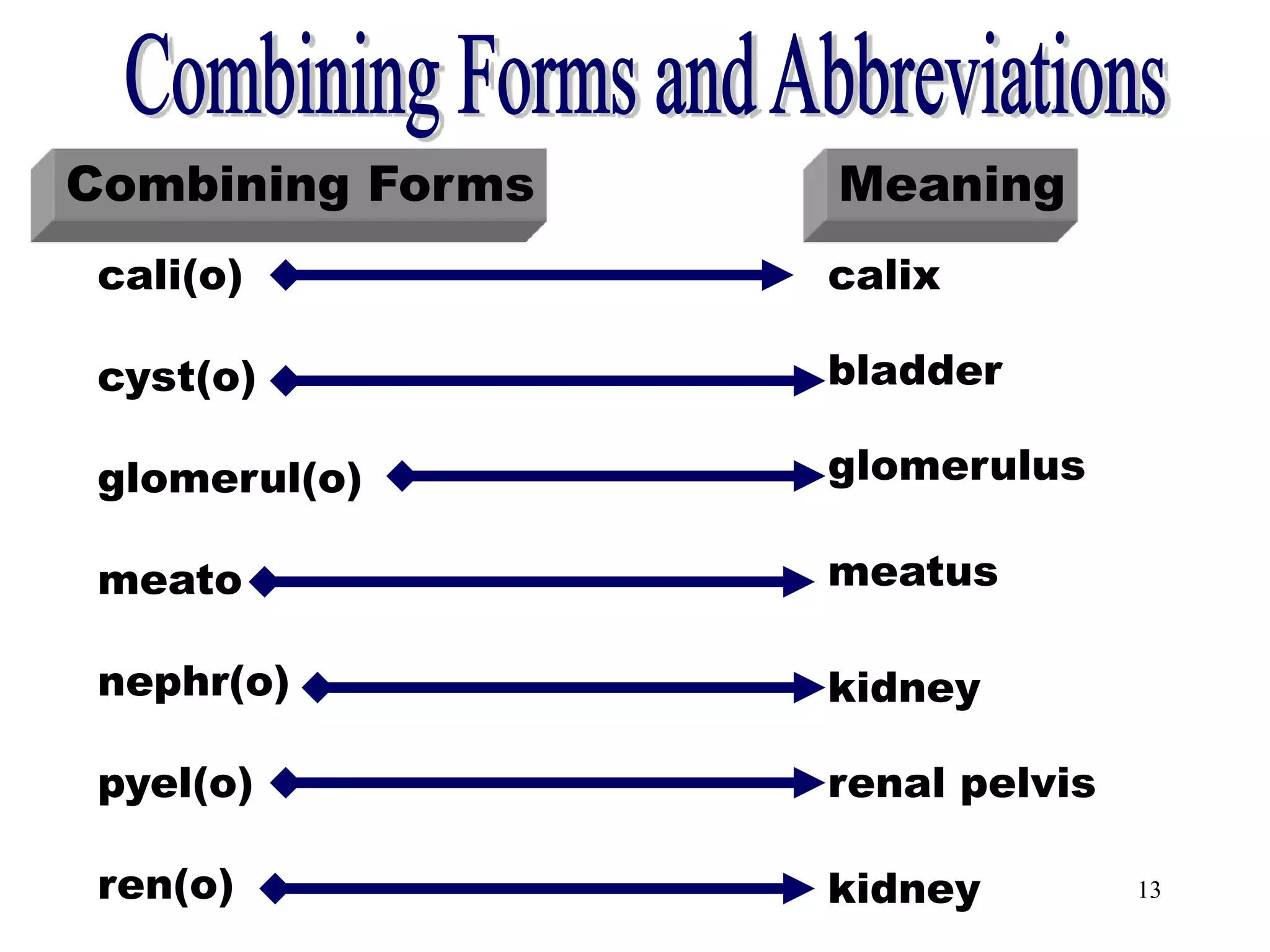
Combining Forms and
Abbreviations
Combining Forms Meaning
cali(o)
cyst(o)
glomerul(o)
meato
nephr(o)
pyel(o)
ren(o)
calix
bladder
glomerulus
meatus
kidney
renal pelvis
kidney
14
Combining Forms [trigon(o)]
Combining Forms Meaning
trigon(o)
urin(o)
ureter(o)
urethr(o)
vesic(o)
trigone
urine
ureter
urethra
bladder
15
Combining Forms [ADH]
Abbreviation Meaning
ADH
A/G
AGN
ARF
ATN
BNO
BUN
antidiuretic hormone
albumin/globulin
acute glomerulonephritis
acute renal failure
acute tubular nephrosis
bladder neck obstruction
blood urea nitrogen
16
Combining Forms [CAPD]
Abbreviation Meaning
CAPD
Cath
Cl
CRF
cysto
ESRD
ESWL
continuous ambulatory peritoneal
dialysis
catheter
chlorine
chronic renal failure
cystoscopy
end-stage renal disease
extracorporeal shock wave
lithotripsy
17
Combining Forms [HD]
Abbreviation Meaning
HD
IVP
K+
KUB
Na+
pH
PKU
hemodialysis
intravenous pyelogram
potassium
kidney, ureter, bladder
sodium
power of hydrogen
concentration
phenylketonuria
18
Combining Forms [RP]
Abbreviation Meaning
RP
SG
UA
UTI
VCU
retrograde pyelogram
specific gravity
urinalysis
urinary tract infection
voiding cystourethrogram
19
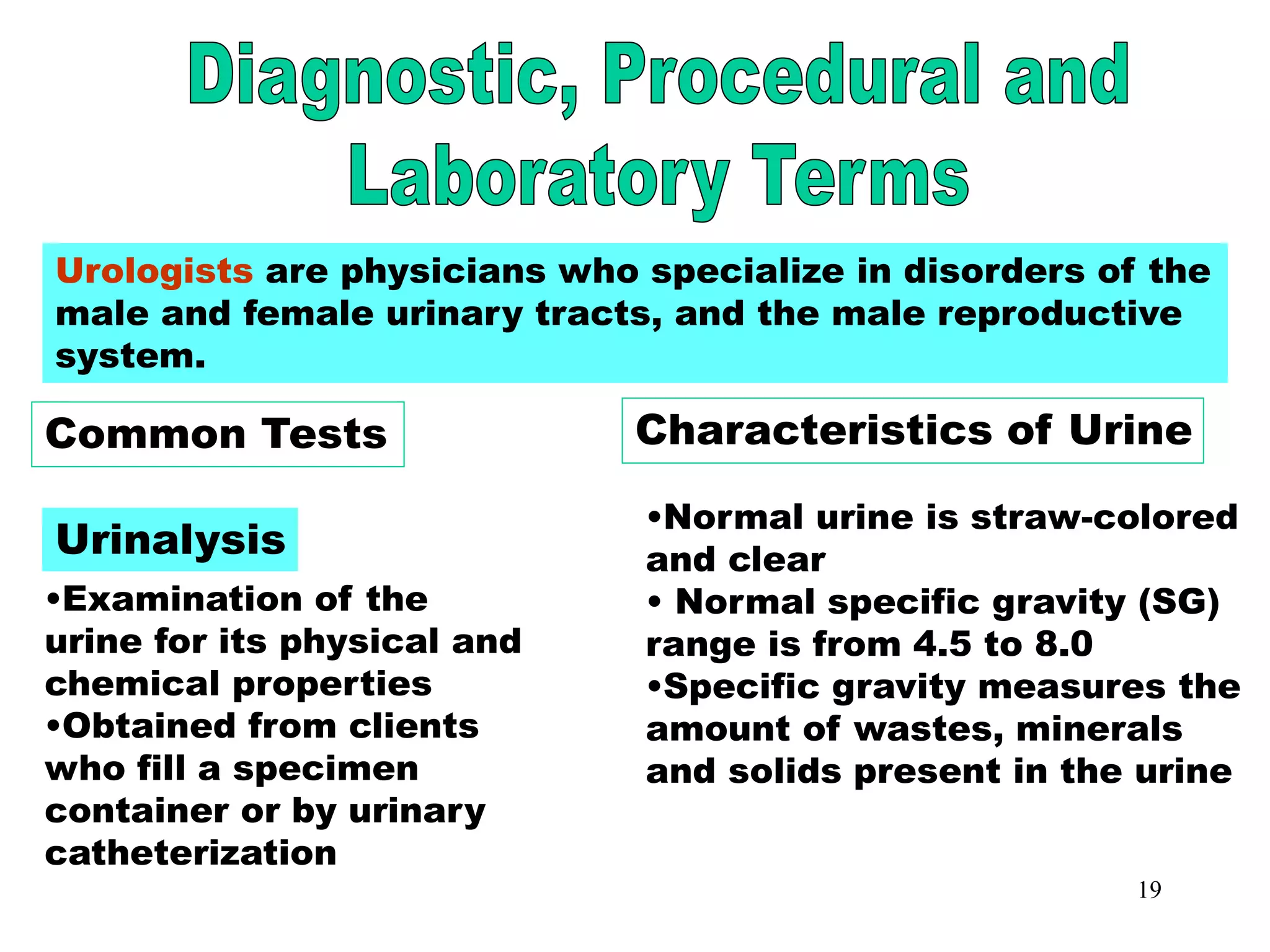
Diagnostic, Procedural &
Laboratory Terms
Urologists are physicians who specialize in disorders of the
male and female urinary tracts, and the male reproductive
system.
Common Tests
Urinalysis
•Examination of the
urine for its physical and
chemical properties
•Obtained from clients
who fill a specimen
container or by urinary
catheterization
Characteristics of Urine
•Normal urine is straw-colored
and clear
• Normal specific gravity (SG)
range is from 4.5 to 8.0
•Specific gravity measures the
amount of wastes, minerals
and solids present in the urine
20
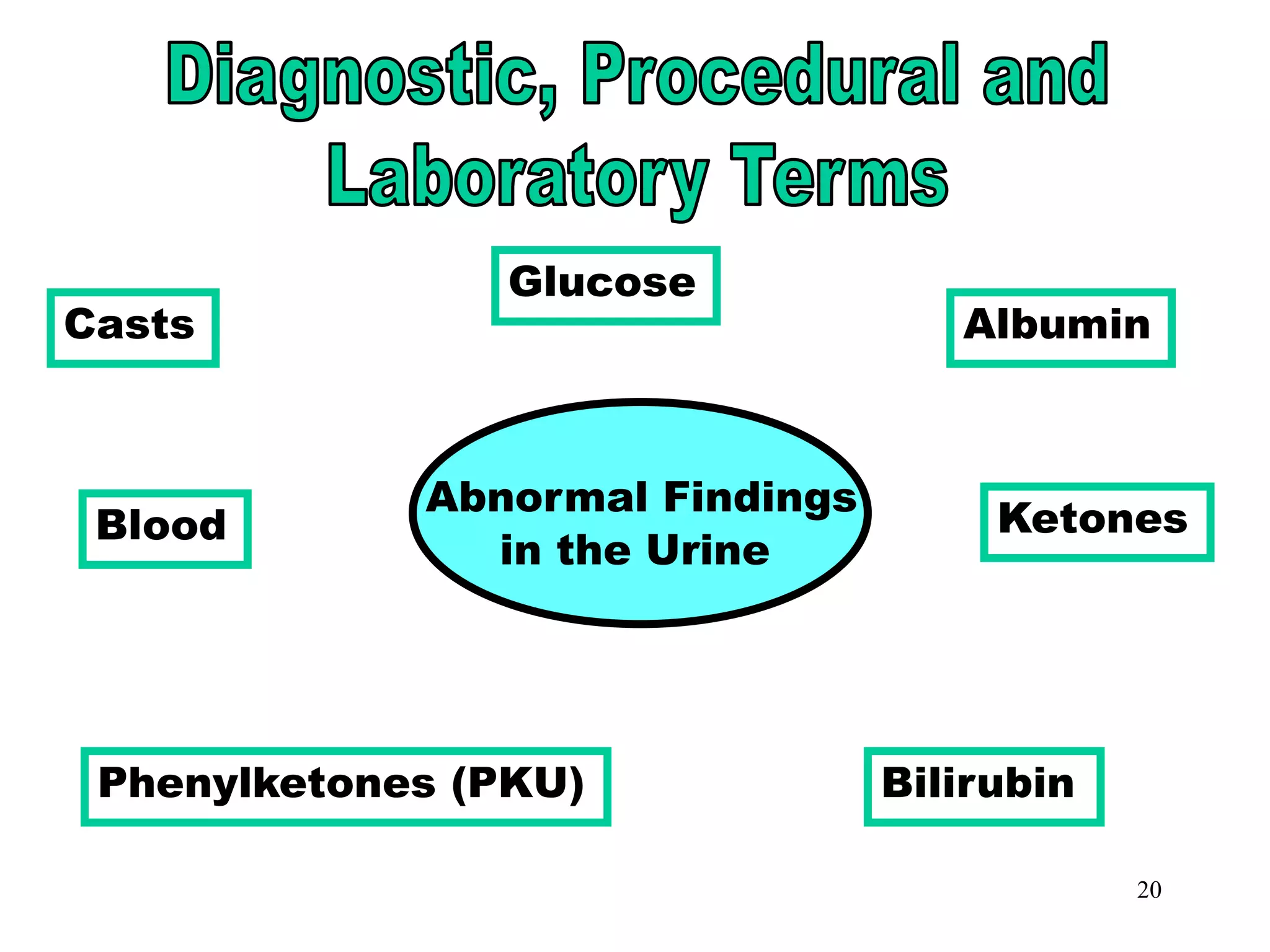
Abnormal Findings in Urine
Abnormal Findings
in the Urine
Casts
Glucose
Albumin
Phenylketones (PKU) Bilirubin
Blood Ketones
21
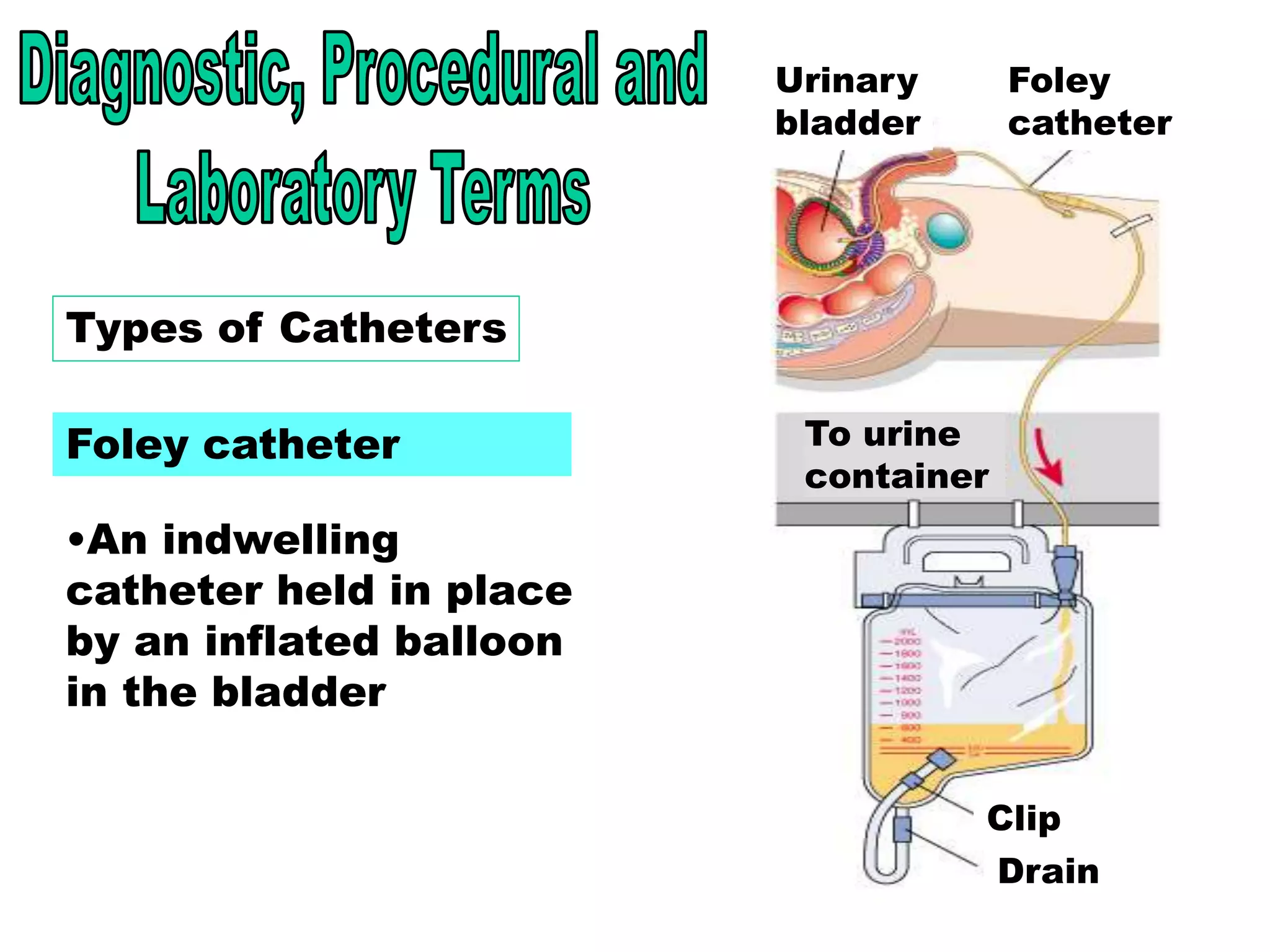
Types of Catheters - Foley
Types of Catheters
Foley catheter
•An indwelling
catheter held in place
by an inflated balloon
in the bladder
Urinary
bladder
Foley
catheter
To urine
container
Clip
Drain
22
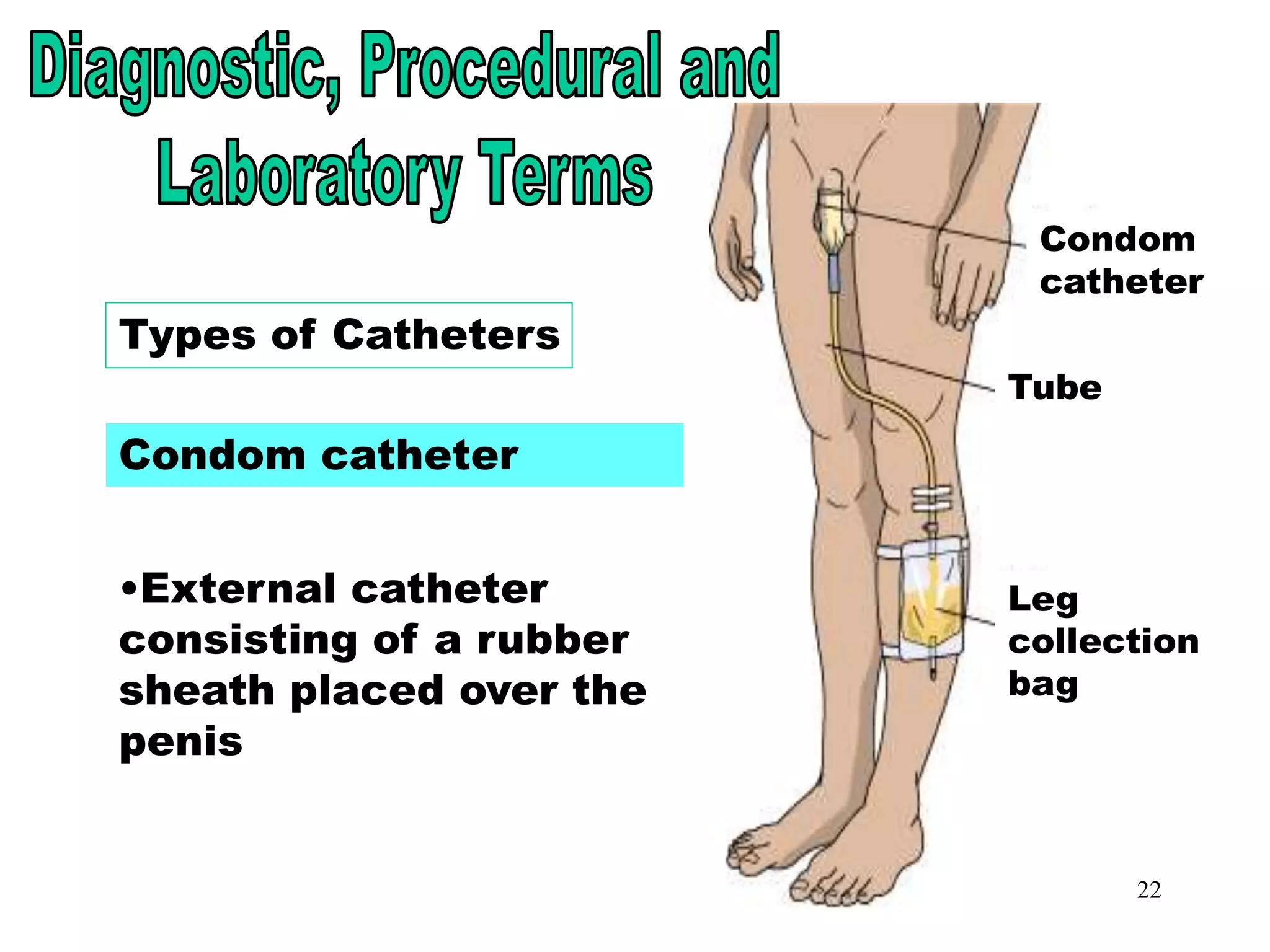
Types of Catheters - Condom
Condom catheter
•External catheter
consisting of a rubber
sheath placed over the
penis
Types of Catheters
Condom
catheter
Tube
Leg
collection
bag
23
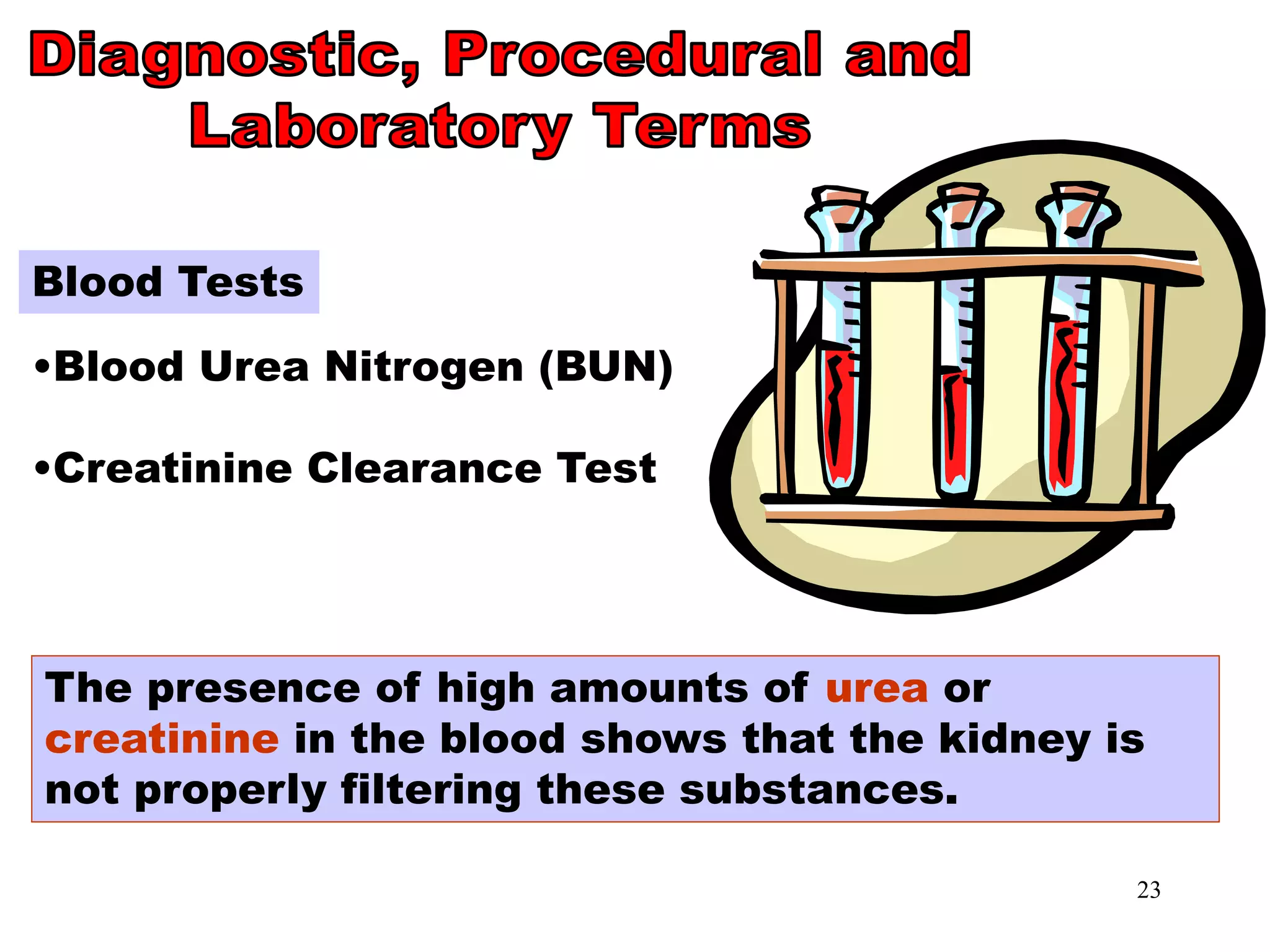
Blood Tests
Blood Tests
•Blood Urea Nitrogen (BUN)
•Creatinine Clearance Test
The presence of high amounts of urea or
creatinine in the blood shows that the kidney is
not properly filtering these substances.
24
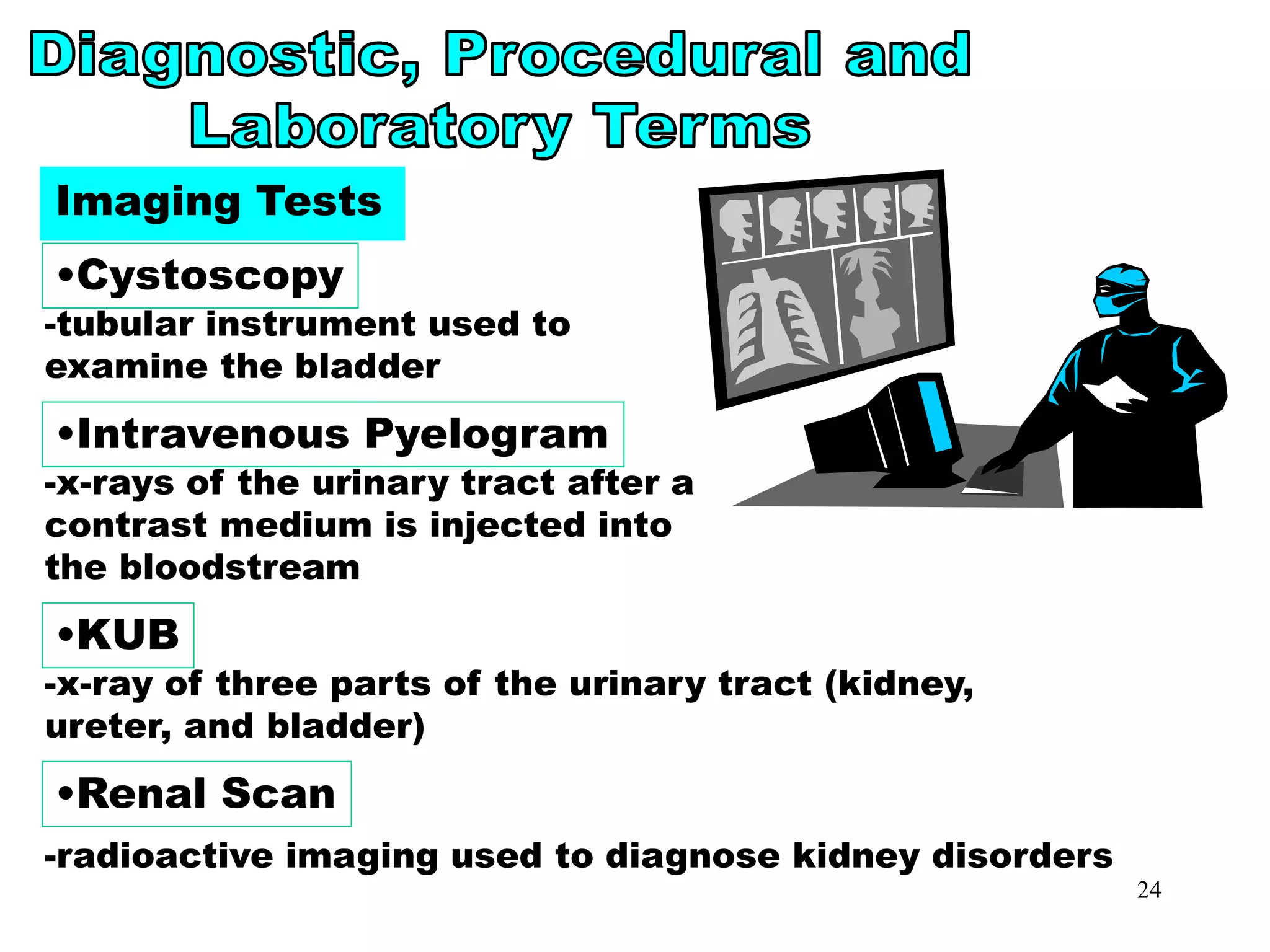
Imaging Tests
Imaging Tests
•Cystoscopy
-tubular instrument used to
examine the bladder
•Intravenous Pyelogram
-x-rays of the urinary tract after a
contrast medium is injected into
the bloodstream
•KUB
-x-ray of three parts of the urinary tract (kidney,
ureter, and bladder)
•Renal Scan
-radioactive imaging used to diagnose kidney disorders
25
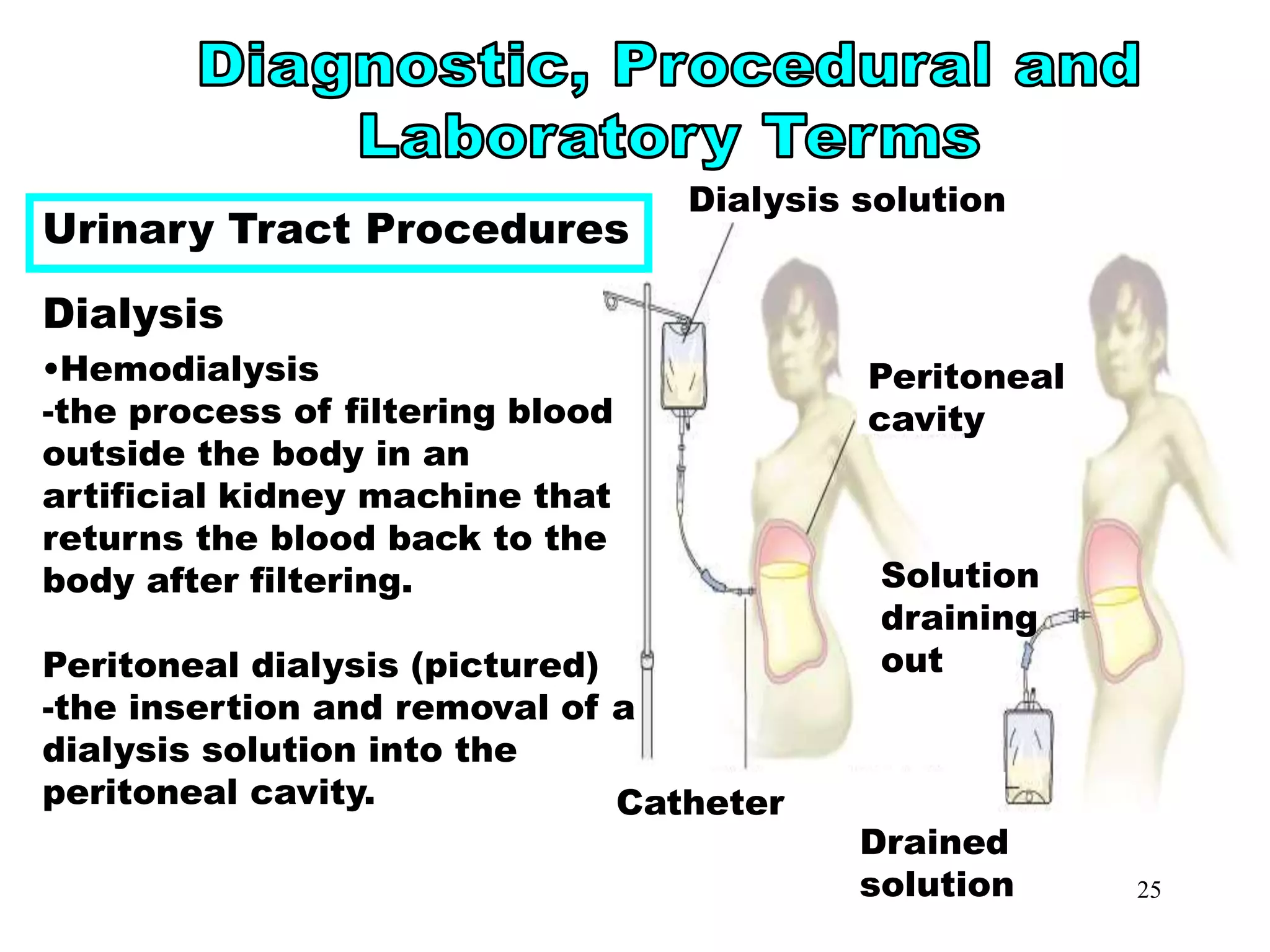
Urinary Tract Procedures
Dialysis
•Hemodialysis
-the process of filtering blood
outside the body in an
artificial kidney machine that
returns the blood back to the
body after filtering.
Peritoneal dialysis (pictured)
-the insertion and removal of a
dialysis solution into the
peritoneal cavity.
Dialysis solution
Peritoneal
cavity
Catheter
Solution
draining
out
Drained
solution
26
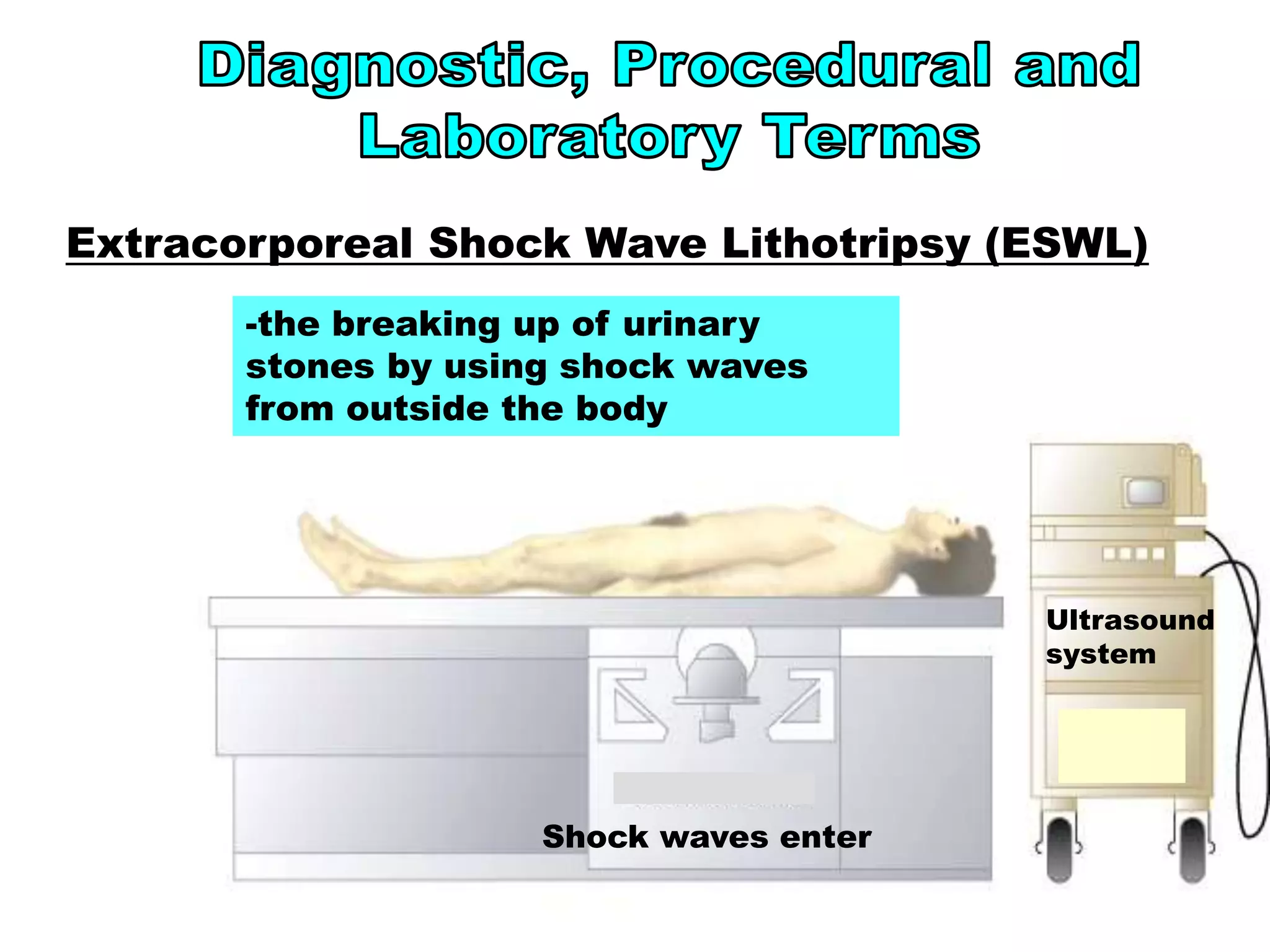
ESWL
Extracorporeal Shock Wave Lithotripsy (ESWL)
-the breaking up of urinary
stones by using shock waves
from outside the body
Shock waves enter
Ultrasound
system
27
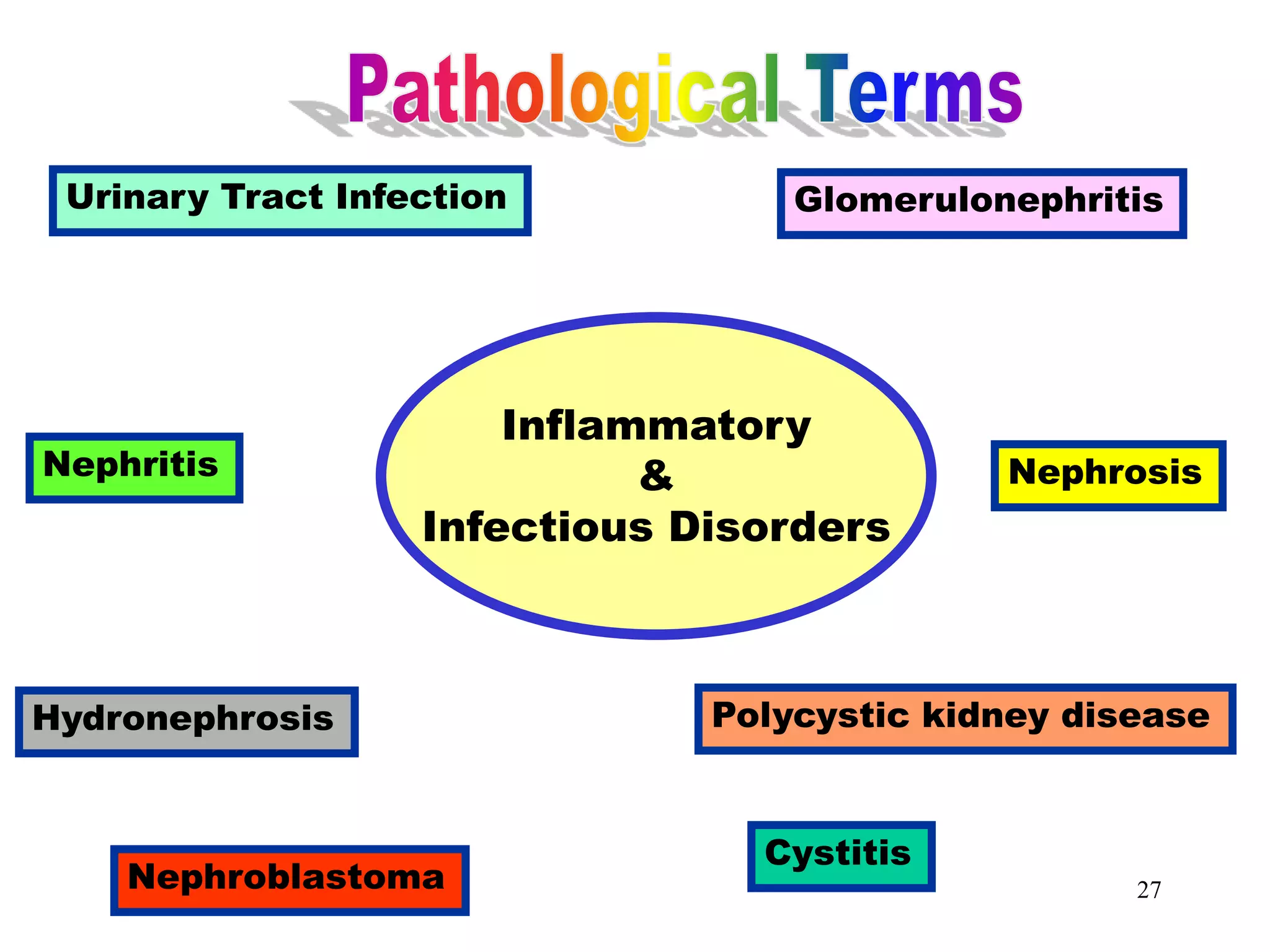
Inflammatory & Infectious
Disorders
Inflammatory
&
Infectious Disorders
Urinary Tract Infection Glomerulonephritis
Nephritis Nephrosis
Hydronephrosis Polycystic kidney disease
Nephroblastoma
Cystitis
28
Pathological Terms
Terms Used to Describe Difficulties in Urination
anuresis
•No urinary output
dysuria
•Painful urination
enuresis
•Lack of bladder
control
oliguria
•Scanty urination
polyuria
•Excessive urination
incontinence
•Involuntary discharge of
urine or feces
29
Surgical Terms
Parts of the urinary system
may be surgically removed
•Nephrectomy- removal of a kidney
•Ureterectomy- removal of a ureter
•Cystectomy- removal of the bladder
Surgical repair procedures
•Pyeloplasty- repair of the renal pelvis
•Cystoplasty- repair of the bladder
•Urethroplasty- repair of the urethra
A urostomy is the creation of an artificial opening in the
abdomen through which urine exits the body.
30
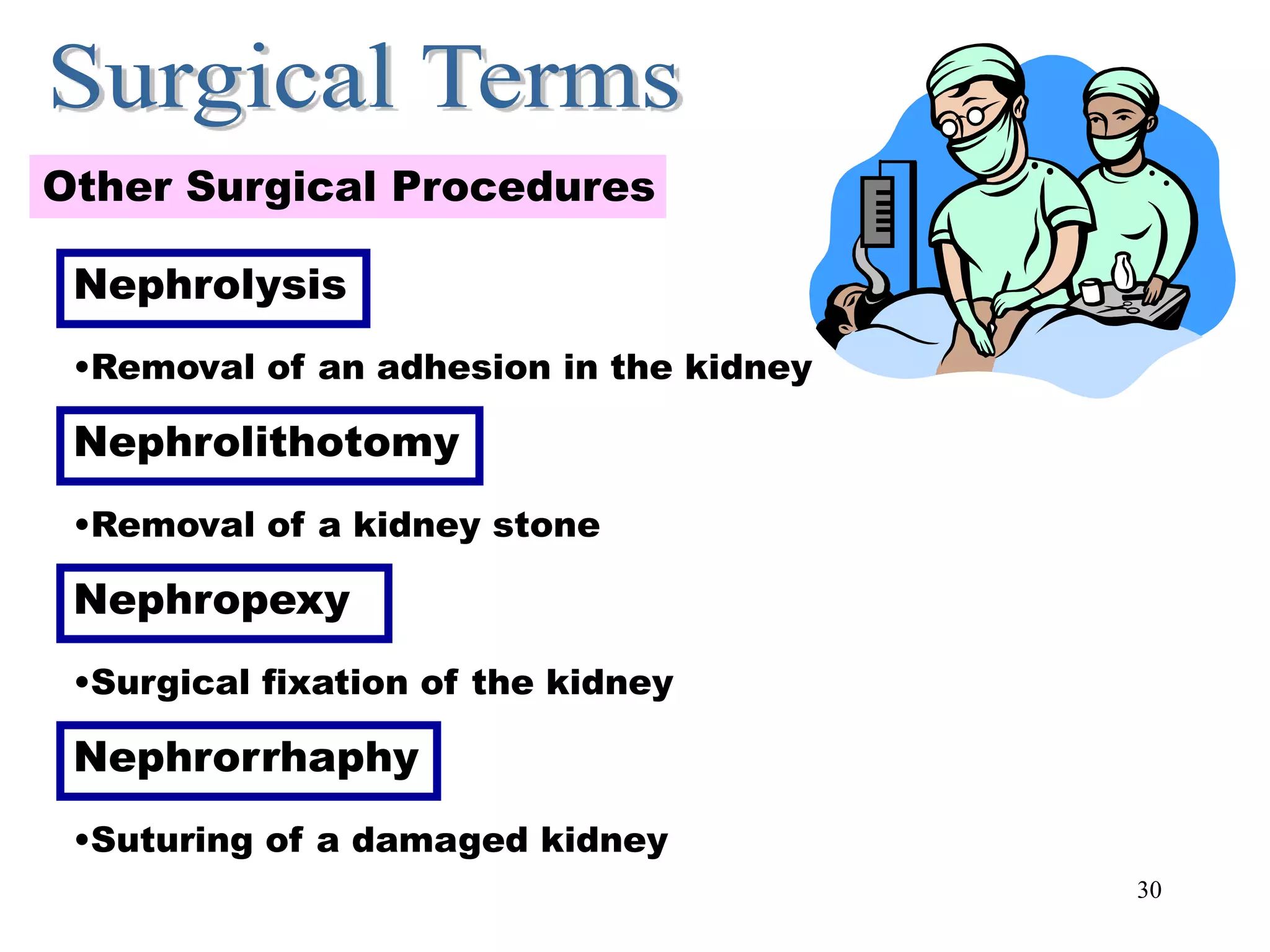
Other Surgical Procedures
Nephrolysis
•Removal of an adhesion in the kidney
Nephrolithotomy
•Removal of a kidney stone
Nephropexy
•Surgical fixation of the kidney
Nephrorrhaphy
•Suturing of a damaged kidney
31
Pharmacological Terms
Medications used for urinary conditions assist to:
•Relieve Pain (analgesic)
•Relieve Spasms (antispasmodic)
•Inhibit the growth of
microorganisms (antibiotic)
•Increase urine output
(diuretic)
•Decrease urine output
(antidiuretic)
32
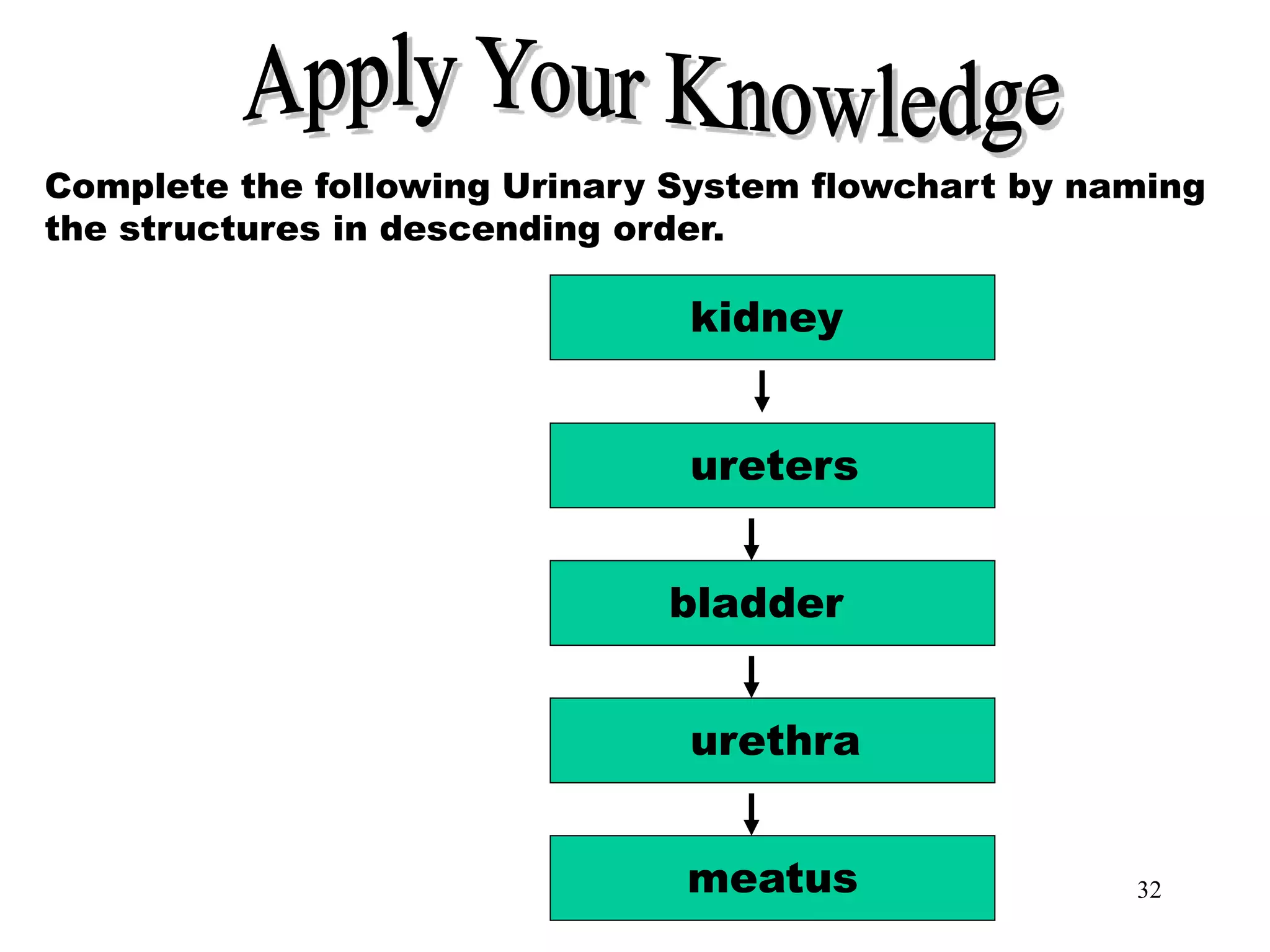
Apply Your Knowledge
Complete the following Urinary System flowchart by naming
the structures in descending order.
meatus
kidney
ureters
bladder
urethra
33
Apply Your Knowledge Part 2
Following a severe injury, Mr. Hudson is told by
his urologist that he will need a surgical
procedure to allow urine to exit the body through
an opening in the abdomen.
Which of the following procedures will Mr.
Hudson have performed?
A. urethrotomy
B. ureterectomy
C. urostomy
Answer: C. urostomy
34
Apply Your Knowledge Part 3
Susan was diagnosed with a bladder infection
and given medication to treat the infection but
she did not take it. Failure to treat a bladder
infection may lead to which of the following?
A. kidney infection
B. cystitis
C. bladder cancer
Answer: A. kidney infection
35
Apply Your Knowledge Part 4
If an individual were to have a drastic drop
in blood pressure below normal, which of
the following would you expect, based on
what you have learned about the renal
system?
A. increase in urine production
B. decrease in urine production
C. no change in urine production
Answer: B. decrease in urine production

Chap09.ppt

  • 1.
  • 2.
    2 Objectives After studying thischapter, you will be able to: •Name the parts of the urinary system and discuss the function of each part •Define combining forms used in building words that relate to the urinary system •Identify the meaning of related abbreviations •Name the common diagnoses, clinical procedures, and laboratory tests used in treating disorders of the urinary system
  • 3.
    3 Objectives Part 2 •Listand define the major pathological conditions of the urinary system •Explain the meaning of surgical terms related to the urinary system •Recognize common pharmacological agents used in treating the urinary system
  • 4.
    4 Structure and Function UrinarySystem The Urinary System •Also called the excretory system •Maintains water balance •Removes waste products from the blood by excreting them in the urine Bladder Kidneys Urethra Ureters Meatus
  • 5.
    5 Kidneys Kidneys The kidneys arebean-shaped organs located in the retroperitoneal portion of the abdominal cavity on either side of the vertebral column. Two Primary Functions •To form urine for excretion •To retain essential substances the body needs in the process called reabsorption
  • 6.
    6 Parts of theKidney kidney Kidneys filter about 1700 liters of blood daily in the average adult. Parts of the kidneys •Cortex -outer protective portion •Medulla -inner soft portion •Hilum -a depression located in the middle of the concave side of the kidney where blood vessels, nerves, and the ureters enter and exit the kidneys cortex medulla hilum
  • 7.
    7 Urine Production Urine isproduced by filtration of: •water •salts •sugar •urea •creatine •uric acid Each kidney contains more than 1 million nephrons which are the functional units of the kidneys. Blood Flow through the Kidneys Blood enters through the renal artery arterioles Each arteriole leads to a nephron renal corpuscle (which has a group of capillaries called the glomerulus) The glomerulus filters fluid from the blood, and is the first place where urine is formed in the kidneys.
  • 8.
    8 Structure and Function •Bloodflows through the glomerulus at a constant rate. •Each glomerulus is surrounded by a capsule known as Bowman’s capsule. •Blood then passes into the renal tubules where some substances are reabsorbed and the remaining become urine. Urine Flow Blood Flow Glomeruli
  • 9.
    9 Flow of Urine Flowof Urine glomerulus renal tubules renal pelvis renal calices ureters The renal tubules carry urine to ducts in the renal cortex. Renal cortex Renal capsule Renal medulla Ureter Renal vein Renal artery Nephron Filtered blood exits the kidneys via the renal vein.
  • 10.
    10 Ureters Ureters •A tube approximately6 to 7 inches long attached to each kidney •Made up of three layers of tissue -smooth muscle -fibrous tissue -mucous layer Peristalsis, a rhythmic contraction of the ureter smooth muscle which helps to move the urine into the bladder.
  • 11.
    11 Urinary Bladder Urinary Bladder •Hollow,muscular organ that stores urine •Sphincter muscles hold the urine in place •Holds 300 to 400 milliliters of urine before emptying •Walls contain epithelial tissue that stretch to allow the bladder to hold twice its capacity •The trigone is a triangular area at the base of the bladder where the ureters enter and the urethra exits Urethra Prostate gland Ureter Urinary bladder
  • 12.
    12 Urethra Urethra A tube ofsmooth muscle with a mucous lining that carries urine from the bladder to the outside of the body. Female Urethra Male Urethra •Approximately 1.5 inches long •Opens through the meatus •Approximately 8 inches long •Passes through three different regions: -prostate gland -membranous portion -penis Excreting urine is called voiding or micturition
  • 13.
    13 Combining Forms and Abbreviations CombiningForms Meaning cali(o) cyst(o) glomerul(o) meato nephr(o) pyel(o) ren(o) calix bladder glomerulus meatus kidney renal pelvis kidney
  • 14.
    14 Combining Forms [trigon(o)] CombiningForms Meaning trigon(o) urin(o) ureter(o) urethr(o) vesic(o) trigone urine ureter urethra bladder
  • 15.
    15 Combining Forms [ADH] AbbreviationMeaning ADH A/G AGN ARF ATN BNO BUN antidiuretic hormone albumin/globulin acute glomerulonephritis acute renal failure acute tubular nephrosis bladder neck obstruction blood urea nitrogen
  • 16.
    16 Combining Forms [CAPD] AbbreviationMeaning CAPD Cath Cl CRF cysto ESRD ESWL continuous ambulatory peritoneal dialysis catheter chlorine chronic renal failure cystoscopy end-stage renal disease extracorporeal shock wave lithotripsy
  • 17.
    17 Combining Forms [HD] AbbreviationMeaning HD IVP K+ KUB Na+ pH PKU hemodialysis intravenous pyelogram potassium kidney, ureter, bladder sodium power of hydrogen concentration phenylketonuria
  • 18.
    18 Combining Forms [RP] AbbreviationMeaning RP SG UA UTI VCU retrograde pyelogram specific gravity urinalysis urinary tract infection voiding cystourethrogram
  • 19.
    19 Diagnostic, Procedural & LaboratoryTerms Urologists are physicians who specialize in disorders of the male and female urinary tracts, and the male reproductive system. Common Tests Urinalysis •Examination of the urine for its physical and chemical properties •Obtained from clients who fill a specimen container or by urinary catheterization Characteristics of Urine •Normal urine is straw-colored and clear • Normal specific gravity (SG) range is from 4.5 to 8.0 •Specific gravity measures the amount of wastes, minerals and solids present in the urine
  • 20.
    20 Abnormal Findings inUrine Abnormal Findings in the Urine Casts Glucose Albumin Phenylketones (PKU) Bilirubin Blood Ketones
  • 21.
    21 Types of Catheters- Foley Types of Catheters Foley catheter •An indwelling catheter held in place by an inflated balloon in the bladder Urinary bladder Foley catheter To urine container Clip Drain
  • 22.
    22 Types of Catheters- Condom Condom catheter •External catheter consisting of a rubber sheath placed over the penis Types of Catheters Condom catheter Tube Leg collection bag
  • 23.
    23 Blood Tests Blood Tests •BloodUrea Nitrogen (BUN) •Creatinine Clearance Test The presence of high amounts of urea or creatinine in the blood shows that the kidney is not properly filtering these substances.
  • 24.
    24 Imaging Tests Imaging Tests •Cystoscopy -tubularinstrument used to examine the bladder •Intravenous Pyelogram -x-rays of the urinary tract after a contrast medium is injected into the bloodstream •KUB -x-ray of three parts of the urinary tract (kidney, ureter, and bladder) •Renal Scan -radioactive imaging used to diagnose kidney disorders
  • 25.
    25 Urinary Tract Procedures UrinaryTract Procedures Dialysis •Hemodialysis -the process of filtering blood outside the body in an artificial kidney machine that returns the blood back to the body after filtering. Peritoneal dialysis (pictured) -the insertion and removal of a dialysis solution into the peritoneal cavity. Dialysis solution Peritoneal cavity Catheter Solution draining out Drained solution
  • 26.
    26 ESWL Extracorporeal Shock WaveLithotripsy (ESWL) -the breaking up of urinary stones by using shock waves from outside the body Shock waves enter Ultrasound system
  • 27.
    27 Inflammatory & Infectious Disorders Inflammatory & InfectiousDisorders Urinary Tract Infection Glomerulonephritis Nephritis Nephrosis Hydronephrosis Polycystic kidney disease Nephroblastoma Cystitis
  • 28.
    28 Pathological Terms Terms Usedto Describe Difficulties in Urination anuresis •No urinary output dysuria •Painful urination enuresis •Lack of bladder control oliguria •Scanty urination polyuria •Excessive urination incontinence •Involuntary discharge of urine or feces
  • 29.
    29 Surgical Terms Parts ofthe urinary system may be surgically removed •Nephrectomy- removal of a kidney •Ureterectomy- removal of a ureter •Cystectomy- removal of the bladder Surgical repair procedures •Pyeloplasty- repair of the renal pelvis •Cystoplasty- repair of the bladder •Urethroplasty- repair of the urethra A urostomy is the creation of an artificial opening in the abdomen through which urine exits the body.
  • 30.
    30 Other Surgical Procedures OtherSurgical Procedures Nephrolysis •Removal of an adhesion in the kidney Nephrolithotomy •Removal of a kidney stone Nephropexy •Surgical fixation of the kidney Nephrorrhaphy •Suturing of a damaged kidney
  • 31.
    31 Pharmacological Terms Medications usedfor urinary conditions assist to: •Relieve Pain (analgesic) •Relieve Spasms (antispasmodic) •Inhibit the growth of microorganisms (antibiotic) •Increase urine output (diuretic) •Decrease urine output (antidiuretic)
  • 32.
    32 Apply Your Knowledge Completethe following Urinary System flowchart by naming the structures in descending order. meatus kidney ureters bladder urethra
  • 33.
    33 Apply Your KnowledgePart 2 Following a severe injury, Mr. Hudson is told by his urologist that he will need a surgical procedure to allow urine to exit the body through an opening in the abdomen. Which of the following procedures will Mr. Hudson have performed? A. urethrotomy B. ureterectomy C. urostomy Answer: C. urostomy
  • 34.
    34 Apply Your KnowledgePart 3 Susan was diagnosed with a bladder infection and given medication to treat the infection but she did not take it. Failure to treat a bladder infection may lead to which of the following? A. kidney infection B. cystitis C. bladder cancer Answer: A. kidney infection
  • 35.
    35 Apply Your KnowledgePart 4 If an individual were to have a drastic drop in blood pressure below normal, which of the following would you expect, based on what you have learned about the renal system? A. increase in urine production B. decrease in urine production C. no change in urine production Answer: B. decrease in urine production