

NECROSIS


           1
OBJECTIVES

• Highlight the basic concepts and principles
  of necrosis (cell death)
• Differentiate between different types of
  necrosis


                                                2
CONTENTS

4.1 Definition of necrosis
4.2 Different types of necrosis
4.3 Different types of necrosis base on pathologic

    changes


                                               3
4.1 Definition Of Necrosis
•   Necrosis; defined as focal death along with degradation of tissue by
    hydrolitic enzymes liberated by cells. It’s invariably accompanied
    by inflammatory reaction.
•   Causes; 1. Loss of blood supply - caused by blockage of a vessel by a
                                      blood clot which produces immediate local
                                      anoxia.
             2. Bacterial toxins – inflammation is produced & if it’s strong the
                                   result is necrosis.
             3. Physical irritants – excessive heat, excessive cold, trauma &
                                     radiation.
             4. Chemical irritants – strong acid.


                                                                                4
4.2 Types Of Necrosis
• Morphologically, 5 types of necrosis are identified:


  i) Coagulative necrosis
  ii) Liquefaction (Colliquative) necrosis
  iii) Caseous necrosis
  iv) Fat necrosis
  v) Fibrinoid necrosis


• Gangrene is a form of necrosis of tissue with superadded
  putrefaction; gangrene necrosis

                                                             5
i) Coagulative necrosis


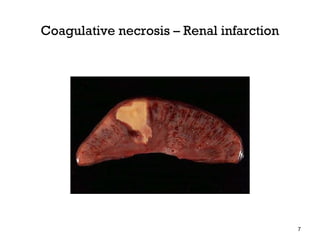
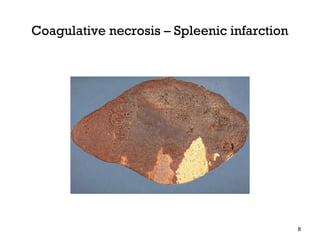
    Most common type of necrosis caused by irreversible
     focal injury (mostly because ischaemia).
    Less often bacterial & chemical agents.
    The organs commonly affected are HEART, KIDNEY &
     SPLEEN.


                                                           6
Coagulative necrosis – Renal infarction


                                          7
Coagulative necrosis – Spleenic infarction


                                             8
ii) Liquefaction (Colliquative) necrosis


 Occurs commonly due to ischaemic injury & bacterial or
  fungal infections.
 Occurs due to degradation of tissue by the action of
  powerful hydrolytic enzymes.
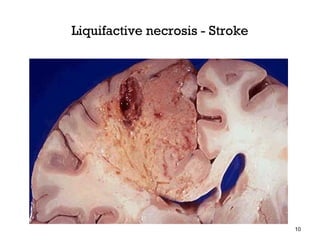
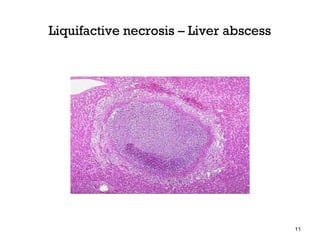
 Examples are INFARCT BRAIN (stroke) & ABSCESS
  CAVITY.


                                                           9
Liquifactive necrosis - Stroke


                                 10
Liquifactive necrosis – Liver abscess


                                        11
iii) Caseous necrosis


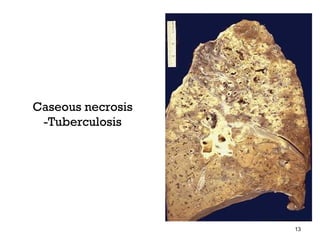
 Found in the centre of foci of tuberculosis infections.
 It combines features of both coagulative & liquefactive
  necrosis.


                                                            12
Caseous necrosis
 -Tuberculosis


                   13
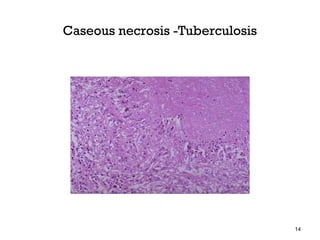
Caseous necrosis -Tuberculosis


                                 14
iv) Fat necrosis


 Special form of cell death occurring at two anatomically different
  locations but morphologically similar lesions.
 These are ACUTE PANCREATIC NECROSIS & TRAUMATIC FAT
  NECROSIS (breast).
 In the case of pancreas, there is liberation of pancreatic lipase from
  injured or inflamed tissue that results in necrosis of the pancreas.
 Fat necrosis in either of the two instances results in hydrolysis of
  neutral fat present in adipose cells into glycerol & free fatty acid.


                                                                           15
v) Fibrinoid necrosis
 Characterized by deposition of fibrin-like material which has the
   staining properties of fibrin.
 It’s encountered in various examples of immunologic tissues injury,
   arterioles in hypertension, peptic ulcer etc.


vi) Gangrene necrosis
 The type of necrosis is usually coagulative due to ischaemia.
 Is characterized by primarily inflammation provoked by virulent
  bacteria.
 3 types; dry, wet & gas gangrene.


                                                                    16
4.3 Types Of Necrosis Base On
                Pathologic Changes

i) Coagulative necrosis


    Grossly: foci of coagulative necrosis in the early stage are PALE, FIRM
              & SLIGHTLY SWOLLEN.
             : with progression, they become more YELLOWISH, SOFTER
              & SHRUNKEN.


     Micro: the pattern of microscopic change results from 2 processes
            which are DENATURATION OF PROTEINS & ENZYMATIC
            DIGESTION OF THE CELL.

                                                                         17
ii) Liquefaction (Colliquative) necrosis


 Grossly: the affected area is soft with liquefied centre containing necrotic
            debris.
           : later, a cyst wall is formed.


   Micro: the cystic space contains necrotic cell debris & macrophages filled
          with phagocytosed material.
         : the cyst wall is formed by proliferating cappilaries,
          inflammatory cells & gliosis (proliferating glial cells) in the
          case of brain & proliferating fibroblasts in the case of
          abscess cavity.

                                                                            18
iii) Caseous necrosis
 Grossly: resemble dry cheese and are soft, granular & yellowish.


   Micro: the necrosed foci are structureless, eosinophilic & contain granular
         debris.


iv) Fat necrosis
 Grossly: appears as yellowish-white & firm deposits.
          : formation of calcium soaps imparts the necrosed foci firmer &
            chalky white appearance.


   Micro: necrosed fat cells have cloudy appearance & are surrounded by an
         inflammatory reaction.

                                                                         19
v) Fibrinoid necrosis
 Grossly: is identified by brightly eosinophilic, hyaline-like deposition in
            the vessel wall or on the luminar surface of peptic ulcer.
           : local haemorrhages may occur due to rupture of these blood
            vessels.


vi) Dry gangrene
 Macro: the affected part is dry, shrunken & dark black, resembling the foot
          : it’s black due to liberation of haemoglobin from haemolysed red
           blood cells.
   Histo: the separation consists of inflammatory granulation tissue.


                                                                           20
vii) Wet gangrene
 Macro; the affected part is soft, swollen, putrid, rotten & dark.
         : the example is gangrene of bowel.


   Histo: there is ulceration of the mucosa & intense inflammatory infiltration.


viii) Gas gangrene
 Grossly: the affected area is swollen, edematous, painful & crepitant due
           to accumulation of gas bubbles within the tissues.
           : the affected tissue becomes dark black & foul smelling.


   Micro: at the periphery, a zone of leucocytic infiltration, edema &
          congestion are found.

                                                                           21
THANK YOU


            22

Necrosis

  • 1.
  • 2.
    OBJECTIVES • Highlight thebasic concepts and principles of necrosis (cell death) • Differentiate between different types of necrosis 2
  • 3.
    CONTENTS 4.1 Definition ofnecrosis 4.2 Different types of necrosis 4.3 Different types of necrosis base on pathologic changes 3
  • 4.
    4.1 Definition OfNecrosis • Necrosis; defined as focal death along with degradation of tissue by hydrolitic enzymes liberated by cells. It’s invariably accompanied by inflammatory reaction. • Causes; 1. Loss of blood supply - caused by blockage of a vessel by a blood clot which produces immediate local anoxia. 2. Bacterial toxins – inflammation is produced & if it’s strong the result is necrosis. 3. Physical irritants – excessive heat, excessive cold, trauma & radiation. 4. Chemical irritants – strong acid. 4
  • 5.
    4.2 Types OfNecrosis • Morphologically, 5 types of necrosis are identified: i) Coagulative necrosis ii) Liquefaction (Colliquative) necrosis iii) Caseous necrosis iv) Fat necrosis v) Fibrinoid necrosis • Gangrene is a form of necrosis of tissue with superadded putrefaction; gangrene necrosis 5
  • 6.
    i) Coagulative necrosis  Most common type of necrosis caused by irreversible focal injury (mostly because ischaemia).  Less often bacterial & chemical agents.  The organs commonly affected are HEART, KIDNEY & SPLEEN. 6
  • 7.
    Coagulative necrosis –Renal infarction 7
  • 8.
    Coagulative necrosis –Spleenic infarction 8
  • 9.
    ii) Liquefaction (Colliquative)necrosis  Occurs commonly due to ischaemic injury & bacterial or fungal infections.  Occurs due to degradation of tissue by the action of powerful hydrolytic enzymes.  Examples are INFARCT BRAIN (stroke) & ABSCESS CAVITY. 9
  • 10.
  • 11.
    Liquifactive necrosis –Liver abscess 11
  • 12.
    iii) Caseous necrosis Found in the centre of foci of tuberculosis infections.  It combines features of both coagulative & liquefactive necrosis. 12
  • 13.
  • 14.
  • 15.
    iv) Fat necrosis Special form of cell death occurring at two anatomically different locations but morphologically similar lesions.  These are ACUTE PANCREATIC NECROSIS & TRAUMATIC FAT NECROSIS (breast).  In the case of pancreas, there is liberation of pancreatic lipase from injured or inflamed tissue that results in necrosis of the pancreas.  Fat necrosis in either of the two instances results in hydrolysis of neutral fat present in adipose cells into glycerol & free fatty acid. 15
  • 16.
    v) Fibrinoid necrosis Characterized by deposition of fibrin-like material which has the staining properties of fibrin.  It’s encountered in various examples of immunologic tissues injury, arterioles in hypertension, peptic ulcer etc. vi) Gangrene necrosis  The type of necrosis is usually coagulative due to ischaemia.  Is characterized by primarily inflammation provoked by virulent bacteria.  3 types; dry, wet & gas gangrene. 16
  • 17.
    4.3 Types OfNecrosis Base On Pathologic Changes i) Coagulative necrosis  Grossly: foci of coagulative necrosis in the early stage are PALE, FIRM & SLIGHTLY SWOLLEN. : with progression, they become more YELLOWISH, SOFTER & SHRUNKEN. Micro: the pattern of microscopic change results from 2 processes which are DENATURATION OF PROTEINS & ENZYMATIC DIGESTION OF THE CELL. 17
  • 18.
    ii) Liquefaction (Colliquative)necrosis  Grossly: the affected area is soft with liquefied centre containing necrotic debris. : later, a cyst wall is formed. Micro: the cystic space contains necrotic cell debris & macrophages filled with phagocytosed material. : the cyst wall is formed by proliferating cappilaries, inflammatory cells & gliosis (proliferating glial cells) in the case of brain & proliferating fibroblasts in the case of abscess cavity. 18
  • 19.
    iii) Caseous necrosis Grossly: resemble dry cheese and are soft, granular & yellowish. Micro: the necrosed foci are structureless, eosinophilic & contain granular debris. iv) Fat necrosis  Grossly: appears as yellowish-white & firm deposits. : formation of calcium soaps imparts the necrosed foci firmer & chalky white appearance. Micro: necrosed fat cells have cloudy appearance & are surrounded by an inflammatory reaction. 19
  • 20.
    v) Fibrinoid necrosis Grossly: is identified by brightly eosinophilic, hyaline-like deposition in the vessel wall or on the luminar surface of peptic ulcer. : local haemorrhages may occur due to rupture of these blood vessels. vi) Dry gangrene  Macro: the affected part is dry, shrunken & dark black, resembling the foot : it’s black due to liberation of haemoglobin from haemolysed red blood cells. Histo: the separation consists of inflammatory granulation tissue. 20
  • 21.
    vii) Wet gangrene Macro; the affected part is soft, swollen, putrid, rotten & dark. : the example is gangrene of bowel. Histo: there is ulceration of the mucosa & intense inflammatory infiltration. viii) Gas gangrene  Grossly: the affected area is swollen, edematous, painful & crepitant due to accumulation of gas bubbles within the tissues. : the affected tissue becomes dark black & foul smelling. Micro: at the periphery, a zone of leucocytic infiltration, edema & congestion are found. 21
  • 22.