Outline:
• Collection and Handling of urine sample
• Types of urine specimen
• Physical & chemical examination of urinalysis
• Discrepancies in urinalysis
• Microscopic examination of urine sediment
• Quiz…
Alyazeed hussein, BSc-SUST
A Comprehensive Review of Urinalysis
Medical Laboratory
Science
Urinalysis
 A complete urinalysis is composed of multiple tests, including macroscopic, physical, chemical, and microscopic
examination.
 Specimen Collection and Handling: Use clean, dry container, receive and analyze the sample within 2 hours!!?
 Types of urine specimen:
1. Random urine: Most common type, for routine tests.
2. First morning: Concentrated specimen used for routine screening, pregnancy test.
3. Fasting & 2-Hour postprandial: for DM(insulin monitoring), 2 hours after eating.
4. 24-Hour: Collected over a period of 24 hours for creatinine clearance, Glomerular Filtration Rate (GFR).
5. Midstream clean-catch (MSU): urine collected in the middle of urination; used for bacterial culture.
6. Catheterized: Collected from a tube placed through the urethra into the bladder; used for bacterial culture and
routine screening.
7. Suprapubic aspiration: Needle inserted into the bladder through the abdominal wall; used for bacterial culture and
cytologic testing.
8. Pediatric collection: Use small, clear plastic bags with adhesive to adhere to the genital area.
Alyazeed hussein, BSc-SUST
URINE SPECIMEN STORAGE AND HANDLING
• Most common form of preservation, refrigeration at 2°C to 8°C, is suitable for the majority of specimens. Any
urine specimen for microbiological studies should be refrigerated immediately if it cannot be transported directly
to the laboratory, the specimen remains suitable for culture for up to 24 hours.
• Before testing, urine must be brought to room temperature.
• Other preservatives are: Boric acid (acceptable for culture), Thymol (cells & casts), formalin (cellular preservative)
Alyazeed hussein, BSc-SUST
Physical examination of urine
(Color, Appearance and Specific gravity)
A. color:
1. Pale yellow & yellow: normal color of urine(urochrome: urobilin).
2. Colorless: may due to dilution, or Diabetes Meletus.
3. Dark yellow: may due to dehydration, or First morning( concentrated), usually with high specific
gravity.
4. Orange or dark yellow-amber: Bilirubinemia occurs from liver problems, such as hepatitis >
bilirubinuria, yellow foam forms when urine is shaken due to the presence of conjugated
bilirubin. Smith iodine test positive (green ring), hay's test (sulfur powder) positive.
5. Red/pink: (RBCs, (hemoglobin-brown and myoglobin-muscle) or menstrual contamination.
6. Green/blue: medication or pseudomonas.
Note that! Uroerythrin adds a slight pink pigment, mostly apparent following refrigeration, when
the pigment attaches to precipitated amorphous urates.
Alyazeed hussein, BSc-SUST
B. Appearance and clarity:
1. Clear: normal.
2. Slightly cloudy: May be due to the presence of low numbers of formed
elements.
3. Cloudy or milky: presence of amorphous, crystals, pus cells, epithelial cells, also
due to Chyluria (W. bancrofti, lymphatic filariasis). Bence jones protein: light
chain of immunoglobulins in urine(multiple myeloma) = (heat test).
C. Specific Gravity: determines the kidney's reabsorption ability.
• Normal range: 1.015 to 1.030
• Low specific gravity: loss of the kidney's ability to concentrate urine or presence
of disease, It can also be found normally with large fluid intake.
• High specific gravity may result from adrenal insufficiency, diabetes
mellitus(glycosuria). Note that! If urine pH >8.0, add 0.005 to the reading.
Alyazeed hussein, BSc-SUST
Chemical examination of urine
multi-parameter reagent strip (Multistix)
Procedure: MUST BE FOLLOWED EXACTLY TO ACHIEVE RELIABLE TEST RESULTS
1. Collect FRESH urine specimen in a clean, dry container. Mix well immediately before testing.
2. Remove one strip from bottle and replace cap. Completely immerse reagent areas of the
strip in FRESH urine and remove immediately to avoid dissolving out reagents
3. While removing, run the edge of the strip against the rim of the urine container to remove
excess urine. Hold the strip in a horizontal position to prevent possible mixing of chemicals
from adjacent reagent areas/or contaminating the hands with urine.
4. Compare reagent areas to corresponding Color chart on the bottle label at the time
specified. Hold strip close to color blocks and match carefully. Avoid laying the strip directly on
the Color chart as this will result in the urine soiling the chart. For optimal results, read the
ketone test at 15 seconds after dipping; read the bilirubin test at 20 seconds; glucose at 30
seconds; blood at 40 seconds; urobilinogen at 45 seconds; and specific gravity from 45 to 60
seconds after dipping.
Alyazeed hussein, BSc-SUST
False-negativeFalse-positiveTest
Not mixed will, high
proteinuria, glucosuria,
Boric acid
Expired strip, formalinLeukocyte esterase
Formalin, lack of nitrateImproper storage
(bacterial proliferation)
Nitrite
Formalin, high vitamin CPeroxidasesBlood
High ketones, high
ascorbic acid
Alkaline urine, oxidizing
agent : bleach,
Glucose
Ascorbic acid, boric acid,
sample exposed to light
Colored substancesBilirubin
Boric acid, formalin,
hypochlorite, delay in
examination, volatilization
Highly pigmented urine,
drugs
Ketones
Bence-jones protein,
sperms
Alkaline urine, drugsProtein
Formalin, hypochlorite,
antibiotics
Sulfonamide, drugs, beetUrobilinogen
Discrepancies
Alyazeed hussein, BSc-SUST
Discrepancies
• Renal glycosuria: presence of glucose in urine with normal blood glucose level! Due to defect in renal
tubular dysfunction or by glucagon hormone. (>180mg/dl)
• Strip positive for blood with absence of RBCs microscopically: hemoglobinuria(Hb from lysed RBCs) or
diluted urine (Ghost RBCs) pH > 7, SG < 1.010, handling, old sample, high temperature, peroxidase
positive bacteria (E. coli), myoglobin, too fast centrifugation,
• Sterile pyuria, presence of pus in urine with no bacteria: using of antibiotics.
• RBCs can be confused with yeast cells or oil droplets. Diluted acetic acid can be used to lyse RBCs,
leaving only yeast, oil droplets, and WBCs.
• Positive leukocyte esterase with Glitter cells or absence of WBCs microscopically: dilute alkaline urine.
• Excessive shaking or taping of sediment against edges of table to mix it up> cause the casts to dissolve.
• Note that!! Native urine: urine not centrifuged > counting chamber method > small volume of urine
only.
Alyazeed hussein, BSc-SUST
• 10 to 15 mL (12ml) Centrifuged at 400 – 450 g (RCF), 1500 – 2000
(1600) (RPM) for 5 mins hold the test tube upside down and count to
3, then turn the test tube again and stand it upright mix drop (20
μL) in a slide + glass cover slip (carefully to avoid air bubbles) examine.
• Report RBCs/WBCs using high-power magnification (i.e., high-power field [hpf]),
report casts and crystals using low-power magnification (i.e., low-power field [lpf]).
• Normal Urines: Contain 0-4 RBCs (hpf), 0-3 WBCs (hpf), 0-2 hyaline casts (lpf), several
epithelial cells (hpf), some types of crystals, and mucus.
• Casts have a tendency to locate near the edges of the cover slip (LPF scanning around
the cover slip).
Microscopic examination
Alyazeed hussein, BSc-SUST
Sediment constituents such as bacteria, yeast cells, crystals,
and spermatozoa are not counted, but instead given as
crosses
Urine cells
Alyazeed hussein, BSc-SUST
Isomorphic RBCs
Dysmorphic RBCs, Have cellular blebs (mickey mouse ear), associated with glomerular bleeding
(glomerulonephritis).
Ghost RBC
In dilute urine, absorb
water, swell, and lyse
rapidly, releasing
hemoglobin. Examined
under reduced light.
RBCs, Seen in
kidney or urinary
tract diseases or
menstrual blood
contamination,
<3 /HPF is
normal
Alyazeed hussein, BSc-SUST
Pus cells, neutrophils in acute infections, eosinophils in interstitial nephritis, lymphocytes in renal transplantation
Alyazeed hussein, BSc-SUST
Elongated WBCs
Macrophages, Contain digested material, lipids, seen in chronic inflammation and radiation therapy
Alyazeed hussein, BSc-SUST
Renal tubular cells (RTEs) line the nephron, seen in renal tubular damage (acute tubular necrosis, viral infection, or renal
transplant rejection)
Alyazeed hussein, BSc-SUST
Sperms, found in men with retrograde ejaculation, post-prostatectomy, or in sample collected soon after ejaculation
Alyazeed hussein, BSc-SUST
Squamous epithelial cells, from urethra, skin and vaginal mucosa
Alyazeed hussein, BSc-SUST
Clue cell: Gardnerella vaginalis
Alyazeed hussein, BSc-SUST
Tadpole cells or caudate cells
Alyazeed hussein, BSc-SUST
Transitional epithelial cells (Urothelial cells), from renal pelvis, ureter and bladder, increased in infections, renal stones,
bladder cancer, and post-catheterization.
Chronic urinary tract infection
Alyazeed hussein, BSc-SUST
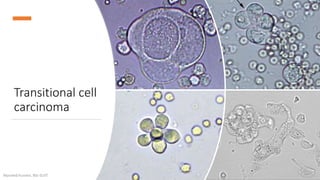
Transitional cell
carcinoma
Alyazeed hussein, BSc-SUST
Decoy cells: viral infection (polyoma virus) or malignancy
Alyazeed hussein, BSc-SUST
Oval fat bodies: with marked proteinuria, acute tubular necrosis or nephrotic syndrome
Alyazeed hussein, BSc-SUST
Urine casts
Alyazeed hussein, BSc-SUST
Fatty casts, with marked proteinuria, acute tubular necrosis or nephrotic syndrome
Oval fat bodies
Alyazeed hussein, BSc-SUST
Renal tubular epithelial cells (RTEs) casts: Found in tubular damage, acute
tubular necrosis, or renal transplant rejection
Alyazeed hussein, BSc-SUST
White blood cells (WBCs) casts: in pyelonephritis, lupus or allergic nephritis
Alyazeed hussein, BSc-SUST
Granular casts: found in normal urine following stress, strenuous exercise, or in renal diseases
Alyazeed hussein, BSc-SUST
Hyaline casts: seen in normal urine following strenuous exercise also seen in renal diseases
Alyazeed hussein, BSc-SUST
Red blood cells (RBCs) casts: indicates serious renal disease, acute nephritis, glomerular injuries, or glomerulonephritis
and malignant hypertension Alyazeed hussein, BSc-SUST
Hemoglobin casts
Alyazeed hussein, BSc-SUST
Myoglobin cast
Alyazeed hussein, BSc-SUST
Bilirubin/bile cast
Alyazeed hussein, BSc-SUST
Waxy cast: found in sever renal disease or acute glomerulonephritis
Alyazeed hussein, BSc-SUST
Broad cast: poor prognosis, renal failure
Alyazeed hussein, BSc-SUST
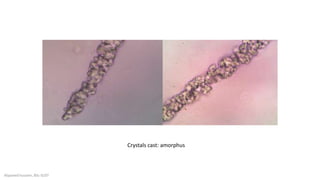
Crystals cast: amorphus
Alyazeed hussein, BSc-SUST
Myeloma cast
Alyazeed hussein, BSc-SUST
Mixed cast (yeast, WBC, granular ,hyaline)
Alyazeed hussein, BSc-SUST
Bacterial cast
Urine crystals at acid pH
Alyazeed hussein, BSc-SUST
Cystine crystals: in patients with cystinosis, a congenital condition, most common aminoaciduria
Alyazeed hussein, BSc-SUST
Sulfonamide crystals: form renal calculi in dehydrated patients, infrequently seen today
Alyazeed hussein, BSc-SUST
Ampicillin crystals
Alyazeed hussein, BSc-SUST
Drug crystals
Alyazeed hussein, BSc-SUST
Uric acid crystals: associated with hyperuricemia, uric acid stone, tumor lysis syndrome, gouty nephropathy
Alyazeed hussein, BSc-SUST
Found in concentrated urine associated with fever and dehydration, may hide bacteria, casts and crystals
Amorphus urate
(acidic urine)
Amorphus phosphate
(alkaline urine)
Alyazeed hussein, BSc-SUST
Bilirubin crystals: in urine contain high amounts of bilirubin
Alyazeed hussein, BSc-SUST
Calcium oxalate crystals: patients consume tomatoes, apples, oranges (rich in oxalic acid) may have these crystals in
urine. Found in renal calculi.
Alyazeed hussein, BSc-SUST
Cholesterol crystals: associated with nephrotic syndrome
Alyazeed hussein, BSc-SUST
Hippuric acid: in person who eat a diet rich in benzoic acid, may also seen in liver diseases
Alyazeed hussein, BSc-SUST
Leucine crystals: in liver disease, appears in
association with tyrosine crystals
Alyazeed hussein, BSc-SUST
Tyrosine crystals: seen in hepatic failure
Alyazeed hussein, BSc-SUST
Acid urate: old sample not significant
Sodium urate: no clinical significance
Alyazeed hussein, BSc-SUST
Urine crystals at neutral
or alkaline pH
Alyazeed hussein, BSc-SUST
Calcium carbonate: no
clinical significance
Alyazeed hussein, BSc-SUST
Calcium phosphate: in normal urine may cause renal calculi
Alyazeed hussein, BSc-SUST
Ammonium biurate crystals (thorn apple): seen in old urine sample (teaching sample), have no clinical significance
Alyazeed hussein, BSc-SUST
Ammonium magnesium phosphate (triple phosphate, struvite crystals, coffin lid), appear fern-like feathery
(dissolved), normal in urine but may be associated with bacterial growth (Proteus). Calculi seen in chronic UTI
Alyazeed hussein, BSc-SUST
Organisms
Alyazeed hussein, BSc-SUST
Bacteria: in urinary tract infection, or may be a vaginal or fecal contaminant
Alyazeed hussein, BSc-SUST
Yeast/fungi: candida albicans, appears as budding yeast or pseudohyphae, may be from a vaginal contaminant, bladder or
kidney inaction Alyazeed hussein, BSc-SUST
Adult female of E. vermicularis
Eggs of E. vermicularis
Trophozoites of T. vaginalis
Egg of S. haematobium
Alyazeed hussein, BSc-SUST
Miscellaneous
Alyazeed hussein, BSc-SUST
Oil droplets
Corpora amylacea
Glass artifacts
fibers
Alyazeed hussein, BSc-SUST
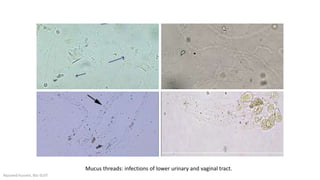
Mucus threads: infections of lower urinary and vaginal tract.
Alyazeed hussein, BSc-SUST
Pollen grains: from contaminate urine and urine container
Alyazeed hussein, BSc-SUST
Air bubbles
Starch globules
Alyazeed hussein, BSc-SUST
Fecal contamination
Rotifer
Alternaria
Pubic lice
Dust mite
Alyazeed hussein, BSc-SUST
• This has been a presentation of Alyazeed Hussein.
• Thanks for your attention and kind patience.
• Any questions, additions, or comments?
Alyazeed hussein, BSc-SUST
References
• Urinalysis Benchtop Reference Guide, CAP.
• Kjeldsberg's Body Fluid Analysis, ASCP.
• A Handbook Of Routine Urinalysis, Sister Laurine Graff.
• Textbook of urinalysis and body fluids, Landy J. McBride-Lippincott.
• Graff's textbook of urinalysis and body fluids, Lillian A. Mundt, 3rd e
• Success in clinical laboratory science, ANNA P. CIULLA, 4th e
• www.researchgate.net
• www.sciencedirect.com
• www.diagnostics.roche.com
Alyazeed hussein, BSc-SUST

Urinalysis a comprehensive review

  • 1.
    Outline: • Collection andHandling of urine sample • Types of urine specimen • Physical & chemical examination of urinalysis • Discrepancies in urinalysis • Microscopic examination of urine sediment • Quiz… Alyazeed hussein, BSc-SUST A Comprehensive Review of Urinalysis Medical Laboratory Science
  • 2.
    Urinalysis  A completeurinalysis is composed of multiple tests, including macroscopic, physical, chemical, and microscopic examination.  Specimen Collection and Handling: Use clean, dry container, receive and analyze the sample within 2 hours!!?  Types of urine specimen: 1. Random urine: Most common type, for routine tests. 2. First morning: Concentrated specimen used for routine screening, pregnancy test. 3. Fasting & 2-Hour postprandial: for DM(insulin monitoring), 2 hours after eating. 4. 24-Hour: Collected over a period of 24 hours for creatinine clearance, Glomerular Filtration Rate (GFR). 5. Midstream clean-catch (MSU): urine collected in the middle of urination; used for bacterial culture. 6. Catheterized: Collected from a tube placed through the urethra into the bladder; used for bacterial culture and routine screening. 7. Suprapubic aspiration: Needle inserted into the bladder through the abdominal wall; used for bacterial culture and cytologic testing. 8. Pediatric collection: Use small, clear plastic bags with adhesive to adhere to the genital area. Alyazeed hussein, BSc-SUST
  • 3.
    URINE SPECIMEN STORAGEAND HANDLING • Most common form of preservation, refrigeration at 2°C to 8°C, is suitable for the majority of specimens. Any urine specimen for microbiological studies should be refrigerated immediately if it cannot be transported directly to the laboratory, the specimen remains suitable for culture for up to 24 hours. • Before testing, urine must be brought to room temperature. • Other preservatives are: Boric acid (acceptable for culture), Thymol (cells & casts), formalin (cellular preservative) Alyazeed hussein, BSc-SUST
  • 4.
    Physical examination ofurine (Color, Appearance and Specific gravity) A. color: 1. Pale yellow & yellow: normal color of urine(urochrome: urobilin). 2. Colorless: may due to dilution, or Diabetes Meletus. 3. Dark yellow: may due to dehydration, or First morning( concentrated), usually with high specific gravity. 4. Orange or dark yellow-amber: Bilirubinemia occurs from liver problems, such as hepatitis > bilirubinuria, yellow foam forms when urine is shaken due to the presence of conjugated bilirubin. Smith iodine test positive (green ring), hay's test (sulfur powder) positive. 5. Red/pink: (RBCs, (hemoglobin-brown and myoglobin-muscle) or menstrual contamination. 6. Green/blue: medication or pseudomonas. Note that! Uroerythrin adds a slight pink pigment, mostly apparent following refrigeration, when the pigment attaches to precipitated amorphous urates. Alyazeed hussein, BSc-SUST
  • 5.
  • 6.
    B. Appearance andclarity: 1. Clear: normal. 2. Slightly cloudy: May be due to the presence of low numbers of formed elements. 3. Cloudy or milky: presence of amorphous, crystals, pus cells, epithelial cells, also due to Chyluria (W. bancrofti, lymphatic filariasis). Bence jones protein: light chain of immunoglobulins in urine(multiple myeloma) = (heat test). C. Specific Gravity: determines the kidney's reabsorption ability. • Normal range: 1.015 to 1.030 • Low specific gravity: loss of the kidney's ability to concentrate urine or presence of disease, It can also be found normally with large fluid intake. • High specific gravity may result from adrenal insufficiency, diabetes mellitus(glycosuria). Note that! If urine pH >8.0, add 0.005 to the reading. Alyazeed hussein, BSc-SUST
  • 7.
    Chemical examination ofurine multi-parameter reagent strip (Multistix) Procedure: MUST BE FOLLOWED EXACTLY TO ACHIEVE RELIABLE TEST RESULTS 1. Collect FRESH urine specimen in a clean, dry container. Mix well immediately before testing. 2. Remove one strip from bottle and replace cap. Completely immerse reagent areas of the strip in FRESH urine and remove immediately to avoid dissolving out reagents 3. While removing, run the edge of the strip against the rim of the urine container to remove excess urine. Hold the strip in a horizontal position to prevent possible mixing of chemicals from adjacent reagent areas/or contaminating the hands with urine. 4. Compare reagent areas to corresponding Color chart on the bottle label at the time specified. Hold strip close to color blocks and match carefully. Avoid laying the strip directly on the Color chart as this will result in the urine soiling the chart. For optimal results, read the ketone test at 15 seconds after dipping; read the bilirubin test at 20 seconds; glucose at 30 seconds; blood at 40 seconds; urobilinogen at 45 seconds; and specific gravity from 45 to 60 seconds after dipping. Alyazeed hussein, BSc-SUST
  • 8.
  • 9.
    False-negativeFalse-positiveTest Not mixed will,high proteinuria, glucosuria, Boric acid Expired strip, formalinLeukocyte esterase Formalin, lack of nitrateImproper storage (bacterial proliferation) Nitrite Formalin, high vitamin CPeroxidasesBlood High ketones, high ascorbic acid Alkaline urine, oxidizing agent : bleach, Glucose Ascorbic acid, boric acid, sample exposed to light Colored substancesBilirubin Boric acid, formalin, hypochlorite, delay in examination, volatilization Highly pigmented urine, drugs Ketones Bence-jones protein, sperms Alkaline urine, drugsProtein Formalin, hypochlorite, antibiotics Sulfonamide, drugs, beetUrobilinogen Discrepancies Alyazeed hussein, BSc-SUST
  • 10.
    Discrepancies • Renal glycosuria:presence of glucose in urine with normal blood glucose level! Due to defect in renal tubular dysfunction or by glucagon hormone. (>180mg/dl) • Strip positive for blood with absence of RBCs microscopically: hemoglobinuria(Hb from lysed RBCs) or diluted urine (Ghost RBCs) pH > 7, SG < 1.010, handling, old sample, high temperature, peroxidase positive bacteria (E. coli), myoglobin, too fast centrifugation, • Sterile pyuria, presence of pus in urine with no bacteria: using of antibiotics. • RBCs can be confused with yeast cells or oil droplets. Diluted acetic acid can be used to lyse RBCs, leaving only yeast, oil droplets, and WBCs. • Positive leukocyte esterase with Glitter cells or absence of WBCs microscopically: dilute alkaline urine. • Excessive shaking or taping of sediment against edges of table to mix it up> cause the casts to dissolve. • Note that!! Native urine: urine not centrifuged > counting chamber method > small volume of urine only. Alyazeed hussein, BSc-SUST
  • 11.
    • 10 to15 mL (12ml) Centrifuged at 400 – 450 g (RCF), 1500 – 2000 (1600) (RPM) for 5 mins hold the test tube upside down and count to 3, then turn the test tube again and stand it upright mix drop (20 μL) in a slide + glass cover slip (carefully to avoid air bubbles) examine. • Report RBCs/WBCs using high-power magnification (i.e., high-power field [hpf]), report casts and crystals using low-power magnification (i.e., low-power field [lpf]). • Normal Urines: Contain 0-4 RBCs (hpf), 0-3 WBCs (hpf), 0-2 hyaline casts (lpf), several epithelial cells (hpf), some types of crystals, and mucus. • Casts have a tendency to locate near the edges of the cover slip (LPF scanning around the cover slip). Microscopic examination Alyazeed hussein, BSc-SUST
  • 12.
  • 13.
    Alyazeed hussein, BSc-SUST Sedimentconstituents such as bacteria, yeast cells, crystals, and spermatozoa are not counted, but instead given as crosses
  • 14.
  • 15.
    Isomorphic RBCs Dysmorphic RBCs,Have cellular blebs (mickey mouse ear), associated with glomerular bleeding (glomerulonephritis). Ghost RBC In dilute urine, absorb water, swell, and lyse rapidly, releasing hemoglobin. Examined under reduced light. RBCs, Seen in kidney or urinary tract diseases or menstrual blood contamination, <3 /HPF is normal Alyazeed hussein, BSc-SUST
  • 16.
    Pus cells, neutrophilsin acute infections, eosinophils in interstitial nephritis, lymphocytes in renal transplantation Alyazeed hussein, BSc-SUST Elongated WBCs
  • 17.
    Macrophages, Contain digestedmaterial, lipids, seen in chronic inflammation and radiation therapy Alyazeed hussein, BSc-SUST
  • 18.
    Renal tubular cells(RTEs) line the nephron, seen in renal tubular damage (acute tubular necrosis, viral infection, or renal transplant rejection) Alyazeed hussein, BSc-SUST
  • 19.
    Sperms, found inmen with retrograde ejaculation, post-prostatectomy, or in sample collected soon after ejaculation Alyazeed hussein, BSc-SUST
  • 20.
    Squamous epithelial cells,from urethra, skin and vaginal mucosa Alyazeed hussein, BSc-SUST
  • 21.
    Clue cell: Gardnerellavaginalis Alyazeed hussein, BSc-SUST
  • 22.
    Tadpole cells orcaudate cells Alyazeed hussein, BSc-SUST Transitional epithelial cells (Urothelial cells), from renal pelvis, ureter and bladder, increased in infections, renal stones, bladder cancer, and post-catheterization. Chronic urinary tract infection
  • 23.
  • 24.
  • 25.
    Decoy cells: viralinfection (polyoma virus) or malignancy Alyazeed hussein, BSc-SUST
  • 26.
    Oval fat bodies:with marked proteinuria, acute tubular necrosis or nephrotic syndrome Alyazeed hussein, BSc-SUST
  • 27.
  • 28.
    Fatty casts, withmarked proteinuria, acute tubular necrosis or nephrotic syndrome Oval fat bodies Alyazeed hussein, BSc-SUST
  • 29.
    Renal tubular epithelialcells (RTEs) casts: Found in tubular damage, acute tubular necrosis, or renal transplant rejection Alyazeed hussein, BSc-SUST
  • 30.
    White blood cells(WBCs) casts: in pyelonephritis, lupus or allergic nephritis Alyazeed hussein, BSc-SUST
  • 31.
    Granular casts: foundin normal urine following stress, strenuous exercise, or in renal diseases Alyazeed hussein, BSc-SUST
  • 32.
    Hyaline casts: seenin normal urine following strenuous exercise also seen in renal diseases Alyazeed hussein, BSc-SUST
  • 33.
  • 34.
    Red blood cells(RBCs) casts: indicates serious renal disease, acute nephritis, glomerular injuries, or glomerulonephritis and malignant hypertension Alyazeed hussein, BSc-SUST
  • 35.
  • 36.
  • 37.
  • 38.
    Waxy cast: foundin sever renal disease or acute glomerulonephritis Alyazeed hussein, BSc-SUST
  • 39.
    Broad cast: poorprognosis, renal failure Alyazeed hussein, BSc-SUST
  • 40.
  • 41.
  • 42.
    Mixed cast (yeast,WBC, granular ,hyaline) Alyazeed hussein, BSc-SUST Bacterial cast
  • 43.
    Urine crystals atacid pH Alyazeed hussein, BSc-SUST
  • 44.
    Cystine crystals: inpatients with cystinosis, a congenital condition, most common aminoaciduria Alyazeed hussein, BSc-SUST
  • 45.
    Sulfonamide crystals: formrenal calculi in dehydrated patients, infrequently seen today Alyazeed hussein, BSc-SUST
  • 46.
  • 47.
  • 48.
    Uric acid crystals:associated with hyperuricemia, uric acid stone, tumor lysis syndrome, gouty nephropathy Alyazeed hussein, BSc-SUST
  • 49.
  • 50.
  • 51.
  • 52.
    Found in concentratedurine associated with fever and dehydration, may hide bacteria, casts and crystals Amorphus urate (acidic urine) Amorphus phosphate (alkaline urine) Alyazeed hussein, BSc-SUST
  • 53.
    Bilirubin crystals: inurine contain high amounts of bilirubin Alyazeed hussein, BSc-SUST
  • 54.
    Calcium oxalate crystals:patients consume tomatoes, apples, oranges (rich in oxalic acid) may have these crystals in urine. Found in renal calculi. Alyazeed hussein, BSc-SUST
  • 55.
    Cholesterol crystals: associatedwith nephrotic syndrome Alyazeed hussein, BSc-SUST
  • 56.
    Hippuric acid: inperson who eat a diet rich in benzoic acid, may also seen in liver diseases Alyazeed hussein, BSc-SUST
  • 57.
    Leucine crystals: inliver disease, appears in association with tyrosine crystals Alyazeed hussein, BSc-SUST
  • 58.
    Tyrosine crystals: seenin hepatic failure Alyazeed hussein, BSc-SUST
  • 59.
    Alyazeed hussein, BSc-SUST Acidurate: old sample not significant
  • 60.
    Sodium urate: noclinical significance Alyazeed hussein, BSc-SUST
  • 61.
    Urine crystals atneutral or alkaline pH Alyazeed hussein, BSc-SUST
  • 62.
    Calcium carbonate: no clinicalsignificance Alyazeed hussein, BSc-SUST
  • 63.
    Calcium phosphate: innormal urine may cause renal calculi Alyazeed hussein, BSc-SUST
  • 64.
    Ammonium biurate crystals(thorn apple): seen in old urine sample (teaching sample), have no clinical significance Alyazeed hussein, BSc-SUST
  • 65.
    Ammonium magnesium phosphate(triple phosphate, struvite crystals, coffin lid), appear fern-like feathery (dissolved), normal in urine but may be associated with bacterial growth (Proteus). Calculi seen in chronic UTI Alyazeed hussein, BSc-SUST
  • 66.
  • 67.
    Bacteria: in urinarytract infection, or may be a vaginal or fecal contaminant Alyazeed hussein, BSc-SUST
  • 68.
    Yeast/fungi: candida albicans,appears as budding yeast or pseudohyphae, may be from a vaginal contaminant, bladder or kidney inaction Alyazeed hussein, BSc-SUST
  • 69.
    Adult female ofE. vermicularis Eggs of E. vermicularis Trophozoites of T. vaginalis Egg of S. haematobium Alyazeed hussein, BSc-SUST
  • 70.
  • 71.
    Alyazeed hussein, BSc-SUST Oildroplets Corpora amylacea Glass artifacts
  • 72.
  • 73.
    Mucus threads: infectionsof lower urinary and vaginal tract. Alyazeed hussein, BSc-SUST
  • 74.
    Pollen grains: fromcontaminate urine and urine container Alyazeed hussein, BSc-SUST
  • 75.
    Alyazeed hussein, BSc-SUST Airbubbles Starch globules
  • 76.
    Alyazeed hussein, BSc-SUST Fecalcontamination Rotifer Alternaria Pubic lice Dust mite
  • 77.
  • 78.
    • This hasbeen a presentation of Alyazeed Hussein. • Thanks for your attention and kind patience. • Any questions, additions, or comments? Alyazeed hussein, BSc-SUST
  • 79.
    References • Urinalysis BenchtopReference Guide, CAP. • Kjeldsberg's Body Fluid Analysis, ASCP. • A Handbook Of Routine Urinalysis, Sister Laurine Graff. • Textbook of urinalysis and body fluids, Landy J. McBride-Lippincott. • Graff's textbook of urinalysis and body fluids, Lillian A. Mundt, 3rd e • Success in clinical laboratory science, ANNA P. CIULLA, 4th e • www.researchgate.net • www.sciencedirect.com • www.diagnostics.roche.com Alyazeed hussein, BSc-SUST