Urinary Tract Infections


Hongbiao (Hank) Liu MD PhD

    Luna Medical Care
Urinary Tract Infections
 Leading cause of morbidity and health
  care expenditures in persons of all ages.

 An estimated 50 % of women report
  having had a UTI at some point in their
  lives.

 8.3 million office visits and more than 1
  million hospitalizations, for an overall
  annual cost > $1 billion.
Acute Uncomplicated Cystitis
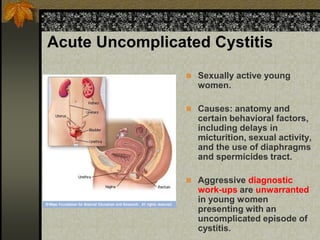
                  Sexually active young
                   women.

                  Causes: anatomy and
                   certain behavioral factors,
                   including delays in
                   micturition, sexual activity,
                   and the use of diaphragms
                   and spermicides tract.

                  Aggressive diagnostic
                   work-ups are unwarranted
                   in young women
                   presenting with an
                   uncomplicated episode of
                   cystitis.
Acute Uncomplicated Cystitis
 The microbiology is limited
  to a few pathogens.

 70%- 85% are caused by
  Escherichia coli

 5-20%are caused by
  coagulase-negative
  Staphylococcus
  saprophyticus

 5-12% are caused by other
  Enterobacteriaceae such
  as Klebsiella and Proteus.
Acute Uncomplicated Cystitis
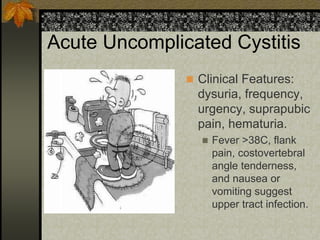
                Clinical Features:
                 dysuria, frequency,
                 urgency, suprapubic
                 pain, hematuria.
                    Fever >38C, flank
                     pain, costovertebral
                     angle tenderness,
                     and nausea or
                     vomiting suggest
                     upper tract infection.
Acute Uncomplicated Cystitis
 Diagnosis: direct history and PE


 PE: Temperature, abdominal exam,
 assessment of CVA tenderness, pelvic
 exam.
   H/o STD’s, new sexual partner, partner
    with urethral symptoms, gradual onset.
Acute Uncomplicated Cystitis
 Guidelines for tx of acute cystitis
  recommend empiric antibiotic tx.
 Unnecessary antibiotic use??
 Clinical criteria for Dx:
 Dysuria, presence of > trace urine leukocytes,
 and presence of nitrites or...
 Dysuria and frequency in the absence of
 vaginal discharge.
Acute Uncomplicated Cystitis
 UA: Evaluation of midstream urine for pyuria.
   White blood cell casts in the urine are Dx of upper
    tract infection.

 Urine Culture: Not necessary
   Warranted in: Suspected complicated infection,
    persistent symptoms following tx, symptoms recur
    < 1 mo after tx.
Acute Uncomplicated Cystitis
 Urine dipsticks:
   Leukocyte esterase (pyuria), sensitivity 75-90%,
    specificity 95%
   Nitrite (Enterobacteriacea), sensitivity 35-85%,
    specificity 95%, false positive with
    phenazopyridine, beets.
   Microscopic evaluation for pyuria or a culture is
    indicated in pt with negative leukocyte esterase
    that have urinary symptoms.
Acute Uncomplicated Cystitis
 Susceptibility:
   E.coli
           30% isolates resistance to ampicillin and sulfonamides
           Increasing of resistance to TMP-SMX
           Resistance to nitrofurantoin is <5%
           Resistance to fluoroquinolones <5%
      S.saprophyticus
           3% resistant to TMP-SMX
           0% resistant to nitrofurantoin
           0.4% resistant to ciprofloxacin
Acute Uncomplicated Cystitis
 Treatment:
   Short course vs. prolonged tx
        Short course preferred except with beta-lactam
         agents
   TMP-SMX       (160/800mg BID x 3) first-line tx
    if: no allergy to the drug, no antibiotics in the past
    3 mo, no recent hospitalization.
   Nitrofurantoin(100mg BID x 5 days)
   Analgesia: Phenazopyridine 200mg TIDx2
Acute Urethral Syndrome
 Acute symptomatic women with dysuria
  and frequency with a midstream culture
  containing < 10(5) CFU/mL.
 > 10(2) CFU/mL in women with acute
  symptomatic pyuria = UTI
 Tx as an uncomplicated UTI
 Mycoplasma genitalium, Ureaplasma
  urealyticum
Acute Complicated Cystitis
 UTI when/with structural, functional or metabolic
  abnormalities (polycystic, solitary, transplant
  kidney;DM, CRF, indwelling cath, neurogenic
  bladder) or elderly, male, child, pregnant or h/o
  recurrent UTI)
 E.coli accounts for fewer than one third of
  complicated cases.

 Clinically, the spectrum of complicated UTIs may
  range from cystitis to urosepsis with septic shock.
Acute Complicated Cystitis
 Urine culture and susceptibility are necessary.


 These infections are usually associated with high-
  count bacteriuria (> 10(5) CFU/mL).


 MO: Proteus, Klebsiella, Pseudomonas, Serratia, and
  Providencia, enterococci, staphylococci and fungi
  AND E.coli
Acute Complicated Cystitis
 Empiric therapy for these patients should include an
  agent with a broad spectrum of activity against the
  expected uropathogens: fluoroquinolone,
  ceftazidime, cefepime, aztreonam, imipenem-
  cilastatin. (Obtain Ucx prior to Tx)
 Tx x 7-14 days
 Follow-up urine culture should be performed
  within 14 days after treatment???
Recurrent Cystitis
 Up to 27% of young women with acute cystitis
  develop recurrent UTIs.
 The causative organism should be identified
  by urine culture.
 Relapse: infection with the same organism
  (multiple relapses = complicated UTIs).
 Recurrence: infection with different
  organisms.
Recurrent Cystitis
 >3 UTI recurrences documented by urine Cx within
   one year can be managed using one of three
   preventive strategies:
1. Acute self-treatment with a three-day course of
   standard therapy.
2. Postcoital prophylaxis with one-half of a TMP-SMX
   double-strength tablet (80/400 mg).
3. Continuous daily prophylaxis TMP-SMX one-half
   tablet per day (40/200 mg); nitrofurantoin 50 to 100
   mg per day; norfloxacin 200 mg per day.
Uncomplicated Pyelonephritis
 Suspect if:
   Cystitis-like   illness and accompanying flank
    pain
   Severe illness with fever, chills, nausea,
    vomiting, abdominal pain
   Gram-negative bacteremia.
Uncomplicated Pyelonephritis
 DX: Clinical, confirm with:
   UA:pyuria and/or WBC casts
   UCx with > 10 (5) CFU/mL (80%)

 Tx: 14 days total
   Oral: TMP/SMX, fluoroquinolones
   IV: 3rd gen cephalosporin, aztreonam,
    quinolones, aminoglycoside
Uncomplicated Pyelonephritis
 Pt with symptoms after 3 days of
 appropriate antimicrobial tx should be
 evaluated by renal US or CT for
 obstruction or abscess.
UTI in Men
 At risk: Older men with prostatic
  disease, UT instrumentation, anal sex,
  or partner colonized with uropathogens.
 UCx: 10 (3) CFU/mL sensitivity and
  specificity 97%.
 Additional studies?
   Notnecessary in young healthy men who
    have a single episode.
UTI in Men
 Tx:
   Uncomplicated         cystitis:
           TMP/SMX or fluoroquinolones x 7 days
   Complicated        cystitis:
           Fluoroquinolones x 7-14 days
   Bacterial      prostatitis:
           Fluoroquinolone x 6-12 weeks
Catheter-Associated UTI
 Risk of bacteriuria is ~ 5%/day (long
  term catheter bacteriuria is inevitable).
 40% of nosocomial infections
 Most common source of gram-negative
  bacteremia.
 Dx: Ucx 10 (2) CFU/mL
   MO: E.coli, Proteus, Enterococcus,
    Pseudomona, Enterobacter, Serratia,
    Candida
Catheter-Associated UTI
 Mild to mod: oral quinolones10-14days
 Severe infection: IV/oral 14-21days
 Asymptomatic bacteriuria in pt with
 an indwelling Foley should not be Tx
 unless they are immunosuppressed,
 have risk of bacterial endocarditis or pt
 who are about to undergo urinary tract
 instrumentation.
Asymptomatic Bacteriuria
 UCx: > 10(5)CFU/mL with no symptoms
 Three groups of pt with asymptomatic
 bacteruria have been shown to benefit
 from tx:
   Pregnant
   Renal transplant
   Pt who are about to undergo urinary tract
    procedures.
Pregnant patients
 Asymptomatic bacteriuria: two
 consecutive voided urine specimens
 with isolation of the same bacterial
 strain >10(5) or a single cath urine
 specimen.
   Nitrofurantoin
                 100mg BID x 5-7 days
   Amoxi/Clav 500mg BID or 250 TID x 7days
   Fosfomycin 3g PO x 1
Interstitial Cystitis
 Frequency, urgency, urge incontinence
  with periurethral and suprapubic pain on
  bladder filling that is improved by
  voiding. Terminal hematuria may be
  present.
 Etiology. Unclear (autoimmune, altered
  glycosaminoglycal layer, allergic)
Interstitial Cystitis
 TX
   Refer to urology for cystoscopy.
   Dietary modifications
   Behavioral modifications
   Rx:
         Pyridium
        Pentosan polysulfate 100mg TID x 6mo to 2
         years.
        Amitriptyline 10-75mg QHS
Interstitial Cystitis
 Intravesical therapies
   Dimethyl Sulfoxide instillations q1-2 wks
   BCG instilled q1wk x 6-8 wks
   Hyaluronic acid instilled q1wk x 4-6wk.

Urinary tract infections

  • 1.
    Urinary Tract Infections Hongbiao(Hank) Liu MD PhD Luna Medical Care
  • 2.
    Urinary Tract Infections Leading cause of morbidity and health care expenditures in persons of all ages.  An estimated 50 % of women report having had a UTI at some point in their lives.  8.3 million office visits and more than 1 million hospitalizations, for an overall annual cost > $1 billion.
  • 3.
    Acute Uncomplicated Cystitis  Sexually active young women.  Causes: anatomy and certain behavioral factors, including delays in micturition, sexual activity, and the use of diaphragms and spermicides tract.  Aggressive diagnostic work-ups are unwarranted in young women presenting with an uncomplicated episode of cystitis.
  • 4.
    Acute Uncomplicated Cystitis The microbiology is limited to a few pathogens.  70%- 85% are caused by Escherichia coli  5-20%are caused by coagulase-negative Staphylococcus saprophyticus  5-12% are caused by other Enterobacteriaceae such as Klebsiella and Proteus.
  • 5.
    Acute Uncomplicated Cystitis  Clinical Features: dysuria, frequency, urgency, suprapubic pain, hematuria.  Fever >38C, flank pain, costovertebral angle tenderness, and nausea or vomiting suggest upper tract infection.
  • 6.
    Acute Uncomplicated Cystitis Diagnosis: direct history and PE  PE: Temperature, abdominal exam, assessment of CVA tenderness, pelvic exam.  H/o STD’s, new sexual partner, partner with urethral symptoms, gradual onset.
  • 7.
    Acute Uncomplicated Cystitis Guidelines for tx of acute cystitis recommend empiric antibiotic tx.  Unnecessary antibiotic use??  Clinical criteria for Dx: Dysuria, presence of > trace urine leukocytes, and presence of nitrites or... Dysuria and frequency in the absence of vaginal discharge.
  • 8.
    Acute Uncomplicated Cystitis UA: Evaluation of midstream urine for pyuria.  White blood cell casts in the urine are Dx of upper tract infection.  Urine Culture: Not necessary  Warranted in: Suspected complicated infection, persistent symptoms following tx, symptoms recur < 1 mo after tx.
  • 9.
    Acute Uncomplicated Cystitis Urine dipsticks:  Leukocyte esterase (pyuria), sensitivity 75-90%, specificity 95%  Nitrite (Enterobacteriacea), sensitivity 35-85%, specificity 95%, false positive with phenazopyridine, beets.  Microscopic evaluation for pyuria or a culture is indicated in pt with negative leukocyte esterase that have urinary symptoms.
  • 10.
    Acute Uncomplicated Cystitis Susceptibility:  E.coli  30% isolates resistance to ampicillin and sulfonamides  Increasing of resistance to TMP-SMX  Resistance to nitrofurantoin is <5%  Resistance to fluoroquinolones <5%  S.saprophyticus  3% resistant to TMP-SMX  0% resistant to nitrofurantoin  0.4% resistant to ciprofloxacin
  • 11.
    Acute Uncomplicated Cystitis Treatment:  Short course vs. prolonged tx  Short course preferred except with beta-lactam agents  TMP-SMX (160/800mg BID x 3) first-line tx if: no allergy to the drug, no antibiotics in the past 3 mo, no recent hospitalization.  Nitrofurantoin(100mg BID x 5 days)  Analgesia: Phenazopyridine 200mg TIDx2
  • 12.
    Acute Urethral Syndrome Acute symptomatic women with dysuria and frequency with a midstream culture containing < 10(5) CFU/mL.  > 10(2) CFU/mL in women with acute symptomatic pyuria = UTI  Tx as an uncomplicated UTI  Mycoplasma genitalium, Ureaplasma urealyticum
  • 13.
    Acute Complicated Cystitis UTI when/with structural, functional or metabolic abnormalities (polycystic, solitary, transplant kidney;DM, CRF, indwelling cath, neurogenic bladder) or elderly, male, child, pregnant or h/o recurrent UTI)  E.coli accounts for fewer than one third of complicated cases.  Clinically, the spectrum of complicated UTIs may range from cystitis to urosepsis with septic shock.
  • 14.
    Acute Complicated Cystitis Urine culture and susceptibility are necessary.  These infections are usually associated with high- count bacteriuria (> 10(5) CFU/mL).  MO: Proteus, Klebsiella, Pseudomonas, Serratia, and Providencia, enterococci, staphylococci and fungi AND E.coli
  • 15.
    Acute Complicated Cystitis Empiric therapy for these patients should include an agent with a broad spectrum of activity against the expected uropathogens: fluoroquinolone, ceftazidime, cefepime, aztreonam, imipenem- cilastatin. (Obtain Ucx prior to Tx)  Tx x 7-14 days  Follow-up urine culture should be performed within 14 days after treatment???
  • 16.
    Recurrent Cystitis  Upto 27% of young women with acute cystitis develop recurrent UTIs.  The causative organism should be identified by urine culture.  Relapse: infection with the same organism (multiple relapses = complicated UTIs).  Recurrence: infection with different organisms.
  • 17.
    Recurrent Cystitis  >3UTI recurrences documented by urine Cx within one year can be managed using one of three preventive strategies: 1. Acute self-treatment with a three-day course of standard therapy. 2. Postcoital prophylaxis with one-half of a TMP-SMX double-strength tablet (80/400 mg). 3. Continuous daily prophylaxis TMP-SMX one-half tablet per day (40/200 mg); nitrofurantoin 50 to 100 mg per day; norfloxacin 200 mg per day.
  • 18.
    Uncomplicated Pyelonephritis  Suspectif:  Cystitis-like illness and accompanying flank pain  Severe illness with fever, chills, nausea, vomiting, abdominal pain  Gram-negative bacteremia.
  • 19.
    Uncomplicated Pyelonephritis  DX:Clinical, confirm with:  UA:pyuria and/or WBC casts  UCx with > 10 (5) CFU/mL (80%)  Tx: 14 days total  Oral: TMP/SMX, fluoroquinolones  IV: 3rd gen cephalosporin, aztreonam, quinolones, aminoglycoside
  • 20.
    Uncomplicated Pyelonephritis  Ptwith symptoms after 3 days of appropriate antimicrobial tx should be evaluated by renal US or CT for obstruction or abscess.
  • 21.
    UTI in Men At risk: Older men with prostatic disease, UT instrumentation, anal sex, or partner colonized with uropathogens.  UCx: 10 (3) CFU/mL sensitivity and specificity 97%.  Additional studies?  Notnecessary in young healthy men who have a single episode.
  • 22.
    UTI in Men Tx:  Uncomplicated cystitis:  TMP/SMX or fluoroquinolones x 7 days  Complicated cystitis:  Fluoroquinolones x 7-14 days  Bacterial prostatitis:  Fluoroquinolone x 6-12 weeks
  • 23.
    Catheter-Associated UTI  Riskof bacteriuria is ~ 5%/day (long term catheter bacteriuria is inevitable).  40% of nosocomial infections  Most common source of gram-negative bacteremia.  Dx: Ucx 10 (2) CFU/mL  MO: E.coli, Proteus, Enterococcus, Pseudomona, Enterobacter, Serratia, Candida
  • 24.
    Catheter-Associated UTI  Mildto mod: oral quinolones10-14days  Severe infection: IV/oral 14-21days  Asymptomatic bacteriuria in pt with an indwelling Foley should not be Tx unless they are immunosuppressed, have risk of bacterial endocarditis or pt who are about to undergo urinary tract instrumentation.
  • 25.
    Asymptomatic Bacteriuria  UCx:> 10(5)CFU/mL with no symptoms  Three groups of pt with asymptomatic bacteruria have been shown to benefit from tx:  Pregnant  Renal transplant  Pt who are about to undergo urinary tract procedures.
  • 26.
    Pregnant patients  Asymptomaticbacteriuria: two consecutive voided urine specimens with isolation of the same bacterial strain >10(5) or a single cath urine specimen.  Nitrofurantoin 100mg BID x 5-7 days  Amoxi/Clav 500mg BID or 250 TID x 7days  Fosfomycin 3g PO x 1
  • 27.
    Interstitial Cystitis  Frequency,urgency, urge incontinence with periurethral and suprapubic pain on bladder filling that is improved by voiding. Terminal hematuria may be present.  Etiology. Unclear (autoimmune, altered glycosaminoglycal layer, allergic)
  • 28.
    Interstitial Cystitis  TX  Refer to urology for cystoscopy.  Dietary modifications  Behavioral modifications  Rx:  Pyridium  Pentosan polysulfate 100mg TID x 6mo to 2 years.  Amitriptyline 10-75mg QHS
  • 29.
    Interstitial Cystitis  Intravesicaltherapies  Dimethyl Sulfoxide instillations q1-2 wks  BCG instilled q1wk x 6-8 wks  Hyaluronic acid instilled q1wk x 4-6wk.