UTI
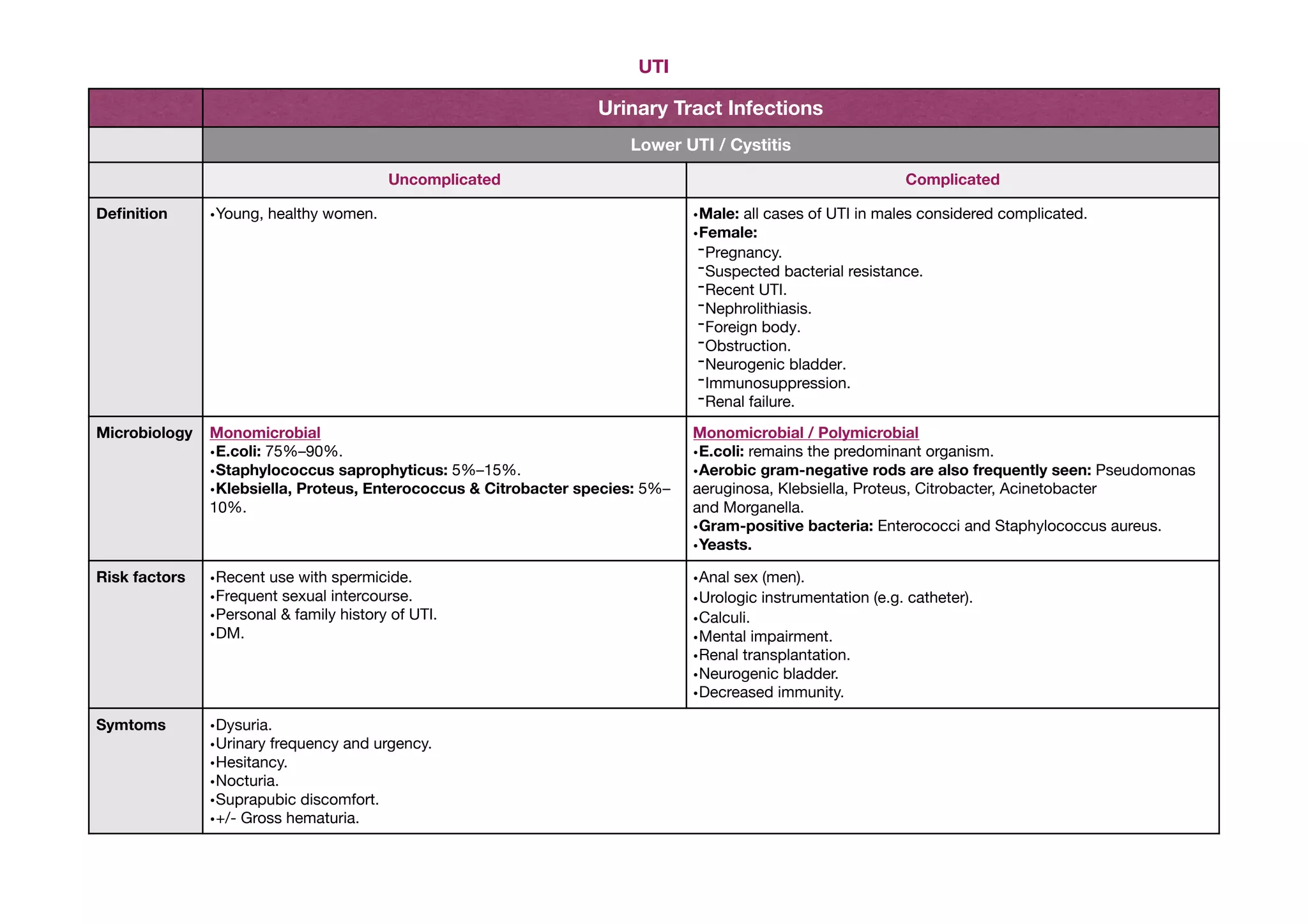
Urinary Tract Infections
Lower UTI / Cystitis
Uncomplicated Complicated
Definition •Young, healthy women. •Male: all cases of UTI in males considered complicated.
•Female:
-Pregnancy.
-Suspected bacterial resistance.
-Recent UTI.
-Nephrolithiasis.
-Foreign body.
-Obstruction.
-Neurogenic bladder.
-Immunosuppression.
-Renal failure.
Microbiology Monomicrobial
•E.coli: 75%–90%.
•Staphylococcus saprophyticus: 5%–15%.
•Klebsiella, Proteus, Enterococcus & Citrobacter species: 5%–
10%.
Monomicrobial / Polymicrobial
•E.coli: remains the predominant organism.
•Aerobic gram-negative rods are also frequently seen: Pseudomonas
aeruginosa, Klebsiella, Proteus, Citrobacter, Acinetobacter
and Morganella.
•Gram-positive bacteria: Enterococci and Staphylococcus aureus.
•Yeasts.
Risk factors •Recent use with spermicide.
•Frequent sexual intercourse.
•Personal & family history of UTI.
•DM.
•Anal sex (men).
•Urologic instrumentation (e.g. catheter).
•Calculi.
•Mental impairment.
•Renal transplantation.
•Neurogenic bladder.
•Decreased immunity.
Symtoms •Dysuria.
•Urinary frequency and urgency.
•Hesitancy.
•Nocturia.
•Suprapubic discomfort.
•+/- Gross hematuria.
UTI
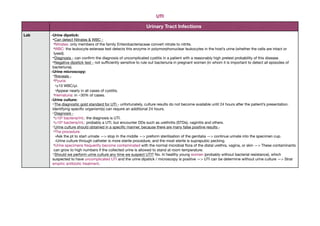
Lab •Urine dipstick:
-Can detect Nitrates & WBC -
Nitrates: only members of the family Enterobacteriaceae convert nitrate to nitrite.
WBC: the leukocyte esterase test detects this enzyme in polymorphonuclear leukocytes in the host’s urine (whether the cells are intact or
lysed).
-Diagnosis - can confirm the diagnosis of uncomplicated cystitis in a patient with a reasonably high pretest probability of this disease.
-Negative dipstick test - not sufficiently sensitive to rule out bacteriuria in pregnant women (in whom it is important to detect all episodes of
bacteriuria).
•Urine microscopy:
-Rreveals -
Pyuria:
✴≥10 WBC/µl.
✴Appear nearly in all cases of cystitis.
Hematuria: in ~30% of cases.
•Urine culture:
-The diagnostic gold standard for UTI - unfortunately, culture results do not become available until 24 hours after the patient’s presentation.
Identifying specific organism(s) can require an additional 24 hours.
-Diagnosis -
≥105 bacteria/mL: the diagnosis is UTI.
≥103 bacteria/mL: probably a UTI, but encounter DDs such as urethritis (STDs), vaginitis and others.
-Urine culture should obtained in a specific manner, because there are many false positive results -
The procedure:
✴Ask the pt to start urinate —> stop In the middle —> preform sterilisation of the genitalia —> continue urinate into the specimen cup.
✴Urine culture through catheter is more sterile procedure, and the most sterile is suprapubic pecking.
Urine specimens frequently become contaminated with the normal microbial flora of the distal urethra, vagina, or skin —> These contaminants
can grow to high numbers if the collected urine is allowed to stand at room temperature.
-Should we perform urine culture any time we suspect UTI? No. In healthy young women (probably without bacterial resistance), which
suspected to have uncomplicated UTI and the urine dipstick / microscopy is positive —> UTI can be determine without urine culture —> Strat
empiric antibiotic treatment.
Urinary Tract Infections
UTI
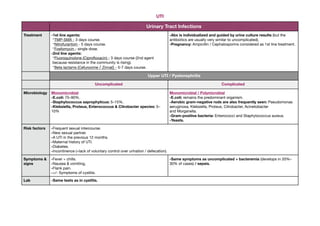
Treatment •1st line agents:
-TMP-SMX - 3 days course.
-Nitrofurantoin - 5 days course.
-Fosfomycin - single dose.
•2nd line agents:
-Fluoroquinolone (Ciprofloxacin) - 3 days course (2nd agent
because resistance in the community is rising).
-Βeta lactams (Cefuroxime / Zinnat) - 5-7 days course.
•Abx is individualized and guided by urine culture results (but the
antibiotics are usually very similar to uncomplicated).
•Pregnancy: Ampicillin / Cephalosporins considered as 1st line treatment.
Upper UTI / Pyelonephritis
Uncomplicated Complicated
Microbiology Monomicrobial
•E.coli: 75–90%.
•Staphylococcus saprophyticus: 5–15%.
•Klebsiella, Proteus, Enterococcus & Citrobacter species: 5–
10%
Monomicrobial / Polymicrobial
•E.coli: remains the predominant organism.
•Aerobic gram-negative rods are also frequently seen: Pseudomonas
aeruginosa, Klebsiella, Proteus, Citrobacter, Acinetobacter
and Morganella.
•Gram-positive bacteria: Enterococci and Staphylococcus aureus.
•Yeasts.
Risk factors •Frequent sexual intercourse.
•New sexual partner.
•A UTI in the previous 12 months.
•Maternal history of UTI.
•Diabetes.
•Incontinence (=lack of voluntary control over urination / defecation).
Symptoms &
signs
•Fever + chills.
•Nausea & vomiting,
•Flank pain.
•+/- Symptoms of cystitis.
•Same symptoms as uncomplicated + bacteremia (develops in 20%–
30% of cases) / sepsis.
Lab •Same tests as in cystitis.
Urinary Tract Infections
UTI
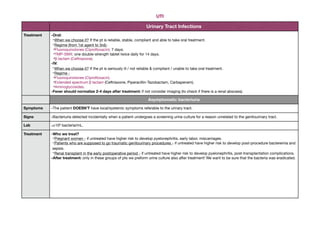
Treatment •Oral:
-When we choose it? If the pt is reliable, stable, compliant and able to take oral treatment.
-Regime (from 1st agent to 3rd)-
Fluoroquinolones (Ciprofloxacin): 7 days.
TMP-SMX: one double-strength tablet twice daily for 14 days.
β-lactam (Ceftriaxone).
•IV:
-When we choose it? If the pt is seriously ill / not reliable & compliant / unable to take oral treatment.
-Regime -
Fluoroquinolones (Ciprofloxacin).
Extended spectrum β lactam (Ceftriaxone, Piperacillin-Tazobactam, Carbapenem).
Aminoglycosides.
•Fever should normalize 2-4 days after treatment: if not consider imaging (to check if there is a renal abscess).
Asymptomatic bacteriuria
Symptoms •The patient DOESN’T have local/systemic symptoms referable to the urinary tract.
Signs •Bacteriuria detected incidentally when a patient undergoes a screening urine culture for a reason unrelated to the genitourinary tract.
Lab •≥105 bacteria/mL.
Treatment •Who we treat?
-Pregnant women - if untreated have higher risk to develop pyelonephritis, early labor, miscarriages.
-Patients who are supposed to go traumatic genitourinary procedures - if untreated have higher risk to develop post-procedure bacteremia and
sepsis.
-Renal transplant in the early postoperative period - if untreated have higher risk to develop pyelonephritis, post-transplantation complications.
•After treatment: only in these groups of pts we preform urine culture also after treatment! We want to be sure that the bacteria was eradicated.
Urinary Tract Infections
UTI
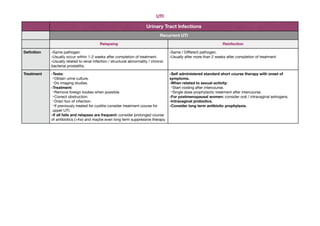
Recurrent UTI
Relapsing Reinfection
Definition •Same pathogen.
•Usually occur within 1-2 weeks after completion of treatment.
•Usually related to renal infection / structural abnormality / chronic
bacterial prostatitis.
•Same / Different pathogen.
•Usually after more than 2 weeks after completion of treatment.
Treatment •Tests:
-Obtain urine culture.
-Do imaging studies.
•Treatment:
-Remove foreign bodies when possible.
-Correct obstruction.
-Drain foci of infection.
-If previously treated for cystitis consider treatment course for
upper UTI.
•If all fails and relapses are frequent: consider prolonged course
of antibiotics (>4w) and maybe even long term suppressive therapy.
•Self administered standard short course therapy with onset of
symptoms.
•When related to sexual activity:
-Start voiding after intercourse.
-Single dose prophylactic treatment after intercourse.
•For postmenopausal women: consider oral / intravaginal estrogens.
•Intravaginal probiotics.
•Consider long term antibiotic prophylaxis.
Urinary Tract Infections

UTI.pdf

  • 1.
    UTI Urinary Tract Infections LowerUTI / Cystitis Uncomplicated Complicated Definition •Young, healthy women. •Male: all cases of UTI in males considered complicated. •Female: -Pregnancy. -Suspected bacterial resistance. -Recent UTI. -Nephrolithiasis. -Foreign body. -Obstruction. -Neurogenic bladder. -Immunosuppression. -Renal failure. Microbiology Monomicrobial •E.coli: 75%–90%. •Staphylococcus saprophyticus: 5%–15%. •Klebsiella, Proteus, Enterococcus & Citrobacter species: 5%– 10%. Monomicrobial / Polymicrobial •E.coli: remains the predominant organism. •Aerobic gram-negative rods are also frequently seen: Pseudomonas aeruginosa, Klebsiella, Proteus, Citrobacter, Acinetobacter and Morganella. •Gram-positive bacteria: Enterococci and Staphylococcus aureus. •Yeasts. Risk factors •Recent use with spermicide. •Frequent sexual intercourse. •Personal & family history of UTI. •DM. •Anal sex (men). •Urologic instrumentation (e.g. catheter). •Calculi. •Mental impairment. •Renal transplantation. •Neurogenic bladder. •Decreased immunity. Symtoms •Dysuria. •Urinary frequency and urgency. •Hesitancy. •Nocturia. •Suprapubic discomfort. •+/- Gross hematuria.
  • 2.
    UTI Lab •Urine dipstick: -Candetect Nitrates & WBC - Nitrates: only members of the family Enterobacteriaceae convert nitrate to nitrite. WBC: the leukocyte esterase test detects this enzyme in polymorphonuclear leukocytes in the host’s urine (whether the cells are intact or lysed). -Diagnosis - can confirm the diagnosis of uncomplicated cystitis in a patient with a reasonably high pretest probability of this disease. -Negative dipstick test - not sufficiently sensitive to rule out bacteriuria in pregnant women (in whom it is important to detect all episodes of bacteriuria). •Urine microscopy: -Rreveals - Pyuria: ✴≥10 WBC/µl. ✴Appear nearly in all cases of cystitis. Hematuria: in ~30% of cases. •Urine culture: -The diagnostic gold standard for UTI - unfortunately, culture results do not become available until 24 hours after the patient’s presentation. Identifying specific organism(s) can require an additional 24 hours. -Diagnosis - ≥105 bacteria/mL: the diagnosis is UTI. ≥103 bacteria/mL: probably a UTI, but encounter DDs such as urethritis (STDs), vaginitis and others. -Urine culture should obtained in a specific manner, because there are many false positive results - The procedure: ✴Ask the pt to start urinate —> stop In the middle —> preform sterilisation of the genitalia —> continue urinate into the specimen cup. ✴Urine culture through catheter is more sterile procedure, and the most sterile is suprapubic pecking. Urine specimens frequently become contaminated with the normal microbial flora of the distal urethra, vagina, or skin —> These contaminants can grow to high numbers if the collected urine is allowed to stand at room temperature. -Should we perform urine culture any time we suspect UTI? No. In healthy young women (probably without bacterial resistance), which suspected to have uncomplicated UTI and the urine dipstick / microscopy is positive —> UTI can be determine without urine culture —> Strat empiric antibiotic treatment. Urinary Tract Infections
  • 3.
    UTI Treatment •1st lineagents: -TMP-SMX - 3 days course. -Nitrofurantoin - 5 days course. -Fosfomycin - single dose. •2nd line agents: -Fluoroquinolone (Ciprofloxacin) - 3 days course (2nd agent because resistance in the community is rising). -Βeta lactams (Cefuroxime / Zinnat) - 5-7 days course. •Abx is individualized and guided by urine culture results (but the antibiotics are usually very similar to uncomplicated). •Pregnancy: Ampicillin / Cephalosporins considered as 1st line treatment. Upper UTI / Pyelonephritis Uncomplicated Complicated Microbiology Monomicrobial •E.coli: 75–90%. •Staphylococcus saprophyticus: 5–15%. •Klebsiella, Proteus, Enterococcus & Citrobacter species: 5– 10% Monomicrobial / Polymicrobial •E.coli: remains the predominant organism. •Aerobic gram-negative rods are also frequently seen: Pseudomonas aeruginosa, Klebsiella, Proteus, Citrobacter, Acinetobacter and Morganella. •Gram-positive bacteria: Enterococci and Staphylococcus aureus. •Yeasts. Risk factors •Frequent sexual intercourse. •New sexual partner. •A UTI in the previous 12 months. •Maternal history of UTI. •Diabetes. •Incontinence (=lack of voluntary control over urination / defecation). Symptoms & signs •Fever + chills. •Nausea & vomiting, •Flank pain. •+/- Symptoms of cystitis. •Same symptoms as uncomplicated + bacteremia (develops in 20%– 30% of cases) / sepsis. Lab •Same tests as in cystitis. Urinary Tract Infections
  • 4.
    UTI Treatment •Oral: -When wechoose it? If the pt is reliable, stable, compliant and able to take oral treatment. -Regime (from 1st agent to 3rd)- Fluoroquinolones (Ciprofloxacin): 7 days. TMP-SMX: one double-strength tablet twice daily for 14 days. β-lactam (Ceftriaxone). •IV: -When we choose it? If the pt is seriously ill / not reliable & compliant / unable to take oral treatment. -Regime - Fluoroquinolones (Ciprofloxacin). Extended spectrum β lactam (Ceftriaxone, Piperacillin-Tazobactam, Carbapenem). Aminoglycosides. •Fever should normalize 2-4 days after treatment: if not consider imaging (to check if there is a renal abscess). Asymptomatic bacteriuria Symptoms •The patient DOESN’T have local/systemic symptoms referable to the urinary tract. Signs •Bacteriuria detected incidentally when a patient undergoes a screening urine culture for a reason unrelated to the genitourinary tract. Lab •≥105 bacteria/mL. Treatment •Who we treat? -Pregnant women - if untreated have higher risk to develop pyelonephritis, early labor, miscarriages. -Patients who are supposed to go traumatic genitourinary procedures - if untreated have higher risk to develop post-procedure bacteremia and sepsis. -Renal transplant in the early postoperative period - if untreated have higher risk to develop pyelonephritis, post-transplantation complications. •After treatment: only in these groups of pts we preform urine culture also after treatment! We want to be sure that the bacteria was eradicated. Urinary Tract Infections
  • 5.
    UTI Recurrent UTI Relapsing Reinfection Definition•Same pathogen. •Usually occur within 1-2 weeks after completion of treatment. •Usually related to renal infection / structural abnormality / chronic bacterial prostatitis. •Same / Different pathogen. •Usually after more than 2 weeks after completion of treatment. Treatment •Tests: -Obtain urine culture. -Do imaging studies. •Treatment: -Remove foreign bodies when possible. -Correct obstruction. -Drain foci of infection. -If previously treated for cystitis consider treatment course for upper UTI. •If all fails and relapses are frequent: consider prolonged course of antibiotics (>4w) and maybe even long term suppressive therapy. •Self administered standard short course therapy with onset of symptoms. •When related to sexual activity: -Start voiding after intercourse. -Single dose prophylactic treatment after intercourse. •For postmenopausal women: consider oral / intravaginal estrogens. •Intravaginal probiotics. •Consider long term antibiotic prophylaxis. Urinary Tract Infections