THE URINARY SYSTEM STRUCTURE, FUNCTION AND CONTROL John Bastin
General System Anatomy The urinary system is composed of: 1)  2 Kidneys 2)  2 Ureters 3)  1 Bladder 4)  1 Urethra Kidneys lie outside peritoneum, covered in protective fat, either side of vertebral column. Right kidney is lower than left (due to liver).
http://www.agen.ufl.edu/~chyn/age2062/lect/lect_20/31_16.GIF
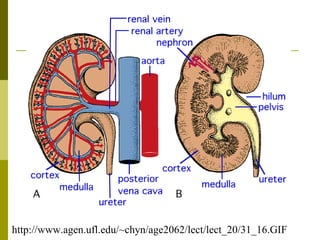
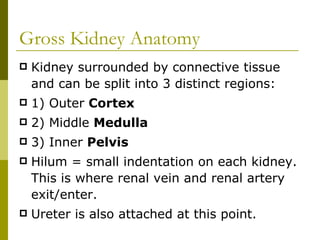
Gross Kidney Anatomy Kidney surrounded by connective tissue and can be split into 3 distinct regions: 1) Outer  Cortex 2) Middle  Medulla 3) Inner  Pelvis Hilum = small indentation on each kidney. This is where renal vein and renal artery exit/enter. Ureter is also attached at this point.
Functions of the Urinary System 1.  Excretes waste products from blood 2.  Regulates fluid volume 3.  Regulates ion/electrolyte concentration 4.  Regulates acid/base balance 5.  Produces erythropoietin and renin Functional unit of kidney =  nephron .  Over a million nephrons in each kidney. Nephrons process fluid into  urine .
 
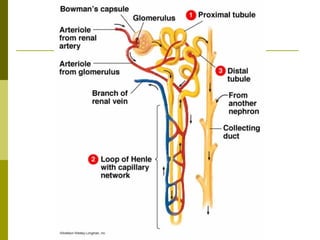
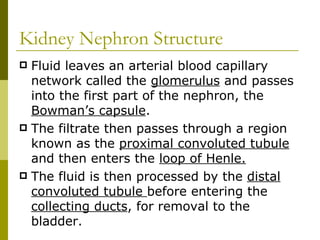
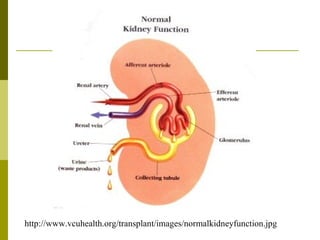
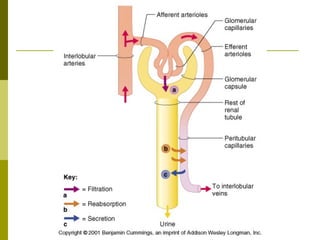
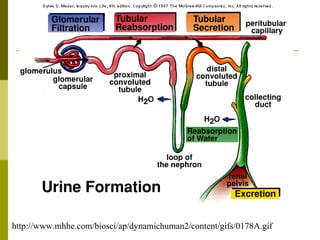
Kidney Nephron Structure Fluid leaves an arterial blood capillary network called the  glomerulus  and passes into the first part of the nephron, the  Bowman’s capsule . The filtrate then passes through a region known as the  proximal convoluted tubule  and then enters the  loop of Henle. The fluid is then processed by the  distal convoluted tubule  before entering the  collecting ducts , for removal to the bladder.
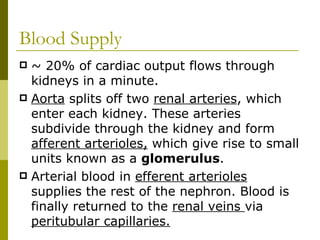
Blood Supply ~ 20% of cardiac output flows through kidneys in a minute. Aorta  splits off two  renal arteries , which enter each kidney. These arteries subdivide through the kidney and form  afferent arterioles,  which give rise to small units known as a  glomerulus .  Arterial blood in  efferent arterioles  supplies the rest of the nephron. Blood is finally returned to the  renal veins  via  peritubular capillaries.
http://www.vcuhealth.org/transplant/images/normalkidneyfunction.jpg
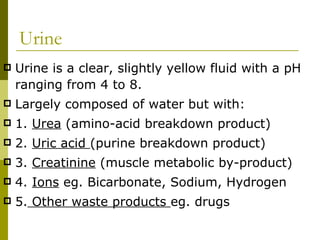
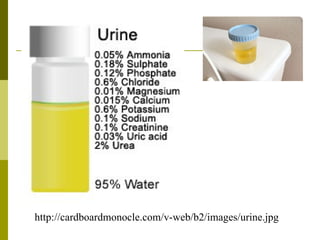
Urine Urine is a clear, slightly yellow fluid with a pH ranging from 4 to 8. Largely composed of water but with: 1.  Urea  (amino-acid breakdown product) 2.  Uric acid  (purine breakdown product) 3.  Creatinine  (muscle metabolic by-product) 4.  Ions  eg. Bicarbonate, Sodium, Hydrogen 5.  Other waste products  eg. drugs
http://cardboardmonocle.com/v-web/b2/images/urine.jpg
Urine Production Kidneys process over  180  litres of fluid a day.  BUT! Actual urine production is limited between  0.5 to 2.5  litres a day. Urine formation involves: 1) FILTRATION 2) REABSORPTION 3) SECRETION So, urine is fluid that has been  filtered , minus substances that have been  reabsorbed  plus substances that are  secreted .
 
Filtration Movement of substances from an area of high pressure (in glomerulus) to an area of low pressure (Bowman’s capsule). Fluid is forced out by arterial hydrostatic pressure.  Blood cells and most proteins are NOT normally filtered, as they are too big. Only small molecules usually pass through. The inherent problem of this system is that the body potentially loses things it needs...
Tubular Reabsorption A necessary process to reabsorb  back  all the water and small nutrients that the body would otherwise lose. Most nutrients are reabsorbed back into the blood in the proximal tubule eg. glucose, amino-acids, ions etc... This process is achieved via active transport.  Water moves via osmosis, largely in the loop of Henle and also later in the distal nephron.
Tubular Secretion Some substances can be actively moved  against  a concentration gradient, across the wall of the nephron from the blood into the kidney filtrate.  These substances are waste products of metabolism (or drugs) and secretion helps the body to keep their levels from becoming toxic eg. ammonia, hydrogen ions.
http://www.mhhe.com/biosci/ap/dynamichuman2/content/gifs/0178A.gif
Regulation of Urine Production Homeostasis requires that intake of substances eg. water & electrolytes, is equivalent to their elimination. As the body loses between 0.5 to 2.5 litres of fluid in urine daily, this needs to be balanced.  Kidney is able to adapt to different situations by varying the  composition  and  volume  of the urine that is produced. This is achieved by hormonal and nervous control.
Blood Volume & Blood Pressure Changes in the rate of urine production affect both  blood volume  &  blood pressure . If blood volume and pressure rise, then urine production will rise. If they both fall, then urine production will fall. A range of hormones have a direct effect on  blood volume and pressure by increasing or decreasing the amount of urine produced.
Antidiuretic Hormone (ADH) Hormone also known as  vasopressin . Produced by  hypothalamus  stored in  posterior pituitary When blood volume  falls  or becomes more  concentrated , ADH is released. It travels via the blood to kidneys, where it alters permeability of the distal tubules and collecting ducts.  This causes more water to be reabsorbed, restoring fluid balance.  ( Diabetes insipidus  is a complication)
Aldosterone Produced in the adrenal glands.(steroid) Aldosterone  is released and  promotes  reabsorption of Sodium This alters the osmotic concentration of blood  Aldosterone turns off as Sodium levels increases
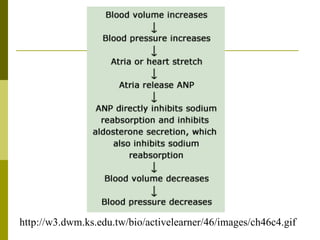
Atrial Natriuretic Hormone This hormone counteracts the effects of ADH and aldosterone by bringing about a  fall  in blood volume and blood pressure. It is secreted by certain cells in the right atrium of the  heart.  When these cells get stretched ie. due to high blood volume or pressure, ANH  hormone is produced which  inhibits ADH. This causes more fluid to be lost in urine, hence reducing blood pressure and blood volume.
http://w3.dwm.ks.edu.tw/bio/activelearner/46/images/ch46c4.gif
Thirst An important means of regulating body fluid content. Water intake is controlled by a collection of neurones in the hypothalamus called the  thirst centre . When blood concentration increases (or blood volume falls), the thirst centre responds by initiating sensation of thirst by ANS stimulation.  If water is consumed, concentration of blood decreases and so thirst sensation dies away.
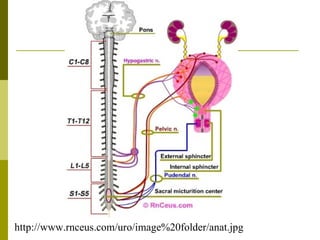
The Micturition Reflex A reflex that causes the bladder to empty when it is full. Initiated by stretching of bladder wall. Stretching causes receptors to send impulses to the spinal cord, which results in  parasympathetic stimulation  of the bladder.  Motor impulses result in contraction of the bladder wall and relaxation of the  inner  urinary sphincter, as well as the desire to urinate.
http://www.rnceus.com/uro/image%20folder/anat.jpg

Kidney127

  • 1.
    THE URINARY SYSTEMSTRUCTURE, FUNCTION AND CONTROL John Bastin
  • 2.
    General System AnatomyThe urinary system is composed of: 1) 2 Kidneys 2) 2 Ureters 3) 1 Bladder 4) 1 Urethra Kidneys lie outside peritoneum, covered in protective fat, either side of vertebral column. Right kidney is lower than left (due to liver).
  • 3.
  • 4.
    Gross Kidney AnatomyKidney surrounded by connective tissue and can be split into 3 distinct regions: 1) Outer Cortex 2) Middle Medulla 3) Inner Pelvis Hilum = small indentation on each kidney. This is where renal vein and renal artery exit/enter. Ureter is also attached at this point.
  • 5.
    Functions of theUrinary System 1. Excretes waste products from blood 2. Regulates fluid volume 3. Regulates ion/electrolyte concentration 4. Regulates acid/base balance 5. Produces erythropoietin and renin Functional unit of kidney = nephron . Over a million nephrons in each kidney. Nephrons process fluid into urine .
  • 6.
  • 7.
    Kidney Nephron StructureFluid leaves an arterial blood capillary network called the glomerulus and passes into the first part of the nephron, the Bowman’s capsule . The filtrate then passes through a region known as the proximal convoluted tubule and then enters the loop of Henle. The fluid is then processed by the distal convoluted tubule before entering the collecting ducts , for removal to the bladder.
  • 8.
    Blood Supply ~20% of cardiac output flows through kidneys in a minute. Aorta splits off two renal arteries , which enter each kidney. These arteries subdivide through the kidney and form afferent arterioles, which give rise to small units known as a glomerulus . Arterial blood in efferent arterioles supplies the rest of the nephron. Blood is finally returned to the renal veins via peritubular capillaries.
  • 9.
  • 10.
    Urine Urine isa clear, slightly yellow fluid with a pH ranging from 4 to 8. Largely composed of water but with: 1. Urea (amino-acid breakdown product) 2. Uric acid (purine breakdown product) 3. Creatinine (muscle metabolic by-product) 4. Ions eg. Bicarbonate, Sodium, Hydrogen 5. Other waste products eg. drugs
  • 11.
  • 12.
    Urine Production Kidneysprocess over 180 litres of fluid a day. BUT! Actual urine production is limited between 0.5 to 2.5 litres a day. Urine formation involves: 1) FILTRATION 2) REABSORPTION 3) SECRETION So, urine is fluid that has been filtered , minus substances that have been reabsorbed plus substances that are secreted .
  • 13.
  • 14.
    Filtration Movement ofsubstances from an area of high pressure (in glomerulus) to an area of low pressure (Bowman’s capsule). Fluid is forced out by arterial hydrostatic pressure. Blood cells and most proteins are NOT normally filtered, as they are too big. Only small molecules usually pass through. The inherent problem of this system is that the body potentially loses things it needs...
  • 15.
    Tubular Reabsorption Anecessary process to reabsorb back all the water and small nutrients that the body would otherwise lose. Most nutrients are reabsorbed back into the blood in the proximal tubule eg. glucose, amino-acids, ions etc... This process is achieved via active transport. Water moves via osmosis, largely in the loop of Henle and also later in the distal nephron.
  • 16.
    Tubular Secretion Somesubstances can be actively moved against a concentration gradient, across the wall of the nephron from the blood into the kidney filtrate. These substances are waste products of metabolism (or drugs) and secretion helps the body to keep their levels from becoming toxic eg. ammonia, hydrogen ions.
  • 17.
  • 18.
    Regulation of UrineProduction Homeostasis requires that intake of substances eg. water & electrolytes, is equivalent to their elimination. As the body loses between 0.5 to 2.5 litres of fluid in urine daily, this needs to be balanced. Kidney is able to adapt to different situations by varying the composition and volume of the urine that is produced. This is achieved by hormonal and nervous control.
  • 19.
    Blood Volume &Blood Pressure Changes in the rate of urine production affect both blood volume & blood pressure . If blood volume and pressure rise, then urine production will rise. If they both fall, then urine production will fall. A range of hormones have a direct effect on blood volume and pressure by increasing or decreasing the amount of urine produced.
  • 20.
    Antidiuretic Hormone (ADH)Hormone also known as vasopressin . Produced by hypothalamus stored in posterior pituitary When blood volume falls or becomes more concentrated , ADH is released. It travels via the blood to kidneys, where it alters permeability of the distal tubules and collecting ducts. This causes more water to be reabsorbed, restoring fluid balance. ( Diabetes insipidus is a complication)
  • 21.
    Aldosterone Produced inthe adrenal glands.(steroid) Aldosterone is released and promotes reabsorption of Sodium This alters the osmotic concentration of blood Aldosterone turns off as Sodium levels increases
  • 22.
    Atrial Natriuretic HormoneThis hormone counteracts the effects of ADH and aldosterone by bringing about a fall in blood volume and blood pressure. It is secreted by certain cells in the right atrium of the heart. When these cells get stretched ie. due to high blood volume or pressure, ANH hormone is produced which inhibits ADH. This causes more fluid to be lost in urine, hence reducing blood pressure and blood volume.
  • 23.
  • 24.
    Thirst An importantmeans of regulating body fluid content. Water intake is controlled by a collection of neurones in the hypothalamus called the thirst centre . When blood concentration increases (or blood volume falls), the thirst centre responds by initiating sensation of thirst by ANS stimulation. If water is consumed, concentration of blood decreases and so thirst sensation dies away.
  • 25.
    The Micturition ReflexA reflex that causes the bladder to empty when it is full. Initiated by stretching of bladder wall. Stretching causes receptors to send impulses to the spinal cord, which results in parasympathetic stimulation of the bladder. Motor impulses result in contraction of the bladder wall and relaxation of the inner urinary sphincter, as well as the desire to urinate.
  • 26.