Dr Abdul Rehman
Post Graduate Resident
Urology Unit II
Mayo Hospital Lahore
• INTRODUCTION
• EPIDEMIOLOGY
• RELEVANT ANATOMY
• AETIOLOGY
• CLASSIFICATION
• PATHOGENESIS
• CLINICAL FEATURES
• INVESTIGATIONS
• TREATMENT OPTIONS
• CONCLUSION
• REFERENCES
• Urethral stricture is an abnormal narrowing or loss of distensibility of
any part of the urethra as a result of fibrosis at the site of injury or
inflammation.
• It is a common cause of urinary retention.
• Urethral stricture is a relatively common disease in men with an
associated prevalence of 229-627 per 100,000 males
• It is commoner in males due to the length of the male urethra
• Mean age of occurrence is 50 years
• The male urethra extends from the bladder neck and terminates at
the external urethral meatus.
• The male urethra measures about 20.5cm in length and comprises
two(2) part – The Anterior and Posterior urethra.
• The longer Anterior urethra measures about 15cm and comprises the
Penile and Bulbous Urethra
• The shorter Posterior urethra comprises the Prostatic and
M
embranous urethras.
• The epithelium of the urethra is stratified or pseudo stratified in the
Penile Urethra and transitional proximal to the Penile.
• Lymphatics from the deep urethra drain into the hypogastric and
common iliac nodes while those of the meatus drain into the inguinal
nodes.
• Arterial supply is from the inferior vesical and internal pudendal
arteries with concomitant venous drainage.
1. CONGENITAL : Pin hole meatus
Non meatal Stricture
External trauma
Urethral instrumentation
Foreign body or urethral calculus.
2. TRAUMATIC:
3.POSTOPERATIVE:Transurethral procedures
4.INFLAMMATORY: Post gonococcal (70%)
Non specific urethritis
Schistosomiasis
Tuberculous urethritis
• Based on Aetiology (Traumatic vs Infective)
• Proximal or Distal (Posterior vs Anterior)
• Partial or Complete
• Single or Multiple
• Urethral stricture forms when the urethral epithelium heals by
proliferation of fibroblasts which later contracts leading to
scarring.
• Post inflammatory strictures are usually confined to the anterior
urethra particularly the bulbous urethra.
• Instrumental injury usually occurs at the bulb but stricture following
prostatic surgery is found at the bladder neck.
• Urethral stricture following pelvic injuries usually occurs at the
membranous urethra
Urethral stricture leads to
1. Dilatation of the urethra proximal to the stricture
2. Compensatory changes in the bladder musculature resulting in
hypertrophy, trabecculation, sacculation and diverticular formation.
3. Hypertrophy of the uretero-trigonal complex or vesicoureteral
reflux causing hydroureters and hydronephrosis.
4. Stasis of urine and subsequent infection of the urinary tract
• Symptoms are usually insidious in onset and are usually LUTS
which include poor stream, intermittency, frequency, hesitancy,
dribbling, acute and chronic retention.
• It may present as a periurethral abscess, periurethral,scrotal or
perineal fistulae with dribbling of urine and as extravasation of urine.
• When infection occurs, symptoms of cystitis, prostatitis, epididymitis
and pyelonephritis can occur.
• Examination of the external genitalia may reveal periurethral
induration, periurethral abscess, perineal urinary fistulae or
extravasation of urine.
• A visible or palpable bladder may be found if urinary retention
occurs.
• Digital rectal examination is done for the state of the prostate.
• Urinalysis, Urine microscopy and culture.
• Blood urea and serum creatinine.
• USG KUB with Residual Volume.
• Plain pelvic or abdominal xrays
• Uroflowmetry
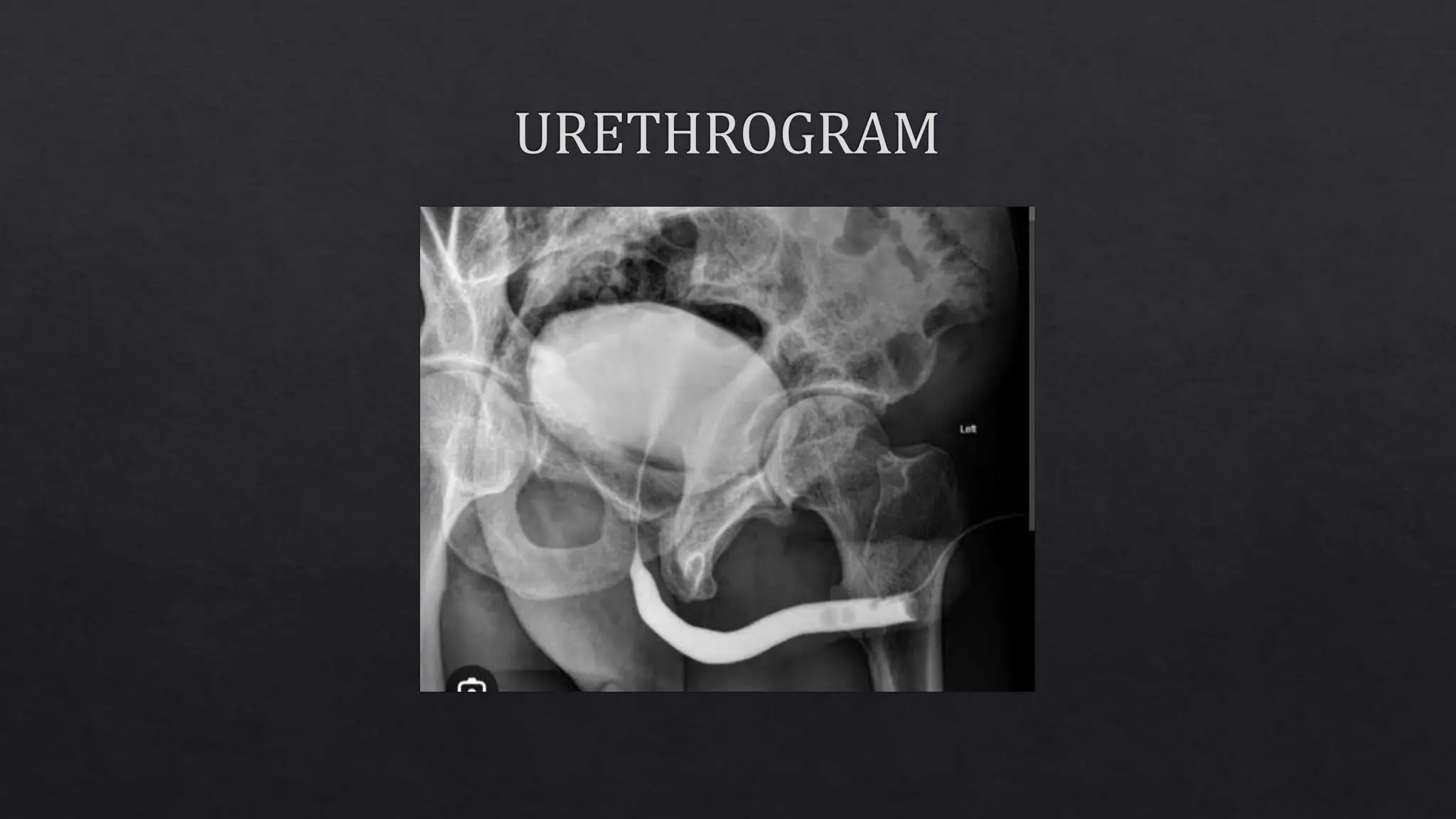
• Retrograde urethrogram and voiding cystourethrogram
• Urethroscopy
• Endoscopic visualization of entire urethra
TEMPORARY MEASURES
• Suprapubic Cystostomy
(i) Urinary retention
(ii) Temporary measure in uraemia
• Antibiotics for UTI
• Correction of electrolyte imbalance
• SPECIFIC MEASURES
1. INTERMITTENT DILATATION : It is palliative but adequate for most
patients. This is done using bougies
• Indication – passable incomplete strictures
• Goal is to stretch the scar without producing more scarring
• Intermittent dilatation is done at increasing intervals starting with a
small sized bougie .
• Complications of Intermittent Dilatation
(i)
(ii)
(iii)
(iv)
Infection
Bleeding and clot retention
Extravasation of urine
Fistulae
Given the above complications, it is of utmost importance dilatation is
done under strict asepsis and bougies should be passed gently.
2. VISUAL INTERNAL URETHROTOMY
This involves incising of the stricture under direct vision using a
cystoscope and a cold blade urethrotome e.g. Sachse urethrotome.
Indication – short, uncomplicated strictures
• After internal urethrotomy, it is advisable to splint the urethra with in
indwelling catheter for 3-5 days or for longer durations in
complicated stricture .
3. URETHROPLASTY
It is an open repair of the urethra.
Indications
(ii)
(i) Failed conservative management i.e Intermittent dilatation and
urethrotomy
Very long strictures or complete strictures with extensive spongiofibrosis
(iii) Complicated strictures with periurethral abscess, calculi or neoplasia.
• Most dependable technique is complete excision of area of fibrosis with
primary anastomosis of normal urethral ends
• Urethral anastomosis is tension free, widely spatulated and creates a large
ovoid anastomosis
• Urethroplasty can be anastomostic or substitutional.
• Grafts include the buccal mucosa, bladder mucosa, penile skin, scrotal skin,
prepuce, posterior auricular skin.
• PROBLEMS OF URETHROPLASTY
(i) Infection
(ii) Prolonged hospital stay
(iii) Necrosis of flap/graft
(iv) Leakage and fistula formation
(v) Restenosis
• Urethral strictures arise from various causes and can result in a range
of manifestations, from an asymptomatic presentation to severe
discomfort secondary to urinary retention
• Establishing effective drainage of the urinary bladder can be
challenging, and a thorough understanding of urethral anatomy and
urologic technology is essential
• Hence, early consultation of a urologist is of utmost importance
Urethral-Stricture-By-Dr-Abdul-Rehman.pptx

Urethral-Stricture-By-Dr-Abdul-Rehman.pptx

  • 1.
    Dr Abdul Rehman PostGraduate Resident Urology Unit II Mayo Hospital Lahore
  • 2.
    • INTRODUCTION • EPIDEMIOLOGY •RELEVANT ANATOMY • AETIOLOGY • CLASSIFICATION • PATHOGENESIS • CLINICAL FEATURES • INVESTIGATIONS • TREATMENT OPTIONS • CONCLUSION • REFERENCES
  • 3.
    • Urethral strictureis an abnormal narrowing or loss of distensibility of any part of the urethra as a result of fibrosis at the site of injury or inflammation. • It is a common cause of urinary retention.
  • 4.
    • Urethral strictureis a relatively common disease in men with an associated prevalence of 229-627 per 100,000 males • It is commoner in males due to the length of the male urethra • Mean age of occurrence is 50 years
  • 5.
    • The maleurethra extends from the bladder neck and terminates at the external urethral meatus. • The male urethra measures about 20.5cm in length and comprises two(2) part – The Anterior and Posterior urethra. • The longer Anterior urethra measures about 15cm and comprises the Penile and Bulbous Urethra • The shorter Posterior urethra comprises the Prostatic and M embranous urethras.
  • 7.
    • The epitheliumof the urethra is stratified or pseudo stratified in the Penile Urethra and transitional proximal to the Penile. • Lymphatics from the deep urethra drain into the hypogastric and common iliac nodes while those of the meatus drain into the inguinal nodes. • Arterial supply is from the inferior vesical and internal pudendal arteries with concomitant venous drainage.
  • 8.
    1. CONGENITAL :Pin hole meatus Non meatal Stricture External trauma Urethral instrumentation Foreign body or urethral calculus. 2. TRAUMATIC: 3.POSTOPERATIVE:Transurethral procedures 4.INFLAMMATORY: Post gonococcal (70%) Non specific urethritis Schistosomiasis Tuberculous urethritis
  • 9.
    • Based onAetiology (Traumatic vs Infective) • Proximal or Distal (Posterior vs Anterior) • Partial or Complete • Single or Multiple
  • 10.
    • Urethral strictureforms when the urethral epithelium heals by proliferation of fibroblasts which later contracts leading to scarring. • Post inflammatory strictures are usually confined to the anterior urethra particularly the bulbous urethra. • Instrumental injury usually occurs at the bulb but stricture following prostatic surgery is found at the bladder neck. • Urethral stricture following pelvic injuries usually occurs at the membranous urethra
  • 12.
    Urethral stricture leadsto 1. Dilatation of the urethra proximal to the stricture 2. Compensatory changes in the bladder musculature resulting in hypertrophy, trabecculation, sacculation and diverticular formation. 3. Hypertrophy of the uretero-trigonal complex or vesicoureteral reflux causing hydroureters and hydronephrosis. 4. Stasis of urine and subsequent infection of the urinary tract
  • 13.
    • Symptoms areusually insidious in onset and are usually LUTS which include poor stream, intermittency, frequency, hesitancy, dribbling, acute and chronic retention. • It may present as a periurethral abscess, periurethral,scrotal or perineal fistulae with dribbling of urine and as extravasation of urine. • When infection occurs, symptoms of cystitis, prostatitis, epididymitis and pyelonephritis can occur.
  • 14.
    • Examination ofthe external genitalia may reveal periurethral induration, periurethral abscess, perineal urinary fistulae or extravasation of urine. • A visible or palpable bladder may be found if urinary retention occurs. • Digital rectal examination is done for the state of the prostate.
  • 15.
    • Urinalysis, Urinemicroscopy and culture. • Blood urea and serum creatinine. • USG KUB with Residual Volume. • Plain pelvic or abdominal xrays
  • 16.
    • Uroflowmetry • Retrogradeurethrogram and voiding cystourethrogram • Urethroscopy
  • 23.
  • 24.
    TEMPORARY MEASURES • SuprapubicCystostomy (i) Urinary retention (ii) Temporary measure in uraemia • Antibiotics for UTI • Correction of electrolyte imbalance
  • 26.
    • SPECIFIC MEASURES 1.INTERMITTENT DILATATION : It is palliative but adequate for most patients. This is done using bougies • Indication – passable incomplete strictures • Goal is to stretch the scar without producing more scarring • Intermittent dilatation is done at increasing intervals starting with a small sized bougie .
  • 28.
    • Complications ofIntermittent Dilatation (i) (ii) (iii) (iv) Infection Bleeding and clot retention Extravasation of urine Fistulae Given the above complications, it is of utmost importance dilatation is done under strict asepsis and bougies should be passed gently.
  • 29.
    2. VISUAL INTERNALURETHROTOMY This involves incising of the stricture under direct vision using a cystoscope and a cold blade urethrotome e.g. Sachse urethrotome. Indication – short, uncomplicated strictures • After internal urethrotomy, it is advisable to splint the urethra with in indwelling catheter for 3-5 days or for longer durations in complicated stricture .
  • 32.
    3. URETHROPLASTY It isan open repair of the urethra. Indications (ii) (i) Failed conservative management i.e Intermittent dilatation and urethrotomy Very long strictures or complete strictures with extensive spongiofibrosis (iii) Complicated strictures with periurethral abscess, calculi or neoplasia.
  • 33.
    • Most dependabletechnique is complete excision of area of fibrosis with primary anastomosis of normal urethral ends • Urethral anastomosis is tension free, widely spatulated and creates a large ovoid anastomosis • Urethroplasty can be anastomostic or substitutional. • Grafts include the buccal mucosa, bladder mucosa, penile skin, scrotal skin, prepuce, posterior auricular skin.
  • 35.
    • PROBLEMS OFURETHROPLASTY (i) Infection (ii) Prolonged hospital stay (iii) Necrosis of flap/graft (iv) Leakage and fistula formation (v) Restenosis
  • 36.
    • Urethral stricturesarise from various causes and can result in a range of manifestations, from an asymptomatic presentation to severe discomfort secondary to urinary retention • Establishing effective drainage of the urinary bladder can be challenging, and a thorough understanding of urethral anatomy and urologic technology is essential • Hence, early consultation of a urologist is of utmost importance