A comprehensive review of male
urethral stricture disease
Sukhdev, CMC Vellore
Definition
• Scar of subepithelial tissue of corpus spongiosum that constricts the
urethral lumen
• Applies only to anterior urethra
• Elsewhere, stenosis or contracture would be the terms used
Aetiology
• Idiopathic
• Iatrogenic
• Infection
• Inflammatory
• Trauma
• Young adults/adolescents with a short focal stricture – idiopathic
• High success rate
Iatrogenic
• Catheterisation – ‘pressure sores’ of urethra - ischemic
• Post lower endourological procedures
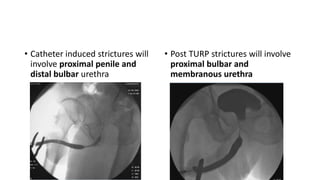
• Catheter induced strictures will
involve proximal penile and
distal bulbar urethra
• Post TURP strictures will involve
proximal bulbar and
membranous urethra
• Gonococcal strictures have a long latency period ~20 years
• Rare now
Lichen sclerosus
• Old name is Balanitis xerotica obliterans
• Involves perineal skin
• Extensive disease involving penile urethra. Rarely involves bulbar
urethra
• Commonest cause of stricture in young adults now
• Starts at meatus and involves penile urethra
Prevalence
Penile urethra
• Inflammatory(40%)
• Iatrogenic(40%)
• Idiopathic(15%)
• Trauma(5%)
Bulbar urethra
• Idiopathic(40%)
• Iatrogenic(35%)
• Traumatic(15%)
• Inflammatory(10%)
Pathology
• Urethra normally lined by pseudostratified
Columnar epithelium
• Noxious stimuli induces squamous
metaplasia which easily fissures under stress
• This leads to urine extravasation and
spongiofibrosis
The metaplastic epithelium has wash leather appearance in cystoscopy
Natural history
• Voiding LUTS
• Trabeculated bladder with backpressure changes in kidneys
• Acute retention
• Prostatitis and EPO
• Peri urethral abscess
Management
• Uroflowmetry
• Urethroscopy
• MCU + RGU
• USG
• MRI
• Uroflowmetry
• Plateau pattern – constrictive flow
• Depending on the calibre of the stricture, the plateau can be higher
or lower
Urethroscopy:
• Can identify a stricture which can be ‘passed or not passed’ by
cystoscopy
• The proximal status not definable, unless a ureteroscope is used
MCU + RGU
• Best imaging modality
 The patient should be positioned such that the obturator
foramen is closed and oriented downwards
 This position will make the urethra parallel to the film
 If the urethra is not parallel, there can be under estimation
of urethral stricture length
 The penis should always be kept in traction to avoid under
estimating urethral stricture length
Instrumentation for RUG
 A foleys can be inserted into the urethra and balloon inflated to 2 ml in fossa
navicularis
 Alternatively, a metal tip can be introduced into the urethra and a penile clamp can be
used
 20-30 ml of contrast has to be injected
 Contrast material, which is used for IV injection, should be used, because thicker
contrast can increase urethral inflammation
 The imaging can be done as a static(under normal X ray unit) or as a dynamic
procedure(Flouroscopy)
Urethral ultrasonogram
• Urethra appears hypoechoic and stricture appears hyperechoic
• Can comment on the length of the stricture, but not on the
density/depth of spongiofibrosis
• Continuous infusion of an irrigant should occur during the study
which makes the study uncomfortable
Treatment
• Dilatation
• Incision
• Excision
• Substitution
• Augmentation
Dilatation
• Practised over 3000 years
• Almost 50% of soft, superficial, short bulbar urethral strictures can be
cured by just dilatation
• Successful dilatation – stretching the scar without further scarring
• Bleeding after dilatation means there is going to be more
spongiofibrosis
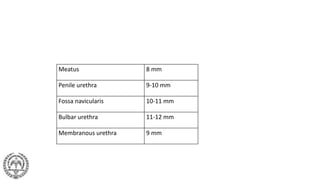
Meatus 8 mm
Penile urethra 9-10 mm
Fossa navicularis 10-11 mm
Bulbar urethra 11-12 mm
Membranous urethra 9 mm
Indications Contraindications
• Stricture urethra
• Strictureless urethra – prior to
lower tract endourological
procedures
• Active urethritis
• Urethral fistula
Clutton dilators
Lister dilators
Incision - Urethrotomy
• Blind urethrotomy
Otis knife
• Endoscopic internal urethrotomy
Sachse knife
Laser urethrotomy
Post urethrotomy
• Will need age old dilatation, but in the name of self
calibration/intermittent self dilatation
Complications of urethrotomy:
• Recurrence
• Bleeding
• Extravasation of irrigation fluid into perispongiosal tissues
• Cavernosal veno occlusive dysfunction
Excision and primary anastomosis
• Most useful for bulbar urethral strictures
• Traumatic bulbar strictures are preferably treated by EPA because
they have transmural fibrosis, unlike other aetiologies which have
more superficial fibrosis
Urethroplasty – substitution vs augmentation
• Substitution – entire circumference of urethra is excised and
substituting with a graft
• Augmentation – lumen increased by stricturotomy(without excising
the entire circumference of the stricture) and augmenting with a graft
General concepts of urethroplasty
 Onlay procedures better than tubularised procedures
 Grafts are equal to flaps in success rates
 However, grafts are easier to perform
 Flaps are better for distal urethra because grafting if done in distal urethra ventrally, will not be
adequately encompassed by corpus spongiosum(spongioplasty) and so graft fixation and blood supply
to graft is not adequate
 Radiation strictures are the only place, where flaps are useful
Grafts
• Ventral and Dorsal onlay augmented
Urethroplasty
Can be harvested from:
1. Buccal mucosa
2. Bladder mucosa
3. Post auricular skin
Types:
1. Barbagli
2. Asopa
3. Johanson
4. Kulkarni
Flaps
Local penile skin flaps
1. Mcaninch
2. Orandi
3. Turner warwick
4. Johanson
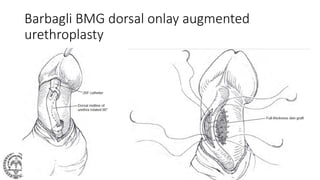
Barbagli BMG dorsal onlay augmented
urethroplasty
Asopa dorsal inlay augmented urethroplasty
• Ventral urethrotomy
• Dorsal urethrotomy
• Graft quilted to corpora cavernosa
• Dorsal urethrotomy sutured to graft edges
• Ventral urethrotomy closed
Johanson urethroplasty
Urethral stricture.pptx

Urethral stricture.pptx

  • 1.
    A comprehensive reviewof male urethral stricture disease Sukhdev, CMC Vellore
  • 2.
    Definition • Scar ofsubepithelial tissue of corpus spongiosum that constricts the urethral lumen • Applies only to anterior urethra • Elsewhere, stenosis or contracture would be the terms used
  • 3.
    Aetiology • Idiopathic • Iatrogenic •Infection • Inflammatory • Trauma
  • 4.
    • Young adults/adolescentswith a short focal stricture – idiopathic • High success rate
  • 5.
    Iatrogenic • Catheterisation –‘pressure sores’ of urethra - ischemic • Post lower endourological procedures
  • 6.
    • Catheter inducedstrictures will involve proximal penile and distal bulbar urethra • Post TURP strictures will involve proximal bulbar and membranous urethra
  • 7.
    • Gonococcal strictureshave a long latency period ~20 years • Rare now
  • 8.
    Lichen sclerosus • Oldname is Balanitis xerotica obliterans • Involves perineal skin • Extensive disease involving penile urethra. Rarely involves bulbar urethra • Commonest cause of stricture in young adults now • Starts at meatus and involves penile urethra
  • 10.
    Prevalence Penile urethra • Inflammatory(40%) •Iatrogenic(40%) • Idiopathic(15%) • Trauma(5%) Bulbar urethra • Idiopathic(40%) • Iatrogenic(35%) • Traumatic(15%) • Inflammatory(10%)
  • 11.
    Pathology • Urethra normallylined by pseudostratified Columnar epithelium • Noxious stimuli induces squamous metaplasia which easily fissures under stress • This leads to urine extravasation and spongiofibrosis
  • 12.
    The metaplastic epitheliumhas wash leather appearance in cystoscopy
  • 13.
    Natural history • VoidingLUTS • Trabeculated bladder with backpressure changes in kidneys • Acute retention • Prostatitis and EPO • Peri urethral abscess
  • 14.
  • 15.
    • Uroflowmetry • Plateaupattern – constrictive flow • Depending on the calibre of the stricture, the plateau can be higher or lower
  • 16.
    Urethroscopy: • Can identifya stricture which can be ‘passed or not passed’ by cystoscopy • The proximal status not definable, unless a ureteroscope is used
  • 17.
    MCU + RGU •Best imaging modality  The patient should be positioned such that the obturator foramen is closed and oriented downwards  This position will make the urethra parallel to the film  If the urethra is not parallel, there can be under estimation of urethral stricture length  The penis should always be kept in traction to avoid under estimating urethral stricture length
  • 19.
    Instrumentation for RUG A foleys can be inserted into the urethra and balloon inflated to 2 ml in fossa navicularis  Alternatively, a metal tip can be introduced into the urethra and a penile clamp can be used  20-30 ml of contrast has to be injected  Contrast material, which is used for IV injection, should be used, because thicker contrast can increase urethral inflammation  The imaging can be done as a static(under normal X ray unit) or as a dynamic procedure(Flouroscopy)
  • 20.
    Urethral ultrasonogram • Urethraappears hypoechoic and stricture appears hyperechoic • Can comment on the length of the stricture, but not on the density/depth of spongiofibrosis • Continuous infusion of an irrigant should occur during the study which makes the study uncomfortable
  • 21.
    Treatment • Dilatation • Incision •Excision • Substitution • Augmentation
  • 22.
    Dilatation • Practised over3000 years • Almost 50% of soft, superficial, short bulbar urethral strictures can be cured by just dilatation • Successful dilatation – stretching the scar without further scarring • Bleeding after dilatation means there is going to be more spongiofibrosis
  • 23.
    Meatus 8 mm Penileurethra 9-10 mm Fossa navicularis 10-11 mm Bulbar urethra 11-12 mm Membranous urethra 9 mm
  • 24.
    Indications Contraindications • Strictureurethra • Strictureless urethra – prior to lower tract endourological procedures • Active urethritis • Urethral fistula
  • 25.
  • 26.
  • 27.
    Incision - Urethrotomy •Blind urethrotomy Otis knife • Endoscopic internal urethrotomy Sachse knife Laser urethrotomy
  • 28.
    Post urethrotomy • Willneed age old dilatation, but in the name of self calibration/intermittent self dilatation Complications of urethrotomy: • Recurrence • Bleeding • Extravasation of irrigation fluid into perispongiosal tissues • Cavernosal veno occlusive dysfunction
  • 29.
    Excision and primaryanastomosis • Most useful for bulbar urethral strictures • Traumatic bulbar strictures are preferably treated by EPA because they have transmural fibrosis, unlike other aetiologies which have more superficial fibrosis
  • 30.
    Urethroplasty – substitutionvs augmentation • Substitution – entire circumference of urethra is excised and substituting with a graft • Augmentation – lumen increased by stricturotomy(without excising the entire circumference of the stricture) and augmenting with a graft
  • 31.
    General concepts ofurethroplasty  Onlay procedures better than tubularised procedures  Grafts are equal to flaps in success rates  However, grafts are easier to perform  Flaps are better for distal urethra because grafting if done in distal urethra ventrally, will not be adequately encompassed by corpus spongiosum(spongioplasty) and so graft fixation and blood supply to graft is not adequate  Radiation strictures are the only place, where flaps are useful
  • 32.
    Grafts • Ventral andDorsal onlay augmented Urethroplasty Can be harvested from: 1. Buccal mucosa 2. Bladder mucosa 3. Post auricular skin Types: 1. Barbagli 2. Asopa 3. Johanson 4. Kulkarni
  • 33.
    Flaps Local penile skinflaps 1. Mcaninch 2. Orandi 3. Turner warwick 4. Johanson
  • 34.
    Barbagli BMG dorsalonlay augmented urethroplasty
  • 35.
    Asopa dorsal inlayaugmented urethroplasty
  • 36.
    • Ventral urethrotomy •Dorsal urethrotomy • Graft quilted to corpora cavernosa • Dorsal urethrotomy sutured to graft edges • Ventral urethrotomy closed
  • 37.