
PRESENTED BY
DILWAR HOSSAIN NOOR
M.Sc. (THESIS) – 2010
ROLL NO. 06035024
Supervised by
Dr. M. Taufiq Alam
Dept. of Applied Chemistry and Chemical Engineering
University of Rajshahi
“ “Purification of Urease from Sword
Bean for Clinical Use
Introduction
Urease
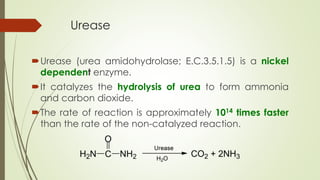
Urease (urea amidohydrolase; E.C.3.5.1.5) is a nickel
dependent enzyme.
It catalyzes the hydrolysis of urea to form ammonia
and carbon dioxide.
The rate of reaction is approximately 1014 times faster
than the rate of the non-catalyzed reaction.
Applications
Diagnostic kit preparation to analysis of urea, arginine,
creatinine and IgG.
Removal of urea in kidney failure.
Removal of urea from alcoholic beverages in the food
industry.
Analysis of heavy-metal ions and other pollutants.
Treatment of industrial wastewater containing urea.
Wastewater reclamation in aboard manned spacecraft
by urease bioreactors.
Previous work from our laboratory
Commercially available urease: Jack bean (not grow well in
Bangladesh).
Results of our screening experiments: watermelon, yard long
bean, arahar dal, sword bean etc.
Saem et al. [1] from our laboratory has purified this sword
bean urease by preparing a urease selective affinity
chromatographic matrix.
Affinity matrix itself became unusable after several
purification processes, thus increased the purification cost of
urease.
[1] Saem et al., (January, 2012) Isolation and affinity purification of urease from sword bean, M. Sc. Thesis, ACCE, RU.
Aim of the present investigation
To purify urease by a simple solvent extraction
method followed by isoelectric focusing technique
to minimize the purification cost.
And preparation of low cost urea test kit from this
purified urease.
Materials and Methods
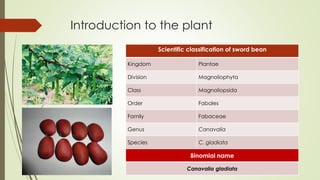
Introduction to the plant
Scientific classification of sword bean
Kingdom Plantae
Division Magnoliophyta
Class Magnoliopsida
Order Fabales
Family Fabaceae
Genus Canavalia
Species C. gladiata
Binomial name
Canavalia gladiata
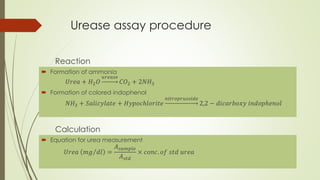
Urease assay procedure
Reaction
 Formation of ammonia
𝑈𝑟𝑒𝑎 + 𝐻2 𝑂
𝑢𝑟𝑒𝑎𝑠𝑒
𝐶𝑂2 + 2𝑁𝐻3
 Formation of colored indophenol
𝑁𝐻3 + 𝑆𝑎𝑙𝑖𝑐𝑦𝑙𝑎𝑡𝑒 + 𝐻𝑦𝑝𝑜𝑐ℎ𝑙𝑜𝑟𝑖𝑡𝑒
𝑛𝑖𝑡𝑟𝑜𝑝𝑟𝑢𝑠𝑠𝑖𝑑𝑒
2,2 − 𝑑𝑖𝑐𝑎𝑟𝑏𝑜𝑥𝑦 𝑖𝑛𝑑𝑜𝑝ℎ𝑒𝑛𝑜𝑙
Calculation
 Equation for urea measurement
𝑈𝑟𝑒𝑎 𝑚𝑔 𝑑𝑙 =
𝐴 𝑠𝑎𝑚𝑝𝑙𝑒
𝐴 𝑠𝑡𝑑
× 𝑐𝑜𝑛𝑐. 𝑜𝑓 𝑠𝑡𝑑 𝑢𝑟𝑒𝑎
Results and Discussion
Choice of solvent
SBM + 32% acetone
Supernatant
Centrifugation
 There is a significant body of works on the solvent
extraction of jack bean urease and almost all the works
are based on the method of Sumner [1].
 In his work, urease was extracted with 32% (v/v) acetone
solution of water at 28℃ and we have made a similar
approach.
Designation R1 (ml) Crude Extract (µl) Urea (µl) R2 (ml) Abs
Blank 1 100 - 1 0.098
Sample 1 100 10 1 0.156
[1] Sumner, J. B., (1951) Urease, In: Sumner, J. B. and Myrback, K. (Eds.) The enzymes, Academic Press,
New York, 873-892.
Remedy from inhibitor and activity loss
SBM + 32% acetone
+
1 mM EDTA and 1 mM
2-mercaptoethanol
Supernatant
Centrifugation
 It has been reported that many divalent metal ions
inhibit urease in the following decreasing order [1]:
𝐻𝑔2+
> 𝐶𝑢2+
> 𝑍𝑛2+
> 𝐶𝑑2+
> 𝑁𝑖2+
> 𝑃𝑏2+
> 𝐶𝑜2+
> 𝐹𝑒2+
 It has also been reported that JBU contains cysteine
residue near catalytic site [2] and it should most
probably be maintained in reduced condition for its
catalytic activity.
Designation R1 (ml) Crude Extract (µl) Urea (µl) R2 (ml) Abs
Blank 1 100 - 1 0.074
Sample 1 100 10 1 0.378
[1] Rezaei Behbehani et al., (2012) Inhibitory effect of cobalt (II) ion on jack bean urease, Res J Chem Sci, 2
(7), 72-74.
[2] Follmer et al., (2004) Jack bean urease (EC 3.5.1.5) aggregation monitored by dynamic and static light
scattering, Biophysical chemistry, 111 (1), 79-87.
Dependency of acetone concentration
SBM + 20% acetone
+
1 mM EDTA and 1 mM
2-mercaptoethanol
Supernatant
Centrifugation
0
2
4
6
8
10
12
14
0
25
50
75
100
125
150
0 5 10 15 20 25 30 35 40
Totalactivity((U×103)
Specificactivity(U/mgprotein)
Acetone (% v/v)
Specific activity Total activity
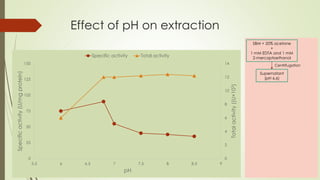
Effect of pH on extraction
SBM + 20% acetone
+
1 mM EDTA and 1 mM
2-mercaptoethanol
Supernatant
(pH 6.6)
Centrifugation
0
2
4
6
8
10
12
14
0
25
50
75
100
125
150
5.5 6 6.5 7 7.5 8 8.5 9
Totalactivity((U×103)
Specificactivity(U/mgprotein)
pH
Specific activity Total activity
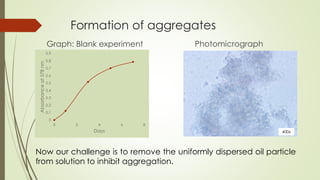
Formation of aggregates
Graph: Blank experiment Photomicrograph
0
0.1
0.2
0.3
0.4
0.5
0.6
0.7
0.8
0.9
0 2 4 6 8
Absorbanceat578nm
Days 400x
Now our challenge is to remove the uniformly dispersed oil particle
from solution to inhibit aggregation.
Heat treatment for clarity
Figure: Before and after heat treatment
Heat treatment
(40℃, 5 min)
SBM + 20% acetone
+
1 mM EDTA and 1 mM
2-mercaptoethanol
Supernatant
Supernatant
Centrifugation
pH adjusted to 8.4
Acetone conc. to 32%
Centrifugation
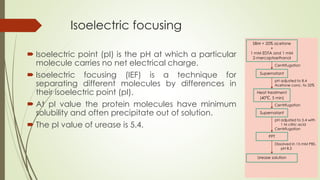
Isoelectric focusing
 Isoelectric point (pI) is the pH at which a particular
molecule carries no net electrical charge.
 Isoelectric focusing (IEF) is a technique for
separating different molecules by differences in
their isoelectric point (pI).
 At pI value the protein molecules have minimum
solubility and often precipitate out of solution.
 The pI value of urease is 5.4.
Heat treatment
(40℃, 5 min)
SBM + 20% acetone
+
1 mM EDTA and 1 mM
2-mercaptoethanol
Supernatant
Supernatant
Centrifugation
pH adjusted to 8.4
Acetone conc. to 32%
Centrifugation
PPT
pH adjusted to 5.4 with
1 M citric acid
Centrifugation
Dissolved in 15 mM PBS,
pH 8.5
Urease solution
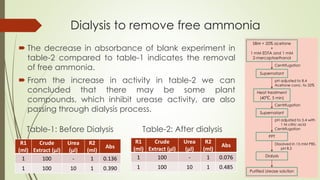
Dialysis to remove free ammonia
 The decrease in absorbance of blank experiment in
table-2 compared to table-1 indicates the removal
of free ammonia.
 From the increase in activity in table-2 we can
concluded that there may be some plant
compounds, which inhibit urease activity, are also
passing through dialysis process.
Heat treatment
(40℃, 5 min)
SBM + 20% acetone
+
1 mM EDTA and 1 mM
2-mercaptoethanol
Supernatant
Supernatant
Centrifugation
pH adjusted to 8.4
Acetone conc. to 32%
Centrifugation
PPT
pH adjusted to 5.4 with
1 M citric acid
Centrifugation
Dialysis
Dissolved in 15 mM PBS,
pH 8.5
Purified Urease solution
Table-1: Before Dialysis Table-2: After dialysis
R1
(ml)
Crude
Extract (µl)
Urea
(µl)
R2
(ml)
Abs
1 100 - 1 0.076
1 100 10 1 0.485
R1
(ml)
Crude
Extract (µl)
Urea
(µl)
R2
(ml)
Abs
1 100 - 1 0.136
1 100 10 1 0.390
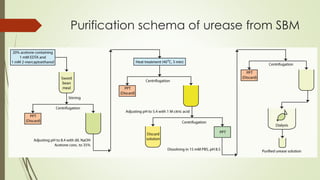
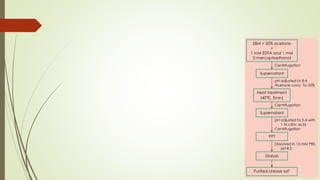
Purification schema of urease from SBM
Conclusion
Our cost effective simple solvent extraction method
followed by isoelectric focusing technique was used
successfully to purify urease.
The purified urease retains its all required
characteristics.
This inexpensive purification technique could be
used in the commercial production of urease for
clinical use.
THANKS TO ALL
THANKS TO ALL
THANKS TO ALL
Preface
 The simple solvent extraction followed by isoelectric focusing approach
encountered some problems such as:
 Inhibitor
 Activity loss
 Solvent selectivity
 pH
 Microbial growth
 Clarity
 Stability
 Free ammonia content
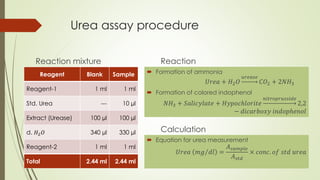
Urea assay procedure
Reaction mixture
Reagent Blank Sample
Reagent-1 1 ml 1 ml
Std. Urea --- 10 µl
Extract (Urease) 100 µl 100 µl
d. 𝐻2 𝑂 340 µl 330 µl
Reagent-2 1 ml 1 ml
Total 2.44 ml 2.44 ml
Reaction
 Formation of ammonia
𝑈𝑟𝑒𝑎 + 𝐻2 𝑂
𝑢𝑟𝑒𝑎𝑠𝑒
𝐶𝑂2 + 2𝑁𝐻3
 Formation of colored indophenol
𝑁𝐻3 + 𝑆𝑎𝑙𝑖𝑐𝑦𝑙𝑎𝑡𝑒 + 𝐻𝑦𝑝𝑜𝑐ℎ𝑙𝑜𝑟𝑖𝑡𝑒
𝑛𝑖𝑡𝑟𝑜𝑝𝑟𝑢𝑠𝑠𝑖𝑑𝑒
2,2
− 𝑑𝑖𝑐𝑎𝑟𝑏𝑜𝑥𝑦 𝑖𝑛𝑑𝑜𝑝ℎ𝑒𝑛𝑜𝑙
Calculation
 Equation for urea measurement
𝑈𝑟𝑒𝑎 𝑚𝑔 𝑑𝑙 =
𝐴 𝑠𝑎𝑚𝑝𝑙𝑒
𝐴 𝑠𝑡𝑑
× 𝑐𝑜𝑛𝑐. 𝑜𝑓 𝑠𝑡𝑑 𝑢𝑟𝑒𝑎
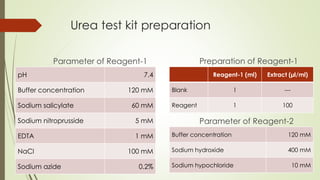
Urea test kit preparation
Parameter of Reagent-1
pH 7.4
Buffer concentration 120 mM
Sodium salicylate 60 mM
Sodium nitroprusside 5 mM
EDTA 1 mM
NaCl 100 mM
Sodium azide 0.2%
Parameter of Reagent-2
Buffer concentration 120 mM
Sodium hydroxide 400 mM
Sodium hypochloride 10 mM
Preparation of Reagent-1
Reagent-1 (ml) Extract (µl/ml)
Blank 1 ---
Reagent 1 100
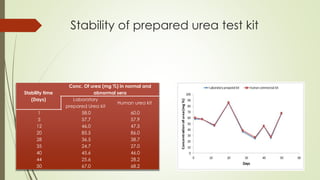
Stability of prepared urea test kit
Stability time
(Days)
Conc. Of urea (mg %) in normal and
abnormal sera
Laboratory
prepared Urea kit
Human urea kit
1 58.0 60.0
5 57.7 57.9
12 46.0 47.5
20 85.5 86.0
28 36.5 38.7
35 24.7 27.0
40 45.6 46.0
44 25.6 28.2
50 67.0 68.2
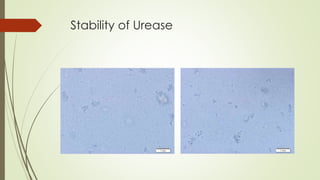
Stability of Urease
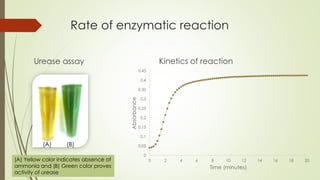
Rate of enzymatic reaction
Urease assay Kinetics of reaction
0
0.05
0.1
0.15
0.2
0.25
0.3
0.35
0.4
0.45
0 2 4 6 8 10 12 14 16 18 20
Absorbance
Time (minutes)
(A) Yellow color indicates absence of
ammonia and (B) Green color proves
activity of urease
(A) (B)
Heat treatment
(40℃, 5min)
SBM + 20% acetone
+
1 mM EDTA and 1 mM
2-mercaptoethanol
Supernatant
Supernatant
Centrifugation
pH adjusted to 8.4
Acetone conc. To 32%
Centrifugation
PPT
pH adjusted to 5.4 with
1 M citric acid
Centrifugation
Dialysis
Dissolved in 15 mM PBS,
pH 8.5
Purified Urease soln

Purification of Urease from Sword Bean for Clinical Use

  • 1.
    PRESENTED BY DILWAR HOSSAINNOOR M.Sc. (THESIS) – 2010 ROLL NO. 06035024 Supervised by Dr. M. Taufiq Alam Dept. of Applied Chemistry and Chemical Engineering University of Rajshahi “ “Purification of Urease from Sword Bean for Clinical Use
  • 2.
  • 3.
    Urease Urease (urea amidohydrolase;E.C.3.5.1.5) is a nickel dependent enzyme. It catalyzes the hydrolysis of urea to form ammonia and carbon dioxide. The rate of reaction is approximately 1014 times faster than the rate of the non-catalyzed reaction.
  • 4.
    Applications Diagnostic kit preparationto analysis of urea, arginine, creatinine and IgG. Removal of urea in kidney failure. Removal of urea from alcoholic beverages in the food industry. Analysis of heavy-metal ions and other pollutants. Treatment of industrial wastewater containing urea. Wastewater reclamation in aboard manned spacecraft by urease bioreactors.
  • 5.
    Previous work fromour laboratory Commercially available urease: Jack bean (not grow well in Bangladesh). Results of our screening experiments: watermelon, yard long bean, arahar dal, sword bean etc. Saem et al. [1] from our laboratory has purified this sword bean urease by preparing a urease selective affinity chromatographic matrix. Affinity matrix itself became unusable after several purification processes, thus increased the purification cost of urease. [1] Saem et al., (January, 2012) Isolation and affinity purification of urease from sword bean, M. Sc. Thesis, ACCE, RU.
  • 6.
    Aim of thepresent investigation To purify urease by a simple solvent extraction method followed by isoelectric focusing technique to minimize the purification cost. And preparation of low cost urea test kit from this purified urease.
  • 7.
  • 8.
    Introduction to theplant Scientific classification of sword bean Kingdom Plantae Division Magnoliophyta Class Magnoliopsida Order Fabales Family Fabaceae Genus Canavalia Species C. gladiata Binomial name Canavalia gladiata
  • 9.
    Urease assay procedure Reaction Formation of ammonia 𝑈𝑟𝑒𝑎 + 𝐻2 𝑂 𝑢𝑟𝑒𝑎𝑠𝑒 𝐶𝑂2 + 2𝑁𝐻3  Formation of colored indophenol 𝑁𝐻3 + 𝑆𝑎𝑙𝑖𝑐𝑦𝑙𝑎𝑡𝑒 + 𝐻𝑦𝑝𝑜𝑐ℎ𝑙𝑜𝑟𝑖𝑡𝑒 𝑛𝑖𝑡𝑟𝑜𝑝𝑟𝑢𝑠𝑠𝑖𝑑𝑒 2,2 − 𝑑𝑖𝑐𝑎𝑟𝑏𝑜𝑥𝑦 𝑖𝑛𝑑𝑜𝑝ℎ𝑒𝑛𝑜𝑙 Calculation  Equation for urea measurement 𝑈𝑟𝑒𝑎 𝑚𝑔 𝑑𝑙 = 𝐴 𝑠𝑎𝑚𝑝𝑙𝑒 𝐴 𝑠𝑡𝑑 × 𝑐𝑜𝑛𝑐. 𝑜𝑓 𝑠𝑡𝑑 𝑢𝑟𝑒𝑎
  • 10.
  • 11.
    Choice of solvent SBM+ 32% acetone Supernatant Centrifugation  There is a significant body of works on the solvent extraction of jack bean urease and almost all the works are based on the method of Sumner [1].  In his work, urease was extracted with 32% (v/v) acetone solution of water at 28℃ and we have made a similar approach. Designation R1 (ml) Crude Extract (µl) Urea (µl) R2 (ml) Abs Blank 1 100 - 1 0.098 Sample 1 100 10 1 0.156 [1] Sumner, J. B., (1951) Urease, In: Sumner, J. B. and Myrback, K. (Eds.) The enzymes, Academic Press, New York, 873-892.
  • 12.
    Remedy from inhibitorand activity loss SBM + 32% acetone + 1 mM EDTA and 1 mM 2-mercaptoethanol Supernatant Centrifugation  It has been reported that many divalent metal ions inhibit urease in the following decreasing order [1]: 𝐻𝑔2+ > 𝐶𝑢2+ > 𝑍𝑛2+ > 𝐶𝑑2+ > 𝑁𝑖2+ > 𝑃𝑏2+ > 𝐶𝑜2+ > 𝐹𝑒2+  It has also been reported that JBU contains cysteine residue near catalytic site [2] and it should most probably be maintained in reduced condition for its catalytic activity. Designation R1 (ml) Crude Extract (µl) Urea (µl) R2 (ml) Abs Blank 1 100 - 1 0.074 Sample 1 100 10 1 0.378 [1] Rezaei Behbehani et al., (2012) Inhibitory effect of cobalt (II) ion on jack bean urease, Res J Chem Sci, 2 (7), 72-74. [2] Follmer et al., (2004) Jack bean urease (EC 3.5.1.5) aggregation monitored by dynamic and static light scattering, Biophysical chemistry, 111 (1), 79-87.
  • 13.
    Dependency of acetoneconcentration SBM + 20% acetone + 1 mM EDTA and 1 mM 2-mercaptoethanol Supernatant Centrifugation 0 2 4 6 8 10 12 14 0 25 50 75 100 125 150 0 5 10 15 20 25 30 35 40 Totalactivity((U×103) Specificactivity(U/mgprotein) Acetone (% v/v) Specific activity Total activity
  • 14.
    Effect of pHon extraction SBM + 20% acetone + 1 mM EDTA and 1 mM 2-mercaptoethanol Supernatant (pH 6.6) Centrifugation 0 2 4 6 8 10 12 14 0 25 50 75 100 125 150 5.5 6 6.5 7 7.5 8 8.5 9 Totalactivity((U×103) Specificactivity(U/mgprotein) pH Specific activity Total activity
  • 15.
    Formation of aggregates Graph:Blank experiment Photomicrograph 0 0.1 0.2 0.3 0.4 0.5 0.6 0.7 0.8 0.9 0 2 4 6 8 Absorbanceat578nm Days 400x Now our challenge is to remove the uniformly dispersed oil particle from solution to inhibit aggregation.
  • 16.
    Heat treatment forclarity Figure: Before and after heat treatment Heat treatment (40℃, 5 min) SBM + 20% acetone + 1 mM EDTA and 1 mM 2-mercaptoethanol Supernatant Supernatant Centrifugation pH adjusted to 8.4 Acetone conc. to 32% Centrifugation
  • 17.
    Isoelectric focusing  Isoelectricpoint (pI) is the pH at which a particular molecule carries no net electrical charge.  Isoelectric focusing (IEF) is a technique for separating different molecules by differences in their isoelectric point (pI).  At pI value the protein molecules have minimum solubility and often precipitate out of solution.  The pI value of urease is 5.4. Heat treatment (40℃, 5 min) SBM + 20% acetone + 1 mM EDTA and 1 mM 2-mercaptoethanol Supernatant Supernatant Centrifugation pH adjusted to 8.4 Acetone conc. to 32% Centrifugation PPT pH adjusted to 5.4 with 1 M citric acid Centrifugation Dissolved in 15 mM PBS, pH 8.5 Urease solution
  • 18.
    Dialysis to removefree ammonia  The decrease in absorbance of blank experiment in table-2 compared to table-1 indicates the removal of free ammonia.  From the increase in activity in table-2 we can concluded that there may be some plant compounds, which inhibit urease activity, are also passing through dialysis process. Heat treatment (40℃, 5 min) SBM + 20% acetone + 1 mM EDTA and 1 mM 2-mercaptoethanol Supernatant Supernatant Centrifugation pH adjusted to 8.4 Acetone conc. to 32% Centrifugation PPT pH adjusted to 5.4 with 1 M citric acid Centrifugation Dialysis Dissolved in 15 mM PBS, pH 8.5 Purified Urease solution Table-1: Before Dialysis Table-2: After dialysis R1 (ml) Crude Extract (µl) Urea (µl) R2 (ml) Abs 1 100 - 1 0.076 1 100 10 1 0.485 R1 (ml) Crude Extract (µl) Urea (µl) R2 (ml) Abs 1 100 - 1 0.136 1 100 10 1 0.390
  • 19.
    Purification schema ofurease from SBM
  • 20.
    Conclusion Our cost effectivesimple solvent extraction method followed by isoelectric focusing technique was used successfully to purify urease. The purified urease retains its all required characteristics. This inexpensive purification technique could be used in the commercial production of urease for clinical use.
  • 21.
  • 22.
  • 23.
  • 24.
    Preface  The simplesolvent extraction followed by isoelectric focusing approach encountered some problems such as:  Inhibitor  Activity loss  Solvent selectivity  pH  Microbial growth  Clarity  Stability  Free ammonia content
  • 25.
    Urea assay procedure Reactionmixture Reagent Blank Sample Reagent-1 1 ml 1 ml Std. Urea --- 10 µl Extract (Urease) 100 µl 100 µl d. 𝐻2 𝑂 340 µl 330 µl Reagent-2 1 ml 1 ml Total 2.44 ml 2.44 ml Reaction  Formation of ammonia 𝑈𝑟𝑒𝑎 + 𝐻2 𝑂 𝑢𝑟𝑒𝑎𝑠𝑒 𝐶𝑂2 + 2𝑁𝐻3  Formation of colored indophenol 𝑁𝐻3 + 𝑆𝑎𝑙𝑖𝑐𝑦𝑙𝑎𝑡𝑒 + 𝐻𝑦𝑝𝑜𝑐ℎ𝑙𝑜𝑟𝑖𝑡𝑒 𝑛𝑖𝑡𝑟𝑜𝑝𝑟𝑢𝑠𝑠𝑖𝑑𝑒 2,2 − 𝑑𝑖𝑐𝑎𝑟𝑏𝑜𝑥𝑦 𝑖𝑛𝑑𝑜𝑝ℎ𝑒𝑛𝑜𝑙 Calculation  Equation for urea measurement 𝑈𝑟𝑒𝑎 𝑚𝑔 𝑑𝑙 = 𝐴 𝑠𝑎𝑚𝑝𝑙𝑒 𝐴 𝑠𝑡𝑑 × 𝑐𝑜𝑛𝑐. 𝑜𝑓 𝑠𝑡𝑑 𝑢𝑟𝑒𝑎
  • 26.
    Urea test kitpreparation Parameter of Reagent-1 pH 7.4 Buffer concentration 120 mM Sodium salicylate 60 mM Sodium nitroprusside 5 mM EDTA 1 mM NaCl 100 mM Sodium azide 0.2% Parameter of Reagent-2 Buffer concentration 120 mM Sodium hydroxide 400 mM Sodium hypochloride 10 mM Preparation of Reagent-1 Reagent-1 (ml) Extract (µl/ml) Blank 1 --- Reagent 1 100
  • 27.
    Stability of preparedurea test kit Stability time (Days) Conc. Of urea (mg %) in normal and abnormal sera Laboratory prepared Urea kit Human urea kit 1 58.0 60.0 5 57.7 57.9 12 46.0 47.5 20 85.5 86.0 28 36.5 38.7 35 24.7 27.0 40 45.6 46.0 44 25.6 28.2 50 67.0 68.2
  • 28.
  • 29.
    Rate of enzymaticreaction Urease assay Kinetics of reaction 0 0.05 0.1 0.15 0.2 0.25 0.3 0.35 0.4 0.45 0 2 4 6 8 10 12 14 16 18 20 Absorbance Time (minutes) (A) Yellow color indicates absence of ammonia and (B) Green color proves activity of urease (A) (B)
  • 30.
    Heat treatment (40℃, 5min) SBM+ 20% acetone + 1 mM EDTA and 1 mM 2-mercaptoethanol Supernatant Supernatant Centrifugation pH adjusted to 8.4 Acetone conc. To 32% Centrifugation PPT pH adjusted to 5.4 with 1 M citric acid Centrifugation Dialysis Dissolved in 15 mM PBS, pH 8.5 Purified Urease soln

Editor's Notes

  • #2 Honorable teachers Assalamu Alaykum. I am Dilwar Hossain Noor and my thesis title is “Purification of Urease from Sword Bean for Clinical Use.”.
  • #4 Urease is a nickel dependent enzyme that catalyzes the hydrolysis of urea to form ammonia and carbon dioxide with a rate approximately 1014 times faster than the rate of the non-catalyzed reaction. You see this is the ureolytic reaction of urease. Here urease catalyzes the hydrolysis of urea to carbon-dioxide and ammonia.
  • #5 Urease has a wide range of applications in health science, food industry and in diagnostic purposes. It is used in diagnostic kit preparation to analysis of urea, creatinine, arginine, immunoglobulin G in biological fluids and removal of urea in kidney failure. Other potential applications are: Analysis of heavy-metal ions and pollutants Treatment of industrial wastewaters Wastewater reclamation in aboard manned spacecraft etc.
  • #6 Most of the commercially available urease comes from Jack bean, which does not grow well in Bangladesh. In our laboratory, we have tested locally available alternative sources. Based on a previous screening experiment, it has been shown that watermelon, yard long bean, arahar dal, sword bean etc. contain considerable amount of urease. Among them sword bean contains the highest amount of urease. Saem et al. [1] from our laboratory has purified this sword bean urease in a single tby preparing a urease selective affinity chromatographic matrix. However, the affinity matrix itself became unusable after several purification processes, thus increased the purification cost of urease.
  • #7 The aim of the present investigation is to purify urease by a simple solvent extraction method followed by isoelectric focusing technique to minimize the purification cost still purifying urease with properties which could meet the prerequisite needs for clinical use. And preparation of low cost urea test kit from this purified urease.
  • #9 This slide shows the photographs and the scientific classification of sword bean.
  • #10 Urease catalyzes the conversation of urea to ammonia. In a modified Berthelot reaction, the ammonium ion reacts with a mixture of salicylate, hypochlorite, nitroprusside to yield a blue-green indophenol dye. And here is the equation for the measurement of urea.
  • #12 As said earlier our aim is to extract urease from sword bean in solvent extraction method. But the choice of solvent is challenging. There is a significant body of works on the solvent extraction of jack bean urease and almost all the works are based on the method of Sumner (1951). In his work, Sumner extracted urease with 32% acetone at 28℃ and from right you see, we have made a similar approach. In right side I will show the gradual progress of our work schematically. However, the extract did not show significant urease activity compared to blank. We therefore had to solve this problem.
  • #13 It has been reported that many divalent metal ions inhibit urease in the following decreasing order: We, therefore, hypothesized that our sword bean extract contains several of these metal ions that inhibit its activity. It has also been reported that JBU contains cysteine residue near its catalytic site and it should most probably be maintained in reduced condition for its catalytic activity. We, therefore, added 1 mM EDTA as chelating agent and 1 mM 2-mercaptoethanol as reducing agent. It is interesting to see that after addition of chelating agent and reducing agent, the extract regains its enzymatic activity as the absorbance in table increases in compared to blank.
  • #14 Next, we measured the dependency of acetone concentration of the extracting media in terms of total activity and specific activity of urease. Up to now we used 32% acetone. But it is evident from the graph that highest extraction is obtained in a medium containing 20% acetone and most of the other proteins are left behind. Therefore, instead of 32% we used before, now 20% acetone containing 1 mM EDTA and 1 mM 2-mercaptoethanol was optimized as extracting solvent.
  • #15 We have also studied the effect of pH. At pH 6.8, the highest total activity and specific activity of urease were obtained. After mixing the meal with extracting solvent, the pH of the extracting medium was around 6.8, in our case 6.6. It is therefore unnecessary to adjust the pH of the extracting medium with acid or alkali.
  • #16 From graph we see that absorbance of blank experiment is increasing gradually with time indicating unsuitability to use it as diagnostic kit. Sword bean, as other seeds, contains considerable amount of oil. There is a possibility that oil particles are also coming in solution with urease as we are extracting with acetone. Upon standing for several days this uniformly dispersed oil particle may form aggregates with urease molecule, which might be the reason for such increase in absorbance. Our hypothesis was supported when we observed it under microscope. The photomicrograph clearly indicates the presence of aggregated particle after 7 days. Now our challenge is to remove these uniformly dispersed oil particle from solution to inhibit aggregation formation.
  • #17 One possible way of removing oil particle may be increasing the hydrophobic interaction by heat treatment, which could help the oil particle to coagulate. As a result it might be separated out form aqueous layer. The optimum temperature of SBU is 40℃ and optimum pH is 8.4. We therefore adjusted the pH to 8.4, acetone concentration to 32% and then heated at 40℃ for 5 min. The resultant solution is shown in test tube number 2. It is clear from the figure that oil layer separates out from aqueous layer. After centrifugation we obtained clear supernatant in this stage.
  • #18 Finally, isoelectric focusing technique was applied to selectively separate urease from solution. The pI of SBU is 5.4. We therefore brought the pH of the urease solution to 5.4 with 1 M citric acid and only urease started to precipitate out from the solution leaving other proteins in the solution. The ppt was collected by centrifugation and dissolved in 15 mM PBS.
  • #19 In table-1, we see that the absorbance of blank experiment is quite high. For this reason, we did dialysis to reduce the free ammonia content. The decrease in absorbance of blank experiment in table-2 compared to table-1 indicates the removal of ammonia. We can also see the activity of urease has increased in table-2. From this interestingly increase in activity, we can concluded that there may be some plant compounds, which inhibit urease activity, are also passing through dialysis process.
  • #20 It is the final purification schema you can see at a glance.
  • #21 Our cost effective simple solvent extraction method followed by isoelectric focusing technique was used successfully to purify urease. The purified urease retains its all required characteristics. This inexpensive purification technique could be used in the commercial production of urease for clinical use.
  • #26 Urease catalyzes the conversation of urea to ammonia. In a modified Berthelot reaction, the ammonium ions react with a mixture of salicylate, hypochlorite, nitroprusside to yield a blue-green indophenol dye. Here is the composition of reaction mixture we followed. And here is the equation for the measurement of urea.
  • #27 In first table, you see the parameters for Reagent-1. We prepared kit with 100 µl urease solution per 1 ml Reagent-1. And here are the parameters for Reagent-2.
  • #30 It is very important to confirm that the purified crude extract contains active form of enzyme. We, therefore, measured the rate of enzymatic reaction of the purified urease by a modified Berthelot reaction. When we added the Reagent-1, purified extract, urea and Reagent-2 sequentially the color turns into blue-green which you can see in this in vitro image. After measuring the kinetics at 578 nm up to 20 minutes, we found this graph. It proves that the enzyme has activity and thereafter we mix this enzyme with Reagent-1 to complete the kit.