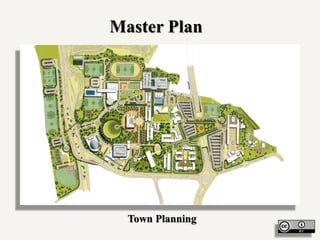

Master Plan
Town Planning
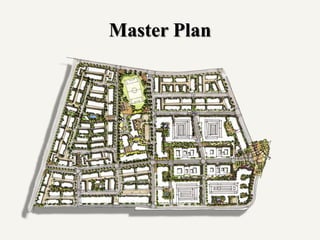
Master Plan
• A development plan or a master plan or a town
plan may be defined as a plan for the future
layout of a city showing both existing and
proposed streets or roads, open spaces, public
building etc.
• A development plan or A master plan is thus a
blue print of the various proposals that are
intended to improve the existing condition and to
control the future growth of town in a coordinated
manner.
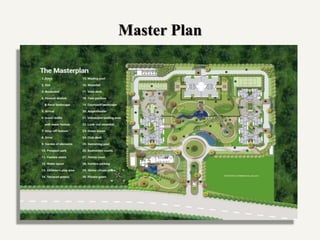
Master Plan
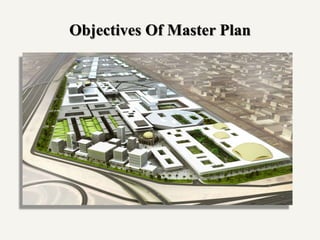
Objectives Of Master Plan
• It aims at intelligent and economic spending of the
public funds for achieving welfare of the inhabitants in
respect of amenities, convenience and health.
• It arranges the pattern of town in such a way so as to
satisfy present requirement without introduction of
future improvement by coming generation.
• It helps in restricting the haphazard and unplanned
growth.
• It places the various functions which a town has to
perform in physical relationship of each other so as to
avoid the chances of mutual conflict.
• It serves as a guide to the planning body for making any
recommendations for public improvement.
Objectives Of Master Plan
Necessity Of Development Plan
• Following are the reasons which has lead to the thinking
of having a development plan:
• To control the development of various industries in a
systematic manner.
• To discourage the growth of town in an unplanned and
unscientific way.
• To give a perspective picture of a fully development
town.
• To limit to a certain extent the unprecedented flow of
rural population.
• To offset the evils which have come up due to
overcrowding of population such as shortage of houses,
traffic congestion, inadequate open spaces and insufficient
public amenities, etc.
Necessity Of Development Plan
Data To Be Collected
In general data required for the preparation of master plan is as
follows;
• Meteorological data regarding direction, intensity of wind,
temperature and rainfall.
• Geological data regarding soil condition.
• Mineral resources
• Places of historical, cultural and scientific importance.
• Population present and future growth.
• Economic conditions
• Trade and Communications
• Water supply and drainage arrangement
• Expansion, development of environments.
• Political position of the place with regard to its neighboring area.
Data To Be Collected
Master Plan
Drawings To Be Prepared
To give graphical representation to various ideas and proposals contained in the
development plan of a town, various maps and drawings are to be prepared
Following are the details;
• Boundaries of land of different types such as residential, agricultural, industrial,
etc.
• Boundaries of green belt surrounding the town.
• Contours of the whole city;
• Different Zones;
• Landscape features;
• Location of public building and town centres;
• Open space including parks & playgrounds
• Positions of natural water courses;
• Position of Public Utility services such as water supply stations, sewage disposal
plant, etc.
• Road systems;
• In addition to the drawing perspective views, panoramas, models etc should be
accompanied the project drawing, when found necessary.
Drawings To Be Prepared
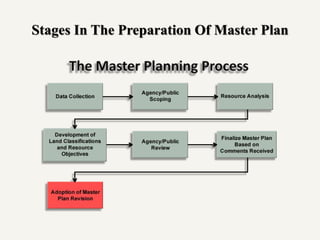
Stages In The Preparation Of Master
Plan
• The re- planning of an existing town is more
complex then planning and designing a new town on
virgin land, such as Capital towns like New Delhi,
Chandigarh, Military Cantonments etc.
• After taking the Government sanction to prepare
the scheme, network is to collect the data and
relevant information, with the help of civic survey.
From the data of civic survey he is in position to make
a correct diagnosis of the various ills of the town and
suggest remedies of their cure.
Stages In The Preparation Of Master Plan
Stages In The Preparation Of Master
Plan
• For the collection of data for the planning schemes, the
town is divided into old town and new town . In the
former case the work is tedious because the old town
usually consists of narrow streets, congestion, insanitation
and unhealthy conditions. Etc.
• But in the later case, the town planners work is more
easy as he gets virgin land for the application of modern
methods of development and control through the
provisions of new network of roads, zoned areas ,
provision of all civic amenities etc. However care should
be taken to keep the whole town, old and new alike in all
aspect and finally blend skillfully so as to form In- separate
interwoven structure.
Features Of Master Plan
• The development plan serves as an outline for the future
growth of town and as such, its preparation demand high skill,
training, imagination and experience on the part of person who
frame it. He has to keep in mind three fundamental
requirement namely amenity, convenience, and health.
• The Most important features which receives the top
priorities in the preparation of master plan are given
below;
• Population
• The prospective population to be prepared for the next
thirty to fifty years should be calculated on the basis of the
present population, and its rate of growth during the last three
to four decades.
Features Of Master Plan
Density
• The next task is to fix the density of population as per the required standard
vary for the town centre, suburbs, type of buildings, flats etc. An average over all
density of eighty to hundred person per acre can be allowed.
Requirement of land
• The next task is to work out the total land requirement for the anticipated
population. If the population is surplus then has to decant and provide for all it in
new layouts.
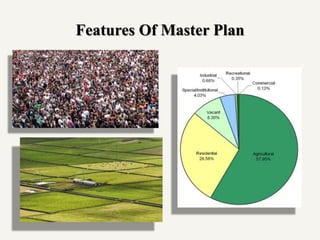
Distribution of Land
• The total land will have to be distributed for the different uses such as
• Residential
• Commercial
• Industrial
• Public and Semi public
• Open spaces
• Communication
• Other special uses.
Features Of Master Plan
Residential Use
• The total population will have to be
distributed in various zones, based on
neighborhood planning, fixing the density
which may vary from 40 to 50 persons to a
maximum of 100 to 200 persons per acre or
even more. Usually the density varies from
town centres, suburbs to the outer fringe areas
of the town.
Residential Use
Features Of Master Plan
Commercial Use
• The shopping facilities for the neighborhood will
have to be provided. These include small shops for
day to day purchases; shopping sub-centres for casual
purchases, and shopping main centres for special
purchases. Provision will also be made of the
wholesale trading godowns, warehouses, cattle
market etc.
Commercial Use
Features Of Master Plan
Industrial use;
• The location of industry in the development plan is
very important it depends upon nearness to roads,
railways, availability of electric power, water supply
etc.
• The industries should have to be planned leeward of
the town so that the smoke, dust, dangerous gases
will not travel over the town. Except the service
industries such as bakeries, dairies, laundries, flour
mills, auto works, the industry should be located at the
outskirts of the town. A green belt should be left
between the industries and other uses.
Industrial Use
Features Of Master Plan
Public & Semi Public Uses;
• These include schools colleges, Govt offices etc
which should be located in the convenient places
to serve all the people in the unit.
Open Spaces;
• These include parks, playgrounds, stadiums etc
• According to this standard the open space for
outdoor recreation purpose should not be less than
10 acres or 25 acres for 10,000 population.
Public & Semi Public Uses
Open Spaces
Features Of Master Plan
Communication
• The area occupied by roads, bustands, railways
etc. come under this category. The main arterial
roads should be aligned on the boundaries of the
unit. Each unit will be divided by sub- roads
giving access to its principal parts and it will
again be subdivided into smaller groups by the
local roads. The width of road should be
proportional to the volume of traffic.
Other special uses:
• These include the refuse disposal, grave yards etc.
Communication
Features of Master Plan
• Convenience and cheap means of Transport
• Good Sanitation and water Supply
• Open air spaces
• Population Density Control
• Proper situations for places of worship,
education and recreation
• Rational Layout
• Width of road
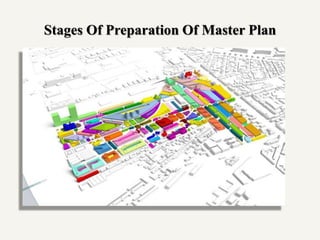
Stages Of Preparation Of Master Plan
• The procedure to be followed in the preparation of a developmental
plan for a town is quite lengthy and takes considerable time as many
factors and legally formalities are to be observed.
• How ever for convenience the various stages of master plan can be
summarized as
• Collection of data and relevant information from civic surveys and other
resources.
• Preparation of tentative draft of the development plan and notifying for
the same for comments, suggestions, and discussions from experts &
public.
• Considerations of views received from experts and public with sympathy
and without any prejudice.
• Preparation of the received developmental plan accommodating the
good aspects of comment received.
• Determination of sequence in which the developmental plan will be
implemented.
Stages Of Preparation Of Master Plan
Methods Of Execution Of Development Plan
• The execution of the developmental plan is carried out by
the municipal or corporation authorities. Every new public
improvement proposed should fit in the developmental plan.
The first thing to be determined is the layout of the road
system. Once that is finalized, the regulation may be made
for preventing any building to be built which will upset the
street pattern. The improvement work in a developmental
plan can be carried out without affecting the continuity of
the project and progress from part to the whole becomes
natural and satisfactory.
• It thus becomes necessary to divide the proposals in
various stages and the stages thus prepared can be
arranged in order of preference for execution of the
developmental plan.
Methods Of Execution Of Development Plan
• The deploymental plan is nothing more than
a skeleton prepared on various assumption
and approximation.
• If prepared, it insures that the development
and growth of various parts of the town will
be in harmony and proper proportion.
Methods Of Execution Of Development Plan
References
• Fundamentals of Town Planning : G.K. Hiraskar
• Internet Websites
Thanks…

Master Plan

  • 1.
  • 2.
    Master Plan • Adevelopment plan or a master plan or a town plan may be defined as a plan for the future layout of a city showing both existing and proposed streets or roads, open spaces, public building etc. • A development plan or A master plan is thus a blue print of the various proposals that are intended to improve the existing condition and to control the future growth of town in a coordinated manner.
  • 3.
  • 4.
    Objectives Of MasterPlan • It aims at intelligent and economic spending of the public funds for achieving welfare of the inhabitants in respect of amenities, convenience and health. • It arranges the pattern of town in such a way so as to satisfy present requirement without introduction of future improvement by coming generation. • It helps in restricting the haphazard and unplanned growth. • It places the various functions which a town has to perform in physical relationship of each other so as to avoid the chances of mutual conflict. • It serves as a guide to the planning body for making any recommendations for public improvement.
  • 5.
  • 6.
    Necessity Of DevelopmentPlan • Following are the reasons which has lead to the thinking of having a development plan: • To control the development of various industries in a systematic manner. • To discourage the growth of town in an unplanned and unscientific way. • To give a perspective picture of a fully development town. • To limit to a certain extent the unprecedented flow of rural population. • To offset the evils which have come up due to overcrowding of population such as shortage of houses, traffic congestion, inadequate open spaces and insufficient public amenities, etc.
  • 7.
  • 8.
    Data To BeCollected In general data required for the preparation of master plan is as follows; • Meteorological data regarding direction, intensity of wind, temperature and rainfall. • Geological data regarding soil condition. • Mineral resources • Places of historical, cultural and scientific importance. • Population present and future growth. • Economic conditions • Trade and Communications • Water supply and drainage arrangement • Expansion, development of environments. • Political position of the place with regard to its neighboring area.
  • 9.
    Data To BeCollected
  • 10.
  • 11.
    Drawings To BePrepared To give graphical representation to various ideas and proposals contained in the development plan of a town, various maps and drawings are to be prepared Following are the details; • Boundaries of land of different types such as residential, agricultural, industrial, etc. • Boundaries of green belt surrounding the town. • Contours of the whole city; • Different Zones; • Landscape features; • Location of public building and town centres; • Open space including parks & playgrounds • Positions of natural water courses; • Position of Public Utility services such as water supply stations, sewage disposal plant, etc. • Road systems; • In addition to the drawing perspective views, panoramas, models etc should be accompanied the project drawing, when found necessary.
  • 12.
  • 13.
    Stages In ThePreparation Of Master Plan • The re- planning of an existing town is more complex then planning and designing a new town on virgin land, such as Capital towns like New Delhi, Chandigarh, Military Cantonments etc. • After taking the Government sanction to prepare the scheme, network is to collect the data and relevant information, with the help of civic survey. From the data of civic survey he is in position to make a correct diagnosis of the various ills of the town and suggest remedies of their cure.
  • 14.
    Stages In ThePreparation Of Master Plan
  • 15.
    Stages In ThePreparation Of Master Plan • For the collection of data for the planning schemes, the town is divided into old town and new town . In the former case the work is tedious because the old town usually consists of narrow streets, congestion, insanitation and unhealthy conditions. Etc. • But in the later case, the town planners work is more easy as he gets virgin land for the application of modern methods of development and control through the provisions of new network of roads, zoned areas , provision of all civic amenities etc. However care should be taken to keep the whole town, old and new alike in all aspect and finally blend skillfully so as to form In- separate interwoven structure.
  • 16.
    Features Of MasterPlan • The development plan serves as an outline for the future growth of town and as such, its preparation demand high skill, training, imagination and experience on the part of person who frame it. He has to keep in mind three fundamental requirement namely amenity, convenience, and health. • The Most important features which receives the top priorities in the preparation of master plan are given below; • Population • The prospective population to be prepared for the next thirty to fifty years should be calculated on the basis of the present population, and its rate of growth during the last three to four decades.
  • 17.
  • 18.
    Features Of MasterPlan Density • The next task is to fix the density of population as per the required standard vary for the town centre, suburbs, type of buildings, flats etc. An average over all density of eighty to hundred person per acre can be allowed. Requirement of land • The next task is to work out the total land requirement for the anticipated population. If the population is surplus then has to decant and provide for all it in new layouts. Distribution of Land • The total land will have to be distributed for the different uses such as • Residential • Commercial • Industrial • Public and Semi public • Open spaces • Communication • Other special uses.
  • 19.
  • 20.
    Features Of MasterPlan Residential Use • The total population will have to be distributed in various zones, based on neighborhood planning, fixing the density which may vary from 40 to 50 persons to a maximum of 100 to 200 persons per acre or even more. Usually the density varies from town centres, suburbs to the outer fringe areas of the town.
  • 21.
  • 22.
    Features Of MasterPlan Commercial Use • The shopping facilities for the neighborhood will have to be provided. These include small shops for day to day purchases; shopping sub-centres for casual purchases, and shopping main centres for special purchases. Provision will also be made of the wholesale trading godowns, warehouses, cattle market etc.
  • 23.
  • 24.
    Features Of MasterPlan Industrial use; • The location of industry in the development plan is very important it depends upon nearness to roads, railways, availability of electric power, water supply etc. • The industries should have to be planned leeward of the town so that the smoke, dust, dangerous gases will not travel over the town. Except the service industries such as bakeries, dairies, laundries, flour mills, auto works, the industry should be located at the outskirts of the town. A green belt should be left between the industries and other uses.
  • 25.
  • 26.
    Features Of MasterPlan Public & Semi Public Uses; • These include schools colleges, Govt offices etc which should be located in the convenient places to serve all the people in the unit. Open Spaces; • These include parks, playgrounds, stadiums etc • According to this standard the open space for outdoor recreation purpose should not be less than 10 acres or 25 acres for 10,000 population.
  • 27.
    Public & SemiPublic Uses
  • 28.
  • 29.
    Features Of MasterPlan Communication • The area occupied by roads, bustands, railways etc. come under this category. The main arterial roads should be aligned on the boundaries of the unit. Each unit will be divided by sub- roads giving access to its principal parts and it will again be subdivided into smaller groups by the local roads. The width of road should be proportional to the volume of traffic. Other special uses: • These include the refuse disposal, grave yards etc.
  • 30.
  • 31.
    Features of MasterPlan • Convenience and cheap means of Transport • Good Sanitation and water Supply • Open air spaces • Population Density Control • Proper situations for places of worship, education and recreation • Rational Layout • Width of road
  • 32.
    Stages Of PreparationOf Master Plan • The procedure to be followed in the preparation of a developmental plan for a town is quite lengthy and takes considerable time as many factors and legally formalities are to be observed. • How ever for convenience the various stages of master plan can be summarized as • Collection of data and relevant information from civic surveys and other resources. • Preparation of tentative draft of the development plan and notifying for the same for comments, suggestions, and discussions from experts & public. • Considerations of views received from experts and public with sympathy and without any prejudice. • Preparation of the received developmental plan accommodating the good aspects of comment received. • Determination of sequence in which the developmental plan will be implemented.
  • 33.
    Stages Of PreparationOf Master Plan
  • 34.
    Methods Of ExecutionOf Development Plan • The execution of the developmental plan is carried out by the municipal or corporation authorities. Every new public improvement proposed should fit in the developmental plan. The first thing to be determined is the layout of the road system. Once that is finalized, the regulation may be made for preventing any building to be built which will upset the street pattern. The improvement work in a developmental plan can be carried out without affecting the continuity of the project and progress from part to the whole becomes natural and satisfactory. • It thus becomes necessary to divide the proposals in various stages and the stages thus prepared can be arranged in order of preference for execution of the developmental plan.
  • 35.
    Methods Of ExecutionOf Development Plan
  • 36.
    Methods Of ExecutionOf Development Plan • The deploymental plan is nothing more than a skeleton prepared on various assumption and approximation. • If prepared, it insures that the development and growth of various parts of the town will be in harmony and proper proportion.
  • 37.
    Methods Of ExecutionOf Development Plan
  • 38.
    References • Fundamentals ofTown Planning : G.K. Hiraskar • Internet Websites
  • 39.