Ups and downs…
IN AN ORAL PRESENTATION
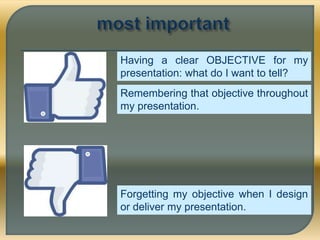
Having a clear OBJECTIVE for my
presentation: what do I want to tell?
Remembering that objective throughout
my presentation.
Forgetting my objective when I design
or deliver my presentation.
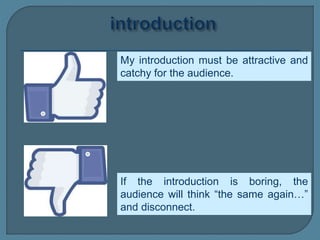
My introduction must be attractive and
catchy for the audience.
If the introduction is boring, the
audience will think “the same again…”
and disconnect.
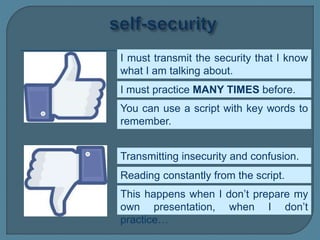
I must transmit the security that I know
what I am talking about.
Transmitting insecurity and confusion.
I must practice MANY TIMES before.
This happens when I don’t prepare my
own presentation, when I don’t
practice…
You can use a script with key words to
remember.
Reading constantly from the script.
Give interesting, deep and true
information to the audience.
If your information is incorrect,
confusing, or false, the audience will
not trust you.
Show that you know the information
and have reflected to form your own
opinion.
Don’t just read your slides. It’s very
boring and the audience doesn’t need
you for that!
Speak in a loud clear tone.
Speaking too low to be heard.
Emphasize important words or
sentences.
Boring flat intentionless intonation.
Pronouncing many words incorrectly.
I must know how to pronounce every
word (use wordreference).
Eye contact: every person must feel
that you are talking to them.
Looking at the floor or ceiling or only to
the teacher (or to your friends).
Emphasize ideas with your hands and
gestures. Be dynamic.
Static hands and body don’t transmit
anything and make it boring.
Avoid chewing gum, putting hands into
pockets, playing with your script,
leaning on the wall, showing your back
to the audience…
Before you deliver your presentation
you must know how long it is (you will
know if you practice).
Forgetting about time and being too
short or too long for the teacher’s
requirements.
You should be aware of the time
passed at every moment.
Making a good distribution of the time
that every member is speaking.
Some members take up the whole time
and others hardly speak.
Showing that you have worked together
as a team and you share the same
objective.
Knowing every members’ skills and
using them to succeed.
Presenting in an impersonal way
without showing what makes you
special.
SUPPORT. You must know everyone’s
parts so you can help them if they get
blocked.
LACK OF RESPONSABILITY. If you
distribute the presentation in parts and
never practice together, it will be a
disaster.
Present deep, rational and clear
conclusions that create emotions in the
audience.
Finish your presentation sharply
without worrying about the aucience’s
impressions.
Invite the audience to ask questions
and debate.
Moderate the questions and the debate
so you don’t reach the time limit.
Saying goodbye without inviting the
audience to express themselves.
Lose control of the debate and let the
time extend too much.

Ups and downs oral presentations

  • 1.
    Ups and downs… INAN ORAL PRESENTATION
  • 2.
    Having a clearOBJECTIVE for my presentation: what do I want to tell? Remembering that objective throughout my presentation. Forgetting my objective when I design or deliver my presentation.
  • 3.
    My introduction mustbe attractive and catchy for the audience. If the introduction is boring, the audience will think “the same again…” and disconnect.
  • 4.
    I must transmitthe security that I know what I am talking about. Transmitting insecurity and confusion. I must practice MANY TIMES before. This happens when I don’t prepare my own presentation, when I don’t practice… You can use a script with key words to remember. Reading constantly from the script.
  • 5.
    Give interesting, deepand true information to the audience. If your information is incorrect, confusing, or false, the audience will not trust you. Show that you know the information and have reflected to form your own opinion. Don’t just read your slides. It’s very boring and the audience doesn’t need you for that!
  • 6.
    Speak in aloud clear tone. Speaking too low to be heard. Emphasize important words or sentences. Boring flat intentionless intonation. Pronouncing many words incorrectly. I must know how to pronounce every word (use wordreference).
  • 7.
    Eye contact: everyperson must feel that you are talking to them. Looking at the floor or ceiling or only to the teacher (or to your friends).
  • 8.
    Emphasize ideas withyour hands and gestures. Be dynamic. Static hands and body don’t transmit anything and make it boring. Avoid chewing gum, putting hands into pockets, playing with your script, leaning on the wall, showing your back to the audience…
  • 9.
    Before you deliveryour presentation you must know how long it is (you will know if you practice). Forgetting about time and being too short or too long for the teacher’s requirements. You should be aware of the time passed at every moment.
  • 10.
    Making a gooddistribution of the time that every member is speaking. Some members take up the whole time and others hardly speak. Showing that you have worked together as a team and you share the same objective.
  • 11.
    Knowing every members’skills and using them to succeed. Presenting in an impersonal way without showing what makes you special.
  • 12.
    SUPPORT. You mustknow everyone’s parts so you can help them if they get blocked. LACK OF RESPONSABILITY. If you distribute the presentation in parts and never practice together, it will be a disaster.
  • 13.
    Present deep, rationaland clear conclusions that create emotions in the audience. Finish your presentation sharply without worrying about the aucience’s impressions.
  • 14.
    Invite the audienceto ask questions and debate. Moderate the questions and the debate so you don’t reach the time limit. Saying goodbye without inviting the audience to express themselves. Lose control of the debate and let the time extend too much.