Unit 4
DEPARTMENT OF TECHNOLOGIES 3rd ESO
INDEX
1. Forces and stresses
2. Structures and loads
3. Types of structures
4. Elements of structures
5. Structural conditions
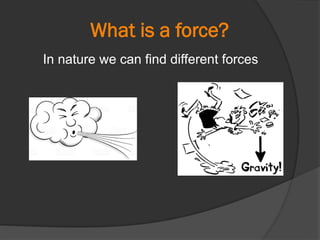
What is a force?
In nature we can find different forces
What is a force?
A force is an influence that can deform a
body or change its state of movement or
rest.
 When the force deforms the body we
say it has a static effect
 When the force moves the body we
say it has a dynamic effect
How can we define a force?
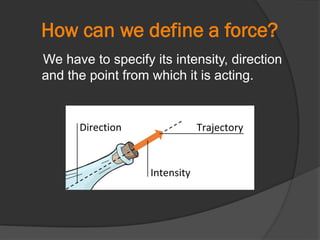
We have to specify its intensity, direction
and the point from which it is acting.
What is an stress?
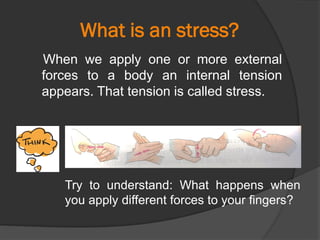
Try to understand: What happens when
you apply different forces to your fingers?
When we apply one or more external
forces to a body an internal tension
appears. That tension is called stress.
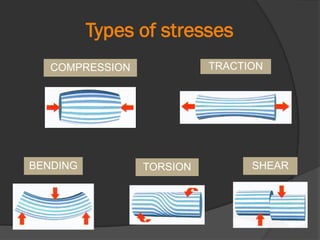
Types of stresses
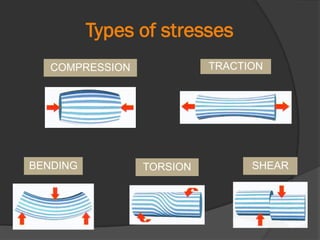
TRACTIONCOMPRESSION
SHEARTORSIONBENDING
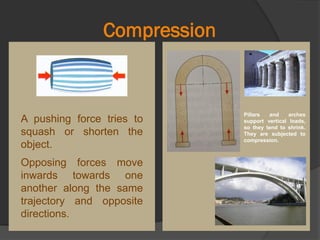
Compression
Pillars and arches
support vertical loads,
so they tend to shrink.
They are subjected to
compression.
A pushing force tries to
squash or shorten the
object.
Opposing forces move
inwards towards one
another along the same
trajectory and opposite
directions.
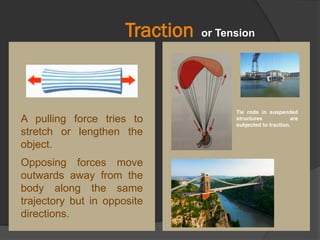
Traction
Tie rods in suspended
structures are
subjected to traction.
A pulling force tries to
stretch or lengthen the
object.
Opposing forces move
outwards away from the
body along the same
trajectory but in opposite
directions.
or Tension
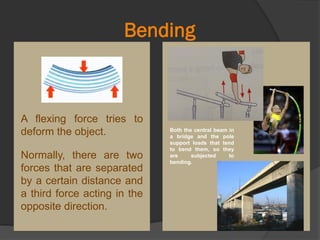
Bending
Both the central beam in
a bridge and the pole
support loads that tend
to bend them, so they
are subjected to
bending.
A flexing force tries to
deform the object.
Normally, there are two
forces that are separated
by a certain distance and
a third force acting in the
opposite direction.
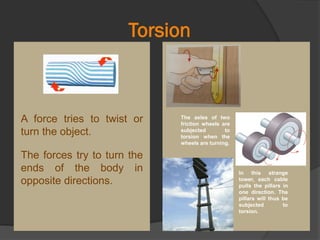
Torsion
The axles of two
friction wheels are
subjected to
torsion when the
wheels are turning.
In this strange
tower, each cable
pulls the pillars in
one direction. The
pillars will thus be
subjected to
torsion.
A force tries to twist or
turn the object.
The forces try to turn the
ends of the body in
opposite directions.
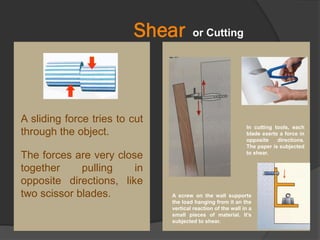
Shear
In cutting tools, each
blade exerts a force in
opposite directions.
The paper is subjected
to shear.
A screw on the wall supports
the load hanging from it an the
vertical reaction of the wall in a
small pieces of material. It’s
subjected to shear.
or Cutting
A sliding force tries to cut
through the object.
The forces are very close
together pulling in
opposite directions, like
two scissor blades.
Types of stresses
TRACTIONCOMPRESSION
SHEARTORSIONBENDING
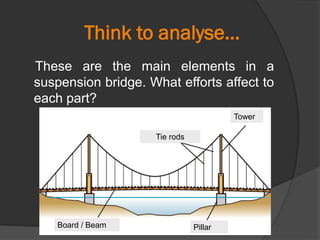
Think to analyse…
These are the main elements in a
suspension bridge. What efforts affect to
each part?
Board / Beam
Tie rods
Tower
Pillar
See, think and wonder
What is a structure?
But, what is exactly a structure?
What are structures for?
What would happen if you did not have a
skeleton?
Both living beings and the great number
of objects that have been designed and
created by human beings can be
understood as structures.
What is a structure?
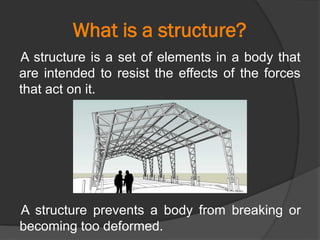
A structure is a set of elements in a body that
are intended to resist the effects of the forces
that act on it.
A structure prevents a body from breaking or
becoming too deformed.
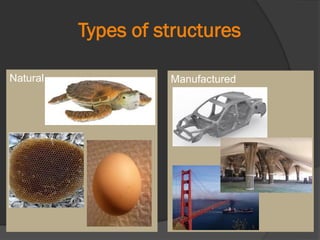
Types of structures
Natural Manufactured
What is a load?
Natural and artificial structures are created to
support loads. Loads are forces that can
deform a body or make it move.
Types of loads:
 Fixed Loads: They always have the same
value.
 Variable loads: Those that can change as
time passes or due to natural disasters.
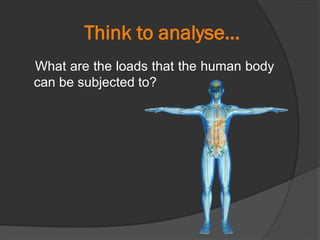
Think to analyse…
What are the loads that the human body
can be subjected to?
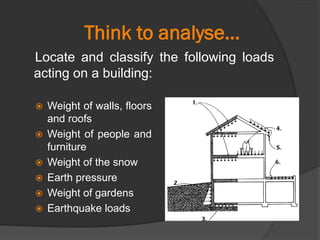
Think to analyse…
Locate and classify the following loads
acting on a building:
 Weight of walls, floors
and roofs
 Weight of people and
furniture
 Weight of the snow
 Earth pressure
 Weight of gardens
 Earthquake loads
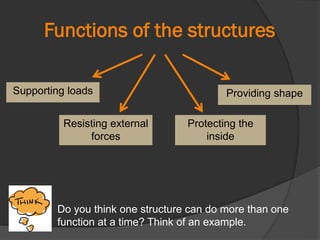
Functions of the structures
Supporting loads
Resisting external
forces
Providing shape
Protecting the
inside
Do you think one structure can do more than one
function at a time? Think of an example.
Functions of the structures
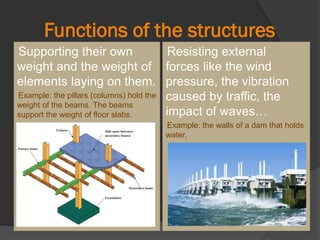
Supporting their own
weight and the weight of
elements laying on them.
Example: the pillars (columns) hold the
weight of the beams. The beams
support the weight of floor slabs.
Resisting external
forces like the wind
pressure, the vibration
caused by traffic, the
impact of waves…
Example: the walls of a dam that holds
water.
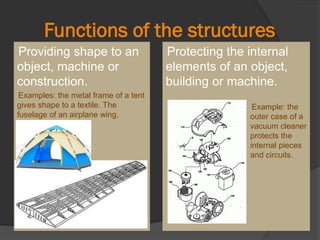
Providing shape to an
object, machine or
construction.
Examples: the metal frame of a tent
gives shape to a textile. The
fuselage of an airplane wing.
Protecting the internal
elements of an object,
building or machine.
Example: the
outer case of a
vacuum cleaner
protects the
internal pieces
and circuits.
Functions of the structures
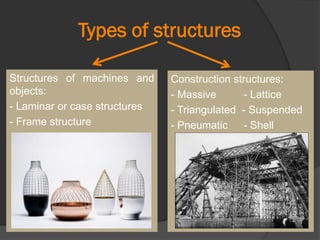
Types of structures
Structures of machines and
objects:
- Laminar or case structures
- Frame structure
--E
Construction structures:
- Massive - Lattice
- Triangulated - Suspended
- Pneumatic - Shell
Structures of machines and objects
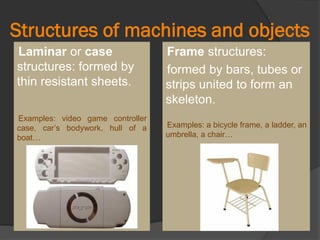
Laminar or case
structures: formed by
thin resistant sheets.
Examples: video game controller
case, car’s bodywork, hull of a
boat…
Frame structures:
formed by bars, tubes or
strips united to form an
skeleton.
Examples: a bicycle frame, a ladder, an
umbrella, a chair…
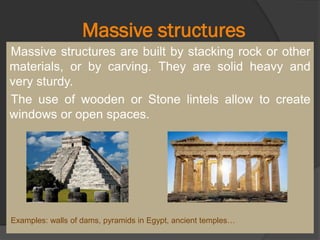
Massive structures
Massive structures are built by stacking rock or other
materials, or by carving. They are solid heavy and
very sturdy.
The use of wooden or Stone lintels allow to create
windows or open spaces.
Examples: walls of dams, pyramids in Egypt, ancient temples…
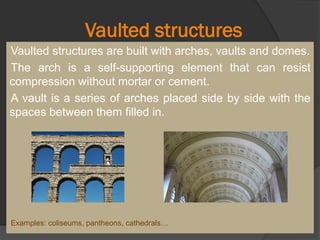
Vaulted structures
Vaulted structures are built with arches, vaults and domes.
The arch is a self-supporting element that can resist
compression without mortar or cement.
A vault is a series of arches placed side by side with the
spaces between them filled in.
Examples: coliseums, pantheons, cathedrals…
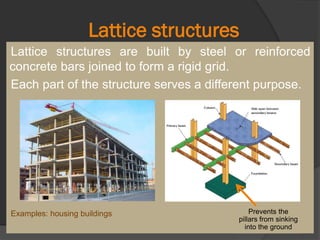
Lattice structures
Lattice structures are built by steel or reinforced
concrete bars joined to form a rigid grid.
Each part of the structure serves a different purpose.
Examples: housing buildings Prevents the
pillars from sinking
into the ground
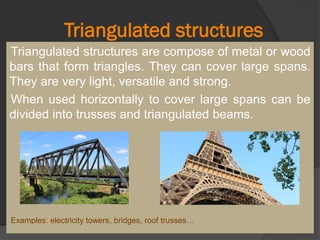
Triangulated structures
Triangulated structures are compose of metal or wood
bars that form triangles. They can cover large spans.
They are very light, versatile and strong.
When used horizontally to cover large spans can be
divided into trusses and triangulated beams.
Examples: electricity towers, bridges, roof trusses…
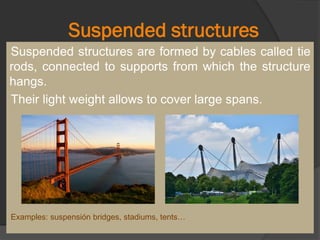
Suspended structures
Suspended structures are formed by cables called tie
rods, connected to supports from which the structure
hangs.
Their light weight allows to cover large spans.
Examples: suspensión bridges, stadiums, tents…
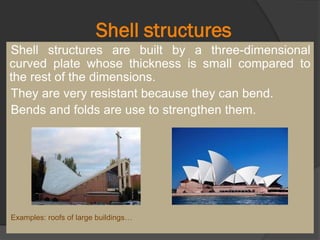
Shell structures
Shell structures are built by a three-dimensional
curved plate whose thickness is small compared to
the rest of the dimensions.
They are very resistant because they can bend.
Bends and folds are use to strengthen them.
Examples: roofs of large buildings…
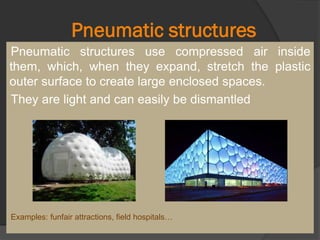
Pneumatic structures
Pneumatic structures use compressed air inside
them, which, when they expand, stretch the plastic
outer surface to create large enclosed spaces.
They are light and can easily be dismantled
Examples: funfair attractions, field hospitals…
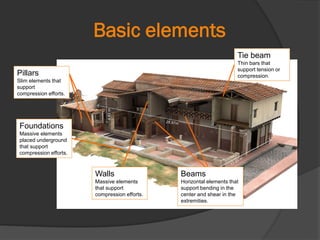
Basic elements
Foundations
Massive elements
placed underground
that support
compression efforts.
Tie beam
Thin bars that
support tension or
compression.
Walls
Massive elements
that support
compression efforts.
Beams
Horizontal elements that
support bending in the
center and shear in the
extremities.
Pillars
Slim elements that
support
compression efforts.
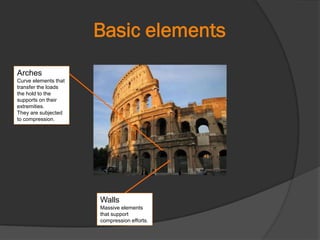
Basic elements
Walls
Massive elements
that support
compression efforts.
Arches
Curve elements that
transfer the loads
the hold to the
supports on their
extremities.
They are subjected
to compression.
Basic elements
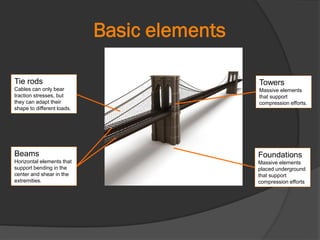
Beams
Horizontal elements that
support bending in the
center and shear in the
extremities.
Foundations
Massive elements
placed underground
that support
compression efforts
Tie rods
Cables can only bear
traction stresses, but
they can adapt their
shape to different loads.
Towers
Massive elements
that support
compression efforts.
Structural conditions
For a structure to work well it needs to meet
three conditions:
 Stability: The capacity of a structure to
remain upright and not tip over
 Resistance: The capacity of a structure to
bear the tension that is subjected to without
breaking it
 Rigidity: The capacity of a structure to keep
its form when a force is applied to it
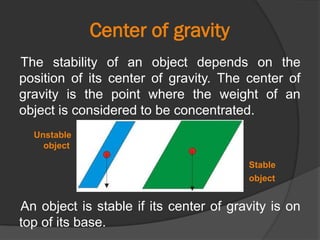
Center of gravity
The stability of an object depends on the
position of its center of gravity. The center of
gravity is the point where the weight of an
object is considered to be concentrated.
An object is stable if its center of gravity is on
top of its base.
Stable
object
Unstable
object
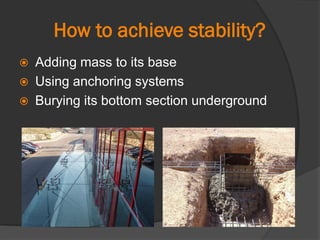
How to achieve stability?
 Adding mass to its base
 Using anchoring systems
 Burying its bottom section underground
How to achieve resistance?
 Adding more material
 Choosing the best materials to support them,
taking into account the efforts that will act on
the structure.
 Choosing a proper shape, taking into
account the efforts that will act on the
structure.
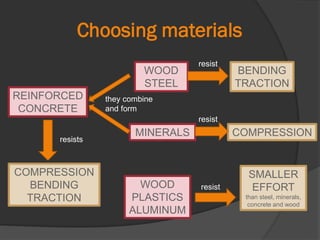
Choosing materials
WOOD
STEEL
BENDING
TRACTION
MINERALS COMPRESSION
resist
they combine
and form
COMPRESSION
BENDING
TRACTION
REINFORCED
CONCRETE
resists
WOOD
PLASTICS
ALUMINUM
resist
SMALLER
EFFORT
than steel, minerals,
concrete and wood
resist
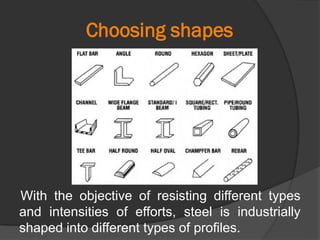
Choosing shapes
With the objective of resisting different types
and intensities of efforts, steel is industrially
shaped into different types of profiles.
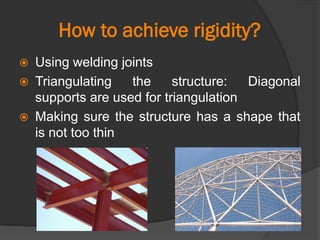
How to achieve rigidity?
 Using welding joints
 Triangulating the structure: Diagonal
supports are used for triangulation
 Making sure the structure has a shape that
is not too thin

Structures presentation for 3rd ESO

  • 1.
    Unit 4 DEPARTMENT OFTECHNOLOGIES 3rd ESO
  • 2.
    INDEX 1. Forces andstresses 2. Structures and loads 3. Types of structures 4. Elements of structures 5. Structural conditions
  • 4.
    What is aforce? In nature we can find different forces
  • 5.
    What is aforce? A force is an influence that can deform a body or change its state of movement or rest.  When the force deforms the body we say it has a static effect  When the force moves the body we say it has a dynamic effect
  • 6.
    How can wedefine a force? We have to specify its intensity, direction and the point from which it is acting.
  • 7.
    What is anstress? Try to understand: What happens when you apply different forces to your fingers? When we apply one or more external forces to a body an internal tension appears. That tension is called stress.
  • 8.
  • 9.
    Compression Pillars and arches supportvertical loads, so they tend to shrink. They are subjected to compression. A pushing force tries to squash or shorten the object. Opposing forces move inwards towards one another along the same trajectory and opposite directions.
  • 10.
    Traction Tie rods insuspended structures are subjected to traction. A pulling force tries to stretch or lengthen the object. Opposing forces move outwards away from the body along the same trajectory but in opposite directions. or Tension
  • 11.
    Bending Both the centralbeam in a bridge and the pole support loads that tend to bend them, so they are subjected to bending. A flexing force tries to deform the object. Normally, there are two forces that are separated by a certain distance and a third force acting in the opposite direction.
  • 12.
    Torsion The axles oftwo friction wheels are subjected to torsion when the wheels are turning. In this strange tower, each cable pulls the pillars in one direction. The pillars will thus be subjected to torsion. A force tries to twist or turn the object. The forces try to turn the ends of the body in opposite directions.
  • 13.
    Shear In cutting tools,each blade exerts a force in opposite directions. The paper is subjected to shear. A screw on the wall supports the load hanging from it an the vertical reaction of the wall in a small pieces of material. It’s subjected to shear. or Cutting A sliding force tries to cut through the object. The forces are very close together pulling in opposite directions, like two scissor blades.
  • 14.
  • 15.
    Think to analyse… Theseare the main elements in a suspension bridge. What efforts affect to each part? Board / Beam Tie rods Tower Pillar
  • 17.
  • 18.
    What is astructure? But, what is exactly a structure? What are structures for? What would happen if you did not have a skeleton? Both living beings and the great number of objects that have been designed and created by human beings can be understood as structures.
  • 19.
    What is astructure? A structure is a set of elements in a body that are intended to resist the effects of the forces that act on it. A structure prevents a body from breaking or becoming too deformed.
  • 20.
  • 21.
    What is aload? Natural and artificial structures are created to support loads. Loads are forces that can deform a body or make it move. Types of loads:  Fixed Loads: They always have the same value.  Variable loads: Those that can change as time passes or due to natural disasters.
  • 22.
    Think to analyse… Whatare the loads that the human body can be subjected to?
  • 23.
    Think to analyse… Locateand classify the following loads acting on a building:  Weight of walls, floors and roofs  Weight of people and furniture  Weight of the snow  Earth pressure  Weight of gardens  Earthquake loads
  • 24.
    Functions of thestructures Supporting loads Resisting external forces Providing shape Protecting the inside Do you think one structure can do more than one function at a time? Think of an example.
  • 25.
    Functions of thestructures Supporting their own weight and the weight of elements laying on them. Example: the pillars (columns) hold the weight of the beams. The beams support the weight of floor slabs. Resisting external forces like the wind pressure, the vibration caused by traffic, the impact of waves… Example: the walls of a dam that holds water.
  • 26.
    Providing shape toan object, machine or construction. Examples: the metal frame of a tent gives shape to a textile. The fuselage of an airplane wing. Protecting the internal elements of an object, building or machine. Example: the outer case of a vacuum cleaner protects the internal pieces and circuits. Functions of the structures
  • 28.
    Types of structures Structuresof machines and objects: - Laminar or case structures - Frame structure --E Construction structures: - Massive - Lattice - Triangulated - Suspended - Pneumatic - Shell
  • 29.
    Structures of machinesand objects Laminar or case structures: formed by thin resistant sheets. Examples: video game controller case, car’s bodywork, hull of a boat… Frame structures: formed by bars, tubes or strips united to form an skeleton. Examples: a bicycle frame, a ladder, an umbrella, a chair…
  • 30.
    Massive structures Massive structuresare built by stacking rock or other materials, or by carving. They are solid heavy and very sturdy. The use of wooden or Stone lintels allow to create windows or open spaces. Examples: walls of dams, pyramids in Egypt, ancient temples…
  • 31.
    Vaulted structures Vaulted structuresare built with arches, vaults and domes. The arch is a self-supporting element that can resist compression without mortar or cement. A vault is a series of arches placed side by side with the spaces between them filled in. Examples: coliseums, pantheons, cathedrals…
  • 32.
    Lattice structures Lattice structuresare built by steel or reinforced concrete bars joined to form a rigid grid. Each part of the structure serves a different purpose. Examples: housing buildings Prevents the pillars from sinking into the ground
  • 33.
    Triangulated structures Triangulated structuresare compose of metal or wood bars that form triangles. They can cover large spans. They are very light, versatile and strong. When used horizontally to cover large spans can be divided into trusses and triangulated beams. Examples: electricity towers, bridges, roof trusses…
  • 34.
    Suspended structures Suspended structuresare formed by cables called tie rods, connected to supports from which the structure hangs. Their light weight allows to cover large spans. Examples: suspensión bridges, stadiums, tents…
  • 35.
    Shell structures Shell structuresare built by a three-dimensional curved plate whose thickness is small compared to the rest of the dimensions. They are very resistant because they can bend. Bends and folds are use to strengthen them. Examples: roofs of large buildings…
  • 36.
    Pneumatic structures Pneumatic structuresuse compressed air inside them, which, when they expand, stretch the plastic outer surface to create large enclosed spaces. They are light and can easily be dismantled Examples: funfair attractions, field hospitals…
  • 38.
    Basic elements Foundations Massive elements placedunderground that support compression efforts. Tie beam Thin bars that support tension or compression. Walls Massive elements that support compression efforts. Beams Horizontal elements that support bending in the center and shear in the extremities. Pillars Slim elements that support compression efforts.
  • 39.
    Basic elements Walls Massive elements thatsupport compression efforts. Arches Curve elements that transfer the loads the hold to the supports on their extremities. They are subjected to compression.
  • 40.
    Basic elements Beams Horizontal elementsthat support bending in the center and shear in the extremities. Foundations Massive elements placed underground that support compression efforts Tie rods Cables can only bear traction stresses, but they can adapt their shape to different loads. Towers Massive elements that support compression efforts.
  • 42.
    Structural conditions For astructure to work well it needs to meet three conditions:  Stability: The capacity of a structure to remain upright and not tip over  Resistance: The capacity of a structure to bear the tension that is subjected to without breaking it  Rigidity: The capacity of a structure to keep its form when a force is applied to it
  • 43.
    Center of gravity Thestability of an object depends on the position of its center of gravity. The center of gravity is the point where the weight of an object is considered to be concentrated. An object is stable if its center of gravity is on top of its base. Stable object Unstable object
  • 44.
    How to achievestability?  Adding mass to its base  Using anchoring systems  Burying its bottom section underground
  • 45.
    How to achieveresistance?  Adding more material  Choosing the best materials to support them, taking into account the efforts that will act on the structure.  Choosing a proper shape, taking into account the efforts that will act on the structure.
  • 46.
    Choosing materials WOOD STEEL BENDING TRACTION MINERALS COMPRESSION resist theycombine and form COMPRESSION BENDING TRACTION REINFORCED CONCRETE resists WOOD PLASTICS ALUMINUM resist SMALLER EFFORT than steel, minerals, concrete and wood resist
  • 47.
    Choosing shapes With theobjective of resisting different types and intensities of efforts, steel is industrially shaped into different types of profiles.
  • 48.
    How to achieverigidity?  Using welding joints  Triangulating the structure: Diagonal supports are used for triangulation  Making sure the structure has a shape that is not too thin