CINEMA
THEORETICAL
PROJECT
THEORETICAL WORK_2ND TERM
2ND ESO_ARTS AND VISUAL EDUCATION
INTRODUCTION: ANSWER THESE QUESTIONS WITH YOUR
OWN WORDS
· What is cinema?
· What is a movie / film?
· What is a frame?
· What is the meaning of fps?
· What are the 3 most important movies in the history of
cinema? Find their most relevant scene and print them. Write
the year of the movie.
CONCEPTS WE’LL WORK ON
 CAMERA SHOT
 CAMERA ANGLE
 Why do directors use different camera shots/angles
while they film a movie?
CAMERA SHOT
A CAMERA SHOT is a series of frames shot
with no stop from the moment when the
camera starts shooting until it stops.
CAMERA ANGLE
The CAMERA ANGLE means where the camera
is placed respect to the characters/objects in a
scene.
WHY DO THE DIRECTORS CHANGE SHOTS AND ANGLES?
They are used to:
• Explain different moments of the story with
more/less details
• Make more dramatic scenes
• Give an emphasis to a specific object or
character.
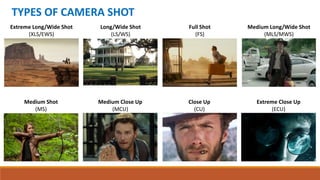
TYPES OF CAMERA SHOT
Extreme Long/Wide Shot
(XLS/EWS)
Long/Wide Shot
(LS/WS)
Full Shot
(FS)
Medium Long/Wide Shot
(MLS/MWS)
Medium Shot
(MS)
Medium Close Up
(MCU)
Close Up
(CU)
Extreme Close Up
(ECU)
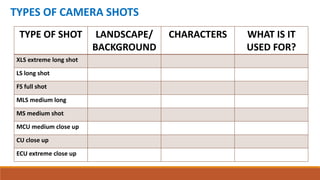
TYPES OF CAMERA SHOTS
TYPE OF SHOT LANDSCAPE/
BACKGROUND
CHARACTERS WHAT IS IT
USED FOR?
XLS extreme long shot
LS long shot
FS full shot
MLS medium long
MS medium shot
MCU medium close up
CU close up
ECU extreme close up
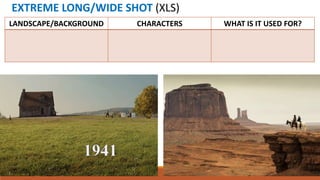
EXTREME LONG/WIDE SHOT (XLS)
LANDSCAPE/BACKGROUND CHARACTERS WHAT IS IT USED FOR?
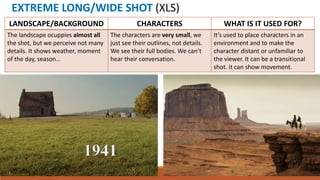
EXTREME LONG/WIDE SHOT (XLS)
LANDSCAPE/BACKGROUND CHARACTERS WHAT IS IT USED FOR?
The landscape ocuppies almost all
the shot, but we perceive not many
details. It shows weather, moment
of the day, season…
The characters are very small, we
just see their outlines, not details.
We see their full bodies. We can’t
hear their conversation.
It’s used to place characters in an
environment and to make the
character distant or unfamiliar to
the viewer. It can be a transitional
shot. It can show movement.
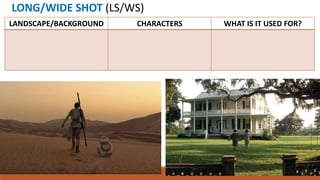
LONG/WIDE SHOT (LS/WS)
LANDSCAPE/BACKGROUND CHARACTERS WHAT IS IT USED FOR?
LONG/WIDE SHOT (LS/WS)
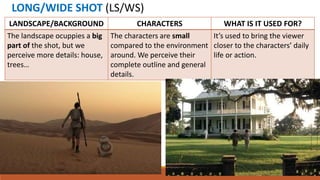
LANDSCAPE/BACKGROUND CHARACTERS WHAT IS IT USED FOR?
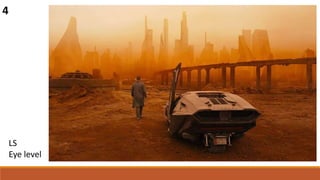
The landscape ocuppies a big
part of the shot, but we
perceive more details: house,
trees…
The characters are small
compared to the environment
around. We perceive their
complete outline and general
details.
It’s used to bring the viewer
closer to the characters’ daily
life or action.
FULL SHOT (FS)
LANDSCAPE/BACKGROUND CHARACTERS WHAT IS IT USED FOR?
FULL SHOT (FS)
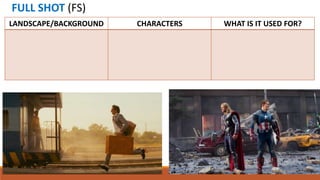
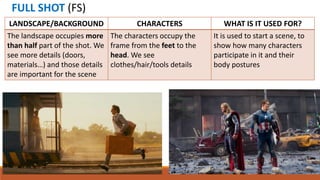
LANDSCAPE/BACKGROUND CHARACTERS WHAT IS IT USED FOR?
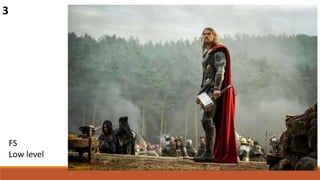
The landscape occupies more
than half part of the shot. We
see more details (doors,
materials…) and those details
are important for the scene
The characters occupy the
frame from the feet to the
head. We see
clothes/hair/tools details
It is used to start a scene, to
show how many characters
participate in it and their
body postures
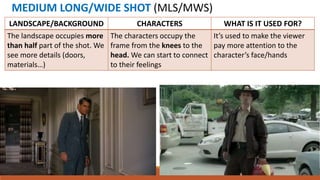
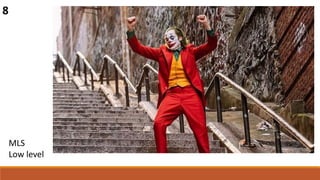
MEDIUM LONG/WIDE SHOT (MLS/MWS)
LANDSCAPE/BACKGROUND CHARACTERS WHAT IS IT USED FOR?
MEDIUM LONG/WIDE SHOT (MLS/MWS)
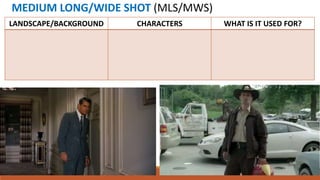
LANDSCAPE/BACKGROUND CHARACTERS WHAT IS IT USED FOR?
The landscape occupies more
than half part of the shot. We
see more details (doors,
materials…)
The characters occupy the
frame from the knees to the
head. We can start to connect
to their feelings
It’s used to make the viewer
pay more attention to the
character’s face/hands
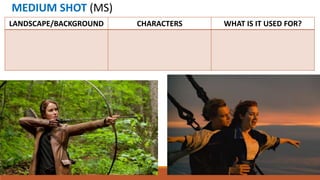
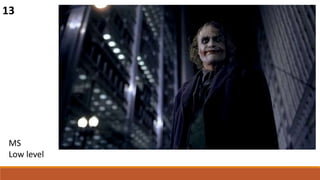
MEDIUM SHOT (MS)
LANDSCAPE/BACKGROUND CHARACTERS WHAT IS IT USED FOR?
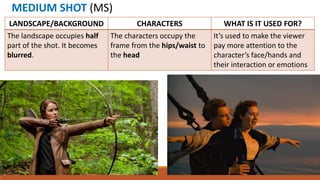
MEDIUM SHOT (MS)
LANDSCAPE/BACKGROUND CHARACTERS WHAT IS IT USED FOR?
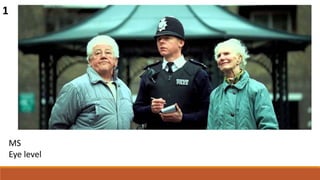
The landscape occupies half
part of the shot. It becomes
blurred.
The characters occupy the
frame from the hips/waist to
the head
It’s used to make the viewer
pay more attention to the
character’s face/hands and
their interaction or emotions
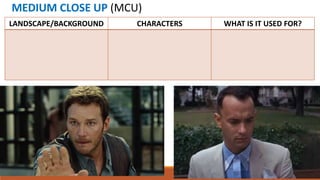
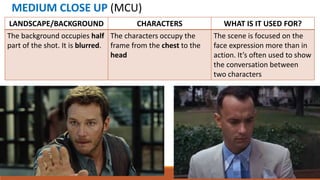
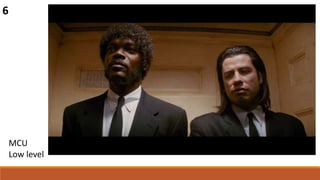
MEDIUM CLOSE UP (MCU)
LANDSCAPE/BACKGROUND CHARACTERS WHAT IS IT USED FOR?
MEDIUM CLOSE UP (MCU)
LANDSCAPE/BACKGROUND CHARACTERS WHAT IS IT USED FOR?
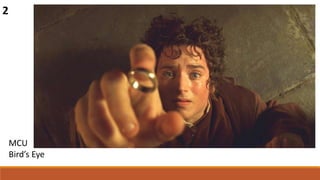
The background occupies half
part of the shot. It is blurred.
The characters occupy the
frame from the chest to the
head
The scene is focused on the
face expression more than in
action. It’s often used to show
the conversation between
two characters
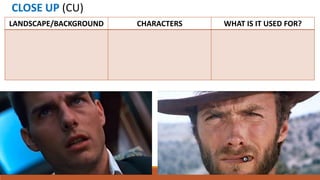
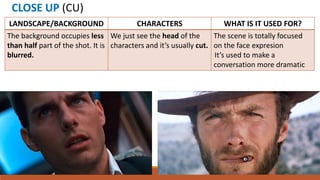
CLOSE UP (CU)
LANDSCAPE/BACKGROUND CHARACTERS WHAT IS IT USED FOR?
CLOSE UP (CU)
LANDSCAPE/BACKGROUND CHARACTERS WHAT IS IT USED FOR?
The background occupies less
than half part of the shot. It is
blurred.
We just see the head of the
characters and it’s usually cut.
The scene is totally focused
on the face expresion
It’s used to make a
conversation more dramatic
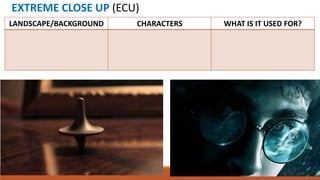
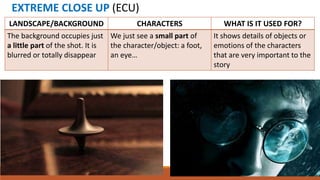
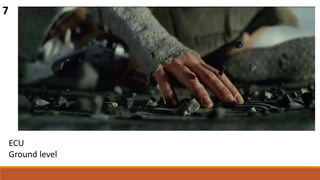
EXTREME CLOSE UP (ECU)
LANDSCAPE/BACKGROUND CHARACTERS WHAT IS IT USED FOR?
EXTREME CLOSE UP (ECU)
LANDSCAPE/BACKGROUND CHARACTERS WHAT IS IT USED FOR?
The background occupies just
a little part of the shot. It is
blurred or totally disappear
We just see a small part of
the character/object: a foot,
an eye…
It shows details of objects or
emotions of the characters
that are very important to the
story
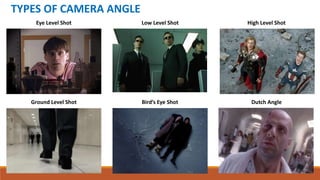
TYPES OF CAMERA ANGLE
Eye Level Shot Low Level Shot High Level Shot
Ground Level Shot Dutch Angle
Bird’s Eye Shot
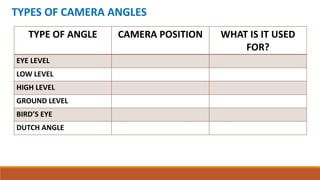
TYPES OF CAMERA ANGLES
TYPE OF ANGLE CAMERA POSITION WHAT IS IT USED
FOR?
EYE LEVEL
LOW LEVEL
HIGH LEVEL
GROUND LEVEL
BIRD’S EYE
DUTCH ANGLE
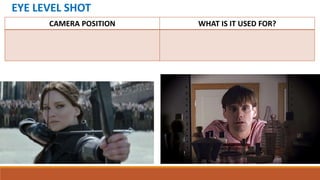
EYE LEVEL SHOT
CAMERA POSITION WHAT IS IT USED FOR?
EYE LEVEL SHOT
CAMERA POSITION WHAT IS IT USED FOR?
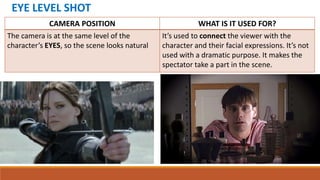
The camera is at the same level of the
character’s EYES, so the scene looks natural
It’s used to connect the viewer with the
character and their facial expressions. It’s not
used with a dramatic purpose. It makes the
spectator take a part in the scene.
LOW LEVEL SHOT
CAMERA POSITION WHAT IS IT USED FOR?
LOW LEVEL SHOT
CAMERA POSITION WHAT IS IT USED FOR?
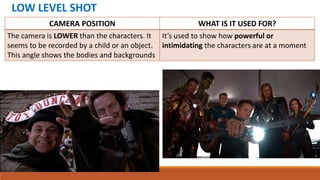
The camera is LOWER than the characters. It
seems to be recorded by a child or an object.
This angle shows the bodies and backgrounds
It’s used to show how powerful or
intimidating the characters are at a moment
HIGH LEVEL SHOT
CAMERA POSITION WHAT IS IT USED FOR?
HIGH LEVEL SHOT
CAMERA POSITION WHAT IS IT USED FOR?
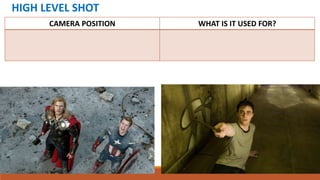
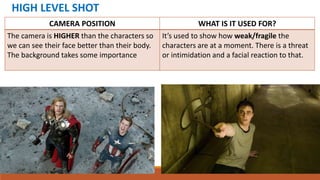
The camera is HIGHER than the characters so
we can see their face better than their body.
The background takes some importance
It’s used to show how weak/fragile the
characters are at a moment. There is a threat
or intimidation and a facial reaction to that.
GROUND LEVEL SHOT
CAMERA POSITION WHAT IS IT USED FOR?
GROUND LEVEL SHOT
CAMERA POSITION WHAT IS IT USED FOR?
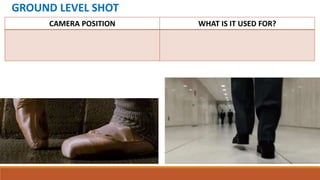
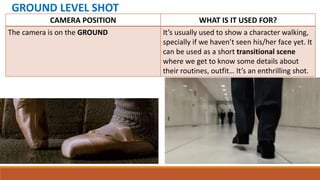
The camera is on the GROUND It’s usually used to show a character walking,
specially if we haven’t seen his/her face yet. It
can be used as a short transitional scene
where we get to know some details about
their routines, outfit… It’s an enthrilling shot.
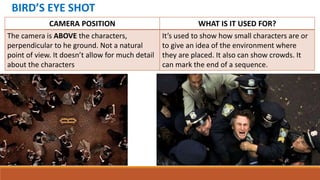
BIRD’S EYE SHOT
CAMERA POSITION WHAT IS IT USED FOR?
BIRD’S EYE SHOT
CAMERA POSITION WHAT IS IT USED FOR?
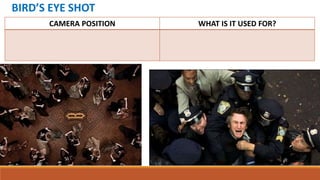
The camera is ABOVE the characters,
perpendicular to he ground. Not a natural
point of view. It doesn’t allow for much detail
about the characters
It’s used to show how small characters are or
to give an idea of the environment where
they are placed. It also can show crowds. It
can mark the end of a sequence.
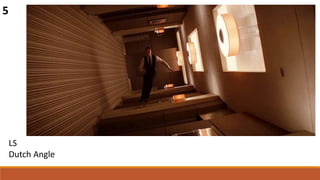
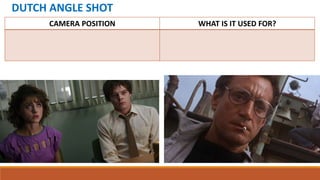
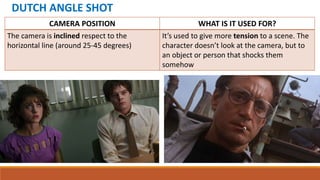
DUTCH ANGLE SHOT
CAMERA POSITION WHAT IS IT USED FOR?
DUTCH ANGLE SHOT
CAMERA POSITION WHAT IS IT USED FOR?
The camera is inclined respect to the
horizontal line (around 25-45 degrees)
It’s used to give more tension to a scene. The
character doesn’t look at the camera, but to
an object or person that shocks them
somehow
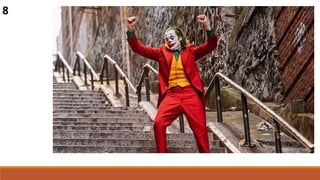
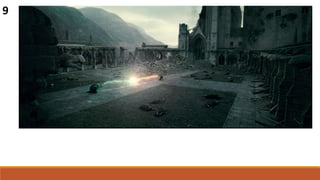
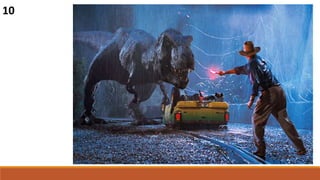
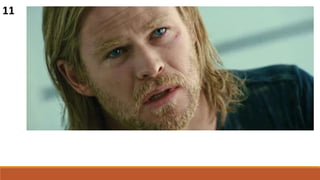
QUIZ
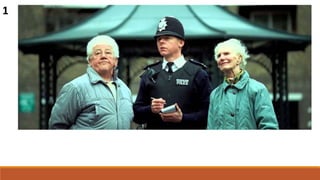
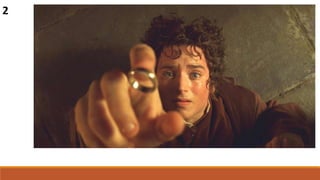
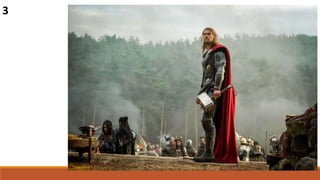
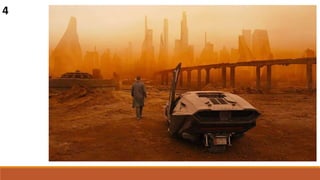
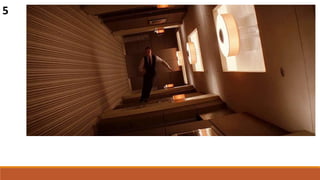
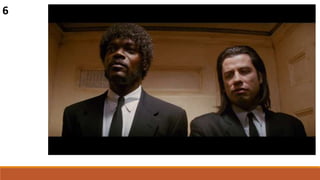
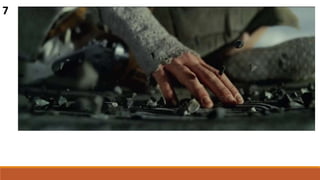
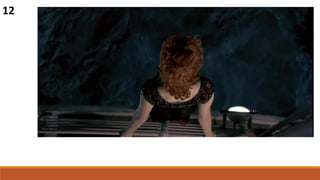
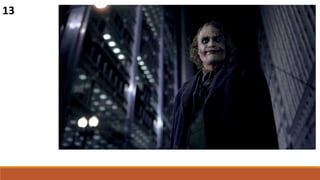
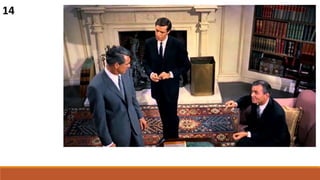
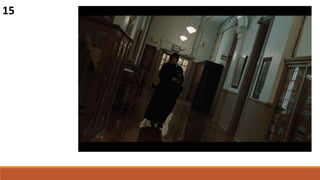
SAY THE CAMERA SHOT AND CAMERA ANGLE USED IN THESES SCENES
ELS/EWS LS FS MLS/MWS MS MCU CU ECU
CAMERA SHOT
EYE LEVEL LOW HIGH BIRD’S EYE GROUND DUTCH
CAMERA ANGLE
1
2
3
4
5
6
7
8
9
10
11
12
13
14
15
SOLUTIONS!
1
MS
Eye level
2
MCU
Bird’s Eye
3
FS
Low level
4
LS
Eye level
5
LS
Dutch Angle
6
MCU
Low level
7
ECU
Ground level
8
MLS
Low level
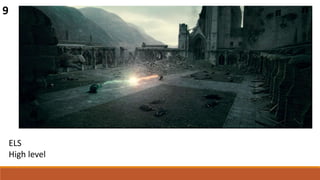
9
ELS
High level
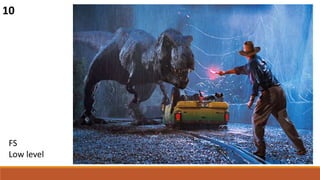
10
FS
Low level
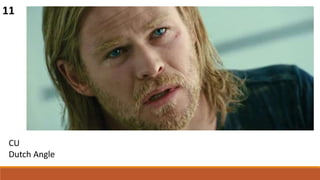
11
CU
Dutch Angle
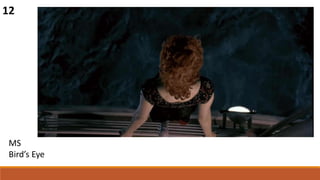
12
MS
Bird’s Eye
13
MS
Low level
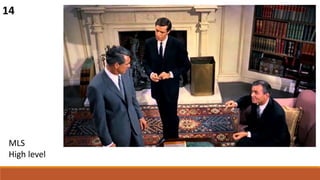
14
MLS
High level
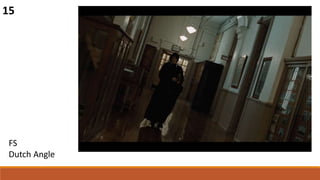
15
FS
Dutch Angle
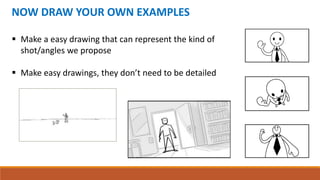
NOW DRAW YOUR OWN EXAMPLES
 Make a easy drawing that can represent the kind of
shot/angles we propose
 Make easy drawings, they don’t need to be detailed
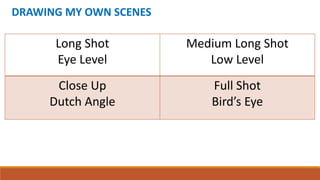
DRAWING MY OWN SCENES
Long Shot
Eye Level
Medium Long Shot
Low Level
Close Up
Dutch Angle
Full Shot
Bird’s Eye
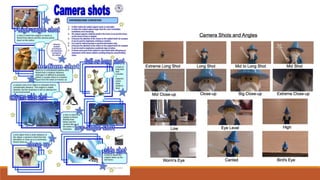
Camera shots and angles

Camera shots and angles

  • 1.
  • 2.
    INTRODUCTION: ANSWER THESEQUESTIONS WITH YOUR OWN WORDS · What is cinema? · What is a movie / film? · What is a frame? · What is the meaning of fps? · What are the 3 most important movies in the history of cinema? Find their most relevant scene and print them. Write the year of the movie.
  • 3.
    CONCEPTS WE’LL WORKON  CAMERA SHOT  CAMERA ANGLE  Why do directors use different camera shots/angles while they film a movie?
  • 4.
    CAMERA SHOT A CAMERASHOT is a series of frames shot with no stop from the moment when the camera starts shooting until it stops.
  • 5.
    CAMERA ANGLE The CAMERAANGLE means where the camera is placed respect to the characters/objects in a scene.
  • 6.
    WHY DO THEDIRECTORS CHANGE SHOTS AND ANGLES? They are used to: • Explain different moments of the story with more/less details • Make more dramatic scenes • Give an emphasis to a specific object or character.
  • 7.
    TYPES OF CAMERASHOT Extreme Long/Wide Shot (XLS/EWS) Long/Wide Shot (LS/WS) Full Shot (FS) Medium Long/Wide Shot (MLS/MWS) Medium Shot (MS) Medium Close Up (MCU) Close Up (CU) Extreme Close Up (ECU)
  • 8.
    TYPES OF CAMERASHOTS TYPE OF SHOT LANDSCAPE/ BACKGROUND CHARACTERS WHAT IS IT USED FOR? XLS extreme long shot LS long shot FS full shot MLS medium long MS medium shot MCU medium close up CU close up ECU extreme close up
  • 9.
    EXTREME LONG/WIDE SHOT(XLS) LANDSCAPE/BACKGROUND CHARACTERS WHAT IS IT USED FOR?
  • 10.
    EXTREME LONG/WIDE SHOT(XLS) LANDSCAPE/BACKGROUND CHARACTERS WHAT IS IT USED FOR? The landscape ocuppies almost all the shot, but we perceive not many details. It shows weather, moment of the day, season… The characters are very small, we just see their outlines, not details. We see their full bodies. We can’t hear their conversation. It’s used to place characters in an environment and to make the character distant or unfamiliar to the viewer. It can be a transitional shot. It can show movement.
  • 11.
    LONG/WIDE SHOT (LS/WS) LANDSCAPE/BACKGROUNDCHARACTERS WHAT IS IT USED FOR?
  • 12.
    LONG/WIDE SHOT (LS/WS) LANDSCAPE/BACKGROUNDCHARACTERS WHAT IS IT USED FOR? The landscape ocuppies a big part of the shot, but we perceive more details: house, trees… The characters are small compared to the environment around. We perceive their complete outline and general details. It’s used to bring the viewer closer to the characters’ daily life or action.
  • 13.
    FULL SHOT (FS) LANDSCAPE/BACKGROUNDCHARACTERS WHAT IS IT USED FOR?
  • 14.
    FULL SHOT (FS) LANDSCAPE/BACKGROUNDCHARACTERS WHAT IS IT USED FOR? The landscape occupies more than half part of the shot. We see more details (doors, materials…) and those details are important for the scene The characters occupy the frame from the feet to the head. We see clothes/hair/tools details It is used to start a scene, to show how many characters participate in it and their body postures
  • 15.
    MEDIUM LONG/WIDE SHOT(MLS/MWS) LANDSCAPE/BACKGROUND CHARACTERS WHAT IS IT USED FOR?
  • 16.
    MEDIUM LONG/WIDE SHOT(MLS/MWS) LANDSCAPE/BACKGROUND CHARACTERS WHAT IS IT USED FOR? The landscape occupies more than half part of the shot. We see more details (doors, materials…) The characters occupy the frame from the knees to the head. We can start to connect to their feelings It’s used to make the viewer pay more attention to the character’s face/hands
  • 17.
    MEDIUM SHOT (MS) LANDSCAPE/BACKGROUNDCHARACTERS WHAT IS IT USED FOR?
  • 18.
    MEDIUM SHOT (MS) LANDSCAPE/BACKGROUNDCHARACTERS WHAT IS IT USED FOR? The landscape occupies half part of the shot. It becomes blurred. The characters occupy the frame from the hips/waist to the head It’s used to make the viewer pay more attention to the character’s face/hands and their interaction or emotions
  • 19.
    MEDIUM CLOSE UP(MCU) LANDSCAPE/BACKGROUND CHARACTERS WHAT IS IT USED FOR?
  • 20.
    MEDIUM CLOSE UP(MCU) LANDSCAPE/BACKGROUND CHARACTERS WHAT IS IT USED FOR? The background occupies half part of the shot. It is blurred. The characters occupy the frame from the chest to the head The scene is focused on the face expression more than in action. It’s often used to show the conversation between two characters
  • 21.
    CLOSE UP (CU) LANDSCAPE/BACKGROUNDCHARACTERS WHAT IS IT USED FOR?
  • 22.
    CLOSE UP (CU) LANDSCAPE/BACKGROUNDCHARACTERS WHAT IS IT USED FOR? The background occupies less than half part of the shot. It is blurred. We just see the head of the characters and it’s usually cut. The scene is totally focused on the face expresion It’s used to make a conversation more dramatic
  • 23.
    EXTREME CLOSE UP(ECU) LANDSCAPE/BACKGROUND CHARACTERS WHAT IS IT USED FOR?
  • 24.
    EXTREME CLOSE UP(ECU) LANDSCAPE/BACKGROUND CHARACTERS WHAT IS IT USED FOR? The background occupies just a little part of the shot. It is blurred or totally disappear We just see a small part of the character/object: a foot, an eye… It shows details of objects or emotions of the characters that are very important to the story
  • 25.
    TYPES OF CAMERAANGLE Eye Level Shot Low Level Shot High Level Shot Ground Level Shot Dutch Angle Bird’s Eye Shot
  • 26.
    TYPES OF CAMERAANGLES TYPE OF ANGLE CAMERA POSITION WHAT IS IT USED FOR? EYE LEVEL LOW LEVEL HIGH LEVEL GROUND LEVEL BIRD’S EYE DUTCH ANGLE
  • 27.
    EYE LEVEL SHOT CAMERAPOSITION WHAT IS IT USED FOR?
  • 28.
    EYE LEVEL SHOT CAMERAPOSITION WHAT IS IT USED FOR? The camera is at the same level of the character’s EYES, so the scene looks natural It’s used to connect the viewer with the character and their facial expressions. It’s not used with a dramatic purpose. It makes the spectator take a part in the scene.
  • 29.
    LOW LEVEL SHOT CAMERAPOSITION WHAT IS IT USED FOR?
  • 30.
    LOW LEVEL SHOT CAMERAPOSITION WHAT IS IT USED FOR? The camera is LOWER than the characters. It seems to be recorded by a child or an object. This angle shows the bodies and backgrounds It’s used to show how powerful or intimidating the characters are at a moment
  • 31.
    HIGH LEVEL SHOT CAMERAPOSITION WHAT IS IT USED FOR?
  • 32.
    HIGH LEVEL SHOT CAMERAPOSITION WHAT IS IT USED FOR? The camera is HIGHER than the characters so we can see their face better than their body. The background takes some importance It’s used to show how weak/fragile the characters are at a moment. There is a threat or intimidation and a facial reaction to that.
  • 33.
    GROUND LEVEL SHOT CAMERAPOSITION WHAT IS IT USED FOR?
  • 34.
    GROUND LEVEL SHOT CAMERAPOSITION WHAT IS IT USED FOR? The camera is on the GROUND It’s usually used to show a character walking, specially if we haven’t seen his/her face yet. It can be used as a short transitional scene where we get to know some details about their routines, outfit… It’s an enthrilling shot.
  • 35.
    BIRD’S EYE SHOT CAMERAPOSITION WHAT IS IT USED FOR?
  • 36.
    BIRD’S EYE SHOT CAMERAPOSITION WHAT IS IT USED FOR? The camera is ABOVE the characters, perpendicular to he ground. Not a natural point of view. It doesn’t allow for much detail about the characters It’s used to show how small characters are or to give an idea of the environment where they are placed. It also can show crowds. It can mark the end of a sequence.
  • 37.
    DUTCH ANGLE SHOT CAMERAPOSITION WHAT IS IT USED FOR?
  • 38.
    DUTCH ANGLE SHOT CAMERAPOSITION WHAT IS IT USED FOR? The camera is inclined respect to the horizontal line (around 25-45 degrees) It’s used to give more tension to a scene. The character doesn’t look at the camera, but to an object or person that shocks them somehow
  • 39.
    QUIZ SAY THE CAMERASHOT AND CAMERA ANGLE USED IN THESES SCENES ELS/EWS LS FS MLS/MWS MS MCU CU ECU CAMERA SHOT EYE LEVEL LOW HIGH BIRD’S EYE GROUND DUTCH CAMERA ANGLE
  • 40.
  • 41.
  • 42.
  • 43.
  • 44.
  • 45.
  • 46.
  • 47.
  • 48.
  • 49.
  • 50.
  • 51.
  • 52.
  • 53.
  • 54.
  • 55.
  • 56.
  • 57.
  • 58.
  • 59.
  • 60.
  • 61.
  • 62.
  • 63.
  • 64.
  • 65.
  • 66.
  • 67.
  • 68.
  • 69.
  • 70.
  • 71.
    NOW DRAW YOUROWN EXAMPLES  Make a easy drawing that can represent the kind of shot/angles we propose  Make easy drawings, they don’t need to be detailed
  • 72.
    DRAWING MY OWNSCENES Long Shot Eye Level Medium Long Shot Low Level Close Up Dutch Angle Full Shot Bird’s Eye