

REFLECTIVE
PRACTICE
WORKSHOP
June 2017
Claire Sewell
Research Support Skills Coordinator
Office of Scholarly Communication
ces43@cam.ac.uk
1
www.osc.cam.ac.uk
Contents page
2
www.osc.cam.ac.uk
Introduction to reflective practice
Definitions of reflective practice
Please take a couple of minutes to write down what reflective practice means
for you. There is no one correct answer as different people will have different
experiences of reflection.
Why should you reflect?
You can practice reflection both within the workplace and out in the wider
world. We all have that little voice inside our heads that reminds us of all the
things that went wrong during a particular experience, whether that be giving
a library tour or having a job interview. You always focus on what you should
have said or what you said wrong. But what about all the things that you did
right? Being a reflective practitioner can help you to focus on everything that
happened and improve for the future.
There are many other reasons why you might want to reflect:
 If you know what worked then you can repeat this in the future
 Gives you areas for improvement/development
 Aid creativity and helps to avoid stagnation
 Helps to overcome assumptions we might make about other people
 Key part of emotional intelligence
 Helps to maintain a healthy work/life balance
Add any other reasons below:
3
www.osc.cam.ac.uk
Everyday reflective practice
Reflection can happen at any time and for any reason. Think about
some of the ways and places that you reflect during a typical day.
NOTE: This doesn’t have to be formal reflection.
e.g. Chatting with a friend over coffee
4
www.osc.cam.ac.uk
Listening exercise
Reflecting in groups can be a really helpful exercise but it’s important
to listen as well as talk. This exercise aims to develop your listening
skills.
In pairs sit back to back. Person A will be talking and Person B will be
drawing. Person A should describe the diagram on the card and
Person B should try to recreate it. You have three minutes and no
questions are allowed. Then swap and repeat so that Person A is
drawing.
5
www.osc.cam.ac.uk
Reflective practice models
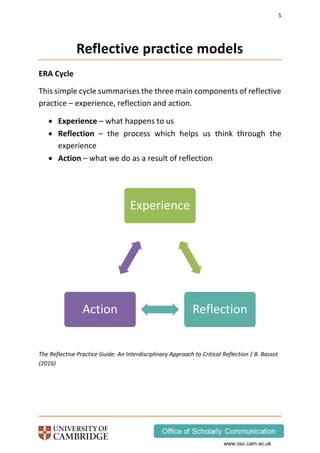
ERA Cycle
This simple cycle summarises the three main components of reflective
practice – experience, reflection and action.
 Experience – what happens to us
 Reflection – the process which helps us think through the
experience
 Action – what we do as a result of reflection
The Reflective Practice Guide: An Interdisciplinary Approach to Critical Reflection / B. Bassot
(2016)
Experience
ReflectionAction
6
www.osc.cam.ac.uk
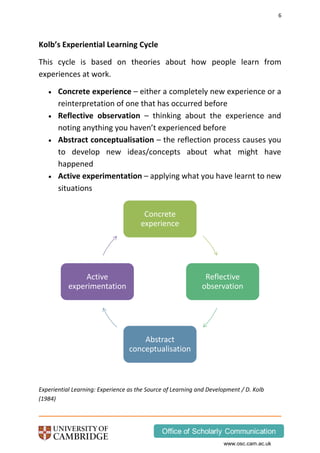
Kolb’s Experiential Learning Cycle
This cycle is based on theories about how people learn from
experiences at work.
 Concrete experience – either a completely new experience or a
reinterpretation of one that has occurred before
 Reflective observation – thinking about the experience and
noting anything you haven’t experienced before
 Abstract conceptualisation – the reflection process causes you
to develop new ideas/concepts about what might have
happened
 Active experimentation – applying what you have learnt to new
situations
Experiential Learning: Experience as the Source of Learning and Development / D. Kolb
(1984)
Concrete
experience
Reflective
observation
Abstract
conceptualisation
Active
experimentation
7
www.osc.cam.ac.uk
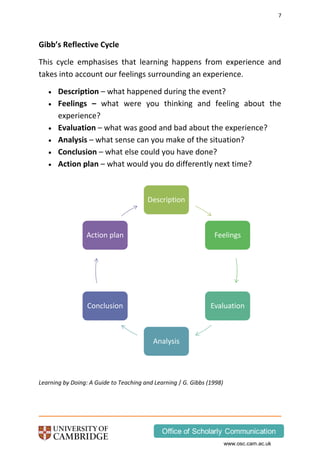
Gibb’s Reflective Cycle
This cycle emphasises that learning happens from experience and
takes into account our feelings surrounding an experience.
 Description – what happened during the event?
 Feelings – what were you thinking and feeling about the
experience?
 Evaluation – what was good and bad about the experience?
 Analysis – what sense can you make of the situation?
 Conclusion – what else could you have done?
 Action plan – what would you do differently next time?
Learning by Doing: A Guide to Teaching and Learning / G. Gibbs (1998)
Description
Feelings
Evaluation
Analysis
Conclusion
Action plan
8
www.osc.cam.ac.uk
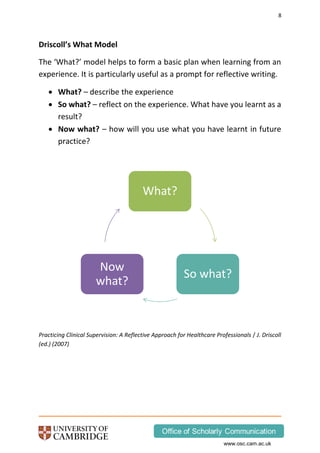
Driscoll’s What Model
The ‘What?’ model helps to form a basic plan when learning from an
experience. It is particularly useful as a prompt for reflective writing.
 What? – describe the experience
 So what? – reflect on the experience. What have you learnt as a
result?
 Now what? – how will you use what you have learnt in future
practice?
Practicing Clinical Supervision: A Reflective Approach for Healthcare Professionals / J. Driscoll
(ed.) (2007)
What?
So what?
Now
what?
9
www.osc.cam.ac.uk
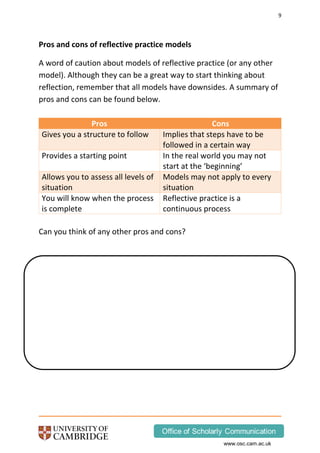
Pros and cons of reflective practice models
A word of caution about models of reflective practice (or any other
model). Although they can be a great way to start thinking about
reflection, remember that all models have downsides. A summary of
pros and cons can be found below.
Pros Cons
Gives you a structure to follow Implies that steps have to be
followed in a certain way
Provides a starting point In the real world you may not
start at the ‘beginning’
Allows you to assess all levels of
situation
Models may not apply to every
situation
You will know when the process
is complete
Reflective practice is a
continuous process
Can you think of any other pros and cons?
10
www.osc.cam.ac.uk
Barriers to reflective practice
There are many reasons why becoming a reflective practitioner is a
positive step but it would be unrealistic to think that it is always
easier. Think about some of the barriers you may face in your
reflection and list them below.
11
www.osc.cam.ac.uk
Reflective writing
What is reflective writing?
Writing reflectively involves critically analysing an experience,
recording how it has impacted you and what you plan to do with
your new knowledge. It can help you reflect on a deeper level as the
act of getting something down on paper helps many people to think
an experience through.
The key to reflective writing is to be analytical not descriptive.
Always ask why rather than describing what happened.
Remember…
Reflective writing is… Reflective writing isn’t…
Written in the first person Written in the third person
Analytical Descriptive
Free flowing What you think you should write
Subjective Objective
Tool to challenge assumptions Tool to ignore assumptions
Time investment Waste of time
The Reflective Practice Guide: an Interdisciplinary Approach / B. Bassot (2016)
Where might you use reflective writing in the workplace?
12
www.osc.cam.ac.uk
Driscoll’s What model
This simple model is useful as a way to get started with reflective
writing. Simply follow the three prompts below:
Practicing Clinical Supervision: A Reflective Approach for Healthcare Professionals / J. Driscoll
(ed.) (2007)
What? - describe the situation: achievements, consequences,
responses, feelings and problems
So what? – discuss what has been learnt: learning about self,
relationships, models, attitudes, thoughts, understanding and
improvements
Now what? – identify what needs to be done in order to improve
future outcomes and develop learning
What?
So what?
Now
what?
13
www.osc.cam.ac.uk
Reflection in action exercise
Try this exercise to get you to think about the What?
model. Get into pairs and choose person one and
person two. Person A needs to think of an activity they
have recently taken part in. Person B will ask the three
what questions: what, so what, now what? Person A should note
their answers below. After two minutes switch places so Person B is
now describing an activity.
14
www.osc.cam.ac.uk
Reflective writing exercises
Exercise 1 – Free writing
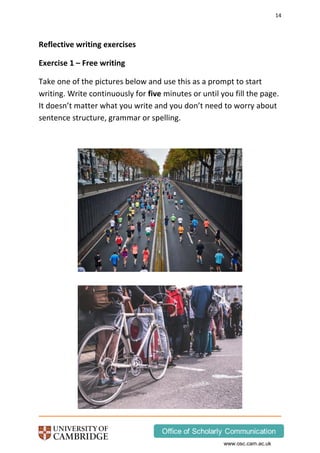
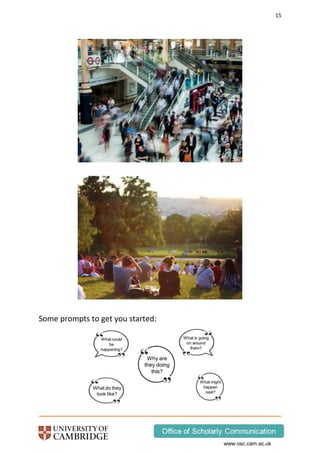
Take one of the pictures below and use this as a prompt to start
writing. Write continuously for five minutes or until you fill the page.
It doesn’t matter what you write and you don’t need to worry about
sentence structure, grammar or spelling.
15
www.osc.cam.ac.uk
Some prompts to get you started:
16
www.osc.cam.ac.uk
Space for free writing:
17
www.osc.cam.ac.uk
Exercise 2 – Writing about an experience
Think about an event or activity that you could learn
from - it doesn’t matter if it went well or if it went
badly. Use the prompts below to write a short
reflective piece on the activity.
Looking back at the activity reflect upon:
 Your expectations before embarking on the activity
 How you approached the activity
 Which parts of the activity you found easy/hard
Think about what you learned as a result of participating in the
activity:
 How did your knowledge and understanding change?
 What would you do differently if faced with a similar situation
in future?
Consider how the learning activity might be tested in the future:
 How might you go about putting into practice what you’ve
learnt?
 What challenges might you encounter?
 How would you go about dealing with such challenges?
It doesn’t matter what you write and you don’t need to worry about
sentence structure, grammar or spelling.
18
www.osc.cam.ac.uk
Space for reflective writing:
19
www.osc.cam.ac.uk
Top tips for reflective practice
Below are some top tips for reflective practice. Feel free to
add any more tips you might want to remind yourself of at
the end.
Time spent on reflection is an investment
Making time to do something as abstract as reflection can
sometimes seem like a waste of time but you need to look at it as
time well spent for the future. Being a reflective practitioner can help
you deal with situations, improve your performance and contribute
to your overall wellbeing.
Reflection doesn’t have to focus on the big things
You can reflect on anything that happens to you whether at work or
outside. Only you can judge how much of an impact an event or
situation has on you so you will be able to devote the appropriate
amount of reflection time. Reflecting on the small things that happen
can be a nice way to ease into being a reflective practitioner.
Choose the method that works for you
Reflective practice is a very personal thing and there is no right or
wrong way to approach it. Whether you keep a written diary or
devote five minutes on your train ride home to thinking about your
day the important thing is that the reflection helps you.
20
www.osc.cam.ac.uk
Mini reflections on the workshop
This section gives you a chance to briefly reflect on the course and
make plans for including reflective practice in your work in the
future. These reflections are for you personally to complete either at
the end of the course or after a little thinking time.
What is the top lesson you will take away from today?
Have you found a method of reflection that you think would work for you?
Will you change anything in your practice as a result of taking this course?
Feel free to note down any other reflections
21
www.osc.cam.ac.uk
Bibliography
Below are some useful resources on being a reflective practitioner.
Bassot, B. (2016). The reflective practice guide: an interdisciplinary
approach. Abingdon: Routledge.
Bolton, G. (2014). Reflective practice: writing and professional
development. London: Sage.
Driscoll, J. (ed.). (2007). Practicing clinical supervision: a reflective
approach for healthcare professionals. Edinburgh: Balliere Tindall.
Gibbs, G. (1998). Learning by doing: a guide to teaching and learning.
Oxford: Further Education Unit.
Illingworth, E. (2012). Thing 5 – Reflective practice [CPD25].
http://cpd23.blogspot.co.uk/2012/05/thing-5-reflective-
practice.html
Kolb, D. (1984). Experiential learning: experience as the source of
learning and development. Upper Saddle River: Prentice Hall.
OpenLearn (2016). Learning to teach: becoming a reflective
practitioner. http://www.open.edu/openlearn/education/learning-
teach-becoming-reflective-practitioner/content-section-0
Ronan, S. (2015). Thing 17: Reflective practice [Rudai 23].
http://rudai23.blogspot.co.uk/2015/09/thing-17-reflective-
practice.html
Stone, D. & Heen, S. (2014). Thanks for the feedback: the science and
art of receiving feedback well. London: Portfolio Penguin.

Reflective Practice Handout

  • 1.
    REFLECTIVE PRACTICE WORKSHOP June 2017 Claire Sewell ResearchSupport Skills Coordinator Office of Scholarly Communication ces43@cam.ac.uk
  • 2.
  • 3.
    2 www.osc.cam.ac.uk Introduction to reflectivepractice Definitions of reflective practice Please take a couple of minutes to write down what reflective practice means for you. There is no one correct answer as different people will have different experiences of reflection. Why should you reflect? You can practice reflection both within the workplace and out in the wider world. We all have that little voice inside our heads that reminds us of all the things that went wrong during a particular experience, whether that be giving a library tour or having a job interview. You always focus on what you should have said or what you said wrong. But what about all the things that you did right? Being a reflective practitioner can help you to focus on everything that happened and improve for the future. There are many other reasons why you might want to reflect:  If you know what worked then you can repeat this in the future  Gives you areas for improvement/development  Aid creativity and helps to avoid stagnation  Helps to overcome assumptions we might make about other people  Key part of emotional intelligence  Helps to maintain a healthy work/life balance Add any other reasons below:
  • 4.
    3 www.osc.cam.ac.uk Everyday reflective practice Reflectioncan happen at any time and for any reason. Think about some of the ways and places that you reflect during a typical day. NOTE: This doesn’t have to be formal reflection. e.g. Chatting with a friend over coffee
  • 5.
    4 www.osc.cam.ac.uk Listening exercise Reflecting ingroups can be a really helpful exercise but it’s important to listen as well as talk. This exercise aims to develop your listening skills. In pairs sit back to back. Person A will be talking and Person B will be drawing. Person A should describe the diagram on the card and Person B should try to recreate it. You have three minutes and no questions are allowed. Then swap and repeat so that Person A is drawing.
  • 6.
    5 www.osc.cam.ac.uk Reflective practice models ERACycle This simple cycle summarises the three main components of reflective practice – experience, reflection and action.  Experience – what happens to us  Reflection – the process which helps us think through the experience  Action – what we do as a result of reflection The Reflective Practice Guide: An Interdisciplinary Approach to Critical Reflection / B. Bassot (2016) Experience ReflectionAction
  • 7.
    6 www.osc.cam.ac.uk Kolb’s Experiential LearningCycle This cycle is based on theories about how people learn from experiences at work.  Concrete experience – either a completely new experience or a reinterpretation of one that has occurred before  Reflective observation – thinking about the experience and noting anything you haven’t experienced before  Abstract conceptualisation – the reflection process causes you to develop new ideas/concepts about what might have happened  Active experimentation – applying what you have learnt to new situations Experiential Learning: Experience as the Source of Learning and Development / D. Kolb (1984) Concrete experience Reflective observation Abstract conceptualisation Active experimentation
  • 8.
    7 www.osc.cam.ac.uk Gibb’s Reflective Cycle Thiscycle emphasises that learning happens from experience and takes into account our feelings surrounding an experience.  Description – what happened during the event?  Feelings – what were you thinking and feeling about the experience?  Evaluation – what was good and bad about the experience?  Analysis – what sense can you make of the situation?  Conclusion – what else could you have done?  Action plan – what would you do differently next time? Learning by Doing: A Guide to Teaching and Learning / G. Gibbs (1998) Description Feelings Evaluation Analysis Conclusion Action plan
  • 9.
    8 www.osc.cam.ac.uk Driscoll’s What Model The‘What?’ model helps to form a basic plan when learning from an experience. It is particularly useful as a prompt for reflective writing.  What? – describe the experience  So what? – reflect on the experience. What have you learnt as a result?  Now what? – how will you use what you have learnt in future practice? Practicing Clinical Supervision: A Reflective Approach for Healthcare Professionals / J. Driscoll (ed.) (2007) What? So what? Now what?
  • 10.
    9 www.osc.cam.ac.uk Pros and consof reflective practice models A word of caution about models of reflective practice (or any other model). Although they can be a great way to start thinking about reflection, remember that all models have downsides. A summary of pros and cons can be found below. Pros Cons Gives you a structure to follow Implies that steps have to be followed in a certain way Provides a starting point In the real world you may not start at the ‘beginning’ Allows you to assess all levels of situation Models may not apply to every situation You will know when the process is complete Reflective practice is a continuous process Can you think of any other pros and cons?
  • 11.
    10 www.osc.cam.ac.uk Barriers to reflectivepractice There are many reasons why becoming a reflective practitioner is a positive step but it would be unrealistic to think that it is always easier. Think about some of the barriers you may face in your reflection and list them below.
  • 12.
    11 www.osc.cam.ac.uk Reflective writing What isreflective writing? Writing reflectively involves critically analysing an experience, recording how it has impacted you and what you plan to do with your new knowledge. It can help you reflect on a deeper level as the act of getting something down on paper helps many people to think an experience through. The key to reflective writing is to be analytical not descriptive. Always ask why rather than describing what happened. Remember… Reflective writing is… Reflective writing isn’t… Written in the first person Written in the third person Analytical Descriptive Free flowing What you think you should write Subjective Objective Tool to challenge assumptions Tool to ignore assumptions Time investment Waste of time The Reflective Practice Guide: an Interdisciplinary Approach / B. Bassot (2016) Where might you use reflective writing in the workplace?
  • 13.
    12 www.osc.cam.ac.uk Driscoll’s What model Thissimple model is useful as a way to get started with reflective writing. Simply follow the three prompts below: Practicing Clinical Supervision: A Reflective Approach for Healthcare Professionals / J. Driscoll (ed.) (2007) What? - describe the situation: achievements, consequences, responses, feelings and problems So what? – discuss what has been learnt: learning about self, relationships, models, attitudes, thoughts, understanding and improvements Now what? – identify what needs to be done in order to improve future outcomes and develop learning What? So what? Now what?
  • 14.
    13 www.osc.cam.ac.uk Reflection in actionexercise Try this exercise to get you to think about the What? model. Get into pairs and choose person one and person two. Person A needs to think of an activity they have recently taken part in. Person B will ask the three what questions: what, so what, now what? Person A should note their answers below. After two minutes switch places so Person B is now describing an activity.
  • 15.
    14 www.osc.cam.ac.uk Reflective writing exercises Exercise1 – Free writing Take one of the pictures below and use this as a prompt to start writing. Write continuously for five minutes or until you fill the page. It doesn’t matter what you write and you don’t need to worry about sentence structure, grammar or spelling.
  • 16.
  • 17.
  • 18.
    17 www.osc.cam.ac.uk Exercise 2 –Writing about an experience Think about an event or activity that you could learn from - it doesn’t matter if it went well or if it went badly. Use the prompts below to write a short reflective piece on the activity. Looking back at the activity reflect upon:  Your expectations before embarking on the activity  How you approached the activity  Which parts of the activity you found easy/hard Think about what you learned as a result of participating in the activity:  How did your knowledge and understanding change?  What would you do differently if faced with a similar situation in future? Consider how the learning activity might be tested in the future:  How might you go about putting into practice what you’ve learnt?  What challenges might you encounter?  How would you go about dealing with such challenges? It doesn’t matter what you write and you don’t need to worry about sentence structure, grammar or spelling.
  • 19.
  • 20.
    19 www.osc.cam.ac.uk Top tips forreflective practice Below are some top tips for reflective practice. Feel free to add any more tips you might want to remind yourself of at the end. Time spent on reflection is an investment Making time to do something as abstract as reflection can sometimes seem like a waste of time but you need to look at it as time well spent for the future. Being a reflective practitioner can help you deal with situations, improve your performance and contribute to your overall wellbeing. Reflection doesn’t have to focus on the big things You can reflect on anything that happens to you whether at work or outside. Only you can judge how much of an impact an event or situation has on you so you will be able to devote the appropriate amount of reflection time. Reflecting on the small things that happen can be a nice way to ease into being a reflective practitioner. Choose the method that works for you Reflective practice is a very personal thing and there is no right or wrong way to approach it. Whether you keep a written diary or devote five minutes on your train ride home to thinking about your day the important thing is that the reflection helps you.
  • 21.
    20 www.osc.cam.ac.uk Mini reflections onthe workshop This section gives you a chance to briefly reflect on the course and make plans for including reflective practice in your work in the future. These reflections are for you personally to complete either at the end of the course or after a little thinking time. What is the top lesson you will take away from today? Have you found a method of reflection that you think would work for you? Will you change anything in your practice as a result of taking this course? Feel free to note down any other reflections
  • 22.
    21 www.osc.cam.ac.uk Bibliography Below are someuseful resources on being a reflective practitioner. Bassot, B. (2016). The reflective practice guide: an interdisciplinary approach. Abingdon: Routledge. Bolton, G. (2014). Reflective practice: writing and professional development. London: Sage. Driscoll, J. (ed.). (2007). Practicing clinical supervision: a reflective approach for healthcare professionals. Edinburgh: Balliere Tindall. Gibbs, G. (1998). Learning by doing: a guide to teaching and learning. Oxford: Further Education Unit. Illingworth, E. (2012). Thing 5 – Reflective practice [CPD25]. http://cpd23.blogspot.co.uk/2012/05/thing-5-reflective- practice.html Kolb, D. (1984). Experiential learning: experience as the source of learning and development. Upper Saddle River: Prentice Hall. OpenLearn (2016). Learning to teach: becoming a reflective practitioner. http://www.open.edu/openlearn/education/learning- teach-becoming-reflective-practitioner/content-section-0 Ronan, S. (2015). Thing 17: Reflective practice [Rudai 23]. http://rudai23.blogspot.co.uk/2015/09/thing-17-reflective- practice.html Stone, D. & Heen, S. (2014). Thanks for the feedback: the science and art of receiving feedback well. London: Portfolio Penguin.