

Cultivating Reflection
University of the Western Cape
October 2013
Melanie Alperstein
M Phil (Ad Ed) P G Dip (PHC Ed) B Soc Sc (Nursing)
Education Development Unit, Health Sciences Faculty, University of Cape Town, South Africa
Veronica Mitchell
M Phil (HES) B Sc (Physio)
Today’s pathway
Introduction
Free writing for 3 mins
Video clip
Theoretical concepts
Melanie Alperstein
Veronica Mitchell
Sharing experiences
Different contexts
Challenges
Insights
is to encourage
the development of
a habit of processing cognitive material
that can lead the student to
ideas that are beyond the curriculum,
beyond learning defined by learning outcomes,
and beyond those of the teacher
who is managing the learning.
Moon, J., 2001. PDP Working Paper 4
Reflection in Higher Education Learning
http://www.york.ac.uk/admin/hr/researcher-development/students/resources/pgwt/reflectivepractice.pdf
“
Our objective as educators:
Free writing
Video clip
YouTube video on reflective writing
http://www.youtube.com/watch?v=0plCU9oyZlM
Introduction to reflective journaling
Melanie Alperstein
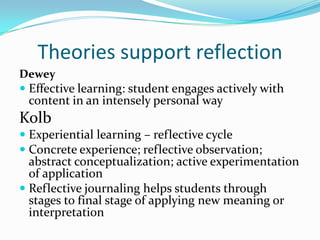
Theories support reflection
Dewey
 Effective learning: student engages actively with
content in an intensely personal way
Kolb
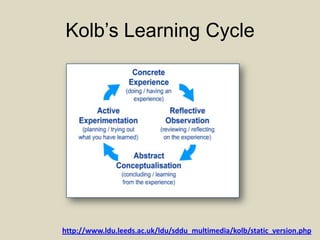
 Experiential learning – reflective cycle
 Concrete experience; reflective observation;
abstract conceptualization; active experimentation
of application
 Reflective journaling helps students through
stages to final stage of applying new meaning or
interpretation
3 concepts
 Journals
 Portfolios
 Reflection
 reflective practice
 reflective writing
Reflection
Why reflect?
What exactly is reflection?
“An important human activity in which people recapture
their experience, think about it, mull over it and
evaluate it” (Boud et al, 1995)
 Reflective journaling helps adult learners toward
higher levels of critical thinking and personal insight.
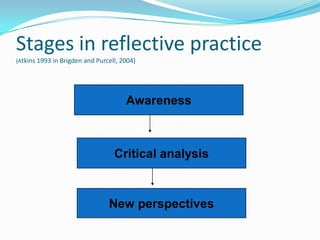
Stages in reflective practice
(Atkins 1993 in Brigden and Purcell, 2004)
Awareness
Critical analysis
New perspectives
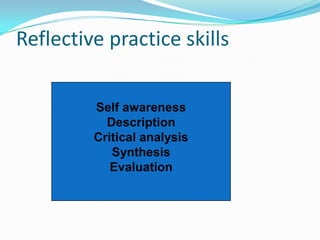
Reflective practice skills
Self awareness
Description
Critical analysis
Synthesis
Evaluation
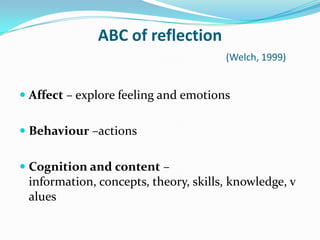
ABC of reflection
(Welch, 1999)
 Affect – explore feeling and emotions
 Behaviour –actions
 Cognition and content –
information, concepts, theory, skills, knowledge, v
alues
CC:BY: Highways Agency
http://www.flickr.com/photos/highwaysagency/6194928490/sizes/m/in/photolist-arqCpU-9rHqvz-8RTDrv-9RRoEj-39UXyD-7mw8Ht-73JeRH-73NdZ1-73NcS1-73NcM3-73NdCC-73JfpX-73NdJN-73JfLT-73NcXA-73Jgjv-
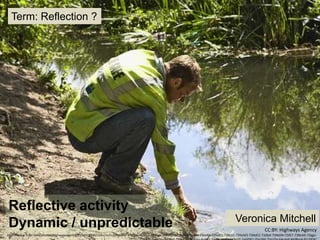
Reflective activity
Dynamic / unpredictable
Term: Reflection ?
Veronica Mitchell
Multiple forces, interpretations & resistance
Exploring beyond the surface
Reflection is the process we use when
working with material that is presented in
an unstructured manner – not organised
and purified as in a traditional curriculum.
Moon, J., 2001. PDP Working Paper 4
Reflection in Higher Education Learning
http://www.york.ac.uk/admin/hr/researcher-development/students/resources/pgwt/reflectivepractice.pdf
“
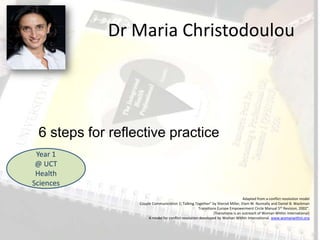
Dr Maria Christodoulou
Adapted from a conflict resolution model
Couple Communication 1: Talking Together” by Sherod Miller, Elam W. Nunnally and Daniel B. Wackman
Transitions Europe Empowerment Circle Manual 5th Revision, 2002”.
(Transitions is an outreach of Woman Within International)
A model for conflict resolution developed by Woman Within lnternational. www.womanwithin.orq
6 steps for reflective practice
Year 1
@ UCT
Health
Sciences
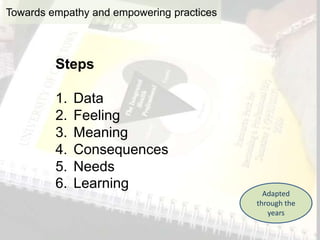
Towards empathy and empowering practices
Steps
1. Data
2. Feeling
3. Meaning
4. Consequences
5. Needs
6. Learning
Adapted
through the
years
Kolb’s Learning Cycle
http://www.ldu.leeds.ac.uk/ldu/sddu_multimedia/kolb/static_version.php
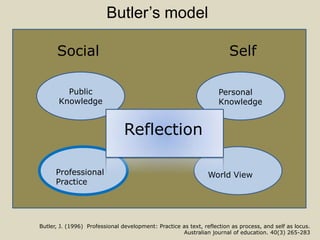
Butler’s model
Social Self
Public
Knowledge
Reflection
Professional
Practice
Personal
Knowledge
World View
Butler, J. (1996) Professional development: Practice as text, reflection as process, and self as locus.
Australian journal of education. 40(3) 265-283
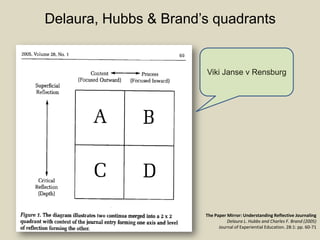
The Paper Mirror: Understanding Reflective Journaling
Delaura L. Hubbs and Charles F. Brand (2005)
Journal of Experiential Education. 28:1: pp. 60-71
Viki Janse v Rensburg
Delaura, Hubbs & Brand’s quadrants
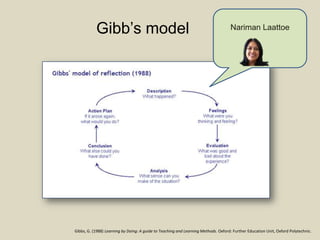
Gibbs, G. (1988) Learning by Doing: A guide to Teaching and Learning Methods. Oxford: Further Education Unit, Oxford Polytechnic.
Gibb’s model Nariman Laattoe
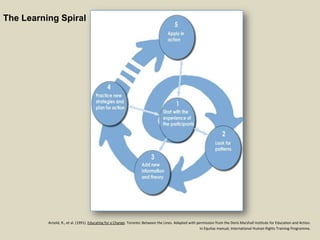
Arnold, R., et al. (1991). Educating for a Change. Toronto: Between the Lines. Adapted with permission from the Doris Marshall Institute for Education and Action.
In Equitas manual, International Human Rights Training Programme.
The Learning Spiral
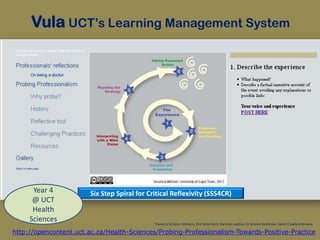
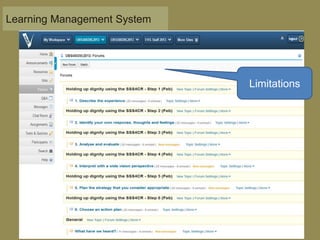
Vula UCT’s Learning Management System
http://opencontent.uct.ac.za/Health-Sciences/Probing-Professionalism-Towards-Positive-Practice
Six Step Spiral for Critical Reflexivity (SSS4CR)
Thanks to Dr Kevin Williams, Prof Athol Kent, Nariman Laattoe, Dr Simone Honikman, Sarah Crawford-Browne
Year 4
@ UCT
Health
Sciences
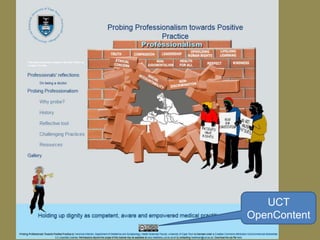
UCT
OpenContent
Learning Management System
Limitations
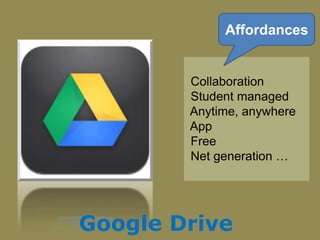
Google Drive
Collaboration
Student managed
Anytime, anywhere
App
Free
Net generation …
Affordances
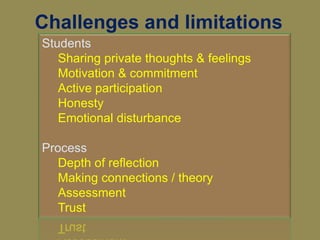
Challenges and limitations
Students
Sharing private thoughts & feelings
Motivation & commitment
Active participation
Honesty
Emotional disturbance
Process
Depth of reflection
Making connections / theory
Assessment
Trust
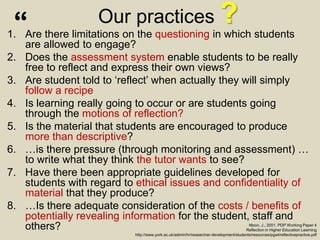
Our practices ?1. Are there limitations on the questioning in which students
are allowed to engage?
2. Does the assessment system enable students to be really
free to reflect and express their own views?
3. Are student told to ‘reflect’ when actually they will simply
follow a recipe
4. Is learning really going to occur or are students going
through the motions of reflection?
5. Is the material that students are encouraged to produce
more than descriptive?
6. …is there pressure (through monitoring and assessment) …
to write what they think the tutor wants to see?
7. Have there been appropriate guidelines developed for
students with regard to ethical issues and confidentiality of
material that they produce?
8. …Is there adequate consideration of the costs / benefits of
potentially revealing information for the student, staff and
others? Moon, J., 2001. PDP Working Paper 4
Reflection in Higher Education Learning
http://www.york.ac.uk/admin/hr/researcher-development/students/resources/pgwt/reflectivepractice.pdf
“
Thank you

Cultivating Reflection

  • 1.
    Cultivating Reflection University ofthe Western Cape October 2013 Melanie Alperstein M Phil (Ad Ed) P G Dip (PHC Ed) B Soc Sc (Nursing) Education Development Unit, Health Sciences Faculty, University of Cape Town, South Africa Veronica Mitchell M Phil (HES) B Sc (Physio)
  • 2.
  • 3.
    Introduction Free writing for3 mins Video clip Theoretical concepts Melanie Alperstein Veronica Mitchell Sharing experiences Different contexts Challenges Insights
  • 4.
    is to encourage thedevelopment of a habit of processing cognitive material that can lead the student to ideas that are beyond the curriculum, beyond learning defined by learning outcomes, and beyond those of the teacher who is managing the learning. Moon, J., 2001. PDP Working Paper 4 Reflection in Higher Education Learning http://www.york.ac.uk/admin/hr/researcher-development/students/resources/pgwt/reflectivepractice.pdf “ Our objective as educators:
  • 5.
    Free writing Video clip YouTubevideo on reflective writing http://www.youtube.com/watch?v=0plCU9oyZlM
  • 6.
    Introduction to reflectivejournaling Melanie Alperstein
  • 7.
    Theories support reflection Dewey Effective learning: student engages actively with content in an intensely personal way Kolb  Experiential learning – reflective cycle  Concrete experience; reflective observation; abstract conceptualization; active experimentation of application  Reflective journaling helps students through stages to final stage of applying new meaning or interpretation
  • 8.
    3 concepts  Journals Portfolios  Reflection  reflective practice  reflective writing
  • 9.
    Reflection Why reflect? What exactlyis reflection? “An important human activity in which people recapture their experience, think about it, mull over it and evaluate it” (Boud et al, 1995)  Reflective journaling helps adult learners toward higher levels of critical thinking and personal insight.
  • 10.
    Stages in reflectivepractice (Atkins 1993 in Brigden and Purcell, 2004) Awareness Critical analysis New perspectives
  • 11.
    Reflective practice skills Selfawareness Description Critical analysis Synthesis Evaluation
  • 12.
    ABC of reflection (Welch,1999)  Affect – explore feeling and emotions  Behaviour –actions  Cognition and content – information, concepts, theory, skills, knowledge, v alues
  • 13.
  • 14.
  • 15.
  • 16.
    Reflection is theprocess we use when working with material that is presented in an unstructured manner – not organised and purified as in a traditional curriculum. Moon, J., 2001. PDP Working Paper 4 Reflection in Higher Education Learning http://www.york.ac.uk/admin/hr/researcher-development/students/resources/pgwt/reflectivepractice.pdf “
  • 17.
    Dr Maria Christodoulou Adaptedfrom a conflict resolution model Couple Communication 1: Talking Together” by Sherod Miller, Elam W. Nunnally and Daniel B. Wackman Transitions Europe Empowerment Circle Manual 5th Revision, 2002”. (Transitions is an outreach of Woman Within International) A model for conflict resolution developed by Woman Within lnternational. www.womanwithin.orq 6 steps for reflective practice Year 1 @ UCT Health Sciences
  • 18.
    Towards empathy andempowering practices Steps 1. Data 2. Feeling 3. Meaning 4. Consequences 5. Needs 6. Learning Adapted through the years
  • 19.
  • 20.
    Butler’s model Social Self Public Knowledge Reflection Professional Practice Personal Knowledge WorldView Butler, J. (1996) Professional development: Practice as text, reflection as process, and self as locus. Australian journal of education. 40(3) 265-283
  • 21.
    The Paper Mirror:Understanding Reflective Journaling Delaura L. Hubbs and Charles F. Brand (2005) Journal of Experiential Education. 28:1: pp. 60-71 Viki Janse v Rensburg Delaura, Hubbs & Brand’s quadrants
  • 22.
    Gibbs, G. (1988)Learning by Doing: A guide to Teaching and Learning Methods. Oxford: Further Education Unit, Oxford Polytechnic. Gibb’s model Nariman Laattoe
  • 23.
    Arnold, R., etal. (1991). Educating for a Change. Toronto: Between the Lines. Adapted with permission from the Doris Marshall Institute for Education and Action. In Equitas manual, International Human Rights Training Programme. The Learning Spiral
  • 24.
    Vula UCT’s LearningManagement System http://opencontent.uct.ac.za/Health-Sciences/Probing-Professionalism-Towards-Positive-Practice Six Step Spiral for Critical Reflexivity (SSS4CR) Thanks to Dr Kevin Williams, Prof Athol Kent, Nariman Laattoe, Dr Simone Honikman, Sarah Crawford-Browne Year 4 @ UCT Health Sciences
  • 25.
  • 26.
  • 27.
    Google Drive Collaboration Student managed Anytime,anywhere App Free Net generation … Affordances
  • 28.
    Challenges and limitations Students Sharingprivate thoughts & feelings Motivation & commitment Active participation Honesty Emotional disturbance Process Depth of reflection Making connections / theory Assessment Trust
  • 29.
    Our practices ?1.Are there limitations on the questioning in which students are allowed to engage? 2. Does the assessment system enable students to be really free to reflect and express their own views? 3. Are student told to ‘reflect’ when actually they will simply follow a recipe 4. Is learning really going to occur or are students going through the motions of reflection? 5. Is the material that students are encouraged to produce more than descriptive? 6. …is there pressure (through monitoring and assessment) … to write what they think the tutor wants to see? 7. Have there been appropriate guidelines developed for students with regard to ethical issues and confidentiality of material that they produce? 8. …Is there adequate consideration of the costs / benefits of potentially revealing information for the student, staff and others? Moon, J., 2001. PDP Working Paper 4 Reflection in Higher Education Learning http://www.york.ac.uk/admin/hr/researcher-development/students/resources/pgwt/reflectivepractice.pdf “
  • 30.

Editor's Notes

  • #5 Our aim
  • #6 Our aim
  • #14 Beyond mirrors and still water and reflective gear
  • #19 The data – what happenedMy feelings in response to the teaching experience – the affective dimensionThe meaning related to the theory & my interpretationThe impact on the students and my learningMy needs for the future – changes I can makeMy learning about myself from the experience
  • #20 Dynamic flow
  • #25 Spiral spring with strength and resilience, momentum
  • #30 To reflect back on our discussion, question our practices