ASSIGNMENT 
TOPIC: CONCEPT OF REFLECTIVE PRACTICES 
SUBMITTED TO SUBMITTED BY 
Fathimi Teacher Fousiya .R 
(Lecturer in Mathamatics) Optional : Mathamatics
INTRODUCTION: 
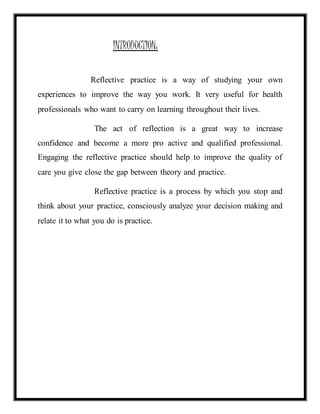
Reflective practice is a way of studying your own 
experiences to improve the way you work. It very useful for health 
professionals who want to carry on learning throughout their lives. 
The act of reflection is a great way to increase 
confidence and become a more pro active and qualified professional. 
Engaging the reflective practice should help to improve the quality of 
care you give close the gap between theory and practice. 
Reflective practice is a process by which you stop and 
think about your practice, consciously analyze your decision making and 
relate it to what you do is practice.
CONCEPT OF REFLECTIVE PRACTICE 
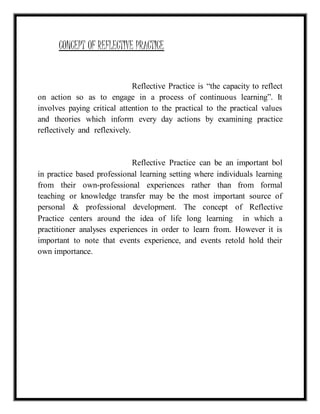
Reflective Practice is “the capacity to reflect 
on action so as to engage in a process of continuous learning”. It 
involves paying critical attention to the practical to the practical values 
and theories which inform every day actions by examining practice 
reflectively and reflexively. 
Reflective Practice can be an important bol 
in practice based professional learning setting where individuals learning 
from their own-professional experiences rather than from formal 
teaching or knowledge transfer may be the most important source of 
personal & professional development. The concept of Reflective 
Practice centers around the idea of life long learning in which a 
practitioner analyses experiences in order to learn from. However it is 
important to note that events experience, and events retold hold their 
own importance.
Reflective Practice also works at an 
organizational level and can help facilitate insight that might otherwise 
be missed. Progress to some group per review, when you feel confident 
to close. Sharing our reflections with others is an courage as ; 
 You share your experiences and learning with others. So they can 
from you. 
 Another’s thoughts about your experience can help you to draw 
out more from the experience. 
 Another point of view takes away some of the subjectivity of 
reflective practice. 
The primary benefit of reflective 
practice for teachers is a deeper understanding of their on teaching style 
and ultimately, greater effectiveness as a teacher. Other specific benefit 
noted in current literature include the validation of a teachers ideal, 
beneficial challenges to tradition, the recognition of teaching as artistry, 
and respect for diversity in applying they to classroom practice.
Suggetced ways for professionals to practice reflective 
management include: 
1) Coaching 
2) Keeping a journal 
3) Seeking feedback 
4) View experiences objectively & 
5) Taking time at the end of each day meeting, 
experience etc to reflect on actions 
6) Group discussions 
When experiencing something (reflection-in-action) we are 
learning, however it can be difficult to put emotions, events and 
thoughts into a coherent sequence of events. 
Reflective practice is used to promote independent professionals 
who are continuously engaged in the reflection of situations they 
encounter in their professional worlds.
HISTORY AND BACKGROUND 
Reflective practice was introduced by Donald Sehon in his book 
The Reflective practitioner in 1983. However the concepts underlying 
reflective practice are much older underlying reflective practice are 
much older. 
Daries (2012) identifies that there are benefits as well as 
limitations to reflective practices. 
BENEFITS TO REFELECTIVE PRACTICES: 
1. Increased hearing from an experience for situation 
2. Promotion of deep learning 
3. Identification of personal and professional strengths and areas for 
improvement. 
4. Identification of educational needs. 
5. Acquisition of new knowledge & skills. 
6. Further understanding of own benefits, attitudes and values. 
7. Could act as a source of feedback. 
8. Encouragement of self motivation & self-directed learning.
LIMITATIONS: 
1. Not all practitioners may understand the reflective process. 
2. May full in comfortable challenging & evaluating own practice. 
3. Could be time consuming. 
4. May have confusion as to which situations/ experiences to reflect 
upon. 
IN EDUCATION 
In education, Reflective practice refers to the 
process of the education studying his or her teaching methods and 
determining what works best for the students. It involves the 
consideration of the ethical consequences of classroom procedures on 
students. 
The appeal of the use of Reflective practice for 
teachers is that as teaching and learning are complex and there is not 
one right approach, reflecting on different versions of teaching and 
are shaping past, current experience will lead to improvement in 
teaching practices.
CONCLUSION 
Reflective practice can be a beneficial form of professional 
development at both the pre-service and in service levels of 
teaching. By gaining a better understanding of their own individual 
teaching styles through Reflective practices, teachers can improve 
their effectiveness in the classroom. 
REFERENCES 
www.wikipedia.com

Assignment

  • 1.
    ASSIGNMENT TOPIC: CONCEPTOF REFLECTIVE PRACTICES SUBMITTED TO SUBMITTED BY Fathimi Teacher Fousiya .R (Lecturer in Mathamatics) Optional : Mathamatics
  • 2.
    INTRODUCTION: Reflective practiceis a way of studying your own experiences to improve the way you work. It very useful for health professionals who want to carry on learning throughout their lives. The act of reflection is a great way to increase confidence and become a more pro active and qualified professional. Engaging the reflective practice should help to improve the quality of care you give close the gap between theory and practice. Reflective practice is a process by which you stop and think about your practice, consciously analyze your decision making and relate it to what you do is practice.
  • 3.
    CONCEPT OF REFLECTIVEPRACTICE Reflective Practice is “the capacity to reflect on action so as to engage in a process of continuous learning”. It involves paying critical attention to the practical to the practical values and theories which inform every day actions by examining practice reflectively and reflexively. Reflective Practice can be an important bol in practice based professional learning setting where individuals learning from their own-professional experiences rather than from formal teaching or knowledge transfer may be the most important source of personal & professional development. The concept of Reflective Practice centers around the idea of life long learning in which a practitioner analyses experiences in order to learn from. However it is important to note that events experience, and events retold hold their own importance.
  • 4.
    Reflective Practice alsoworks at an organizational level and can help facilitate insight that might otherwise be missed. Progress to some group per review, when you feel confident to close. Sharing our reflections with others is an courage as ;  You share your experiences and learning with others. So they can from you.  Another’s thoughts about your experience can help you to draw out more from the experience.  Another point of view takes away some of the subjectivity of reflective practice. The primary benefit of reflective practice for teachers is a deeper understanding of their on teaching style and ultimately, greater effectiveness as a teacher. Other specific benefit noted in current literature include the validation of a teachers ideal, beneficial challenges to tradition, the recognition of teaching as artistry, and respect for diversity in applying they to classroom practice.
  • 5.
    Suggetced ways forprofessionals to practice reflective management include: 1) Coaching 2) Keeping a journal 3) Seeking feedback 4) View experiences objectively & 5) Taking time at the end of each day meeting, experience etc to reflect on actions 6) Group discussions When experiencing something (reflection-in-action) we are learning, however it can be difficult to put emotions, events and thoughts into a coherent sequence of events. Reflective practice is used to promote independent professionals who are continuously engaged in the reflection of situations they encounter in their professional worlds.
  • 6.
    HISTORY AND BACKGROUND Reflective practice was introduced by Donald Sehon in his book The Reflective practitioner in 1983. However the concepts underlying reflective practice are much older underlying reflective practice are much older. Daries (2012) identifies that there are benefits as well as limitations to reflective practices. BENEFITS TO REFELECTIVE PRACTICES: 1. Increased hearing from an experience for situation 2. Promotion of deep learning 3. Identification of personal and professional strengths and areas for improvement. 4. Identification of educational needs. 5. Acquisition of new knowledge & skills. 6. Further understanding of own benefits, attitudes and values. 7. Could act as a source of feedback. 8. Encouragement of self motivation & self-directed learning.
  • 7.
    LIMITATIONS: 1. Notall practitioners may understand the reflective process. 2. May full in comfortable challenging & evaluating own practice. 3. Could be time consuming. 4. May have confusion as to which situations/ experiences to reflect upon. IN EDUCATION In education, Reflective practice refers to the process of the education studying his or her teaching methods and determining what works best for the students. It involves the consideration of the ethical consequences of classroom procedures on students. The appeal of the use of Reflective practice for teachers is that as teaching and learning are complex and there is not one right approach, reflecting on different versions of teaching and are shaping past, current experience will lead to improvement in teaching practices.
  • 8.
    CONCLUSION Reflective practicecan be a beneficial form of professional development at both the pre-service and in service levels of teaching. By gaining a better understanding of their own individual teaching styles through Reflective practices, teachers can improve their effectiveness in the classroom. REFERENCES www.wikipedia.com