Reflective
Writing
Nicki Forgham-Healey, Professional Registration Support Officer
Cynthia R Banfield Professional Registration Support Officer Ireland.
February 2022
(Adapted from a workshop presentation developed at Teesside
University) and from CILIP Ireland.
Before the session starts
Open the Chat facility to ask any
questions – tell us which professional
registration you are on
Be polite and listen to others,
Do turn on your camera, as we are not
recording
Remember no question is too silly
Learning outcomes
• What reflection is and why it is
valuable
• Introduce some models of reflection
• How to write in a reflective style
• Time to practice reflective writing
This
session
will
cover:
What are your concerns when you are
asked to write reflectively?
Write any comments in chat.
One
definition
of
reflection
“Reflection is a form of mental processing –
like a form of thinking – that we may use to
fulfil a purpose or to achieve some
anticipated outcome or we may simply ‘be
reflective’ and then an outcome can be
expected. Reflection is applied to relatively
complicated, ill-structured ideas for which
there is not an obvious solution and is
largely based on the further processing of
knowledge and understanding” (Moon,
2004, p.82)
Key
aspects
of
reflective
thinking
It is about a way of thinking and learning
from that thinking (Focused)
Involves a set of actions / practices
(Purposeful)
Asking questions – lots of questions!
Links thinking, practice (or action) and
learning (based on Experience)
Why reflection is valuable
• Improvement in practice – deeper learning
• Facilitate a change / improvement in practice
Specific goals:
• Review a process critically - stand back – explore ideas
• Build explanation from our own experiences and observations – and
relate to theory
• Personal / professional development
• Personal responsibility and ethical practice
• Make a decision / resolve uncertainty
Personal
qualities for
reflection
• Needs:
• Openness to different ideas / angles
(Mindfulness)
• Curiosity (asking questions)
• Patience (if the question is complex then the
answer is probably going to be as well)
• Honesty (acknowledge uncertainties / what
went badly as well as what went well.
• Personal responsibility / Integrity
• Rigour (analytical / insightful)
• Time and Space (need to start early)
Models of
reflective
thinking
• Kolb (1984) – developed a cycle of experiential
learning. This formed the basis of many strategies
or models that followed.
• Most follow a basic cycle of :
• You have an experience
• You reflect on it to learn from the experience
• You form a plan of what you will do as a result
of any new perspectives
Cycle of reflective thinking
WHAT?
An
experience
SO
WHAT?
Reflective
processes
NOW
WHAT?
Action
Borton, 1970
cited in Rolfe,
Jasper and
Freshwater, 2011
Cycles of reflective learning (Jasper, 2013, p. 4)
Gibbs Reflective Cycle
Description
What happened?
Feelings
What were you thinking and feeling?
Evaluation
What was good and bad about the
situation?
Analysis
What sense can you make of the
situation?
Conclusion
What else could you have done?
Action Plan
If it arose again, what would you do?
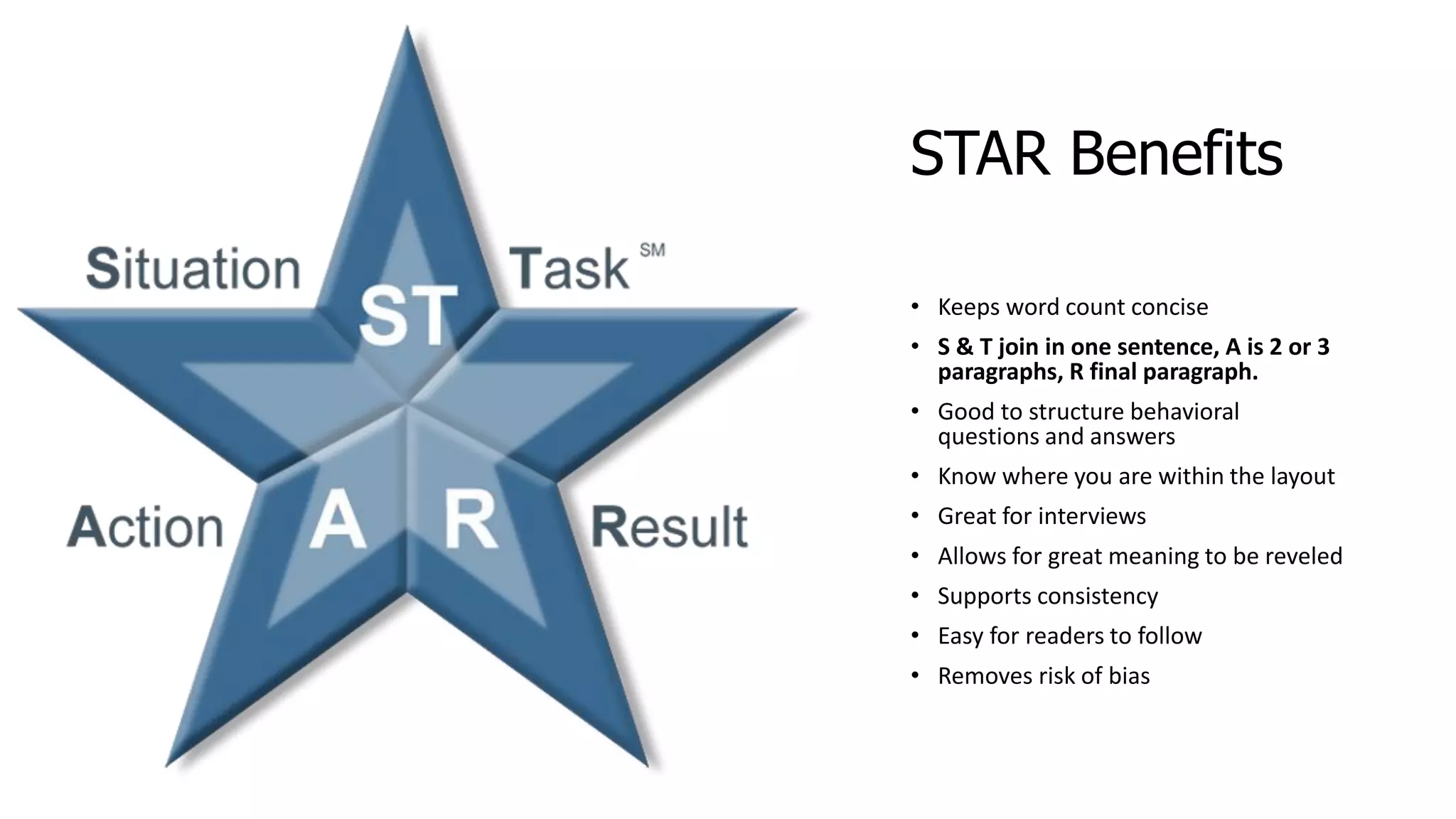
STAR Benefits
• Keeps word count concise
• S & T join in one sentence, A is 2 or 3
paragraphs, R final paragraph.
• Good to structure behavioral
questions and answers
• Know where you are within the layout
• Great for interviews
• Allows for great meaning to be reveled
• Supports consistency
• Easy for readers to follow
• Removes risk of bias
The Librarian's way!
• STARCH EASY.
• S Situation E Easy or Exciting
• T Task or Timetable A Accountable/
• A Action Auditable
• R Results or outcomes S Self Descriptive
• C Consistency Y Yawn
• H Honesty
Example of STAR
• Changing and Improving
• S & T Red
• A Black
• R Blue
s a self-motivated professional individual, who enjoys a challenge and has an eye for detail, I respond quickly and positively
to change and continually embrace it as an opportunity to learn, develop, and apply new skills, ideas and technologies.
• I continually focused on and am constantly evaluating the efficiency and effectiveness of my own work and the services
provided by ALIS and the impact that this has on clients and users. I used my experience within my Postgraduate studies
to benchmark against other library sectors best practices and shared this information with management and work
colleagues. To help me ensure I provide a service that is current, flexible and supportive within a user-friendly
environment. I have defined, suggested and developed potential improvements that my library could make through
digitalization, physical library, social space increases and partnerships.
• I have suggested to line management new information literacy programs and moderation techniques as incorporated by
other library sectors in the usage of text messages as first overdue notices and pro-actively carried out samples to
determine benefits of usage. The results being a 98% return that day and a 2% by the next day.
• 190 words used.
What
reflective
writing is
NOT
• A straightforward description –
don’t tell a story.
• A straightforward decision – should
involve an element of weighing up
and consideration of both sides
• Simple problem solving- there
might not be a right answer.
• Impersonal - it’s about your
feelings and experiences
• Complacent – you need to
acknowledge what has happened
Reflective writing
– what do you
think?
Reflective
writing
includes
evidence From your reading. This should show why you approached
something in the way you did.
need references
From the views of others:
Mentor Peers Audience
From your personal experience
Useful Phrases
For me, the most
significant
experience was...
At first, I did not
know...
This might be
due to...
Having analysed
the situation I
now feel...
I have learned
that...
This means
that...
This knowledge
is useful to me
because...
I now need to...
Your turn to practice
• For the next 5 minutes, write
down a piece of reflection
• For example
• Reflect on this session
• What reflective model to you would
be helpful to you
• Your journey to work
Any questions?
References
• Jasper, M. (2013) Beginning reflective practice. 2nd edn. Andover: Cengage Learning.
• Moon, J.A. (2004) A handbook of reflective and experiential learning: theory and practice. London:
RoutledgeFalmer.
• Rolfe, G., Freshwater, D., and Jasper, M. (2001) Critical reflection in nursing and the helping
professions: a user’s guide. Basingstoke: Palgrave Macmillan
• Williams, K., Woolliams, M. and Spiro, J. (2012) Reflective writing. Basingstoke: Palgrave Macmillan
• Banfield, C R. (2020) Changing and Improving

Reflective writing

  • 1.
    Reflective Writing Nicki Forgham-Healey, ProfessionalRegistration Support Officer Cynthia R Banfield Professional Registration Support Officer Ireland. February 2022 (Adapted from a workshop presentation developed at Teesside University) and from CILIP Ireland.
  • 2.
    Before the sessionstarts Open the Chat facility to ask any questions – tell us which professional registration you are on Be polite and listen to others, Do turn on your camera, as we are not recording Remember no question is too silly
  • 3.
    Learning outcomes • Whatreflection is and why it is valuable • Introduce some models of reflection • How to write in a reflective style • Time to practice reflective writing This session will cover:
  • 4.
    What are yourconcerns when you are asked to write reflectively? Write any comments in chat.
  • 5.
    One definition of reflection “Reflection is aform of mental processing – like a form of thinking – that we may use to fulfil a purpose or to achieve some anticipated outcome or we may simply ‘be reflective’ and then an outcome can be expected. Reflection is applied to relatively complicated, ill-structured ideas for which there is not an obvious solution and is largely based on the further processing of knowledge and understanding” (Moon, 2004, p.82)
  • 6.
    Key aspects of reflective thinking It is abouta way of thinking and learning from that thinking (Focused) Involves a set of actions / practices (Purposeful) Asking questions – lots of questions! Links thinking, practice (or action) and learning (based on Experience)
  • 7.
    Why reflection isvaluable • Improvement in practice – deeper learning • Facilitate a change / improvement in practice Specific goals: • Review a process critically - stand back – explore ideas • Build explanation from our own experiences and observations – and relate to theory • Personal / professional development • Personal responsibility and ethical practice • Make a decision / resolve uncertainty
  • 8.
    Personal qualities for reflection • Needs: •Openness to different ideas / angles (Mindfulness) • Curiosity (asking questions) • Patience (if the question is complex then the answer is probably going to be as well) • Honesty (acknowledge uncertainties / what went badly as well as what went well. • Personal responsibility / Integrity • Rigour (analytical / insightful) • Time and Space (need to start early)
  • 9.
    Models of reflective thinking • Kolb(1984) – developed a cycle of experiential learning. This formed the basis of many strategies or models that followed. • Most follow a basic cycle of : • You have an experience • You reflect on it to learn from the experience • You form a plan of what you will do as a result of any new perspectives
  • 10.
    Cycle of reflectivethinking WHAT? An experience SO WHAT? Reflective processes NOW WHAT? Action Borton, 1970 cited in Rolfe, Jasper and Freshwater, 2011
  • 11.
    Cycles of reflectivelearning (Jasper, 2013, p. 4)
  • 12.
    Gibbs Reflective Cycle Description Whathappened? Feelings What were you thinking and feeling? Evaluation What was good and bad about the situation? Analysis What sense can you make of the situation? Conclusion What else could you have done? Action Plan If it arose again, what would you do?
  • 13.
    STAR Benefits • Keepsword count concise • S & T join in one sentence, A is 2 or 3 paragraphs, R final paragraph. • Good to structure behavioral questions and answers • Know where you are within the layout • Great for interviews • Allows for great meaning to be reveled • Supports consistency • Easy for readers to follow • Removes risk of bias
  • 14.
    The Librarian's way! •STARCH EASY. • S Situation E Easy or Exciting • T Task or Timetable A Accountable/ • A Action Auditable • R Results or outcomes S Self Descriptive • C Consistency Y Yawn • H Honesty
  • 15.
    Example of STAR •Changing and Improving • S & T Red • A Black • R Blue s a self-motivated professional individual, who enjoys a challenge and has an eye for detail, I respond quickly and positively to change and continually embrace it as an opportunity to learn, develop, and apply new skills, ideas and technologies. • I continually focused on and am constantly evaluating the efficiency and effectiveness of my own work and the services provided by ALIS and the impact that this has on clients and users. I used my experience within my Postgraduate studies to benchmark against other library sectors best practices and shared this information with management and work colleagues. To help me ensure I provide a service that is current, flexible and supportive within a user-friendly environment. I have defined, suggested and developed potential improvements that my library could make through digitalization, physical library, social space increases and partnerships. • I have suggested to line management new information literacy programs and moderation techniques as incorporated by other library sectors in the usage of text messages as first overdue notices and pro-actively carried out samples to determine benefits of usage. The results being a 98% return that day and a 2% by the next day. • 190 words used.
  • 16.
    What reflective writing is NOT • Astraightforward description – don’t tell a story. • A straightforward decision – should involve an element of weighing up and consideration of both sides • Simple problem solving- there might not be a right answer. • Impersonal - it’s about your feelings and experiences • Complacent – you need to acknowledge what has happened
  • 17.
  • 18.
    Reflective writing includes evidence From yourreading. This should show why you approached something in the way you did. need references From the views of others: Mentor Peers Audience From your personal experience
  • 19.
    Useful Phrases For me,the most significant experience was... At first, I did not know... This might be due to... Having analysed the situation I now feel... I have learned that... This means that... This knowledge is useful to me because... I now need to...
  • 20.
    Your turn topractice • For the next 5 minutes, write down a piece of reflection • For example • Reflect on this session • What reflective model to you would be helpful to you • Your journey to work
  • 21.
  • 22.
    References • Jasper, M.(2013) Beginning reflective practice. 2nd edn. Andover: Cengage Learning. • Moon, J.A. (2004) A handbook of reflective and experiential learning: theory and practice. London: RoutledgeFalmer. • Rolfe, G., Freshwater, D., and Jasper, M. (2001) Critical reflection in nursing and the helping professions: a user’s guide. Basingstoke: Palgrave Macmillan • Williams, K., Woolliams, M. and Spiro, J. (2012) Reflective writing. Basingstoke: Palgrave Macmillan • Banfield, C R. (2020) Changing and Improving