Reflective PracticeIn our community of practice
Something to start us thinking!IQ is a reliable indicator of learning abilityReflectiveness is a critical element in learningTeaching adults is the same as teaching childrenLearning on-the-job is the best way of learning
The context of this topic within the industry.Key words:·Reflect·improve upon·professionalwe need to:·think about what we do·reflect on how we could do it better·locate what we do, and the standard to which  we do it, within a professional framework.
“Reflective teachers never stop asking themselves what the nature of teaching really is.”Max van Manen 1994, “ Pedagogy, virtue and narrative identity in teaching” cited in P.Willis,1998 Inviting Learning
Why is the process of reflection, evaluation and continuing professional development important?
Because skilled workers are more productive workers, we could assume that this will result in:higher retention rates
lower staff turnover
higher productivity
better client service
higher profit or use of funds.Why keep professional journals?
SELF-EVALUATIONSelf-evaluation is both a concept, and a set of strategies or tools.  It refers to our understanding of ourselves – how we ‘manage’ ourselves and the growing need to manage change.
What do I do well? What could I do better? The conceptual approach to managing self or ‘self-evaluation’ stresses that the most effective workers and managers know themselves.  They know:Their strengthsWeaknessesWhat they stand for – their valuesWhen to say yes and when to say noWhat they want to achieve.
Small Group DiscussionAsk yourselves How do I:work better under pressure?meet core functions within deadlines?maintain enthusiasm for my job?Maintain my health?Manage my time?
Our own professional journeyPersonal wikis:  A place to practise becoming critically reflective learners.
Discussion Threads:  A place to practise being critically reflective workersThis is the place to be the “analytical worker”. Use it to post up events that happen in your centre  that you would like to share with us and to reflect upon as a group. An insight you gained or that “aha” moment when something in your perception shifted for you.
I will also post up questions which you will use as starters fro discussion. Reflecting on Discussion threads
Why does Reflective Learning matter?
Reflective Learning
Reflective LearningWhat does it mean to you?
Reflective Learning: QuestioningWHO SAYS SO?   	IN WHOSE INTEREST?		WHY?   		WHAT’S MISSING?WHAT IF?										accuracy								logic						depth				fairness							credibility											intellectual clarity
Reflective Learning: Bridging§ Reflection can help to bridge the gap between theory and practicehttp://webcampus.drexelmed.edu/CommunityExperience/
Reflective Learning: IncorporatingI’ve started to incorporate reflective practice into my work…I’m now much more aware of what’s working and whether things need to be changed.
Reflective Learning: Sustaining§ Reflection can help deal with ambiguity, stress and changehttp://www.sussex.ac.uk/elearning/splash.php
Reflective Learning: EmpoweringA person with strong critical thinking skills can be described as self-directed,self-monitoredand self-disciplined.http://www.yourdictionary.com/dictionary-articles/define-critical-thinking.html

Reflectivepracticeelluminatesessionlgg16 5-11

  • 1.
    Reflective PracticeIn ourcommunity of practice
  • 2.
    Something to startus thinking!IQ is a reliable indicator of learning abilityReflectiveness is a critical element in learningTeaching adults is the same as teaching childrenLearning on-the-job is the best way of learning
  • 3.
    The context ofthis topic within the industry.Key words:·Reflect·improve upon·professionalwe need to:·think about what we do·reflect on how we could do it better·locate what we do, and the standard to which we do it, within a professional framework.
  • 4.
    “Reflective teachers neverstop asking themselves what the nature of teaching really is.”Max van Manen 1994, “ Pedagogy, virtue and narrative identity in teaching” cited in P.Willis,1998 Inviting Learning
  • 5.
    Why is theprocess of reflection, evaluation and continuing professional development important?
  • 6.
    Because skilled workersare more productive workers, we could assume that this will result in:higher retention rates
  • 7.
  • 8.
  • 9.
  • 10.
    higher profit oruse of funds.Why keep professional journals?
  • 11.
    SELF-EVALUATIONSelf-evaluation is botha concept, and a set of strategies or tools. It refers to our understanding of ourselves – how we ‘manage’ ourselves and the growing need to manage change.
  • 12.
    What do Ido well? What could I do better? The conceptual approach to managing self or ‘self-evaluation’ stresses that the most effective workers and managers know themselves. They know:Their strengthsWeaknessesWhat they stand for – their valuesWhen to say yes and when to say noWhat they want to achieve.
  • 13.
    Small Group DiscussionAskyourselves How do I:work better under pressure?meet core functions within deadlines?maintain enthusiasm for my job?Maintain my health?Manage my time?
  • 14.
    Our own professionaljourneyPersonal wikis: A place to practise becoming critically reflective learners.
  • 15.
    Discussion Threads: A place to practise being critically reflective workersThis is the place to be the “analytical worker”. Use it to post up events that happen in your centre that you would like to share with us and to reflect upon as a group. An insight you gained or that “aha” moment when something in your perception shifted for you.
  • 16.
    I will alsopost up questions which you will use as starters fro discussion. Reflecting on Discussion threads
  • 17.
    Why does ReflectiveLearning matter?
  • 18.
  • 19.
  • 20.
    Reflective Learning: QuestioningWHOSAYS SO? IN WHOSE INTEREST? WHY? WHAT’S MISSING?WHAT IF? accuracy logic depth fairness credibility intellectual clarity
  • 21.
    Reflective Learning: Bridging§Reflection can help to bridge the gap between theory and practicehttp://webcampus.drexelmed.edu/CommunityExperience/
  • 22.
    Reflective Learning: IncorporatingI’vestarted to incorporate reflective practice into my work…I’m now much more aware of what’s working and whether things need to be changed.
  • 23.
    Reflective Learning: Sustaining§Reflection can help deal with ambiguity, stress and changehttp://www.sussex.ac.uk/elearning/splash.php
  • 24.
    Reflective Learning: EmpoweringAperson with strong critical thinking skills can be described as self-directed,self-monitoredand self-disciplined.http://www.yourdictionary.com/dictionary-articles/define-critical-thinking.html

Editor's Notes

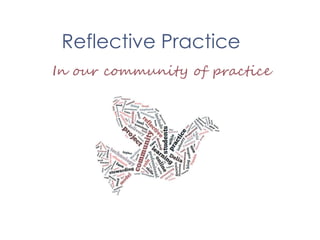
  • #2 Think about the symbol on this slide. I wonder if anyone might like to suggest what this symbol means to them.?
  • #12  How is your own professional learning journey going? Have you discovered any new insights into yourself so far? Share some examples of your reflections with others
  • #13 Discussion Threads – another form of reflective learningThis is the place to be the “analytical worker” outlined in your reading. Us it to post up events that happen in your centre that you would like to share with us and to reflect upon as a group. An insight you gained or that “aha” moment when something in your perception shifted for you.
  • #14  As readers and writers on this thread, how is it going for you so far? Have you been able to contribute some new thoughts to share with us? If you have not yet put something on the discussion forum other than your introduction – what is it that is preventing you? Can we help? What do you think of this way of learning? What are some of the benefits – any drawbacks? As future early childhood leaders, teachers, adult educators etc why is it important to be able to be a critically reflective professional? What is your role in all of this?
  • #25 Cross to openhouseopenlearning wiki after this