



MEMORY MANAGEMENT IN
OS
SESSION 6
LINK IN THE DESCRIPTION FOR ALL SESSIONS
PREVIOUS SESSION
• Process synchronization
• Race condition
• Critical section problem
• Software and hardware based solutions
• Semaphore and mutex
• Producer consumer problem
• Reader writer problem
INTERVIEW QUESTIONS
• Difference between 32-bit and 64-bit system
• Logical memory vs Physical memory
• Normal paging vs demand paging vs pure demand paging
• Segmentation and paging
• Virtual memory and its advantage
• Paging vs segmentation
• Physical address vs virtual address
• Inverted paging
MAIN MEMORY
• Memory consists of a large array of words or bytes, each with its own
address.
• Typical instruction-execution cycle
• Fetch instruction from memory
• Instruction decoding ( may cause more memory access a+b -> add)
• Execute instruction and store result back in memory
• Memory unit doesn’t know how these address are generated
• CPU can only access registers and main memory (not disk)
FASTEST MEMORY
• Registers
• Processor Cache – L1, L2 and L3
• Main Memory – RAM
• Disk
ADDRESS BINDING
• Compile time
• Starting address is known
• Starting location changes ?
• Load time
• Address not known at compile time
• Final binding is delayed till load time
• Relocatable code
• Execution time
• If process can be moved during execution?
• Binding is delayed till run time
• Used in most modern OS
CONTIGUOUS MEMORY ALLOCATION
• Traditional approach
• Allocate contiguous memory blocks for a process
• Two approaches
• Fixed partitioning
• Variable partitioning
FIXED PARTITIONING
• Memory is divided into partitions of fixed size which cannot change
• Each partition can only contain one process
• Find a suitable partition and allocate it
DISADVANTAGE
• Degree of multiprogramming bounded by number of partitions
• Size of process is bounded by size of largest partition
• Suffers from internal fragmentation
VARIABLE PARTITION METHOD
• Partitions are created dynamically as process are loaded
• Free partitions -> holes
• Initially, one hole whose size is of main memory
• OS keeps tracks of these holes
• If process size > selected hole, split hole into two
• Give one to process
• Other is returned to the OS
• Process terminates, hole is released.
• Two adjacent holes are merged
• No internal fragmentation
• Degree of multiprogramming
Disadvantage
• Size of the process is limited by size of biggest hole
• Leads to external fragmentation
ALGORITHMS FOR VARIABLE PARTITIONING
• FIRST FIT
• Scan from beginning
• Allocate the first hole that is big enough
• Next Fit
• Scan from location at which previous searched ended
• Allocate the first hole that is big enough
• BEST FIT
• Allocate the smallest hole that is big enough
• Produces smallest leftover hole
• WORST FIT
• Allocate the largest hole that is big enough
• Produces largest leftover hole
• Leftover hole may be more useful than best-fit created hole
Example - https://youtu.be/fz9v-SZt3cQ
LOGICAL VS PHYSICAL ADDRESS
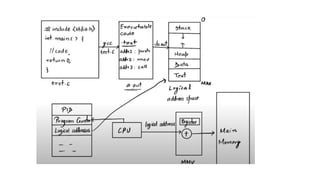
• Address which the CPU sees -> logical address
• Address contained in the program counter
• Address that exists in main memory is called physical address
• User programs never see the physical address, they only see logical address
addr = malloc(int)
Print(“%p”,&addr) -> logical or physical ?
Detailed video - https://youtu.be/8FSZfCbM_hA
MEMORY MAPPING AND PROTECTION IN
CONTIGUOUS MEMORY ALLOCATION
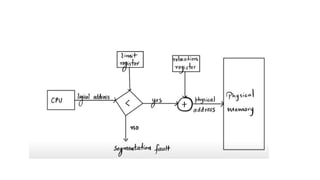
• The logical address need to be converted into physical address for
instruction execution
• Also, one process should not be able to access other process memory
• Use limit register and relocation register
• Limit register = size of the process
• Relocation register = Starting physical address of the process
• Detailed video - https://youtu.be/oN8nr4ug1cw
NONCONTIGUOUS MEMORY ALLOCATION
TECHNIQUES
• Limitation with contiguous memory allocation
• Internal fragmentation – Fixed partition
• External fragmentation – Variable partition
• Use compaction to solve the external fragmentation
• But compaction is very expensive because of copying operation (I/O)
• Other solutions?
• Allow process to have noncontiguous physical address space
• Break down logical address of a process into chunks and allocate
them
• Noncontiguous memory management techniques
• Paging
• Segmentation
• Paging + Segmentation
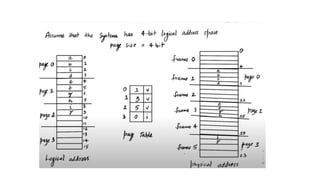
PAGING TECHNIQUE
• Assume byte addressable memory
• Each byte is a unique address
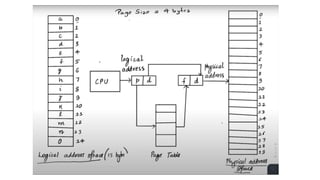
• Break down the logical memory into partitions called pages
• Break down the physical memory into partitions called frames
• Page size = frame size
• Use page tables to map logical address to physical address
• Note: In simple paging, all the pages are bought in memory before
process starts executing.
• If there are N pages, then at least N frames must be available for
process to run. See demand paging
• Logical address – page number + page offset
• MMU combines page table mapping with page offset to arrive at
physical address
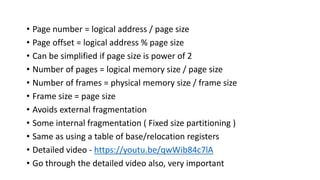
• Page number = logical address / page size
• Page offset = logical address % page size
• Can be simplified if page size is power of 2
• Number of pages = logical memory size / page size
• Number of frames = physical memory size / frame size
• Frame size = page size
• Avoids external fragmentation
• Some internal fragmentation ( Fixed size partitioning )
• Same as using a table of base/relocation registers
• Detailed video - https://youtu.be/qwWib84c7lA
• Go through the detailed video also, very important
CLEARLY UNDERSTAND
• PAGE
• FRAME
• PAGE NUMBER
• FRAME NUMBER
• PAGE SIZE
• FRAME SIZE
• LOGICAL ADDRESS SPACE
• PHYSICAL ADDRESS SPACE
• PAGE TABLE
• PAGE TABLE SIZE
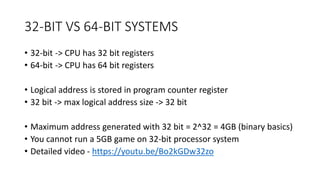
32-BIT VS 64-BIT SYSTEMS
• 32-bit -> CPU has 32 bit registers
• 64-bit -> CPU has 64 bit registers
• Logical address is stored in program counter register
• 32 bit -> max logical address size -> 32 bit
• Maximum address generated with 32 bit = 2^32 = 4GB (binary basics)
• You cannot run a 5GB game on 32-bit processor system
• Detailed video - https://youtu.be/Bo2kGDw32zo
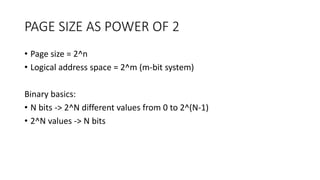
PAGE SIZE AS POWER OF 2
• Page size = 2^n
• Logical address space = 2^m (m-bit system)
Binary basics:
• N bits -> 2^N different values from 0 to 2^(N-1)
• 2^N values -> N bits
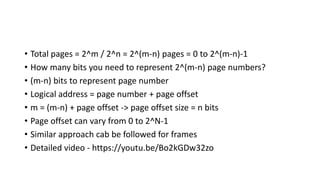
• Total pages = 2^m / 2^n = 2^(m-n) pages = 0 to 2^(m-n)-1
• How many bits you need to represent 2^(m-n) page numbers?
• (m-n) bits to represent page number
• Logical address = page number + page offset
• m = (m-n) + page offset -> page offset size = n bits
• Page offset can vary from 0 to 2^N-1
• Similar approach cab be followed for frames
• Detailed video - https://youtu.be/Bo2kGDw32zo
ISSUE WITH KEEPING PAGE TABLE IN MAIN
MEMORY
• The page table is kept in main memory, and a points to the page
table. Changing page tables requires changing only this one register,
substantially reducing context-switch time
• Threads vs Process context switch time (Thread lecture)
• Two memory access required to access a byte in memory
• Page table access
• Access the required byte
• Doing this for every byte will slow down the system!!
TRANSLATION LOOK-ASIDE BUFFER (TLB)
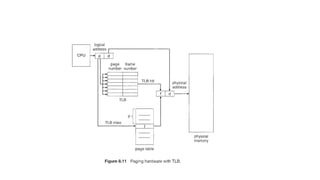
• A small, expensive cache that sits close to CPU
• Key, value data structure
• Key -> page number
• Value -> Frame number
• Total entries = 64-1024
• TLB hit and TLB miss
• Detailed video - https://youtu.be/AE13Po9t8AQ
MEMORY PROTECTION IN PAGING
• Protection bits can be associated with along side frame number in
page table
• Valid-invalid bit -> page exists in logical memory or not
• Dirty bit -> Page has been modified or not
• Cache enabled/disabled -> where caching is enabled for page or not
• Reference bit -> whether page was referenced in last clock cycle
• Detailed video - https://youtu.be/WjH03LKVXfg
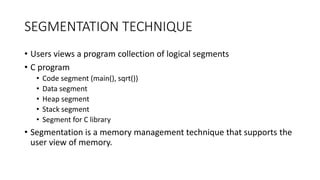
SEGMENTATION TECHNIQUE
• Users views a program collection of logical segments
• C program
• Code segment (main(), sqrt())
• Data segment
• Heap segment
• Stack segment
• Segment for C library
• Segmentation is a memory management technique that supports the
user view of memory.
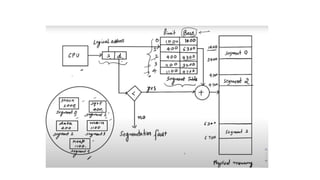
• Logical address -> Collection of segments
• Segment name and length
• Logical address = segment name + offset
• Detailed video - https://youtu.be/ce5vR0IHea8
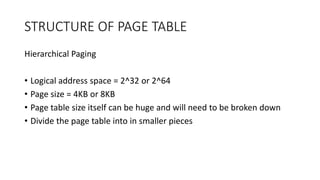
STRUCTURE OF PAGE TABLE
Hierarchical Paging
• Logical address space = 2^32 or 2^64
• Page size = 4KB or 8KB
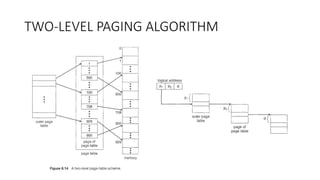
• Page table size itself can be huge and will need to be broken down
• Divide the page table into in smaller pieces
TWO-LEVEL PAGING ALGORITHM
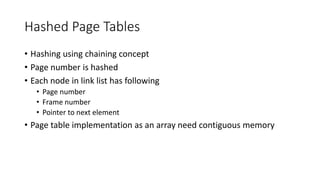
Hashed Page Tables
• Hashing using chaining concept
• Page number is hashed
• Each node in link list has following
• Page number
• Frame number
• Pointer to next element
• Page table implementation as an array need contiguous memory
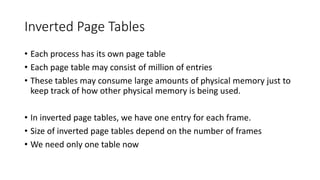
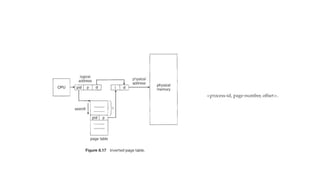
Inverted Page Tables
• Each process has its own page table
• Each page table may consist of million of entries
• These tables may consume large amounts of physical memory just to
keep track of how other physical memory is being used.
• In inverted page tables, we have one entry for each frame.
• Size of inverted page tables depend on the number of frames
• We need only one table now
VIRTUAL MEMORY MANAGEMENT
TECHNIQUES
• Normal paging – all instructions should be in memory before program
can start
• Do we really need to load the whole program at once?
• Error handling code are used very less
• Arrays -> allocated more memory than we use
• Certain functions are used very less
• Even if entire program is needed, it will not be needed at the same
time.
• What is the maximum size of the process in simple paging?
VIRTUAL MEMORY, VIRTUAL ADDRESS SPACE
• Virtual memory management technique -> size of the process can be
larger than size of main memory
• Disk is also used to store pages of the process.
• Virtual address space -> logical address space
• Virtual memory = concept of logical memory + using disk for storing
pages
• When we say virtual, we mean that disk is being used for storing
pages.
• Logical address is called virtual address as they are also not real.
DEMAND PAGING IN OPERATING SYSTEM
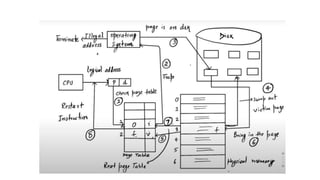
• Load the page only when they are needed -> demand paging
• When a process is created, some pages are loaded into main memory
by pager ( frame allocation algorithms )
• CPU starts executing the program. Two things happen.
• Page is their in main memory
• Page is not there in main memory but on disk - page fault
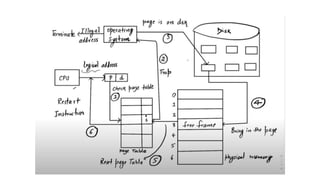
• In page fault case, the kernel has to bring the page from disk to main
memory.
• Pure demand paging -> no pages are loaded initially. When page fault
happens, then a page is loaded.
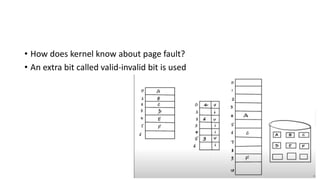
• How does kernel know about page fault?
• An extra bit called valid-invalid bit is used
• Valid
• Page is legal
• Is in the memory
• Invalid
• Page is not legal ? Separate table in PCB keeps track of it
• Page is legal but not in main memory ?
• Detailed video
• https://youtu.be/uuno-YQn0l4
• https://youtu.be/R5nA98-N1-4
PAGE REPLACEMENT TECHNIQUES
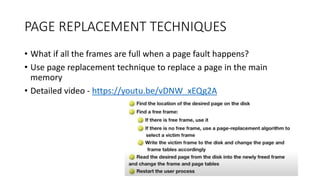
• What if all the frames are full when a page fault happens?
• Use page replacement technique to replace a page in the main
memory
• Detailed video - https://youtu.be/vDNW_xEQg2A
FIFO PAGE REPLACEMENT ALGORITHM
• Oldest page is replaced first
• First in, first out
• If number of frames is increased, one would expect page faults to go
down.
• Using FIFO, it’s not always true. This is called Belady’s anomaly.
• Example - https://youtu.be/a2yJKKh48a4
OPTIMAL PAGE REPLACEMENT
• An algorithm with lowest page-fault rates
• Replace the page that will not be used for longest period of time
• Requires looking into future (SJF)
• Not used in OS
• Used for comparing algorithms.
• Example - https://youtu.be/1JryPF1Ajsc
LRU PAGE REPLACEMENT TECHNIQUE
• Replace page from past that has not been used for longest period of
time.
• Optimal page replacement looking backwards
• Used in most modern OS
• Doesn’t suffer from Belady’s anomaly
• Example - https://youtu.be/ul3dFPkvU-I
THRASHING
• More time is spent in swapping pages than doing actual work
• If more time is spent in swapping, CPU will be idle.
• Global page replacement -> Kernel sees that CPU are idle. It brings
more process. Leads to more thrashing and a cycle.
• Local page replacement -> thrashing will not happen but local page
replacement has some disadvantages.
• Equal frame allocation vs proportional frame allocation
FILE SYSTEM
MANAGEMENT

Memory management in operating system | Paging | Virtual memory

  • 1.
    MEMORY MANAGEMENT IN OS SESSION6 LINK IN THE DESCRIPTION FOR ALL SESSIONS
  • 2.
    PREVIOUS SESSION • Processsynchronization • Race condition • Critical section problem • Software and hardware based solutions • Semaphore and mutex • Producer consumer problem • Reader writer problem
  • 3.
    INTERVIEW QUESTIONS • Differencebetween 32-bit and 64-bit system • Logical memory vs Physical memory • Normal paging vs demand paging vs pure demand paging • Segmentation and paging • Virtual memory and its advantage • Paging vs segmentation • Physical address vs virtual address • Inverted paging
  • 4.
    MAIN MEMORY • Memoryconsists of a large array of words or bytes, each with its own address. • Typical instruction-execution cycle • Fetch instruction from memory • Instruction decoding ( may cause more memory access a+b -> add) • Execute instruction and store result back in memory • Memory unit doesn’t know how these address are generated • CPU can only access registers and main memory (not disk)
  • 5.
    FASTEST MEMORY • Registers •Processor Cache – L1, L2 and L3 • Main Memory – RAM • Disk
  • 6.
    ADDRESS BINDING • Compiletime • Starting address is known • Starting location changes ? • Load time • Address not known at compile time • Final binding is delayed till load time • Relocatable code • Execution time • If process can be moved during execution? • Binding is delayed till run time • Used in most modern OS
  • 7.
    CONTIGUOUS MEMORY ALLOCATION •Traditional approach • Allocate contiguous memory blocks for a process • Two approaches • Fixed partitioning • Variable partitioning
  • 8.
    FIXED PARTITIONING • Memoryis divided into partitions of fixed size which cannot change • Each partition can only contain one process • Find a suitable partition and allocate it
  • 9.
    DISADVANTAGE • Degree ofmultiprogramming bounded by number of partitions • Size of process is bounded by size of largest partition • Suffers from internal fragmentation
  • 10.
    VARIABLE PARTITION METHOD •Partitions are created dynamically as process are loaded • Free partitions -> holes • Initially, one hole whose size is of main memory • OS keeps tracks of these holes • If process size > selected hole, split hole into two • Give one to process • Other is returned to the OS • Process terminates, hole is released. • Two adjacent holes are merged
  • 11.
    • No internalfragmentation • Degree of multiprogramming Disadvantage • Size of the process is limited by size of biggest hole • Leads to external fragmentation
  • 12.
    ALGORITHMS FOR VARIABLEPARTITIONING • FIRST FIT • Scan from beginning • Allocate the first hole that is big enough • Next Fit • Scan from location at which previous searched ended • Allocate the first hole that is big enough • BEST FIT • Allocate the smallest hole that is big enough • Produces smallest leftover hole
  • 13.
    • WORST FIT •Allocate the largest hole that is big enough • Produces largest leftover hole • Leftover hole may be more useful than best-fit created hole Example - https://youtu.be/fz9v-SZt3cQ
  • 14.
    LOGICAL VS PHYSICALADDRESS • Address which the CPU sees -> logical address • Address contained in the program counter • Address that exists in main memory is called physical address • User programs never see the physical address, they only see logical address addr = malloc(int) Print(“%p”,&addr) -> logical or physical ? Detailed video - https://youtu.be/8FSZfCbM_hA
  • 16.
    MEMORY MAPPING ANDPROTECTION IN CONTIGUOUS MEMORY ALLOCATION • The logical address need to be converted into physical address for instruction execution • Also, one process should not be able to access other process memory • Use limit register and relocation register • Limit register = size of the process • Relocation register = Starting physical address of the process • Detailed video - https://youtu.be/oN8nr4ug1cw
  • 18.
    NONCONTIGUOUS MEMORY ALLOCATION TECHNIQUES •Limitation with contiguous memory allocation • Internal fragmentation – Fixed partition • External fragmentation – Variable partition • Use compaction to solve the external fragmentation • But compaction is very expensive because of copying operation (I/O) • Other solutions?
  • 19.
    • Allow processto have noncontiguous physical address space • Break down logical address of a process into chunks and allocate them • Noncontiguous memory management techniques • Paging • Segmentation • Paging + Segmentation
  • 20.
    PAGING TECHNIQUE • Assumebyte addressable memory • Each byte is a unique address • Break down the logical memory into partitions called pages • Break down the physical memory into partitions called frames • Page size = frame size • Use page tables to map logical address to physical address • Note: In simple paging, all the pages are bought in memory before process starts executing.
  • 21.
    • If thereare N pages, then at least N frames must be available for process to run. See demand paging • Logical address – page number + page offset • MMU combines page table mapping with page offset to arrive at physical address
  • 23.
    • Page number= logical address / page size • Page offset = logical address % page size • Can be simplified if page size is power of 2 • Number of pages = logical memory size / page size • Number of frames = physical memory size / frame size • Frame size = page size • Avoids external fragmentation • Some internal fragmentation ( Fixed size partitioning ) • Same as using a table of base/relocation registers • Detailed video - https://youtu.be/qwWib84c7lA • Go through the detailed video also, very important
  • 24.
    CLEARLY UNDERSTAND • PAGE •FRAME • PAGE NUMBER • FRAME NUMBER • PAGE SIZE • FRAME SIZE • LOGICAL ADDRESS SPACE • PHYSICAL ADDRESS SPACE • PAGE TABLE • PAGE TABLE SIZE
  • 25.
    32-BIT VS 64-BITSYSTEMS • 32-bit -> CPU has 32 bit registers • 64-bit -> CPU has 64 bit registers • Logical address is stored in program counter register • 32 bit -> max logical address size -> 32 bit • Maximum address generated with 32 bit = 2^32 = 4GB (binary basics) • You cannot run a 5GB game on 32-bit processor system • Detailed video - https://youtu.be/Bo2kGDw32zo
  • 26.
    PAGE SIZE ASPOWER OF 2 • Page size = 2^n • Logical address space = 2^m (m-bit system) Binary basics: • N bits -> 2^N different values from 0 to 2^(N-1) • 2^N values -> N bits
  • 27.
    • Total pages= 2^m / 2^n = 2^(m-n) pages = 0 to 2^(m-n)-1 • How many bits you need to represent 2^(m-n) page numbers? • (m-n) bits to represent page number • Logical address = page number + page offset • m = (m-n) + page offset -> page offset size = n bits • Page offset can vary from 0 to 2^N-1 • Similar approach cab be followed for frames • Detailed video - https://youtu.be/Bo2kGDw32zo
  • 28.
    ISSUE WITH KEEPINGPAGE TABLE IN MAIN MEMORY • The page table is kept in main memory, and a points to the page table. Changing page tables requires changing only this one register, substantially reducing context-switch time • Threads vs Process context switch time (Thread lecture) • Two memory access required to access a byte in memory • Page table access • Access the required byte • Doing this for every byte will slow down the system!!
  • 29.
    TRANSLATION LOOK-ASIDE BUFFER(TLB) • A small, expensive cache that sits close to CPU • Key, value data structure • Key -> page number • Value -> Frame number • Total entries = 64-1024 • TLB hit and TLB miss • Detailed video - https://youtu.be/AE13Po9t8AQ
  • 31.
    MEMORY PROTECTION INPAGING • Protection bits can be associated with along side frame number in page table • Valid-invalid bit -> page exists in logical memory or not • Dirty bit -> Page has been modified or not • Cache enabled/disabled -> where caching is enabled for page or not • Reference bit -> whether page was referenced in last clock cycle • Detailed video - https://youtu.be/WjH03LKVXfg
  • 33.
    SEGMENTATION TECHNIQUE • Usersviews a program collection of logical segments • C program • Code segment (main(), sqrt()) • Data segment • Heap segment • Stack segment • Segment for C library • Segmentation is a memory management technique that supports the user view of memory.
  • 34.
    • Logical address-> Collection of segments • Segment name and length • Logical address = segment name + offset • Detailed video - https://youtu.be/ce5vR0IHea8
  • 36.
    STRUCTURE OF PAGETABLE Hierarchical Paging • Logical address space = 2^32 or 2^64 • Page size = 4KB or 8KB • Page table size itself can be huge and will need to be broken down • Divide the page table into in smaller pieces
  • 37.
  • 38.
    Hashed Page Tables •Hashing using chaining concept • Page number is hashed • Each node in link list has following • Page number • Frame number • Pointer to next element • Page table implementation as an array need contiguous memory
  • 39.
    Inverted Page Tables •Each process has its own page table • Each page table may consist of million of entries • These tables may consume large amounts of physical memory just to keep track of how other physical memory is being used. • In inverted page tables, we have one entry for each frame. • Size of inverted page tables depend on the number of frames • We need only one table now
  • 41.
    VIRTUAL MEMORY MANAGEMENT TECHNIQUES •Normal paging – all instructions should be in memory before program can start • Do we really need to load the whole program at once? • Error handling code are used very less • Arrays -> allocated more memory than we use • Certain functions are used very less • Even if entire program is needed, it will not be needed at the same time. • What is the maximum size of the process in simple paging?
  • 42.
    VIRTUAL MEMORY, VIRTUALADDRESS SPACE • Virtual memory management technique -> size of the process can be larger than size of main memory • Disk is also used to store pages of the process. • Virtual address space -> logical address space • Virtual memory = concept of logical memory + using disk for storing pages • When we say virtual, we mean that disk is being used for storing pages. • Logical address is called virtual address as they are also not real.
  • 43.
    DEMAND PAGING INOPERATING SYSTEM • Load the page only when they are needed -> demand paging • When a process is created, some pages are loaded into main memory by pager ( frame allocation algorithms ) • CPU starts executing the program. Two things happen. • Page is their in main memory • Page is not there in main memory but on disk - page fault • In page fault case, the kernel has to bring the page from disk to main memory. • Pure demand paging -> no pages are loaded initially. When page fault happens, then a page is loaded.
  • 44.
    • How doeskernel know about page fault? • An extra bit called valid-invalid bit is used
  • 45.
    • Valid • Pageis legal • Is in the memory • Invalid • Page is not legal ? Separate table in PCB keeps track of it • Page is legal but not in main memory ? • Detailed video • https://youtu.be/uuno-YQn0l4 • https://youtu.be/R5nA98-N1-4
  • 47.
    PAGE REPLACEMENT TECHNIQUES •What if all the frames are full when a page fault happens? • Use page replacement technique to replace a page in the main memory • Detailed video - https://youtu.be/vDNW_xEQg2A
  • 49.
    FIFO PAGE REPLACEMENTALGORITHM • Oldest page is replaced first • First in, first out • If number of frames is increased, one would expect page faults to go down. • Using FIFO, it’s not always true. This is called Belady’s anomaly. • Example - https://youtu.be/a2yJKKh48a4
  • 50.
    OPTIMAL PAGE REPLACEMENT •An algorithm with lowest page-fault rates • Replace the page that will not be used for longest period of time • Requires looking into future (SJF) • Not used in OS • Used for comparing algorithms. • Example - https://youtu.be/1JryPF1Ajsc
  • 51.
    LRU PAGE REPLACEMENTTECHNIQUE • Replace page from past that has not been used for longest period of time. • Optimal page replacement looking backwards • Used in most modern OS • Doesn’t suffer from Belady’s anomaly • Example - https://youtu.be/ul3dFPkvU-I
  • 52.
    THRASHING • More timeis spent in swapping pages than doing actual work • If more time is spent in swapping, CPU will be idle. • Global page replacement -> Kernel sees that CPU are idle. It brings more process. Leads to more thrashing and a cycle. • Local page replacement -> thrashing will not happen but local page replacement has some disadvantages. • Equal frame allocation vs proportional frame allocation
  • 53.