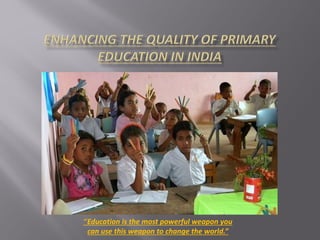
“Education is the most powerful weapon you
can use this weapon to change the world.”
YEAR Educational institutions
1950-51 209671
1960-21 330399
1970-71 408378
1980-81 494503
1990-91 560935
2000-2001 638738
2001-2002 664041
 The future of India will be fascinated in the classroom. While India has made
great studies in improving her education system, much still remains to be
done.
 There has been a massive expansion of schooling facilities since 1947.
 The number of primary schools has been increased from about 200,000 in
1950-1 to about 220,000 in 2001-02.
 The growth rate of secondary schools during 1986 and 1993 was 25 percent
and senior secondary schools was 52 percent, compared to about an 8
percent growth rate of primary schools during the same period.
GROWTH OF RECOGNISED PRIMARY
EDUCATIONAL INSTITUTIONS
CAUSES:
 Due to shortage of well-trained teachers.
 Poor design of curriculum.
 Poor or ineffective delivery and teaching methods.
 Improper school buildings.
SOLUTION:
 Activity based learning.
 Periodic inspections and interaction between officials and
students.
 IMPLEMENTING STRICT RULES:
 Warning the teachers in the case of improper teaching.
 If the condition prevails “salary reduction” should be
implemented, if it further continues they must be “checked
out” from the school.
DEFECTIVE EDUCATION SYSTEM
Sarva Shiksha Abhiyan(Education
for All):
The goals of this movement has not
reached its 100%.
Only 70% of the funds allotted were
spent towards this.
CAUSES:
Funds that are being allotted for the construction
of government schools do not reach them.
 They vanish at intermediate stages leaving a
mere amount for the schools.
 School authorities stay hesitant to question the
higher officials to save their posts.
SOLUTIONS:
Special committee should be organized
to monitor the conditions of the school building in
a regular interval.
 To ensure that the students study under
peaceful and safe environment.
CAUSES:
 Lack of proper awareness among the parents.
 Poverty due to unemployment
 Rules and regulations are not strictly followed
SOLUTIONS:
 Providing strong awareness among the public
about the legal penalties.
 Make them to understand the importance of
education.
 Provision for employment opportunities.
MID DAY MEALS:
 A healthy body possesses a healthy
mind.
 Since our children do not get a
balanced diet with a result their
physical development gets retarded.
Their mind and the memory, do not
develop up to the desired extent.
 Social aspect plays a vital role in education
 Students are affected adversely by violence, race, caste,
gender discrimination so they don’t feel to go to school.
 Sexual harassment, another crucial issue that prevents them
from going to school.
 Children groom habits such as smoking, fighting, stealing from
their elders.
 Lack of Extracurricular Activities like games, painting, music,
dancing, speech, gathering and workshops that helps to
build self-esteem, confidence and satisfaction.
 No definite rules regarding admission in primary classes.
 Any child of any age within the age group may seek admission
in any class.
 No co-ordination and balance between one’s age and mental
development causes droupouts.
 •About 57 per cent of rural elementary (primary and upper primary) schools
in India has less than four classrooms. The proportion of rural schools that do
not have one classroom per grade is substantially higher.
 •About 13 per cent of rural elementary schools in India do not have drinking
water facilities.
 •About 16 per cent of rural elementary schools in India do not have any toilet
facilities.
 •About 49 per cent of rural elementary schools in India do not have separate
toilets for girls.
 •About 70 per cent of rural elementary schools in India do not have electricity.
 •About 14 per cent of rural primary schools in India have only one teacher.
 • About 3.5 crore children have not enrolled in school.
 • About 39% of primary and 54.6% of upper primary students drop out of
school.
 • Quality of education is poor because of high student-teacher ratio – national
average of 46.1 with some states as high as 68 (Rajasthan).
YEAR 1960-61 1970-71 1980-81 1990-91 1992-93 1999-
2000
2001-02
BOYS 61.7 64.5 56.2 40.1 43.8 38.7 38.4
GIRLS 70.9 70.9 62.5 46.0 46.7 42.3 39.9
TOTAL 64.9 67.0 58.7 42.6 45.0 40.3 39.0
DROP OUT RATES:
 "A student who has missed a class
can easily pick up the concept the
next day, which is not possible in
textbook teaching. The child picks
up the activity from where he or
she has left off,“
 For effective monitoring and
supervising of the ABL, all BRTEs,
HM's, DEOs, CEOs and ADPCs,
Supervisors, AEEOs should be
trained by core team members.
No scope to recover the loss of
learning during the period of absence
of children.
Coverage of syllabus by the teacher
and not by the children.
Teaching learning materials not
attractive for children
Advertising the importance
of education.
Offering more amenities to
students.
Frequent supervision of the
reach of the schemes to the
rural public.
Checking the above
explained scenarios and make
sure it happens.
Keeping intact policies to
frame a controlled
educational system.
 We should encourage all the
people to educate their children.
 Thereby abolish child marriage,
and child labour completely.
 Standard of education can be
upgraded and preserved.
 Eradicate poverty in the long term
for economic development.
 A hope of good socio economic
environment for our younger and
forthcoming generations.
 A good sustainable future can be
achieved.
“I Hear; I forget,
I see; I remember,
I do; I understand.”

5REVOLUTIONERS

  • 1.
    “Education is themost powerful weapon you can use this weapon to change the world.”
  • 2.
    YEAR Educational institutions 1950-51209671 1960-21 330399 1970-71 408378 1980-81 494503 1990-91 560935 2000-2001 638738 2001-2002 664041  The future of India will be fascinated in the classroom. While India has made great studies in improving her education system, much still remains to be done.  There has been a massive expansion of schooling facilities since 1947.  The number of primary schools has been increased from about 200,000 in 1950-1 to about 220,000 in 2001-02.  The growth rate of secondary schools during 1986 and 1993 was 25 percent and senior secondary schools was 52 percent, compared to about an 8 percent growth rate of primary schools during the same period. GROWTH OF RECOGNISED PRIMARY EDUCATIONAL INSTITUTIONS
  • 3.
    CAUSES:  Due toshortage of well-trained teachers.  Poor design of curriculum.  Poor or ineffective delivery and teaching methods.  Improper school buildings. SOLUTION:  Activity based learning.  Periodic inspections and interaction between officials and students.  IMPLEMENTING STRICT RULES:  Warning the teachers in the case of improper teaching.  If the condition prevails “salary reduction” should be implemented, if it further continues they must be “checked out” from the school. DEFECTIVE EDUCATION SYSTEM Sarva Shiksha Abhiyan(Education for All): The goals of this movement has not reached its 100%. Only 70% of the funds allotted were spent towards this.
  • 4.
    CAUSES: Funds that arebeing allotted for the construction of government schools do not reach them.  They vanish at intermediate stages leaving a mere amount for the schools.  School authorities stay hesitant to question the higher officials to save their posts. SOLUTIONS: Special committee should be organized to monitor the conditions of the school building in a regular interval.  To ensure that the students study under peaceful and safe environment.
  • 5.
    CAUSES:  Lack ofproper awareness among the parents.  Poverty due to unemployment  Rules and regulations are not strictly followed SOLUTIONS:  Providing strong awareness among the public about the legal penalties.  Make them to understand the importance of education.  Provision for employment opportunities.
  • 6.
    MID DAY MEALS: A healthy body possesses a healthy mind.  Since our children do not get a balanced diet with a result their physical development gets retarded. Their mind and the memory, do not develop up to the desired extent.
  • 7.
     Social aspectplays a vital role in education  Students are affected adversely by violence, race, caste, gender discrimination so they don’t feel to go to school.  Sexual harassment, another crucial issue that prevents them from going to school.  Children groom habits such as smoking, fighting, stealing from their elders.  Lack of Extracurricular Activities like games, painting, music, dancing, speech, gathering and workshops that helps to build self-esteem, confidence and satisfaction.  No definite rules regarding admission in primary classes.  Any child of any age within the age group may seek admission in any class.  No co-ordination and balance between one’s age and mental development causes droupouts.
  • 8.
     •About 57per cent of rural elementary (primary and upper primary) schools in India has less than four classrooms. The proportion of rural schools that do not have one classroom per grade is substantially higher.  •About 13 per cent of rural elementary schools in India do not have drinking water facilities.  •About 16 per cent of rural elementary schools in India do not have any toilet facilities.  •About 49 per cent of rural elementary schools in India do not have separate toilets for girls.  •About 70 per cent of rural elementary schools in India do not have electricity.  •About 14 per cent of rural primary schools in India have only one teacher.  • About 3.5 crore children have not enrolled in school.  • About 39% of primary and 54.6% of upper primary students drop out of school.  • Quality of education is poor because of high student-teacher ratio – national average of 46.1 with some states as high as 68 (Rajasthan). YEAR 1960-61 1970-71 1980-81 1990-91 1992-93 1999- 2000 2001-02 BOYS 61.7 64.5 56.2 40.1 43.8 38.7 38.4 GIRLS 70.9 70.9 62.5 46.0 46.7 42.3 39.9 TOTAL 64.9 67.0 58.7 42.6 45.0 40.3 39.0 DROP OUT RATES:
  • 9.
     "A studentwho has missed a class can easily pick up the concept the next day, which is not possible in textbook teaching. The child picks up the activity from where he or she has left off,“  For effective monitoring and supervising of the ABL, all BRTEs, HM's, DEOs, CEOs and ADPCs, Supervisors, AEEOs should be trained by core team members. No scope to recover the loss of learning during the period of absence of children. Coverage of syllabus by the teacher and not by the children. Teaching learning materials not attractive for children
  • 10.
    Advertising the importance ofeducation. Offering more amenities to students. Frequent supervision of the reach of the schemes to the rural public. Checking the above explained scenarios and make sure it happens. Keeping intact policies to frame a controlled educational system.
  • 11.
     We shouldencourage all the people to educate their children.  Thereby abolish child marriage, and child labour completely.  Standard of education can be upgraded and preserved.  Eradicate poverty in the long term for economic development.  A hope of good socio economic environment for our younger and forthcoming generations.  A good sustainable future can be achieved. “I Hear; I forget, I see; I remember, I do; I understand.”