TEAM DETAILS
•ABHISHEK VARSHNEY
•MOHIT VARSHNEY
•PIYUSH VARSHNEY
•SHIVAM GOVIL
•TRIBHUVAN NARAYAN SINGH
 PRIMARY
EDUCATION BY THE
LAW
 THE STATE SHALL PROVIDE
FREE AND COMPULSORY
EDUCATION TO ALL
CHILDREN OF AGE 6 TO 14
YEARS IN SUCH A MANNER
AS THE STATE MAY, BY LAW,
DETERMINE.(ARTICLE 21A)
 THE STATE SHALL
ENDEAVOUR TO PROVIDE
EARLY CHILDHOOD CARE
AND EDUCATION FOR ALL
CHILDREN UNTILL THEY
COMPLETE THE AGE OF 6
YEARS( ARTICLE 45 )
 STATE PARTIES ARE BOUND
TO MAKE “AVAILABLE AND
ACCESSIBLE TO EVERY
CHILD” COMPULSORY AND
FREE PRIMARY EDUCATION
AND OPTIONS FOR ,
INCLUDING VOCATIONAL
EDUCATION (ARTICLE 28-
THE STATE OF WORLD
CHILDREN REPORT-2012
WHAT IS
PRIMARY
EDUCATION?
The basic elementary
education parted to the
children from the age of 6 ,
which makes them capable
of reading , writing and
reasoning.
The very first step towards
achieving the state of
literacy and eligibility for
employment.
WHY PRIMARY
EDUCATION?
A strong primary education
system is the cornerstone of
any country's growth and
prosperity.
A weak foundation in
primary education can
derail the lives, careers and
productivity of hundreds of
millions of its citizens.
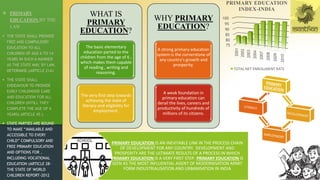
75
80
85
90
95
100
2001
2002
2003
2004
2007
2008
2009
2010
PRIMARY EDUCATION
INDEX-INDIA
TOTAL NET ENROLLMENT RATE
PRIMARY EDUCATION IS AN INEVITABLE LINK IN THE PROCESS CHAIN
OF DEVELOPMENT FOR ANY COUNTRY. DEVELOPMENT AND
PROSPERITY ARE THE ULTIMATE RESULTS OF A PROCESS IN WHICH
PRIMARY EDUCATION IS A VERY FIRST STEP. PRIMARY EDUCATION IS
SEEN AS THE MOST INFLUENTIAL AGENT OF MODERNISATION APART
FORM INDUSTRIALISATION AND URBANISATION IN INDIA
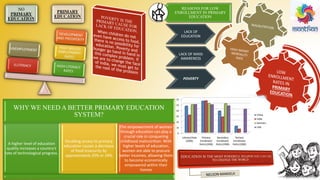
LACK OF
EDUCATION
LACK OF MASS
AWARENESS
POVERTY
REASONS FOR LOW
ENROLLMENT IN PRIMARY
EDUCATION
WHY WE NEED A BETTER PRIMARY EDUCATION
SYSTEM?
A higher level of education
quality increases a country’s
rate of technological progress.
Doubling access to primary
education causes a decrease
of food insecurity by
approximately 20% or 24%
The empowerment of women
through education can play a
crucial role in conquering
childhood malnutrition. With
higher levels of education,
women are able to procure
better incomes, allowing them
to become economically
empowered within their
homes
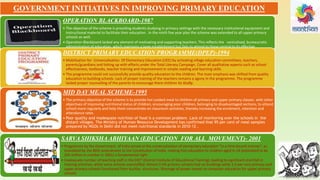
OPERATION BLACKBOARD-1987
• The objective of the scheme is providing students studying in primary settings with the necessary institutional equipment and
instructional material to facilitate their education . In the ninth five year plan the scheme was extended to all upper primary
schools as well.
• Operation Blackboard lacked any element of motivating and supporting teachers. This reflects the centralised, bureaucratic
administration of education, which maintains a large establishment but fails to attend to those central to its effective
functioning
DISTRICT PRIMARY EDUCATION PROGRAMME(DPEP)-1994
• Mobilization for Universalisation Of Elementary Education (UEE) by activating village education committees, teachers,
parents/guardians and linking up with efforts under the Total Literacy Campaign. Cover all qualitative aspects such as school
effectiveness, textbooks, teacher training and improvement in simple reading and learning skills.
• The programme could not successfully provide quality education to the children. The main emphasis was shifted from quality
education to building schools. Lack of proper training of the teachers remains a agony in the programme. The programme
lacked proper counselling of the parents to encourage there children to study.
MID DAY MEAL SCHEME-1995
• The primary objective of the scheme is to provide hot cooked meal to children of primary and upper primary classes. with other
objectives of improving nutritional status of children, encouraging poor children, belonging to disadvantaged sections, to attend
school more regularly and help them concentrate on classroom activities, thereby increasing the enrolment, retention and
attendance rates.
• Poor quality and inadequate nutrition of food is a common problem. Lack of monitoring over the schools in the
distant villages. The Ministry of Human Resource Development has confirmed that 95 per cent of meal samples
prepared by NGOs in Delhi did not meet nutritional standards in 2010-12 .
SARVA SHIKSHA ABHIYAAN (EDUCATION FOR ALL MOVEMENT)- 2001
• Programme by the Government of India aimed at the universalization of elementary education "in a time bound manner", as
mandated by the 86th amendment to the Constitution of India making free education to children aged 6–14 (estimated to be
205 million in number in 2001) a fundamental right .
• Inadequate number of teaching staff in the DIET (District Institute of Educational Training), leading to significant shortfall in
training activities, while some schools overstaffed. Almost 0.5% primary schools had no buildings while 1.6 per cent primary and
upper primary schools functioned from kuchha structures. Shortage of power meant no computer education for upper primary
schools.
GOVERNMENT INITIATIVES IN IMPROVING PRIMARY EDUCATION
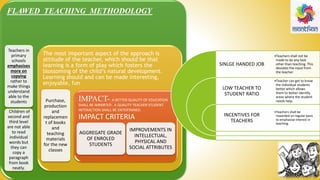
FLAWED TEACHING METHODOLOGY
Teachers in
primary
schools
emphasises
more on
copying
rather to
make things
understand
able to the
students
. Children of
second and
third level
are not able
to read
individual
words but
they can
copy a
paragraph
from book
neatly.
The most important aspect of the approach is
attitude of the teacher, which should be that
learning is a form of play which fosters the
blossoming of the child’s natural development.
Learning should and can be made interesting,
enjoyable, fun
Purchase,
production
and
replacemen
t of books
and
teaching
materials
for the new
classes
IMPACT- A BETTER QUALITY OF EDUCATION
SHALL BE IMPARTED . A QUALITY TEACHER STUDENT
INTERACTION SHALL BE ENTERTAINED.
IMPACT CRITERIA
AGGREGATE GRADE
OF ENROLED
STUDENTS
IMPROVEMENTS IN
INTELLECTUAL,
PHYSICAL AND
SOCIAL ATTRIBUTES
SINLGE HANDED JOB
LOW TEACHER TO
STUDENT RATIO
INCENTIVES FOR
TEACHERS
•Teachers shall not be
made to do any task
other than teaching. This
deviates the input from
the teacher
•Teacher can get to know
the individual students
better which allows
them to better identify
areas where the student
needs help.
•Teachers shall be
rewarded on regular basis
to emphasise interest in
teaching.
LINGUISTIC DIVERSITY
India's
linguistic
diversity
creates
unique
challenges
for the
nation's
education
system
The country's
22 official
languages and
hundreds of
spoken
dialects often
differ
considerably
from the
official
language of
the state or
region
IMPACT- WHEN THE MEDIUM OF STUDY SHALL BE IN THE
NATIVE MEDIUM , THE STUDENTS WILL NOT HESISTATE TO PURSUE
EDUCATION. OFTENLY FEAR OF NOT UNDERSTANDING A
COMPLETELY DIFFERENT LANGUAGE INSTILS FEAR IN THE MIND
OF STUDENTS WHICH SHALL EVENTUALLY BE REDUCED BY
ADOPTING THIS MEASURE
The basic
curriculum
shall
comprise of
native
language as
medium of
study,
whereas
Hindi and
English must
come under
subsidiary
coursed
IMPACT – The students will become well
adept in communicating with native people and
become capable of understanding the basic of the
subject of study.
IMPACT CRITERIA
HIGH ENROLMENT
DUE TO EASE OF
STUDY AND NO FEAR
OF AN ALIEN
LANGUAGE
LESSER NUMBER OF
DROP OUTS.
REVISED CURRICULUM
INVOLVEMENT OF
PARENTS
FOCUSSED TEACHING
STAFF
•CURRICULUM SHALL BE
DECIDED IN THE
LANGIUAGE
CORRESPONDING TO THE
REGION
•SINCE MEDIUM OF STUDY
IS IN NATIVE LANGUAGE
PARENTS CONTRIBUTION
CAN BE INCLUDED
•TEACHING STAFF SHALL
BE EMPLOYED WHICH IS
PROFECIENT IN THE
NATIVE LANGUAGE SO
THAT A GAP IS REDUCED
BETWEEN TEACHER AND
STUDNETS .
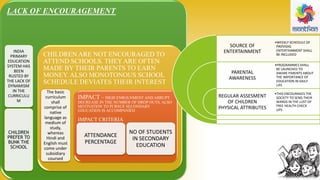
LACK OF ENCOURAGEMENT
INDIA
PRIMARY
EDUCATION
SYSTEM HAS
BEEN
RUSTED BY
THE LACK OF
DYNAMISM
IN THE
CURRICULU
M
CHILDREN
PREFER TO
BUNK THE
SCHOOL
CHILDREN ARE NOT ENCOURAGED TO
ATTEND SCHOOLS. THEYARE OFTEN
MADE BY THEIR PARENTS TO EARN
MONEY. ALSO MONOTONOUS SCHOOL
SCHEDULE DEVIATES THEIR INTEREST
The basic
curriculum
shall
comprise of
native
language as
medium of
study,
whereas
Hindi and
English must
come under
subsidiary
coursed
IMPACT – HIGH ENROLNMENT AND ABRUPT
DECREASE IN THE NUMBER OF DROP OUTS. ALSO
MOTIVATION TO PURSUE SECONDARY
EDUCATION IS ACCOMPANIED
IMPACT CRITERIA
ATTENDANCE
PERCENTAGE
NO OF STUDENTS
IN SECONDARY
EDUCATION
SOURCE OF
ENTERTAINMENT
PARENTAL
AWARENESS
REGULAR ASSESMENT
OF CHILDREN
PHYSICAL ATTRIBUTES
•WEEKLY SCHEDULE OF
PROVIDIG
ENTERTAINMENT SHALL
BE INCLUDED
•PROGRAMMES SHALL
BE LAUNCHED TO
AWARE PARENTS ABOUT
THE IMPORTANCE OF
EDUCATION IN DAILY
LIFE
•THIS ENCOURAGES THE
SOCIETY TO SEND THEIR
WARDS IN THE LUST OF
FREE HEALTH CHECK
UPS
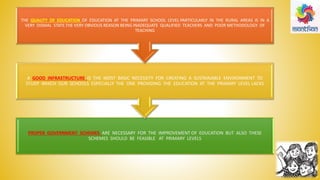
PROPER GOVERNMENT SCHEMES ARE NECESSARY FOR THE IMPROVEMENT OF EDUCATION BUT ALSO THESE
SCHEMES SHOULD BE FEASIBLE AT PRIMARY LEVELS
A GOOD INFRASTRUCTURE IS THE MOST BASIC NECESSITY FOR CREATING A SUSTAINABLE ENVIRONMENT TO
STUDY WHICH OUR SCHOOLS ESPECIALLY THE ONE PROVIDING THE EDUCATION AT THE PRIMARY LEVEL LACKS
THE QUALITY OF EDUCATION OF EDUCATION AT THE PRIMARY SCHOOL LEVEL PARTICULARLY IN THE RURAL AREAS IS IN A
VERY DISMAL STATE.THE VERY OBVIOUS REASON BEING INADEQUATE QUALIFIED TEACHERS AND POOR METHODOLOGY OF
TEACHING
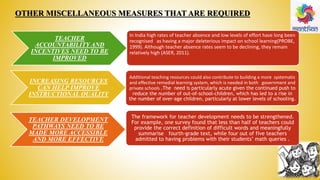
OTHER MISCELLANEOUS MEASURES THAT ARE REQUIRED
TEACHER
ACCOUNTABILITY AND
INCENTIVES NEED TO BE
IMPROVED
INCREASING RESOURCES
CAN HELP IMPROVE
INSTRUCTIONAL QUALITY
TEACHER DEVELOPMENT
PATHWAYS NEED TO BE
MADE MORE ACCESSIBLE
AND MORE EFFECTIVE
In India high rates of teacher absence and low levels of effort have long been
recognised as having a major deleterious impact on school learning(PROBE,
1999). Although teacher absence rates seem to be declining, they remain
relatively high (ASER, 2011).
Additional teaching resources could also contribute to building a more systematic
and effective remedial learning system, which is needed in both government and
private schools .The need is particularly acute given the continued push to
reduce the number of out-of-school-children, which has led to a rise in
the number of over-age children, particularly at lower levels of schooling.
The framework for teacher development needs to be strengthened.
For example, one survey found that less than half of teachers could
provide the correct definition of difficult words and meaningfully
summarise fourth-grade text, while four out of five teachers
admitted to having problems with their students’ math queries .
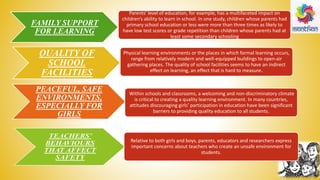
FAMILY SUPPORT
FOR LEARNING
QUALITY OF
SCHOOL
FACILITIES
PEACEFUL, SAFE
ENVIRONMENTS,
ESPECIALLY FOR
GIRLS
Parents’ level of education, for example, has a multifaceted impact on
children’s ability to learn in school. In one study, children whose parents had
primary school education or less were more than three times as likely to
have low test scores or grade repetition than children whose parents had at
least some secondary schooling
Physical learning environments or the places in which formal learning occurs,
range from relatively modern and well-equipped buildings to open-air
gathering places. The quality of school facilities seems to have an indirect
effect on learning, an effect that is hard to measure.
Within schools and classrooms, a welcoming and non-discriminatory climate
is critical to creating a quality learning environment. In many countries,
attitudes discouraging girls’ participation in education have been significant
barriers to providing quality education to all students.
Relative to both girls and boys, parents, educators and researchers express
important concerns about teachers who create an unsafe environment for
students.
EFFECTIVE SCHOOL
DISCIPLINE POLICIES
INCLUSIVE
ENVIRONMENTS
Well-managed schools and classrooms contribute to educational
quality. Students, teachers and administrators should agree upon
school and classroom rules and policies, and these should be clear
and understandable.
Reducing other forms of discrimination is also critical to quality
improvement in learning environments. Most countries, in all parts of
the world, struggle with effective inclusion of students with special
needs and disabilities.
THE FUTURE OF PRIMARY EDUCATION IN INDIA
Education in India has improved dramatically over the last three decades. Schools are accessible to most
children, both student enrollment and attendance are at their highest level, and teachers are adequately
remunerated. The RTE Act guarantees a quality education to a wider range of students than ever before.
However, challenges in implementing and monitoring high standards in teaching and learning outcomes across
regional, cultural and socioeconomic subsets prevent India from fully achieving this goal. In addition, teacher
support and scalability of high-performing teaching professionals in disparate areas, funding allocation for
schools in remote districts and limited use of technology in the classroom remain barriers to reforming primary
education.
India's growth story remains one of the most anticipated global economic trends, and its fulfillment relies on a well-
educated and skilled workforce. Improving education is a critical area of investment and focus if the country wants to
sustain economic growth and harness its young workforce. A weak foundation in primary education can derail the lives,
careers and productivity of tens of millions of its citizens. Already, a significant proportion of the adult workforce in
India is severely under-equipped to perform skilled and semi-skilled jobs. As Rajesh Sawhney, former president of
Reliance Entertainment and founder of GSFSuperangels, noted, "No one is unemployed in India; there are just a lot of
people who are unemployable."
Furthermore, in order to develop India as a consumer market of global standards, it is
imperative that all of its children reap the full benefits of a high-quality education.
Otherwise, large segments of the population in rural India will continue to have low
purchasing power, find themselves in highly leveraged scenarios and, more often than not,
continue to make a living through agricultural means. While some of this can be attributed
to deficiencies in secondary and tertiary education, the root of these issues lies in low-
quality primary education.
REFERENCES
• World Bank Data Bank
• knowledge.wharton.upenn.edu/article.cfm?articleid=3160
• Census of India
• Annual Status of Education Report (ASER)
• Sarva Shiksha Abhiyan
• http://forbesindia.com/article/briefing/primary-education-in-india-needs-a-
fix/35287/1
• birbhum.gov.in/DPSC/reference/19.pdf
• http://www.teachforindia.org/about-us/india-education-crisis
• www.nits.ac.in/department/Humanities%20new/new_hum/.../13.doc
• www.livemint.com/Opinion/.../Challenges-to-primary-education.html
• www.agastya.org/why/...education-in-india/report-on-primary-education
• birbhum.gov.in/DPSC/reference/19.pdf
• http://www.vifindia.org/article/2013/january/29/status-of-indian-
education-present-trends-and-past-systems-some-reflections

EngineersUnited

  • 1.
    TEAM DETAILS •ABHISHEK VARSHNEY •MOHITVARSHNEY •PIYUSH VARSHNEY •SHIVAM GOVIL •TRIBHUVAN NARAYAN SINGH
  • 2.
     PRIMARY EDUCATION BYTHE LAW  THE STATE SHALL PROVIDE FREE AND COMPULSORY EDUCATION TO ALL CHILDREN OF AGE 6 TO 14 YEARS IN SUCH A MANNER AS THE STATE MAY, BY LAW, DETERMINE.(ARTICLE 21A)  THE STATE SHALL ENDEAVOUR TO PROVIDE EARLY CHILDHOOD CARE AND EDUCATION FOR ALL CHILDREN UNTILL THEY COMPLETE THE AGE OF 6 YEARS( ARTICLE 45 )  STATE PARTIES ARE BOUND TO MAKE “AVAILABLE AND ACCESSIBLE TO EVERY CHILD” COMPULSORY AND FREE PRIMARY EDUCATION AND OPTIONS FOR , INCLUDING VOCATIONAL EDUCATION (ARTICLE 28- THE STATE OF WORLD CHILDREN REPORT-2012 WHAT IS PRIMARY EDUCATION? The basic elementary education parted to the children from the age of 6 , which makes them capable of reading , writing and reasoning. The very first step towards achieving the state of literacy and eligibility for employment. WHY PRIMARY EDUCATION? A strong primary education system is the cornerstone of any country's growth and prosperity. A weak foundation in primary education can derail the lives, careers and productivity of hundreds of millions of its citizens. 75 80 85 90 95 100 2001 2002 2003 2004 2007 2008 2009 2010 PRIMARY EDUCATION INDEX-INDIA TOTAL NET ENROLLMENT RATE PRIMARY EDUCATION IS AN INEVITABLE LINK IN THE PROCESS CHAIN OF DEVELOPMENT FOR ANY COUNTRY. DEVELOPMENT AND PROSPERITY ARE THE ULTIMATE RESULTS OF A PROCESS IN WHICH PRIMARY EDUCATION IS A VERY FIRST STEP. PRIMARY EDUCATION IS SEEN AS THE MOST INFLUENTIAL AGENT OF MODERNISATION APART FORM INDUSTRIALISATION AND URBANISATION IN INDIA
  • 3.
    LACK OF EDUCATION LACK OFMASS AWARENESS POVERTY REASONS FOR LOW ENROLLMENT IN PRIMARY EDUCATION WHY WE NEED A BETTER PRIMARY EDUCATION SYSTEM? A higher level of education quality increases a country’s rate of technological progress. Doubling access to primary education causes a decrease of food insecurity by approximately 20% or 24% The empowerment of women through education can play a crucial role in conquering childhood malnutrition. With higher levels of education, women are able to procure better incomes, allowing them to become economically empowered within their homes
  • 4.
    OPERATION BLACKBOARD-1987 • Theobjective of the scheme is providing students studying in primary settings with the necessary institutional equipment and instructional material to facilitate their education . In the ninth five year plan the scheme was extended to all upper primary schools as well. • Operation Blackboard lacked any element of motivating and supporting teachers. This reflects the centralised, bureaucratic administration of education, which maintains a large establishment but fails to attend to those central to its effective functioning DISTRICT PRIMARY EDUCATION PROGRAMME(DPEP)-1994 • Mobilization for Universalisation Of Elementary Education (UEE) by activating village education committees, teachers, parents/guardians and linking up with efforts under the Total Literacy Campaign. Cover all qualitative aspects such as school effectiveness, textbooks, teacher training and improvement in simple reading and learning skills. • The programme could not successfully provide quality education to the children. The main emphasis was shifted from quality education to building schools. Lack of proper training of the teachers remains a agony in the programme. The programme lacked proper counselling of the parents to encourage there children to study. MID DAY MEAL SCHEME-1995 • The primary objective of the scheme is to provide hot cooked meal to children of primary and upper primary classes. with other objectives of improving nutritional status of children, encouraging poor children, belonging to disadvantaged sections, to attend school more regularly and help them concentrate on classroom activities, thereby increasing the enrolment, retention and attendance rates. • Poor quality and inadequate nutrition of food is a common problem. Lack of monitoring over the schools in the distant villages. The Ministry of Human Resource Development has confirmed that 95 per cent of meal samples prepared by NGOs in Delhi did not meet nutritional standards in 2010-12 . SARVA SHIKSHA ABHIYAAN (EDUCATION FOR ALL MOVEMENT)- 2001 • Programme by the Government of India aimed at the universalization of elementary education "in a time bound manner", as mandated by the 86th amendment to the Constitution of India making free education to children aged 6–14 (estimated to be 205 million in number in 2001) a fundamental right . • Inadequate number of teaching staff in the DIET (District Institute of Educational Training), leading to significant shortfall in training activities, while some schools overstaffed. Almost 0.5% primary schools had no buildings while 1.6 per cent primary and upper primary schools functioned from kuchha structures. Shortage of power meant no computer education for upper primary schools. GOVERNMENT INITIATIVES IN IMPROVING PRIMARY EDUCATION
  • 5.
    FLAWED TEACHING METHODOLOGY Teachersin primary schools emphasises more on copying rather to make things understand able to the students . Children of second and third level are not able to read individual words but they can copy a paragraph from book neatly. The most important aspect of the approach is attitude of the teacher, which should be that learning is a form of play which fosters the blossoming of the child’s natural development. Learning should and can be made interesting, enjoyable, fun Purchase, production and replacemen t of books and teaching materials for the new classes IMPACT- A BETTER QUALITY OF EDUCATION SHALL BE IMPARTED . A QUALITY TEACHER STUDENT INTERACTION SHALL BE ENTERTAINED. IMPACT CRITERIA AGGREGATE GRADE OF ENROLED STUDENTS IMPROVEMENTS IN INTELLECTUAL, PHYSICAL AND SOCIAL ATTRIBUTES SINLGE HANDED JOB LOW TEACHER TO STUDENT RATIO INCENTIVES FOR TEACHERS •Teachers shall not be made to do any task other than teaching. This deviates the input from the teacher •Teacher can get to know the individual students better which allows them to better identify areas where the student needs help. •Teachers shall be rewarded on regular basis to emphasise interest in teaching.
  • 6.
    LINGUISTIC DIVERSITY India's linguistic diversity creates unique challenges for the nation's education system Thecountry's 22 official languages and hundreds of spoken dialects often differ considerably from the official language of the state or region IMPACT- WHEN THE MEDIUM OF STUDY SHALL BE IN THE NATIVE MEDIUM , THE STUDENTS WILL NOT HESISTATE TO PURSUE EDUCATION. OFTENLY FEAR OF NOT UNDERSTANDING A COMPLETELY DIFFERENT LANGUAGE INSTILS FEAR IN THE MIND OF STUDENTS WHICH SHALL EVENTUALLY BE REDUCED BY ADOPTING THIS MEASURE The basic curriculum shall comprise of native language as medium of study, whereas Hindi and English must come under subsidiary coursed IMPACT – The students will become well adept in communicating with native people and become capable of understanding the basic of the subject of study. IMPACT CRITERIA HIGH ENROLMENT DUE TO EASE OF STUDY AND NO FEAR OF AN ALIEN LANGUAGE LESSER NUMBER OF DROP OUTS. REVISED CURRICULUM INVOLVEMENT OF PARENTS FOCUSSED TEACHING STAFF •CURRICULUM SHALL BE DECIDED IN THE LANGIUAGE CORRESPONDING TO THE REGION •SINCE MEDIUM OF STUDY IS IN NATIVE LANGUAGE PARENTS CONTRIBUTION CAN BE INCLUDED •TEACHING STAFF SHALL BE EMPLOYED WHICH IS PROFECIENT IN THE NATIVE LANGUAGE SO THAT A GAP IS REDUCED BETWEEN TEACHER AND STUDNETS .
  • 7.
    LACK OF ENCOURAGEMENT INDIA PRIMARY EDUCATION SYSTEMHAS BEEN RUSTED BY THE LACK OF DYNAMISM IN THE CURRICULU M CHILDREN PREFER TO BUNK THE SCHOOL CHILDREN ARE NOT ENCOURAGED TO ATTEND SCHOOLS. THEYARE OFTEN MADE BY THEIR PARENTS TO EARN MONEY. ALSO MONOTONOUS SCHOOL SCHEDULE DEVIATES THEIR INTEREST The basic curriculum shall comprise of native language as medium of study, whereas Hindi and English must come under subsidiary coursed IMPACT – HIGH ENROLNMENT AND ABRUPT DECREASE IN THE NUMBER OF DROP OUTS. ALSO MOTIVATION TO PURSUE SECONDARY EDUCATION IS ACCOMPANIED IMPACT CRITERIA ATTENDANCE PERCENTAGE NO OF STUDENTS IN SECONDARY EDUCATION SOURCE OF ENTERTAINMENT PARENTAL AWARENESS REGULAR ASSESMENT OF CHILDREN PHYSICAL ATTRIBUTES •WEEKLY SCHEDULE OF PROVIDIG ENTERTAINMENT SHALL BE INCLUDED •PROGRAMMES SHALL BE LAUNCHED TO AWARE PARENTS ABOUT THE IMPORTANCE OF EDUCATION IN DAILY LIFE •THIS ENCOURAGES THE SOCIETY TO SEND THEIR WARDS IN THE LUST OF FREE HEALTH CHECK UPS
  • 8.
    PROPER GOVERNMENT SCHEMESARE NECESSARY FOR THE IMPROVEMENT OF EDUCATION BUT ALSO THESE SCHEMES SHOULD BE FEASIBLE AT PRIMARY LEVELS A GOOD INFRASTRUCTURE IS THE MOST BASIC NECESSITY FOR CREATING A SUSTAINABLE ENVIRONMENT TO STUDY WHICH OUR SCHOOLS ESPECIALLY THE ONE PROVIDING THE EDUCATION AT THE PRIMARY LEVEL LACKS THE QUALITY OF EDUCATION OF EDUCATION AT THE PRIMARY SCHOOL LEVEL PARTICULARLY IN THE RURAL AREAS IS IN A VERY DISMAL STATE.THE VERY OBVIOUS REASON BEING INADEQUATE QUALIFIED TEACHERS AND POOR METHODOLOGY OF TEACHING
  • 9.
    OTHER MISCELLANEOUS MEASURESTHAT ARE REQUIRED TEACHER ACCOUNTABILITY AND INCENTIVES NEED TO BE IMPROVED INCREASING RESOURCES CAN HELP IMPROVE INSTRUCTIONAL QUALITY TEACHER DEVELOPMENT PATHWAYS NEED TO BE MADE MORE ACCESSIBLE AND MORE EFFECTIVE In India high rates of teacher absence and low levels of effort have long been recognised as having a major deleterious impact on school learning(PROBE, 1999). Although teacher absence rates seem to be declining, they remain relatively high (ASER, 2011). Additional teaching resources could also contribute to building a more systematic and effective remedial learning system, which is needed in both government and private schools .The need is particularly acute given the continued push to reduce the number of out-of-school-children, which has led to a rise in the number of over-age children, particularly at lower levels of schooling. The framework for teacher development needs to be strengthened. For example, one survey found that less than half of teachers could provide the correct definition of difficult words and meaningfully summarise fourth-grade text, while four out of five teachers admitted to having problems with their students’ math queries .
  • 10.
    FAMILY SUPPORT FOR LEARNING QUALITYOF SCHOOL FACILITIES PEACEFUL, SAFE ENVIRONMENTS, ESPECIALLY FOR GIRLS Parents’ level of education, for example, has a multifaceted impact on children’s ability to learn in school. In one study, children whose parents had primary school education or less were more than three times as likely to have low test scores or grade repetition than children whose parents had at least some secondary schooling Physical learning environments or the places in which formal learning occurs, range from relatively modern and well-equipped buildings to open-air gathering places. The quality of school facilities seems to have an indirect effect on learning, an effect that is hard to measure. Within schools and classrooms, a welcoming and non-discriminatory climate is critical to creating a quality learning environment. In many countries, attitudes discouraging girls’ participation in education have been significant barriers to providing quality education to all students. Relative to both girls and boys, parents, educators and researchers express important concerns about teachers who create an unsafe environment for students.
  • 11.
    EFFECTIVE SCHOOL DISCIPLINE POLICIES INCLUSIVE ENVIRONMENTS Well-managedschools and classrooms contribute to educational quality. Students, teachers and administrators should agree upon school and classroom rules and policies, and these should be clear and understandable. Reducing other forms of discrimination is also critical to quality improvement in learning environments. Most countries, in all parts of the world, struggle with effective inclusion of students with special needs and disabilities.
  • 12.
    THE FUTURE OFPRIMARY EDUCATION IN INDIA Education in India has improved dramatically over the last three decades. Schools are accessible to most children, both student enrollment and attendance are at their highest level, and teachers are adequately remunerated. The RTE Act guarantees a quality education to a wider range of students than ever before. However, challenges in implementing and monitoring high standards in teaching and learning outcomes across regional, cultural and socioeconomic subsets prevent India from fully achieving this goal. In addition, teacher support and scalability of high-performing teaching professionals in disparate areas, funding allocation for schools in remote districts and limited use of technology in the classroom remain barriers to reforming primary education. India's growth story remains one of the most anticipated global economic trends, and its fulfillment relies on a well- educated and skilled workforce. Improving education is a critical area of investment and focus if the country wants to sustain economic growth and harness its young workforce. A weak foundation in primary education can derail the lives, careers and productivity of tens of millions of its citizens. Already, a significant proportion of the adult workforce in India is severely under-equipped to perform skilled and semi-skilled jobs. As Rajesh Sawhney, former president of Reliance Entertainment and founder of GSFSuperangels, noted, "No one is unemployed in India; there are just a lot of people who are unemployable." Furthermore, in order to develop India as a consumer market of global standards, it is imperative that all of its children reap the full benefits of a high-quality education. Otherwise, large segments of the population in rural India will continue to have low purchasing power, find themselves in highly leveraged scenarios and, more often than not, continue to make a living through agricultural means. While some of this can be attributed to deficiencies in secondary and tertiary education, the root of these issues lies in low- quality primary education.
  • 13.
    REFERENCES • World BankData Bank • knowledge.wharton.upenn.edu/article.cfm?articleid=3160 • Census of India • Annual Status of Education Report (ASER) • Sarva Shiksha Abhiyan • http://forbesindia.com/article/briefing/primary-education-in-india-needs-a- fix/35287/1 • birbhum.gov.in/DPSC/reference/19.pdf • http://www.teachforindia.org/about-us/india-education-crisis • www.nits.ac.in/department/Humanities%20new/new_hum/.../13.doc • www.livemint.com/Opinion/.../Challenges-to-primary-education.html • www.agastya.org/why/...education-in-india/report-on-primary-education • birbhum.gov.in/DPSC/reference/19.pdf • http://www.vifindia.org/article/2013/january/29/status-of-indian- education-present-trends-and-past-systems-some-reflections