NATIONALFAMILY WELFARE
PROGRAMME
Submitted by ;
Soumya ranjan parida
NATIONAL FAMILY WELFARE
PROGRAMME
INTRODUCTION : -
The National Family Welfare Programme
was lanced in 1952 as National Family
Planning Program . India was the first one
to do so. It is 100% centrally sponsored
program. The ministry of health and family
welfare is responsible for this program.
In 1977 the
government of India redesignated the
“National Family Planning Program” as the
“National Family Welfare Program”.
History :-
EARLY DEVELOPMENT : -
 The second 5 year plan (1956 to 1961) the
“clinic approach” was adopted . Large no of
family planning clinic were opened .
 The 3rd year plan (1961 to 1966) emphatic
recognition was given to family planning .
 In 1960 the NFWP entered a New
technological era with introduction of the
Lippi's loop later replaced by copper T .
Cont…
Later Development:-
 Target bound program .
 IUD insertion at the rate of 20/1000
urban and 10/1000 rural.
 Integration with maternal and child
welfare , immunization , nutrition and non
formal education.
Medical termination of Pregnancy Act
OBJECTIVE :-
To destabilize the population at the level
of some 130 million by the year 2050 AD
through small family norms.
AIM :-
To achieve a higher end that is to
improve the quality of the life of the
people.
CONCEPT:-
The term “family welfare”
is in much broader in
scope then “family
Planning” . The concept of
welfare is basically related
to “quality of life”. It
includes –
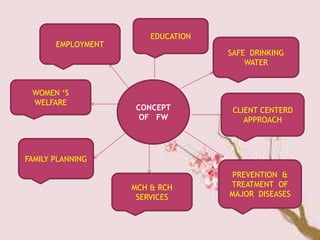
CONCEPT
OF FW
EDUCATION
SAFE DRINKING
WATER
EMPLOYMENT
WOMEN ‘S
WELFARE
FAMILY PLANNING
CLIENT CENTERD
APPROACH
PREVENTION &
TREATMENT OF
MAJOR DISEASES
MCH & RCH
SERVICES
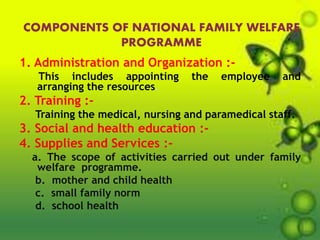
COMPONENTS OF NATIONAL FAMILY WELFARE
PROGRAMME
1. Administration and Organization :-
This includes appointing the employee and
arranging the resources.
2. Training :-
Training the medical, nursing and paramedical staff.
3. Social and health education :-
4. Supplies and Services :-
a. The scope of activities carried out under family
welfare programme.
b. mother and child health
c. small family norm
d. school health
RCH :-
Introduction :-
The reproductive and child health
program was formally launched by
Gov. of India on 15th Oct 1997. As per
recommendation of International
Conference on Population and
development held in Cario in 1994.
 In ICPD at Cairo ,fathallah ,defined RCH as “A
state of complete,physical,mental, and social
well-being and merely the absence of disease or
infirmity in all matters relating to reproductive
system and its function and process.”
 “A state in which people have the ability to
reproduce and regulate their fertility are able to
go through pregnancy and child birth, the
outcome of pregnancy is successful in terms of
maternal and infant survival and well-being ,and
couples are able to have sexual relation free of
the fear of pregnancy and of contracting
diseases.”
OBJECTIVE :-
1. To promote the health of the mothers
and children to ensure safe motherhood
and child survival.
2. The intermediate objective is to
reduce IMR & MMR.
3. The ultimate objective is population
stabilization , through responsible
reproductive behavior.
 Prevention and management of
unwanted pregnancies
Maternal care (safe motherhood)
Child survival
Prevention and management of
RTIS/STD
Prevention of HIV/AIDS
INTERVENTION/CONCEPT OF RCH
COMPONENT OF RCH
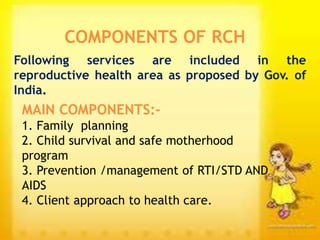
COMPONENTS OF RCH
Following services are included in the
reproductive health area as proposed by Gov. of
India.
MAIN COMPONENTS:-
1. Family planning
2. Child survival and safe motherhood
program
3. Prevention /management of RTI/STD AND
AIDS
4. Client approach to health care.
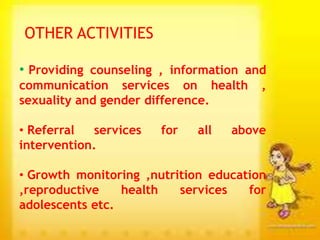
• Providing counseling , information and
communication services on health ,
sexuality and gender difference.
• Referral services for all above
intervention.
• Growth monitoring ,nutrition education
,reproductive health services for
adolescents etc.
OTHER ACTIVITIES
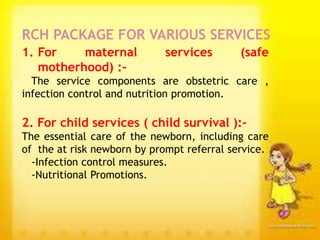
1. For maternal services (safe
motherhood) :-
The service components are obstetric care ,
infection control and nutrition promotion.
2. For child services ( child survival ):-
The essential care of the newborn, including care
of the at risk newborn by prompt referral service.
-Infection control measures.
-Nutritional Promotions.
RCH PACKAGE FOR VARIOUS SERVICES
Cont……
3. Reproductive Health :-
- Fertility control
- MTP services ( for prevention and
management of unwanted Pregnancies.
- Adolescent
- HIV/ AIDS
Under the RCH Programme Phase 1 , various
provision were made to improve the status of
maternal and child health. These include :-
- Provision of essential & emergency and essential care.
- Provision of equipment and drug kits to selected PHCs
and selected FRUs in all districts.
- Provision for additional ANM , Staff nurse, and
Laboratory technicians for selected districts.
- Provision for 24 hours delivery services at PHCs and
CHCs.
CONTI….
 Referral transport in case of obstetric complication
 Immunization and oral rehydration therapy.
 Prevention and control of vitamin A deficiency in
children.
 Integrated management of childhood illness.(IMCI).
 District surveys for focused intervention to reduce
IMR and MMR.
 New initiative undertaken during phase 1
of RCH are :
 setting up of blood storage units at FRUs
 Training of MBBS doctors in anesthetic skills for
emergency obstetric care at FRU.
 They were as follows :-
 The outreach services were not available to the
vulnerable and needy population.
 The management of financial resources were
inadequate .
 The human resources such as doctors , nurse ,
health worker , etc were deficient.
 The management information and evaluation system
was lacking.
 The effective network of first referral units was
lacking .
 Quality of services in PHCs and CHCs was poor.
 Lack of community participation.
RCH 2 was started from 1st April 2005 up to
2009. The RCH 2 vision articulates, “
improving access , use and quality of RCH
services , especially for the poor and
underserved population .”
AIMOF RCH 2
To reduce infant mortality rate , maternal
mortality rate, total fertility rate, and to
increase couple protection rate and
immunization coverage specially in rural areas.
 To improve the management performance.
 To develop human resources intensively.
 To expand RCH services to tribal areas also.
 To monitor and evaluate the services.
 To improve the quality, coverage and
effectiveness of the existing family welfare
services and essential RCH services with a
special focus on the above mentioned EAG
states.
1) Population stabilization
2) Maternal health
3) Newborn care
4) Child health
5) Adolescent health
6) Control of RTI/STIS
7) Urban health
8) Tribal health
9) Monitoring and evaluation
10) Other priority areas
 By increasing the number of trained personnel
like medial officer of PHCs and female health
worker of sub centers.
 By covering the services at grass roots level by
having linkage with ICDS
 Involving panchayati raj institutions urban local
bodies and NGOs
 By training one couple from each village to
provide nonclinical family planning method
services.
 By involving district urban development
authorities (DUDA)cooperative societies and
industrial workers in providing family planning
services
 By identifying NGOs to provide financial technical
and managerial support
The strategies to improve and strengthen
the quality of maternal services are
(a) Essential obstetric care
(b) Emergency obstetric care
(a) ESSENTIAL OBSTETRICCARE:-
• Three or more antenatal checkups
• Two doses of tetanus toxoid
• One pack of Iron folic acid tablets
during the last trimester
• Counseling on promoting of institutional
delivery.
This consists of operationalizing the first referral
units to be fully functional round the clock (24
hours).
 First referral unit(FRU):
 it is an upgraded PHC/CHC into a 30 bedded
hospital, having a well furnished and equipped
operation theater with a newborn care corner, a
labor room , blood bank and laboratory to
provide the services of obstetric emergencies
such as cesarean section and adequate supply of
drugs to the patients , care of sick children
,family welfare services.
1.Janani Suraksha Yojana (JYS)
Scheme.
2. Prasoothi araiker
3. Training of traditional birth
attendants.
4. Training of MOs in the skill of
obstetric management.
The effective health interventions for the newborn
starting from the antenatal period ,intarpartum and
immediate newborn care , early newborn care ,late
neonatal care.
 Navjaat shishu suraksha karyakarm (NSSK):-The main
aspect of NSSK are prevention of hypothermia ,
prevention of infection , early initiation of breast
feeding.
 Facility based IMNCI :- It focuses on providing
appropriate inpatient management of the major
cause of neonatal and childhood mortality .
 Sick newborn care (SNCU).
Home based care (HBNC).
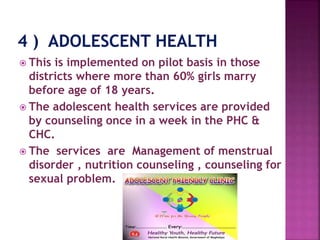
 This is implemented on pilot basis in those
districts where more than 60% girls marry
before age of 18 years.
 The adolescent health services are provided
by counseling once in a week in the PHC &
CHC.
 The services are Management of menstrual
disorder , nutrition counseling , counseling for
sexual problem.
-This is improved by providing quality
primary health care to the urban poor by
establishing urban health centers (UHC)
ratio is 1: 50,000 population .
-Where 1 MO, 3-4 ANM, ! Lab assistant, 1
Public health nurse, 1 clerk , 1 Peon and 1
Chowkidar.
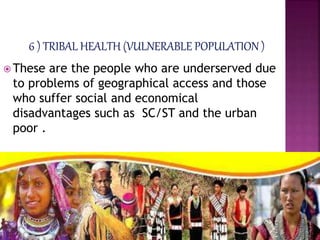
 These are the people who are underserved due
to problems of geographical access and those
who suffer social and economical
disadvantages such as SC/ST and the urban
poor .
Goal is to improve their health
status.
Objective :-
To bring their health status at
par with the rest of the
population
Management Information and Evaluation System
(MIES)
This is done by following measures :
- Planning is done at various levels of Sub center,
PHC, CHC, District & State.
- Monitoring is done by establishing Consumer Need
Assessment Approach cell at district and state level
with an officer incharge.
- Evaluation is done through District Surveys,
National Family Health Survey, Focus studies and
Census report
- -Validation is by supervision and surveys.
The services provided under RCH-2 are :-
 Health education
 TB control programme
 Store and distribution of anti-malaria drugs,
 ANC service
 contraceptive distribution and
 referral for terminal methods.
DEFINITION
WHO “ a way of thinking & living that is
adopted voluntary upon the basis of
knowledge , attitudes & responsible
decisions by individuals and couples , in
order to promote the health & welfare of
the family group & contribute effectively
to the social development of a country”.
-To bring down population growth.
- To reduce the maternal & child
mortality rate.
- To control the unwanted birth.
- To prevent from abortion.
- To bring out wanted birth.
- To bring interval between pregnancies.
1. Operational goals
2. Demographic goals
1. Operational Goals :-
- To promote the voluntary acceptance of small
family norms .
 Family planning has two main goals :-
- To promote the people to use of spacing
between children's.
- Child survival.
- Poverty eradication & socio – economic growth.
- Stabilizing the population by the year 2045.
- Reduce the infant mortality rate to level below
30/1000 live childbirth.
- Reduce the maternal mortality rate to the level
below of 100/100,000 live child birth.
SCOPE OF FAMILY PLANNING :-
-Proper spacing between birth.
- Limited number of child birth.
- Sex education
- Nutritional education.
- Pregnancy test.
- Diagnosis of reproductive tract infection.
- Preparing for first birth.
It means prevention against pregnancy .It can also be
termed as Fertility Regulation.
- Now a days many kinds of contraception are widely
used for family planning purpose.
- The method or device used for the contraception or
prevent pregnancy is called Contraception Device.
CHARACTERISTICS :-
- It should be effective for prevent pregnancy.
- It should not be harmful for the health.
- It should have long life and in expensive
- It should be simple & could be used without any
consultation or supervision of doctor/medical personal
FAMILY PLANNING
METHOD
1. Natural Method
2. Mechanical Method
3. Hormonal Method
4. Surgical Method
1. Natural Method
a. Calendar Method
b. Basal Body Temperature
c. Cervical Mucosa
d. Sympto thermal Method
e. Ovulation awareness
f. Lactional Amenorrhea
g. Withdrawal Method
a. Female condom
b. Male Condom
c. Diaphragm
d. Spermicidal
e. Intra uterine device
f. Sponge
3. Hormonal Method :-
a. Skin patch
b. Pill’s (combined pills)
c. Vaginal ring
d. Injection
e. Implant
a. Vasectomy
b. Tubectomy
1. NATURAL METHOD :-
a. Calendar method
 Woman has to make a record of her periods for
six months
 Each month the number of days between the
starting of one period and the next one is
recorded for the last 6months
 The longest and shortest interval is recorded
between the periods from the shortest interval
subtract 18 days and subtract 11 from the longest
interval between the starting periods .The
interval between these two values will be the
phase of ovulation .
Example:-A woman recorded 28 days as the
shortest interval and 30 days as the longest
interval between the periods .
From shortest interval, subtract 18
28-18=10days
From longest interval, subtract 11
30-11=19days
The phase of conception
10 to 19 days
b. WITHDRAWAL METHOD:-
The withdrawal of the penis from the vagina
just before the ejaculation.
C.LACTATIONAL AMENORRHEA METHOD;-
 This method can be used by a women who is
breastfeeding her baby day and night .It
provide natural protection against pregnancy
for up to 6months .Breastfeeding suppresses
ovulation .
 The failure rate is 1 to 2%
2. MECHANICAL METHOD
A. MALE CONDOM;-
It is a sheath or covering which is made of
thin latex rubber to fit over a man’s erect penis
.
ADVANTAGES :-
Cheaper & easy to carry.
 No side effect .
Protection against STD & AIDS.
Reduce the incidence of tubal
fertility & Ectopic pregency .
DISADVANTAGES :-
Inadequate sexual pleasure .
To discard after one coital act.
B. INTRAUTERINE CONTRACEPTIVE DEVICE
 An IUD is known as Coil is a small plastic and copper
device .
 Usually shaped like ‘T’ which is fitted into uterus by a
doctor using a simple procedure and provide protection
against pregnancy .
 In IUD can stay in place 5 to 10 year .
TYPES OF IUDs:-
(a)LIPPE’S LOOP
(b)COPPER T
COPPER T :- Copper reduces the fertility of woman so
that it is used for contraceptive.
Advantages :-
- Inexpensive , easy to use and can be inserted in minimal
time.
- Effective contraceptive.
- Fertility can be restored removal of copper T.
- Disadvantages
- Pain and bleeding.
- Ectopic pregency.
HORMONAL METHOD
Hormonal contraceptives are the effective
means of maintaining interval between births. It
includes :-
1. ORAL PILLS
2. Mixed Pills
3. Mini Pills ( Progesterone only pills)
4. Post Coital Pills
5. Non Steroidal weekly oral pills
6. Long acting /Once a month pills
7. Emergency Contraceptive pills ( E – Pills )
 It include both Oestron & progestron .
 This pills is to be taken from 5th day of
menstrual cycle upto 21st days continually .
 Department of Family Welfare has made
available the pills named Mala – N & Mala –D.
Their contents are –
• Norethisterone acetate
• +
• Ethynyl oestradiol
Mala - N
• Noregestrol
• +
• Ethynyloestradial
Mala - D
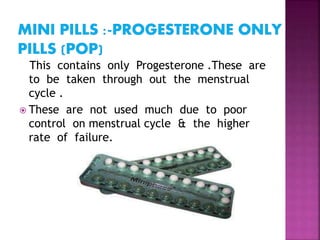
This contains only Progesterone .These are
to be taken through out the menstrual
cycle .
 These are not used much due to poor
control on menstrual cycle & the higher
rate of failure.
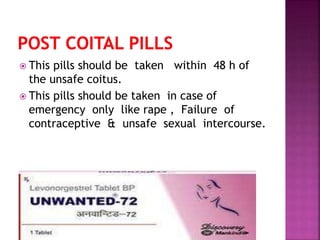
 This pills should be taken within 48 h of
the unsafe coitus.
 This pills should be taken in case of
emergency only like rape , Failure of
contraceptive & unsafe sexual intercourse.
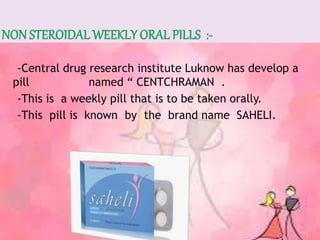
-Central drug research institute Luknow has develop a
pill named “ CENTCHRAMAN .
-This is a weekly pill that is to be taken orally.
-This pill is known by the brand name SAHELI.
-Long acting estrogen & short acting Progesterone are
mixed in this tablet.
- This pill is taken only once a month.
- Its harmful effect only rate of failure is very high .
- Advantages :-
- Prevents pregencey
- Shortness period.
- Prevents ovarian and uterine cancer.
- Disadvantages :-
- Headache
- Malaise
- Leg cramps
- Weight gain.
- Sleep disturbance.
- Hypertension
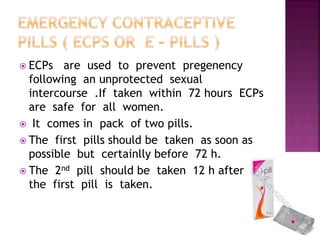
 ECPs are used to prevent pregenency
following an unprotected sexual
intercourse .If taken within 72 hours ECPs
are safe for all women.
 It comes in pack of two pills.
 The first pills should be taken as soon as
possible but certainlly before 72 h.
 The 2nd pill should be taken 12 h after
the first pill is taken.
SURGICAL METHOD :-
 VESECTOMY :-
 It is simple operation performed under local
anaesthsia .
 In this method both of the vas-difference are cut
1cm each & clamped or their heads are tied in a
manner that they can not unite again .
 These days more attention in being paid to
microvesectomy to avoid cuts & stiches.
Permanent , safe
, inexpensive
technique .
Does not effect
normal working
after the
operation .
Does not
interfere with
sexual pleasure. Hospitalization
not required .
Can be
conducted
any where (
Sub center ,
PHC etc.)
Pain ,hematoma in scrotum
Local infection
Impotency
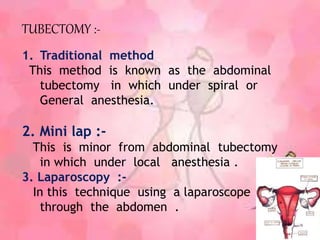
TUBECTOMY :-
1. Traditional method
This method is known as the abdominal
tubectomy in which under spiral or
General anesthesia.
2. Mini lap :-
This is minor from abdominal tubectomy
in which under local anesthesia .
3. Laparoscopy :-
In this technique using a laparoscope
through the abdomen .
 Local infection.
 Some women complain of bleeding.
 Irregulatingr of cycle.
DISADVANTAGES
 This method is almost 100% safe against
pregencey .
 Minimal complication .
 Comparatively less expensive .
ADVANTAGES
 Motivation of eligible couple on family welfare
methods.
 Follow up of IUD & Oral Pills users.
 Organizing special camping .Domiciliary services for
perinatal care.
 Educational activities.
 Records maintainces.
 Maintaining adequate supplies .
Evaluation of programme.
ROLE OF NURSE IN FAMILY WELFARE
PROGRAMME
BIBLIOGRAPHY
1. Park K. , ‘Parks essential of community health &
nursing” , 6th edition , M/S Banarsidas Bhanot
Publishers , 2012 , Pp : 390 – 391
2. Park K. , “ Parks textbook of Preventive &
social medicine 22nd edition , M/S Banarsidas
Bhanot Publishers , 2013 , Pp :371– 318
3. Rao sridhar B. ‘community health Nursing” 2nd
edition Aitbs Publishers Pp : 213
4. Suryakanta AH , community Medicine with
recent advantages 3rd edition Jaypee brothers
medical publishers P (Ltd) Pp :859 -869
National family welfare programme (2)

National family welfare programme (2)

  • 2.
  • 3.
    NATIONAL FAMILY WELFARE PROGRAMME INTRODUCTION: - The National Family Welfare Programme was lanced in 1952 as National Family Planning Program . India was the first one to do so. It is 100% centrally sponsored program. The ministry of health and family welfare is responsible for this program. In 1977 the government of India redesignated the “National Family Planning Program” as the “National Family Welfare Program”.
  • 4.
    History :- EARLY DEVELOPMENT: -  The second 5 year plan (1956 to 1961) the “clinic approach” was adopted . Large no of family planning clinic were opened .  The 3rd year plan (1961 to 1966) emphatic recognition was given to family planning .  In 1960 the NFWP entered a New technological era with introduction of the Lippi's loop later replaced by copper T .
  • 5.
    Cont… Later Development:-  Targetbound program .  IUD insertion at the rate of 20/1000 urban and 10/1000 rural.  Integration with maternal and child welfare , immunization , nutrition and non formal education. Medical termination of Pregnancy Act
  • 6.
    OBJECTIVE :- To destabilizethe population at the level of some 130 million by the year 2050 AD through small family norms. AIM :- To achieve a higher end that is to improve the quality of the life of the people.
  • 7.
    CONCEPT:- The term “familywelfare” is in much broader in scope then “family Planning” . The concept of welfare is basically related to “quality of life”. It includes –
  • 8.
    CONCEPT OF FW EDUCATION SAFE DRINKING WATER EMPLOYMENT WOMEN‘S WELFARE FAMILY PLANNING CLIENT CENTERD APPROACH PREVENTION & TREATMENT OF MAJOR DISEASES MCH & RCH SERVICES
  • 9.
    COMPONENTS OF NATIONALFAMILY WELFARE PROGRAMME 1. Administration and Organization :- This includes appointing the employee and arranging the resources. 2. Training :- Training the medical, nursing and paramedical staff. 3. Social and health education :- 4. Supplies and Services :- a. The scope of activities carried out under family welfare programme. b. mother and child health c. small family norm d. school health
  • 11.
    RCH :- Introduction :- Thereproductive and child health program was formally launched by Gov. of India on 15th Oct 1997. As per recommendation of International Conference on Population and development held in Cario in 1994.
  • 12.
     In ICPDat Cairo ,fathallah ,defined RCH as “A state of complete,physical,mental, and social well-being and merely the absence of disease or infirmity in all matters relating to reproductive system and its function and process.”  “A state in which people have the ability to reproduce and regulate their fertility are able to go through pregnancy and child birth, the outcome of pregnancy is successful in terms of maternal and infant survival and well-being ,and couples are able to have sexual relation free of the fear of pregnancy and of contracting diseases.”
  • 13.
    OBJECTIVE :- 1. Topromote the health of the mothers and children to ensure safe motherhood and child survival. 2. The intermediate objective is to reduce IMR & MMR. 3. The ultimate objective is population stabilization , through responsible reproductive behavior.
  • 14.
     Prevention andmanagement of unwanted pregnancies Maternal care (safe motherhood) Child survival Prevention and management of RTIS/STD Prevention of HIV/AIDS INTERVENTION/CONCEPT OF RCH
  • 15.
  • 16.
    COMPONENTS OF RCH Followingservices are included in the reproductive health area as proposed by Gov. of India. MAIN COMPONENTS:- 1. Family planning 2. Child survival and safe motherhood program 3. Prevention /management of RTI/STD AND AIDS 4. Client approach to health care.
  • 17.
    • Providing counseling, information and communication services on health , sexuality and gender difference. • Referral services for all above intervention. • Growth monitoring ,nutrition education ,reproductive health services for adolescents etc. OTHER ACTIVITIES
  • 18.
    1. For maternalservices (safe motherhood) :- The service components are obstetric care , infection control and nutrition promotion. 2. For child services ( child survival ):- The essential care of the newborn, including care of the at risk newborn by prompt referral service. -Infection control measures. -Nutritional Promotions. RCH PACKAGE FOR VARIOUS SERVICES
  • 19.
    Cont…… 3. Reproductive Health:- - Fertility control - MTP services ( for prevention and management of unwanted Pregnancies. - Adolescent - HIV/ AIDS
  • 20.
    Under the RCHProgramme Phase 1 , various provision were made to improve the status of maternal and child health. These include :- - Provision of essential & emergency and essential care. - Provision of equipment and drug kits to selected PHCs and selected FRUs in all districts. - Provision for additional ANM , Staff nurse, and Laboratory technicians for selected districts. - Provision for 24 hours delivery services at PHCs and CHCs.
  • 21.
    CONTI….  Referral transportin case of obstetric complication  Immunization and oral rehydration therapy.  Prevention and control of vitamin A deficiency in children.  Integrated management of childhood illness.(IMCI).  District surveys for focused intervention to reduce IMR and MMR.  New initiative undertaken during phase 1 of RCH are :  setting up of blood storage units at FRUs  Training of MBBS doctors in anesthetic skills for emergency obstetric care at FRU.
  • 22.
     They wereas follows :-  The outreach services were not available to the vulnerable and needy population.  The management of financial resources were inadequate .  The human resources such as doctors , nurse , health worker , etc were deficient.  The management information and evaluation system was lacking.  The effective network of first referral units was lacking .  Quality of services in PHCs and CHCs was poor.  Lack of community participation.
  • 23.
    RCH 2 wasstarted from 1st April 2005 up to 2009. The RCH 2 vision articulates, “ improving access , use and quality of RCH services , especially for the poor and underserved population .” AIMOF RCH 2 To reduce infant mortality rate , maternal mortality rate, total fertility rate, and to increase couple protection rate and immunization coverage specially in rural areas.
  • 24.
     To improvethe management performance.  To develop human resources intensively.  To expand RCH services to tribal areas also.  To monitor and evaluate the services.  To improve the quality, coverage and effectiveness of the existing family welfare services and essential RCH services with a special focus on the above mentioned EAG states.
  • 25.
    1) Population stabilization 2)Maternal health 3) Newborn care 4) Child health 5) Adolescent health 6) Control of RTI/STIS 7) Urban health 8) Tribal health 9) Monitoring and evaluation 10) Other priority areas
  • 26.
     By increasingthe number of trained personnel like medial officer of PHCs and female health worker of sub centers.  By covering the services at grass roots level by having linkage with ICDS  Involving panchayati raj institutions urban local bodies and NGOs  By training one couple from each village to provide nonclinical family planning method services.  By involving district urban development authorities (DUDA)cooperative societies and industrial workers in providing family planning services  By identifying NGOs to provide financial technical and managerial support
  • 27.
    The strategies toimprove and strengthen the quality of maternal services are (a) Essential obstetric care (b) Emergency obstetric care (a) ESSENTIAL OBSTETRICCARE:- • Three or more antenatal checkups • Two doses of tetanus toxoid • One pack of Iron folic acid tablets during the last trimester • Counseling on promoting of institutional delivery.
  • 28.
    This consists ofoperationalizing the first referral units to be fully functional round the clock (24 hours).  First referral unit(FRU):  it is an upgraded PHC/CHC into a 30 bedded hospital, having a well furnished and equipped operation theater with a newborn care corner, a labor room , blood bank and laboratory to provide the services of obstetric emergencies such as cesarean section and adequate supply of drugs to the patients , care of sick children ,family welfare services.
  • 29.
    1.Janani Suraksha Yojana(JYS) Scheme. 2. Prasoothi araiker 3. Training of traditional birth attendants. 4. Training of MOs in the skill of obstetric management.
  • 30.
    The effective healthinterventions for the newborn starting from the antenatal period ,intarpartum and immediate newborn care , early newborn care ,late neonatal care.  Navjaat shishu suraksha karyakarm (NSSK):-The main aspect of NSSK are prevention of hypothermia , prevention of infection , early initiation of breast feeding.  Facility based IMNCI :- It focuses on providing appropriate inpatient management of the major cause of neonatal and childhood mortality .  Sick newborn care (SNCU). Home based care (HBNC).
  • 31.
     This isimplemented on pilot basis in those districts where more than 60% girls marry before age of 18 years.  The adolescent health services are provided by counseling once in a week in the PHC & CHC.  The services are Management of menstrual disorder , nutrition counseling , counseling for sexual problem.
  • 32.
    -This is improvedby providing quality primary health care to the urban poor by establishing urban health centers (UHC) ratio is 1: 50,000 population . -Where 1 MO, 3-4 ANM, ! Lab assistant, 1 Public health nurse, 1 clerk , 1 Peon and 1 Chowkidar.
  • 33.
     These arethe people who are underserved due to problems of geographical access and those who suffer social and economical disadvantages such as SC/ST and the urban poor .
  • 34.
    Goal is toimprove their health status. Objective :- To bring their health status at par with the rest of the population
  • 35.
    Management Information andEvaluation System (MIES) This is done by following measures : - Planning is done at various levels of Sub center, PHC, CHC, District & State. - Monitoring is done by establishing Consumer Need Assessment Approach cell at district and state level with an officer incharge. - Evaluation is done through District Surveys, National Family Health Survey, Focus studies and Census report - -Validation is by supervision and surveys.
  • 36.
    The services providedunder RCH-2 are :-  Health education  TB control programme  Store and distribution of anti-malaria drugs,  ANC service  contraceptive distribution and  referral for terminal methods.
  • 38.
    DEFINITION WHO “ away of thinking & living that is adopted voluntary upon the basis of knowledge , attitudes & responsible decisions by individuals and couples , in order to promote the health & welfare of the family group & contribute effectively to the social development of a country”.
  • 39.
    -To bring downpopulation growth. - To reduce the maternal & child mortality rate. - To control the unwanted birth. - To prevent from abortion. - To bring out wanted birth. - To bring interval between pregnancies.
  • 40.
    1. Operational goals 2.Demographic goals 1. Operational Goals :- - To promote the voluntary acceptance of small family norms .  Family planning has two main goals :- - To promote the people to use of spacing between children's. - Child survival. - Poverty eradication & socio – economic growth.
  • 41.
    - Stabilizing thepopulation by the year 2045. - Reduce the infant mortality rate to level below 30/1000 live childbirth. - Reduce the maternal mortality rate to the level below of 100/100,000 live child birth. SCOPE OF FAMILY PLANNING :- -Proper spacing between birth. - Limited number of child birth. - Sex education - Nutritional education. - Pregnancy test. - Diagnosis of reproductive tract infection. - Preparing for first birth.
  • 43.
    It means preventionagainst pregnancy .It can also be termed as Fertility Regulation. - Now a days many kinds of contraception are widely used for family planning purpose. - The method or device used for the contraception or prevent pregnancy is called Contraception Device. CHARACTERISTICS :- - It should be effective for prevent pregnancy. - It should not be harmful for the health. - It should have long life and in expensive - It should be simple & could be used without any consultation or supervision of doctor/medical personal
  • 44.
  • 45.
    1. Natural Method 2.Mechanical Method 3. Hormonal Method 4. Surgical Method 1. Natural Method a. Calendar Method b. Basal Body Temperature c. Cervical Mucosa d. Sympto thermal Method e. Ovulation awareness f. Lactional Amenorrhea g. Withdrawal Method
  • 46.
    a. Female condom b.Male Condom c. Diaphragm d. Spermicidal e. Intra uterine device f. Sponge 3. Hormonal Method :- a. Skin patch b. Pill’s (combined pills) c. Vaginal ring d. Injection e. Implant
  • 47.
    a. Vasectomy b. Tubectomy 1.NATURAL METHOD :- a. Calendar method  Woman has to make a record of her periods for six months  Each month the number of days between the starting of one period and the next one is recorded for the last 6months
  • 48.
     The longestand shortest interval is recorded between the periods from the shortest interval subtract 18 days and subtract 11 from the longest interval between the starting periods .The interval between these two values will be the phase of ovulation . Example:-A woman recorded 28 days as the shortest interval and 30 days as the longest interval between the periods . From shortest interval, subtract 18 28-18=10days From longest interval, subtract 11 30-11=19days The phase of conception 10 to 19 days
  • 49.
    b. WITHDRAWAL METHOD:- Thewithdrawal of the penis from the vagina just before the ejaculation. C.LACTATIONAL AMENORRHEA METHOD;-  This method can be used by a women who is breastfeeding her baby day and night .It provide natural protection against pregnancy for up to 6months .Breastfeeding suppresses ovulation .  The failure rate is 1 to 2% 2. MECHANICAL METHOD A. MALE CONDOM;- It is a sheath or covering which is made of thin latex rubber to fit over a man’s erect penis .
  • 50.
    ADVANTAGES :- Cheaper &easy to carry.  No side effect . Protection against STD & AIDS. Reduce the incidence of tubal fertility & Ectopic pregency . DISADVANTAGES :- Inadequate sexual pleasure . To discard after one coital act.
  • 51.
    B. INTRAUTERINE CONTRACEPTIVEDEVICE  An IUD is known as Coil is a small plastic and copper device .  Usually shaped like ‘T’ which is fitted into uterus by a doctor using a simple procedure and provide protection against pregnancy .  In IUD can stay in place 5 to 10 year .
  • 52.
    TYPES OF IUDs:- (a)LIPPE’SLOOP (b)COPPER T COPPER T :- Copper reduces the fertility of woman so that it is used for contraceptive. Advantages :- - Inexpensive , easy to use and can be inserted in minimal time. - Effective contraceptive. - Fertility can be restored removal of copper T. - Disadvantages - Pain and bleeding. - Ectopic pregency.
  • 53.
    HORMONAL METHOD Hormonal contraceptivesare the effective means of maintaining interval between births. It includes :- 1. ORAL PILLS 2. Mixed Pills 3. Mini Pills ( Progesterone only pills) 4. Post Coital Pills 5. Non Steroidal weekly oral pills 6. Long acting /Once a month pills 7. Emergency Contraceptive pills ( E – Pills )
  • 54.
     It includeboth Oestron & progestron .  This pills is to be taken from 5th day of menstrual cycle upto 21st days continually .  Department of Family Welfare has made available the pills named Mala – N & Mala –D. Their contents are – • Norethisterone acetate • + • Ethynyl oestradiol Mala - N • Noregestrol • + • Ethynyloestradial Mala - D
  • 55.
    This contains onlyProgesterone .These are to be taken through out the menstrual cycle .  These are not used much due to poor control on menstrual cycle & the higher rate of failure.
  • 56.
     This pillsshould be taken within 48 h of the unsafe coitus.  This pills should be taken in case of emergency only like rape , Failure of contraceptive & unsafe sexual intercourse.
  • 57.
    -Central drug researchinstitute Luknow has develop a pill named “ CENTCHRAMAN . -This is a weekly pill that is to be taken orally. -This pill is known by the brand name SAHELI.
  • 58.
    -Long acting estrogen& short acting Progesterone are mixed in this tablet. - This pill is taken only once a month. - Its harmful effect only rate of failure is very high . - Advantages :- - Prevents pregencey - Shortness period. - Prevents ovarian and uterine cancer. - Disadvantages :- - Headache - Malaise - Leg cramps - Weight gain. - Sleep disturbance. - Hypertension
  • 59.
     ECPs areused to prevent pregenency following an unprotected sexual intercourse .If taken within 72 hours ECPs are safe for all women.  It comes in pack of two pills.  The first pills should be taken as soon as possible but certainlly before 72 h.  The 2nd pill should be taken 12 h after the first pill is taken.
  • 60.
    SURGICAL METHOD :- VESECTOMY :-  It is simple operation performed under local anaesthsia .  In this method both of the vas-difference are cut 1cm each & clamped or their heads are tied in a manner that they can not unite again .  These days more attention in being paid to microvesectomy to avoid cuts & stiches.
  • 61.
    Permanent , safe ,inexpensive technique . Does not effect normal working after the operation . Does not interfere with sexual pleasure. Hospitalization not required . Can be conducted any where ( Sub center , PHC etc.)
  • 62.
    Pain ,hematoma inscrotum Local infection Impotency
  • 63.
    TUBECTOMY :- 1. Traditionalmethod This method is known as the abdominal tubectomy in which under spiral or General anesthesia. 2. Mini lap :- This is minor from abdominal tubectomy in which under local anesthesia . 3. Laparoscopy :- In this technique using a laparoscope through the abdomen .
  • 64.
     Local infection. Some women complain of bleeding.  Irregulatingr of cycle. DISADVANTAGES  This method is almost 100% safe against pregencey .  Minimal complication .  Comparatively less expensive . ADVANTAGES
  • 65.
     Motivation ofeligible couple on family welfare methods.  Follow up of IUD & Oral Pills users.  Organizing special camping .Domiciliary services for perinatal care.  Educational activities.  Records maintainces.  Maintaining adequate supplies . Evaluation of programme. ROLE OF NURSE IN FAMILY WELFARE PROGRAMME
  • 68.
    BIBLIOGRAPHY 1. Park K., ‘Parks essential of community health & nursing” , 6th edition , M/S Banarsidas Bhanot Publishers , 2012 , Pp : 390 – 391 2. Park K. , “ Parks textbook of Preventive & social medicine 22nd edition , M/S Banarsidas Bhanot Publishers , 2013 , Pp :371– 318 3. Rao sridhar B. ‘community health Nursing” 2nd edition Aitbs Publishers Pp : 213 4. Suryakanta AH , community Medicine with recent advantages 3rd edition Jaypee brothers medical publishers P (Ltd) Pp :859 -869