ELECTRIC
VEHICLES:
An Alternate Urban
Commuting
Krishnakumar R V
M.E Power Engineering And Management
Anna University Chennai
CEG Campus
Why EV?
1.Pollution:
According to DOE (USA)
• Transportation accounts for one third of all energy usage.
• Use of 10% of ZEV cuts 1 million tons/year of air pollutants
• With 100% EV - CO2 emission would be cut by half
2.Capital Cost and Maintenance Cost:
• EV has a more capital cost
• But life cycle cost of EV is lesser than ICEV
6/6/2017
DeptofPowerEngg&Mgmt.,AnnaUniversity
Chennai
2
Why EV?
3.Availability of Fuel
Fast depletion of fossil fuel and dependence on
middle east countries for fuel.
4.Well to Wheel Efficiency
The EV is found to have a better WTW efficiency
than ICEV
6/6/2017
DeptofPowerEngg&Mgmt.,AnnaUniversity
Chennai
3
What is an EV?
It is a vehicle which has following features
• Portable energy source
• Traction effort provided by electric motor
6/6/2017
DeptofPowerEngg&Mgmt.,AnnaUniversity
Chennai
4
Classification of Alternative
Vehicle
• Electric Vehicle
• Hybrid Electric Vehicle
• Plug-in Hybrid Electric Vehicle
6/6/2017
DeptofPowerEngg&Mgmt.,AnnaUniversity
Chennai
5
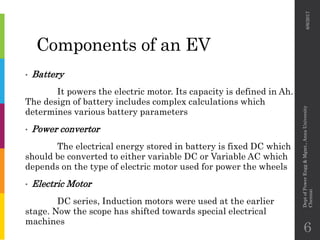
Components of an EV
• Battery
It powers the electric motor. Its capacity is defined in Ah.
The design of battery includes complex calculations which
determines various battery parameters
• Power convertor
The electrical energy stored in battery is fixed DC which
should be converted to either variable DC or Variable AC which
depends on the type of electric motor used for power the wheels
• Electric Motor
DC series, Induction motors were used at the earlier
stage. Now the scope has shifted towards special electrical
machines
6/6/2017
DeptofPowerEngg&Mgmt.,AnnaUniversity
Chennai
6
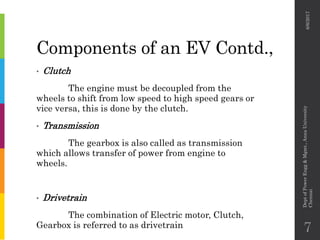
Components of an EV Contd.,
• Clutch
The engine must be decoupled from the
wheels to shift from low speed to high speed gears or
vice versa, this is done by the clutch.
• Transmission
The gearbox is also called as transmission
which allows transfer of power from engine to
wheels.
• Drivetrain
The combination of Electric motor, Clutch,
Gearbox is referred to as drivetrain
6/6/2017
DeptofPowerEngg&Mgmt.,AnnaUniversity
Chennai
7
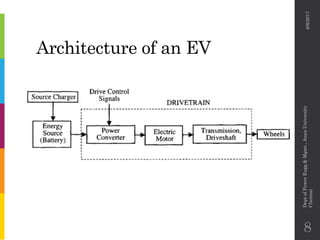
Architecture of an EV
6/6/2017
DeptofPowerEngg&Mgmt.,AnnaUniversity
Chennai
8
Hybrid Electric Vehicle
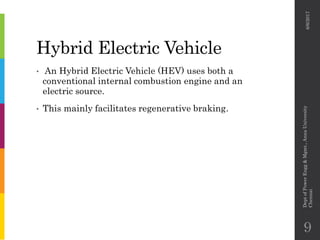
• An Hybrid Electric Vehicle (HEV) uses both a
conventional internal combustion engine and an
electric source.
• This mainly facilitates regenerative braking.
6/6/2017
DeptofPowerEngg&Mgmt.,AnnaUniversity
Chennai
9
Regenerative Braking
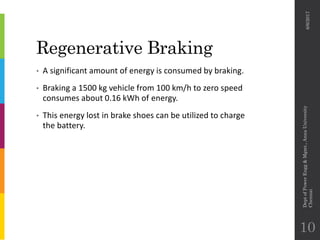
• A significant amount of energy is consumed by braking.
• Braking a 1500 kg vehicle from 100 km/h to zero speed
consumes about 0.16 kWh of energy.
• This energy lost in brake shoes can be utilized to charge
the battery.
6/6/2017
DeptofPowerEngg&Mgmt.,AnnaUniversity
Chennai
10
Classification of HEV
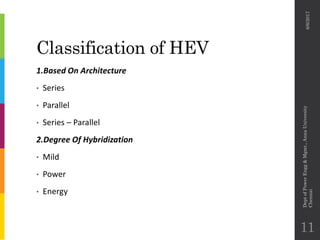
1.Based On Architecture
• Series
• Parallel
• Series – Parallel
2.Degree Of Hybridization
• Mild
• Power
• Energy
6/6/2017
DeptofPowerEngg&Mgmt.,AnnaUniversity
Chennai
11
Degree of Hybridization
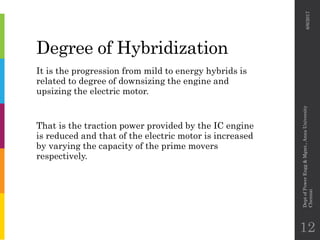
It is the progression from mild to energy hybrids is
related to degree of downsizing the engine and
upsizing the electric motor.
That is the traction power provided by the IC engine
is reduced and that of the electric motor is increased
by varying the capacity of the prime movers
respectively.
6/6/2017
DeptofPowerEngg&Mgmt.,AnnaUniversity
Chennai
12
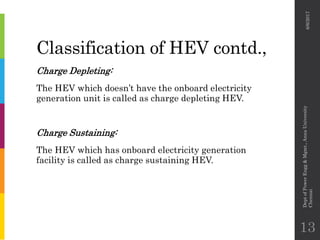
Classification of HEV contd.,
Charge Depleting:
The HEV which doesn’t have the onboard electricity
generation unit is called as charge depleting HEV.
Charge Sustaining:
The HEV which has onboard electricity generation
facility is called as charge sustaining HEV.
6/6/2017
DeptofPowerEngg&Mgmt.,AnnaUniversity
Chennai
13
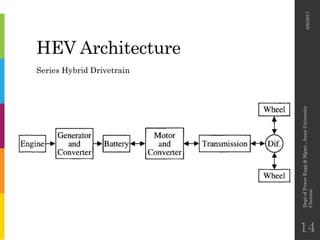
HEV Architecture
Series Hybrid Drivetrain
6/6/2017
DeptofPowerEngg&Mgmt.,AnnaUniversity
Chennai
14
Series Hybrid Drivetrain
Contd.,
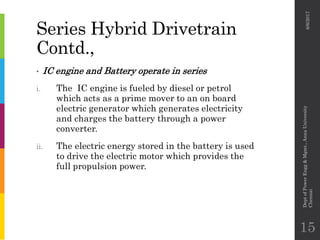
• IC engine and Battery operate in series
i. The IC engine is fueled by diesel or petrol
which acts as a prime mover to an on board
electric generator which generates electricity
and charges the battery through a power
converter.
ii. The electric energy stored in the battery is used
to drive the electric motor which provides the
full propulsion power.
6/6/2017
DeptofPowerEngg&Mgmt.,AnnaUniversity
Chennai
15
Series Hybrid Drivetrain
Contd.,
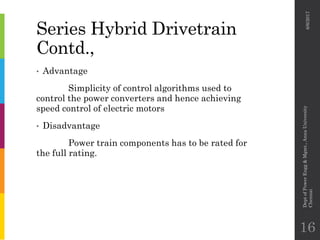
• Advantage
Simplicity of control algorithms used to
control the power converters and hence achieving
speed control of electric motors
• Disadvantage
Power train components has to be rated for
the full rating.
6/6/2017
DeptofPowerEngg&Mgmt.,AnnaUniversity
Chennai
16
HEV Architecture Contd.,
Parallel Hybrid Drivetrain
6/6/2017
DeptofPowerEngg&Mgmt.,AnnaUniversity
Chennai
17
Parallel Hybrid Drivetrain contd.,
• IC engine and battery operate in parallel
i. Based on the rating of the IC engine and
battery, electric motor the propulsion power is
shared between the sources
ii. The battery can be charged through wheels by
increasing the power output of the IC engine by
using the control algorithm for regenerative
braking
6/6/2017
DeptofPowerEngg&Mgmt.,AnnaUniversity
Chennai
18
Parallel Hybrid Drivetrain
Contd.,
• Advantage
Reduction in size of drive train components
• Disadvantage
Power blending from two sources becomes
difficult and it requires additional mechanical
equipment like planetary gear arrangement.
6/6/2017
DeptofPowerEngg&Mgmt.,AnnaUniversity
Chennai
19
HEV Architecture Contd.,
Series- Parallel Hybrid Drivetrain
6/6/2017
DeptofPowerEngg&Mgmt.,AnnaUniversity
Chennai
20
Series- Parallel Hybrid Drivetrain
• It combines both the architecture to extract
respective benefits
• A power splitter is used to feed a part of IC engine
power to drive the on board electric generator
which is used to charge the battery through a
power converter when the SoC of the battery is
below the threshold value.
6/6/2017
DeptofPowerEngg&Mgmt.,AnnaUniversity
Chennai
21
• PHEVs are charge depleting HEV
• They operate in fully electric mode up to certain
distance and then as a regular hybrid vehicle for
longer distances.
• It has a large rated storage system compared to
HEVs
• It has to be plugged in for recharging the battery
6/6/2017
DeptofPowerEngg&Mgmt.,AnnaUniversity
Chennai
22
Plug In Hybrid Electric
Vehicle Contd.,
• They are designed for daily commute to work and
for longer distances the it is supplemented by the
IC engine.
• This type of PHEV is also called as range extender.
• Hence this has high potential to replace ICEV for
urban commuting.
6/6/2017
DeptofPowerEngg&Mgmt.,AnnaUniversity
Chennai
23
PHEV charging stations
• Plug and charge
• Battery swapping
6/6/2017
DeptofPowerEngg&Mgmt.,AnnaUniversity
Chennai
24
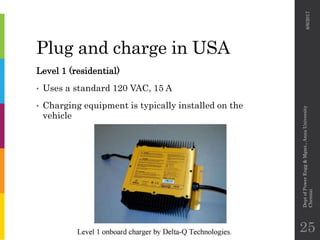
Plug and charge in USA
Level 1 (residential)
• Uses a standard 120 VAC, 15 A
• Charging equipment is typically installed on the
vehicle
6/6/2017
DeptofPowerEngg&Mgmt.,AnnaUniversity
Chennai
25
Contd.,
Level 2
• Preferred method for a battery electric vehicle
charger for both private and public facilities.
• Uses 240-VAC, single-phase, 10-40-A branch
circuit.
• The conversion from AC to DC takes place on
board.
6/6/2017
DeptofPowerEngg&Mgmt.,AnnaUniversity
Chennai
26
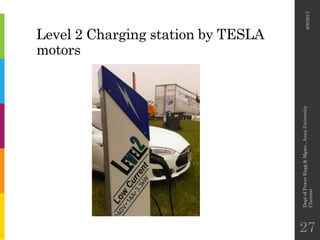
Level 2 Charging station by TESLA
motors
6/6/2017
DeptofPowerEngg&Mgmt.,AnnaUniversity
Chennai
27
Contd.,
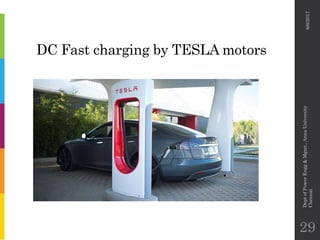
Level 3 (Fast Charging)
• For commercial and public applications.
• It uses an off board charge system serviced by a
480-VAC, three-phase circuit.
• The conversion from AC to DC is done off board.
6/6/2017
DeptofPowerEngg&Mgmt.,AnnaUniversity
Chennai
28
DC Fast charging by TESLA motors
6/6/2017
DeptofPowerEngg&Mgmt.,AnnaUniversity
Chennai
29
Present scenario in India
6/6/2017
DeptofPowerEngg&Mgmt.,AnnaUniversity
Chennai
30
National Mission for Electric
Mobility (NMEM)
• Government of India approved the National
Mission on Electric Mobility in 2011.
• As part of the mission, Department of Heavy
Industries has formulated a scheme namely
FAME – India
Faster Adoption and Manufacturing of Hybrid &
Electric Vehicles in India.
6/6/2017
DeptofPowerEngg&Mgmt.,AnnaUniversity
Chennai
31
NMEM Contd.,
Phase-1
Proposed to be implemented in 2 year period of
2015-2017
Focus on four Major Areas
• Technology Development
• Demand Creation
• Pilot Projects
• Charging Infrastructure
6/6/2017
DeptofPowerEngg&Mgmt.,AnnaUniversity
Chennai
32
National Electric Mobility
Mission Plan 2020 (NEMMP)
• Launched in January 2013 by the then Prime
Minister of India Dr. Manmohan Singh under the
Ministry of Heavy Industries and Public
Enterprises.
• Aims at ensuring vehicle population of 6-7 million
electric/hybrid vehicles in India by the year 2020 .
6/6/2017
DeptofPowerEngg&Mgmt.,AnnaUniversity
Chennai
33
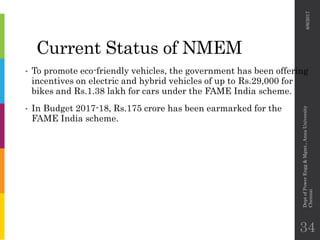
Current Status of NMEM
• To promote eco-friendly vehicles, the government has been offering
incentives on electric and hybrid vehicles of up to Rs.29,000 for
bikes and Rs.1.38 lakh for cars under the FAME India scheme.
• In Budget 2017-18, Rs.175 crore has been earmarked for the
FAME India scheme.
6/6/2017
DeptofPowerEngg&Mgmt.,AnnaUniversity
Chennai
34
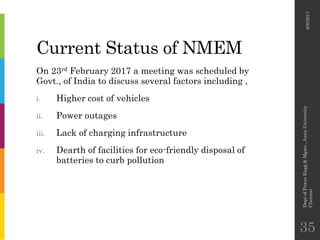
Current Status of NMEM
On 23rd February 2017 a meeting was scheduled by
Govt., of India to discuss several factors including ,
i. Higher cost of vehicles
ii. Power outages
iii. Lack of charging infrastructure
iv. Dearth of facilities for eco-friendly disposal of
batteries to curb pollution
6/6/2017
DeptofPowerEngg&Mgmt.,AnnaUniversity
Chennai
35
BHEL: Pivoting from Power
Sector to Transportation
• On 16th February 2017 BHEL signed an agreement
with Ashok Leyland Ltd and Tata Motors Ltd for
developing a propulsion system for buses.
• It is also seeking technical collaboration to
manufacture metro rail locomotives and has
initiated separate talks with Hitachi
Transportation Systems, Mitsubishi Heavy
Industries and Škoda Transportation.
6/6/2017
DeptofPowerEngg&Mgmt.,AnnaUniversity
Chennai
36
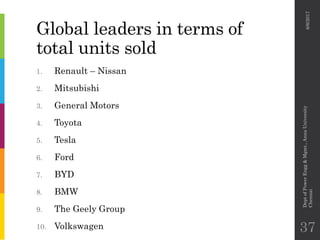
Global leaders in terms of
total units sold
1. Renault – Nissan
2. Mitsubishi
3. General Motors
4. Toyota
5. Tesla
6. Ford
7. BYD
8. BMW
9. The Geely Group
10. Volkswagen
6/6/2017
DeptofPowerEngg&Mgmt.,AnnaUniversity
Chennai
37
Indian Scenario
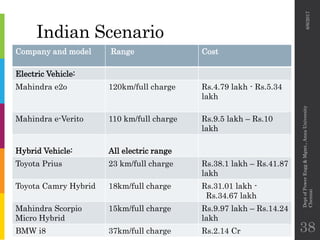
Company and model Range Cost
Electric Vehicle:
Mahindra e2o 120km/full charge Rs.4.79 lakh - Rs.5.34
lakh
Mahindra e-Verito 110 km/full charge Rs.9.5 lakh – Rs.10
lakh
Hybrid Vehicle: All electric range
Toyota Prius 23 km/full charge Rs.38.1 lakh – Rs.41.87
lakh
Toyota Camry Hybrid 18km/full charge Rs.31.01 lakh -
Rs.34.67 lakh
Mahindra Scorpio
Micro Hybrid
15km/full charge Rs.9.97 lakh – Rs.14.24
lakh
BMW i8 37km/full charge Rs.2.14 Cr
6/6/2017
DeptofPowerEngg&Mgmt.,AnnaUniversity
Chennai
38
Contd.,
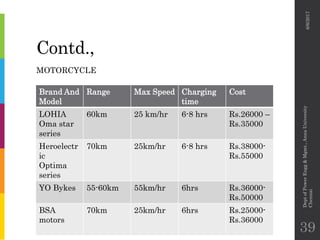
MOTORCYCLE
Brand And
Model
Range Max Speed Charging
time
Cost
LOHIA
Oma star
series
60km 25 km/hr 6-8 hrs Rs.26000 –
Rs.35000
Heroelectr
ic
Optima
series
70km 25km/hr 6-8 hrs Rs.38000-
Rs.55000
YO Bykes 55-60km 55km/hr 6hrs Rs.36000-
Rs.50000
BSA
motors
70km 25km/hr 6hrs Rs.25000-
Rs.36000
6/6/2017
DeptofPowerEngg&Mgmt.,AnnaUniversity
Chennai
39
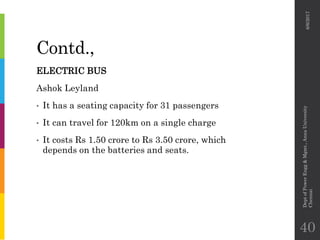
Contd.,
ELECTRIC BUS
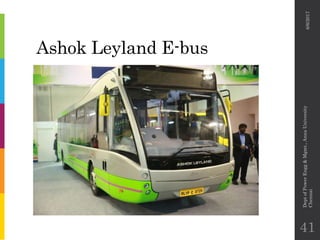
Ashok Leyland
• It has a seating capacity for 31 passengers
• It can travel for 120km on a single charge
• It costs Rs 1.50 crore to Rs 3.50 crore, which
depends on the batteries and seats.
6/6/2017
DeptofPowerEngg&Mgmt.,AnnaUniversity
Chennai
40
Ashok Leyland E-bus
6/6/2017
DeptofPowerEngg&Mgmt.,AnnaUniversity
Chennai
41
References
1. Electric and Hybrid Vehicles Design
Fundamentals 2nd edition by Iqbal Husain.
2. Modern Electric, Hybrid Electric, and Fuel Cell
Vehicles by Mehrdad Ehsani et al.
3. Energy World from Economic Times.
4. Ministry of Heavy Industries and Public
Enterprises, Govt., of India.
5. http://kseboa.org/news/bhel-looks-to-pivot-from-
power-sector-to-transportation-electric-vehicles-
17024527.html
6/6/2017
DeptofPowerEngg&Mgmt.,AnnaUniversity
Chennai
42

Electric vehicles

  • 1.
    ELECTRIC VEHICLES: An Alternate Urban Commuting KrishnakumarR V M.E Power Engineering And Management Anna University Chennai CEG Campus
  • 2.
    Why EV? 1.Pollution: According toDOE (USA) • Transportation accounts for one third of all energy usage. • Use of 10% of ZEV cuts 1 million tons/year of air pollutants • With 100% EV - CO2 emission would be cut by half 2.Capital Cost and Maintenance Cost: • EV has a more capital cost • But life cycle cost of EV is lesser than ICEV 6/6/2017 DeptofPowerEngg&Mgmt.,AnnaUniversity Chennai 2
  • 3.
    Why EV? 3.Availability ofFuel Fast depletion of fossil fuel and dependence on middle east countries for fuel. 4.Well to Wheel Efficiency The EV is found to have a better WTW efficiency than ICEV 6/6/2017 DeptofPowerEngg&Mgmt.,AnnaUniversity Chennai 3
  • 4.
    What is anEV? It is a vehicle which has following features • Portable energy source • Traction effort provided by electric motor 6/6/2017 DeptofPowerEngg&Mgmt.,AnnaUniversity Chennai 4
  • 5.
    Classification of Alternative Vehicle •Electric Vehicle • Hybrid Electric Vehicle • Plug-in Hybrid Electric Vehicle 6/6/2017 DeptofPowerEngg&Mgmt.,AnnaUniversity Chennai 5
  • 6.
    Components of anEV • Battery It powers the electric motor. Its capacity is defined in Ah. The design of battery includes complex calculations which determines various battery parameters • Power convertor The electrical energy stored in battery is fixed DC which should be converted to either variable DC or Variable AC which depends on the type of electric motor used for power the wheels • Electric Motor DC series, Induction motors were used at the earlier stage. Now the scope has shifted towards special electrical machines 6/6/2017 DeptofPowerEngg&Mgmt.,AnnaUniversity Chennai 6
  • 7.
    Components of anEV Contd., • Clutch The engine must be decoupled from the wheels to shift from low speed to high speed gears or vice versa, this is done by the clutch. • Transmission The gearbox is also called as transmission which allows transfer of power from engine to wheels. • Drivetrain The combination of Electric motor, Clutch, Gearbox is referred to as drivetrain 6/6/2017 DeptofPowerEngg&Mgmt.,AnnaUniversity Chennai 7
  • 8.
    Architecture of anEV 6/6/2017 DeptofPowerEngg&Mgmt.,AnnaUniversity Chennai 8
  • 9.
    Hybrid Electric Vehicle •An Hybrid Electric Vehicle (HEV) uses both a conventional internal combustion engine and an electric source. • This mainly facilitates regenerative braking. 6/6/2017 DeptofPowerEngg&Mgmt.,AnnaUniversity Chennai 9
  • 10.
    Regenerative Braking • Asignificant amount of energy is consumed by braking. • Braking a 1500 kg vehicle from 100 km/h to zero speed consumes about 0.16 kWh of energy. • This energy lost in brake shoes can be utilized to charge the battery. 6/6/2017 DeptofPowerEngg&Mgmt.,AnnaUniversity Chennai 10
  • 11.
    Classification of HEV 1.BasedOn Architecture • Series • Parallel • Series – Parallel 2.Degree Of Hybridization • Mild • Power • Energy 6/6/2017 DeptofPowerEngg&Mgmt.,AnnaUniversity Chennai 11
  • 12.
    Degree of Hybridization Itis the progression from mild to energy hybrids is related to degree of downsizing the engine and upsizing the electric motor. That is the traction power provided by the IC engine is reduced and that of the electric motor is increased by varying the capacity of the prime movers respectively. 6/6/2017 DeptofPowerEngg&Mgmt.,AnnaUniversity Chennai 12
  • 13.
    Classification of HEVcontd., Charge Depleting: The HEV which doesn’t have the onboard electricity generation unit is called as charge depleting HEV. Charge Sustaining: The HEV which has onboard electricity generation facility is called as charge sustaining HEV. 6/6/2017 DeptofPowerEngg&Mgmt.,AnnaUniversity Chennai 13
  • 14.
    HEV Architecture Series HybridDrivetrain 6/6/2017 DeptofPowerEngg&Mgmt.,AnnaUniversity Chennai 14
  • 15.
    Series Hybrid Drivetrain Contd., •IC engine and Battery operate in series i. The IC engine is fueled by diesel or petrol which acts as a prime mover to an on board electric generator which generates electricity and charges the battery through a power converter. ii. The electric energy stored in the battery is used to drive the electric motor which provides the full propulsion power. 6/6/2017 DeptofPowerEngg&Mgmt.,AnnaUniversity Chennai 15
  • 16.
    Series Hybrid Drivetrain Contd., •Advantage Simplicity of control algorithms used to control the power converters and hence achieving speed control of electric motors • Disadvantage Power train components has to be rated for the full rating. 6/6/2017 DeptofPowerEngg&Mgmt.,AnnaUniversity Chennai 16
  • 17.
    HEV Architecture Contd., ParallelHybrid Drivetrain 6/6/2017 DeptofPowerEngg&Mgmt.,AnnaUniversity Chennai 17
  • 18.
    Parallel Hybrid Drivetraincontd., • IC engine and battery operate in parallel i. Based on the rating of the IC engine and battery, electric motor the propulsion power is shared between the sources ii. The battery can be charged through wheels by increasing the power output of the IC engine by using the control algorithm for regenerative braking 6/6/2017 DeptofPowerEngg&Mgmt.,AnnaUniversity Chennai 18
  • 19.
    Parallel Hybrid Drivetrain Contd., •Advantage Reduction in size of drive train components • Disadvantage Power blending from two sources becomes difficult and it requires additional mechanical equipment like planetary gear arrangement. 6/6/2017 DeptofPowerEngg&Mgmt.,AnnaUniversity Chennai 19
  • 20.
    HEV Architecture Contd., Series-Parallel Hybrid Drivetrain 6/6/2017 DeptofPowerEngg&Mgmt.,AnnaUniversity Chennai 20
  • 21.
    Series- Parallel HybridDrivetrain • It combines both the architecture to extract respective benefits • A power splitter is used to feed a part of IC engine power to drive the on board electric generator which is used to charge the battery through a power converter when the SoC of the battery is below the threshold value. 6/6/2017 DeptofPowerEngg&Mgmt.,AnnaUniversity Chennai 21
  • 22.
    • PHEVs arecharge depleting HEV • They operate in fully electric mode up to certain distance and then as a regular hybrid vehicle for longer distances. • It has a large rated storage system compared to HEVs • It has to be plugged in for recharging the battery 6/6/2017 DeptofPowerEngg&Mgmt.,AnnaUniversity Chennai 22
  • 23.
    Plug In HybridElectric Vehicle Contd., • They are designed for daily commute to work and for longer distances the it is supplemented by the IC engine. • This type of PHEV is also called as range extender. • Hence this has high potential to replace ICEV for urban commuting. 6/6/2017 DeptofPowerEngg&Mgmt.,AnnaUniversity Chennai 23
  • 24.
    PHEV charging stations •Plug and charge • Battery swapping 6/6/2017 DeptofPowerEngg&Mgmt.,AnnaUniversity Chennai 24
  • 25.
    Plug and chargein USA Level 1 (residential) • Uses a standard 120 VAC, 15 A • Charging equipment is typically installed on the vehicle 6/6/2017 DeptofPowerEngg&Mgmt.,AnnaUniversity Chennai 25
  • 26.
    Contd., Level 2 • Preferredmethod for a battery electric vehicle charger for both private and public facilities. • Uses 240-VAC, single-phase, 10-40-A branch circuit. • The conversion from AC to DC takes place on board. 6/6/2017 DeptofPowerEngg&Mgmt.,AnnaUniversity Chennai 26
  • 27.
    Level 2 Chargingstation by TESLA motors 6/6/2017 DeptofPowerEngg&Mgmt.,AnnaUniversity Chennai 27
  • 28.
    Contd., Level 3 (FastCharging) • For commercial and public applications. • It uses an off board charge system serviced by a 480-VAC, three-phase circuit. • The conversion from AC to DC is done off board. 6/6/2017 DeptofPowerEngg&Mgmt.,AnnaUniversity Chennai 28
  • 29.
    DC Fast chargingby TESLA motors 6/6/2017 DeptofPowerEngg&Mgmt.,AnnaUniversity Chennai 29
  • 30.
    Present scenario inIndia 6/6/2017 DeptofPowerEngg&Mgmt.,AnnaUniversity Chennai 30
  • 31.
    National Mission forElectric Mobility (NMEM) • Government of India approved the National Mission on Electric Mobility in 2011. • As part of the mission, Department of Heavy Industries has formulated a scheme namely FAME – India Faster Adoption and Manufacturing of Hybrid & Electric Vehicles in India. 6/6/2017 DeptofPowerEngg&Mgmt.,AnnaUniversity Chennai 31
  • 32.
    NMEM Contd., Phase-1 Proposed tobe implemented in 2 year period of 2015-2017 Focus on four Major Areas • Technology Development • Demand Creation • Pilot Projects • Charging Infrastructure 6/6/2017 DeptofPowerEngg&Mgmt.,AnnaUniversity Chennai 32
  • 33.
    National Electric Mobility MissionPlan 2020 (NEMMP) • Launched in January 2013 by the then Prime Minister of India Dr. Manmohan Singh under the Ministry of Heavy Industries and Public Enterprises. • Aims at ensuring vehicle population of 6-7 million electric/hybrid vehicles in India by the year 2020 . 6/6/2017 DeptofPowerEngg&Mgmt.,AnnaUniversity Chennai 33
  • 34.
    Current Status ofNMEM • To promote eco-friendly vehicles, the government has been offering incentives on electric and hybrid vehicles of up to Rs.29,000 for bikes and Rs.1.38 lakh for cars under the FAME India scheme. • In Budget 2017-18, Rs.175 crore has been earmarked for the FAME India scheme. 6/6/2017 DeptofPowerEngg&Mgmt.,AnnaUniversity Chennai 34
  • 35.
    Current Status ofNMEM On 23rd February 2017 a meeting was scheduled by Govt., of India to discuss several factors including , i. Higher cost of vehicles ii. Power outages iii. Lack of charging infrastructure iv. Dearth of facilities for eco-friendly disposal of batteries to curb pollution 6/6/2017 DeptofPowerEngg&Mgmt.,AnnaUniversity Chennai 35
  • 36.
    BHEL: Pivoting fromPower Sector to Transportation • On 16th February 2017 BHEL signed an agreement with Ashok Leyland Ltd and Tata Motors Ltd for developing a propulsion system for buses. • It is also seeking technical collaboration to manufacture metro rail locomotives and has initiated separate talks with Hitachi Transportation Systems, Mitsubishi Heavy Industries and Škoda Transportation. 6/6/2017 DeptofPowerEngg&Mgmt.,AnnaUniversity Chennai 36
  • 37.
    Global leaders interms of total units sold 1. Renault – Nissan 2. Mitsubishi 3. General Motors 4. Toyota 5. Tesla 6. Ford 7. BYD 8. BMW 9. The Geely Group 10. Volkswagen 6/6/2017 DeptofPowerEngg&Mgmt.,AnnaUniversity Chennai 37
  • 38.
    Indian Scenario Company andmodel Range Cost Electric Vehicle: Mahindra e2o 120km/full charge Rs.4.79 lakh - Rs.5.34 lakh Mahindra e-Verito 110 km/full charge Rs.9.5 lakh – Rs.10 lakh Hybrid Vehicle: All electric range Toyota Prius 23 km/full charge Rs.38.1 lakh – Rs.41.87 lakh Toyota Camry Hybrid 18km/full charge Rs.31.01 lakh - Rs.34.67 lakh Mahindra Scorpio Micro Hybrid 15km/full charge Rs.9.97 lakh – Rs.14.24 lakh BMW i8 37km/full charge Rs.2.14 Cr 6/6/2017 DeptofPowerEngg&Mgmt.,AnnaUniversity Chennai 38
  • 39.
    Contd., MOTORCYCLE Brand And Model Range MaxSpeed Charging time Cost LOHIA Oma star series 60km 25 km/hr 6-8 hrs Rs.26000 – Rs.35000 Heroelectr ic Optima series 70km 25km/hr 6-8 hrs Rs.38000- Rs.55000 YO Bykes 55-60km 55km/hr 6hrs Rs.36000- Rs.50000 BSA motors 70km 25km/hr 6hrs Rs.25000- Rs.36000 6/6/2017 DeptofPowerEngg&Mgmt.,AnnaUniversity Chennai 39
  • 40.
    Contd., ELECTRIC BUS Ashok Leyland •It has a seating capacity for 31 passengers • It can travel for 120km on a single charge • It costs Rs 1.50 crore to Rs 3.50 crore, which depends on the batteries and seats. 6/6/2017 DeptofPowerEngg&Mgmt.,AnnaUniversity Chennai 40
  • 41.
  • 42.
    References 1. Electric andHybrid Vehicles Design Fundamentals 2nd edition by Iqbal Husain. 2. Modern Electric, Hybrid Electric, and Fuel Cell Vehicles by Mehrdad Ehsani et al. 3. Energy World from Economic Times. 4. Ministry of Heavy Industries and Public Enterprises, Govt., of India. 5. http://kseboa.org/news/bhel-looks-to-pivot-from- power-sector-to-transportation-electric-vehicles- 17024527.html 6/6/2017 DeptofPowerEngg&Mgmt.,AnnaUniversity Chennai 42

Editor's Notes

  • #3 ZEV- Vehicle powered by energy obtained from the alternate energy sources
  • #9 Battery – various mathematical models are presented to analyze the performance and characteristics of battery Range- 30-40km Charging time 6-8 hrs
  • #10 Regenerative braking-
  • #11 Explain down the slope example
  • #15 Advantage Simplicity of control Disadvantage Power train components has to be rated for the full rating.
  • #18 Which is a better architecture? Advantage Reduction in size of drive train components Disadvantage Power blending from two sources becomes difficult and it requires additional mechanical equipment.
  • #35 FY 2017- April 1st 2017 to March 31st 2017
  • #38 Geely- china BYD- china
  • #39 Question Fastest E-Car? 1.Chevrolet Corvette 300 kmph cost is 2.23 cr 2. Tesla Model S P90D 257.5 kmph cost is 1.2cr