BY
Dr. Gurumeet.C.Wadhawa
DEPARTMENT OF CHEMISTRY
K. B. P. College,Vashi,Navimumbai
Passerini Reactions
Reaction involving more than
two starting compounds react to
from a product in such a way
that the majority of atoms of the
starting material can be found in
the product
Multicomponent
reactions
2
MCRs Popular For
…..
3
• Simple procedures
• Time saving
• Superior atom economy
• The one-pot character
• The high yields
• Ever increasing number of accessible backbones
4
Most documented MCRs are
• Isocyanide based MCRs
• Free-radical mediated
• Metal-catalyzed MCRs
• Organo-boron compounds based
5
Passerini
Reactions
6
• Simple three component reaction
• Developed by Mario Passerini
• Product is acyloxy amide
• It involves an oxo component, an isocyanide
and an acid in a single step
History
7
• Mario Passerini of the University of Florence discovered the first example of the
reaction that now bears his name in 1921.
• This was the first example of a family of reactions called isocyanide-based
multicomponent reactions (IMCRs)
• Can be carried out with or without solvents
Passerini Reaction is Green in
Nature Because..
8
• It is has 100% atom-economy
• Every atom in the starting materials is incorporated in the product
• No intrinsic chemical waste associated with the reaction
• This reaction definitely meets one of the goals of the green chemistry movement
The mechanism
…
9
It involve the following steps:
1) Addition to protonated aldehyde
2) Addition to nitrilium ion
3) Acyl transfer
4) Tautomerization
Isocyanides, also known as isonitriles, are a unique class of organic compounds. The carbon center of
the isocyanide group is formally divalent, and it can react with electrophiles and nucleophiles. The
first synthetically useful reaction of isocyanides was described by M. Passerini, who reported that
isocyanides react with carboxylic acids and carbonyl compounds in one step to provide α
acyloxycarboxamides.1 This transformation is known today as the Passerini
multicomponent reaction (MCR). The synthetic power of the Passerini reaction is that three reaction
partners are combined in one pot under mild conditions (three component reaction or P-3CR) and the
product incorporates most atoms of all three starting materials.
These types of transformations coupled with combinatorial chemistry and parallel
synthesis techniques allow the quick assembly of a wide array of compounds from simple starting
materials. Thegeneral features of the classical Passerini reaction are:
1) it is carried out at high concentrations of the starting
materials in inert solvents at or below room temperature;
2) it is accelerated in apolar solvents;2
3) a wide variety of aldehydes and ketones undergo the reaction;
4) there are rare limitations to the carbonyl component, only sterically
hindered ketones and α,β-unsaturated ketones are unreactive;
5) in addition to C-isocyanides, trimethylsilyl isocyanide also undergoes the reaction;
6) when water is used as the nucleophilic component instead of carboxylic acid, the reaction gives
the corresponding α-hydroxycarboxamide under acid catalyzed conditions;
7) when hydrazoic acid is combined with the isocyanide and the carbonyl compound under acidic
conditions, α- hydroxyalkyltetrazole is the product; and
8) catalytic asymmetric variants of the reaction were also developed. By choosing the proper
starting materials
• The final product arises from the intermediate formation
• Formation of intermediate is most likely irreversible step, as suggested by the
asymmetric induction achieved with bulky chiral isocyanide
• According to this the reaction proceed through a relatively non-polar cyclic transition
state 3
1
13
2
• This can either be 5 or 7 membered
depending upon which carboxylate
oxygen participate
• The mechanism is in agreement
with the
depends
fact that reaction rate
on all the three
components
17
Important in combinatorial chemistry
 The total synthesis of natural products
 Synthesis of polycyclics
 Synthesis of macrocycles heterocycles
 Pharmaceutical industry for the synthesis of
drug-like compounds
Application
s
18
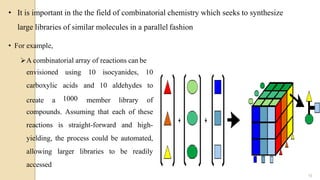
envisioned
carboxylic
create a
using
acids
1000 member library
10 isocyanides, 10
and 10 aldehydes to
of
compounds. Assuming that each of these
reactions is straight-forward and high-
yielding, the process could be automated,
allowing larger libraries to be readily
accessed
• It is important in the the field of combinatorial chemistry which seeks to synthesize
large libraries of similar molecules in a parallel fashion
• For example,
A combinatorial array of reactions can be
19
• Synthesis of analogs of Azinomycin-a DNA binding and alkylatingantibiotic
• Reported by Armstrong et al.
20
21
• Synthesis of natural prolyl endopeptidase inhibitor EurystatinA
• Reported by Schmidt et. al.
22
• Passerini reaction of steroid ketones
• The cholestanone, isocyanides, and benzoic acid reacted with each other to
prepare the related products
• Reported by Baker, R.H. et. al.
23
• Three-component Passerini reaction of
o-carborane aldehyde.
• Synthesis of -carboranyl--acyloxy
amides
• prepared as potential BNCT (Boron
Neutron Capture Therapy)
• Reported by Jonnalagadda, S.C. et. al.
24
• Synthesis of inhibitor libraries based on the 1-isocyanoalkylphosphonate
diaryl ester moiety
• Resulted in formation of phosphonic peptide mimetic inhibitor libraries
• Reported by Sieczyk, M. et. al.
1-isocyanoalkylphosphonate diaryl ester
25
Peptidomimetic
26
• These are the -acyloxyamide
derived from benzaldehyde
• This compound is an important
building block in the synthesis of
biodegradable polymers
• Drugs related to Parkinson’s
Disease
These compounds exhibit both anti-HIV and anti-
malarial activity
Creation of library of peptidomimetic compounds
with an α-hydroxy-β-amino acid unit
Product contain both ester and amide functionalities
22 compounds were tested for activity against HIV
and malaria.
27
α-Hydroxyamides
28
• The hydrolyzed products of Passerini reactions
• Common organic building blocks for natural products and drugs
• Modification of Passerini reaction , called the Ugi reaction, that uses imines
instead of aldehydes was investigated by process chemists at Merck as a method
for synthesizing the antiretroviral drug, Crixivan®
• These reactions are powerful synthetic methods for the synthesis of structurally
diverse molecules
• The importance and application of these reactions can be further increased by post-
condensation and transformations
• These modifications are usually accomplished by using a suitable functional group
and take place spontaneously or upon treatment with additional reagents
29
• The passerini reaction is a pivotal isocyanide‐based MCR—that
contribute to huge number biologically active α‐acyloxyamides.
• Some interesting targets were synthesized following this MCR as a
key synthetic step.
• Additionally, some environmentally benign protocols have been
remarked and more improvements in this respect are expected in the
next years with the increasing concern about the sustainability of the
processes.
Conclusion
30
Referenc
es
31
1. Chandgude, A. L.; Dömling, A., Green Chemistry, 18, 3718, 2016.
2. Wang, R.; Liu, Z.-Q., Tetrahedron Letters, 56, (50), 7028-7033, 2015.
3. Moni, L.; Banfi, L.; Basso, A.; Carcone, L.; Rasparini, M.; Riva, R., The Journal of
organic chemistry, 80, (7), 3411-3428, 2015.
4. Damkaci, F.; Szymaniak, A., Journal of Chemical Education, 91, (6), 943-945, 2014.
5. Reza Kazemizadeh, A.; Ramazani, A., Current Organic Chemistry, 16, (4), 418-450, 2012.
6. Zahoor, A. F.; Thies, S.; Kazmaier, U., Beilstein journal of organic chemistry, 7, (1), 1299-
1303, 2011.
7. Denmark, S. E.; Fan, Y., Journal of the American Chemical Society, 125, (26), 7825-
7827, 2013.
8. Ramozzi, R.; Morokuma, K., The Journal of organic chemistry, 80, (11), 5652-5657,
2015.
9. Zhang, J.; Lin, S.-X.; Cheng, D.-J.; Liu, X.-Y.; Tan, B., Journal of the American
Chemical Society, 137, (44), 14039-14042, 2015.
10. Cai, X.-h.; Hui, G.; Bing, X., International Journal of Chemistry, 3, (1), 216, 2011.
11. Kreye, O.; Tóth, T.; Meier, M. A., Journal of the American Chemical Society, 133, (6),
1790-1792, 2011.
32

Passerini reaction

  • 1.
    BY Dr. Gurumeet.C.Wadhawa DEPARTMENT OFCHEMISTRY K. B. P. College,Vashi,Navimumbai Passerini Reactions
  • 2.
    Reaction involving morethan two starting compounds react to from a product in such a way that the majority of atoms of the starting material can be found in the product Multicomponent reactions 2
  • 3.
    MCRs Popular For ….. 3 •Simple procedures • Time saving • Superior atom economy • The one-pot character • The high yields • Ever increasing number of accessible backbones
  • 4.
  • 5.
    Most documented MCRsare • Isocyanide based MCRs • Free-radical mediated • Metal-catalyzed MCRs • Organo-boron compounds based 5
  • 6.
    Passerini Reactions 6 • Simple threecomponent reaction • Developed by Mario Passerini • Product is acyloxy amide • It involves an oxo component, an isocyanide and an acid in a single step
  • 7.
    History 7 • Mario Passeriniof the University of Florence discovered the first example of the reaction that now bears his name in 1921. • This was the first example of a family of reactions called isocyanide-based multicomponent reactions (IMCRs) • Can be carried out with or without solvents
  • 8.
    Passerini Reaction isGreen in Nature Because.. 8 • It is has 100% atom-economy • Every atom in the starting materials is incorporated in the product • No intrinsic chemical waste associated with the reaction • This reaction definitely meets one of the goals of the green chemistry movement
  • 9.
    The mechanism … 9 It involvethe following steps: 1) Addition to protonated aldehyde 2) Addition to nitrilium ion 3) Acyl transfer 4) Tautomerization
  • 11.
    Isocyanides, also knownas isonitriles, are a unique class of organic compounds. The carbon center of the isocyanide group is formally divalent, and it can react with electrophiles and nucleophiles. The first synthetically useful reaction of isocyanides was described by M. Passerini, who reported that isocyanides react with carboxylic acids and carbonyl compounds in one step to provide α acyloxycarboxamides.1 This transformation is known today as the Passerini multicomponent reaction (MCR). The synthetic power of the Passerini reaction is that three reaction partners are combined in one pot under mild conditions (three component reaction or P-3CR) and the product incorporates most atoms of all three starting materials.
  • 12.
    These types oftransformations coupled with combinatorial chemistry and parallel synthesis techniques allow the quick assembly of a wide array of compounds from simple starting materials. Thegeneral features of the classical Passerini reaction are: 1) it is carried out at high concentrations of the starting materials in inert solvents at or below room temperature; 2) it is accelerated in apolar solvents;2 3) a wide variety of aldehydes and ketones undergo the reaction; 4) there are rare limitations to the carbonyl component, only sterically hindered ketones and α,β-unsaturated ketones are unreactive; 5) in addition to C-isocyanides, trimethylsilyl isocyanide also undergoes the reaction; 6) when water is used as the nucleophilic component instead of carboxylic acid, the reaction gives the corresponding α-hydroxycarboxamide under acid catalyzed conditions; 7) when hydrazoic acid is combined with the isocyanide and the carbonyl compound under acidic conditions, α- hydroxyalkyltetrazole is the product; and 8) catalytic asymmetric variants of the reaction were also developed. By choosing the proper starting materials
  • 13.
    • The finalproduct arises from the intermediate formation • Formation of intermediate is most likely irreversible step, as suggested by the asymmetric induction achieved with bulky chiral isocyanide • According to this the reaction proceed through a relatively non-polar cyclic transition state 3 1 13 2
  • 17.
    • This caneither be 5 or 7 membered depending upon which carboxylate oxygen participate • The mechanism is in agreement with the depends fact that reaction rate on all the three components 17
  • 18.
    Important in combinatorialchemistry  The total synthesis of natural products  Synthesis of polycyclics  Synthesis of macrocycles heterocycles  Pharmaceutical industry for the synthesis of drug-like compounds Application s 18
  • 19.
    envisioned carboxylic create a using acids 1000 memberlibrary 10 isocyanides, 10 and 10 aldehydes to of compounds. Assuming that each of these reactions is straight-forward and high- yielding, the process could be automated, allowing larger libraries to be readily accessed • It is important in the the field of combinatorial chemistry which seeks to synthesize large libraries of similar molecules in a parallel fashion • For example, A combinatorial array of reactions can be 19
  • 20.
    • Synthesis ofanalogs of Azinomycin-a DNA binding and alkylatingantibiotic • Reported by Armstrong et al. 20
  • 21.
  • 22.
    • Synthesis ofnatural prolyl endopeptidase inhibitor EurystatinA • Reported by Schmidt et. al. 22
  • 23.
    • Passerini reactionof steroid ketones • The cholestanone, isocyanides, and benzoic acid reacted with each other to prepare the related products • Reported by Baker, R.H. et. al. 23
  • 24.
    • Three-component Passerinireaction of o-carborane aldehyde. • Synthesis of -carboranyl--acyloxy amides • prepared as potential BNCT (Boron Neutron Capture Therapy) • Reported by Jonnalagadda, S.C. et. al. 24
  • 25.
    • Synthesis ofinhibitor libraries based on the 1-isocyanoalkylphosphonate diaryl ester moiety • Resulted in formation of phosphonic peptide mimetic inhibitor libraries • Reported by Sieczyk, M. et. al. 1-isocyanoalkylphosphonate diaryl ester 25
  • 26.
    Peptidomimetic 26 • These arethe -acyloxyamide derived from benzaldehyde • This compound is an important building block in the synthesis of biodegradable polymers • Drugs related to Parkinson’s Disease
  • 27.
    These compounds exhibitboth anti-HIV and anti- malarial activity Creation of library of peptidomimetic compounds with an α-hydroxy-β-amino acid unit Product contain both ester and amide functionalities 22 compounds were tested for activity against HIV and malaria. 27
  • 28.
    α-Hydroxyamides 28 • The hydrolyzedproducts of Passerini reactions • Common organic building blocks for natural products and drugs • Modification of Passerini reaction , called the Ugi reaction, that uses imines instead of aldehydes was investigated by process chemists at Merck as a method for synthesizing the antiretroviral drug, Crixivan®
  • 29.
    • These reactionsare powerful synthetic methods for the synthesis of structurally diverse molecules • The importance and application of these reactions can be further increased by post- condensation and transformations • These modifications are usually accomplished by using a suitable functional group and take place spontaneously or upon treatment with additional reagents 29
  • 30.
    • The passerinireaction is a pivotal isocyanide‐based MCR—that contribute to huge number biologically active α‐acyloxyamides. • Some interesting targets were synthesized following this MCR as a key synthetic step. • Additionally, some environmentally benign protocols have been remarked and more improvements in this respect are expected in the next years with the increasing concern about the sustainability of the processes. Conclusion 30
  • 31.
    Referenc es 31 1. Chandgude, A.L.; Dömling, A., Green Chemistry, 18, 3718, 2016. 2. Wang, R.; Liu, Z.-Q., Tetrahedron Letters, 56, (50), 7028-7033, 2015. 3. Moni, L.; Banfi, L.; Basso, A.; Carcone, L.; Rasparini, M.; Riva, R., The Journal of organic chemistry, 80, (7), 3411-3428, 2015. 4. Damkaci, F.; Szymaniak, A., Journal of Chemical Education, 91, (6), 943-945, 2014. 5. Reza Kazemizadeh, A.; Ramazani, A., Current Organic Chemistry, 16, (4), 418-450, 2012. 6. Zahoor, A. F.; Thies, S.; Kazmaier, U., Beilstein journal of organic chemistry, 7, (1), 1299- 1303, 2011.
  • 32.
    7. Denmark, S.E.; Fan, Y., Journal of the American Chemical Society, 125, (26), 7825- 7827, 2013. 8. Ramozzi, R.; Morokuma, K., The Journal of organic chemistry, 80, (11), 5652-5657, 2015. 9. Zhang, J.; Lin, S.-X.; Cheng, D.-J.; Liu, X.-Y.; Tan, B., Journal of the American Chemical Society, 137, (44), 14039-14042, 2015. 10. Cai, X.-h.; Hui, G.; Bing, X., International Journal of Chemistry, 3, (1), 216, 2011. 11. Kreye, O.; Tóth, T.; Meier, M. A., Journal of the American Chemical Society, 133, (6), 1790-1792, 2011. 32