BY
SYED YOUSAF SHAH
Assistant Professor ION-DUHS
1.Describe eye in terms of:
Structure related to vision
Accessory structures
2.Discuss image formation by describing
refraction, accommodation and constriction
of the pupil.
3. Explain the process of dark adaptation and
light adaptation.
4.Refrences
The eye is the organ of the sense of sight
situated in the orbital cavity and it is supplied
by the optic nerve (2nd cranial nerve).
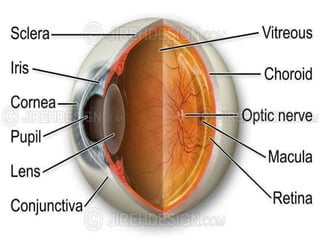
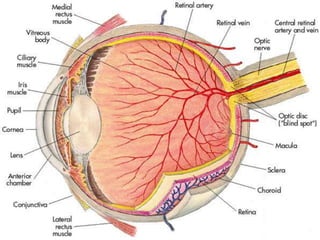
There are three layers of tissue in the walls of
the eye.
They are:
1.The outer fibrous layer: sclera and cornea
2. The middle vascular layer or uveal tract:
choroid,ciliary body and iris
3. The inner nervous tissue layer: retina.
Structures inside the eyeball are the lens,
aqueous fluid
(humour) and vitreous body (humour).
The sclera, or white of the eye, forms the
outermost layer of tissue of the posterior and
lateral aspects of the eyeball and is
continuous anteriorly with the transparent
cornea.
It consists of a firm fibrous membrane that
maintains the shape of the eye and gives
attachment to the extraocular or extrinsic
muscles of the eye.
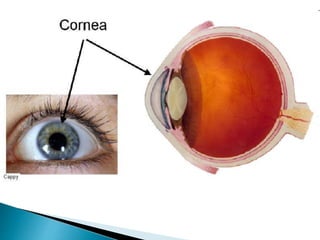
 Anteriorly the sclera continues as a clear
transparent epithelial membrane, the cornea.
Light rays pass through the cornea to reach
the retina.
 The cornea is convex ante-riorly and is
involved in refracting or bending light rays to
focus them on the retina.
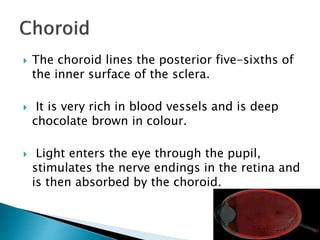
 The choroid lines the posterior five-sixths of
the inner surface of the sclera.
 It is very rich in blood vessels and is deep
chocolate brown in colour.
 Light enters the eye through the pupil,
stimulates the nerve endings in the retina and
is then absorbed by the choroid.
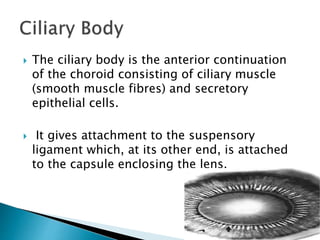
 The ciliary body is the anterior continuation
of the choroid consisting of ciliary muscle
(smooth muscle fibres) and secretory
epithelial cells.
 It gives attachment to the suspensory
ligament which, at its other end, is attached
to the capsule enclosing the lens.
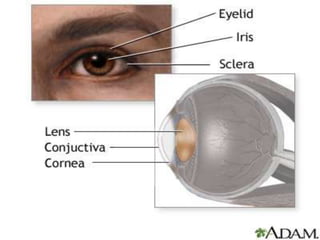
 The iris is the visible coloured part of the eye
and extends anteriorly from the ciliary body,
lying behind the cornea in front of the lens.
 It divides the anterior segment of the eye into
anterior and posterior chambers which
contain aqueous fluid secreted by the ciliary
body.
 The lens is a highly elastic circular biconvex
body, lying immediately behind the pupil.
The lens bends (refracts) light rays reflected
by objects in front of the eye.
The nearer is the object being viewed the
thicker the lens becomes to allow focusing.
 The retina is the innermost layer of the wall
of the eye It is an extremely delicate structure
and is especially adapted for stimulation by
light rays.
 It is composed of several layers of nerve cell
bodies and their axons, lying on a pigmented
layer of epithelial cells which attach it to the
choroid.
 Towards the anterior part of the retina there
are fewer cone- than rod-shaped cells .
 The rods and cones contain photosensitive
pigments that convert light rays into nerve
impulses.
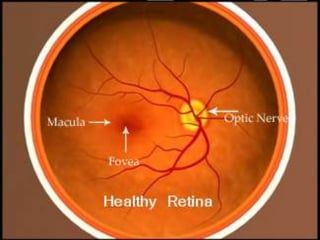
 The small area of retina where the optic nerve
leaves the eye is the optic disc or blind spot.
It has no light-sensitive cells.
• The eye is supplied with arterial blood by the
ciliary arteries and the central retinal artery.
• Venous drainage is by a number of veins,
including the central retinal vein, which
eventually empty into a deep venous sinus.
The central retinal artery and vein are encased
in the optic nerve, entering the eye at the
optic disc.
 Light waves travel at a speed of 186 000
miles (300 000 kilometres) per second.
 Light is reflected into the eyes by objects
within the field of vision.
 White light is a combination of all the colours
of the visual spectrum (rainbow),i.e. red,
orange, yellow, green, blue, indigo and violet.
 This range of colour is the spectrum of visible
light.In a rainbow, white light from the sun is
broken up by raindrops which act as prisms
and reflectors.
 Medial rectus
 Lateral rectus
 Superior rectus
 Inferior rectus
 Superior oblique
 Inferior oblique.
 Eyebrows
 Eyelids and eyelashes
 Lacrimal apparatus.
 Ross and Wilson anatomy and physiology in
health and illness 10th edition.

Eye Anatomy & Physiology

  • 1.
  • 2.
    1.Describe eye interms of: Structure related to vision Accessory structures 2.Discuss image formation by describing refraction, accommodation and constriction of the pupil. 3. Explain the process of dark adaptation and light adaptation. 4.Refrences
  • 3.
    The eye isthe organ of the sense of sight situated in the orbital cavity and it is supplied by the optic nerve (2nd cranial nerve).
  • 5.
    There are threelayers of tissue in the walls of the eye. They are: 1.The outer fibrous layer: sclera and cornea 2. The middle vascular layer or uveal tract: choroid,ciliary body and iris 3. The inner nervous tissue layer: retina. Structures inside the eyeball are the lens, aqueous fluid (humour) and vitreous body (humour).
  • 7.
    The sclera, orwhite of the eye, forms the outermost layer of tissue of the posterior and lateral aspects of the eyeball and is continuous anteriorly with the transparent cornea. It consists of a firm fibrous membrane that maintains the shape of the eye and gives attachment to the extraocular or extrinsic muscles of the eye.
  • 9.
     Anteriorly thesclera continues as a clear transparent epithelial membrane, the cornea. Light rays pass through the cornea to reach the retina.  The cornea is convex ante-riorly and is involved in refracting or bending light rays to focus them on the retina.
  • 10.
     The choroidlines the posterior five-sixths of the inner surface of the sclera.  It is very rich in blood vessels and is deep chocolate brown in colour.  Light enters the eye through the pupil, stimulates the nerve endings in the retina and is then absorbed by the choroid.
  • 11.
     The ciliarybody is the anterior continuation of the choroid consisting of ciliary muscle (smooth muscle fibres) and secretory epithelial cells.  It gives attachment to the suspensory ligament which, at its other end, is attached to the capsule enclosing the lens.
  • 12.
     The irisis the visible coloured part of the eye and extends anteriorly from the ciliary body, lying behind the cornea in front of the lens.  It divides the anterior segment of the eye into anterior and posterior chambers which contain aqueous fluid secreted by the ciliary body.
  • 13.
     The lensis a highly elastic circular biconvex body, lying immediately behind the pupil. The lens bends (refracts) light rays reflected by objects in front of the eye. The nearer is the object being viewed the thicker the lens becomes to allow focusing.
  • 15.
     The retinais the innermost layer of the wall of the eye It is an extremely delicate structure and is especially adapted for stimulation by light rays.  It is composed of several layers of nerve cell bodies and their axons, lying on a pigmented layer of epithelial cells which attach it to the choroid.
  • 16.
     Towards theanterior part of the retina there are fewer cone- than rod-shaped cells .  The rods and cones contain photosensitive pigments that convert light rays into nerve impulses.  The small area of retina where the optic nerve leaves the eye is the optic disc or blind spot. It has no light-sensitive cells.
  • 18.
    • The eyeis supplied with arterial blood by the ciliary arteries and the central retinal artery. • Venous drainage is by a number of veins, including the central retinal vein, which eventually empty into a deep venous sinus. The central retinal artery and vein are encased in the optic nerve, entering the eye at the optic disc.
  • 19.
     Light wavestravel at a speed of 186 000 miles (300 000 kilometres) per second.  Light is reflected into the eyes by objects within the field of vision.  White light is a combination of all the colours of the visual spectrum (rainbow),i.e. red, orange, yellow, green, blue, indigo and violet.
  • 20.
     This rangeof colour is the spectrum of visible light.In a rainbow, white light from the sun is broken up by raindrops which act as prisms and reflectors.
  • 21.
     Medial rectus Lateral rectus  Superior rectus  Inferior rectus  Superior oblique  Inferior oblique.
  • 22.
     Eyebrows  Eyelidsand eyelashes  Lacrimal apparatus.
  • 23.
     Ross andWilson anatomy and physiology in health and illness 10th edition.