Goals of Nursing and Related
Concepts
By
Syed Yousaf Shah
1
Objectives
1.Define basic human needs.
2. Discuss basis of nursing practice.
3. Define World Health Organization.
4. Explain model of conceptual framework for generic
BS N program.
5. Explore nursing and nursing practice.
6. Define goal of nursing process.
7. Identify historical perspective of the nursing process
8. References
2
Basic Human Needs
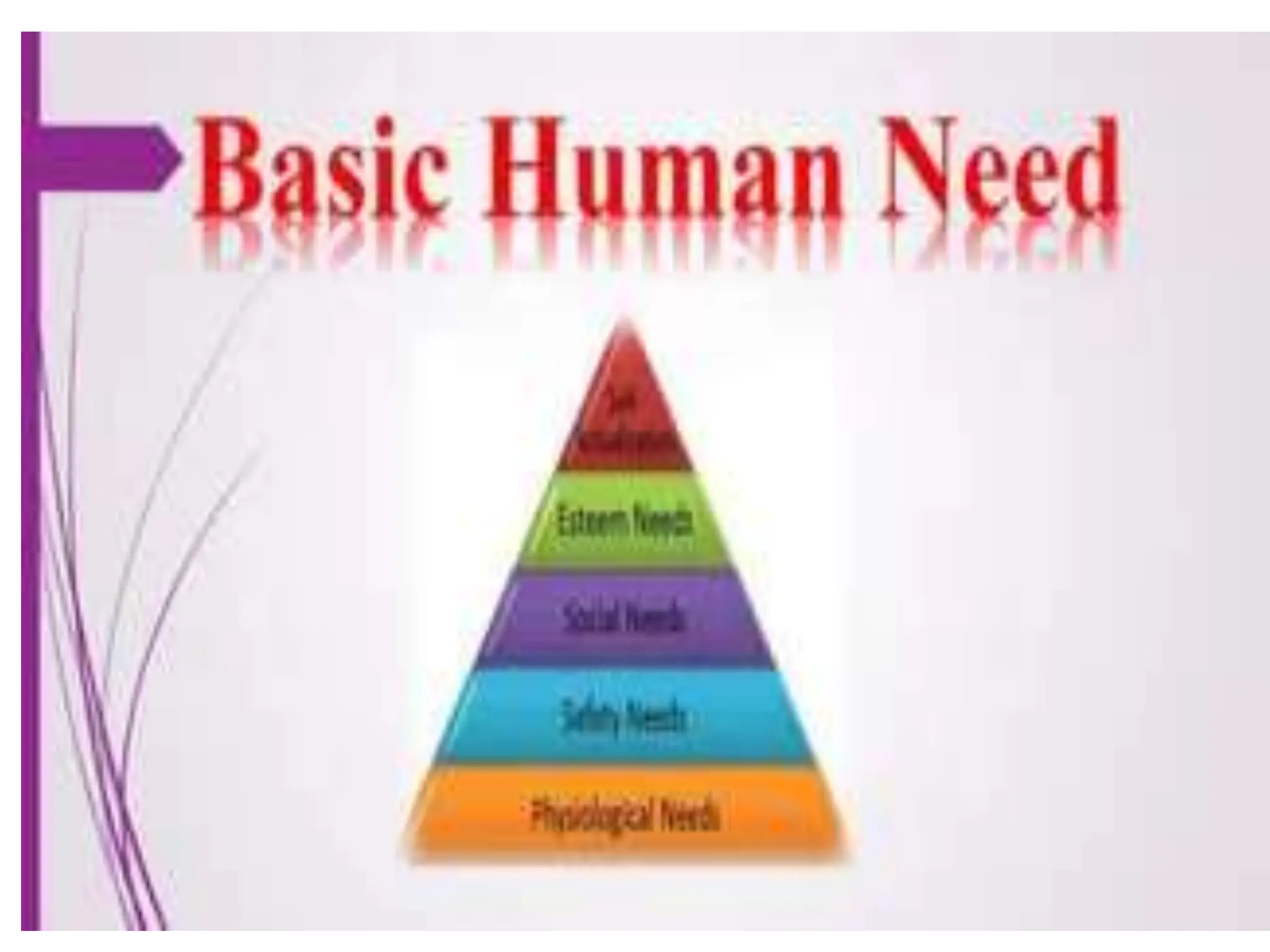
• Basic human needs typically refer to those
fundamental requirements necessary for
human survival and well-being.
• These needs are often categorized into
several main areas:
3
Basic Human Needs
1.Physiological Needs: These are the most
basic needs required for survival, including
air, water, food, shelter, clothing, and
sleep.
2.Safety Needs: Once physiological needs are
met, individuals seek safety and security from
physical and emotional harm, including
protection from danger, violence, or threats.
4
Basic Human Needs
3.Love and Belongingness Needs:
Humans have a natural desire for love,
affection, and social connection.
This includes forming meaningful
relationships, friendships, and feeling a
sense of belonging within a community or
group.
5
Basic Human Needs
4.Esteem Needs: Once the previous needs are
satisfied, individuals strive for recognition, respect,
and self-esteem. This involves feeling a sense of
accomplishment, competence, and being valued by
others.
5.Self-Actualization: At the highest level, according
to Maslow's hierarchy of needs, individuals seek
self-actualization, which involves realizing one's full
potential, personal growth, creativity, and pursuing
meaningful goals and aspirations.
6
7
Basis of Nursing Practice
• Holistic Care
• Patient-Centered Care
• Evidence-Based Practice
• Ethical Practice
• Collaborative Practice
• Health Promotion and Prevention
• Cultural Competence
• Professional Development
8
World Health Organization
• The World Health Organization (WHO) is a
specialized agency of the United Nations (UN)
responsible for international public health.
• It was established on April 7, 1948, with its
headquarters in Geneva, Switzerland. The
WHO serves as the directing and coordinating
authority on international health matters
within the UN system.
9
World Health Organization
• The primary objectives of the World Health
Organization include:
• Promoting Health
• Preventing Diseases
• Providing Technical Support
• Setting Standards and Guidelines
• Coordinating Global Health Initiatives
• Monitoring and Evaluation
• Research and Innovation
10
11
Model of Conceptual Framework
for BSN Program
• A conceptual framework for a generic
Bachelor of Science in Nursing (BSN) program
provides a structured outline of the key
components, principles, and educational goals
that guide the curriculum and the overall
educational experience of nursing students.
12
Model of Conceptual Framework for
BSN Program
• a conceptual framework serves as a
foundation upon which the entire nursing
education is built.
13
Model of Conceptual Framework for BSN
Program
• Here's an explanation of a model conceptual
framework for a generic BSN program:
• Mission and Philosophy
• Core Values
• Educational Outcomes
• Curricular Components
• Pedagogical Approaches
• Clinical Practice
• Professionalism and Ethics
• Evaluation and Assessment
14
Nursing and Nursing Practice
• Nursing is a multifaceted profession that
encompasses a wide range of roles,
responsibilities, and specialties aimed at
promoting health, preventing illness, and
providing care to individuals, families, and
communities across the lifespan.
15
Nursing and Nursing Practice
• Exploration of nursing and nursing practice:
• Roles and Responsibilities
• Specialties and Areas of Practice
• Education and Training
• Evidence-Based Practice
• Patient-Centered Care
• Interdisciplinary Collaboration
• Advocacy and Leadership
16
Goal of Nursing Process
• The goal of the nursing process is to provide
individualized, holistic, and effective care to
patients or clients by systematically addressing
their healthcare needs through a series of
organized steps.
• The nursing process serves as a framework for
critical thinking and problem-solving in nursing
practice, guiding nurses in assessing, diagnosing,
planning, implementing, and evaluating patient
care.
17
Goal of Nursing Process
• Ultimately, the goal of the nursing process is
to promote optimal health outcomes,
enhance quality of life, and empower patients
to achieve their healthcare goals through
collaborative and evidence-based nursing
interventions.
18
Historical Perspective of the Nursing
Process
• The nursing process has evolved over time,
reflecting changes in healthcare delivery,
nursing education, and professional practice.
19
Historical Perspective of the Nursing
Process
• Its historical perspective can be traced through
several key milestones:
• Florence Nightingale: Often regarded as the
founder of modern nursing, Florence Nightingale
emphasized the importance of systematic and
compassionate care.
• In the 19th century, she introduced the concept
of nursing as a scientific discipline, emphasizing
the need for observation, assessment, and
documentation in patient care.
20
Historical Perspective of the Nursing Process
• 1950s-1960s: During this period, nursing
education and practice began to formalize the
nursing process as a systematic approach to
patient care.
• Influential nursing theorists such as Ida Orlando,
Hildegard Peplau, and Virginia Henderson laid the
groundwork for the nursing process by
emphasizing the importance of assessment,
therapeutic communication, and individualized
care planning.
21
Historical Perspective of the Nursing Process
• 1970s: The nursing process gained widespread
recognition and adoption in nursing education
and practice.
• Nursing textbooks and curricula began to
incorporate the nursing process as a core
component of nursing education, emphasizing
its role in promoting critical thinking, clinical
reasoning, and evidence-based practice.
22
Historical Perspective of the Nursing Process
• 1980s-1990s: The American Nurses
Association (ANA) formally endorsed the
nursing process as a standard of practice in
the United States.
• The ANA's Standards of Practice and
Standards of Professional Performance
emphasized the systematic use of the nursing
process to guide nursing care delivery and
ensure quality and safety
23
Historical Perspective of the Nursing Process
• 2000s-Present: The nursing process continues to
evolve in response to advances in healthcare
technology, changes in healthcare policy, and
shifting patient demographics.
• Nursing education programs integrate the nursing
process into their curricula, emphasizing its
relevance to contemporary nursing practice and
its role in promoting patient-centered care,
interdisciplinary collaboration, and quality
improvement.
24
 Kozier, Barbara, Glenora Erb, Shirlee Snyder,
and Audrey Berman. Fundamentals of
Nursing: Concepts, Process, and Practice. 8th
ed.
25
SYED YOUSAF SHAH

Goals of Nursing and Related Concepts.pptx

  • 1.
    Goals of Nursingand Related Concepts By Syed Yousaf Shah 1
  • 2.
    Objectives 1.Define basic humanneeds. 2. Discuss basis of nursing practice. 3. Define World Health Organization. 4. Explain model of conceptual framework for generic BS N program. 5. Explore nursing and nursing practice. 6. Define goal of nursing process. 7. Identify historical perspective of the nursing process 8. References 2
  • 3.
    Basic Human Needs •Basic human needs typically refer to those fundamental requirements necessary for human survival and well-being. • These needs are often categorized into several main areas: 3
  • 4.
    Basic Human Needs 1.PhysiologicalNeeds: These are the most basic needs required for survival, including air, water, food, shelter, clothing, and sleep. 2.Safety Needs: Once physiological needs are met, individuals seek safety and security from physical and emotional harm, including protection from danger, violence, or threats. 4
  • 5.
    Basic Human Needs 3.Loveand Belongingness Needs: Humans have a natural desire for love, affection, and social connection. This includes forming meaningful relationships, friendships, and feeling a sense of belonging within a community or group. 5
  • 6.
    Basic Human Needs 4.EsteemNeeds: Once the previous needs are satisfied, individuals strive for recognition, respect, and self-esteem. This involves feeling a sense of accomplishment, competence, and being valued by others. 5.Self-Actualization: At the highest level, according to Maslow's hierarchy of needs, individuals seek self-actualization, which involves realizing one's full potential, personal growth, creativity, and pursuing meaningful goals and aspirations. 6
  • 7.
  • 8.
    Basis of NursingPractice • Holistic Care • Patient-Centered Care • Evidence-Based Practice • Ethical Practice • Collaborative Practice • Health Promotion and Prevention • Cultural Competence • Professional Development 8
  • 9.
    World Health Organization •The World Health Organization (WHO) is a specialized agency of the United Nations (UN) responsible for international public health. • It was established on April 7, 1948, with its headquarters in Geneva, Switzerland. The WHO serves as the directing and coordinating authority on international health matters within the UN system. 9
  • 10.
    World Health Organization •The primary objectives of the World Health Organization include: • Promoting Health • Preventing Diseases • Providing Technical Support • Setting Standards and Guidelines • Coordinating Global Health Initiatives • Monitoring and Evaluation • Research and Innovation 10
  • 11.
  • 12.
    Model of ConceptualFramework for BSN Program • A conceptual framework for a generic Bachelor of Science in Nursing (BSN) program provides a structured outline of the key components, principles, and educational goals that guide the curriculum and the overall educational experience of nursing students. 12
  • 13.
    Model of ConceptualFramework for BSN Program • a conceptual framework serves as a foundation upon which the entire nursing education is built. 13
  • 14.
    Model of ConceptualFramework for BSN Program • Here's an explanation of a model conceptual framework for a generic BSN program: • Mission and Philosophy • Core Values • Educational Outcomes • Curricular Components • Pedagogical Approaches • Clinical Practice • Professionalism and Ethics • Evaluation and Assessment 14
  • 15.
    Nursing and NursingPractice • Nursing is a multifaceted profession that encompasses a wide range of roles, responsibilities, and specialties aimed at promoting health, preventing illness, and providing care to individuals, families, and communities across the lifespan. 15
  • 16.
    Nursing and NursingPractice • Exploration of nursing and nursing practice: • Roles and Responsibilities • Specialties and Areas of Practice • Education and Training • Evidence-Based Practice • Patient-Centered Care • Interdisciplinary Collaboration • Advocacy and Leadership 16
  • 17.
    Goal of NursingProcess • The goal of the nursing process is to provide individualized, holistic, and effective care to patients or clients by systematically addressing their healthcare needs through a series of organized steps. • The nursing process serves as a framework for critical thinking and problem-solving in nursing practice, guiding nurses in assessing, diagnosing, planning, implementing, and evaluating patient care. 17
  • 18.
    Goal of NursingProcess • Ultimately, the goal of the nursing process is to promote optimal health outcomes, enhance quality of life, and empower patients to achieve their healthcare goals through collaborative and evidence-based nursing interventions. 18
  • 19.
    Historical Perspective ofthe Nursing Process • The nursing process has evolved over time, reflecting changes in healthcare delivery, nursing education, and professional practice. 19
  • 20.
    Historical Perspective ofthe Nursing Process • Its historical perspective can be traced through several key milestones: • Florence Nightingale: Often regarded as the founder of modern nursing, Florence Nightingale emphasized the importance of systematic and compassionate care. • In the 19th century, she introduced the concept of nursing as a scientific discipline, emphasizing the need for observation, assessment, and documentation in patient care. 20
  • 21.
    Historical Perspective ofthe Nursing Process • 1950s-1960s: During this period, nursing education and practice began to formalize the nursing process as a systematic approach to patient care. • Influential nursing theorists such as Ida Orlando, Hildegard Peplau, and Virginia Henderson laid the groundwork for the nursing process by emphasizing the importance of assessment, therapeutic communication, and individualized care planning. 21
  • 22.
    Historical Perspective ofthe Nursing Process • 1970s: The nursing process gained widespread recognition and adoption in nursing education and practice. • Nursing textbooks and curricula began to incorporate the nursing process as a core component of nursing education, emphasizing its role in promoting critical thinking, clinical reasoning, and evidence-based practice. 22
  • 23.
    Historical Perspective ofthe Nursing Process • 1980s-1990s: The American Nurses Association (ANA) formally endorsed the nursing process as a standard of practice in the United States. • The ANA's Standards of Practice and Standards of Professional Performance emphasized the systematic use of the nursing process to guide nursing care delivery and ensure quality and safety 23
  • 24.
    Historical Perspective ofthe Nursing Process • 2000s-Present: The nursing process continues to evolve in response to advances in healthcare technology, changes in healthcare policy, and shifting patient demographics. • Nursing education programs integrate the nursing process into their curricula, emphasizing its relevance to contemporary nursing practice and its role in promoting patient-centered care, interdisciplinary collaboration, and quality improvement. 24
  • 25.
     Kozier, Barbara,Glenora Erb, Shirlee Snyder, and Audrey Berman. Fundamentals of Nursing: Concepts, Process, and Practice. 8th ed. 25 SYED YOUSAF SHAH